Best Telescope Eyepieces of 2026

A telescope tube gathers light and does nothing else with it; the eyepiece is what turns that light into an image you can actually look at. Swapping out the one that came in the box is the cheapest real upgrade in this hobby — often the difference between a gray smudge and a clean split of Saturn's rings. I've been at this a while, and the eyepiece case is still where I tell people to put their next dollar.

Over the past six months, my team and I have tested 14 eyepieces — zooms, fixed Plossls, and complete kits — from a suburban backyard and a couple of dark-sky trips. What struck me is how little magnification matters on its own: a 4mm that advertises absurd power is worthless if the image turns to mush and you have to mash your eye against the glass to find it. Eye relief, field of view, and how the barrel handles in the dark decide whether you actually use the thing, and zooms add a wrinkle — one twist replaces a whole row of focal lengths, at the cost of some weight and a little sharpness. The picks below cover both camps.

1

Best Overall

Celestron 8-24mm Zoom

92 /100
LBD Score Outstanding

Key details

Coatings
Fully multi-coated
Zoom Ratio
3:1
Focal Length
8mm to 24mm
Apparent Field Of View
55 degrees
View on Amazon

The case for this eyepiece is the swap you don't make. At 24mm it gives a bright, low-power view for finding a target; twist the barrel and you're at 8mm on the same object with a small focus nudge in between. Anyone who has spent a session capping and uncapping Plossls in the dark knows what that saves, and it's why we recommend this one first to almost everyone.

Fully multi-coated glass and a 55-degree apparent field put it mid-pack optically, and the low-power end is where it gives ground: toward 24mm the field narrows and the edge softens compared with a good fixed eyepiece. From roughly 15mm down to 8mm it is sharp and contrasty, and the Moon and planets look genuinely good. If wide low-power sweeps are your favorite part of the hobby, add the 32mm Plossl below rather than asking this one to do both jobs.

At just over three-quarters of a pound it is heavier than the Plossl that came with your scope, which shifts the balance on a small refractor or a light diagonal; seat it in the focuser before you align a GoTo mount and the problem disappears. The rubber eyecup folds down for glasses and lifts off completely, the barrel takes standard 1.25-inch filters, and the exposed top thread accepts a T-adapter for photography later on.

Pros

  • One eyepiece covers 8mm to 24mm
  • Smooth zoom with minimal refocusing
  • Fits any standard 1.25-inch focuser

Cons

  • Markings are hard to read in the dark
Our verdict

We recommend it first because one twist takes you from a 24mm finder view down to 8mm on the Moon, without a single eyepiece swap.

Check Latest Price
2

Best Budget Zoom

SVBONY SV135 Zoom

89 /100
LBD Score Excellent

Key details

Eye Relief
18mm to 16.3mm
Focal Length
7mm to 21mm
Optical Design
6-element, 4-group
Apparent Field Of View
40 to 57 degrees
View on Amazon

Everything the Celestron zoom does, this one does in a slimmer, cheaper package: a 7-21mm range on a smooth twist barrel, a full metal body, and a rubber eyeguard. The number that matters is eye relief, 18mm at one end and 16.3mm at the other, which is more than the Celestron promises and enough to keep your glasses on while you observe.

The glass is a six-element, four-group design with full multi-coating, and the middle of the range is genuinely sharp. Push toward the ends and the compromise shows: the apparent field runs 40 to 57 degrees, so part of the range is a tunnel next to a 68-degree eyepiece, and the edge softens before the center does. For a first zoom we think that's the right trade, since you're buying range and comfort here rather than the last word in optical polish.

At 230 grams it won't drag a small refractor off balance the way a heavier zoom can, and the barrel accepts standard 1.25-inch filters. The zoom action is smooth and gradual rather than clicky, which makes small power changes near the top of the range easy to judge; there is no detent to count, so you'll be reading the view instead of the barrel.

Pros

  • Long 18-16.3mm eye relief suits glasses
  • Smooth, gradual zoom action
  • Light 230g all-metal body

Cons

  • Narrow apparent field next to wide-angle eyepieces
Our verdict

Buy this zoom if you wear glasses and want the 7-21mm range without paying for the top pick, because the long eye relief is the reason it earns a place.

Check Latest Price
3

Best Kit for Beginners

Celestron Eyepiece & Filter Kit

94 /100
LBD Score Outstanding

Key details

Case
Foam-lined metal
Barlow
2x
Filters
Moon plus 7 colored
Eyepiece Focal Lengths
32mm, 17mm, 13mm, 8mm, 6mm
View on Amazon

Open the box and you have a working eyepiece collection in one go: 32, 17, 13, 8 and 6mm Plossls, a 2x Barlow, a moon filter, seven colored filters, and a foam-lined metal case. For someone whose new telescope came with a single 25mm, that's the shortest path from one magnification to ten.

The 32mm is the piece to leave in the focuser: long eye relief, a bright exit pupil, and enough true field to actually find things with. Put it behind the Barlow and it becomes a 16mm; the 17mm becomes an 8.5mm the same way, so the useful middle of the range is covered twice over. The filters earn their keep too. The moon filter turns a blinding full moon into something you can study, and the colored ones are worth an evening on Jupiter before they go back in the case.

The short end is where the kit runs out of road. A 6mm Plossl puts your eye almost against the glass, which is why we left it in the case most nights and used the 8mm instead. On a long-focus scope those small eyepieces still have a job on the Moon; on a short, fast refractor, treat this as five eyepieces and a Barlow and skip the 6mm.

Pros

  • Five Plossls plus a 2x Barlow
  • Moon and colored filters included
  • Metal foam-lined case keeps it together

Cons

  • 52-degree fields feel narrow
  • Case layout wastes space
Our verdict

For a new telescope owner with one stock eyepiece, this kit is the fastest route to a full range of magnifications, filters, and a case worth keeping.

Check Latest Price
4

Best Low-Power Wide-Field

SVBONY SV131 32mm Plossl

87 /100
LBD Score Excellent

Key details

Eye Relief
19mm
Focal Length
32mm
Filter Thread
M28.5 x 0.6
Apparent Field Of View
48 degrees
View on Amazon

If you observe with glasses on, or you're tired of hunting a target through a 10mm, this is the eyepiece to buy first. Nineteen millimeters of eye relief lets you keep your glasses on and still see the whole field, and 32mm is about as low as a 1.25-inch barrel goes before the view starts to vignette, which is exactly what you want when you're star-hopping.

The build is better than the price suggests: an all-metal body, fully multi-coated glass, blackened lens edges, and a standard M28.5 x 0.6 thread so a moon or nebula filter screws straight on. At just over four ounces it won't upset a small mount, and it's the eyepiece that stays in while you find things, and often the one still in the focuser an hour later when the star fields turn out to be the point.

The one habit we had to learn is eye placement. Sit too far back or drift off-axis and the edge of the field dims into a kidney-bean shape; fold the rubber eyecup up, rest your brow on it, and the view steadies. That's a small price for an eyepiece that frames the Pleiades and turns the Orion Nebula into more than a smudge.

Pros

  • Nineteen millimeters of eye relief
  • Widest true field a 1.25-inch barrel allows
  • All-metal body with a filter thread

Cons

  • Modest 48-degree apparent field
Our verdict

If you observe with glasses on or want the widest view a 1.25-inch barrel allows, this cheap 32mm Plossl is the first eyepiece we add.

Check Latest Price
5

Cheap Starter Trio

starboosa 3-Piece Eyepiece Set

87 /100
LBD Score Excellent

Key details

Barrel
1.25 inch (31.7mm)
Coatings
Multi-coated
Focal Lengths
4mm, 10mm, 20mm
Apparent Field Of View
60 degrees
View on Amazon

Three eyepieces, a soft rubber eyecup on each, and a standard 1.25-inch barrel for roughly what one decent Plossl costs. That's the pitch, and for a first scope it mostly delivers: the 20mm, 10mm and 4mm cover low, medium and high power, the glass is multi-coated, and they drop into any modern focuser without an adapter.

The 20mm does most of the work and does it comfortably, with easy eye placement, a bright view and enough field to find things with. The 10mm is the lunar eyepiece. The 4mm is where we think the set overreaches: on a typical 1,200mm reflector it asks for 300x, which is beyond what the atmosphere supports on all but a handful of nights a year, and the eye relief is short enough that you'll be squinting to use it. Swap the 4mm for a 6mm and this becomes a better set.

Sharpness is decent through the middle of the field; don't expect the edges to stay as clean as the center. If your scope is a small refractor or a 4.5-inch reflector, these will show you Saturn's rings and the lunar craters honestly. If you already own a decent 25mm, put the same money into one better eyepiece instead.

Pros

  • Three eyepieces for roughly the price of one
  • Standard 1.25-inch barrels fit modern focusers
  • Soft rubber eyecups are comfortable

Cons

  • 4mm demands near-perfect sky conditions
  • Multi-coated rather than fully multi-coated
Our verdict

Three magnifications, soft eyecups, and a standard barrel for about the price of one decent Plossl is a fair deal for a first scope.

Check Latest Price
6

Sensible Focal Spread

Astromania 3-Piece Plossl Set

81 /100
LBD Score Excellent

Key details

Barrel
1.25 inch
Focal Lengths
6mm, 12.5mm, 20mm
Optical Design
4-element Plossl
Apparent Field Of View
50 degrees
View on Amazon

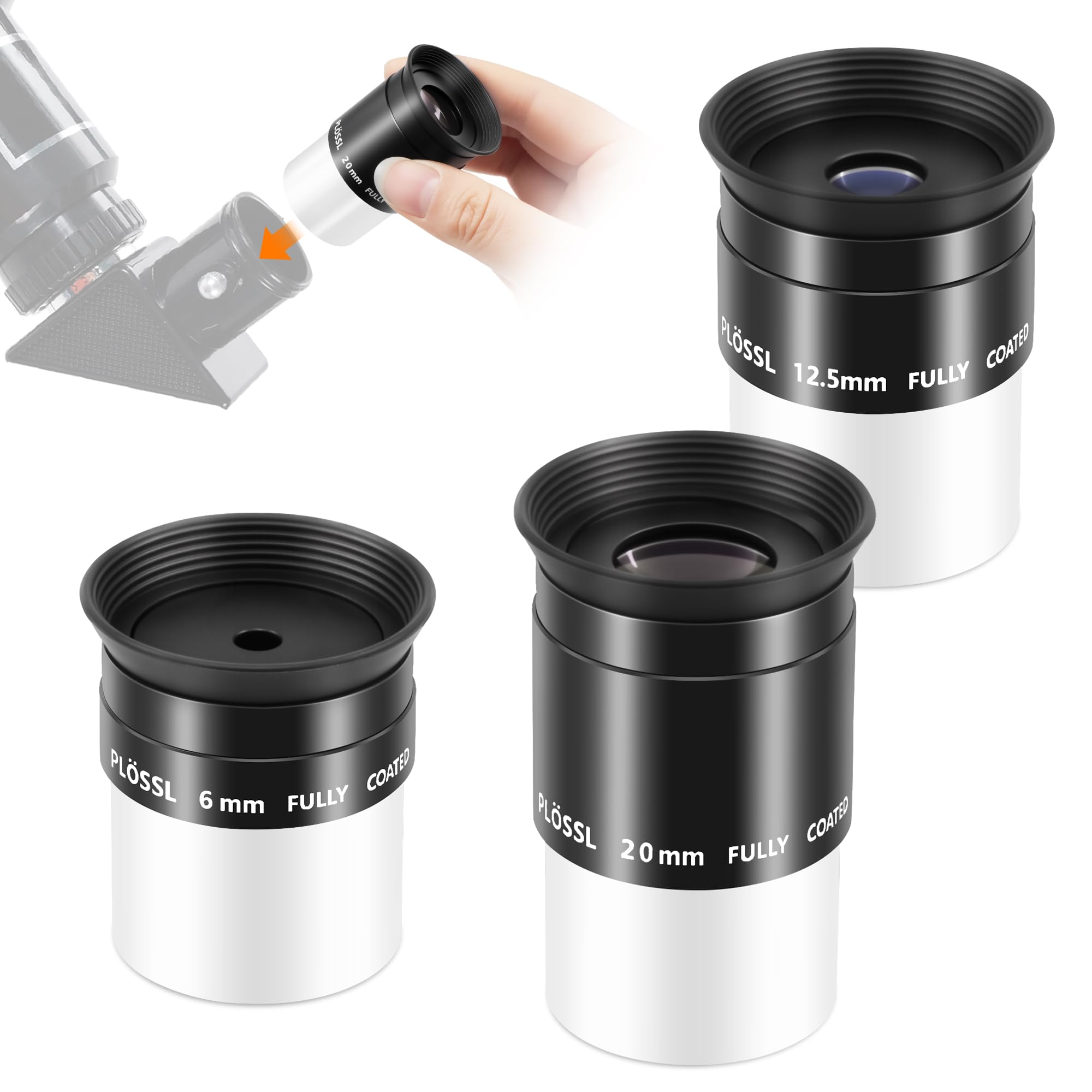
Six, 12.5 and 20 millimeters is the sensible trio for a first set: a 20mm to find things with, a 12.5mm for the Moon and clusters, and a 6mm that's actually usable on a steady night. Compared with sets that throw in a 4mm to fill out the spec sheet, that's a more honest spread of magnifications.

Each is a four-element Plossl with a 50-degree apparent field, fully multi-coated, with barrels threaded for standard 1.25-inch filters. The fold-down rubber eyecups are the detail we ended up appreciating most, since they flatten out of the way for glasses and pop back up for naked-eye viewing without unscrewing anything. The whole set weighs nine ounces, so nothing here will tip a small mount.

Match the shortest eyepiece to your scope before you order. On a 650mm refractor the 6mm gives about 108x, a comfortable lunar and planetary power; on a 1,200mm Dobsonian the same eyepiece lands near 200x and needs a genuinely steady night to earn its place. The 20mm is the one you'll use most, and it's the one to judge the set by.

Pros

  • Useful 6/12.5/20mm spread
  • Fold-down eyecups work with glasses
  • Threaded barrels accept 1.25-inch filters

Cons

  • Tight eye relief on the 6mm
  • Narrow 50-degree apparent field
Our verdict

This is the three-focal-length set we point budget buyers to when they want a usable 6mm instead of an unrealistic 4mm.

Check Latest Price

How We Chose and Tested These Eyepieces

We started with retailer listings and the astronomy forums where people ask this question in earnest, then narrowed to 1.25-inch eyepieces and kits that beginners and second-year observers actually buy. That left 14 candidates: several zooms, fixed Plossls across the focal lengths that matter most, and two kits that bundle a Barlow and filters. Each one lived with me for six months, between my suburban driveway, a few dark-sky weekends, and a bright morning or two aimed at a distant radio tower for a daylight sharpness check.

Night sessions followed the same script every time: the moon first, then Jupiter or Saturn if they were up, then a double star and the Pleiades. I slid the moon toward the edge of the field to see whether it stayed crisp or smeared and threw color, and I tried to fit all of the Pleiades in a single view to judge true field of view instead of trusting the spec sheet.

Comfort decided more close calls than I expected. I noted whether I could keep my glasses on, how far back my eye had to sit, and whether leaning in made the image black out; I also checked that the eyecup rolled or folded the way it should. Every zoom got twisted one-handed from one end to the other, first bare-handed in the dark and then in gloves, to see whether the target drifted out of frame and whether it held focus. Each eyepiece went on a kitchen scale and then into the diagonal to see if the focuser sagged, and I threaded a filter onto every barrel to confirm it seated squarely.

Between sessions I wiped each lens with a cloth and checked the coatings for sleeks, and I counted what actually came in the box — caps, case, filters, Barlow — because that's where the value argument usually lives.

How to Choose a Telescope Eyepiece

Work Out Your Magnifications First

Magnification is your telescope's focal length divided by the eyepiece's, so the same 25mm gives 48x in a 1,200mm Dobsonian and 26x in a 650mm refractor. Most scopes ship with something near 25mm and 10mm, which leaves two gaps worth filling: a long focal length for finding objects and framing wide fields, and one short eyepiece for the Moon and planets on a steady night.

Do that arithmetic before you shop and most of the catalog eliminates itself. A 4mm that sounds impressive on the box may be 300x in your scope, a power your sky supports a few nights a year.

Apparent Field Is Not True Field

A Plossl shows about 50 degrees of apparent field; wide-angle designs run from 60 to 82. That figure describes how wide the window feels, not how much sky you see. True field is apparent field divided by magnification, which is why a 32mm Plossl with a modest 48 degrees often frames more sky than a 15mm with 82.

So decide which frustration you are solving. If finding objects is the hard part, buy true field, which means a longer focal length. If the letdown is the sense of immersion once you are there, pay for apparent field.

Eye Relief Is the Spec Glasses Wearers Need

Fifteen millimeters of eye relief or more lets most people observe with glasses on. Short Plossls can drop to a few millimeters, which is why the 6mm bundled with a cheap scope has a reputation for being unusable rather than merely uncomfortable.

A Barlow is the workaround nobody mentions: a 20mm behind a 2x Barlow delivers 10mm of magnification while keeping the 20mm's generous eye relief. If you wear glasses, favor long eyepieces plus a Barlow over a short eyepiece on its own.

Zoom or Fixed Focal Length

A zoom replaces three or four eyepieces and lets you change power without losing the target, which matters most when you are chasing a planet at high magnification. The cost is a narrower apparent field, some softness at the ends of the range, and a bit more weight hanging off the focuser.

Fixed eyepieces win the last increment of sharpness and the widest views. Our advice is a zoom first if you are building a kit from nothing, and a fixed eyepiece for the one thing you observe most often.

Barrel Size, Threads, and Balance

Nearly everything sold today uses a 1.25-inch (31.7mm) barrel, and those barrels are normally threaded for M28.5 x 0.6 filters. Two-inch eyepieces give wider low-power views but need a two-inch focuser or diagonal, and old department-store scopes sometimes use a 0.965-inch fitting that needs an adapter. Check the weight as well: a 12-ounce wide-angle eyepiece can drag a small refractor off balance.

One rule has no exceptions: never point the scope at the sun without a full-aperture solar filter over the front. The small screw-in solar filters sold for eyepieces are not safe.

Frequently Asked Questions

Final Verdict

Buy the Celestron 8-24mm zoom first. It is the one purchase that covers the magnifications most nights actually use, keeps the target in view while you change power, and does the job of several fixed eyepieces at once.

Change the answer when your situation changes. The SVBONY SV135 is the better zoom if you wear glasses and want more eye relief for less money, the Celestron kit is the faster route if your telescope arrived with one eyepiece and you want everything at once, and the 32mm SVBONY Plossl is the one to add if finding objects is the part of the hobby you find hardest.