Best Telescope Cases of 2026

A telescope case has one job with two halves that pull against each other: protect the optics, and stay light enough that you'll actually carry it. A hard shell shrugs off a slamming trunk lid but eats the back seat; a soft bag slides behind the driver's seat and asks you to trust foam. What you're really buying is the confidence to drive to a darker sky without wondering whether the mirror survived the trip.

I've hauled a scope to the same gravel lot for years, and fit matters more than foam thickness. Over the past six months, my team and I tested 12 cases, hard shells and soft bags alike, loading each with a tube, mount, and tripod, then living with them the way you would: in the trunk, up the basement stairs, on weekend drives.

What separated the good ones wasn't padding depth so much as whether the bag held the tube still; buckles and dividers do more protective work than another inch of foam. Below are the cases that earned a permanent spot in my garage.

1

Best Overall

Celestron 40" Protective Bag

92 /100
LBD Score Outstanding

Key details

Warranty
2 years
Compartments
3
Case Dimensions
40"L x 15"W x 15"H
Shell And Padding
900D polyester, 16mm EPE foam
View on Amazon

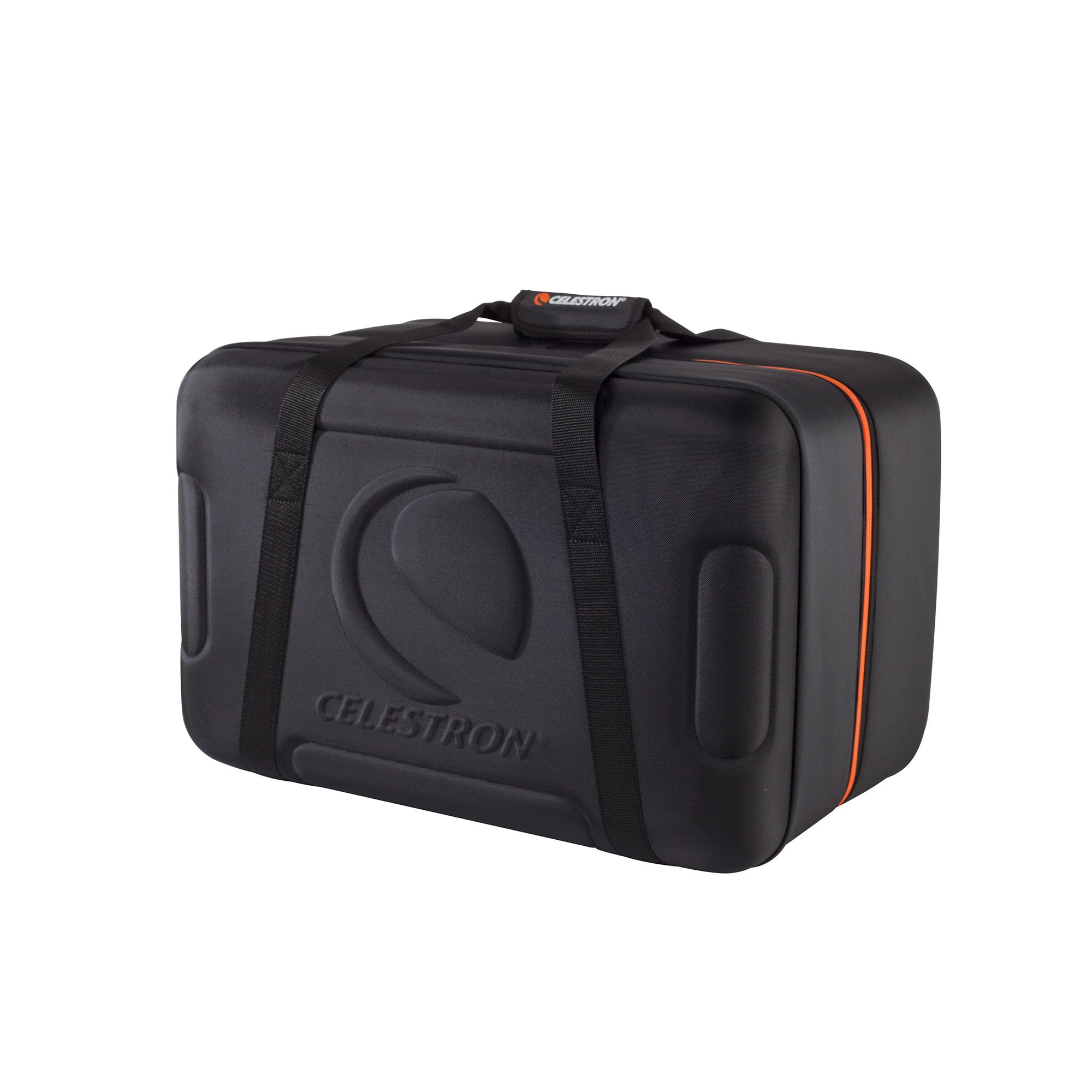
Two openings sounds like a footnote until you're loading a 40-inch tube into a bag by yourself. This Celestron bag unzips along the top and at one end, so the optical tube drops in from above while the mount and tripod settle into their own sections below and beside it. The shell is 900-denier polyester over 16mm EPE foam sheets, and the base is reinforced with a PVC panel, which is the right place to spend the money, since that's where a loaded bag takes every impact.

What makes it our default pick is the cross-section. At 40 by 15 by 15 inches, there's room to keep the mount and the tripod in the same bag as the tube, and that's often the difference between one trip out to the car and three. The interior is configurable, with padded dividers you can move to keep the tube off hard metal, and the external zippered pocket plus the included padded accessory bag hold eyepieces away from the main cavity. Nothing about the fabric or the stitching feels built to a price.

The fit math is where buyers get caught. A bag sold as 40 inches has to swallow the tube with the diagonal and finder still attached, and 15 inches of interior width has to clear the mount head at its widest point. Measure both before you order. A bag that's right for an 8-inch SCT is wrong for a long refractor, and the length in the product name won't tell you which one you have.

There's also a boundary to who this suits. A long Dobsonian tube won't fit, and a small grab-and-go refractor doesn't need this much bag. For a 4- to 8-inch catadioptric or a short-tube refractor, this is the case that turns the whole kit into one trip.

Pros

  • Holds tube, mount, and tripod together
  • 16mm EPE foam over a PVC-reinforced base
  • Opens from the top or the end
  • Backed by a two-year warranty

Cons

  • Bulky 15-inch cross-section when loaded
  • Water-resistant fabric, not a waterproof shell
Our verdict

The bag we recommend first for 40-inch-class kits: tube, mount, and tripod ride together behind 16mm foam and a reinforced base.

Check Latest Price
2

Best Value

GoHimal 40" Telescope Bag

91 /100
LBD Score Outstanding

Key details

Carry
Removable shoulder strap
Weight
3.73 lb
Compartments
5
Case Dimensions
40"L x 11.5"W x 9"H
View on Amazon

Nothing about this bag announces what it costs. The stitching is even, the full-length zipper runs without catching, and the ends are shaped so the tube doesn't wallow in the corners, which are the details that decide whether a cheap bag lasts a few seasons or splits at a seam. It's the least expensive full-size case in this group, and it's the one we recommend when the budget is doing the deciding.

Five compartments do the organizing: a padded sleeve for the optical tube, room for a tripod and mount, an external pocket, and two small pouches that keep eyepieces and a finder from rattling around loose. The shell is polyester over shock-absorbing foam with a water-resistant finish, and at 1.69 kg the bag adds very little to what you're already carrying.

The trade is width. At 11.5 by 9 inches across, this one carries the tube and the accessories, and a full-size tripod rides in your other hand. Padding is adequate rather than generous: the divider is cushioned and the walls are foam-lined, but they're thinner than the 16mm sheets in the Celestron bag, which matters if your gear rides in a truck bed rather than a back seat. For closet storage and car trips, it's plenty.

Pros

  • Lowest-priced full-size bag in this group
  • Even stitching and a zipper that runs clean
  • Two internal pouches hold small parts
  • 1.69 kg adds little to the load

Cons

  • Narrow 11.5-inch width leaves the tripod out
  • Thinner walls than the pricier bags
Our verdict

When the budget decides, this is the bag we recommend: even construction, five compartments, and a price below every other full-size case here.

Check Latest Price
3

Best for Tube and Tripod

samdew Double-layer 40.8" Bag

90 /100
LBD Score Outstanding

Key details

Shell
600D water-resistant polyester
Weight
4.4 lb
Compartments
2
Case Dimensions
40.8"L x 14"W x 11"H
View on Amazon

A tripod and a mounted tube sharing one compartment is how scopes get scratched. Leg locks and dovetail plates sit exactly where a tube's paint doesn't want them, and a bag with a single cavity gives them no reason to stay apart. This samdew divides the interior into two layers, tube on one side and tripod buckled to the other, with the external buckles carrying the load and a sponge divider between them.

The walls are four layers: velvet against the tube, shock-absorbing sponge, pearl cotton, and a 600D water-resistant polyester outer. The extras are more thorough than most, with an attached counterweight pouch so the weight doesn't swing into the optics, front and lid pockets for eyepieces and tools, and a detachable non-slip shoulder strap. At 4.4 pounds empty it's a heavier bag than the GoHimal, and it feels like it in the hand.

The divider is where it slips. It's hook-and-loop rather than sewn in, so it holds a tube steady but shifts under a heavy mount, and packing the mount low and against the buckle side stops that. The rest of the bag is stiffer than its soft-shell label suggests, which is what makes the two-compartment arrangement work at all.

Where this earns its place is a car trip with a full rig: tube on one side, tripod on the other, counterweight contained, and nothing touching anything that can scratch it. That's the whole argument, and we think it's a good one.

Pros

  • Tube and tripod ride in separate compartments
  • Four-layer walls with a 600D outer
  • Counterweight pouch keeps the weight contained
  • Pockets inside the lid and on the front

Cons

  • Hook-and-loop divider shifts under a heavy mount
  • No hard panel in the base
Our verdict

We pick this one when the tripod travels too: two separate compartments keep it off the tube, and the counterweight gets its own pouch.

Check Latest Price
4

Best Hard Case

Case Club Waterproof Case

83 /100
LBD Score Excellent

Key details

Foam
Pre-cut closed-cell polyethylene
Shell
Hard, crushproof
Case Dimensions
44.5"L x 16.5"W x 14"H
Water Resistance
Waterproof (IP67)
View on Amazon

The foam inside this case is pre-cut for one telescope: the Celestron NexStar 8SE optical tube, its GoTo arm mount and hand control, the factory tripod, a 25mm Plössl, the star diagonal, and the red dot finder. Each has its own cavity. If your scope is a different model, none of those cutouts line up, and no amount of repacking fixes a case built around a specific tube.

For an 8SE, we think it's the most protective case in this group. The shell is rated IP67, waterproof, dustproof, and crushproof, with a padlockable closure and handles on the top and side, and the closed-cell polyethylene foam is cut deep enough that components sit in their own pockets rather than resting on the one below. Nothing settles, nothing shifts, and there's no rearranging to do when you close the lid.

The cost is bulk and money. At 44.5 by 16.5 by 14 inches it's the largest case here and the most expensive, and loaded up it's an awkward thing to move on your own. For a scope that rides in a truck bed, gets checked onto a flight, or lives in a damp garage, that's a trade worth making. For a scope that moves between the closet and the patio, it's more case than the job needs.

Pros

  • IP67 waterproof, crushproof shell
  • Foam cut for the entire 8SE kit
  • Padlockable and airtight
  • Built to be shipped as well as carried

Cons

  • Foam fits one telescope model only
  • Largest and most costly case here
Our verdict

For a NexStar 8SE that travels, this is the case we recommend: waterproof, crushproof, and foamed so every part has its own place.

Check Latest Price
5

Best Hard Shell for Compact SCTs

Celestron EVA Deluxe Case

90 /100
LBD Score Outstanding

Key details

Fits
NexStar 4SE, 5SE, 6SE, Evolution 6
Shell
Molded EVA with foam lining
Weight
10 lb
Case Dimensions
23"L x 15"W x 14"H
View on Amazon

Less protection than a waterproof hard case, in a shell you can pick up with one hand: that's the trade we think Celestron's molded EVA case makes. At 23 by 15 by 14 inches and 10 pounds it holds a NexStar 4SE, 5SE, or 6SE, or an Evolution 6, with the tube and mount sharing one padded cavity.

The EVA shell is hard but slightly flexible, lined with foam along all the walls and above the accessory pouch. Two dense foam spacers and a built-in compression strap let one case cover several tube sizes, and the zipped accessory pocket above the tube is the useful part: eyepieces, a diagonal, and a hand control get their own compartment instead of riding loose on top of the optics.

The interior is cut close. A stock scope fits exactly where the foam expects it, and anything that sticks out, an add-on focus knob being the usual offender, needs checking against the cavity before you trust it. Celestron lists this one for the 4-inch, 5-inch, and 6-inch NexStar OTAs and the Evolution 6, so start there and measure rather than assuming your tube will drop in.

Where it earns its place is the SCT owner who wants a hard shell for the car and the closet rather than a flight case. It keeps dust off, takes a knock without passing it on to the tube, and closes with a zip instead of a padlock. If baggage handlers are in your future, the Case Club is the answer; for everything short of that, this is the sensible hard case.

Pros

  • Molded EVA shell lined with foam
  • Foam spacers fit several tube sizes
  • Zipped accessory pocket above the tube
  • Lighter and less costly than the waterproof case

Cons

  • Tight clearance around add-on focus knobs
Our verdict

For a 4-, 5-, or 6-inch NexStar OTA that travels by car, we take this over the flight case: molded protection without the bulk.

Check Latest Price
6

Best for Optical Tube Only

samdew 28" Tube Bag

86 /100
LBD Score Excellent

Key details

Fits
4" to 9.25" optical tubes
Carry
Shoulder strap, padded handles, trolley strap
Compartments
4
Case Dimensions
28"L x 12"W x 12"H
View on Amazon

This one is for the tube alone. The 28-by-12-by-12-inch bag wraps a bare optical tube anywhere from 4 to 9.25 inches, folds flat when the scope is set up in the yard, and takes a shelf instead of a closet. It's the bag we keep for a tube that lives on its mount at home and only needs covering for the drive.

Four layers surround the main compartment, velvet against the tube, sponge, pearl cotton, and a water-resistant outer fabric, and a soft pad with a hook-and-loop fastener wraps the tube so it can't roll. Storage is better than a tube-only bag needs to be: a transparent zip pocket in the lid, a large front pocket, two side pockets, a detachable shoulder strap, padded handles, and a back strap that slides over a rolling suitcase handle.

Treat it as a wrap rather than armor. It handles dust, scratches, and the knocks of a car ride, and not a drop onto pavement or a bag stacked under other luggage. For a tube that goes from a mount at home into a car and back, that's the right amount of padding for the job. Buy it for covering and carrying, not for shipping.

Pros

  • Folds flat between sessions
  • Fits 4- to 9.25-inch optical tubes
  • Back strap slides over a suitcase handle
  • Pockets for eyepieces and tools

Cons

  • Carries the optical tube only
Our verdict

We keep this one for a bare tube: it wraps the OTA, folds flat afterward, and slides onto a rolling suitcase.

Check Latest Price
7

Best for Small Refractors

USA Gear Refractor Case

83 /100
LBD Score Excellent

Key details

Fits
21" to 35" telescopes and tripods
Width
7" at the largest end, 4" at the smallest
Weight
9.52 oz
Warranty
3 years
View on Amazon

The shape gives this one away. USA Gear builds the case with a zippered extension that runs from 21 to 35 inches, and the body tapers from 7 inches across at the wide end to 4 at the narrow end, a profile that follows a small refractor instead of forcing it into a rectangular box.

That taper is what makes it work. The objective end gets the width, the focuser end doesn't need it, and the result stays slim in a packed car and light enough at 0.27 kg to carry by the handle or the shoulder strap. Water-resistant fabric, an accessory pocket that keeps eyepieces away from the tube, and a three-year warranty make this a generous package at the bottom of this group's price range.

What it isn't is armor, and it doesn't pretend to be. For a refractor that rides in the back seat, padded fabric is the right weight, and we'd rather have that than a rigid shell that doubles the size of the thing. Measure the widest point of your tube, dew shield included, against that 7-inch opening before you order, because a short, fat catadioptric won't go near this case.

Pros

  • Expands from 21 to 35 inches
  • Tapered body suits slim refractors
  • Three-year manufacturer's warranty
  • Separate pocket for eyepieces

Cons

  • No rigid structure in the sides
Our verdict

For a small refractor that travels in the car, we think this is enough case: expandable, tapered, and light enough to forget you packed it.

Check Latest Price
8

Two-Person Lifting

HODRANT 40" Telescope Bag

87 /100
LBD Score Excellent

Key details

Carry
Shoulder strap, padded handles, two side handles
Shell
Nylon soft shell
Compartments
5
Case Dimensions
40"L x 12.5"W x 10.5"H
View on Amazon

Two short handles at each end change how a loaded bag gets moved. Instead of one person wrestling 40 inches of tube and tripod through a doorway, two people pick it up like a stretcher, and HODRANT also fits padded long handles and a detachable padded shoulder strap for the solo trips.

The rest of the design is pocket-heavy in a useful way: a sewn-in divider that separates a counterweight pouch from the main cavity, two transparent zip pockets in the lid, flap pockets and a zip pocket outside, and adjustable buckles that hold the tube and tripod against opposite walls. The 40-by-12.5-by-10.5-inch body is long enough for a 39.5-inch reflector tube with room left over.

The buckles are the part to watch. They're what keeps the tube and the tripod apart, and they're the only thing doing it, so check the tension before you lift a loaded bag and keep the heaviest piece low, over the base rather than the lid. Cinched properly, the interior stays put through a car trip.

Where this beats the samdew double-layer is the lift: those side handles turn a two-person carry into a comfortable one, and the pocket layout is easier to live with than a plain open cavity. Where it loses is padding, which is the trade for all that storage.

Pros

  • Side handles for a two-person carry
  • Sewn-in divider separates the counterweight
  • Pockets in the lid and on the outside
  • Buckles hold the tube against the wall

Cons

  • Padding is softer than the top pick's foam
Our verdict

The two-person lift is why we recommend it: side handles at both ends make a loaded 40-inch bag easier to move than anything else here.

Check Latest Price

How We Tested Telescope Cases

We started by pulling published interior dimensions and matching them against the tube-and-mount combinations people actually own, from small refractors up to an 8-inch Schmidt-Cassegrain, and we set aside anything that only promised to fit most telescopes. Price was the other filter: we wanted a spread from budget soft bags to hard-sided waterproof cases so the value question had something to answer to. Twelve cases made the cut, and each one stayed in rotation for six months.

Fit came first. For every case, I loaded an optical tube, a mount, and a tripod, separately and then together, and noted where the tube sat once the lid was closed: whether it was held firmly, whether the finder or focuser pressed against a wall, and whether a bag listed at 40 inches actually took a 40-inch tube. I also timed setup and repacking solo in the dark, since that's when most of us do it.

For protection, we loaded every bag, drove a stretch of washboard gravel, then checked whether the tube had shifted inside. Padding got squeezed by hand to see if it sprang back or stayed flattened. Durability came from six months of ordinary abuse: lifting a full bag by its handle, cycling zippers, tugging at strap stitching, and leaving cases in a hot car for an afternoon. Storage capacity was judged by whether eyepieces, finders, counterweights, and cables went into pockets or had to ride loose.

Value ran underneath all of it. A case is worth its price when it costs less than the repair it prevents.

How to Choose a Telescope Case

Measure the tube, not the telescope

Scopes are sold by aperture and cases are sold by length, so the number that matters is the assembled tube: objective to focuser, with the diagonal and a finder still attached. A tube that measures 38 inches bare can need every one of a 40-inch bag's inches.

Then measure the mount head across its widest point, because that, not the tube, decides whether you keep the whole rig in one case. The Celestron bag's 15-inch cross-section is what lets a mount and tripod ride along; the 11.5-inch GoHimal asks you to carry the tripod separately.

Soft bag or hard shell

Fabric bags absorb knocks, compress into a trunk, and cost less. Hard shells spread an impact across the whole case and keep water and dust out, at the price of weight, bulk, and usually a fixed interior.

For a scope that goes from closet to back seat, a padded bag is the sensible buy. For one that flies, rides in a truck bed, or shares a garage with tools, a molded EVA or polyethylene case earns its bulk: the Case Club is the one here rated IP67 and built to be shipped, and Celestron's EVA case is the lighter middle ground.

Padding, dividers, and the bottom panel

Foam thickness is the figure that gets quoted and it matters less than where the padding sits. Weight lands on the base, so a reinforced panel underneath counts for more than another millimeter on the walls.

Dividers decide whether the tube stays put. A sewn-in divider holds better than a hook-and-loop one under a heavy mount, and straps or buckles that pin the tube against the wall do more than a loose foam block. Check that something stops the tube sliding lengthwise, too.

How you'll carry it

A 40-inch bag with a mount inside is an awkward, off-center load. A shoulder strap and a pair of web handles are the minimum, and a back strap that slides over a rolling suitcase handle is worth having if you fly.

Two side handles, as on the HODRANT bag, let two people lift what one person shouldn't. Wheels show up only on hard cases and only help on smooth ground; on gravel they're extra weight.

One case for the kit, or one for the tube

Decide whether the case carries the whole rig or just the optical tube, because that choice drives everything else. Tube-only bags like the samdew 28-inch are smaller, fold flat, and cost less, but the tripod and mount stay behind.

Full-kit bags need the 40-inch length, a wide cross-section, and a pouch for the counterweight so it doesn't swing into the optics. If you own two scopes, buy for the larger tube and add foam for the smaller one.

Frequently Asked Questions

Final Verdict

The Celestron 40-inch bag is the one we recommend to most people, because it carries the entire kit, tube, mount, tripod, and accessories, behind foam thick enough to matter and a base reinforced where the weight lands. Measure your assembled tube first; that's the one number that can undo the recommendation.

If the scope flies or rides in a truck bed, the Case Club's waterproof shell and pre-cut foam justify the bulk. If the budget is the constraint, the GoHimal does the same job with a narrower body and thinner padding, and the tripod goes in your other hand.