Best Retro Game Consoles of 2026

The scene usually starts the same way: someone hauls an old console out of a closet, plugs it into the flat-screen, and twenty minutes later everyone is squinting at a smeared picture and taking turns blowing on a cartridge. A good retro console skips that detour entirely — clean picture on a modern TV, controllers that feel right in your hands, and enough games loaded to keep people playing past the first round of nostalgia.

This category splits in two, and it's worth knowing which half you're shopping in: some machines come with a fixed library built in, while others take your original cartridges. My team and I have kept 12 of them plugged into TVs at home and around the office for the past six months, and the gaps show up fast — how the picture holds up on a big screen, whether a controller cable actually reaches the couch, and how the plastic survives a room full of enthusiastic kids.

Nostalgia is the easy part; value is where these separate, since a short game list and a thin shell wear out their welcome in a weekend.

1

Best Overall

Super NES Classic

91 /100
LBD Score Outstanding

Key details

Save States
Yes
Video Output
HDMI
Built-in Games
21
Controllers Included
2 wired
View on Amazon

Two controllers in the box is the detail that decides this one for us. Most retro consoles in this group give you a single pad and leave the second player to buy their own, while the Super NES Classic arrives with a pair, an HDMI cable and 21 games already installed — including Star Fox 2, which had never been released before this machine shipped it.

Plug it into a modern TV and it behaves like a modern device: a menu of box art, save points you can drop anywhere in a game, and a picture a current panel accepts without a converter. In our hands the 16-bit library has aged better than the 8-bit one, and not just for nostalgia reasons — Super Mario Kart and Super Metroid are still two-player arguments waiting to happen, and the save system means you can leave one mid-run and come back a week later.

The controllers are the honest weak point. Their cords are short enough that you end up sitting on the floor a few feet from the screen, which is the one flaw worth planning around: an extension cable or a wireless replacement pad solves it for less than a second game. It's a small annoyance in exchange for the simplest setup here.

What it won't do is grow. There's no cartridge slot and no store, so those 21 games are the whole library, and that's the trade for a box you can hand a visiting nephew without a tutorial. If your collection lives on carts, the Retro-Bit Super Retro Trio HD Plus is the better buy; if you want the 16-bit canon in one place, this is the console.

Pros

  • Two controllers included for two-player play
  • 21 built-in games, including Star Fox 2
  • Save points anywhere in a game
  • HDMI output, no adapters needed

Cons

  • No cartridge slot, so 21 games is the whole library
Our verdict

This is the one we recommend to most people: two controllers, 21 games that still hold up, and a save point for every one of them.

Check Latest Price
2

Best NES Library

NES Classic Edition

86 /100
LBD Score Excellent

Key details

In The Box
HDMI cable and AC adapter
Video Output
HDMI
Built-in Games
30
Controllers Included
1 wired
View on Amazon

Thirty games is the biggest built-in library of the two Nintendo minis, which makes the NES Classic the tempting buy on paper — until you notice the box holds one controller. Out of the box this is a solo console, and a second pad is a separate purchase the Super NES Classic simply doesn't ask you to make.

We still keep it near the top for a specific buyer: someone whose memories are 8-bit rather than 16-bit. The line-up leans on arcade-style action and early Mario, the sessions are short and blunt in a way the later library isn't, and that's either the charm or the letdown depending on which decade you're chasing. If you know which one you are, you already know whether this is your console.

Setup is an HDMI cable and the included AC adapter, then a menu — the least fiddly experience in this guide. The controller cord is the familiar complaint and a real one: you'll want an extension cable or a longer HDMI run so the console can sit closer to the couch. Swap in a longer HDMI cable and the whole thing gets easier to live with.

Pros

  • 30 games, the largest Nintendo mini library
  • HDMI cable and AC adapter both included
  • Short, sharp 8-bit sessions for quick play

Cons

  • One controller in the box
  • Short controller cord
Our verdict

We recommend it to anyone whose nostalgia is specifically 8-bit, provided you price a second controller into the purchase.

Check Latest Price
3

Best for Original Cartridges

Atari 2600+

87 /100
LBD Score Excellent

Key details

Power
USB cable, no wall plug
Video Output
HDMI
Included Games
10 on cartridge
Cartridge Support
Atari 2600 and 7800
View on Amazon

Open the box and you get the console, a CX40+ joystick, a ten-games-in-one cartridge, an HDMI cable and a USB power cable — but no wall plug. That's the first practical detail: you need a spare USB adapter before you can play, and it's an odd thing to leave out of a box aimed at people who want to plug in and go.

What you're buying is the cartridge slot. It takes original Atari 2600 and 7800 cartridges, which makes this the only Atari cartridge machine here, and the included games — Adventure, Combat, Yars' Revenge, Haunted House among them — arrive on a cartridge too rather than baked into the console.

The feel is the surprise. The joystick's throw and the resistance on the switches are the details that sell the illusion, and there's something genuinely odd and pleasing about running a 1970s cartridge into a modern panel through HDMI. Cartridge condition matters: a cart that refuses to load is usually a dirty connector rather than a dead console, so clean the contacts before you blame the machine.

For the person who already owns the games, this is the easy recommendation — modern output, original media, no converters. For everyone else, ten games is a thin reason to spend this much, and the handheld Atari Gamestation Go gives you far more software for similar money.

Pros

  • Plays original 2600 and 7800 cartridges
  • HDMI output on a modern TV
  • Joystick and switch feel matched to the original

Cons

  • No USB wall plug in the box
  • Some cartridges fail to load
Our verdict

Our pick for anyone with a shoebox of Atari cartridges: it plays them over HDMI, and the included ten-game cartridge gets you started.

Check Latest Price
4

Best Multi-System Clone

Super Retro Trio HD Plus

84 /100
LBD Score Excellent

Key details

Video Output
HDMI, 720p
Cartridge Slots
NES, SNES, Genesis
Original Controllers
Supported
View on Amazon

Three cartridge slots in one box is the pitch: NES, SNES and Genesis carts all go in, and a single HDMI cable carries the result to your TV at 720p. For a collection that spans more than one format, that's a lot less furniture under the television and one fewer input in use.

The HDMI output is why this beats the cheaper Retro-Bit Duo for most people. It also keeps original controller ports, so your own pads work — the better route with any of these clones, where the supplied pads are usually the first thing to give out. Cartridge fit can be snug enough to make you careful, and the odd SNES title shows colour or sound that's slightly off.

We steer mixed shelves here without pretending it's a museum reproduction, because it isn't. It's the practical way to get three dead formats onto one modern TV, and the picture quality is the part that makes the difference. If you only own SNES carts and your TV has composite inputs, the Duo does the same job for less.

Pros

  • Three cartridge slots: NES, SNES and Genesis
  • 720p HDMI output to a modern TV
  • Original controller accessories supported

Cons

  • Some SNES games show colour and sound glitches
Our verdict

We point anyone with a mixed NES, SNES and Genesis shelf here; the 720p HDMI output is what separates it from the cheaper clones.

Check Latest Price
5

Best Handheld With TV Output

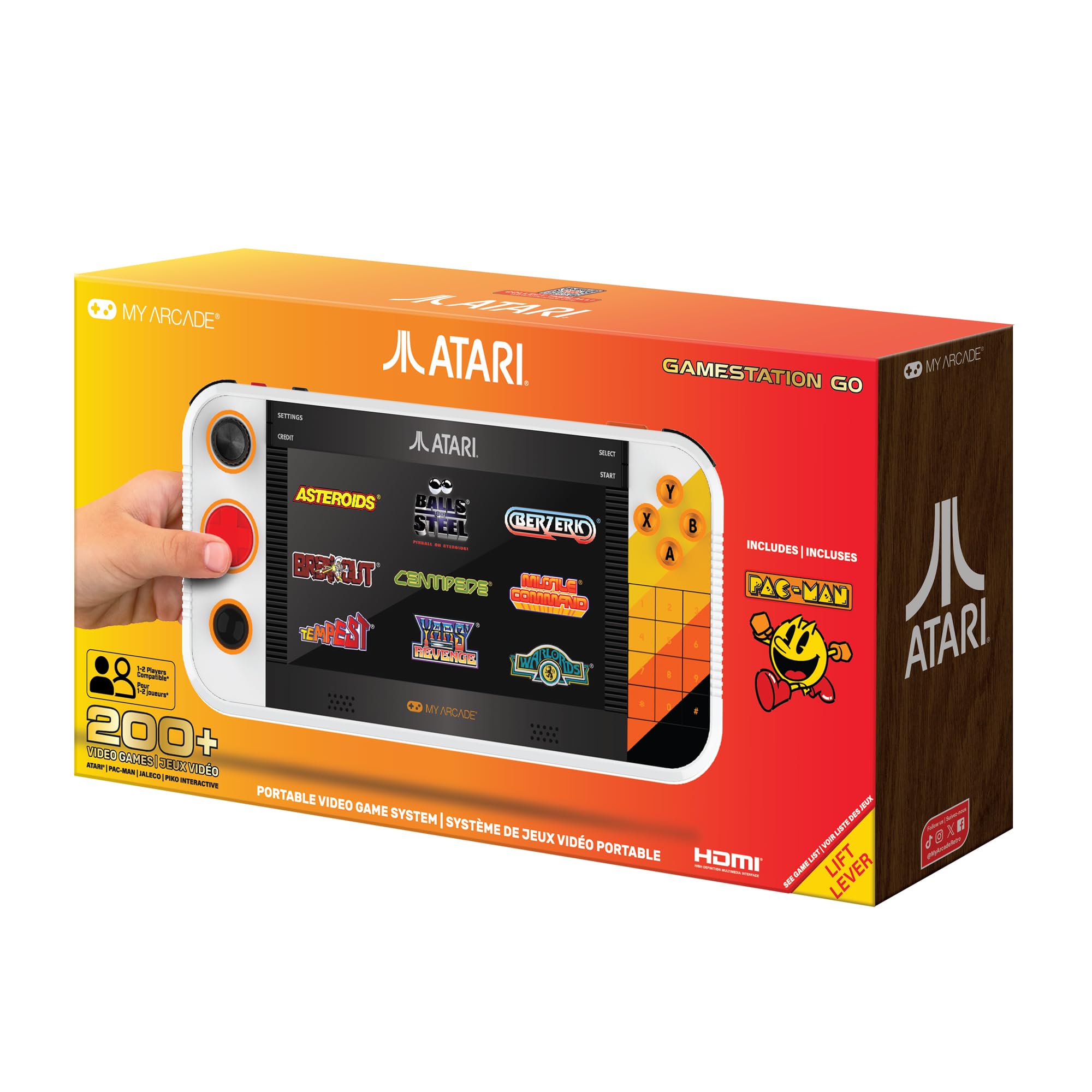
Atari Gamestation Go

86 /100
LBD Score Excellent

Key details

Power
Rechargeable battery
Display
7 inches
Video Output
HDMI
Built-in Games
200+
View on Amazon

A 7-inch screen on a handheld is the headline, but the controls are what make this one interesting. There's a paddle, a d-pad, a trak-ball, a numeric keypad, bumpers and a set of ABXY buttons, so a 2600 paddle game and a 7800 platformer don't have to share one input layout.

Inside are more than 200 licensed games drawn from Atari's console generations, plus Jaleco and PIKO titles, with save options and Wi-Fi for updates. Prop it on a table and it's a small arcade; run the HDMI cable to your TV and it's a console with a controller you already know how to hold. It's the only device here that does both jobs well.

Not every input earns its place. The trak-ball is twitchy enough that we went back to the d-pad for Missile Command, and the shell feels plasticky in a way that doesn't match the rest of the package. The games themselves hold up better than the hardware around them.

For an Atari fan who wants breadth without hunting cartridges, this is the most complete single box in the guide. Buy it for the library and the screen; treat the trak-ball as a bonus that may or may not suit your hands.

Pros

  • 200+ licensed games built in
  • 7-inch screen plus HDMI output
  • Paddle, d-pad, trak-ball and gamepad buttons
  • Rechargeable with Wi-Fi updates

Cons

  • Trak-ball is twitchy for precision games
  • Plasticky shell for the money
Our verdict

For a handheld that also lives under the TV, this is our pick: 200+ games, a 7-inch screen and HDMI out in one rechargeable unit.

Check Latest Price
6

Budget Cartridge Play

Retro-Bit Retro Duo

86 /100
LBD Score Excellent

Key details

Video Output
AV/S-video
Cartridge Slots
NES, SNES
Controllers Included
2 wired
Original Controllers
Supported
View on Amazon

If your television still has a yellow composite input, this is the least expensive way to get your own NES and SNES cartridges running again. Two slots, two wired controllers and the AV/S-video cable all come in the box — a complete kit with no adapters to hunt down, which is more than the Atari 2600+ manages.

The catch is the output. There's no HDMI here, only AV and S-video, so a modern panel needs a converter and the picture won't be as clean as the Trio's 720p. We treat the bundled pads as expendable; the console accepts original controllers through its own ports, which is the fix. A few SNES carts misbehave too, so test your favourites early rather than on a birthday.

That makes it a good buy for one specific household — the one that kept a CRT or an older receiver — and a frustrating one for everybody else. If you're in the second group, spend the difference on the Super Retro Trio HD Plus and skip the converter entirely.

Pros

  • Two cartridge slots for NES and SNES
  • Two controllers and both cables included
  • Works with original controllers and accessories

Cons

  • No HDMI
  • Bundled controllers and shell feel cheap
Our verdict

We recommend the Duo to cartridge owners whose TV still has an AV input; everyone else should look at the Trio instead.

Check Latest Price
7

Kids' First Handheld

Douddy 139-Game Handheld

85 /100
LBD Score Excellent

Key details

Battery
Rechargeable, 5 hours rated
Display
3.0-inch IPS
Charging
USB-C
Built-in Games
139
View on Amazon

For a kid's first handheld, this is where we start. At 6.4 ounces it's light enough for small hands, it charges over USB-C, and it carries 139 games on a 3-inch IPS screen that stays legible in the back of a car. Nothing about it feels precious, which is exactly the point.

The library is sorted into categories, and the manual includes a guide to the games — which sounds like filler until you watch a child try to work out what to do in a 32-bit platformer with no instructions. You won't seek any of these titles out for yourself. That's fine; this is a device for waiting rooms, flights and the hour between school and dinner.

The risk is the hardware. Charging-port and screen failures are what end this class of handheld early, and a unit that stops taking a charge is a drawer ornament. Buy where returns are easy, keep the included cable, and don't expect it to outlast a school year. Everything above that is a bonus at this price.

Pros

  • 139 games on a USB-C rechargeable handheld
  • 3-inch IPS screen sized for kids
  • Light enough to carry anywhere

Cons

  • Charging and screen faults can end it early
Our verdict

We hand this to kids before any other handheld here: light, USB-C charged, and loaded with games a six-year-old can actually finish.

Check Latest Price
8

Desk Novelty

Tiny Arcade Atari 2600

91 /100
LBD Score Outstanding

Key details

Screen
1.5 inches
Controls
Joystick
Built-in Games
10
Recommended Age
8 and up
View on Amazon

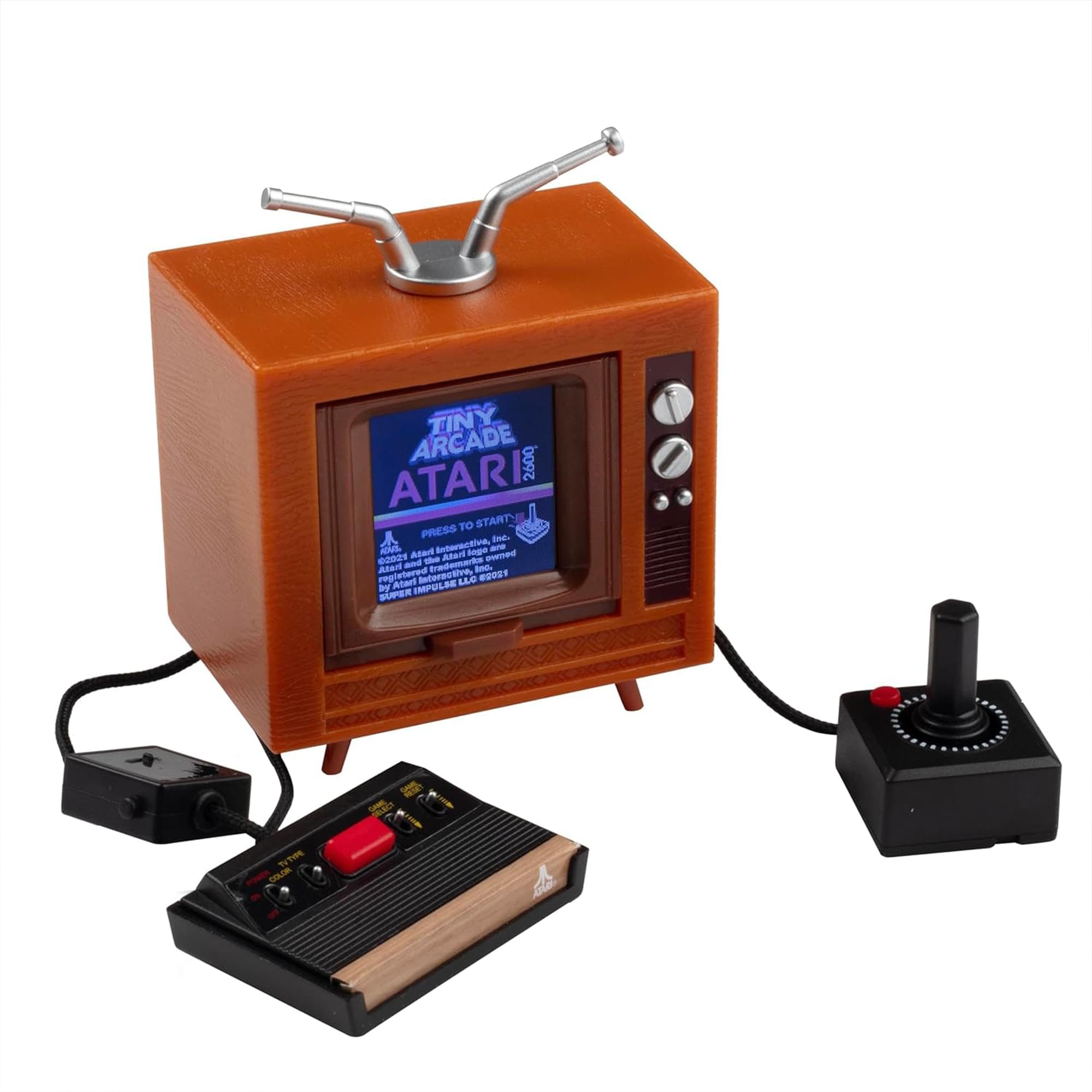
It comes out of the box smaller than the photos suggest: a palm-sized Atari 2600 with a matching miniature TV, a working joystick and a 1.5-inch screen showing ten classic games, Pac-Man and Breakout among them. The whole unit is about seven inches long, and most of that is the joystick cable's housing and the little TV shell.

We treat it as a desk piece that happens to play, and on those terms it's charming. The joystick does what it should, the games are the ones you remember, and it runs on AAA batteries so there's no cable snaking across a desk. Nobody is finishing Adventure on a screen that size, and nobody is meant to — it's a two-minute nostalgia hit between meetings.

As a gift it lands better than its specification suggests, because the reaction happens before anyone switches it on. As a way to actually play Atari, the 2600+ is the honest answer; this one is for the shelf beside it.

Pros

  • Ten Atari classics in a palm-sized replica
  • Working joystick and miniature TV
  • Runs on AAA batteries, no cable

Cons

  • 1.5-inch screen limits it to short bursts
  • AAA batteries are an ongoing cost
Our verdict

We recommend it as a gift or a desk ornament, not as the console you'll actually play all winter.

Check Latest Price

How We Tested 12 Retro Game Consoles

We rounded up every retro console we could get our hands on — minis with built-in libraries, machines that play original cartridges, and a few handhelds — and cut anything that couldn't connect to a modern TV or had a game list too thin to bother with. That left 12 units, which we've been running for six months.

Testing happened where these things actually live: a living room with a 65-inch TV, a spare bedroom with an older 1080p set, a car on a long weekend drive, and one afternoon with a pack of kids between 8 and 12. We played a timing-heavy platformer on each one to feel for input lag, watched for stretched or smeared picture on the big screen, and noted whether the menu made it easy to find a game or dumped us into a wall of titles.

Controllers got their own pass. We measured cord length against the distance from the TV to the couch, played a few rounds of a fighting game to judge the d-pad and buttons, and swapped in original pads wherever the console allowed it. We seated old cartridges again and again to see whether the slot gripped firmly or needed a wiggle, packed and unpacked each handheld five times in a bag with a laptop to check for scuffs and loose parts, and counted how many built-in games we'd genuinely play a second time. Price sat alongside all of it: a machine only scored well if it beat the cost and hassle of digging out the original hardware.

How to Choose a Retro Game Console

Start with the games, not the box

There are two kinds of machine in this guide. Preloaded minis put a fixed library inside the case — 21 games on the Super NES Classic, 30 on the NES Classic, a couple of hundred on the handhelds — and ask nothing of you beyond an HDMI cable. Cartridge consoles do the opposite: the Retro-Bit Duo, the Super Retro Trio HD Plus and the Atari 2600+ play the physical games you already own or can still buy secondhand.

Write down five or six titles you actually want before you shop. If they all appear on one built-in list, buy that console and stop. If they're sitting in a shoebox on cartridges, a preloaded mini is the wrong purchase no matter how good it looks. And treat a big game count as marketing rather than a recommendation — 200 games you don't want is worse than 21 you do.

Make sure it reaches your TV

HDMI is the difference between a ten-second setup and an afternoon of adapters. Every console here except the Retro-Bit Duo offers it; the Duo is AV and S-video only, which is fine if your TV has those inputs and a problem if it doesn't. Check the back of your panel before you order rather than after.

The trap is assuming HDMI guarantees a faithful picture. Clone consoles rebuild the original hardware in modern chips, and the Super Retro Trio HD Plus in particular can show colour and sound that are slightly off on some SNES carts. If exact reproduction matters, use original hardware; if you want convenience, accept the occasional quirk.

Count the controllers and measure the cords

Two-player support is where these consoles quietly differ. The Super NES Classic ships with a pair of pads; the NES Classic ships with one, so family play starts with an extra purchase. The Retro-Bit consoles accept original NES, SNES and Genesis pads through their own ports, which is the cheapest upgrade path if you kept them.

Cord length is the complaint that runs through both Nintendo minis. The cables are short enough that you end up sitting close to the TV, so budget for an extension cable or a wireless replacement pad — a small annoyance that decides whether an impulse purchase becomes a habit or a shelf ornament.

Handhelds: screen, battery and small hands

For a child, screen size and charging matter more than library size. A 3-inch IPS display and USB-C charging, as on the Douddy handheld, survive car trips and school bags in a way that AAA batteries and a 1.5-inch novelty screen do not. Check the stated age range too — the kid handhelds are labeled 4 to 12, while the Tiny Arcade set is 8 and up.

The bigger risk with budget handhelds is hardware, not software. Charging ports and display panels are the two failures that end them early, so buy from a seller with an easy return and don't count on one outliving a school year. The same money spent on a plug-in console buys something that sits still and lasts longer.

Save states and what you can't add later

Old games were designed around limited lives and long sittings. Save points change that, and they're the feature we'd protect hardest: the Super NES Classic lets you drop a save anywhere, which is the difference between finishing Super Metroid as an adult with a job and admiring it from a distance.

What you can't retrofit is a cartridge slot. A preloaded mini stays exactly as full as it was on day one, so if you think you'll want more games in two years, buy the machine that takes carts now rather than replacing the whole thing later.

Frequently Asked Questions

Final Verdict

The Super NES Classic is the console we recommend to most households: two controllers in the box, 21 games that still hold up in two-player, and save points that make finishing them realistic. It's the one you can hand to a guest without explaining anything.

If your games live on cartridges, that recommendation flips to the Retro-Bit Super Retro Trio HD Plus, which puts NES, SNES and Genesis on one HDMI cable. Atari households should go straight to the 2600+, wall plug in hand.