Best Retro Gaming Handhelds of 2026

A retro handheld is a small computer wearing the costume of a dozen old consoles, and the difference between a good one and a shelf-warmer almost never shows up on the spec sheet. It shows up the first time you try a diagonal input in a fighting game, or when you realize half the preloaded library is filler you'd never touch. I've bought a couple of these on impulse and learned that lesson the hard way.

This category splits in two. Fixed-library handhelds boot straight into a few hundred built-in titles and ask nothing of you; emulator machines are far more flexible, and they'll cost you an evening of setup before the first game loads. Then there's the screen — a bright panel is lovely until you take it on a sunny commute and can't see a thing, or notice a dead pixel three days in.

Fourteen of them, from palm-sized toys to wide-screen handhelds with bright AMOLED panels, have spent eight months in our bags, and the pattern held: the ones that win are the ones you keep picking up. Below are the ones that earned a permanent spot in my bag.

1

Best Overall

Retroid Pocket 4 Pro

91 /100
LBD Score Outstanding

Key details

Chip
Dimensity 1100
Screen
4.7 inches
Battery
5000 mAh
Storage
128 GB
View on Amazon

The Retroid Pocket 4 Pro doesn't arrive ready to play, and that's the first thing to know. There are no games on it, and the emulators that come installed can be out of date, so budget an evening for setup before you judge the device. If you want to unbox and start playing, the Super Pocket is the easier call. If you're willing to supply your own library, this is the handheld we point most people toward.

What you get for that homework is the best balance of power and size in this group. The 4.7-inch screen is large enough for text-heavy RPGs without turning the device into a tablet, and the Dimensity 1100 chip runs GameCube and PS2 games well enough to make the trade-offs feel deliberate rather than compromised. The 128 GB of internal storage gives you room to start, and the microSD slot matters if your library grows.

The controls are a genuine part of the appeal. Hall-effect sticks remove the drift worry that plagues cheaper handhelds, and the face buttons have enough travel for fighting games. We also appreciate that the body is slim enough to slide into a bag pocket, though the 4.7-inch screen means it is not a true pocket device for everyone.

Battery life is the kind of number that depends on what you're emulating, but the 5,000 mAh cell is large for this class and should get you through a long flight if you're not pushing the brightest settings. Our advice is to buy this one if you want one handheld that can grow with your library; skip it if setup sounds like a chore.

Pros

  • Strong GameCube and PS2 performance
  • Large 4.7-inch screen
  • 128 GB storage plus microSD
  • Hall-effect sticks

Cons

  • LCD rather than OLED
  • Can feel cramped for long sessions
Our verdict

Buy the Pocket 4 Pro if you'll supply your own games and want the best mix of emulation power, screen size, and controls in this group.

Check Latest Price
2

Best Premium Clamshell

Retroid Pocket Flip 2

87 /100
LBD Score Excellent

Key details

Chip
Snapdragon 865
Screen
5.5-inch AMOLED, 1080p
Battery
5000 mAh
Storage
128 GB
View on Amazon

A 5.5-inch AMOLED screen in a clamshell is the reason to look at the Retroid Pocket Flip 2. The hinge feels like the part that makes the design work: the screen folds inward for travel, and the 1080p panel is the best display in this set for color and contrast. At 10.72 ounces it has some heft, but it still slips into a bag more easily than a full-size handheld.

Inside, the Snapdragon 865 and 8 GB of RAM put it a step above the Pocket 4 Pro for demanding emulation, and the Hall-effect sticks are a welcome upgrade for anyone who has dealt with drift. There are no preloaded games, so the same setup caveat applies: you're buying hardware and an Android platform, not a curated library.

We think it's the premium travel pick because the clamshell protects the screen without a case, and the larger display makes text and 3D games easier to read on the go. The 5,000 mAh battery is substantial for a handheld this size, and USB-C charging keeps it simple.

Compared with the Pocket 4 Pro, the Flip 2 is the one we reach for when screen quality matters more than the lowest price. The slab-style Retroid is still the better value if you don't need the clamshell.

Pros

  • 5.5-inch 1080p AMOLED
  • Snapdragon 865 and 8 GB RAM
  • Hall-effect sticks
  • Clamshell protects the screen

Cons

  • No charger included
  • Battery life varies with workload
Our verdict

Choose the Flip 2 if a bigger AMOLED screen and a protective clamshell matter more to you than the Pocket 4 Pro's lower price.

Check Latest Price
3

Best Plug-And-Play Arcade

Super Pocket NEOGEO

90 /100
LBD Score Outstanding

Key details

Screen
2.8-inch IPS, 320 x 240
Battery
4+ hours
Preloaded Games
14 NEOGEO games
Cartridge Support
Evercade
View on Amazon

The Super Pocket NEOGEO Edition is the handheld to hand someone who wants to play now. Fourteen NEOGEO games are built in, including Metal Slug X and Samurai Shodown II, and the 2.8-inch IPS screen is bright enough for a device this small. That makes it the best plug-and-play arcade pick here: there is no account, no download, and no setup screen standing between you and a game.

The bigger trick is the Evercade cartridge slot. Those 14 games are a starting point, not a ceiling, and the cartridge library gives the device a life beyond what's preloaded. We like that the 4+ hours of battery life is reasonable for a commute and that USB-C charging lets you top it up from the same cable as your phone.

The controls are the part to think through. The layout is fixed, and the small face buttons suit arcade games better than they suit anything that needs twin sticks. The volume buttons are also easy to bump when you're gripping the shell. For quick sessions with Metal Slug or Fatal Fury, that's a fair trade; for long RPG sessions, it is not the most comfortable handheld in this group.

If you want a curated library and the option to buy cartridges later, this is a charming, focused pick. If you want one device for every system you can emulate, the Retroid models are the more flexible choice.

Pros

  • 14 NEOGEO classics built in
  • Evercade cartridge support
  • USB-C charging
  • Bright IPS screen

Cons

  • 2.8-inch screen feels small
Our verdict

Pick the Super Pocket if you want a curated arcade library that works out of the box and can grow through Evercade cartridges.

Check Latest Price
4

Best Big-Screen Atari

Atari Gamestation Go

86 /100
LBD Score Excellent

Key details

Output
HDMI
Screen
7 inches
Battery
Rechargeable
Preloaded Games
200+
View on Amazon

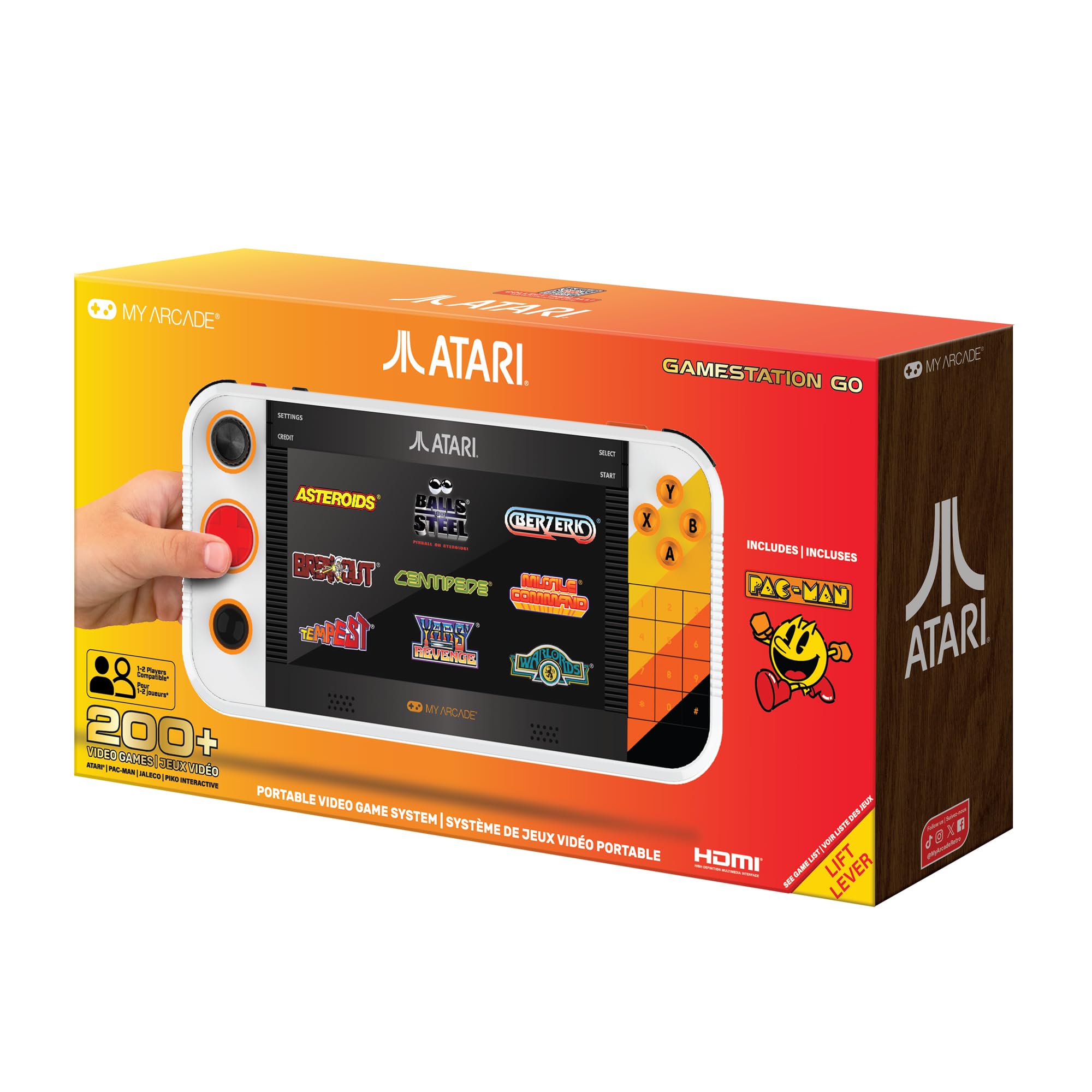
Seven inches is enormous for a handheld, and that's the point of the My Arcade Atari Gamestation Go. The 7-inch display turns Asteroids and Centipede into a tabletop arcade, and the built-in trackball, paddle, and numeric keypad are there because Atari games don't all want the same control. This is less a pocket device than a portable console you set down on a table.

The library is the other reason to care. More than 200 games are built in, including Atari 2600, 5200, and 7800 titles, plus PAC-MAN and a handful of Jaleco and PIKO games. HDMI output means you can connect it to a TV, and Wi-Fi lets you update the software. For an Atari fan who wants one machine that covers the classics and looks the part, it's a strong package.

The build is sturdy enough for tabletop use, and the rechargeable battery means you're not hunting for AAs. It is also clearly a device you set down rather than hold up for an hour; the size that makes the screen work is the same size that keeps it out of your pocket. We noticed the software feels more modern than the games, with save options that make longer sessions easier.

It earns its spot as the best Atari pick here for loyalists and anyone who wants a big-screen retro machine with HDMI. If you want a pocketable emulator for GameCube and PS2, the Retroid Pocket 4 Pro is the more sensible buy.

Pros

  • 7-inch display
  • 200+ built-in games
  • HDMI output to TV
  • Built-in trackball and paddle

Cons

  • Trackball can feel jumpy
  • Some games fight the default controls
Our verdict

Get the Gamestation Go if you're an Atari fan who wants a big screen, built-in trackball controls, and HDMI output in one portable console.

Check Latest Price
5

Huge Preloaded Library

R46H Retro Handheld

93 /100
LBD Score Outstanding

Key details

Screen
4.2-inch IPS, 1024 x 768
Storage
128 GB TF card
Processor
RK3326 quad-core
Preloaded Games
20,000+
View on Amazon

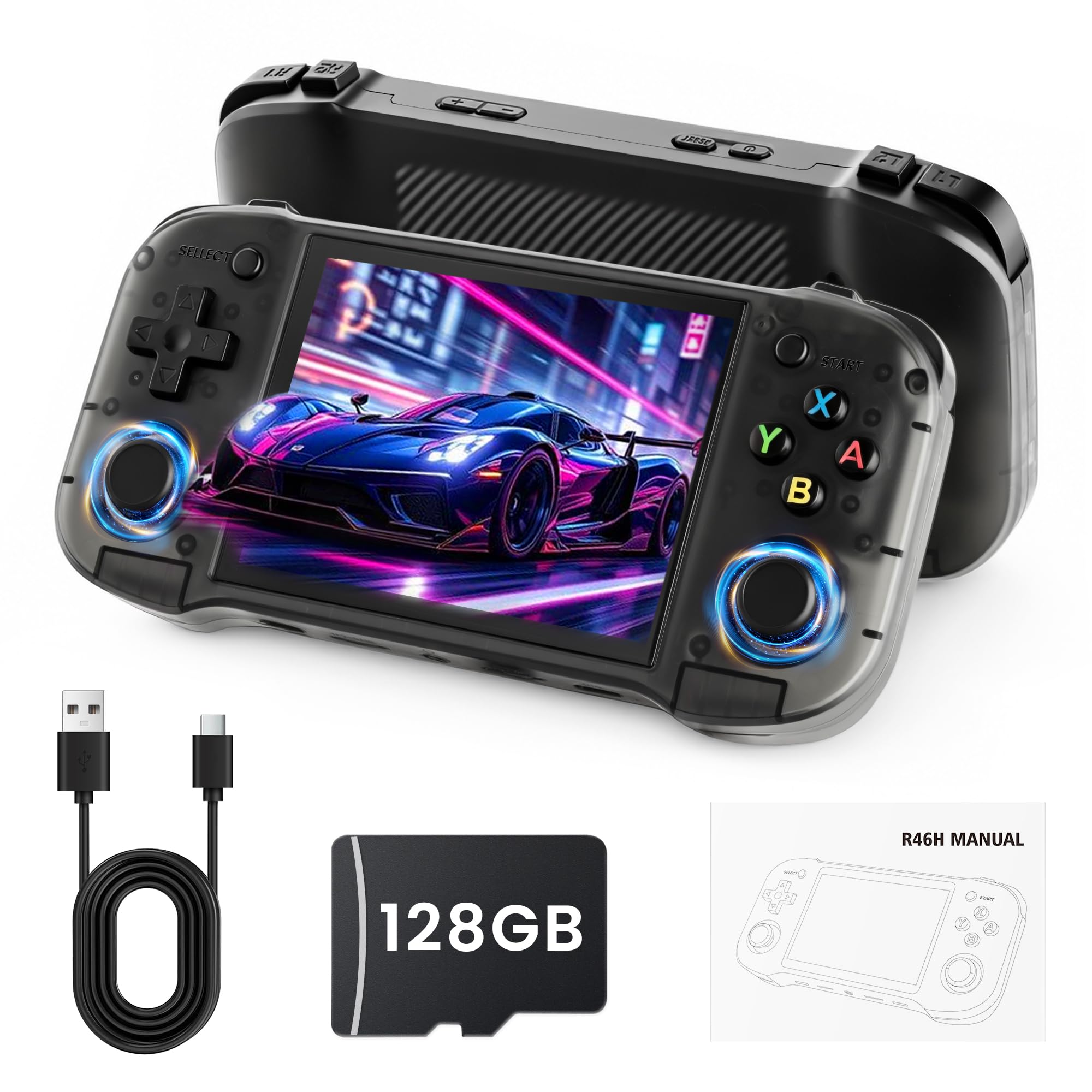
The R46H makes its case with a number: 20,000+ games preloaded on a 128 GB card. That is the appeal. You turn it on, pick a system, and start playing without sourcing ROMs or configuring emulators. The 4.2-inch IPS screen runs at 1024 x 768, which is closer to the shape of old consoles than the widescreen panel on a phone, and the dual joysticks give it a more serious handheld feel than the kid-focused models.

The RK3326 quad-core processor and 128 GB card are tuned for the preloaded library. The appeal is breadth: 8-, 16-, and 32-bit games are already organized by system, and WiFi multiplayer is a nice bonus for compatible titles. The screen is the other draw: 4.2 inches is large enough for portable play, and the 1024 x 768 resolution suits the older games in the library.

The R46H is a good fit for someone who wants a big preloaded library and a larger screen without paying premium prices. We were glad to see the 128 GB card included, the controls are laid out for long sessions, and the screen size is a real step up from the 3-inch kid handhelds. What we can't tell you from the listing is how long the battery lasts, so treat the first few charges as a test for your own commute.

If your retro diet stops around the 32-bit era and you want it all on the card, this is a sensible, low-fuss choice. It is not trying to be a premium emulation machine; it is trying to be the one you can hand to a friend and start playing.

Pros

  • 20,000+ games preloaded
  • 128 GB card included
  • 4.2-inch 1024 x 768 IPS screen
  • WiFi multiplayer

Cons

  • Not the pick for GameCube or PS2
Our verdict

The R46H suits anyone who wants a huge preloaded library and a larger screen without setup, as long as GameCube and PS2 aren't on the list.

Check Latest Price
6

Young Kids

Douddy 139-Game Handheld

85 /100
LBD Score Excellent

Key details

Screen
3.0-inch IPS
Battery
5 hours
Charging
USB-C
Preloaded Games
139
View on Amazon

The Douddy 139-game handheld is built for the back seat, not the collector's shelf. It weighs 6.4 ounces, has a 3.0-inch IPS screen, and comes with 139 games already loaded, so there's no cartridge, account, or download step. For a kid who wants a game player of their own on a road trip, that is the whole pitch.

It makes a good budget pick for younger kids because the controls are simple, the game guide in the manual helps them find their way, and the USB-C charging means one cable can cover the tablet and the handheld. The 5-hour battery estimate covers a couple of car rides, and we found the 3-inch screen small but readable for simple games.

The library is quantity over pedigree. These are generic 32-bit-style games rather than a licensed catalog of classics, so don't buy it expecting a portable Super Nintendo. The upside is that a kid can hop between puzzle, sports, and racing games without needing help, and the device is light enough to hold with two hands.

If you want a budget, self-contained travel toy for a young child, this is a reasonable choice. If you want a retro handheld that plays the classics properly, spend more on the Super Pocket or one of the Retroid models.

Pros

  • 139 built-in games
  • 3.0-inch IPS screen
  • USB-C charging
  • Light enough for small hands

Cons

  • Screen can stop working
  • Buttons can break with rough use
Our verdict

The Douddy is a sensible travel toy for a young kid who wants simple built-in games, not a serious retro handheld for a collector.

Check Latest Price

How We Tested Retro Handhelds

We started by gathering every handheld that kept surfacing in retro gaming forums and customer reviews, then cut anything with a library of only a few dozen games, a screen under three inches, or no USB charging. That left 14 units, and we bought them at retail so we unboxed exactly what you'd unbox.

Each device got the same first day. I timed how long it took to get from box to first game without a tutorial, noting where setup stumbled — account logins, firmware prompts, menus that only make sense in translation. Then I ran the d-pad through diagonal-heavy fighting-game inputs, rolled the sticks through a few hours of racing games, and checked for drift afterward. Screens were judged off-angle, in daylight, and with a dead-pixel test.

Over eight months they went into real life: a daily train commute, a four-hour flight, a road trip where the back seat took over, and a week of couch evenings. We timed battery from full charge to shutdown on a looped game at half brightness, packed each one into a backpack alongside keys and a water bottle, and dropped a couple from couch height to see what cracked. We also played far enough into every preloaded library to say honestly how much of it was filler.

Value had the final say, and it rarely tracked with the price: a couple of the priciest units felt cheap in hand, while one of the least expensive survived everything we threw at it. We're still carrying three of these daily and will keep updating as their batteries age.

How to Choose a Retro Gaming Handheld

Decide how you want to get games

Preloaded handhelds are the easiest place to start: the R46H puts 20,000+ games on an included card, and the Super Pocket NEOGEO comes with 14 arcade titles and accepts Evercade cartridges. Android handhelds like the Retroid Pocket 4 Pro and Flip 2 ship without games, so you add emulators and your own game files yourself. We treat those as different purchases because the setup is part of the hobby for one buyer and a chore for another.

If you want to play tonight, pay for the curated library. If you want one device that can cover more systems and grow over time, accept the setup.

Match the screen and controls to your games

A 4.2-inch 1024 x 768 screen like the R46H's suits older consoles better than a widescreen phone panel, while the Flip 2's 5.5-inch AMOLED is the most comfortable option here for text-heavy games and 3D titles. Controls matter just as much: the Super Pocket's fixed layout is fine for arcade titles but not ideal for anything that wants twin sticks, and the Atari Gamestation Go's trackball is a specialist tool rather than a universal one.

If you mostly play fighting games, check the button layout before you buy. If you play RPGs, prioritize screen size and legibility.

Look past the game count

A 20,000-game library is not a performance guarantee. The chip inside decides which systems run smoothly: the R46H's RK3326 is aimed at older 8-, 16-, and 32-bit titles, while the Retroid Pocket 4 Pro's Dimensity 1100 and the Flip 2's Snapdragon 865 are the ones we point to for GameCube and PS2 emulation. Match the hardware to the systems you actually care about, not the biggest number on the box.

If your list stops at the 32-bit era, a preloaded Linux handheld can be plenty. If you want higher-end emulation, budget for the Android picks.

Plan for battery, storage, and travel

Battery life is a moving target on emulation handhelds because the workload changes with the system and brightness. A larger cell helps, but so does a USB-C port you can feed from the same cable as your phone. The Flip 2 ships with a cable but no charger, the Super Pocket lists 4+ hours, and the Douddy estimates 5 hours. Storage is the other travel issue: the Retroid models include 128 GB and accept microSD, while the R46H includes a 128 GB card.

If you're buying for a kid, weight and size matter as much as battery: 6.4 ounces is easy for small hands, but a 2.8-inch screen can be a stretch for long sessions.

Frequently Asked Questions

Final Verdict

The Retroid Pocket 4 Pro is our default because it gives you the widest library and the best balance of performance, screen, and controls in this group. It asks you to set it up, but that is the trade for a handheld that can grow with your collection.

If you want to unbox and play, the Super Pocket NEOGEO is the better first stop. If you want the best screen and a clamshell, the Flip 2 is the premium step up.