Best Night Vision Monoculars of 2026

Night vision monoculars are a study in trade-offs: the farther you can see, the narrower the view; the more compact the housing, the harder the controls can be to find in the dark. What you’re really shopping for is confidence—the ability to tell a deer from a shrub or a trail marker from a stump without flooding the scene with light. Over the past six months, my team and I put eight monoculars through their paces, from pocket-size digital units to thermal and helmet-mounted setups. We used them on evening walks, backyard stakeouts, and damp camping trips.

Spec sheets can make a budget unit look professional, but clarity, field of view, and brightness are what you notice once the light is gone. Thermal models made warm bodies pop; digital infrared units gave more recognizable shapes; head-mounted designs freed my hands but took longer to adjust. We weighed compact size against battery life and zoom, and noted startup speed and whether controls were easy to find by feel. The picks below are the ones that stayed usable in real dark.

1

Best Overall

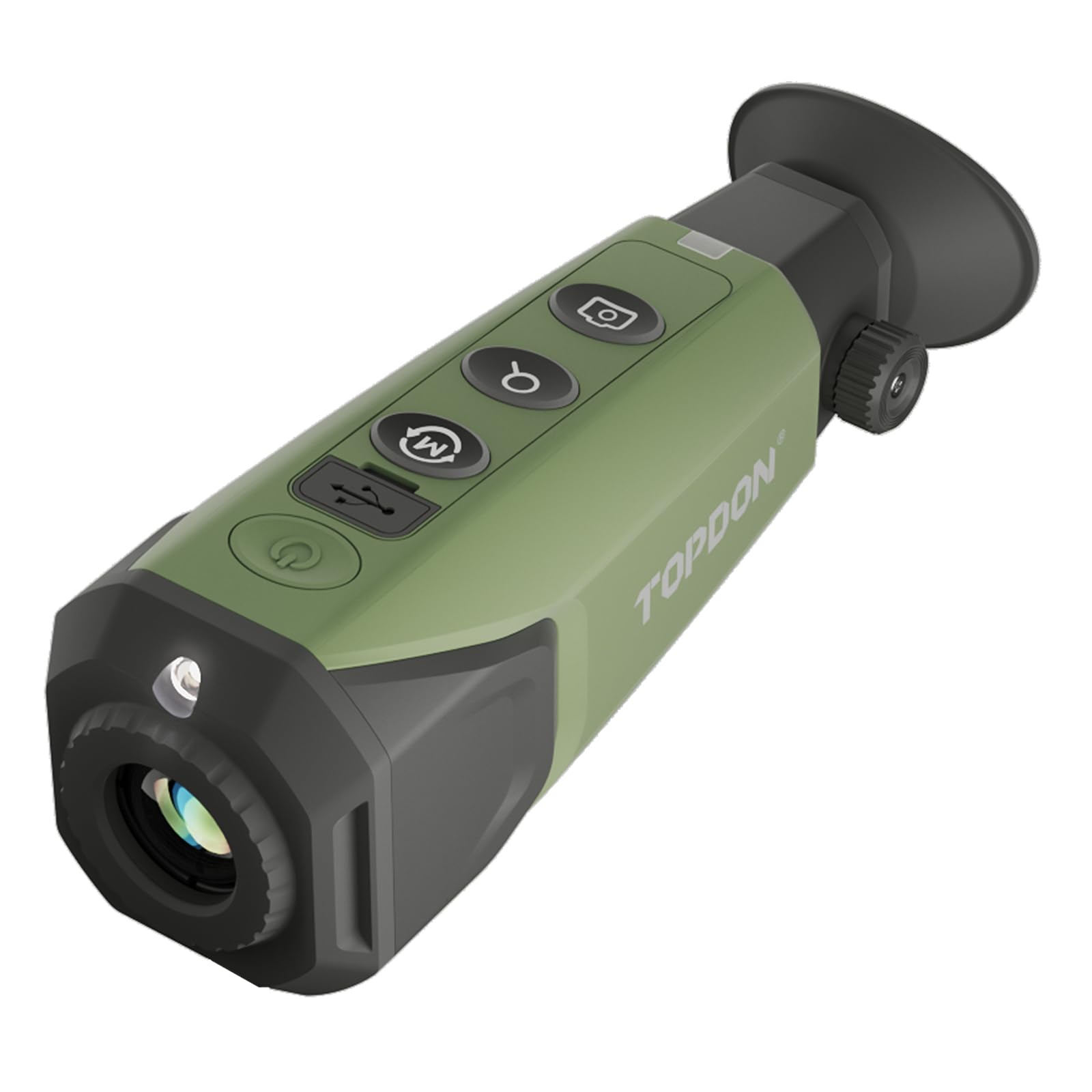
TOPDON TS004

88 /100
LBD Score Excellent

Key details

Battery Life
Up to 11 hours
Refresh Rate
50Hz
Detection Range
Up to 410 m
Thermal Resolution
256 x 192
View on Amazon

Thermal is the one night vision technology here that does not care whether there is any light at all, and the TS004 is the version of it we point most buyers toward. Its 256 x 192 sensor refreshes at 50Hz, so a fox working along a hedge line stays a moving animal instead of a stuttering smear, and the 13mm lens is rated to detect heat out to roughly 410 meters.

What settled it for us was stamina. The 5000mAh battery is rated at 11 hours, several times what most of this group manages and the difference between a device you switch on for a quick look and one that stays running all evening. IP67 sealing and a silicone body rated for two-meter drops mean you stop handling it like glassware, and the housing sits comfortably in one hand.

The phone link earns its place too. The TopInfrared app mirrors the live image and pulls photos and video with audio off the unit, so a second person can watch without crowding the eyepiece, and you can review what you saw without holding anything to your face.

Two things we noticed in use. Even on the low setting the screen is bright enough to sting dark-adapted eyes, so give yourself a minute between looks. And it will not see through window glass: from outside, a lit room reads as a mirror. Both are quirks of the technology rather than faults of this unit.

Pros

  • Reads body heat with no light at all
  • 11-hour battery is the longest in this group
  • IP67 sealed and rated for two-meter drops
  • Live phone mirroring and capture

Cons

  • Narrow 13.5-degree field of view
  • Detail thins past about 100 yards
Our verdict

Start here: it reads body heat in zero light, runs 11 hours on a charge, and takes rain, which is what scanning fields, woods, or a back forty after dark actually demands.

Check Latest Price
2

Best Pocketable Thermal

RIX Pocket K2

85 /100
LBD Score Excellent

Key details

Weight
7.05 oz
Refresh Rate
50Hz
Field Of View
19.4 degrees
Thermal Resolution
256 x 192
View on Amazon

Same sensor generation as our top pick, different job. The Pocket K2 runs a 256 x 192 core at 50Hz, but RIX built it around carry: 200 grams, about the size of a rangefinder, with a lens cover that slides shut under one finger instead of swinging on a tether.

The 19.4-degree field of view is wider than the TS004's, which makes panning a field less work, and the 800x600 OLED display holds contrast well in cold. Focus is fixed at the objective, so you set the eyepiece once for your eye and leave it alone.

This is the thermal we kept reaching for on walks and short trips, because it is the one that does not need a plan. It picks heat out to 100 to 150 yards comfortably, enough for a treeline or the far side of a pasture, and the five-year manufacturer warranty is the longest attached to anything on this page.

Push the digital zoom and the picture goes soft quickly, so treat magnification as a way to center something rather than to identify it; small animals at distance stay shapes. For close and mid-range work that is the right trade, and the sliding cover means you are never hunting for a lens cap in the dark.

Pros

  • 200 grams and rangefinder-sized
  • Sliding integrated lens cover will not get lost
  • 19.4-degree view is wider than the TS004's
  • Five-year manufacturer warranty

Cons

  • Fixed focus leaves close subjects soft
Our verdict

The thermal that goes everywhere: 200 grams, a lens cover you cannot lose, a wider view than our top pick, and a five-year warranty behind it.

Check Latest Price
3

Best for Identification at Distance

RIX Pocket K3

84 /100
LBD Score Excellent

Key details

Weight
7.52 oz
Refresh Rate
50Hz
Field Of View
17.5 degrees
Thermal Resolution
384 x 288
View on Amazon

The number that matters on the Pocket K3 is 384 x 288, roughly twice the pixels of the 256 x 192 units here, in a body that still weighs 7.52 ounces and fits the same pockets as its smaller sibling.

That resolution is what converts a warm shape into an animal. With the 15mm lens and 2x base magnification, this is the unit in the group that lets you tell a raccoon from a cat a couple of hundred yards out instead of merely registering that something is there. The 50Hz refresh and electronic image stabilization keep handheld scanning steady, and IP67 sealing plus a five-year warranty match the K2.

The 2x base magnification and 17.5-degree field are the price of that detail: in thick cover at close range you see less than through the 1x units, and you pan more. We think that is the right trade for open country and the wrong one for a wood at dusk.

Pros

  • 384 x 288 detail at 7.52 ounces
  • 50Hz refresh plus image stabilization
  • IP67 sealed with a five-year warranty
  • Tripod thread for steady scanning

Cons

  • A big step up in price from the K2
  • Digital zoom softens the image quickly
Our verdict

For identifying animals at distance rather than just detecting them, this is the thermal to stretch for: 384 x 288 detail in a 7.5-ounce body.

Check Latest Price
4

Best for Night Walking

Nightfox Prowl

82 /100
LBD Score Excellent

Key details

Weight
8.99 oz
Field Of View
54 degrees
Magnification
1x
Weather Rating
IP54
View on Amazon

Walking with night vision is a different job from spotting with it, and the Prowl is built around the walk: 1x magnification, a 54-degree field of view, and 255 grams riding on the included head strap. That combination gives you the ground in front of your feet instead of a magnified tunnel.

It ships with both a head strap and a dovetail adapter that fits Wilcox G24-style mounts, so it can move onto a bump helmet later without another purchase. Two illuminators cover both jobs, 850nm for reach and 940nm for stealth, and it records 1080p video.

Latency is what decides whether a digital unit is walkable, and at 30fps this one is manageable rather than invisible: we noticed the delay for the first few minutes and then stopped noticing it. Installing the current firmware before you judge the picture is worth the ten minutes.

Where it trails the thermals is the picture itself: pixelated next to a 256 x 192 thermal, fine for navigating and recording, not much use for studying an animal at 200 yards. That is the boundary of what this one is for, and inside it nothing here is easier to live with.

Pros

  • 1x, 54-degree view you can walk with
  • 850nm and 940nm illuminators
  • Dovetail adapter fits Wilcox G24-style mounts
  • Records 1080p video

Cons

  • IP54 only, splash-resistant rather than sealed
  • Head strap needs a very tight fit
Our verdict

Our pick for moving in the dark: a wide 1x view, a stealth 940nm option, and helmet hardware in the box.

Check Latest Price
5

Best All-Around Digital

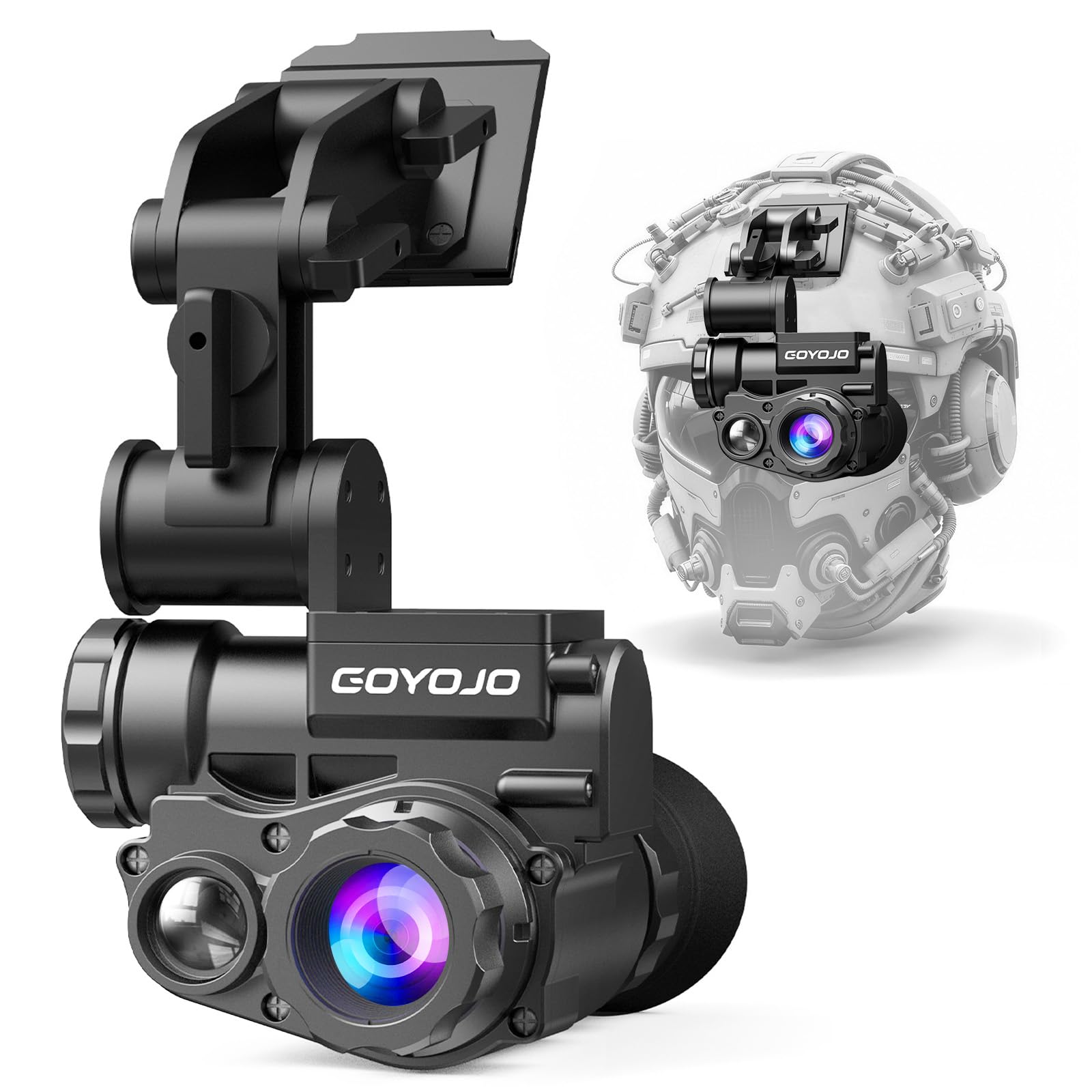
GOYOJO NVG10

81 /100
LBD Score Excellent

Key details

Weight
9.88 oz
Display
1080P
Field Of View
40 degrees
Weather Rating
IP66
View on Amazon

The NVG10 covers more ground than anything else at its price: a 1080p screen, three color modes, a three-level IR illuminator, a compass in the frame, and the bracket and screws you need to put it on a helmet, all in the box.

It is a 1x digital unit with a 40-degree field of view and digital zoom steps at 2x, 4x, and 6x. The housing is rated IP66, which is the sealing the Prowl does not have, and it weighs 280 grams.

What impressed us is the way it handles changing light: step from a dark yard into a lit garage and it adjusts automatically instead of blinding you with its own screen. Focus and diopter have enough travel to set it up once, and the included mounting hardware attaches firmly once the screws are snug.

The 40-degree view is noticeably tighter than the Prowl's 54 degrees, which you feel when you are walking rather than standing still. If your nights are mostly spent moving, that matters; if you are glassing a field from a truck or a porch, it does not.

Pros

  • Mounting bracket and screws in the box
  • Auto brightness adjustment when light changes
  • IP66 sealed for wet weather
  • Three color modes plus a compass overlay

Cons

  • One-year warranty falls short of RIX's five
  • Digital zoom adds no real detail
Our verdict

The most complete digital unit for the money: color view, IP66 sealing, a compass, and helmet hardware included.

Check Latest Price
6

Best Ultralight Pocket Option

Carson MiniAura

83 /100
LBD Score Excellent

Key details

Power
3 AAA batteries
Weight
3.4 oz
Field Of View
19 degrees
Magnification
2x
View on Amazon

At 3.4 ounces and small enough to close a fist around, the MiniAura is the one that lives in a jacket pocket and comes out for thirty seconds at a time.

It is a digital black-and-white unit with 2x magnification and a 19-degree field of view, and the IR intensity steps up with a button press rather than a menu. Power comes from three AAA batteries, which you supply.

Where it earns its keep is close range: across a yard, down a trail, inside a dark garage or the cabin of a boat. The picture is grainy next to the thermal units and the screen is small, but at 30 feet it does the job, and there is nothing to fumble with in the dark.

What we appreciate most is how honestly it is built for that job. It is not trying to be a scanner, and the one thing to know before you rely on it is that the illuminator glows a faint red, which is irrelevant in your own garage and worth thinking about if you are trying not to be seen.

Pros

  • Palm-sized at 3.4 ounces
  • Button controls, no menus to learn
  • Adjustable IR works in total darkness
  • Runs on easy-to-find AAA batteries

Cons

  • Narrow 19-degree field of view
  • Three AAA batteries not included
Our verdict

For the close-range looks that do not warrant a full kit, the yard, the dock, the tent, this palm-sized unit puts night vision in a jacket pocket cheaply.

Check Latest Price
7

Best Image-Intensified

AGM PVS-14

81 /100
LBD Score Excellent

Key details

Weight
2 lb
Field Of View
52 degrees
Magnification
1x
Objective Lens
26 mm
View on Amazon

Everything else here paints a picture on a small screen; the PVS-14 does not, and that difference is why we keep it on the list despite its price. A Gen2+ intensifier tube amplifies whatever light the sky is giving you, so you look through the device rather than at it: no refresh lag, no pixellation, and no screen glowing against your face.

The specifications that matter are 1x magnification, a 26mm objective, a 52-degree field of view, and manual gain, which lets you dial the tube down instead of squinting through a bright image. Automatic bright-light cut-off protects the tube, and a built-in IR illuminator with a flood lens covers the nights when there is genuinely nothing to amplify.

It arrives as a system rather than a device, with head mount assembly, helmet adapter, sacrificial window, demist shields, and a soft case, and it can be weapon-mounted as well as worn. One caution: the listing's model naming is not consistent about tube grade, so confirm the exact tube specification with the seller before you order.

Two pounds is the honest weight of glass and a tube. On a helmet you want a counterweight at the back, and handheld it is a two-hand device, which is the opposite of the pocket thermals. In a windowless room, you will be using its illuminator like everyone else.

Pros

  • True Gen2+ intensification with no screen lag
  • 52-degree field of view at 1x
  • Manual gain and bright-light cut-off
  • Head, helmet, and weapon mounting included

Cons

  • Two pounds needs a counterweight on a helmet
  • Far more expensive than any digital pick
Our verdict

Buy it for real intensification, instant and unpixellated with no screen glow, if the budget is in a different bracket and the helmet is set up properly.

Check Latest Price
8

Budget Total Darkness

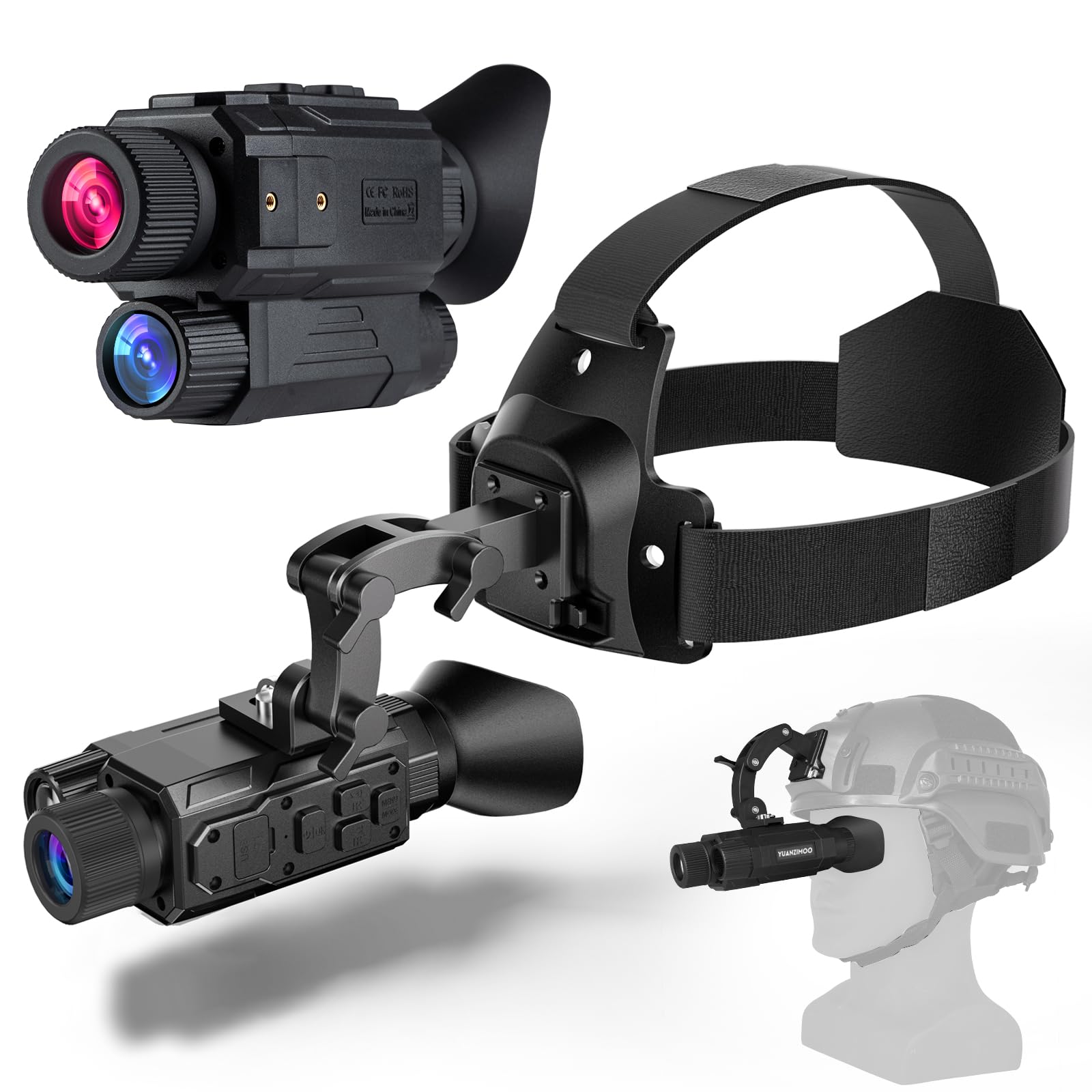
YUANZIMOO LG66

81 /100
LBD Score Excellent

Key details

Battery
2200 mAh
Digital Zoom
8x
Viewing Range
984 ft
IR Illuminator
850nm
View on Amazon

What a small outlay buys in this category is a digital image in total darkness: an 850nm illuminator with seven brightness steps, a 24mm lens, and a claimed reach of 984 feet.

The 2200mAh battery is built in and charges over USB, a 32GB card comes in the box, and it shoots photos and video as well as showing you the live view. It works handheld or on a head mount.

The picture is at its best before you touch the zoom. The 8x digital zoom crops a small sensor and goes soft quickly, so use it to center something rather than to study it, and expect to pan more than the wide 1x units require.

What it does well is the thing we think a first-time buyer actually wants: a usable picture in the dark, a battery that does not need replacing, and recording that works without extra kit. The rest is a matter of expectations, because this is a device for a yard or a campsite, not for identifying animals across a field.

Pros

  • Sees in complete darkness on its own IR
  • Built-in 2200mAh rechargeable battery
  • 32GB card and photo/video recording included
  • Low cost of entry

Cons

  • Narrow view at any zoom level
  • Illuminator glows visibly to anyone facing it
Our verdict

A cheap, self-contained way to see in total darkness, best for a yard, a campsite, or a first taste of night vision.

Check Latest Price

How We Chose and Tested Night Vision Monoculars

We started by researching monoculars that show up repeatedly in owner reviews and enthusiast forums, then narrowed the field by sensor type, lens size, magnification, recording, mounting, weather sealing, and price. We ended up with eight units—handheld digital, thermal, and helmet-mounted designs—and tested them over six months.

Most sessions happened after sunset on a wooded trail and in a backyard with markers at 25, 50, and 100 yards; we also took the units on two camping trips where dew and light rain tested the seals. At each distance, we identified a trail sign, a fence post, and a parked truck, noting how quickly the shape resolved and whether we could read texture or only silhouette. We panned across the same treeline to judge field of view, compared low-light scenes before and after engaging IR or thermal palettes to check brightness and washout, and cycled through zoom on a fixed target to see when the image turned to mush.

We timed startup and battery life from a full charge until the unit dimmed or shut off, and noted whether the compartment was easy to open with cold hands. For compact size, we carried each one in a jacket pocket, on a lanyard, and—where applicable—on a bump cap to see how it balanced. We also compared value by asking whether a step up in price bought better clarity, range, or build rather than extra menu clutter. The finalists are the ones that stayed usable in real dark, not just in the first minute.

How to Choose a Night Vision Monocular

Thermal, Digital Infrared, or Image Intensification

A thermal sensor reads temperature difference, so it works in a sealed dark room and gives away nothing but a faint screen glow. The trade is resolution: a 256 x 192 sensor detects a warm body at 100-plus yards and turns it into a blob much beyond that, and window glass stops thermal cold. A digital unit is a camera, needing its IR illuminator or ambient light and showing the result on a small screen that glows against your face. An intensifier tube amplifies starlight into an immediate, natural view and costs the most.

Our rule is blunt: spotting animals or people in the dark means thermal, and moving around at night means a 1x digital unit or an intensifier.

Resolution Buys Identification; Zoom Only Crops

Thermal comes in two useful steps here. 256 x 192 is the detecting grade, telling you something warm is out there. 384 x 288 is the identifying grade, where you start separating a raccoon from a cat at a couple of hundred yards. Digital units advertise large display numbers, but the sensor captures the detail and the display only shows it.

The trap is zoom. Digital zoom enlarges what the sensor already caught, softness included, so a claimed 8x is not eight times the reach. Put the budget into the sensor and read the zoom figure as a cropping convenience.

Match the Field of View to How You'll Move

Field of view is what you notice in the first minute. 1x with 40 to 54 degrees feels like looking through a big window and is what you want for walking; 2x and above narrows the view into a tunnel meant for standing still and studying a treeline.

The classic mistake is high fixed magnification on a head mount. 7x is serviceable on a tripod and unusable on a walk, because every step swings the view. Decide whether you will move or watch, and let that rule out half the listings.

Mounting: Strap, Helmet Dovetail, or Handheld

Almost everything here works handheld; the difference shows up in hour two. A head strap is inexpensive and effective, but it has to be tight enough to stop the bob and the weight sits on your forehead. A dovetail shoe on a bump helmet, Wilcox G24-style being the common standard, is steadier and flips up out of the way.

Check what comes in the box before you budget. The Prowl and the PVS-14 both ship with helmet hardware, while plenty of cheaper units expect you to source a mount separately. If you already own a helmet with a shroud, buy a unit that fits it.

Batteries, Sealing, and the Cost of Ownership

Runtime varies more than any other number in this category, from a few hours to most of a night, and the question that matters is whether the cell is replaceable. A built-in battery means charging the whole device and waiting; a removable cell means a spare in your pocket.

Sealing deserves the same attention. IP54 shrugs off a splash and a light shower, while IP66 and IP67 handle real rain. The night you need the device is usually the night it is wet, so a spare battery and a dry bag decide whether an outing ends early.

Frequently Asked Questions

Final Verdict

For most people the TOPDON TS004 is the night vision monocular to buy: it finds warm bodies in absolute darkness without an illuminator, its 11-hour battery covers a full night, and IP67 means weather is not the reason you go home.

If you mostly want to move, whether that is walking a field, playing airsoft, or crossing a treeline, the Nightfox Prowl's 1x, 54-degree view is the better tool and costs a fraction as much. And if the job is identifying rather than merely detecting at 200 yards, the RIX Pocket K3's 384 x 288 sensor is the step up that changes what you can actually see.