Best Thermal Monoculars of 2026

A thermal monocular doesn't show you the dark — it shows you heat, painting every warm body in the treeline against cold ground. That's the promise: the deer that vanished at last light, the coyote working the far fence row, the dog that slipped the gate at midnight. The catch is that the spec sheet tells you almost nothing about whether you'll recognize any of it when you raise the unit to your eye.

I've spent eight months carrying nine of these after dark, from pocket scanners to full-size handhelds, and resolution decides less than most shoppers think. A modest sensor behind a clean lens and a bright display reads better than a bigger one with a dim viewfinder, and a 50Hz refresh keeps the image from smearing when you pan. Wi-Fi is mostly for showing a buddy what you're looking at, the weather rating decides whether it survives a wet walk back to the truck, and battery life is what's left at 2 a.m.

The picks below are sorted by what they're good at: pocket carry, all-night glassing, and a first thermal that doesn't cost a mortgage payment.

1

Best Overall

TOPDON TS004

88 /100
LBD Score Excellent

Key details

Lens
13mm
Battery
Up to 11 hours
Thermal Sensor
256 × 192
Weather Sealing
IP67
View on Amazon

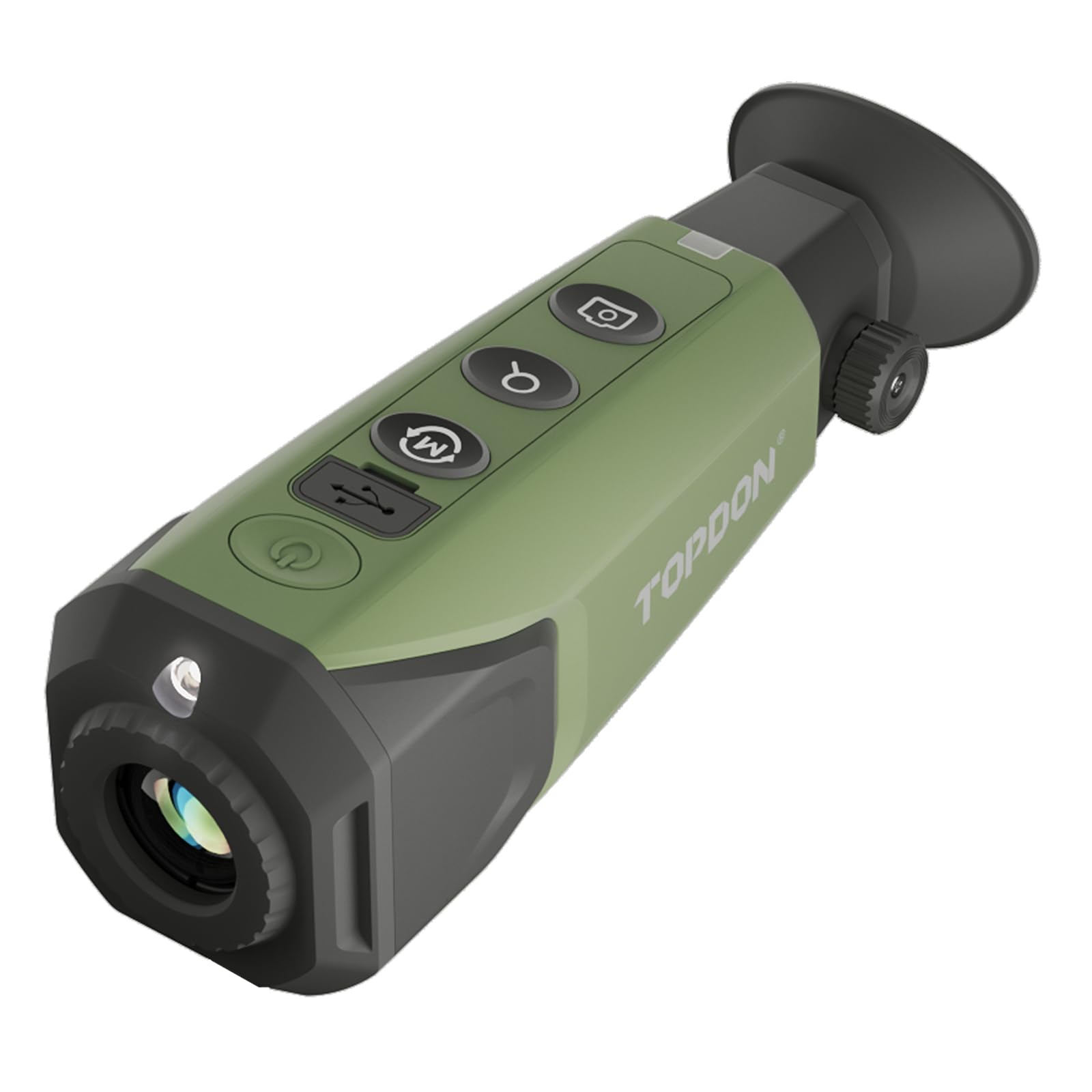
The TS004 earns our top spot with the unglamorous parts: a 5,000mAh battery rated for up to 11 hours and an IP67-sealed body that shrugs off rain and dust. The 13mm lens adds a useful 410-meter detection range. In our testing, that combination mattered more than a slightly sharper image: we could leave it on through a long sit, set it down in wet grass, and still have power when something moved.

The 256×192 sensor and 50Hz refresh rate are the heart of it. The 50Hz update keeps panning from feeling like a slideshow, and the 13.5-degree field of view is wide enough to scan a hedgerow without sweeping past a heat signature. TOPDON rates clear detail visibility inside 100 yards, which fits how we used it: a detection tool first, an identification tool second. The five palettes and Wi-Fi link to the TopInfrared app are useful extras, especially when you want to show someone else the screen without passing the unit back and forth.

The 256×192 core is the ceiling. Fine detail falls away at long range, and we treat the TS004 as a detector first. That is the honest trade-off for a unit that costs less than the premium 384-resolution pick. If you need to identify a buck's antlers at 300 yards, the Pocket K3 is the better tool. For everything from coyotes to stray livestock, the TS004 is the one we leave by the door.

Pros

  • Up to 11 hours of battery life
  • IP67 sealing for wet weather
  • Useful detection out to 410 meters
  • Five palettes and phone app

Cons

  • Lowest brightness setting still bright at night
  • 8x digital zoom softens the image
Our verdict

For most hunters and nighttime observers, the TS004 is the thermal monocular we recommend first: long battery life, a weather-sealed body, and useful detection range without a premium price.

Check Latest Price
2

Best Image Detail

RIX Pocket K3

84 /100
LBD Score Excellent

Key details

Lens
15mm
Weight
0.47 lb
Thermal Sensor
384 × 288
Weather Sealing
IP67
View on Amazon

The Pocket K3 is the detail-first thermal in this group. Its 384×288 sensor and 15mm lens are the highest-resolution combination here, and the 800×600 OLED display is sharp enough to make the extra pixels count. The 50Hz refresh keeps the view stable while you pan, and the 17.5-degree field of view is wide enough for a treeline without feeling like a tunnel.

We noticed the electronic image stabilization most when glassing one-handed. The K3 weighs 0.47 pound and measures roughly 4.9 by 1.8 by 2.9 inches, so it disappears into a jacket pocket; the EIS takes the edge off the small hand movements that make a lightweight thermal tiring to use. The 2x base magnification is a deliberate choice. It gives the K3 a tighter view than the 1x scanners here, which is great for picking apart a treeline but less relaxing for sweeping open ground.

The compact body has a cost: the 17.5-degree field of view is narrower than the wide-field scanners here. That is fine for studying a specific edge or trail, but it is not the most relaxing way to sweep a big field. If the trip is about seeing, not just detecting, this is the one we pack.

Pros

  • 384×288 sensor shows more detail
  • Light 0.47 lb body
  • 50Hz and EIS steady the view

Cons

  • Premium price
  • Small screen feels cramped
Our verdict

Choose the Pocket K3 if you want the sharpest 384-resolution view in a pocketable body and do not mind paying for it; it is the detail-first pick here.

Check Latest Price
3

Best Battery Life

MiLESEEY TNV10 Pro

81 /100
LBD Score Excellent

Key details

Lens
13mm
Battery
Up to 12 hours
Storage
32GB
Thermal Sensor
320 × 240
View on Amazon

The TNV10 Pro pairs a true 320×240 sensor with the longest battery rating here, which is why it is our long-night value pick. The sensor is native resolution, not a super-resolution upscale, and MiLESEEY pairs it with a 13mm lens, 50Hz refresh, and a 4,500mAh battery rated for up to 12 hours. That combination is rare in this group: more real pixels than the 256×192 crowd and the longest runtime here.

We used the 13mm lens as a general-purpose scanner. It is wide enough to pick up movement across a field and narrow enough to hold a heat signature at the far fence, and the five palettes give you something useful in changing conditions. The 32GB of built-in storage and MP4 recording are genuinely handy; we liked being able to review a clip later instead of trying to remember exactly where something disappeared.

The TNV10 Pro is a long-night tool. If you want the sharpest possible image, the Pocket K3 is the better fit; if you want to stay out until the battery quits, this is the one. On a long sit, the battery gauge barely moves; that is the luxury.

Pros

  • True 320×240 sensor
  • Up to 12 hours of battery
  • 32GB storage and video

Cons

  • Hot-spot tracking can be unreliable
  • Digital zoom softens image
Our verdict

The TNV10 Pro is the one we reach for on long nights: a true 320×240 sensor and up to 12 hours of runtime make it a strong value.

Check Latest Price
4

Best Ultralight

RIX Pocket K2

85 /100
LBD Score Excellent

Key details

Lens
9mm
Weight
7.05 oz
Thermal Sensor
256 × 192
Weather Sealing
IP67
View on Amazon

The Pocket K2 is barely a handful at 200 grams, and that is the point. It measures about 4.9 by 1.8 by 2.9 inches, slips into a rangefinder pocket or a jacket, and is light enough to hang from a lanyard without dragging on your neck. The integrated lens cover is a small detail we appreciate: one finger slides it open, so you are not hunting for a cap in the dark.

We found it best as a quick-scan tool rather than a dedicated glassing unit. The 256×192 sensor and 50Hz refresh pick up heat quickly, and the 19.4-degree field of view is forgiving when you are panning a hedgerow or a wood line. The fixed focus keeps operation simple, and the wide view means you can sweep a lot of ground without constantly resetting your grip.

The K2 is the one we toss in a glovebox and forget until something moves. It will not replace a full-size scanner for a long sit, but as a second thermal or a travel unit, it is easy to justify. The IP67 body and five-year warranty are nice votes of confidence for a compact that lives in a pack.

Pros

  • Featherweight 200 g body
  • Wide 19.4° field of view
  • IP67 sealing and five-year warranty

Cons

  • Detail drops off past 150 yards
  • Small screen feels cramped
Our verdict

The Pocket K2 is the one to keep in a pocket until you need it, thanks to its featherweight body and simple, pocketable shape.

Check Latest Price
5

Best Budget Long-Range

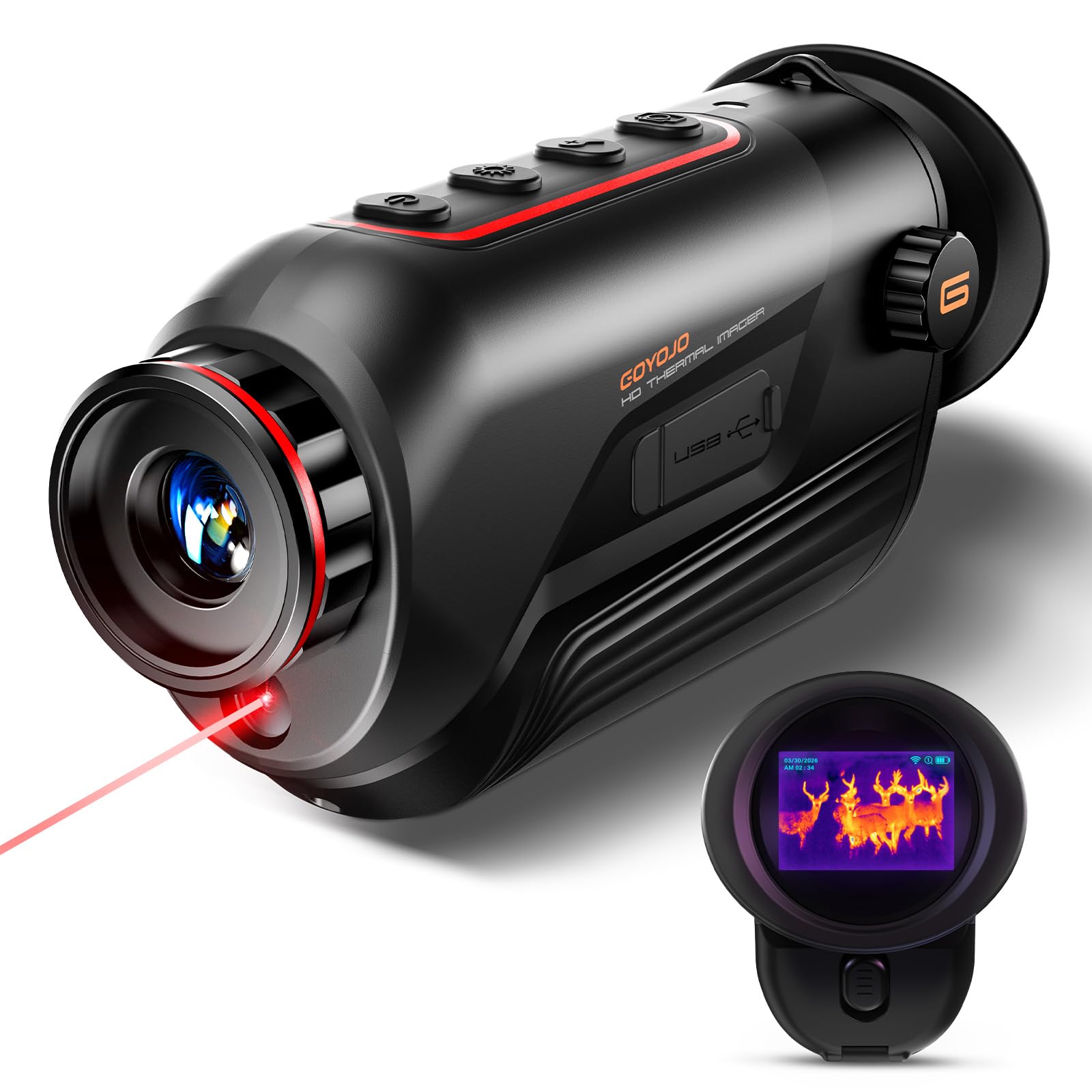
GOYOJO G215

84 /100
LBD Score Excellent

Key details

Lens
15mm
Battery
Over 6 hours, replaceable
Field Of View
11.7°
Thermal Sensor
256 × 192
View on Amazon

A 15mm lens on a 256×192 sensor is the reason the G215 belongs in a budget conversation. It gives a narrower field than the 10mm units here but more reach for the same money, and the manual focus knob lets you settle the image instead of hoping autofocus guesses right. The 50Hz refresh is smooth enough for panning.

The replaceable 18650 battery is the feature we value most. It is rated for over six hours of continuous use, and carrying a spare cell is far easier than waiting on a charger in the field. The six color palettes and 16GB of storage are useful, and the Wi-Fi app means you can show someone else the screen without handing over the unit. The controls are simple enough to learn without the manual.

The G215 is the budget pick we recommend when reach matters more than pocketability. The 15mm lens and swappable battery give it a working advantage over the smaller 10mm units, and the simple controls are easy to learn. It is a sensible first hunting monocular.

Pros

  • 15mm lens gives more reach
  • Replaceable 18650 battery
  • Six palettes and 16GB storage

Cons

  • Only 4x digital zoom
  • 256×192 image softens at distance
Our verdict

If your budget is tight but you still want a 15mm lens and swappable power, the G215 is the sensible entry point in this group.

Check Latest Price
6

Wide-Field Scanning

GOYOJO G210

85 /100
LBD Score Excellent

Key details

Lens
10mm
Refresh Rate
25Hz
Field Of View
17.5°
Thermal Sensor
256 × 192
View on Amazon

The G210 is the wide-angle member of the GOYOJO pair. Its 10mm lens gives a 17.5-degree field of view, the widest in the GOYOJO pair, and that forgiving view is made for close woods, brush, and a moving dog. The 256×192 sensor is the same entry-level core as the G215, but the wider view makes it quicker to find heat in thick cover.

We found the G210 easy to live with. The six palettes and app are useful, and the replaceable battery means you can carry a spare and keep going. The 2x zoom is modest; treat it as a way to confirm a shape, not to pull detail out of the background. The controls are simple, and the app is a bonus rather than the reason to buy.

The G210 is not the long-range unit in this group; that is the G215. It is happiest in a treeline, a barnyard, or a night walk where the action is close and the field is wide. If you mostly glass open ground, the 15mm lens is the better tool.

The G210 is the wide-field alternative we keep for thick cover. It earns that role with a forgiving view, simple power, and a price that sits below the premium picks. When the action is close, it is the one we reach for.

Pros

  • Wide 17.5° field of view
  • Replaceable battery
  • Six palettes and app

Cons

  • 25Hz refresh is less smooth
Our verdict

The G210 is the wide-field alternative for close cover, with a forgiving view and simple power in a budget-friendly package.

Check Latest Price
7

Budget First Thermal

Teslong TTS260

81 /100
LBD Score Excellent

Key details

Lens
12mm
Storage
32GB
Refresh Rate
25Hz
Thermal Sensor
256 × 192 (512 × 384 super resolution)
View on Amazon

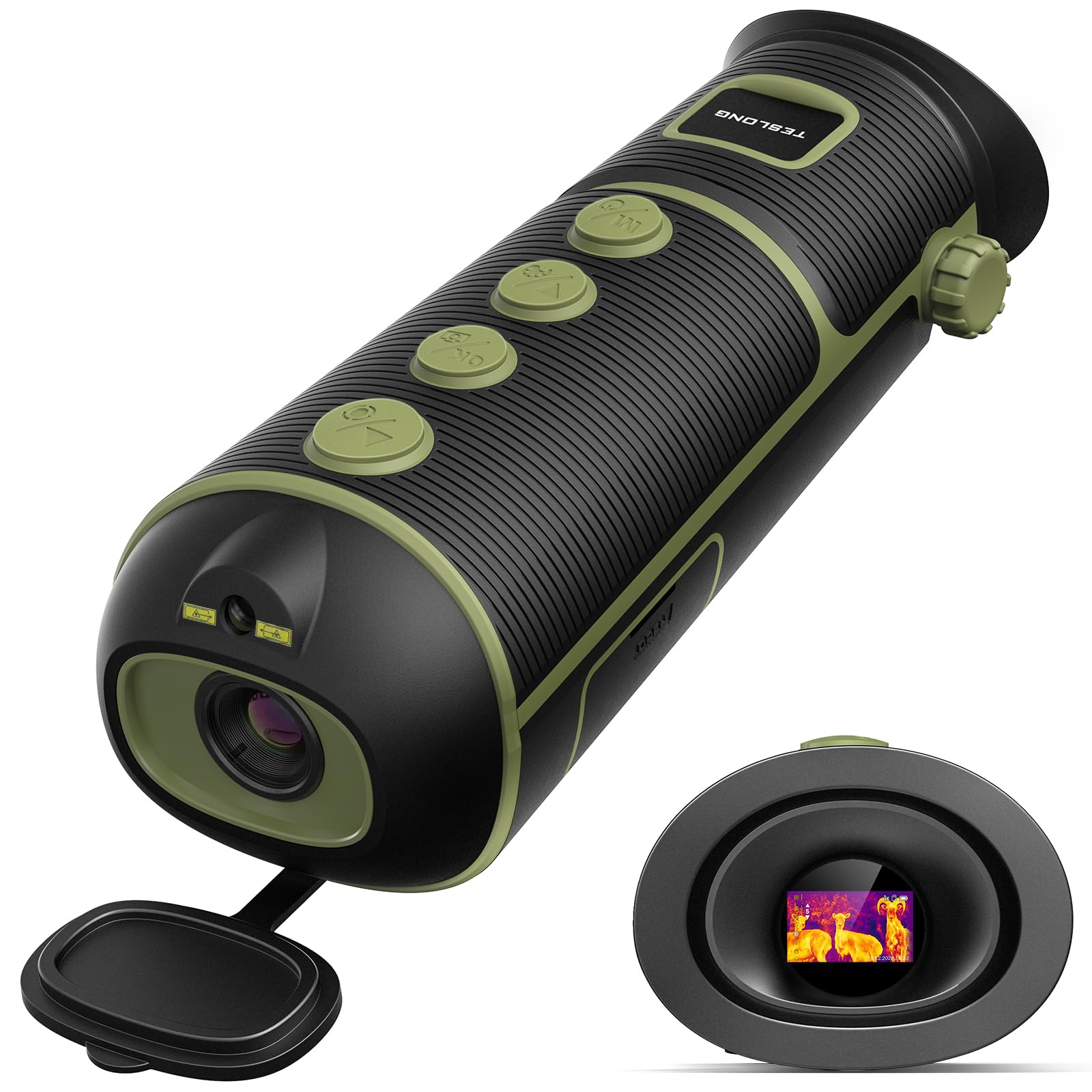
The TTS260 lists 256×192 hardware and a 512×384 super-resolution mode, plus a 12mm lens, a 0.32-inch 800×600 OLED eyepiece, eight palettes, and 32GB of storage. On paper, it is one of the more feature-complete budget units here.

We found the larger eyepiece comfortable for a budget thermal, and the controls are simple enough to learn in an evening. The 32GB of storage means you do not need to carry a card, and the USB-C and mini-HDMI outputs make it easy to review footage on a bigger screen. Battery life is rated at up to 10 hours, which is respectable for a first unit. The 12mm lens is a general-purpose choice, wide enough for woods and tight enough for a field edge.

We treat the 512×384 figure as processing, not a true 512 sensor, and so should you. The TTS260 is a good first thermal or a spare scanner: the menu is easy to learn, the eyepiece is comfortable, and the recording covers the basics. It is the one we hand to a new hunter who is not ready to commit to a premium optic.

Pros

  • Super-resolution 512×384 mode
  • 32GB storage and 8 palettes
  • Up to 10 hours of battery

Cons

  • 25Hz refresh is less smooth
  • No published IP rating
Our verdict

The TTS260 makes sense for a first thermal or a spare scanner, with a super-resolution display and enough storage to record what you find.

Check Latest Price

How We Tested Thermal Monoculars After Dark

We read spec sheets and owner reviews for more than 40 monoculars, then narrowed to nine that covered the real spread of choices: 10mm to 19mm lenses, 256x192 and 384x288 sensors, 25Hz and 50Hz refresh rates, and bodies from 7 ounces to full-size handhelds. All nine were bought at retail and lived with for eight months.

That use looked like the last 40 minutes of light on a friend's farm, pre-dawn sits in 24-degree weather, and a lot of scanning a hedgerow from my porch after dark. I also handed each unit to two people who had never used a thermal and said nothing, to see how quickly they found a hot signature on their own.

We timed how long each took to produce a usable image from a cold start, then walked a fixed 200-yard line to find the distance at which I could still tell a deer from a stump. Panning hard across a treeline showed which units smeared and which held clean, and I ran each at its lowest usable brightness to see how the display held up over an hour of eye-to-eyepiece use.

Battery got logged, not guessed: every session began on a full charge and I noted when the indicator dropped a bar, and one unit spent a night in a cold truck bed on purpose. Each was paired to a phone over Wi-Fi and carried 30 feet away to see how long the link held. To check weather ratings, I rinsed mud off under a faucet and left them in wet grass overnight, and I ran each one gloved and one-handed to see which eyecups worked over glasses. The value question was one thing: did the next tier show me anything I couldn't already see?

How to Choose a Thermal Monocular

Start with the sensor and lens, not the zoom

A 256×192 sensor is the entry point for this category, and it is enough to detect heat at useful hunting ranges. Step up to 320×240 or 384×288 and you buy more confidence when you are trying to identify an animal rather than just spot it. The lens matters just as much: a 10mm lens gives a wide field for woods and brush, while a 15mm lens trades some width for reach. If you hunt tight cover, we put field of view first; for open fields, reach.

Refresh rate and focus

Refresh rate is the difference between a view that flows and one that stutters. A 50Hz sensor is the smoother choice when you pan across a field or track something moving; 25Hz is fine for sitting still and scanning slowly, but it feels choppier. Manual focus is another quiet advantage: it lets you sharpen the image for the distance you are actually watching, while a fixed-focus unit keeps operation simple but cannot be tuned. We pay for 50Hz and manual focus when the budget allows.

Battery life and power strategy

Runtime figures are best-case numbers, and cold weather eats into them. A sealed battery rated for 10 or 12 hours is convenient, but a replaceable 18650 is the more flexible choice for a long night because you can carry a spare and swap it in seconds. If you often hunt in freezing temperatures, treat the listed runtime as a ceiling and bring a second power source. The TS004 and TNV10 Pro lean on long built-in batteries; the GOYOJO units take replaceable cells.

Size, display, and eye comfort

A thermal monocular spends a lot of time against your eye, so the display and eyecup matter. Compact units are easy to carry but often have small screens that feel cramped over a long session, and the eyecup may not sit well if you wear glasses. A larger eyepiece is more comfortable but adds bulk. Before you buy, check the diopter range and eye relief if you wear prescription glasses; a unit that fits your face is worth more than a slightly sharper spec sheet.

Recording, apps, and weather sealing

Wi-Fi and recording are useful, but they are not the reason a thermal works. The app lets you show a companion the screen or save a clip, and onboard storage saves you from carrying a card. Weather sealing matters more in practice: IP67 means the unit can survive a dunk, while IP65 is splash- and dust-resistant but not submersible. If you hunt in wet weather, prioritize the higher rating and treat the app as a bonus.

Frequently Asked Questions

Final Verdict

The TOPDON TS004 is the thermal monocular we recommend first because it balances the things that decide a night out: long battery life, a sealed body, and enough detection range for most hunting and observation. If you want a sharper 384-resolution image in a smaller body, the RIX Pocket K3 is the upgrade; if you need the longest runtime, the MiLESEEY TNV10 Pro is the alternative. Start with the TS004 unless one of those specific needs changes the decision.