Best Night Vision Goggles of 2026

Night vision goggles don't work the way movies taught us to expect. What we can actually buy is digital: an infrared illuminator throws a beam into the dark, a sensor reads what bounces back, and a small screen shows you the result. Two things decide nearly everything — how far that beam truly reaches and how good the screen is.

I've carried these into my backyard after dark, on camping trips, and down a wooded trail over the past six months, and my team has done the same with a dozen pairs. The gap between a satisfying one and a frustrating one shows up fast — in whether a treeline at 100 feet snaps into focus, whether the battery lasts an evening instead of an hour, and whether it's light enough to hold up for more than five minutes.

Before you scroll: the zoom here is digital, not optical, so magnifying a grainy image gets you a bigger grainy image. Getting 20 feet closer beats zooming almost every time. Here are the ones that earned a spot in the bag.

1

Best Overall

VISIOGEAR Night Thunder X3

80 /100
LBD Score Excellent

Key details

Screen
3 inches, HD
Battery
5000mAh, 10 hrs with IR on
Recording
4K video, 40MP photos
IR Illuminator
3-level 850nm
View on Amazon

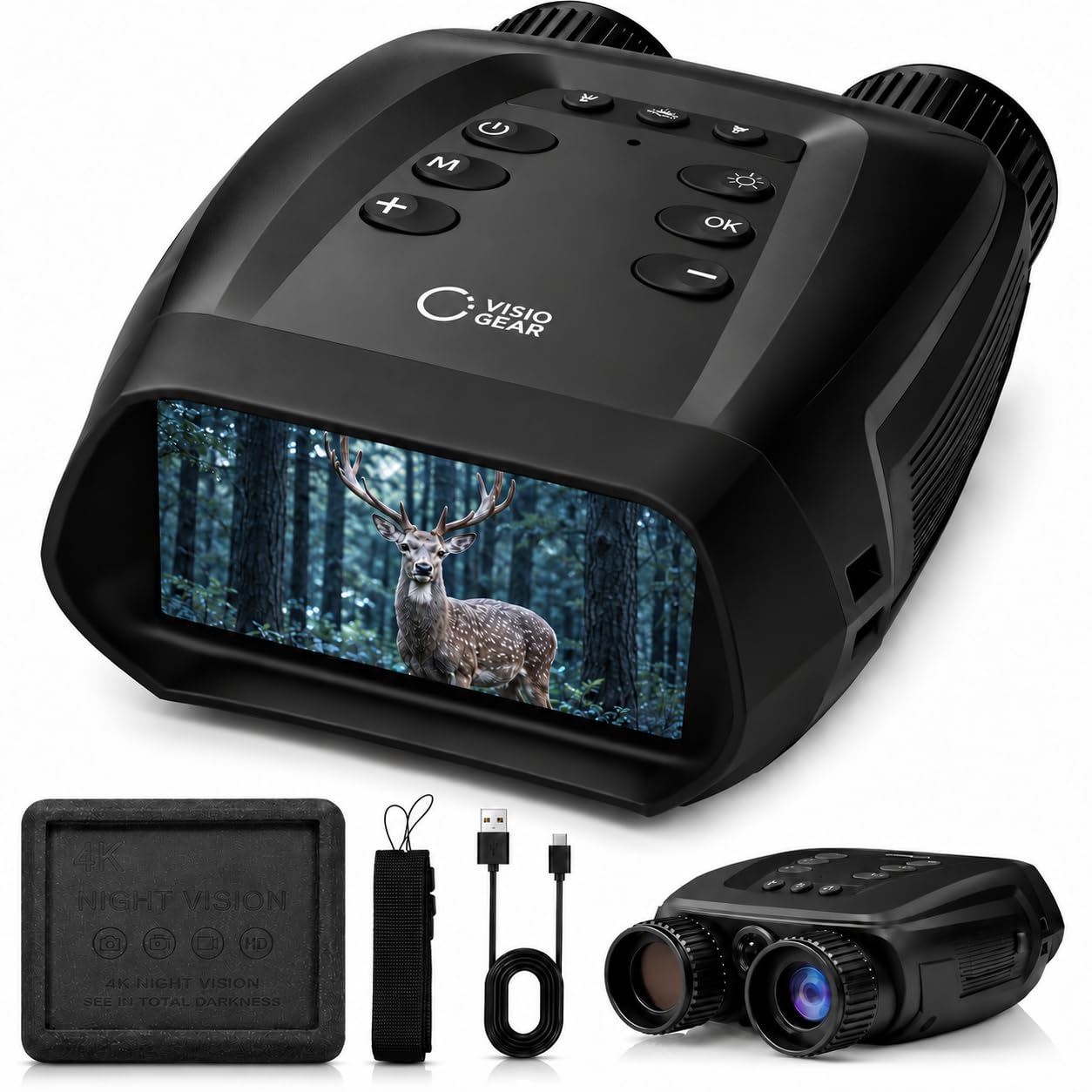
Something moving at the edge of the beam usually reads as a greenish shape you have to interpret. The Night Thunder X3's AI Color Boost takes the ambient light that is already there, whether that is moonlight, a porch light, or the last of the sunset, and renders the shape in color instead. That is the difference between seeing something and knowing what it is, and it is the feature we kept coming back to.

The details around the color mode are what make it usable rather than a demo. The buttons are backlit, so the IR level and the record key are findable by feel with the eyepiece against your face; we stopped taking a hand off the body to hunt for controls, which sounds small until you have done it in the dark. Three IR levels cover close work and open ground, the focus wheel trims up quickly, and the 3-inch screen is bright enough to read without covering your other eye.

Runtime is quoted at 18 hours with the IR off and 10 with it on, and that gap is the honest part of the spec: the illuminator is what eats the battery, so plan on the second number. The body is water resistant, tripod-mountable, and covered for three years. One thing to add at checkout: the kit ships with a strap, a case, and a cable but no memory card, so without one you will be watching and not recording.

Where it gives ground is reach. Eight times is digital, so the top of the zoom range trades sharpness for size, and the sweet spot sat around the middle with the focus trimmed. That is a fair trade for a device that does the identification work the others mostly leave to your imagination. If a second person needs to watch, the VOOPEAK is the alternative; if your hands need to be busy, the ArzzuNiu.

Pros

  • Color image makes identification easier at night
  • Backlit controls you can find in the dark
  • 10 hours of runtime with the IR on
  • Water resistant with a 3-year warranty

Cons

  • No memory card in the box
  • 8X digital zoom only
Our verdict

For most people watching wildlife or a property after dark, this is the one we recommend: color identification, backlit controls, and a battery that lasts the night.
Check Latest Price
2

Best for Sharing Live View

VOOPEAK NV01 WiFi

85 /100
LBD Score Excellent

Key details

Zoom
12X digital
Battery
5000mAh, 9 hrs with IR on
IR Range
Up to 1,500 ft
Connectivity
WiFi app live view
View on Amazon

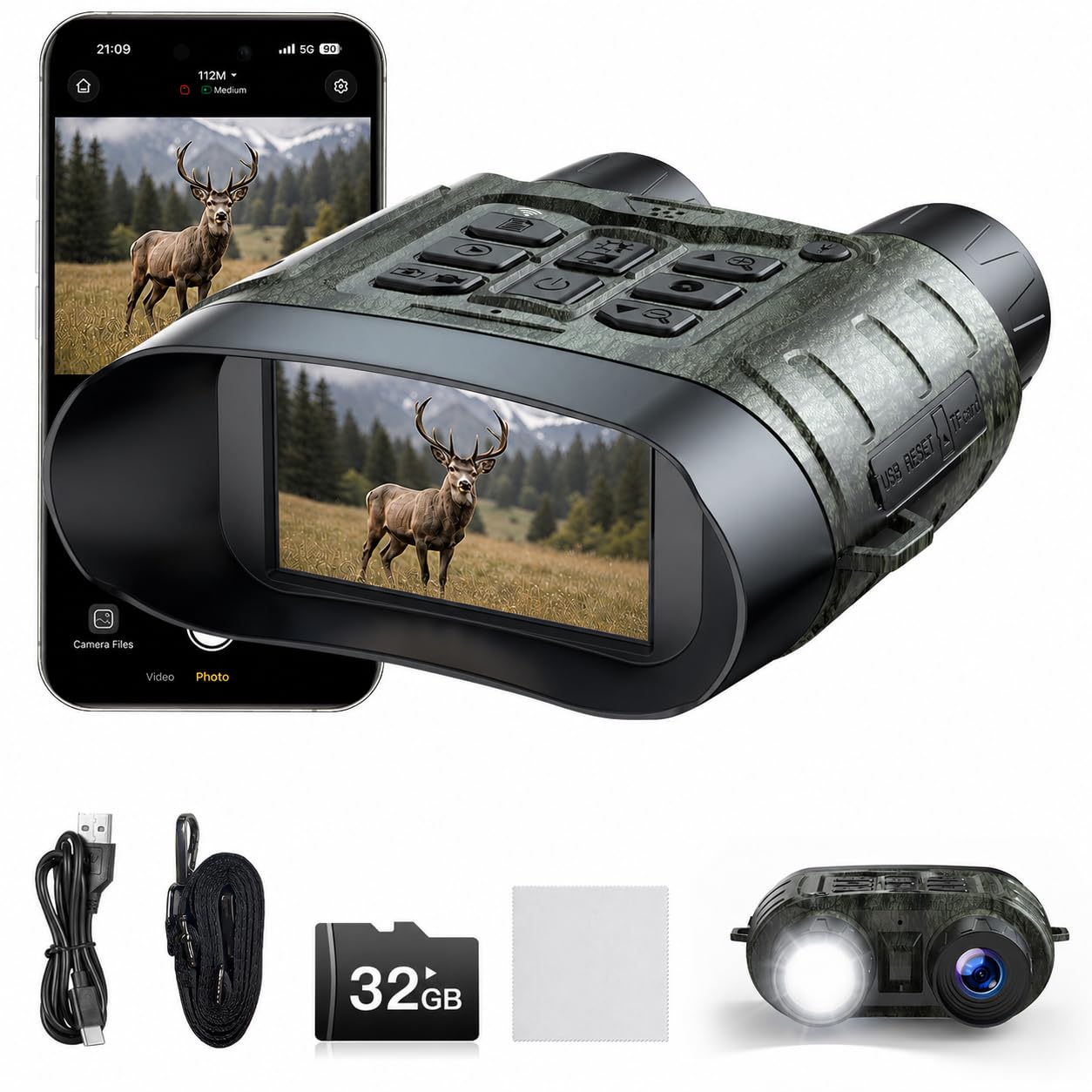
Binocular-style night vision has an audience problem: one eyepiece, one viewer. The NV01 puts the same image on a phone over WiFi, so a second person can watch from the porch while you sweep the field, and the app is also how files come off without hunting for a cable. We used the phone view more than the eyepiece any time someone else was along.

The rest of the package is built around that idea. There is a 3-inch screen, 12X digital zoom, and infrared rated to 1,500 feet with 10 levels of adjustment, plus a 5,000mAh battery quoted at 15 hours with the IR off and 9 with it on. Motion detection starts a recording when something changes in frame. At 450 grams it is light for a full-size body, which matters when you are holding it up for an hour.

We are not surprised that the highest buyer rating in this group belongs to the one that solves the sharing problem. What it does not solve is weather, because there is no water-resistance rating here, so a damp night or a tumble into wet grass is a genuine risk. For two people watching the same animal, though, nothing else on this page does the job.

Pros

  • WiFi live view on a phone
  • 12X zoom and a 1,500-foot IR rating
  • 9 hours with the IR on from 5000mAh
  • Light at 450 grams for a full-size body

Cons

  • No water-resistance rating
Our verdict

Buy this one when two people need to see the same thing: it puts the live image on a phone and stays light in the hand.

Check Latest Price
3

Best Big Screen

WISHBETY 4K Binoculars

86 /100
LBD Score Excellent

Key details

Zoom
16X digital
Screen
3.5 inches, HD
Battery
5000mAh
IR Range
1000 ft
View on Amazon

Sixteen times is the number on the box, and it is the one to be skeptical about: this is digital zoom, so the far end of the range enlarges pixels rather than gathering more light. What earns the WISHBETY its place is the screen. At 3.5 inches it is the largest in this group, which makes it the one two people can crowd around instead of one person squinting. Nine IR levels, a 1,000-foot rating, plus or minus 5 diopters of adjustment, and a tripod socket make it a stationary spotting tool more than a walking-around one.

It is also close to two pounds, so the tripod socket is not decoration. The catch is the field of view, which is tight: panning is slow, and anything that will not sit still is hard to hold. Rest it on a rail, dial the IR down at close range, and it rewards patience with detail the smaller units cannot match. Water resistance and a 32GB card in the box mean it is ready the day it arrives.

Pros

  • Largest screen here at 3.5 inches
  • Nine IR levels and a 1,000-foot rating
  • 5000mAh battery and 32GB card included
  • Water resistant with a tripod mount

Cons

  • 16X digital zoom enlarges rather than resolves
  • Tight field of view slows scanning
Our verdict

Pick this when you want the biggest view for a group: the 3.5-inch screen is the largest here, and you trade portability for it.

Check Latest Price
4

Best for Backyard Watching

Anyork Y4

85 /100
LBD Score Excellent

Key details

Zoom
5X digital
Screen
3 inches, TFT
Battery
4000mAh
Dimensions
5.9 x 4.7 x 2.24 in
View on Amazon

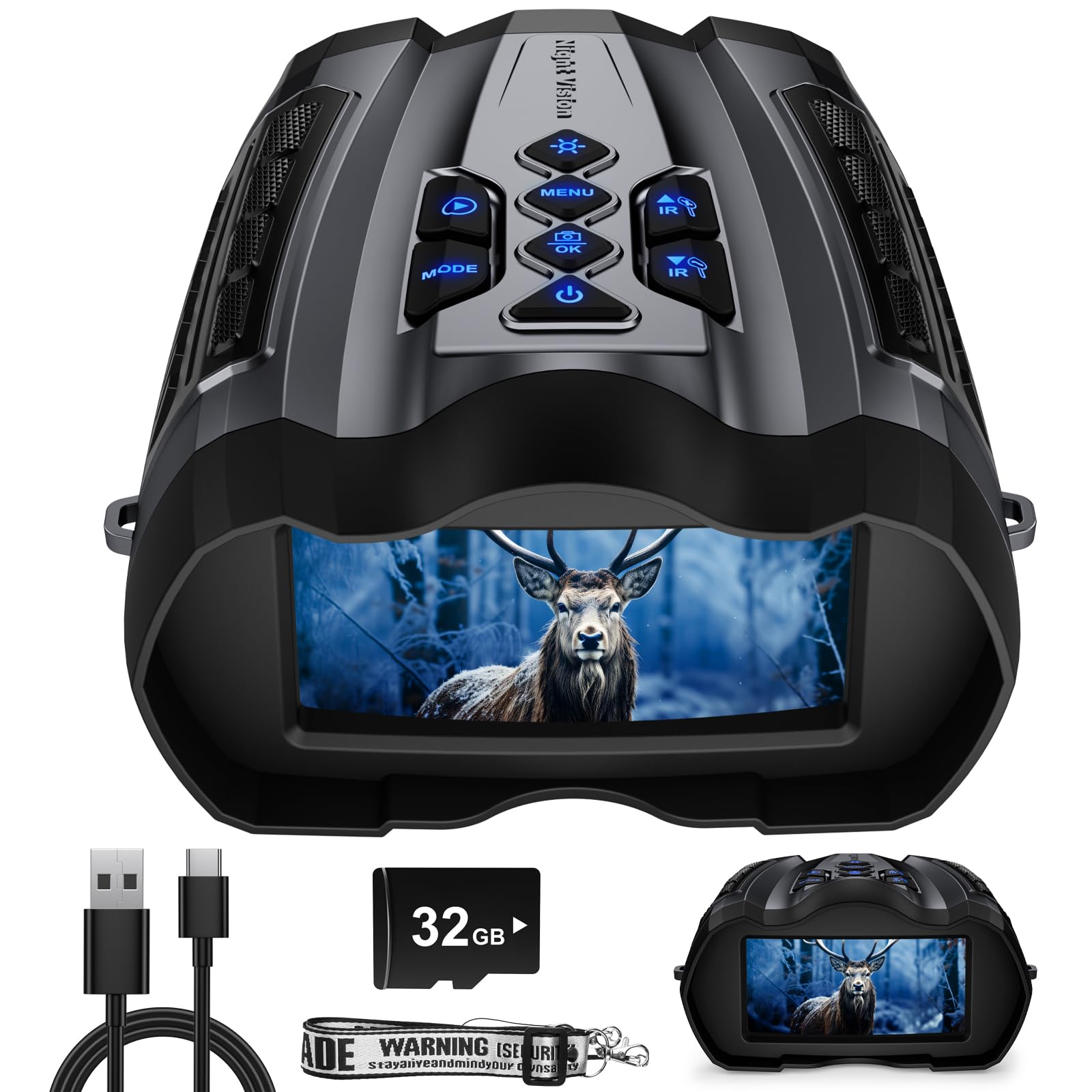
At 5.9 by 4.7 by 2.24 inches, this is the smallest full-featured body in the group, and the size changes how it gets used: it rides in a glove box or a jacket pocket instead of a case in the truck. It is also the least powerful on paper, with 5X digital zoom against the 8X and 16X units here.

What the smaller zoom buys is steadiness. Five times is easy to hold still, anti-shake smooths what is left, and motion detection starts a recording on its own when something crosses the frame, a feature we did not expect at this price and now use more than the zoom. The 3-inch display, 4,000mAh battery, 36MP stills, 4K video, and included 32GB card cover the basics. Focus takes a light touch; the wheel is quick, but fine adjustment is fussier than on the bigger units, and sharpness is good rather than exceptional.

For backyard watching, camping, and handing to someone who has never picked up night vision, this is the one we reach for, because nothing about it needs explaining first. It is not sealed against weather, and anything well past the yard is beyond its reach. That is the compact trade, and it is the right one when your dark is a backyard rather than a field.

Pros

  • Smallest body here at 5.9 by 4.7 by 2.24 inches
  • Anti-shake and motion detection at a low price
  • 4000mAh battery and 32GB card included

Cons

  • Only 5X zoom, the least reach here
  • No water resistance
Our verdict

The easiest one to hand to someone new: small, steady, and simple, as long as your dark is a backyard rather than an open field.

Check Latest Price
5

Best Hands-Free

ArzzuNiu Head-Mounted NVG

81 /100
LBD Score Excellent

Key details

Mount
Headband and helmet bracket
Screen
2.7 inches, LCD
Battery
3000mAh
IR Range
1312 ft
View on Amazon

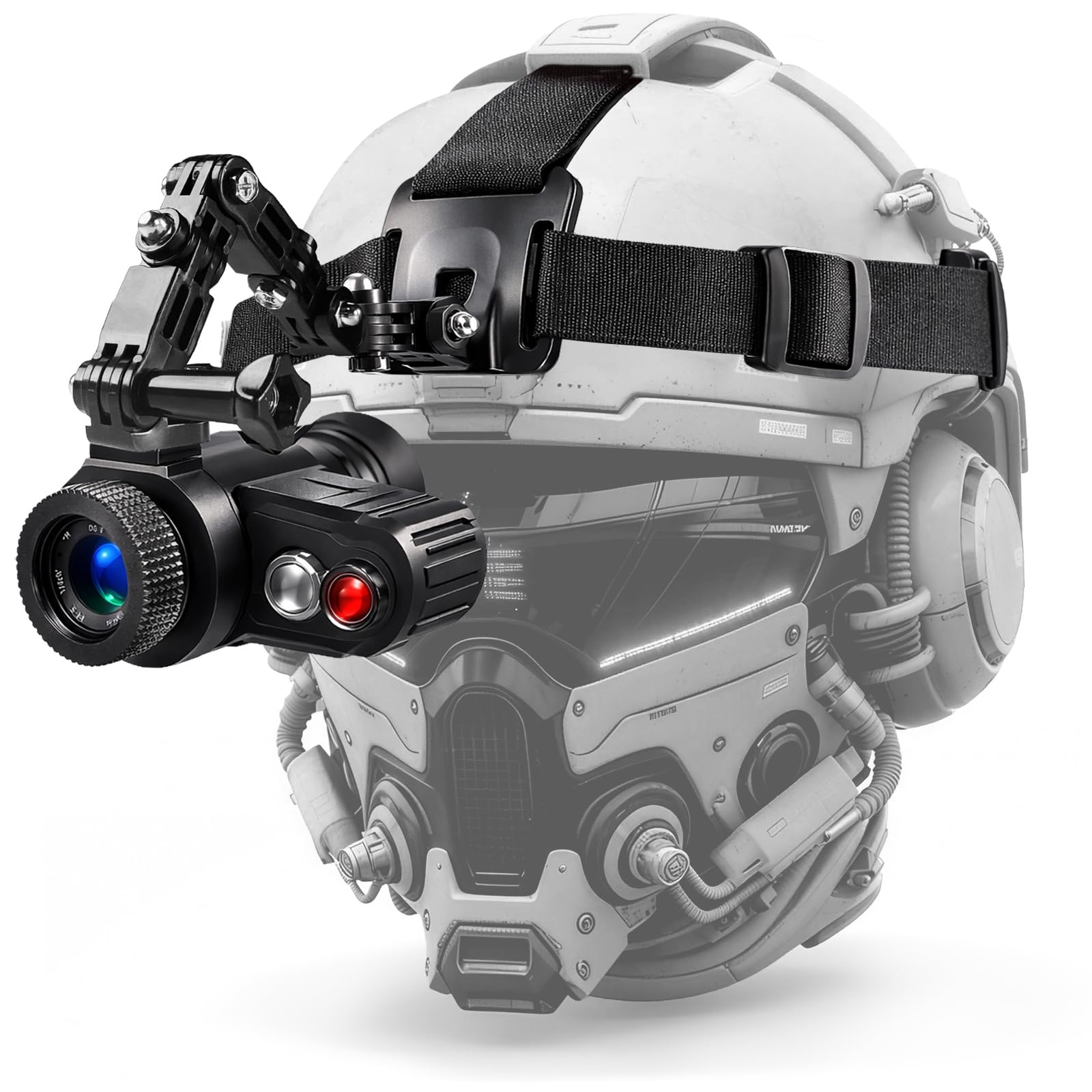
Hands-free is the reason to look at this one, and it is the part we valued most: an adjustable headband in the box, a bracket for a FAST-style helmet, and 300 grams on your head, which is light enough to forget between sessions. Strapped on, both hands stay free for a flashlight, a gate latch, or a rifle.

The view takes adjustment. The screen is 2.7 inches, the field is 8.5 degrees, and a window that narrow means scanning happens with your neck rather than your eyes, so you turn your head to sweep a treeline. Around that there is a 1,312-foot infrared rating, a 3,000mAh battery, 8X digital zoom, and a 32GB card included.

Over a longer session the pressure is what we noticed: the strap presses the unit against your forehead and cheek, and after a while you feel it. That is the cost of hands-free, and it is worth paying when the alternative is holding a binocular up one-handed. The helmet bracket is the part that separates it from a simple head-strap monocular, because it clamps to a standard shroud and sits where a real NVG sits.

Pros

  • Headband and helmet bracket in the box
  • 1,312-foot infrared rating
  • 300 grams, light enough to wear
  • 3000mAh battery and 32GB card included

Cons

  • Strap pressure builds over a long session
  • Narrow 8.5-degree field of view
Our verdict

The hands-free pick: strap it on, keep both hands free, and accept a narrow field of view in exchange.

Check Latest Price
6

Best Budget

NKBZEB VD25

92 /100
LBD Score Outstanding

Key details

Zoom
8X digital
Weight
7.84 oz
Battery
2500mAh
IR Illuminator
7-level 850nm
View on Amazon

The VD25 is the lightest thing here at 7.84 ounces and the least expensive. It is built around a 2,500mAh battery, a plastic body, and a 6-degree field of view, and it still carries the highest buyer rating on this page. The feature list is short and covers what matters: seven levels of 850nm infrared, 8X digital zoom, a focus gear that trims the image up quickly, and a 32GB card in the box.

Endurance is where the budget shows. Half the capacity of the mid-priced units means a long night wants a power bank in a pocket, and there is no water-resistance rating, so a wet evening is the wrong evening for it. Both are easy to work around: carry a battery and watch the forecast. What is left is a device that disappears into a jacket and comes out for ten minutes at a time, which is how most nights with one of these actually go.

Pros

  • Highest buyer rating in this group
  • Lightest at 7.84 ounces
  • Seven IR levels and a 32GB card

Cons

  • Narrow 6-degree field of view
Our verdict

The best first set for the money: light, simple, and rated higher than anything else here, provided you carry a power bank.

Check Latest Price
7

Color Night Video

AKASO Seemor-200

79 /100
LBD Score Very Good

Key details

Zoom
16X digital
Battery
Two rechargeable, up to 8 hrs
IR Range
3280 ft
Water Resistance
Waterproof
View on Amazon

Full color in near-darkness is the Seemor-200's pitch, and it is not just marketing language: the AI-ISP processing produces an image you can read color from, which is what you want when the question is whether the shape at the fence line is a coyote or the neighbor's dog. It is rated to 3,280 feet, the longest reach here, and its waterproof body is the sort of thing the budget units skip.

Two batteries and a dual charger are the practical luxury. You swap cells mid-night instead of plugging in, and the kit quotes up to eight hours of continuous use with a second cell and a charger sitting in the case.

At 1.19 kg it is the heaviest thing in this group by a wide margin, and sharpness is inconsistent. The focus is fussy, the clearest views came with the body braced rather than handheld, and 16X digital zoom spends most of its range on empty magnification.

So the premium buys color, reach, weather sealing, and a spare battery rather than a sharper picture across the board. Where that adds up is a fixed watching position, a porch, a truck bed, or a stand, with the unit braced and the color mode on. Carry it on a walk and the weight and the focus argue with you the whole way.

Pros

  • Full-color night image for identification
  • 3,280-foot reach, the longest here
  • Two batteries and a dual charger
  • Waterproof body

Cons

  • Heaviest here at 1.19 kg
  • Fussy focus and uneven sharpness
Our verdict

The premium choice when color and reach decide the purchase, and you plan to watch from one fixed spot rather than carry it.

Check Latest Price
8

Single-Eye Spotting

GOYOJO CYF-E+ Monocular

81 /100
LBD Score Excellent

Key details

Mount
Head strap included
Range
1148 ft
Screen
1.54 inches, HD
Magnification
7X fixed
View on Amazon

One eyepiece instead of two is the whole idea here, and it suits a specific job: spotting, not watching. You keep one eye on the screen and the other on the dark around you, which is easier on the face than pressing a binocular body against it for an hour.

Magnification is fixed at 7X with no zoom control at all. That sounds like a limitation, and it is one, since you frame a target by turning your head or walking toward it, but it also means there is nothing to fumble with in the dark, and the fully coated 20mm objective with a manual focus ring does the work.

Around that you get a 1.54-inch screen, a 1,148-foot range rating, a USB-rechargeable battery, and an adjustable head strap for hands-free use. The strap is the weak part of the design: it presses around the eye socket, takes fiddling to get the screen centered, and never feels as planted as a helmet bracket.

As the cheapest way into head-mounted night vision here, it earns its place for spotting from a porch or a blind where one eye is enough. If you need a wide view, or both eyes, this is not the shape for you.

Pros

  • Hands-free head strap included
  • 1,148-foot range and a 1.54-inch screen
  • Cheapest head-mounted option here

Cons

  • No zoom adjustment at all
  • Head strap presses and never settles
Our verdict

A cheap way into head-mounted night vision for one-eyed spotting from a porch or a blind, with no zoom to adjust.

Check Latest Price

How We Picked and Tested Night Vision Goggles

We started by rounding up every current model advertising true infrared capability, then narrowed the field by reading spec sheets and customer reviews for the things that actually shape a night out: sensor resolution, IR range in feet, battery capacity, whether images save to a card or a phone app, and whether a unit can be worn on a head strap as well as held. We bought 12 and spent six months with them.

Testing happened where people use these — my back deck after sunset, an unlit wooded trail, two camping weekends, a driveway at 2 a.m., and a walk through a dark stairwell. We set a trail marker and a parked car at 50, 100, and 200 feet and looked at each through every unit, noting the distance where the IR beam stopped reaching and the picture dissolved into grain. We timed how long each took to go from picked-up to usable image — power on, screen up, focus dial turned — and compared screens at their dimmest and brightest settings in full dark to see which stayed readable without washing out.

Battery life got its own run: full charge, IR on high, until the screen dimmed, then repeated on a cold night to see what the chill did. For focusing and ease of use, we focused on a fence post at 30 feet, then handed the unit to someone who'd never held it and had them do it cold, counting the seconds. We counted the zoom steps before an image broke into blocks, strapped on every head-mounted option and walked 200 yards to watch for bounce and strap slip, and noted how the handheld units felt after ten minutes of holding. Throughout, we kept asking what each one gave back for what it cost.

How to Choose Night Vision Goggles

Digital Night Vision Is Not Military Night Vision

Nothing on this list uses an image-intensifier tube. Each set pairs a small sensor with an 850nm infrared illuminator and shows the result on a built-in screen, so what you see is mostly what the illuminator lights up plus whatever ambient light is around.

Two consequences matter at checkout. The 4K figures describe the recorded file, not the live view, and the range ratings assume a reflective target in good conditions. Practical identification happens at a fraction of the number on the box, which is fine for a yard or a treeline and not what you want for anything that requires certainty.

IR Power and Levels: More Is Not Automatically Better

A strong illuminator at ten yards turns the image into a white smear, and it announces your position to anything with eyes. That is why adjustable levels decide more than raw power does. Three levels cover close work, mid-range, and open ground; the units here run from three to ten.

Start low and raise the level only until the image reads. The brightest setting is for open fields, not a fenced backyard, and leaving it there is how a close subject becomes unidentifiable.

Zoom and Field of View Pull Against Each Other

Digital zoom crops the sensor, so every step up in magnification is a step narrower and softer. That is why the 5X set here is the easiest to actually use around a house and the 16X one wants a rest underneath it.

Match the number to the job: 5X for a fence line, 8X for a field, and anything past 10X treated as a tripod feature. For head-mounted use a narrow field is worse than useless, because you cannot walk while you are looking through it.

Handheld, Head Strap, or Helmet Bracket

A handheld body can be braced on a rail and put down when your arms tire. A head strap frees both hands but hands you a narrow view and, after an hour, pressure on your forehead. A helmet bracket is the most stable of the three, though it only fits a helmet with a standard shroud, so confirm the mount before you buy the goggles.

If you want one device for both jobs, choose a set that ships with a strap and a bracket rather than planning to buy the mount separately.

Battery, Storage, and What Is in the Box

Runtime figures usually assume the illuminator is off, and the illuminator is what drains the cell — one 5,000mAh unit here is rated at 18 hours with the IR off and 10 with it on. Budget for the lower number and the day gets a lot more predictable.

Then read the contents list. A 32GB card comes with several of these and not with others, and a spare battery or a power bank turns a short evening into a long one.

Frequently Asked Questions

Final Verdict

Buy the VISIOGEAR Night Thunder X3. Color identification, backlit controls, and ten hours with the illuminator running cover the way most people actually use one of these, and the 8X digital zoom is the only real compromise.

If two of you want to watch at once, the VOOPEAK NV01 puts the live image on a phone. If your hands need to stay free, the ArzzuNiu goes on your head instead.