Best Juicers of 2026

Every juicer makes juice. What separates them is the ten minutes afterward: pulp stuck in the mesh, parts that don't fit in the dishwasher, a counter you wipe down twice. I've owned a centrifugal machine that sounded like a leaf blower and a slow press that took its time but left almost nothing behind, and the difference in the glass surprised me more than the noise.

Over the past eight months my team and I ran 12 juicers through a standing rotation — celery and ginger on weekday mornings, beets and apples midweek, nut milk and sorbet on weekends — and the pattern held. Machines with a wide chute got used; the ones that jammed on kale stems went back in the cabinet.

First-time buyers tend to overrate motor wattage. A slower auger often pulls more juice from the same pound of carrots than a fast-spinning basket, and it's gentler on soft fruit and leafy greens. The picks below were chosen for what they do to your morning and your cleanup, not for the spec sheet.

1

Best Overall

Nama J2 Cold Press Juicer

91 /100
LBD Score Outstanding

Key details

Motor
200 watts
Hopper
Self-feeding, whole recipe
Auger Speed
50 RPM
Juice Container
30 fluid ounces
View on Amazon

Anyone who has owned a juicer knows where it goes wrong: twenty minutes of pushing carrot sticks down a narrow chute, and the machine is in a cupboard by February. The J2 goes at that problem directly. Its hopper takes a whole recipe at once — apples, greens, a lemon, the lot — and the auger feeds itself while you get on with something else. Of everything here, it is the machine that changes how juicing feels rather than just how fast it goes.

At 200 watts and 50 RPM it is not the most powerful juicer in this group, and that is deliberate. Slow crushing keeps heat and foam down and leaves the pulp dry enough to go straight into the compost. It is also among the quietest machines here, quiet enough that juicing before the rest of the house is up does not feel antisocial.

Cleanup is where slow juicers usually lose people, and the quick-release parts come off in seconds without tools. The pulp chute opens right up, so you are not digging fiber out of a corner with a brush, and the strainer rinses clear under the tap.

What it asks in return is the biggest outlay here, and the 30-ounce juice container is worth a thought if you juice for two: a family batch means pouring partway through. For a household that will run it four or five mornings a week, that is a fair trade for a machine that makes the habit stick.

Pros

  • Self-feeding hopper takes a whole recipe
  • Quiet enough for an early-morning kitchen
  • Pulp comes out dry, greens included
  • Quick-release parts rinse in seconds

Cons

  • Lid must be unlocked in a set order
  • Parts are hand wash only
Our verdict

We recommend it for daily juicing: a hopper that takes a whole recipe, quiet running, and quick-release parts that rinse clean.

Check Latest Price
2

Best Value

Ninja NeverClog JC151

89 /100
LBD Score Excellent

Key details

Motor
150 watts
Juice Jug
24 fluid ounces
Pulp Control
2 interchangeable filters
Pulp Container
36 fluid ounces
View on Amazon

Where the J2 asks for a big budget and a permanent counter spot, the Ninja asks for neither. It stands about 16 inches tall and 7 inches wide, so it slides under a cabinet, and the 150-watt auger turns slowly enough to keep heat and foam down. For a first cold press, that is the shape of the deal.

We think it is the best value in this set. The two interchangeable pulp filters are the detail we appreciate most: fit the fine one for clear apple juice, the coarse one when the juice is headed for a smoothie. It is a small thing, and it lets one machine cover two habits.

The 24-ounce jug sits over a 36-ounce pulp bucket, so a long session does not turn into an emptying contest, and the parts are dishwasher-safe. Dense apples can make it squeal; feeding them in more slowly keeps it civil.

Pros

  • Two pulp filters for thin or thick juice
  • Dishwasher-safe parts and a big pulp bucket
  • Slides under a cabinet at 7.9 pounds

Cons

  • Feed opening needs apples cut down
  • Can squeal on dense fruit
Our verdict

The cold press we point most people to: compact, dishwasher-safe, and you decide how much pulp reaches the glass.

Check Latest Price
3

Best Centrifugal

Breville Juice Fountain Plus

91 /100
LBD Score Outstanding

Key details

Chute
3 inches
Motor
850 watts
Speeds
2
Jug Capacity
1 liter
View on Amazon

It is loud. The JE98XL announces every apple you drop into it, and there is no way around that. We still think it is the juicer to buy if speed is what you are after: an 850-watt motor spins a titanium-reinforced disc behind a 3-inch chute, and whole fruit disappears about as fast as you can feed it.

Two speeds give you a gentler pass for soft fruit and full power for carrots and beets, and the 1-liter jug has a froth separator built into the spout, so what lands in the glass is juice rather than foam. The parts are dishwasher-safe, which counts for more on a machine that spins this fast.

It is a 10-pound machine with a big footprint, and it is happiest on a counter where it stays put. Two things earn it that space: the chute swallows whole apples, and the pulp container is large enough that you empty it once at the end rather than three times mid-session.

Pros

  • 3-inch chute takes whole apples
  • Froth separator pours cleaner juice
  • Parts are dishwasher-safe

Cons

  • Soft fruit leaves wet pulp
  • Leafy greens yield less than roots
Our verdict

It is the centrifugal juicer we reach for when speed matters more than the racket.

Check Latest Price
4

Best for Small Counters

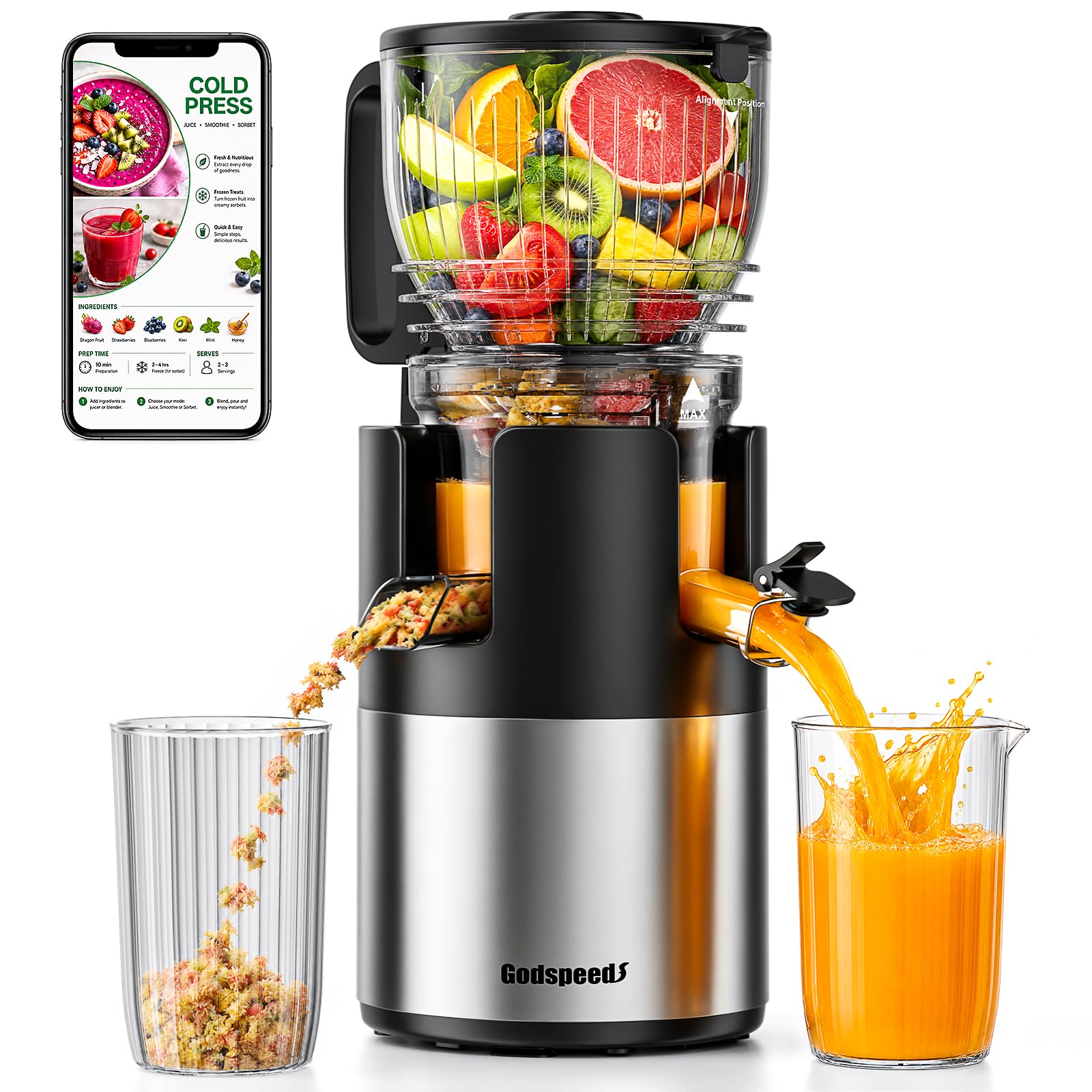
Godspeeds Smoothpress

88 /100
LBD Score Excellent

Key details

Motor
300 watts
Warranty
10 years
Footprint
6"D x 6"W x 16"H
Auger Speed
58 RPM
View on Amazon

Six inches by six inches is the whole footprint. The Smoothpress is a tower rather than a box — 16 inches tall, 7.9 pounds — so it takes less counter than a toaster and moves to a cupboard one-handed when the kitchen needs to be a kitchen again.

A 6-inch chute swallows whole apples and oranges, so prep is a rinse rather than a chopping session, and the 300-watt motor turns at 58 RPM, slow enough to keep the pulp dry and the noise down. The parts snap apart without tools and the toothed filter rinses straight under the tap.

Ten years is a long warranty by the standards of this group, and it is the number we keep coming back to on a machine this small. What we appreciate most is how little ceremony it makes of a glass of juice: rinse the fruit, drop it in, and the job is done before the kettle boils.

Pros

  • 10-year warranty
  • Fits a 6-inch square of counter
  • Quiet 58 RPM cold press

Cons

  • Juice cup holds only 473 ml
Our verdict

For a counter with no room to spare, we like this one best: six inches square, quiet, and backed by a ten-year warranty.

Check Latest Price
5

Best for Big Batches

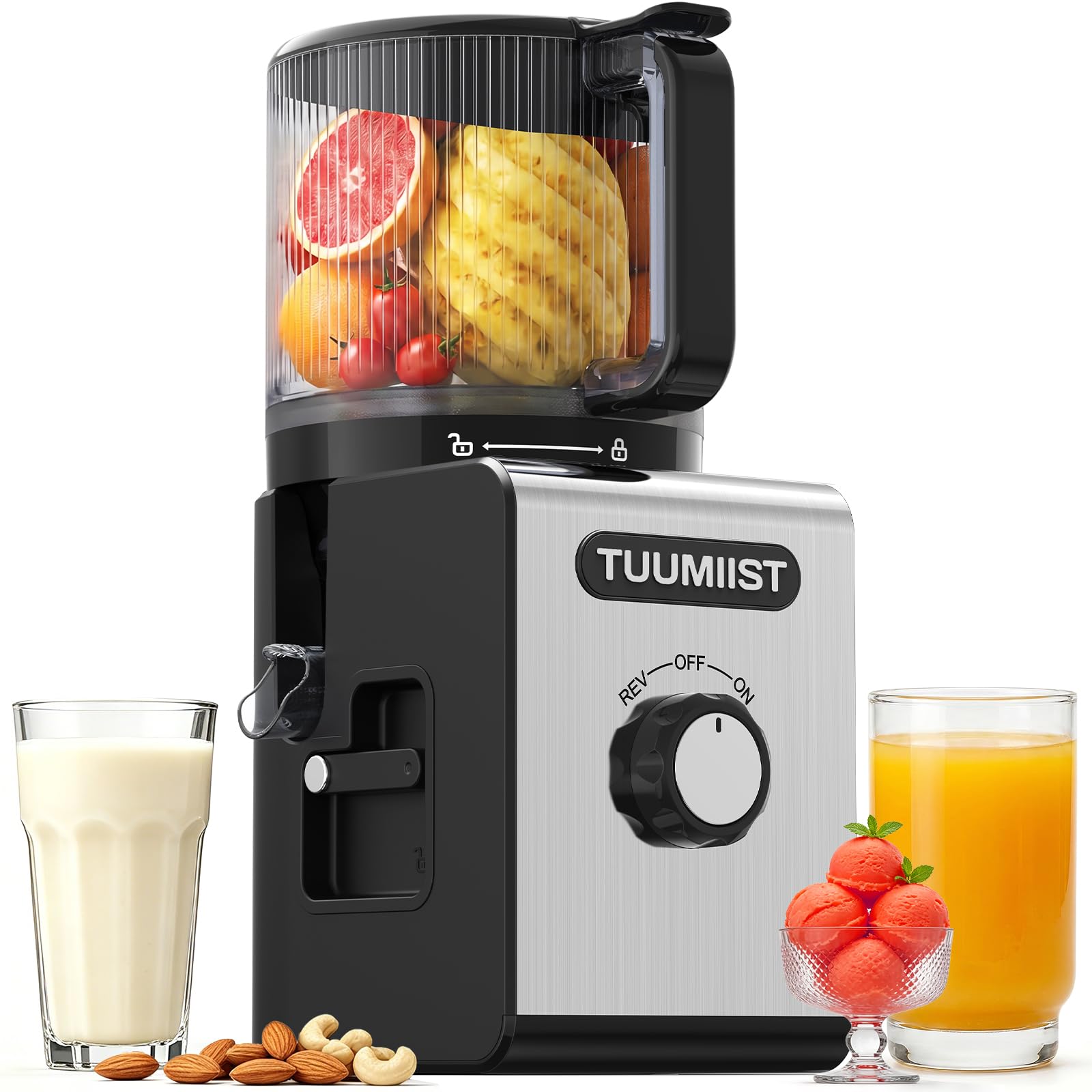
TUUMIIST TM-780SJ

89 /100
LBD Score Excellent

Key details

Chute
6.5 inches
Motor
350 watts
Hopper
3 liters
Auger Speed
60 RPM
View on Amazon

A three-liter hopper changes the rhythm of juicing. Instead of prepping as you go, you load the whole batch — apples, carrots, a knob of ginger — close the lid, and let the auger work through it while you get the rest of breakfast moving.

At 350 watts and 60 RPM it is quiet, and the single strainer is the design choice we appreciate most: the same part handles juice, nut milk and sorbet, so there is no basket to swap mid-recipe and no extra piece in the sink. For the money, that is a lot of the premium experience.

Seven pounds is light enough to lift off the counter one-handed, the parts are dishwasher-safe, and the 6.5-inch chute takes whole apples. It gives up the last word in fit and finish to the J2, but it costs a fraction as much and covers the same ground for a household that juices in batches rather than every morning.

Pros

  • One strainer for juice, nut milk, sorbet
  • 3-liter hopper loads a full batch
  • Quiet at 60 RPM, and light at 7 pounds

Cons

  • Plastic parts can chip under force
Our verdict

Our pick for batch juicing: a three-liter hopper, one strainer for juice, nut milk, and sorbet, and quiet running at 60 RPM.

Check Latest Price
6

Best First Cold Press

YPONE 2-in-1 Cold Press

87 /100
LBD Score Excellent

Key details

Chute
5.8 inches
Motor
400 watts
Capacity
500 ml, 700 ml
Auger Speed
55 RPM
View on Amazon

If you are buying your first cold press and the premium machines feel like a commitment, this is the one to look at. The YPONE runs at 55 RPM with a 400-watt motor and a 5.8-inch chute, and it costs noticeably less than the machines above it here.

Thirteen inches tall, it slides under a cabinet, and it is light enough to carry to the sink rather than hauling parts across the kitchen. Assembly is a matter of clicking a few pieces into place, and the dishwasher-safe parts come off the bottom rack ready to go.

What tips it for us is how little ceremony there is: a chute wide enough for a halved apple, a reverse function when something wedges, and a body short enough that it never needs its own cupboard. It is the least fussy machine here, and for someone easing into juicing, that is the whole point.

Pros

  • 5.8-inch chute takes halved apples
  • 13-inch height clears most cabinets
  • Dishwasher-safe parts break down fast

Cons

  • Cups hold only 500 and 700 ml
  • Some units fail early
Our verdict

We think it is the right first cold press: short enough for a cabinet gap, quiet for an apartment, and simple to break down.

Check Latest Price
7

Nut Milk, Sorbet

EanOruus 3-in-1 Cold Press

87 /100
LBD Score Excellent

Key details

Chute
6.5 inches
Motor
250 watts
Hopper
100 fluid ounces
Weight
12.1 lb
View on Amazon

Feed the E-18 a beet and it will struggle; load it with kale and you will be stopping to clear the chute. That is less a fault than a brief. This is a soft-produce press, and where it earns its place is mango, berries, citrus, and the frozen fruit you turn into sorbet.

Two strainers come in the box, one for juice and one for sorbet, and the same auger makes nut milk from soaked nuts. The 6.5-inch chute takes whole apples, and the 100-ounce hopper means you can load a batch and leave it to work.

The 250-watt brushless motor is quiet in a way that is easy to underestimate in an open kitchen, and the detachable pulp outlet comes off in one piece rather than three. At 12.1 pounds it is one of the heavier machines here, but there is a handle at the back that makes the lift a one-handed job.

Our read: buy it for the sorbet strainer and the big hopper, and treat green juice as a bonus rather than the point of the machine.

Pros

  • Sorbet strainer and nut milk capability
  • 100-ounce hopper loads a whole batch
  • Quiet 250-watt brushless motor

Cons

  • Plastic chute and parts can crack
  • Parts are hand wash only
Our verdict

What we like here is the sorbet strainer and the big hopper: buy it for nut milk and frozen fruit, and treat green juice as a bonus.

Check Latest Price
8

Whole Fruit

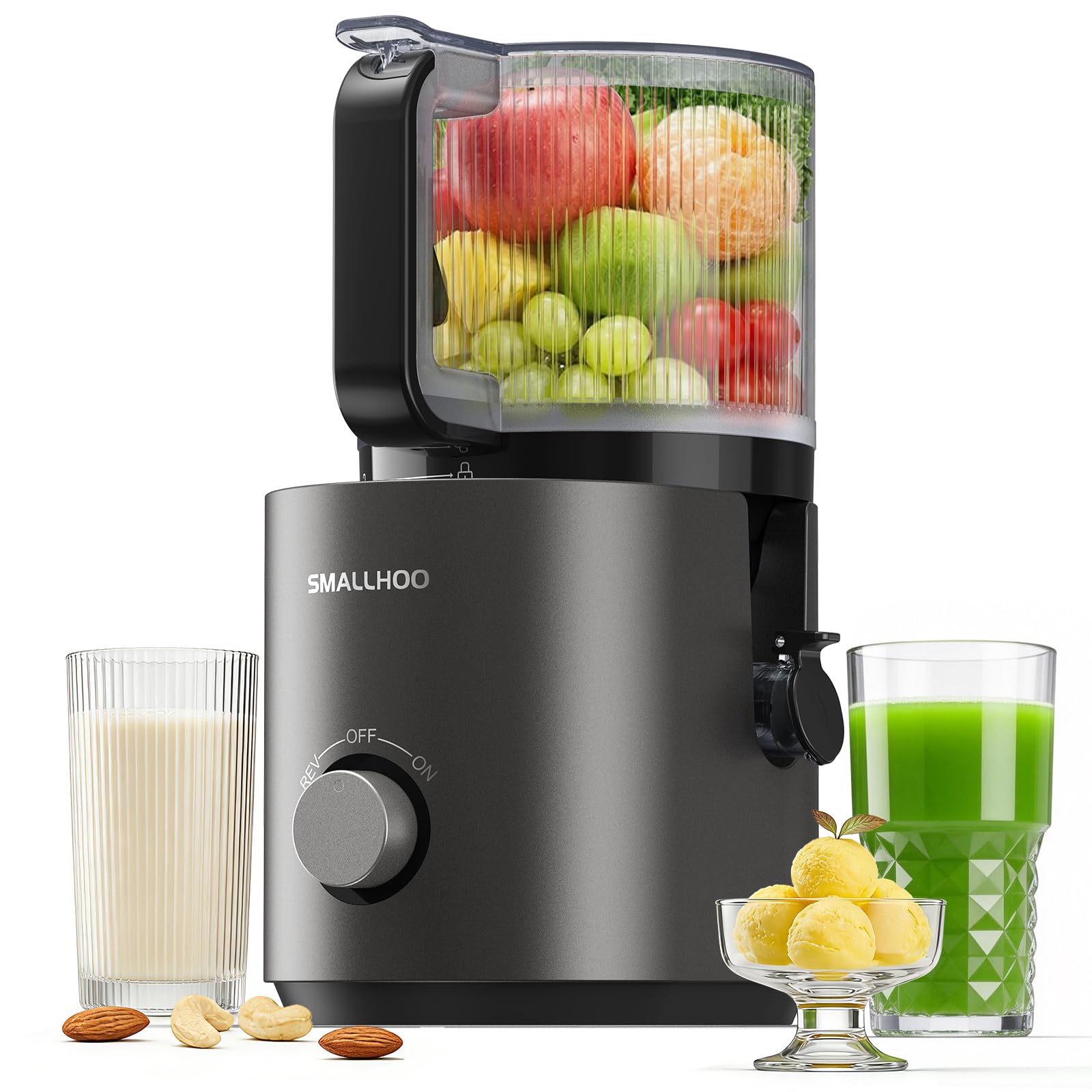
SMALLHOO 3-in-1 Cold Press

86 /100
LBD Score Excellent

Key details

Chute
7 inches
Motor
350 watts
Hopper
120 fluid ounces
Dimensions
13"D x 7.5"W x 17"H
View on Amazon

Seven inches is the widest feed opening in this guide, wide enough for a whole cored apple or a peeled orange, and it sits on the least expensive cold press here. That combination is the reason it is on the page.

The 120-ounce hopper holds a full batch, and at 350 watts and 60 RPM it does the slow-crush job quietly enough to run while someone else is on a call. The parts are dishwasher-safe, the reverse function clears a wedge, and the safety lock will not let the machine run with the lid off.

It is 13 inches deep and 17 inches tall, so it wants a little cabinet clearance, and assembly is tool-free in one obvious order. The safety lock is a small reassurance in a house with children: the auger will not turn until the lid is seated.

Against the TUUMIIST it gives up a little hopper space and gains the wider chute; if whole apples are the point, that is the trade to take. What we noticed most is how plain the body is — the budget clearly went into the auger and the chute rather than the housing.

Pros

  • Widest 7-inch chute here
  • 120-ounce hopper for big batches
  • Dishwasher-safe parts and a safety lock

Cons

  • Celery can jam the auger
  • Slow through a full hopper
Our verdict

Our pick for anyone who hates chopping: the widest chute in this set, on the least expensive cold press.

Check Latest Price

How We Chose and Tested the Best Juicers

We built a shortlist of more than 30 machines from retailer listings, customer review data, and the models readers ask about most, then filtered by the things that change daily use: chute width, auger versus centrifugal design, how many parts are dishwasher safe, and whether the footprint clears a cabinet. That left 12 juicers, which we ran for eight months.

Those 12 lived on our counters, not on a shelf. We juiced celery and ginger before work on weekday mornings, ran beets and apples for a crowd on weekends, and made nut milk and sorbet in the machines that claimed to do it. Whole produce went straight down the chute wherever the opening allowed it, and we timed prep whenever we had to cut fruit down to size.

Two things separated the field fast: how each machine handled fibrous greens, and what cleanup looked like. We weighed the pulp in the bin against the juice in the glass, then pushed that pulp through a second time to see what was left. We noted which ones jammed on celery strings and how quickly the reverse function cleared them. After every session we disassembled each juicer, counted the parts, and washed them by hand and in the dishwasher, watching for staining and for seals that loosened.

Over months, the quieter signals of durability showed up — motor smell under a heavy load, hairline cracks around the housing, mesh screens that clogged no matter how we scrubbed them. Value came down to how often we reached for a machine, not what it cost.

How to Choose a Juicer

Cold press or centrifugal

A centrifugal juicer shreds produce against a disc spinning at high speed. It is fast, it takes whole fruit through a wide chute, and it is the cheaper way into juicing — but it is loud, it whips air into the juice, and soft produce comes out wetter. A cold press crushes slowly with an auger at 50 to 60 RPM: quieter, drier pulp, better results from greens, and a bigger bill.

If green juice is a near-daily habit, the slow machine earns its money. If you want apple and carrot juice in volume on a Sunday morning, the Breville does that faster and more conveniently than anything else here, and the noise is the trade you make.

Chute, hopper, and how much chopping you will accept

Feed openings in this set run from about 3 inches to 7, and that difference is measured in knife work. A 3-inch chute takes an apple in wedges; a 6- or 7-inch opening takes it whole. Above the chute, a hopper lets you load an entire recipe at once instead of feeding pieces one by one, which is why the Nama and the TUUMIIST are built around one.

The trap is assuming a wide chute means no prep at all. Fibrous stalks, stringy celery and a knuckle of ginger still want trimming, and a crowded chute slows the auger rather than speeding it up.

Count the parts before you commit

Every juicer needs rinsing within minutes of use; what separates them is how many pieces end up in the sink and whether those pieces can go in the dishwasher. Smooth stainless drums rinse faster than mesh baskets, and a quick-release design that comes apart without tools gets used more often than one that needs the manual.

Read the care instructions rather than the badge on the box. Several machines here list dishwasher-safe accessories but hand-wash-only main parts, and a mesh strainer needs a brush whatever the label says. Budget for the brush and for two minutes at the sink.

Fit the machine to your counter, not the other way round

A juicer that lives in a cupboard does not get used, and height matters as much as footprint. Most upper cabinets sit about 18 inches above the counter, so a 16- or 17-inch tower clears them and a taller body with the lid on may not. Footprints here range from a 6-inch square to a 14-by-12 base, and weight from 7 pounds to 12.

If you plan to carry the machine to the sink, the lighter cold presses make that a one-handed job. Measure the gap between counter and cabinet before you order rather than after.

Noise, cups, and household size

Slow juicers run quietly enough to use before anyone else is awake; centrifugal machines are not, and that is the most common reason a juicer ends up retired. Cup size decides how many pours one session takes — a 24-ounce jug covers two glasses, while several machines here hold under 500 ml.

For two people drinking juice every morning, buy for the bigger juice container and the bigger pulp bucket so you are not stopping mid-batch. For one person, the compact machines with small cups are easier to live with.

Frequently Asked Questions

Final Verdict

Start with the Nama J2 if juicing is going to be part of your week. The self-feeding hopper removes the chore that ends most juicing habits, and nothing else here is as easy to live with day to day.

If that outlay is a step too far, the Ninja does the same slow crush in a smaller footprint with dishwasher-safe parts, and the Breville is the one to take if you want whole apples juiced fast and do not mind the racket. For a counter with no room to spare, the Godspeeds is six inches square and backed for a decade.