Best Wi-Fi Meat Thermometers of 2026

The worst part of a long cook isn't the waiting — it's lifting the lid, poking the brisket with an instant-read, and realizing you've been guessing for the last two hours. A leave-in thermometer fixes that: a probe stays in the meat, the number lives on a base or your phone, and you get to walk away. What separates a good one from a frustrating one isn't probe count — it's whether the signal survives a trip into the kitchen and whether the reading holds through a fourteen-hour cook.

I've cooked with a dozen of these over the past eight months, my team running the same briskets and roast chickens alongside me, and the differences show up fast. A base that keeps displaying temperature after your phone has wandered off is worth more than any app feature, and battery life is the quiet dealbreaker — a unit that dies at hour nine of an overnight cook is worse than no thermometer at all. Accuracy claims are easy to print; the picks below are the ones that kept earning them, cook after cook.

1

Best Overall

ThermoMaven WT02 Lite

90 /100
LBD Score Outstanding

Key details

Range
1,000 ft probe to base
Probes
2 wireless
Heat Limit
752°F
Stated Accuracy
±0.5°F, NIST-certified
View on Amazon

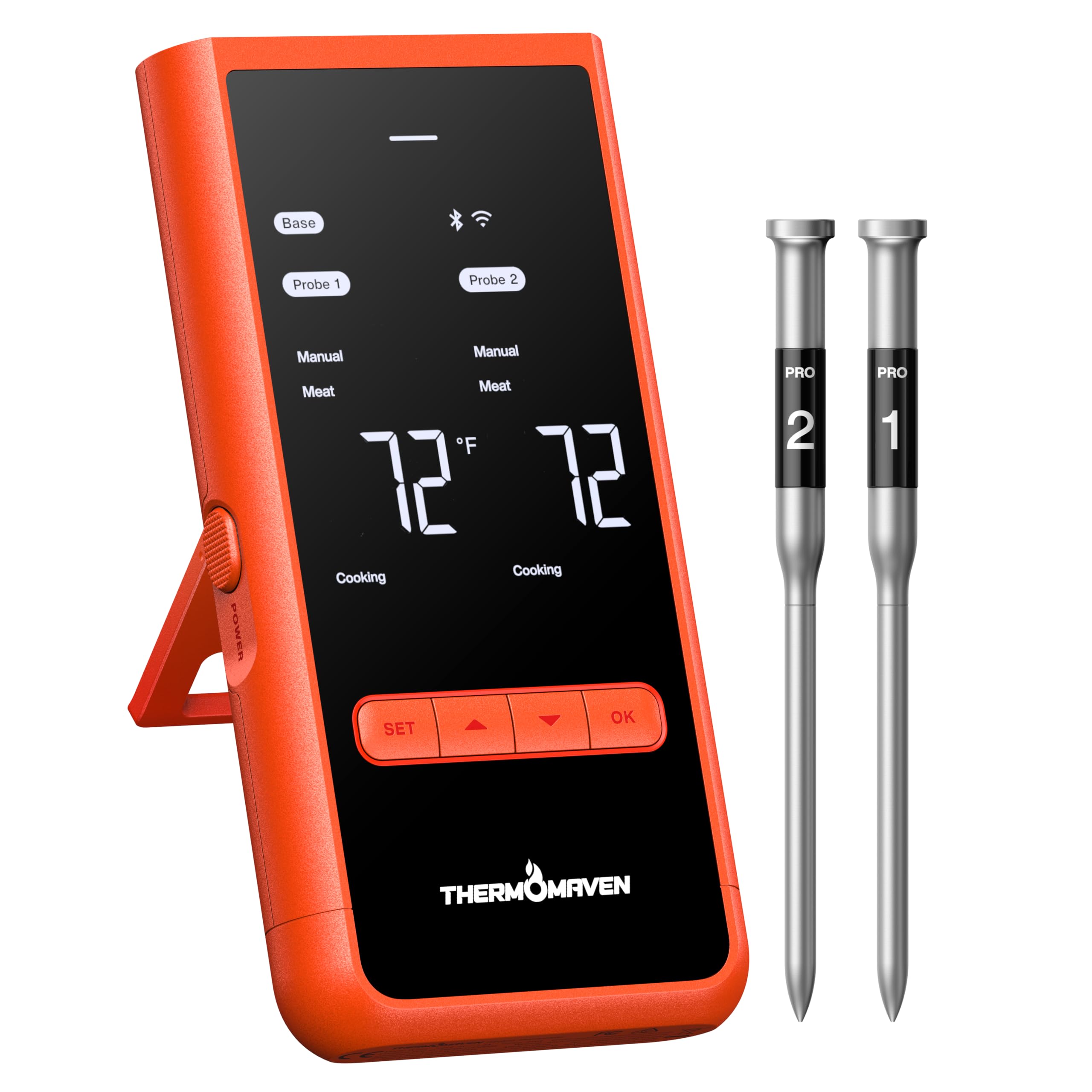
The base is why this one sits at the top of our list. Targets, live readings, and alarms all work on the unit itself, so nobody has to leave a phone awake on the counter to know when a pork loin reaches 145°F. Join it to a 2.4GHz network and those same alerts follow you to the mailbox, the neighbor's porch, or the hardware store, while the probes talk to the base from up to 1,000 feet away.

Two probes is the count most cooks actually use, and we appreciate that ThermoMaven did not pad it. Each probe carries six sensors and a stated ±0.5°F, NIST-certified — more precision than a chicken requires, but it shows up as a number that climbs steadily instead of twitching, which is what you notice six hours into a cook. The probes are slim enough to leave small punctures, rated to 752°F, and dishwasher-safe.

Runtime is the quiet advantage. The probes are rated for 30 hours per charge and the base recharges over USB-C, so an overnight brisket does not begin with a hunt for batteries. The display is legible from across a kitchen — big digits, one glance — and the phone stays a convenience rather than a requirement. A thermometer you have to unlock a screen to read is a thermometer you stop checking.

Plan where the base lives before your first cook. It needs a clear path to the probes and to your router, which usually means a windowsill or a shelf facing the yard rather than the counter beside the smoker. Move it once, watch that the readings hold, and the rest of the setup is a two-minute job.

Pros

  • Base sets targets and alarms without a phone
  • Wi-Fi bridge keeps alerts coming off the property
  • Dishwasher-safe probes rated to 752°F
  • 30-hour probe runtime per charge

Cons

  • Two probes cap you at two dishes
Our verdict

We send most cooks here: the base runs the whole cook without a phone, the probes go in the dishwasher, and Wi-Fi alerts follow you off the property.
Check Latest Price
2

Best for Multiple Dishes

Inkbird INT-14-BW

87 /100
LBD Score Excellent

Key details

Modes
Wi-Fi, Bluetooth, offline
Probes
4 wireless
Heat Limit
572°F
Probe Runtime
25 hours per charge
View on Amazon

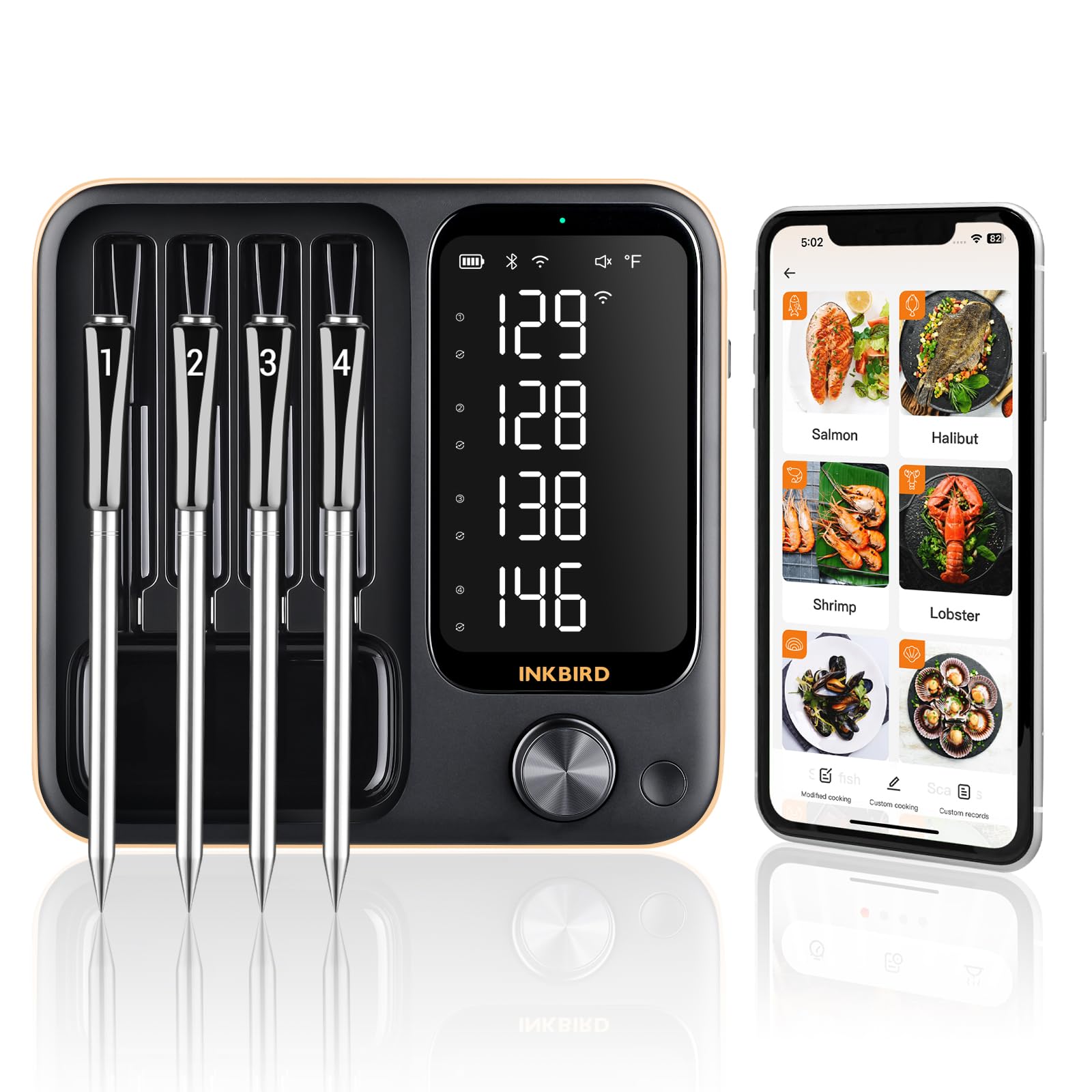
Four wireless probes for a little less than our top pick is the whole case for this Inkbird, and it holds up if your cooks involve more than two things. One probe rides in the brisket, a second keeps an eye on the air in the smoker, and two more are still free for a chicken and a tray of vegetables. That kind of coverage costs noticeably more on this page.

The base is real hardware rather than a charging dock: a 360-degree LCD you can read from any angle, 28 presets built on USDA targets, and buttons for setting each probe without opening the app. It runs on 2.4GHz Wi-Fi for alerts anywhere, on Bluetooth when the network is fussy, and with no phone at all when you just want the screen. Thirty minutes of readings are held even if the connection drops, which is the detail we came to appreciate most on a long cook.

Charging is the pleasant surprise. Twenty-five minutes on the cable gets each probe roughly 25 hours of use, so a probe that ran flat mid-bag of charcoal is back before the fire settles. The probes are IP67 and the ceramic handles feel sturdier in the hand than the plastic on cheaper units.

The app is the weak link. Readings stop arriving on the phone once the screen sleeps, a maddening thing to discover at hour six, and it is why we set the alarm on the base and treat the phone as a bonus. Do that and the gap never costs you anything; rely on push notifications alone and you will eventually get burned, in the boring sense.

Pros

  • Four probes cover multiple cuts at once
  • Runs on Wi-Fi, Bluetooth, or with no phone
  • 25-minute charge gives 25 hours of probe use
  • 360-degree LCD readable from any angle

Cons

  • 572°F probe ceiling limits high-heat searing
  • ±1.8°F stated accuracy is the loosest of the three
Our verdict

If four dishes at once is a normal cook for you, this is the one we hand over: four wireless probes, a base you can read from any angle, and a charge measured in minutes.

Check Latest Price
3

Best for Long-Range Monitoring

ThermoMaven G4

89 /100
LBD Score Excellent

Key details

Range
Up to 3,000 ft unobstructed
Probes
4 wireless
Heat Limit
752°F
Stated Accuracy
±0.5°F, NIST-certified
View on Amazon

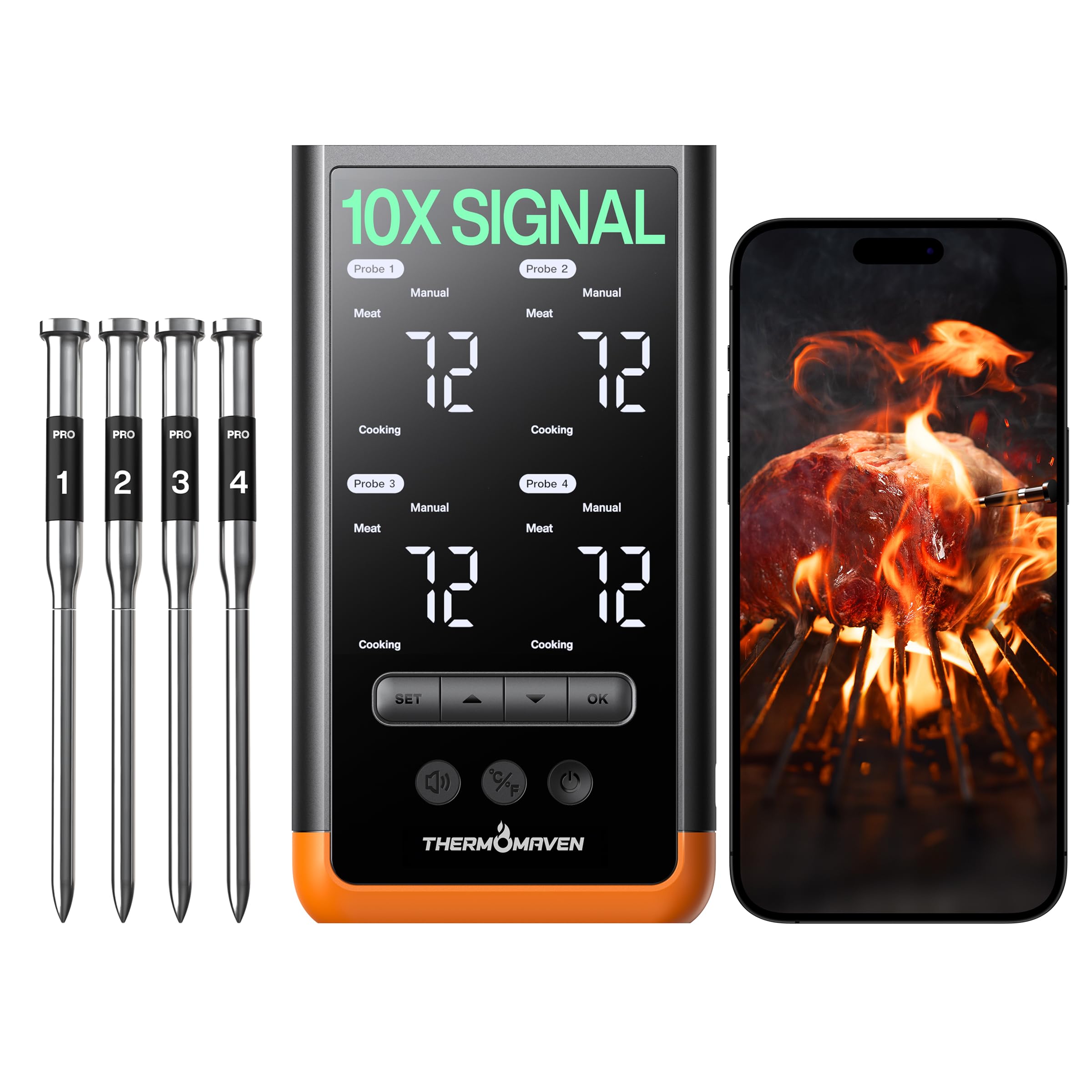
Three thousand feet is the headline, and the more useful number sits right beside it: 700 feet with walls and a smoker in the way. That is the Sub-1G radio doing what Bluetooth cannot, and it is why this is the pick for a cook who wanders — a long property, a workshop out back, a neighbor's deck while the coals do their work.

The hardware matches the range claim. Four probes, six sensors, a stated ±0.5°F with 0.01°F resolution, probes rated to 752°F and sealed to IPX8, dishwasher-safe, and a base that sets targets and shows every probe's reading without the app. Everything charges over USB-C, and the warranty runs 18 months.

Steady connection is where the money goes. In this group the G4 has the strongest story on staying linked while the cook moves around: the probe-to-base link shrugs off distance and obstruction, and the base-to-Wi-Fi hop is what lets you watch a twelve-hour brisket from the other side of town. The app's guided cooking is pleasant rather than essential — we ended up using the base screen most of the time.

Heat is the place to stay awake. A 752°F rating and an IPX8 seal cover a hot grill, but that is the environment where any probe's electronics take the hardest punishment, and the 18-month warranty is the backstop worth knowing about. If your grill sits on a patio outside the kitchen window, the WT02 Lite covers the same cook for less.

Pros

  • Sub-1G link holds at 3,000 ft and through walls
  • Four probes rated to 752°F and sealed to IPX8
  • Base sets targets and reads out without the app
  • 18-month warranty backs the probes

Cons

  • The priciest pick here
  • Charge life varies between units
Our verdict

Buy this one when distance is the problem — Sub-1G range that survives walls, four probes, and the steadiest connection in this group.

Check Latest Price

How We Tested Wi-Fi Meat Thermometers

We built the shortlist from spec sheets and listings first, then cut anything that couldn't hold more than one probe, anything that only logged while a phone stayed within Bluetooth range, and anything that read like a repackaged instant-read. That left 12 thermometers, running from simple two-probe bases to units that broadcast over Wi-Fi and hold their own readings onboard. We bought them at retail and cooked with all 12 for eight months.

The cooking happened where these things actually live: overnight pork butts on a charcoal smoker, a Sunday chicken in the oven, steaks on a hot gas grill, and a rotisserie bird that stress-tested every probe clip in the drawer. Mid-cook we carried the receiver out to the far fence, back into the kitchen, and down to the basement to find where the app dropped, and we noted whether the base kept displaying temperature after the phone lost its connection. We also logged how long a full charge lasted and whether the low-battery warning arrived before a cook or halfway through one.

For accuracy, every probe went into an ice bath and a pot of boiling water before its first cook, then sat in the same roast beside a trusted instant-read so we could compare readings at the same moment. We ran the cables through high-heat cooks, coiled them while wet, and washed them under the tap, checking the joint where probe meets cable for fraying or a loose crimp.

Ease of use we judged by handing each unit to someone who had never seen it and timing how long the first reading took with no instructions. Versatility came down to whether a set handled a smoker, an oven, and a grill without swapping parts, and value came down to whether the extra probes and app features were worth the step up in price.

How to Choose a Wi-Fi Meat Thermometer

Wi-Fi Is Only Half the Connection

A wireless thermometer makes two hops: probe to base, then base to your phone. The Wi-Fi badge describes only the second one. The first is a radio link measured in hundreds or thousands of feet, and it is the hop that fails when the base sits indoors and the grill is behind brick. The G4's Sub-1G link is quoted at 3,000 feet in the open and 700 feet with obstructions, which tells you more than any "unlimited" claim.

A base we can read across the yard beats an app we have to unlock, so favor a unit with its own display and alarm and plan where it lives — somewhere it can see both the cook and the router.

How Many Probes You'll Actually Use

Count the dishes in your biggest cook before paying for extra probes. Two handles a roast and a chicken, or two steaks headed for different doneness, and it keeps charging and scrubbing to a minimum. Four earns its place when a brisket, a pork butt, and sides all share the grate — that is the Inkbird's case here.

Each probe is another thing to charge and wash, and a probe that dies at hour five is worse than a spare you never needed.

Probe Heat Limits and Cleanup

Check a probe's maximum temperature against your hottest cook rather than against a generic grill number. Both ThermoMavens rate their probes to 752°F; the Inkbird stops at 572°F, which covers smoking and roasting but sits close to what a hard sear throws at the metal. Sealed probes rated IP67 or IPX8 can be rinsed, and dishwasher-safe probes spare you the worst of the grease.

If you like a screaming-hot fire, take the higher ceiling — or pull the probe before the sear and put it back after.

What the Accuracy Numbers Actually Mean

A ±0.5°F claim and a ±1.8°F claim are both brand statements, and the gap between them is smaller than the error you create by reading the wrong spot. What the tighter figure buys is steadiness: readings that climb in a smooth line instead of jumping a degree at a time, which is what makes an alert you can trust at 3 a.m.

Resolution is the other tell. A probe quoting 0.01°F is showing you far more digits than any cook needs, but it usually signals a sensor package built to hold a stable number.

Frequently Asked Questions

Final Verdict

For most cooks the ThermoMaven WT02 Lite is the one to buy: a base that runs the entire cook without a phone, two probes that go in the dishwasher, and Wi-Fi alerts that follow you off the property. Run four dishes at once and the Inkbird covers more for slightly less. Cook far from the house — a shop, a barn, a long lot — and the G4's Sub-1G range earns its premium.

The deciding question is not which app is prettier. It is where your cook happens and where the base can sit, and that answer picks the thermometer for you.