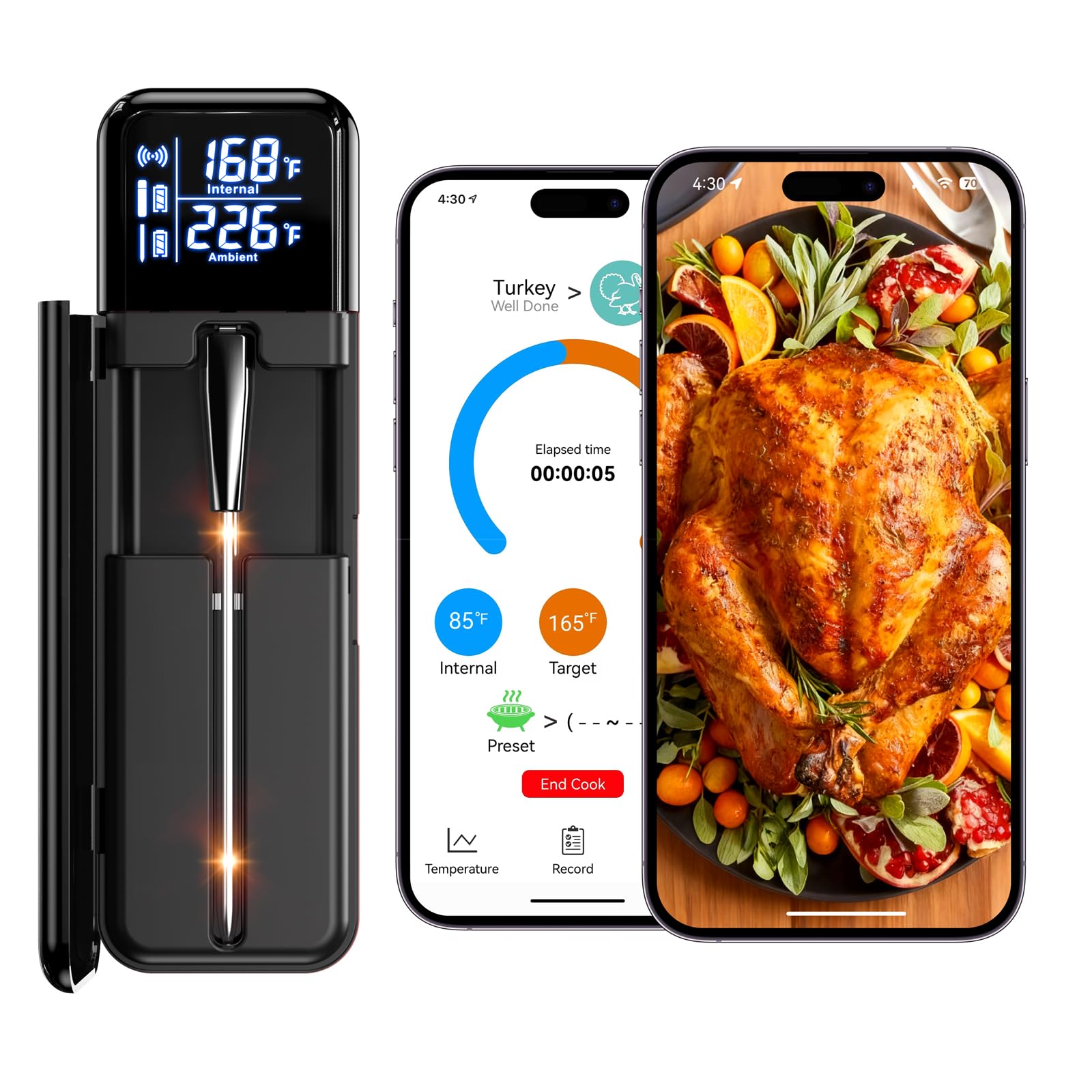
Best Wireless Meat Thermometers of 2026

A wireless meat thermometer sells you one thing: permission to walk away from the grill. The catch is that the signal has to push through a closed lid, a foil wrap, and a cloud of smoke, and that's exactly where the flimsy ones give up — usually at the moment dinner depends on them. That's the worry I started with, and it's the one that shaped how we tested.

Over the past eight months my team and I have cooked with a dozen of these, from overnight briskets to a Tuesday-night chicken in the oven, and the gap between a thermometer you trust and one you second-guess shows up within the first hour of a long cook.

Two things I'd pass along to a first-time buyer. Probe placement matters more than the accuracy rating — bury the tip against a bone and even a certified-accurate probe reads wrong. And a base with its own display earns its keep on a 14-hour cook, when the thing that runs out of battery is your phone, not the thermometer. The picks below are the ones that held up.

1

Best Overall

ThermoMaven G1

89 /100
LBD Score Excellent

Key details

Probes
1 wireless
Accuracy
±0.5 °F
Max Ambient
752 °F
Wireless Range
3,000 ft unobstructed
View on Amazon

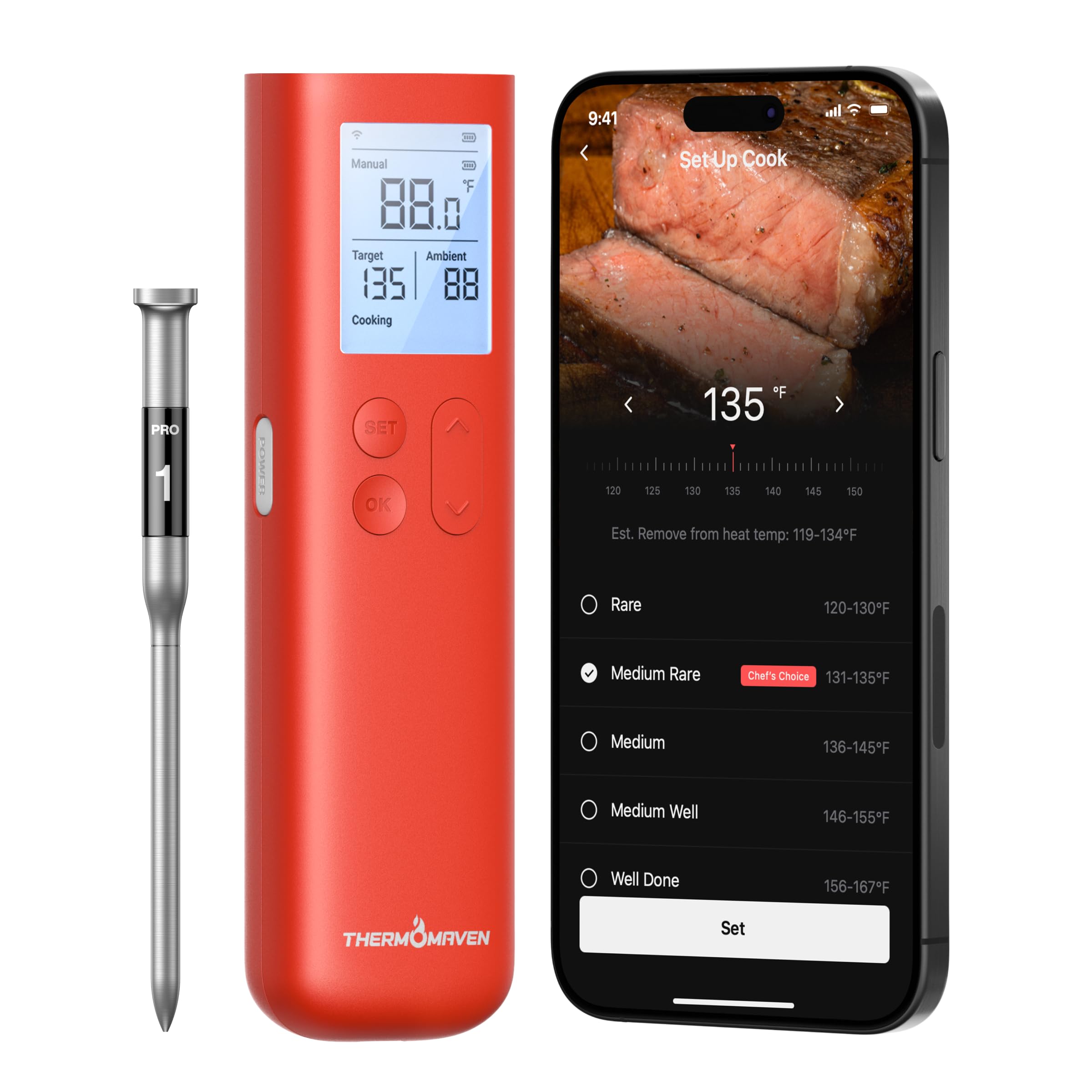
A screen you can set on the counter, a phone app for when you wander off, and a probe rated to 752°F — the ThermoMaven G1 does all three jobs without making you choose between them. Set a target on the base and it watches the cook on its own, so the alert arrives even if your phone has gone to sleep in your pocket. The Sub-1G radio is rated to 3,000 feet unobstructed, which is more yard than most of us have.

The probe is just as well sorted: six sensors, NIST-certified to ±0.5°F, and an internal ceiling of 221°F that no roast will trouble. We were also impressed by how little the app insists on itself — presets for beef and poultry, a finish estimate, and a graph of the cook, without turning a steak into a project. Use it or don't; the base works either way.

The limitation is the single probe. One roast, one chicken, one steak you're hovering over: perfect. Two cuts headed for different targets, and you're either guessing or buying a second unit, which is why the X2 below exists and why the Inkbird earns its place on holiday cooking.

One thing to know going in: the probe is a sealed sensor that goes from a 200°F roast to a rinse under the tap and back into the heat, and it's the part that wears out first on any wireless unit. ThermoMaven covers the G1 for 18 months, which takes some of the sting out of a replacement.

Pros

  • Standalone base works without a phone
  • 3,000-foot Sub-1G radio plus Wi-Fi app
  • 752°F ambient limit suits smokers and hot ovens
  • Six-sensor probe certified to ±0.5°F

Cons

  • One probe only, so one cut per cook
Our verdict

We recommend the G1 to anyone who wants to stop guessing: a base that works without a phone, a radio that reaches the yard, and a heat ceiling that covers any cooker.

Check Latest Price
2

Best Without an App

ThermoMaven X2

86 /100
LBD Score Excellent

Key details

Probes
2 wireless
Max Ambient
752 °F
App Required
No
Wireless Range
3,000 ft unobstructed
View on Amazon

Some cooks want their phone in the loop. Plenty of others want a thermometer that never asks them to create an account, and the ThermoMaven X2 is built for that second group: put the probes in, set a target on the base's LCD, and the base handles the rest. No app, no sign-up, no pairing dance.

That's a real feature rather than a limitation dressed up. Cooking with wet hands and a cold drink nearby is no time to be troubleshooting a login, and a base you can read at arm's length beats unlocking a phone every time you want a number. We like the trade it makes.

Two probes is the other reason to pick it over the single-probe G1: independent targets mean a brisket and a chicken can share one cook. Both carry the same six-sensor NIST spec and the same 752°F ambient ceiling, the base has a magnetic mount so it can live on the side of the grill rather than a shelf you have to keep clear, and the probes are IPX8 and dishwasher-safe.

Pros

  • No app, account, or pairing required
  • Two probes with independent targets
  • 3,000-foot range and a magnetic base
  • 752°F ambient limit and IPX8 probes

Cons

  • Monitoring stops at the base's radio range
  • Probe collar can come apart under repeated heat
Our verdict

If your phone stays in your pocket while you cook, this is the thermometer we hand you — two probes, no account, no app to babysit.

Check Latest Price
3

Best for Four Cuts at Once

Inkbird INT-14-BW

87 /100
LBD Score Excellent

Key details

Probes
4 wireless
Runtime
25 hours
Connection
Wi-Fi, Bluetooth, offline
Max Ambient
572 °F
View on Amazon

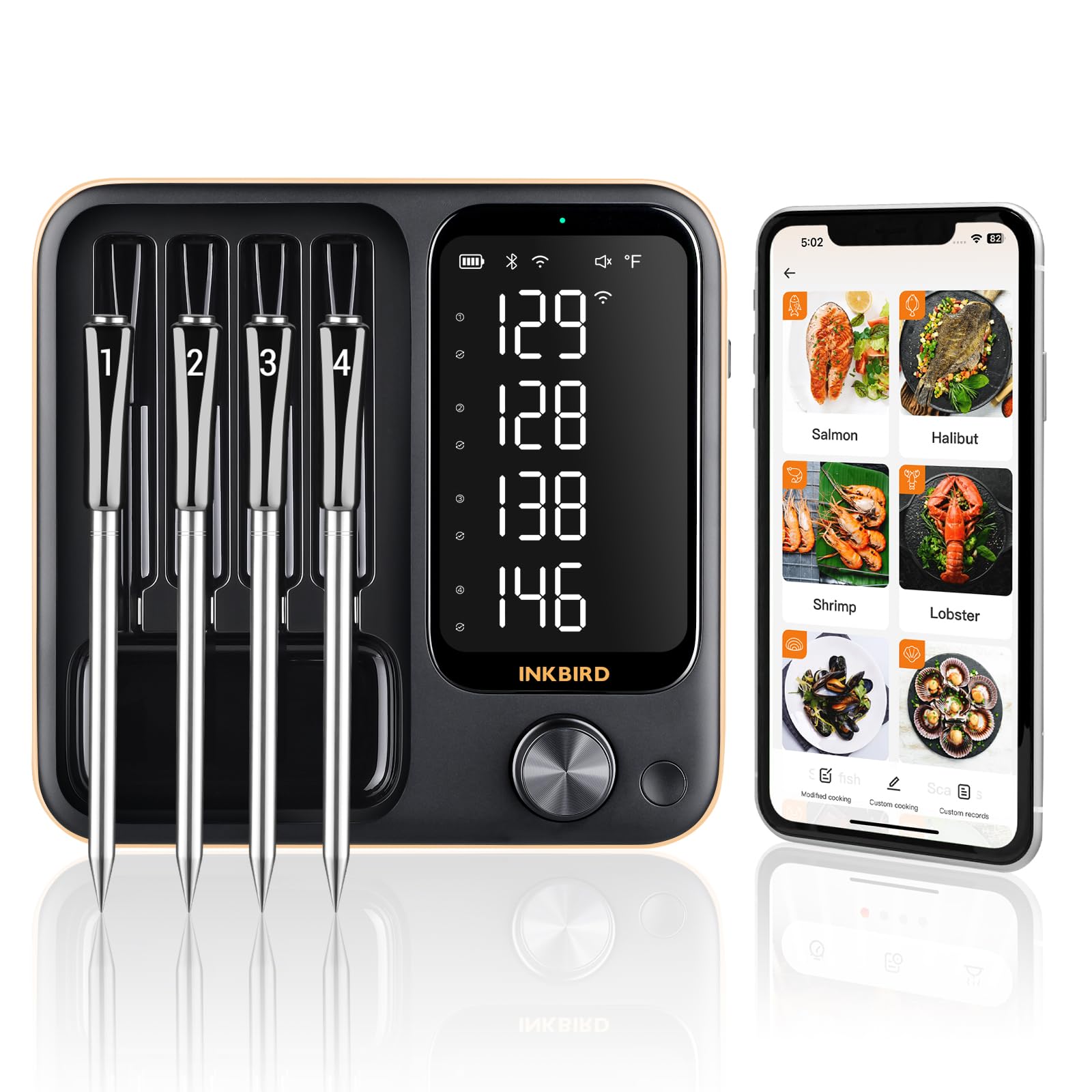
Four probes is the whole pitch, and it's what separates the INT-14-BW from everything above it on this list: four cuts, four targets, one base. The 360° display is chunky enough to read from across the kitchen, and the whole thing runs offline when the Wi-Fi doesn't.

Each probe charges in the base in about 25 minutes and then runs for 25 hours, which is the number that makes an overnight brisket realistic rather than aspirational. On a holiday cook the four probes earn their keep: a bird, a loin, a pan of stuffing that needs to reach 165°F, and one probe left over for the oven's ambient air.

The app is the weak link, and specifically so: the connection drops when the phone screen times out, so keep the screen awake or trust the base's alarm instead. We treat the phone as a bonus and the base as the tool, and that's the right way to run this one. Calibration is there if a probe drifts, and the probes are IP67, so a rinse is fine.

Pros

  • Four probes with separate targets
  • 25-minute charge, 25 hours of runtime
  • 360° display readable across the kitchen
  • Keeps working offline without Wi-Fi

Cons

  • 572°F ceiling rules out pizza ovens and hard sears
Our verdict

We reach for the INT-14-BW when four things are cooking at once: four probes, a readable counter base, and 25 hours between charges.

Check Latest Price
4

App-First Cooks

InkGrill 4-Probe

85 /100
LBD Score Excellent

Key details

Probes
4 wireless
Runtime
25 hours
Max Ambient
572 °F
Sensors Per Probe
2
View on Amazon

Every probe in the InkGrill set carries two sensors, so four of them read both the meat and the air around it — four internal temperatures and four ambient ones from a single set. That makes it the best unit here for reading a whole cooker at once: you can watch the hot end of the grate and the cool end without adding a second thermometer.

The cooks who get the most from it already run a long smoke from their phone — a graph to check from the couch, 28 USDA presets that take the guesswork out of a first brisket, and a custom range for anything the presets miss. Local mode keeps the probes reporting when the Wi-Fi doesn't, a 25-minute charge buys 25 hours, and the probes go in the dishwasher afterward.

Pros

  • Four probes, each reading meat and ambient air
  • Bluetooth, Wi-Fi, and offline local mode
  • 28 USDA presets for the first cook
  • 25-hour runtime from a 25-minute charge

Cons

  • No display base; the app is the only screen
  • 572°F ambient ceiling limits very hot cooking
Our verdict

For app-first cooks who want four probes and a pit reading from every corner of the grate, the InkGrill earns its place.

Check Latest Price
5

Tight Budgets

SMNQIUA Smart Base

91 /100
LBD Score Outstanding

Key details

Probes
1 wireless
Accuracy
±0.5 °F
Max Ambient
572 °F
Wireless Range
1,000 ft
View on Amazon

Six sensors, a ±0.5°F claim, and 1,000 feet of Bluetooth 5.4 — the DT-133 reads like the expensive end of this list, and it's the cheapest thing on it. There's a display base you can set targets on, so a quick chicken check doesn't require unlocking anything.

What we didn't expect at this price is 4.1 inches of insertion depth, enough to reach the middle of a thick chop or a small roast instead of just scoring the surface. The two-second response time sounds slow next to the half-second claims further up, but that spec matters for a handheld probe you stab into four steaks looking for the coolest one — not for a probe that sits in the meat and reports continuously. For oven roasting and skillet work, this is the right set of priorities.

Where it stops is heat. The 572°F ceiling and the hand-wash-only probe are the two compromises, and both are easy to live with if your cooks stay in the oven and the smoker. Sear over a chimney starter or want a second probe in the grill, and the G1 costs a little more and covers both.

Pros

  • Display base sets targets without the app
  • Six sensors at ±0.5°F
  • 1,000-foot Bluetooth 5.4 range
  • 4.1-inch insertion depth for thick cuts

Cons

  • 572°F ambient ceiling caps it below the top picks
  • Probe is hand-wash only
Our verdict

Our budget pick: a display base, a ±0.5°F claim, and a probe deep enough for a roast, for less than the picks above.

Check Latest Price

How We Chose and Tested Wireless Meat Thermometers

We started by reading through specs and customer reviews for more than 40 models and pulling out a mix of probe counts, connection types, and price points, then bought 12 of them and lived with those for eight months. The first stop was a glass of ice water: every probe went in, and we watched whether the reading settled quickly, drifted, or landed somewhere it had no business being compared with a reference thermometer alongside it.

From there they went into real cooking — an overnight brisket on a pellet smoker, a Sunday roast chicken in the oven, rotisserie chicken, air-fryer wings, steaks over a hot gas grill. We watched the temperature curve rather than just the endpoint, since a probe that spikes and stalls at odd moments is telling you something about its sensor. We also noted which units let us set a target and walk away, and which ones demanded we keep checking.

Connectivity got its own round of abuse. We carried each base to the far corner of the yard with the lid closed, wrapped a brisket in foil mid-cook to see whether the signal survived, and timed how long it took before a reading dropped out. Battery life was tracked across the whole eight months — how often each unit needed a charge, which one died first, and how much a probe lost sitting in a drawer for a month.

For durability, probes were scrubbed under a hot tap and a few were left soaking in a bowl of water to check whether moisture crept in at the seam. And for ease of use, we handed each thermometer to a friend who'd never used one and timed how long it took them to pair it and set a target without the manual. More people got stuck in the app than on the probe itself.

How to Choose a Wireless Meat Thermometer

Decide where the temperature shows up

Every unit here does the same basic job; they differ in where the number appears. A standalone base means a glance from across the kitchen with no unlocking and no network. An app means history, finish estimates, and a check from another room over Wi-Fi. The trap is assuming an app-first unit stays easy at the grill: a phone that has gone to sleep is a thermometer with no display. We prefer units that give you both and treat app-only designs as a deliberate choice rather than the default.

Count the cuts you cook at once

One probe covers a roast, a chicken, or a steak you're hovering over. Two let you run different targets side by side — a pork butt headed for 203°F while a chicken comes off at 165°F. Four is for holiday spreads and loaded smokers. The trap runs opposite to what you expect: every extra probe is another battery to charge and another seal to keep clean, so buying four when you cook one is paying for chores.

Match the ambient limit to your hottest cooker

A wireless probe carries two temperature limits and only one of them is about dinner. The internal limit, usually around 212°F, is a ceiling no roast will reach. The ambient limit is how hot the air around the probe can get, and it decides where the unit can go: 572°F covers low-and-slow smoking and a normal oven, while 752°F leaves room for a hot sear, a pizza oven, or a kamado running wide open. If you only ever smoke at 225°F, this number barely matters. If you sear, check it first.

Plan for the probe to wear out

Sealed probes go from a 200°F roast to a rinse under the tap and back into the heat, and the collar is what fails first across this category — a probe that stops holding a charge or comes apart in your hand. Two habits help: stay under the ambient limit, and wash by hand unless the probe is explicitly rated for a dishwasher. Before you commit, confirm that single probes are sold on their own, because a system with no replacement path is a disposable one.

Frequently Asked Questions

Final Verdict

The ThermoMaven G1 is the one we point most people to: a base that keeps working when your phone doesn't, 3,000 feet of Sub-1G range, and a 752°F ceiling, all at the budget end of this list.

Change one requirement and the answer changes with it. Cooking two cuts at different targets without an account? That's the X2. Four probes and a screen sitting on the counter? The Inkbird INT-14-BW. Neither is a better thermometer than the G1 — each is the better thermometer for a cook the G1 can't quite cover.