Best Bread Makers of 2026

A bread machine is a trade: you give up a chunk of counter space, and in return the machine kneads, proofs, and bakes while you're at work. The catch is that a mediocre one bakes a pale, dense brick and then makes you chisel the paddle out of the pan. I've had both kinds sitting on my counter.

Over six months, my team and I baked through 11 machines, from compact 1-pound models to 2.2-pound stainless workhorses. What separated them was unglamorous: whether the loaf came out evenly browned and shaped like actual bread, whether the delay timer really delivered warm bread at 7 a.m., and how long the pan needed to soak afterward. Instructions matter more than you'd expect, too — a confusing control panel is a machine you quietly stop using.

The ones below earned their counter space, whether you bake gluten-free, feed a family, or just want one dependable sandwich loaf a week.

1

Best Overall

KITCHENARM 29-in-1 Bread Machine

93 /100
LBD Score Outstanding

Key details

Programs
29
Warranty
2 years
Dimensions
14.2 x 8.9 x 12 in
Loaf Sizes
1, 1.5, and 2 lb
View on Amazon

The 29-program count sounds like overkill until you notice what it buys: a one-press routine that remembers your last menu, loaf size, and crust color. We used that memory more than any single preset; once you settle on a sandwich loaf, the machine stops asking you to re-enter the same choices. The Home Made menu is the other feature we appreciate, because it lets you build four custom cycles instead of hunting for a preset that almost fits.

In our testing, the KITCHENARM produced the most consistent everyday loaves in this group. The 550-watt motor is not the most powerful here, but it kneaded stiff whole-wheat dough without straining, and the 2-pound loaf is the right default for a family. The 1- and 1.5-pound settings are there when you want a smaller batch. The crust browns evenly across the three shades, and the loaf releases cleanly from the nonstick pan.

The manual is unusually useful for this category. It walks through the cycles, includes a substantial recipe section, and the one-press memory means you are not relearning the panel every time. We also like the two-year warranty, which is longer than most here.

If you want a machine that can handle sourdough starter, gluten-free, dough, jam, and everyday loaves without turning the counter into a control tower, this is the one we point to first. The 9.6-pound body stays put during kneading, but it is happiest with a permanent spot on the counter.

Pros

  • 29 programs with one-press memory
  • Consistent everyday loaves
  • Two-year warranty for peace of mind
  • Useful manual and recipes

Cons

  • Flour can collect behind the control panel
Our verdict

For most kitchens, the KITCHENARM 29-in-1 is the bread maker we recommend: it covers the useful cycles, saves your last settings, and backs the machine with a two-year warranty.

Check Latest Price
2

Best Premium

Zojirushi Home Bakery Supreme

89 /100
LBD Score Excellent

Key details

Capacity
2 lb
Programs
10
Dimensions
8.5 x 16.9 x 12.25 in
Delay Timer
13-hour
View on Amazon

The first thing you notice about the Home Bakery Supreme is the shape of the loaf. It bakes a horizontal rectangular bread, not the tall vertical brick many machines produce, so the slices are closer to what you get from a bakery and fit a toaster without trimming. That one design choice makes it feel more like a bread oven and less like an appliance.

At 19.5 pounds, it is the heaviest machine in this group, and that weight buys stability. It stays put during kneading, and it runs quietly enough that we stopped noticing it in the next room. The 10 programs cover the basics plus cake, jam, dough, and sourdough starter, and the 13-hour timer is there when you want bread ready in the morning. We did not miss the 29-program menus; most people will use three or four cycles.

The nonstick pan releases cleanly, and the control panel is simple enough to use without the manual. We also like that the loaf comes out in a shape you can slice for sandwiches without carving around a tall dome.

This is the machine for the baker who wants a familiar loaf shape and quiet operation more than a long list of presets. It is also the one here we trust for a Sunday bake when the kitchen is busy and the machine has to work in the background.

Pros

  • Horizontal bakery-style loaf
  • Very quiet operation
  • Stable, heavy build
  • Simple controls and recipes

Cons

  • Heavy, wide body needs dedicated counter space
  • Paddle marks in bottom crust
Our verdict

If you want a quiet machine that turns out a traditional horizontal loaf, the Zojirushi Home Bakery Supreme is the premium pick we reach for.

Check Latest Price
3

Best for Crust and Mix-Ins

Cuisinart Convection Bread Maker

84 /100
LBD Score Excellent

Key details

Programs
16
Warranty
3 years
Loaf Sizes
1, 1.5, and 2 lb
Mix-in Capacity
3/4 cup
View on Amazon

The convection fan is the reason to look at this Cuisinart. It circulates air during baking, which gives the crust more even color than the still-air machines here, and the three crust shades let you push it darker without guessing. We noticed the difference most on a lean white loaf, where the top browned evenly instead of streaking.

The automatic mix-in dispenser holds up to three-quarters of a cup and releases fruit or nuts at the right moment, so you are not standing over the machine with a timer. That is a real convenience for raisin bread or walnut loaves. The catch is that not every program uses the dispenser, including the dough cycle, so check the manual before you fill it and assume you will add some ingredients by hand.

The 16 programs include a sourdough starter cycle, gluten-free, low carb, and a custom memory slot. The removable paddle is designed to come out before the final rise, which helps with the hole in the bottom of the loaf. The 13-hour delay and three-year warranty are both generous for this group.

This is a specialist's machine rather than the default. If you bake mostly plain sandwich bread and want the simplest possible routine, the KITCHENARM is easier to live with. If you want to chase a darker crust or a loaf studded with nuts, the Cuisinart earns its counter space.

Pros

  • Convection for even crust
  • Automatic mix-in dispenser
  • Sourdough starter cycle
  • Three-year warranty

Cons

  • Paddle can be stiff to remove
Our verdict

Choose the Cuisinart Convection if you care about crust and want nuts or fruit dropped in automatically; it is the most controlled baker here for those details.

Check Latest Price
4

Best for Nut and Seed Loaves

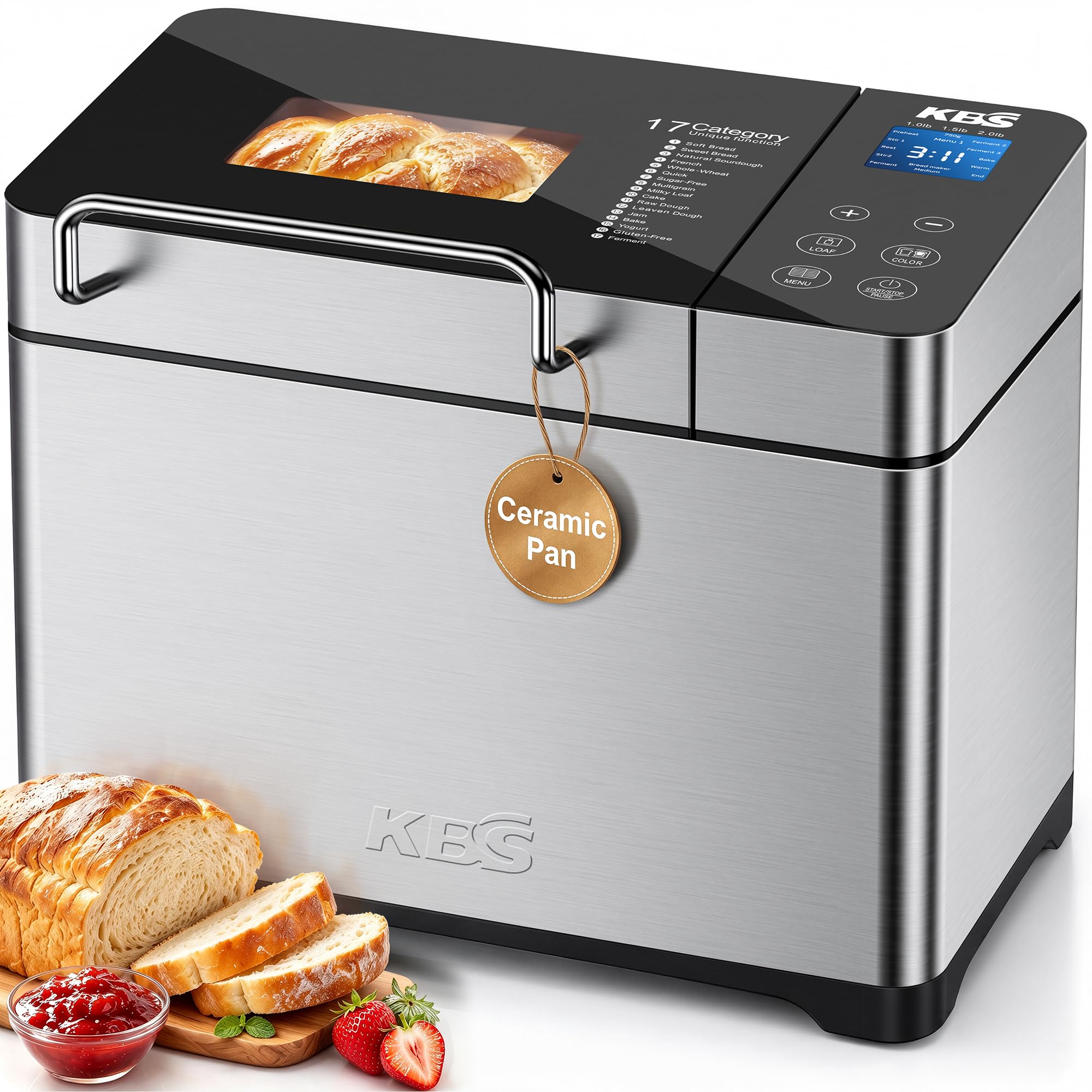
KBS Pro 17-in-1 Bread Maker

89 /100
LBD Score Excellent

Key details

Capacity
2 lb
Programs
17
Delay Timer
15-hour
Nut Dispenser
Automatic
View on Amazon

The KBS Pro is built around volume. It has a 2-pound stated capacity, a 710-watt motor, and a ceramic pan that is meant to handle stiff dough without the coating worries of a standard nonstick bucket. The automatic nut dispenser is the feature that separates it from the simpler machines here: fill it, choose the program, and the machine drops the add-ins at the right time.

We like the horizontal pan and the large viewing window, and the 15-hour delay plus one-hour keep-warm are useful if your schedule is not predictable. The 17 programs cover gluten-free, sourdough, French, sweet, and dough, and the touch panel is easy to wipe down. The 14.7-pound body is stable on the counter, but it takes up more room than the compact picks.

The manual is the part we struggle with. It reads as a translation, and the recipe measurements are not always clear, so we recommend starting with a bread-machine recipe you trust rather than the included book. The rest of the routine is straightforward: load the pan, close the lid, and let the dispenser do its job.

For a household that goes through a loaf every couple of days and likes nuts or seeds in the dough, the KBS Pro is a strong choice. If you mostly bake plain 1.5-pound loaves, the KITCHENARM is easier to use and has a clearer manual.

Pros

  • 710-watt motor for stiff dough
  • Automatic nut dispenser
  • Ceramic pan
  • 15-hour delay timer

Cons

  • Ceramic pan can chip
Our verdict

The KBS Pro is the pick for seeded and nutty loaves: a ceramic pan, a 710-watt motor, and an automatic dispenser make add-ins easier.

Check Latest Price
5

Best for Small Households

Zojirushi Home Bakery Mini

90 /100
LBD Score Outstanding

Key details

Capacity
1 lb
Programs
9
Quick-bake
Under 2 hours
Delay Timer
13-hour
View on Amazon

A one-pound loaf is the whole point of the Home Bakery Mini. It makes a compact loaf that is enough for several sandwiches or a few days of toast, without leaving you with half a loaf going stale. The body is small enough to keep on the counter, and the basic white bread recipe is printed on the side of the machine, which is the kind of detail you appreciate when the manual is in a drawer.

The 9 programs cover the essentials plus dough, jam, and cake, and the quick-bake cycle can finish a loaf in under two hours. That is the setting we use when we want fresh bread for dinner and did not plan ahead. The 13-hour timer is there for overnight bakes, and the machine runs quietly enough that it does not dominate the kitchen.

The controls are simple, and the nonstick pan releases cleanly. The one-pound loaf is not a novelty: it makes enough for a couple of days, and the smaller pan is easier to wash than a full-size bucket. The body is compact enough to move without clearing a permanent shelf.

For singles, couples, and anyone who wants a small loaf without a big machine on the counter, this is the one we reach for. It is the right size for the job, and that is the reason to choose it.

Pros

  • One-pound loaves for small households
  • Quick-bake under two hours
  • Compact body
  • Quiet operation

Cons

  • Only one loaf size
Our verdict

For one or two people, the Zojirushi Home Bakery Mini is the small-loaf specialist we recommend, with a quick-bake cycle and a footprint that fits a tight counter.

Check Latest Price
6

Simple 2-Pound Baking

OSIPOTO 17-in-1 Bread Maker

90 /100
LBD Score Outstanding

Key details

Power
600W
Capacity
2 lb
Programs
17
Delay Timer
15-hour
View on Amazon

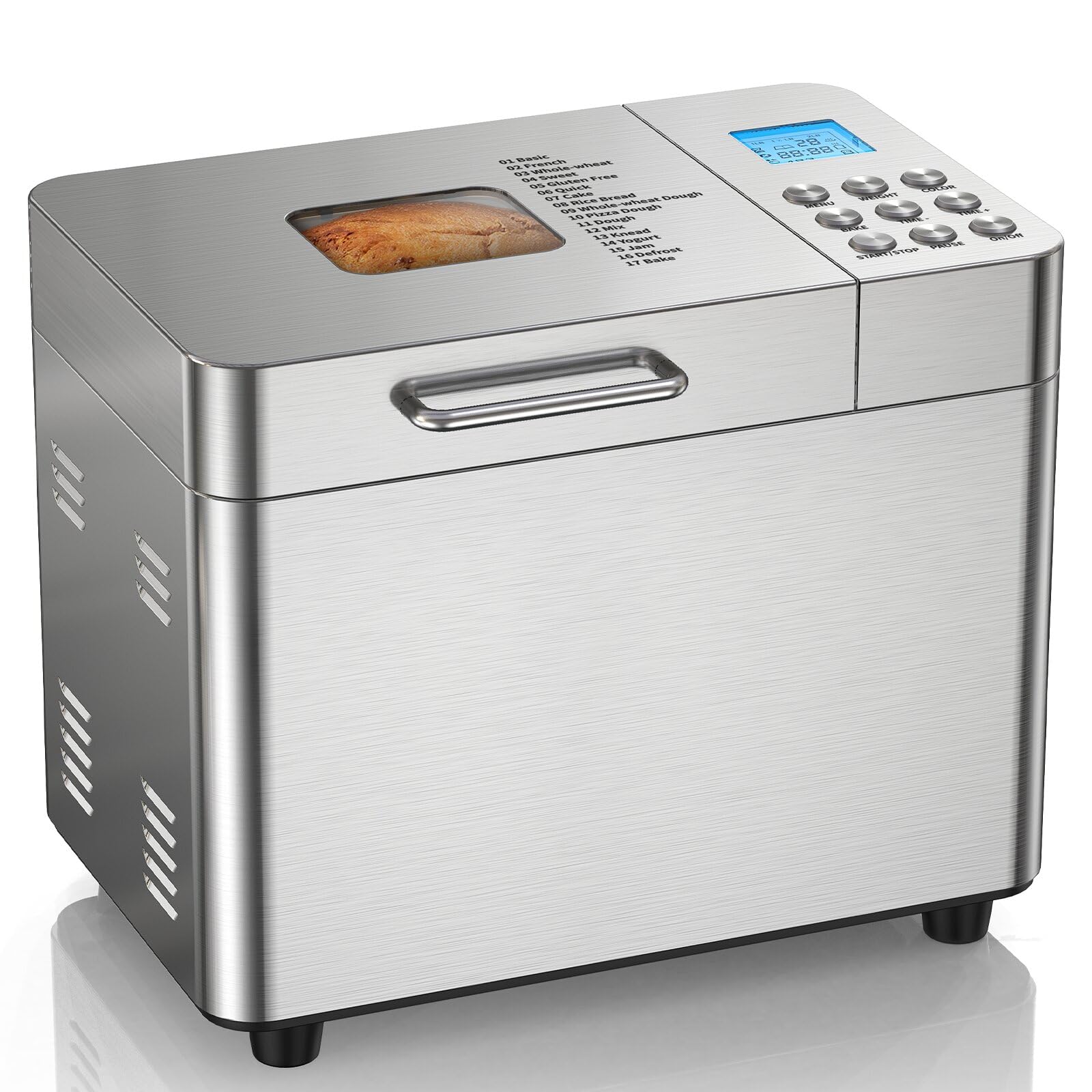
The OSIPOTO does not bury its controls in a maze of submenus. It has 17 programs, a 15-hour delay, a keep-warm cycle, and a 600-watt motor, and the stainless body looks more upscale than the feature set suggests. For a first-time baker, that combination is easier to approach than a 29-program panel with custom memory slots.

The 2-pound capacity is the right size for a family, and the nonstick pan and included measuring cup, spoon, hook, and stirring rod mean you can start baking without buying a separate kit. We like the keep-warm function for the nights when dinner runs late; the loaf is still warm when you are ready to slice it. The 15-hour delay is long enough to set up before work and come home to bread.

The machine is straightforward to wipe down, and the control panel is legible without a manual. It does not have the specialty feel of the convection or ceramic-pan machines here, but it covers the cycles most people use. The stainless finish also hides fingerprints better than a black plastic body.

For a first bread machine, or a second machine for a vacation kitchen, the OSIPOTO is a sensible, uncomplicated choice. It does the core job without asking you to learn a new appliance language.

Pros

  • 17 programs for everyday baking
  • 15-hour delay timer
  • Keep-warm cycle
  • Stainless body

Cons

  • 11.7-pound body is not very portable
Our verdict

The OSIPOTO is a straightforward 2-pound machine with a useful 15-hour timer and keep-warm cycle; it suits a first-time baker who wants the basics without a steep control panel.

Check Latest Price
7

Compact 2-Pound Loaves

Neretva 20-in-1 Bread Maker

89 /100
LBD Score Excellent

Key details

Capacity
2 lb
Programs
20
Dimensions
11 x 7.9 x 9.25 in
Delay Timer
15-hour
View on Amazon

The Neretva is the smallest 2-pound machine in this group, and that is its main appeal. At about 8 inches wide and 9.25 inches tall, it takes up less counter space than the KBS or Zojirushi Supreme, but it still lists a 2-pound capacity. The dual heaters sit above and below the pan, and the ceramic pan is a nice upgrade from standard nonstick.

The 20 programs cover the usual white, French, whole wheat, gluten-free, cake, and dough cycles, and the 15-hour delay plus one-hour keep-warm are useful for everyday scheduling. We found the controls easy enough to learn, and the stainless body wipes down without fuss. The two paddles are a change from the single-paddle machines here; they mix more thoroughly, but they also give you two holes in the bottom of the loaf.

The compact body means the loaf is more vertical than a horizontal bakery shape, so slices are tall rather than wide. That is a real difference if you like sandwich bread, but it is also what lets the machine fit where a wider one will not. The timer and keep-warm functions are easy to set, and the display is readable from across the counter.

For a small kitchen that still wants a 2-pound loaf, the Neretva is a practical fit. If you have the counter space and want a more robust pan, the KBS Pro is the sturdier choice.

Pros

  • Compact 2-pound body
  • Dual heaters
  • Ceramic pan
  • 20 programs

Cons

  • Pan coating can wear
Our verdict

The Neretva 20-in-1 fits a 2-pound loaf into a compact body and adds dual heaters and a ceramic pan; it is the compact choice for small kitchens that still want family-size bread.

Check Latest Price

How We Chose and Tested the Best Bread Makers

We started with a list of roughly 40 machines and narrowed it by the specs shoppers actually compare: loaf capacity from 1 to 2.2 pounds, nonstick versus ceramic pans, automatic fruit-and-nut dispensers, delay timers, keep-warm settings, and how many programs you get for the money. Anything without a delay timer, or with a manual that read like translation software, was cut. That left 11 units, which we ran for six months.

Each machine baked the same white sandwich loaf first, then a whole wheat, then a gluten-free loaf wherever it had a setting for one. We loaded the delay timers overnight and checked at 7 a.m. whether the bread was warm and properly risen or had slumped into the pan. Dispensers got filled with walnuts and raisins to see whether the mix-ins arrived whole or got pulverized into the dough.

Bread quality is where the field split. We noted whether the loaf rose evenly or domed to one side, whether the crust browned on all sides, and how the crumb held up two days later in a paper bag; taste got a plain butter test, no jam to hide behind. Cleaning was timed: paddle out, pan soaked, whether the crust released in one piece. We followed each manual as first-time bakers, measured the footprint on a standard counter, and kept baking weekly for six months to see whether coatings scratched or the paddle mechanism loosened.

How to Choose a Bread Maker

Start With Loaf Size and Shape

A 1-pound machine like the Zojirushi Home Bakery Mini suits one or two people who eat a few slices at a time; a 2-pound machine is the family default, and a 2.2- or 3.3-pound model only makes sense if you freeze half or bake for a crowd. Loaf shape matters too: horizontal pans give sandwich-friendly slices, while vertical pans take less counter depth. Measure the spot before you buy, and leave clearance for the lid and steam. In our view, buying more capacity than you will eat is the most common way a bread maker ends up in a cupboard.

Look Past the Program Count

A 29-program panel is not automatically better than a 10-program one. What matters is whether the cycles you will actually use are there: basic white, whole wheat, gluten-free, dough, and maybe sourdough starter or jam. A one-press memory that saves your last loaf size and crust setting is more useful day to day than a long list of presets you never touch. The manual matters just as much; a clear recipe book and plain-English controls make a bigger difference than two extra menus. We prefer a well-written guide for 16 programs to a confusing guide for 29.

Decide Whether You Need Crust Control and a Dispenser

Convection fans and adjustable crust shades help even browning, and an automatic fruit-and-nut dispenser saves you from standing over the machine at the add-in beep. Those features are worth paying for if you bake raisin bread, seeded loaves, or nut breads often. They add less value if you mostly make plain sandwich bread. Check which programs actually use the dispenser before you count on it; on some machines, the dough cycle does not. A delay timer is a separate convenience: it lets you wake up to bread, but it works best with dry ingredients and water, not perishables left at room temperature.

Measure the Counter and the Cleanup

Bread machines are deeper than they look, and the heaviest models stay put but are awkward to move. Put the machine where you can open the lid fully and reach the pan without dragging it across the counter. Cleanup is the other daily cost: a nonstick or ceramic pan that releases cleanly and a paddle that comes out without a fight make the machine easier to use. Hand wash the pan and paddle unless the manual says otherwise, and avoid metal utensils. The KBS Pro and Neretva are the larger, heavier end of this group; the Zojirushi Mini is the easiest to tuck away.

Treat Durability as Part of the Recipe

Durability is the weak spot across bread machines, and coating wear is the most common long-term issue. A longer warranty helps, but care matters just as much: use the included paddle hook, avoid abrasive cleaners, and do not cut bread in the pan. If you bake several times a week, a machine with a two- or three-year warranty and a ceramic or well-coated pan is worth the extra attention. Register the warranty when you unbox it, and keep the receipt. A bread maker is a simple appliance, but the pan and paddle are the parts that decide how long it stays useful.

Frequently Asked Questions

Final Verdict

For most kitchens, the KITCHENARM 29-in-1 is the bread maker we recommend. It has the most useful mix of programs, a one-press memory that saves your settings, a clear manual, and a two-year warranty, and it bakes a dependable 2-pound loaf. If you want a traditional horizontal loaf and quieter operation, the Zojirushi Home Bakery Supreme is the premium alternative. If you only bake for one or two, the Zojirushi Mini is the better size.