Best In-Wall Speakers of 2026

Cutting a hole in your living room wall is permanent, and that's exactly why so many people stall on buying in-wall speakers — the drywall saw comes out once, and there is no putting it back. The payoff is worth the nerve: the speakers disappear into the room, the floor space comes back to you, and dialogue finally comes from the screen instead of a box beside it.

After eight months and 12 speakers, the lesson I keep repeating is that the wall matters as much as the driver. Placement and aiming do more for sound than an extra woofer, which is why I paid attention to aimable tweeters, paintable grilles, and cutout dimensions that actually match the template on the box. Two of the units went into a bathroom and a covered porch, where damp air is the real test of how a speaker is built.

The picks below are sorted by the job you're hiring them for — front stage, surround, whole-house background music — and every one earned its hole in the wall.

1

Best Overall

Polk Audio RC85i

93 /100
LBD Score Outstanding

Key details

Woofer
8 inches
Configuration
2-way pair
Mounting Depth
3.5 inches
Power Handling
100 W per speaker
View on Amazon

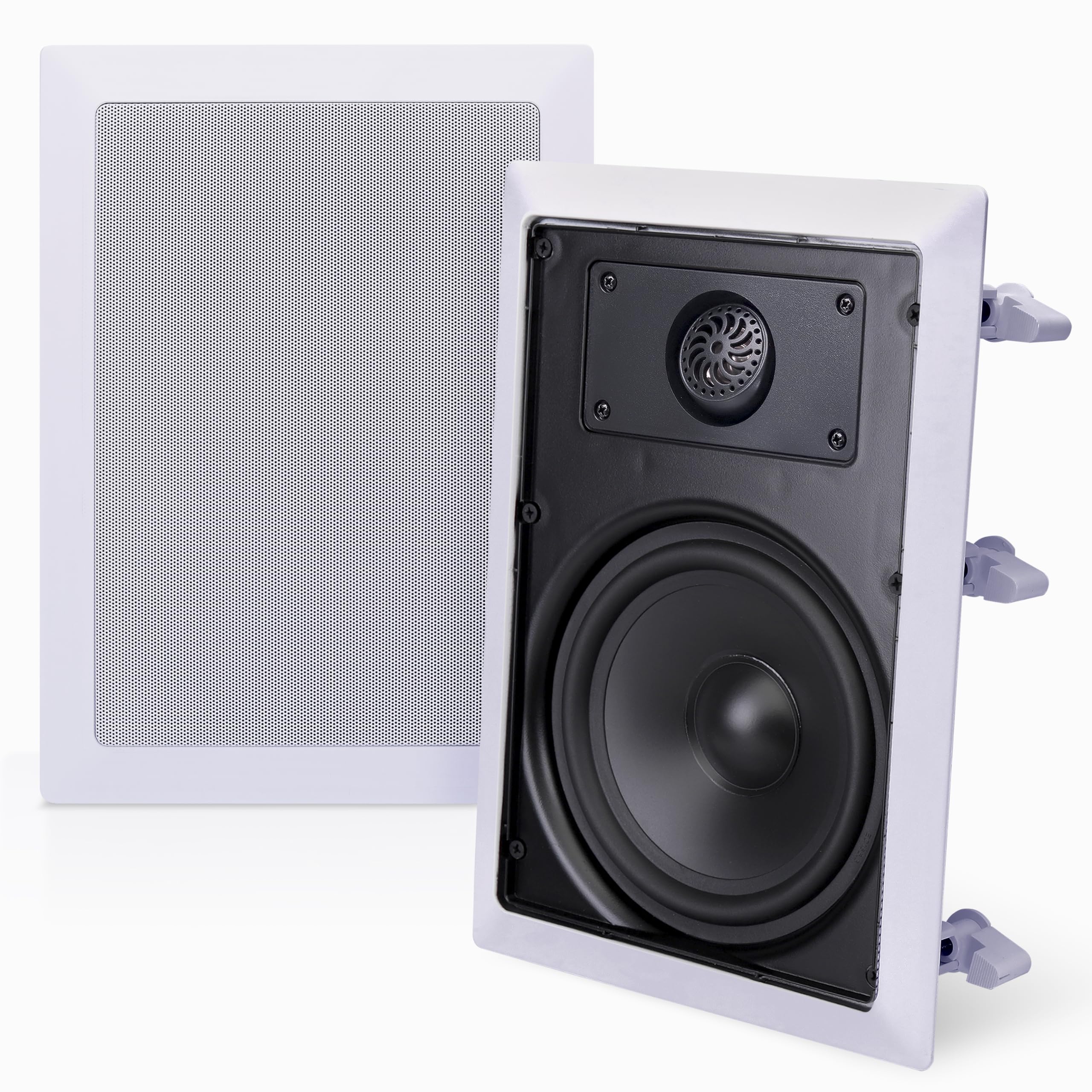
Two speakers come in the box here, and that single detail settles a lot of purchases once you do the arithmetic. The Klipsch and the 265-RT in this guide are sold one at a time, so a pair of RC85i costs less than two of either — and you still get an 8-inch Dynamic Balance woofer, a swiveling 1-inch silk dome, and 100 watts of power handling per speaker. Against the rest of this set, that is the best value on the value dimension, and it is where we start for a first theater or a room that just needs music.

Placement is unusually forgiving. Polk rates the RC85i for damp and humid indoor spots, so a bathroom, a kitchen, or a covered porch is fair game rather than a compromise. The 10.1-by-14.2-inch frame and 3.5-inch depth still want a clear bay with nothing behind it — a switch box or a pipe on the far side of the drywall is a stop sign, not an inconvenience — so measure before the saw comes out.

Sound lands where it should for the money: crisp highs, a woofer with enough surface to give music body, and enough output to sit behind a projector without strain. Bass is the compromise. These are open-back two-ways breathing in a stud bay, and the bottom octave belongs to a subwoofer, so we cross them at 80Hz and let a sub do the work it was built for.

The supplied cardboard template is a hair smaller than the frame, which leaves room to shave the opening before the speaker drops in — a small thing that prevents a large mistake. The grille is plain: a white rectangle that shows on a painted wall until you paint it. What you give up against the 265-RT is invisibility, not sound.

Pros

  • Pair pricing undercuts buying two premium singles
  • 8-inch woofers with swiveling silk tweeters
  • Rated for damp and humid rooms
  • Template and cam clamps make the cut simple

Cons

  • Plastic mounting clips; tight in double drywall
Our verdict

We think this is the pair to buy for most rooms: two 8-inch in-walls for less than a pair of the premium picks, and rated for kitchens and baths.

Check Latest Price
2

Best for Dedicated Home Theaters

Polk Audio 265-RT

93 /100
LBD Score Outstanding

Key details

Woofer
6.5 inches
Warranty
Lifetime
Configuration
3-way
Power Handling
200 W
View on Amazon

The sheer grille is the whole idea. Most in-walls leave a rimmed white rectangle on the wall; the 265-RT's wafer-thin grille sits nearly flush and takes paint, so the finished wall reads as wall. That is the entire promise of cutting a hole in a room, and this is the pick here that keeps it.

Behind the grille is a genuine three-way: a 6.5-inch mineral-filled woofer, a dedicated midrange, and a 1-inch tweeter, with Polk's Power Port there to add low-end weight without a bigger cabinet. We think this is the one to build a theater around when the room is the reason for the system — vocals come through crisply, and the 200-watt, 8-ohm load suits any normal receiver. The lifetime warranty is the longest in this group and the reason a lot of buyers stop comparison shopping.

Installation is where the price shows up as hardware: a rotating cam system clamps the frame flat against the drywall, the perfect-fit template takes the guesswork out of the cut, and pre-construction brackets are available if the drywall isn't up yet. Each box holds one speaker, so you buy exactly the channels you need — three across the front, two behind — without paying for a pair you won't hang.

Pros

  • Grille all but vanishes once painted
  • True three-way with Power Port bass
  • Lifetime warranty coverage
  • Buy only the channels you need

Cons

  • Sold individually, so a five-channel room adds up
Our verdict

Our pick when the wall has to disappear: a true three-way with a paint-ready sheer grille, a lifetime warranty, and enough bass weight for music without a sub.

Check Latest Price
3

Best Center Channel

Klipsch R-5502-W II

92 /100
LBD Score Outstanding

Key details

Depth
3.5 inches
Tweeter
1-inch titanium horn
Woofers
Dual 5.25 inches
Power Handling
150 W
View on Amazon

Two center channels made this list, and they solve the same problem from opposite ends. The Micca M-CS is the budget answer; this is the one that behaves like a small PA speaker. A 1-inch titanium compression driver sits behind a 90-by-90-degree Tractrix horn, which raises output and holds distortion down when the soundtrack gets loud.

Voices are the reason to buy it. Horn loading puts dialogue out front where a dome tweeter in a shallow frame can smear it, and the dual 5.25-inch Cerametallic woofers hold their ground underneath. As a center channel against the rest of this set, it is the strongest, and it works just as well behind an acoustically transparent screen where the grille never shows at all.

It mounts horizontally or vertically, which is what lets it live under a screen, but the frame runs 17.8 inches long — longer than the clear space between studs on 16-inch centers. Plan that placement before the saw comes out, or turn it vertical. The white grille takes spray paint cleanly, so matching a colored wall is not a problem.

Pros

  • Horn-loaded dialogue stays clear at volume
  • Mounts horizontally or vertically
  • Grille takes spray paint cleanly

Cons

  • Pricier per speaker than the pair-based picks
Our verdict

If dialogue has to cut through a loud room, this horn-loaded center is the one we trust — just check the framing before you cut a horizontal opening.

Check Latest Price
4

Best Budget Single Speaker

Micca M-6S

89 /100
LBD Score Excellent

Key details

Cutout
7.3 x 10.7 inches
Woofer
6.5 inches
Power Handling
80 W
Frequency Response
50Hz–20kHz
View on Amazon

Not every job is a pair. A kitchen corner, a workshop wall, one speaker over a counter — those are the jobs the M-6S was built for, and it is one of the few picks here you can buy by the piece instead of committing to two.

What you get is a 6.5-inch poly woofer and a pivoting 1-inch silk dome in an 8.7-by-12.1-inch frame, with an 80-watt rating, 87 dB sensitivity, and a 50Hz-to-20kHz range. The pivoting tweeter matters more than the numbers: it lets you aim the highs at the spot where people actually stand or sit, which is the difference between background music that sounds thin and background music that sounds placed.

Installation is the part that surprised us. Two built-in tabs grab drywall or a wood panel — no back box, no brackets to buy — and the supplied template gets the cut right the first time. The cutout is a manageable 7.3 by 10.7 inches, so this is a hole one person can measure, cut, and fill without help.

Two caveats. The grille is rimmed, so it sits slightly proud of the wall rather than vanishing into it, and painting helps the color without hiding the edge. The warranty runs a year, the shortest in this group — acceptable for a kitchen speaker, worth thinking about before it goes into a wall you don't want to open again.

Pros

  • Pivoting tweeter aims at the listening spot
  • Clean sound at background and moderate levels
  • Built-in tabs need no back box

Cons

  • One-year warranty, shortest in this group
  • Rimmed grille sits proud of the wall
Our verdict

For a single speaker in a kitchen, workshop, or bedroom, we reach for this one: aimable tweeter, honest sound, and the least fuss of anything here.

Check Latest Price
5

Best Budget Center Channel

Micca M-CS

92 /100
LBD Score Outstanding

Key details

Cutout
13.8 x 6.7 inches
Sensitivity
90 dB
Configuration
Dual 5.25-inch MTM
Frequency Response
60Hz–20kHz
View on Amazon

Home theater setups usually fail at the center channel first. Voices sink under score and effects, and the standard fix is a big box on a shelf. Cutting one into the wall under the screen costs less than most of the speakers here and gives the floor back.

The M-CS is a proper MTM layout: two 5.25-inch poly woofers flanking a pivoting 1-inch silk dome, with 90 dB sensitivity, a 60Hz-to-20kHz range, and a 13.8-by-6.7-inch cutout. That sensitivity figure is the useful one — a normal receiver drives it without strain, so dialogue comes through clear and forward without asking more of the amplifier.

The frame runs 15.4 inches wide, so it lands between studs only if you center it carefully in a 16-inch bay. Measure first. Once it is in, the self-securing brackets hold it flat against the drywall and the grille takes paint like the rest of the Media Series, which is why these disappear into a wall once the room is finished.

We think this is the value pick of the whole set for a first theater. Buy three and run them as left, center, and right — the MTM design is meant for exactly that — and you have a matched front stage for roughly what one of the premium single speakers here costs. That is a lot of system for the outlay.

Pros

  • Dual-woofer MTM centers dialogue
  • 90 dB sensitivity suits any receiver
  • Cheap route to a matched front three

Cons

  • Grille is stiff to remove for painting
Our verdict

A budget center channel that fixes the thing people notice first: we think it is the smartest first upgrade for a theater on a tight budget.

Check Latest Price
6

Best for Surround and Height Duty

Monoprice Vari-Angled 5.25

85 /100
LBD Score Excellent

Key details

Depth
6.2 inches
Woofers
Dual 5.25-inch carbon fiber
Power Handling
100 W
Adjustable Angle
46° to 70°
View on Amazon

In-wall speakers fire straight ahead, which is a problem when the seats aren't straight ahead. This Monoprice angles its baffle anywhere from 46 to 70 degrees, so both drivers can be pointed at the listening position from a side wall or a rear corner.

The hardware is serious for the price. Two 5.25-inch carbon fiber woofers, a 1-inch silk-and-aluminum dome, 100 watts peak, 88 dB sensitivity, and a 60Hz-to-20kHz range — plus a high-frequency attenuator that lets you trim the top end when the speaker ends up close to a head.

Depth is the thing to check before committing. At 6.2 inches it wants a deeper cavity than the 3.5-inch Polk frames, so a shallow exterior wall or the space above a door header is out.

Coverage is the payoff. Aimed down and across at the sofa, a pair does the work of surrounds that would otherwise sit on stands, and the paintable metal grille keeps the wall looking finished rather than rigged.

It is a specialist rather than a front speaker: pair it with one of the Polk or Klipsch models up front and let it handle effects. Of the picks here, this is the one we specify for surround and height duty.

Pros

  • Angled baffle aims sound at the seats
  • Carbon fiber woofers and dome tweeter
  • High-frequency attenuator trims the top end

Cons

  • 6.2-inch depth needs a deep cavity
  • Grille mesh is fiddly to fit
Our verdict

For surround and height channels in a room with awkward seating, this angled in-wall is the one we choose — as long as the wall is deep enough.

Check Latest Price
7

High-Power Music

Monoprice 3-Way 8-Inch

83 /100
LBD Score Excellent

Key details

Woofer
8-inch carbon fiber
Configuration
3-way pair
Power Handling
200 W
Frequency Response
45Hz–20kHz
View on Amazon

Three drivers and an 8-inch carbon fiber woofer, sold as a pair: on paper that is the most speaker per box in this guide. The midrange and tweeter are adjustable, the grille is magnetic, and the terminals are spring-loaded rather than the wrap-around posts on the budget picks.

Carbon fiber is light and stiff, and Monoprice leans on that for its sensitivity to power. The practical version of that pitch is simple: this pair takes 200 watts and stays composed at high volume, which is what you want in a big, reflective room where the volume knob gets used.

We think this is the pair to look at if you are chasing output. A 45Hz-to-20kHz range means you can run them without a sub for music, and the three-way layout keeps vocals out of the woofer's job, so dialogue and singing don't get muddy when the bass gets busy. The magnetic grille comes off without a fight, which matters more than it sounds when you are painting.

The one wrinkle is documentation. The cutout template is a plain white card in the box and easy to mistake for packing material, so read the sheet before anything goes out with the recycling. Otherwise the install is undemanding: a 3.6-inch depth and ordinary mounting clamps.

Pros

  • Three-way pair with an 8-inch carbon woofer
  • Handles 200 W without strain
  • Magnetic grille and spring terminals

Cons

  • Template is easy to mistake for packing
Our verdict

A three-way pair with an 8-inch carbon woofer and 200 watts for buyers who want output without a sub — we just wish the template were labeled.

Check Latest Price
8

Budget Three-Way Pair

Yamaha NS-IW470

78 /100
LBD Score Very Good

Key details

Woofer
6.5 inches
Impedance
6 ohm
Configuration
3-way pair
Power Handling
240 W
View on Amazon

Both the tweeter and the midrange swivel on this pair, so a speaker mounted high on a wall can still be aimed down at the sofa. That sounds like a small thing until you are fitting speakers around a low basement ceiling or a screen that isn't centered on the wall.

Inside is a three-way array: a 6.5-inch coated paper woofer, a 2-inch paper cone midrange, and a 1-inch silk dome, rated to 240 watts with 87 dB sensitivity and a 6-ohm nominal load. That impedance figure is the one to notice — most receivers handle 6 ohms, but check yours rather than assuming.

The kit is complete: template, mounting clamps, paint-protective covers, and glue strips for the grilles. If you plan to paint, do it before the speakers go in; spraying an unmounted grille gives a coat that touch-up work never matches.

This is the least expensive three-way pair in this guide, and the swiveling drivers are what earn it a place rather than the price alone. Yamaha covers it with two years of parts and labor, which is a reasonable middle ground between the one-year budget picks and Polk's lifetime coverage.

Pros

  • Swiveling tweeter and midrange aim at the room
  • 240 W rating with a three-way array
  • Cheapest three-way pair in this guide

Cons

  • 6-ohm nominal load limits receiver pairing
Our verdict

A three-way pair with aimable drivers for a finished basement: we like it best when the wall is high and the seats are off to one side.

Check Latest Price
9

Kitchen and Garage

Pyle PDIW55

86 /100
LBD Score Excellent

Key details

Cutout
6 5/8 x 10 1/8 x 2 3/4 inches
Woofer
5.25 inches
Tweeter
0.5-inch polymer dome
Power Handling
150 W
View on Amazon

At 2.75 inches deep, this pair drops into cavities the deeper picks here can't use — under a stair, above a soffit, in a wall with plumbing behind it. At this price we think it is the right call for a kitchen, a garage, or two rooms where music plays in the background and nobody sits down to listen.

The 5.25-inch midbass and half-inch polymer dome give clear, easy sound at conversation levels, and the 4-to-8-ohm rating means almost any receiver or amplifier will drive them. Two pairs still come in under a single pair of the Polk RC85i, which is how a whole basement gets covered on a small outlay. One thing to plan for: the terminals take bare wire wrapped around posts rather than standard connectors, so sort your cable ends before you are up a ladder.

Pros

  • 2.75-inch depth fits shallow cavities
  • 4-to-8-ohm load suits most amplifiers
  • Two pairs cost less than one Polk pair

Cons

  • Terminals need bare wire, not standard plugs
Our verdict

Cheap, shallow, and easy to drive: we reach for this pair when the wall is thin and the job is background music, not a theater.

Check Latest Price

How We Tested the In-Wall Speakers

I started by pulling every in-wall and in-ceiling model I could find across the mainstream price tiers, then filtered on the specs that actually decide whether an install goes smoothly: cutout dimensions, mounting depth, impedance, and whether the grille is paintable or magnetic. Anything with spring-clip terminals or a depth that wouldn't clear a standard 2x4 wall got dropped. That left 12 units across nine configurations, including single center channels and vari-angled surrounds.

Installation came first, because a speaker that fights the hole is a speaker you'll resent. I traced each template onto drywall in a living room, on a kitchen ceiling, in a bathroom, and on a covered porch, cut with a drywall saw, and noted how much play the dog-ear clamps gave me when a cut ran a quarter inch wide. I ran 14-gauge wire to every position, checked whether the terminals swallowed banana plugs, spades, or bare wire without a fight, then pressed each grille on and sighted down the wall for a lip or a shadow.

With all 12 wired to the same receiver, I rotated units through the same cutouts so the room stayed constant. I listened at low volume for dialogue — the test that separates a clean in-wall from a muddy one — then pushed them for breakup on music with real low end. Aimable tweeters got aimed at the couch and then away from it, just to hear how much difference the angle makes.

Painted grilles got two coats to see whether the perforations clogged into a speckled mess and whether the frame still sat flush afterward. The bathroom and porch units ran through humid weeks, and I checked cones and frames for swelling, rust, or discoloration. Value came down to what a single speaker delivers against a pair in the same cutout — a few of the cheaper units held their own, and one of the pricier ones didn't.

How to Choose In-Wall Speakers

Measure the bay before you fall for the specs

Standard framing puts studs 16 inches apart on center, which leaves roughly 14.5 inches of clear space. A frame wider than that changes the plan: the Micca M-CS runs 15.4 inches across and the Klipsch R-5502-W II is 17.8 inches long, so both need a stretch of uninterrupted drywall rather than a bay between two studs.

Look inside the cavity as well. A light fixture, a duct, or a plumbing run on the far side of the drywall rules the spot out no matter how good the speaker is. Measure clear width, clear height, and depth, and compare them with the cutout rather than the outer frame.

Price the channels, not the speaker

Some of these are sold one at a time and some come in pairs, which makes a straight sticker comparison misleading. A pair of Polk RC85i costs less than two Klipsch R-5502-W IIs, and that reads very differently from the per-unit numbers on the two listings.

Work the total out for the channels you are actually building: two for stereo, three for a front stage, five or more for surround. That arithmetic is also why the Micca M-CS earns a place for three-across-the-front builds.

Decide how much bass the wall has to make

An in-wall lives in a stud bay, and the bay is part of its sound. An 8-inch two-way like the RC85i moves more air than a 5.25-inch design, and a ported model such as the Polk 265-RT uses its Power Port to pull more low end out of the same volume.

If a subwoofer is part of the plan, cross everything over at 80Hz and put the money into midrange and an aimable tweeter. If it isn't, favor the bigger woofer or the three-way design, and accept that none of these replaces a real sub.

Match the load to the receiver you own

Power handling looks impressive on a box and rarely decides anything; impedance does. Most of these are 8-ohm nominal, the Yamaha pair is 6-ohm, and the Pyle pair is rated 4-to-8. All of them work, but a receiver rated only for 8 ohms will run hotter driving the lower figures.

Sensitivity is worth a glance too: the 90 dB Micca M-CS needs less power for the same volume than an 87 dB design. Check the receiver's minimum impedance and per-channel output before you fall for a 200-watt rating.

Grilles, paint, and damp rooms

The grille is what you look at for years. Sheer models like the Polk 265-RT sit nearly flush and all but vanish once painted; rimmed designs sit slightly proud of the drywall no matter what you do. Spray the grille before it goes on the wall, in light passes, so the perforations stay open and the coat stays even.

If the wall backs onto a bathroom, a kitchen, or a covered porch, start with the Polk RC85i, which is rated for damp and humid placement.

Frequently Asked Questions

Final Verdict

Start with the Polk Audio RC85i. It is the pair we recommend to nearly everyone: two 8-inch in-walls for less than two of the premium singles, flexible enough for a kitchen or a covered porch, and honest about its limits once a subwoofer is in the room.

If the wall has to look like nothing was done to it, the Polk 265-RT and its sheer grille justify the step up. And if the complaint is dialogue and the budget is tight, three Micca M-CS across the front will fix more than they cost.