Best In-Ceiling Speakers of 2026

The scary part of in-ceiling speakers isn't the wiring — it's the saw. Once you've cut a 9-inch hole in your ceiling, every future upgrade has to fit that same circle, so the first pair you commit to matters more than in almost any other audio purchase. What you get in return is real: full, room-filling sound with no floor space given up, no box to dust, and nothing looking back at you but a flat white grille you can paint to match the ceiling.

I've lived with these in living rooms, kitchens, and a covered porch, and the pattern I keep landing on is that the numbers on the box tell you less than the small details do. An aimable tweeter you can point at the couch usually changes what you hear more than an extra 20 watts of rated power, and a grille that pops off without chipping is worth more than a fancy trim ring. Over nine months, we put 12 speakers through daily use in real rooms — a basement theater, a kitchen, and a bathroom where one speaker had to cover the whole space — and durability in humid air, ease of install, and how easily you can get the grille back on all turned out to matter as much as sound. Here are the ones worth the hole in your ceiling.

1

Best Overall

Polk Audio RC80i

94 /100
LBD Score Outstanding

Key details

Woofer
8 in.
Sold As
Pair
Tweeter
1 in. aimable
Low-frequency Limit
35 Hz
View on Amazon

Most of the 8-inch speakers here are living-room products; this is the one that also goes over a shower. Polk seals the RC80i frame with a rubber gasket rated for damp and humid placement, which is why it is our overall pick: the same pair that anchors a 5.1 living room works over a kitchen sink, in a bathroom, or under a covered porch. The 1-inch tweeter swivels, so you can angle the highs at the sofa instead of straight down at the rug.

Bass is the other argument. Polk lists the low end at 35 Hz, as deep as anything in this group and a long way below the 60 Hz floor on the Klipsch. An 8-ohm load means a normal AV receiver or a Sonos Amp drives it without complaint, and the paintable aluminum grille takes ceiling paint so the hole stops being the thing guests notice.

The number worth knowing is power: the listing gives 50 watts maximum, the lowest figure among the 8-inch pairs, while the Yamaha is rated at 140. In a bedroom or a kitchen that never comes up. In a large open-plan room run hard for a party, the Yamaha is the safer spec, and that is the one place we hand it the edge.

Then there is the grille, which is friction-fit and tight: hook a bent paper clip into the mesh and it comes off without marking the drywall. The room list is what separates it from the cheaper Micca M-8C, which has no moisture protection at all. If half your holes are in bathrooms or under a porch, buying one model you can aim, paint, and forget about is worth the step up.

Pros

  • Moisture-rated frame suits bathrooms and covered porches
  • Aimable 1-inch tweeter points at the listening seat
  • 35 Hz low end is the deepest figure in this set
  • Paintable aluminum grille blends into the ceiling

Cons

  • 50 W maximum is the lowest rating among 8-inch pairs
Our verdict

Our default for most rooms: deep bass for an 8-inch ceiling speaker, an aimable tweeter, and a moisture-rated frame that survives the bathroom.

Check Latest Price
2

Best for Easy Installation

Yamaha NS-IC800

92 /100
LBD Score Outstanding

Key details

Grille
Magnetic
Woofer
8 in.
Mounting Depth
4.3 in.
Power Handling
140 W max / 50 W nominal
View on Amazon

A grille that snaps back on with magnets sounds trivial until you have spent twenty minutes overhead trying to seat a friction ring. The Yamaha grille is magnetic, the mounting tabs lock down firmly, and installation is the part of this speaker that holds up best of anything in the group. If you are doing this once, in a finished room, that ease is worth real money.

It is also the headroom pick. Yamaha rates it at 140 watts maximum with 50 watts nominal, the most generous figure among the 8-inch pairs here, and the 8-ohm load suits whatever receiver you already own. What we heard matches the rating: these play loud without hardening up, and the sound is bigger than a 4.3-inch-deep ceiling speaker has any right to be. That is the pair we point at a large open-plan room or a set of outdoor channels.

Two details to plan around. The grille reads closer to cream than bright white, which is obvious against a freshly painted ceiling until you paint it to match. And the 4.3-inch mounting depth pairs with a 10.9-inch overall diameter, so check for joists, ductwork, and shallow soffits before you commit to a location.

Pros

  • Magnetic grille snaps on flush from below
  • 140 W max / 50 W nominal is the most headroom here
  • Mounting tabs lock down firmly

Cons

  • Grille color reads cream against white paint
  • 4.3-inch mounting depth needs above-ceiling clearance
Our verdict

Magnetic grilles, firm mounting tabs, and the most amp headroom here — this is the pair we recommend when the install has to go smoothly.

Check Latest Price
3

Best Value

Micca M-8C

93 /100
LBD Score Outstanding

Key details

Woofer
8 in. poly
Tweeter
1 in. pivoting silk dome
Power Handling
100 W each
Cutout Diameter
9.4 in.
View on Amazon

Sold one at a time, the M-8C solves a problem the pairs do not: an Atmos layout that wants three or five ceiling speakers rather than four. It is the value pick of this group at well under what our top pick costs per speaker, and the recipe is the one the expensive names use — an 8-inch poly woofer and a pivoting 1-inch silk dome.

Ninety decibels of sensitivity means a small amp gets real volume out of it; a Sonos Amp or a modest receiver is plenty. The character is friendly rather than forensic, clear through the mids and highs, and happiest as background music across several rooms or as surround channels doing support work. Expect a ceiling speaker's bass rather than a subwoofer's, and cross it at 80 Hz in a theater.

Installation is the least fussy here. The cutout is 9.4 inches, the built-in tabs grab drywall or a ceiling tile with no extra bracket, and the grille sits low and white. Be careful at the terminals — a snapped post has taken a few of these out of service, so hold the frame steady while you tighten instead of letting it hang on the wire.

Pros

  • Buy exactly the number of speakers you need
  • Pivoting silk dome tweeter at a budget price
  • 90 dB sensitivity suits small amplifiers
  • Built-in mounting tabs need no extra brackets

Cons

  • Heavy bass distorts at high volume
Our verdict

When you are buying per speaker, the M-8C is the one we reach for: 8-inch sound, a pivoting tweeter, and no bracket to buy.

Check Latest Price
4

Best for Whole-House Audio

Acoustic Audio CS-IC83

92 /100
LBD Score Outstanding

Key details

Sold As
5 speakers
Configuration
3-way, 8 in. woofer
Mounting Depth
3.78 in.
Cutout Diameter
9.45 in.
View on Amazon

Five speakers arrive in one box, which is the difference between buying a surround system and assembling one. They are 3-way designs as well: an 8-inch poly woofer, a poly-mica midrange, and a 13 mm soft dome, so vocals come from a dedicated driver instead of being handed between a woofer and a tweeter. At this price that is unusual, and it is why a whole room can be done in a single order.

Pressure-lock clamps hold them to drywall from below, so no attic crawl is needed to secure them, and the cutout is 9.45 inches with a 3.78-inch mounting depth — shallow enough for joist bays a deeper speaker fouls. Cutout templates come in the box.

Sound lands where the money suggests: clean and room-filling rather than refined, and the crossover does not buy the midrange clarity a Polk or a Yamaha does. What it does buy is coverage — five matched speakers in one finish at the lowest cost per 8-inch driver here. In a basement theater or a whole-floor install, that consistency counts for more than a small edge in detail.

Pros

  • Five matched speakers cover a whole surround room
  • 3-way design with a dedicated midrange driver
  • Shallow 3.78-inch mounting depth
  • Lowest cost per 8-inch speaker in this set

Cons

  • Grilles are hard to reseat after mounting
Our verdict

Five matched 3-way speakers in a single order, at the lowest cost per 8-inch driver here — that is what we buy for a whole room.

Check Latest Price
5

Best for Atmos Overheads

Klipsch CDT-5800-C II

92 /100
LBD Score Outstanding

Key details

Woofer
8 in., aimable
Sold As
Single
Tweeter
Horn-loaded, aimable
Low-frequency Limit
60 Hz
View on Amazon

This is the only speaker here that aims both drivers. The tweeter sits in a horn-loaded pod, the woofer tilts separately, and between them you can point the sound at the seats in a room where the sofa is not centered under the speaker or the ceiling vaults away from it.

Klipsch also fits treble and midbass attenuation switches to the baffle. In a hard room — tile floor, glass wall, little upholstery — dropping the treble a step keeps the horn from turning brittle, and it is a switch you set with the grille off rather than a menu you dig through on the receiver. The magnetic grille is paintable and sits flush.

Three things to weigh. It is sold singly, at the top of the price range here. Mounting depth is 5.4 inches, the deepest in this group, which rules out shallow soffits and some joist bays. And 60 Hz is the highest low-end figure among the 8-inch models, so a subwoofer is not optional in a theater. A cracked circuit board is the failure worth catching early — test each one on the bench before it goes into the ceiling.

For overhead Atmos channels in a 5.1.4 build, or a room where the listening position sits off to one side, nothing cheaper here solves the problem this one does. You are paying for aim rather than bass, and in the right room that is the better trade.

Pros

  • Woofer and tweeter aim independently
  • Treble and midbass attenuation switches on the baffle
  • Magnetic, paintable grille sits flush
  • 200 W power handling, the highest here

Cons

  • 5.4-inch depth is the deepest in this group
  • 60 Hz low-end limit needs a subwoofer
Our verdict

For Atmos overheads and awkward geometry, we point you here: the only speaker in the group that aims the woofer as well as the tweeter.

Check Latest Price
6

Best for One-Speaker Rooms

Polk Audio RC6s

87 /100
LBD Score Excellent

Key details

Woofer
6.5 in. dual voice coil
Sold As
Single
Tweeters
Two 0.75 in.
Power Handling
100 W
View on Amazon

A powder room with a light fixture and an exhaust fan has no space for a left and a right. The RC6s puts both channels in one 6.5-inch frame: a dual-voice-coil woofer and two 0.75-inch silk dome tweeters that swivel independently. It is the only single-point stereo speaker in this group, and in a bathroom, a hallway, or a kitchen soffit it is the difference between music and nothing.

The catch is wiring, and it is worth knowing before the drywall opens: one hole, two channels, so two runs of speaker wire — or both channels of one amplifier — have to arrive at the same spot. Polk builds the frame for damp and humid placement with rubber surrounds, which is exactly what a bathroom or a covered porch asks of it.

The mounting system is the usual Polk cam clamp, which holds firmly to drywall without a bracket behind it, and the paintable grille blends into the ceiling. For a room where the alternative is no speaker at all, that is plenty.

Pros

  • Stereo from one 6.5-inch speaker location
  • Rubber surrounds suit damp rooms
  • Cam-clamp mounting holds without a bracket

Cons

  • 6.5-inch woofer limits low-end output
Our verdict

Where only one hole fits, this is the speaker we specify: stereo from a single 6.5-inch frame, which nothing else here does.

Check Latest Price
7

Sonos Amp Systems

Sonos In-Ceiling by Sonance

89 /100
LBD Score Excellent

Key details

Grille
Round or square, paintable
Woofer
6.5 in.
Max Power
300 W
Required Amp
Sonos Amp
View on Amazon

These only make sense with a Sonos Amp in the rack. They are passive, they are tuned for that amplifier specifically, and the room correction that justifies the price — Trueplay — runs in the Amp rather than in the speaker. One Amp can drive up to three pairs of them, which is how a whole floor gets covered from a single chassis.

What Trueplay buys is the thing a passive ceiling speaker cannot do for itself: it measures the room — the glass, the hard floor, the awkward shape — and flattens the response to suit. In a living room with a wall of windows, that is a bigger improvement than moving up a driver size. The grille comes round or square and paints to match, so the ceiling stays clean either way.

The trade is bass and money. A 6.5-inch woofer sits behind that grille, smaller than the 8-inch drivers the rest of this group uses, so the deep end is the subwoofer's job. And the price is the highest in this group by some margin — you are paying for the tuning and the ecosystem as much as for the driver.

Pros

  • Trueplay room tuning runs through the Amp
  • Round or square grille, paintable
  • One Amp can drive up to three pairs

Cons

  • Needs a Sonos Amp to run at all
  • Highest price in this group
Our verdict

For a Sonos Amp owner, these are the ceiling speakers worth the money: Trueplay tuning evens out a hard room in a way a passive model cannot.

Check Latest Price
8

Tuning the Sound

Micca R-8C

89 /100
LBD Score Excellent

Key details

Woofer
8 in. carbon-glass fiber
Tweeter
1 in. pivoting aluminum dome
Tone Controls
±3 dB, woofer and tweeter
Cutout Diameter
9.5 in.
View on Amazon

Two small switches on the front of the R-8C trim the woofer and the tweeter independently, 3 dB either way, and you can reach them with the grille off and the speaker already in the ceiling. A corner that booms gets the woofer trimmed; a hard soffit making everything spit gets the tweeter trimmed. Only the Klipsch offers comparable adjustment on the baffle, and it costs far more per speaker.

Behind the grille is a more serious driver than the price suggests: a carbon and glass fiber woofer with a concave cap, a pivoting aluminum dome tweeter, and a 12 dB crossover. The rimless grille is the cleanest look in this group — from below, the speaker reads as a circle of perforated metal and nothing else.

The aluminum dome is also the brightest tweeter here, which is either the point or the problem depending on the room. In a carpeted room with soft furnishings, leave the switches flat and it sounds detailed; in a live room, use the minus 3 dB position rather than fighting it at the receiver. Sold singly, it suits Atmos overheads where the channel count comes out uneven.

Pros

  • Separate ±3 dB trims for woofer and tweeter
  • Carbon-glass woofer with a 12 dB crossover
  • Rimless grille sits nearly flush
  • Pivoting aluminum dome tweeter

Cons

  • 5-inch mounting depth needs above-ceiling room
Our verdict

We choose the R-8C when a room needs voicing: separate woofer and tweeter trims, plus a rimless grille, at mid-range money.

Check Latest Price
9

Garage and Shop

Pyle PIC8E

90 /100
LBD Score Outstanding

Key details

Sold As
Pair
Tweeter
1 in. pivoting silk dome
Power Handling
150 W RMS / 300 W peak
Frequency Response
35 Hz to 20 kHz
View on Amazon

A 150-watt RMS pair with 8-inch poly woofers, pivoting silk dome tweeters, and a 3 dB treble switch on the baffle — near the bottom of this group's price range, that is more control than the money suggests. Pyle rates the pair from 35 Hz to 20 kHz on an 8-ohm load, and the 9.4-inch cutout matches the templates most installs already use.

Where the money shows is the mounting hardware. The plastic tabs that clamp to drywall are thin, and they are the part to be careful with: support the speaker with one hand while you tighten with the other, and stop at snug. Do that and you have a pair for a garage, a porch, or a workshop where a scuffed grille does not matter and a cheap replacement does.

Pros

  • 150 W RMS handling at a budget price
  • ±3 dB treble switch on the baffle
  • Pivoting silk dome tweeter
  • Rated 35 Hz to 20 kHz

Cons

  • Grilles are hard to reseat overhead
Our verdict

A garage or covered porch that will knock the speakers about is where we put this pair: 8-inch drivers and a treble switch on a budget.

Check Latest Price
10

Shallow Ceilings

Pyle PDIC1651RD

85 /100
LBD Score Excellent

Key details

Woofer
5.25 in.
Impedance
16 ohm
Mounting Depth
2.6 in.
Cutout Diameter
6.5 in.
View on Amazon

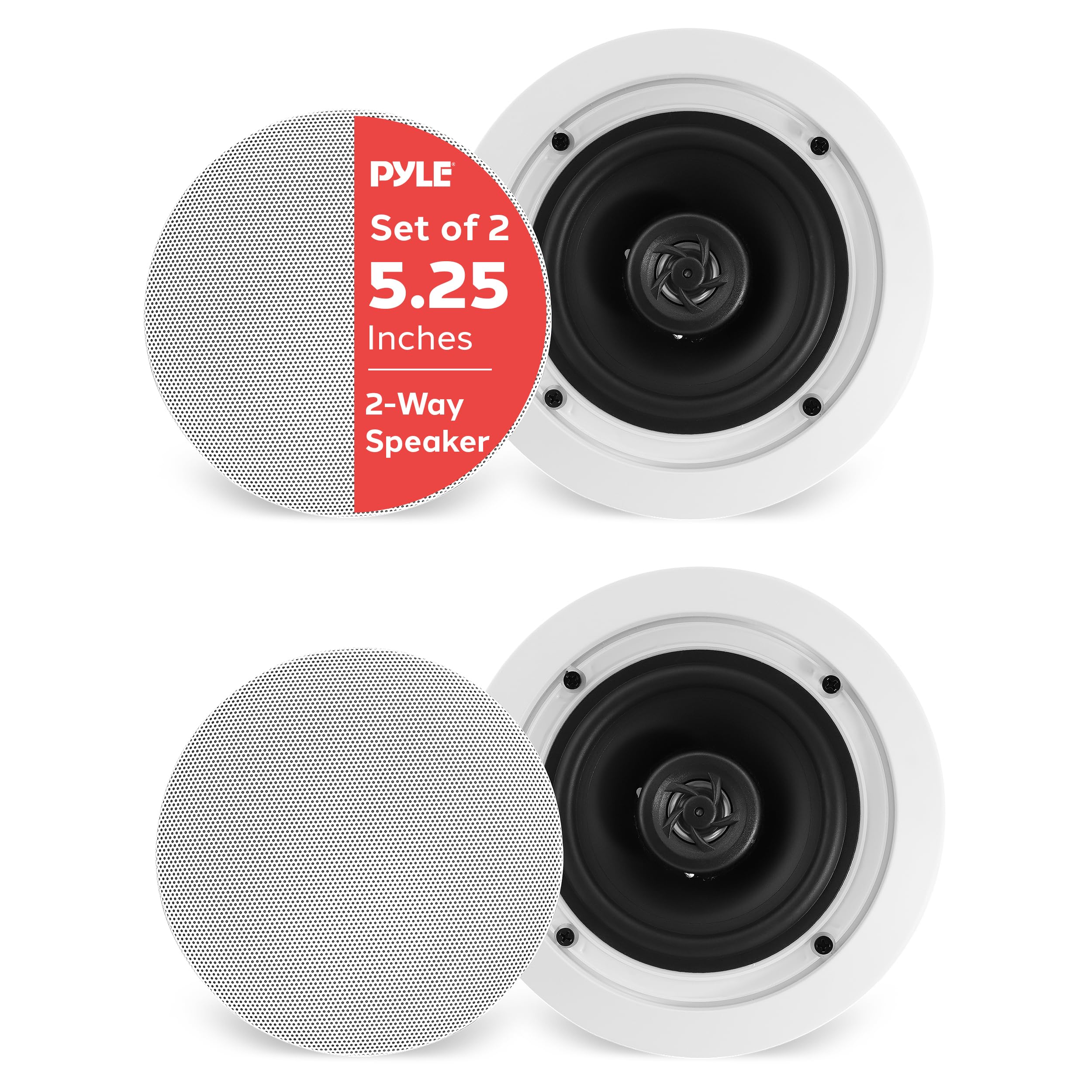
When the ceiling cannot take an 8-inch hole, this is the pair that still fits: a 6.5-inch cutout and 2.6 inches of mounting depth, which gets it into a shallow soffit, a small bathroom, or a hallway where the bigger grilles would look out of scale. Spring-loaded terminals take bare wire, and Pyle includes a cutout template.

Impedance is the number that matters. These are listed at 16 ohms, roughly double the load of every other speaker here, and a 16-ohm speaker draws about half the power from an amplifier rated for 8. They will play, and they will play cleanly, but plan on more amp or accept lower output — this is not the pair for a party.

For a laundry room, a hallway, or the rear channels of a modest surround setup, the smaller drivers are a fair trade for the size. The point of this pair is fitting, not filling a room.

Pros

  • 6.5-inch cutout fits where 8-inch models will not
  • 2.6-inch mounting depth clears shallow bays
  • Spring-loaded terminals take bare wire
  • Lowest price of any pair here

Cons

  • Small 5.25-inch woofer limits output
Our verdict

When the ceiling will not take an 8-inch hole, we fit this pair: a 6.5-inch cutout, shallow mounting depth, and a hallway price.

Check Latest Price

How We Tested the Best In-Ceiling Speakers

Every pick started on paper. We pulled spec sheets for a few dozen models and narrowed to 6.5- and 8-inch drivers that would drop into a standard stud bay, ruled out anything with odd impedance or power ratings for the price, and paid attention to cutout diameter so a reader wouldn't get boxed into an unusual hole size. We also filtered for paintable, low-profile grilles and for models rated for damp or humid rooms, since those are the placements people actually ask about. That left 12 speakers, which we installed and lived with for nine months.

Testing happened in ceilings, not on a bench. Each speaker went into drywall in a living room, a kitchen, a finished basement, or the covered porch off my back deck, and I logged how long the cutout took, whether the mounting clamps grabbed cleanly, and whether the trim sat flush enough to vanish after a coat of paint. One speaker went into a small bathroom where a single stereo unit made more sense than a pair. The porch set stayed up through a wet spring so I could pull the grilles months later and check terminals and cones for corrosion.

For listening, every speaker played the same tracks and the same movie scenes at matched volume — quiet dialogue, a bass-heavy track with no subwoofer in the loop, and a slow walk around the room to hear how the sound held up off-axis. I aimed each adjustable tweeter at the main seat, then away from it, to hear the difference it made. Every grille came off and went back on half a dozen times to see whether paint chipped or tabs bent, and I checked whether the terminals took a single run of wire cleanly and whether bi-wiring was even an option on that model.

Value came last: I went back through my notes and asked whether the pricier speakers actually sounded better in the room where each was installed, or just on the invoice. Some did. A few didn't.

How to Choose In-Ceiling Speakers

Measure the Hole and the Cavity Above It

An 8-inch speaker does not use an 8-inch hole. The 8-inch models here need a cutout between 9.4 and 9.5 inches across, while the 5.25-inch Pyle wants 6.5 inches — a difference that matters when you are matching an existing hole or squeezing between joists. Depth is the other half of the decision: the Klipsch needs 5.4 inches of clearance, the Acoustic Audio only 3.78.

Check both before the drywall saw comes out. A stud finder, a tape measure, and a look into the cavity from a nearby recessed light will tell you more than any spec chart, and shallow soffits, ductwork, or insulation will make the choice for you.

Match the Load to Your Amplifier

Nearly everything here is a passive 8-ohm speaker that any AV receiver or Sonos Amp will drive without complaint. The exception is the Pyle PDIC1651RD at 16 ohms, which draws roughly half the power from an amplifier rated for 8 — fine for a hallway, wrong for a room where you want volume.

Power handling runs from 50 watts maximum on the Polk RC80i to 200 watts on the Klipsch. You do not need to match the figures exactly; a higher rating mostly means more headroom before the sound hardens up when the room is full and the volume is up.

Aim the Sound at Where People Sit

A fixed ceiling speaker fires straight down, which is rarely where the sofa is. A pivoting tweeter — found on the Polk RC80i, Micca M-8C, Micca R-8C, and Pyle PIC8E — lets you tilt the highs toward the seats. The Klipsch goes further and tilts the woofer as well, which is why it is the pick for overhead Atmos channels.

If your seating is off-center or the ceiling vaults away from the listening position, that adjustment does more for the sound than an extra driver size. Mount the speakers, aim them with the grilles off, then finish the ceiling.

Choose a Grille You Can Live With

Magnetic grilles on the Yamaha, Klipsch, and Sonos snap back on from below with one hand. Friction-fit grilles on the Polk RC80i and the Acoustic Audio need a flat palm and patience, and the Acoustic Audio set is the fussiest of the group. Since you will be pulling them off to aim tweeters, set switches, and paint, that difference shows up on install day rather than years later.

Paintability is worth checking too: the Polk, Micca, Klipsch, and Sonos grilles all take ceiling paint. The Yamaha grille reads cream against bright white until you do.

Buy the Number of Speakers You Actually Need

Pairs are the default, but plenty of installs need an odd number — three across the front, or ceiling channels in an Atmos layout. The Micca M-8C, Micca R-8C, and Klipsch are sold singly so you buy exactly what the room needs, while the Acoustic Audio five-pack covers a whole five-channel room in a single order at the lowest per-speaker cost in this group.

Count locations before you order. A spare speaker in a box costs more than the per-unit saving, and a room with five holes needs a plan rather than a pair plus improvisation.

Frequently Asked Questions

Final Verdict

The Polk RC80i is the pair we point most people to, and the reason is breadth: it works in a living room, a bathroom, and a covered porch, it reaches down to 35 Hz, and its tweeter aims. That combination covers the widest range of rooms in this group.

Change the requirement and the pick changes with it. If the install has to go smoothly in a finished room, the Yamaha's magnetic grilles and 140-watt rating make it the better buy. If you are covering a whole floor and paying per speaker, the Micca M-8C sold one at a time is where the money goes furthest.