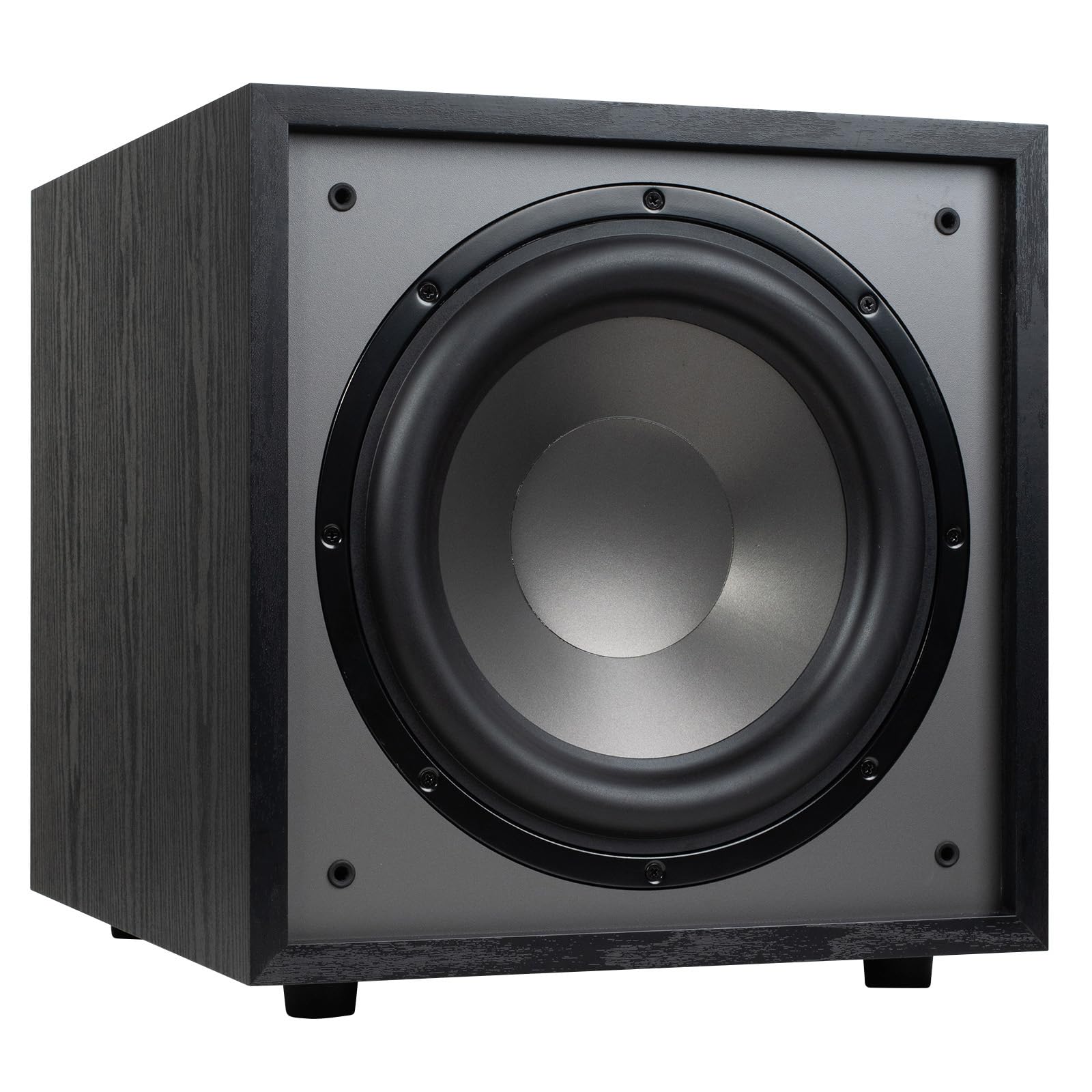
Best Home Theater Subwoofers of 2026

A subwoofer is the one speaker in a home theater you feel before you hear it, which is why the wrong one gives itself away in about ten seconds — usually as a rattle from somewhere behind the couch. The right one hands you the low end of an explosion or a stand-up bass line and then disappears into the corner of the room.

What separates them isn't the wattage printed on the spec sheet. Cabinet volume and tuning decide whether a ported box goes deep and stays clean or huffs through the quiet parts, and a sealed cabinet trades a little depth for tightness. My team and I have spent the past eight months cycling 12 subwoofers through our living rooms — 10-inch boxes tucked beside sofas, a 15-inch brute that demanded its own corner — listening for exactly that difference.

Build quality matters more than most people expect, since a light cabinet buzzes at high volume while a heavy one stays quiet. So does the boring stuff: how the gain and crossover controls feel, whether the auto-on circuit wakes up during a whispered dialogue scene, and whether the thing idles without hum. Below are the ones worth your money, from compact models for smaller rooms to big boxes that shake the floor.

1

Best Overall

Klipsch R-12SW

96 /100
LBD Score Outstanding

Key details

Driver
12 inches
Inputs
Line and LFE
Amplifier
400 watts dynamic
Dimensions
20"D x 20"W x 17.75"H
View on Amazon

A 12-inch driver and 400 watts in a cabinet that costs barely more than the compact 10-inch options — that ratio is the whole argument for the R-12SW, and it is why we point most people building a first real system at it. In use it does what a subwoofer is actually for: it puts weight under a door slam and makes an explosion feel like it happened in the room. We kept waiting for the moment it would sound like it was working hard, and in a normal living-room setup we never got there.

Klipsch's number needs a footnote. That 400 watts is dynamic power, the company's term for short-burst output, while the SVS models on this page publish 325 watts RMS — do not read the two side by side as a leaderboard. What sits on the back panel matters more day to day: line and LFE inputs, a low-pass crossover and a phase switch, which is everything a modern receiver needs and nothing it does not.

Nothing about the cabinet is subtle. It is a big black box with a spun-copper driver behind a removable grille, and the brushed polymer finish and painted plinth hold up better in a living room than the money suggests. If a 12-inch cone in the corner is not the look you want, the grille goes back on and it becomes anonymous black furniture, which is more than some of the premium picks manage.

The detail that surprised us is how little gain it needed. We ended up well below halfway on the dial to fill an ordinary room, and that is the difference between a subwoofer working comfortably and one sitting near its limit. It is also why this one holds together at the volumes people actually use rather than only at the ones they demo.

Pros

  • 12-inch driver and 400-watt amplifier at a low price
  • Deep, physical output for movie soundtracks
  • Line and LFE inputs with crossover and phase controls

Cons

  • No app, DSP or room-correction tuning
  • 20 inches deep, so it needs real floor space
Our verdict

This is the subwoofer we recommend to most people building a home theater: 12 inches, plenty of output for film soundtracks, for barely more than the compact picks.

Check Latest Price
2

Best for Large Rooms

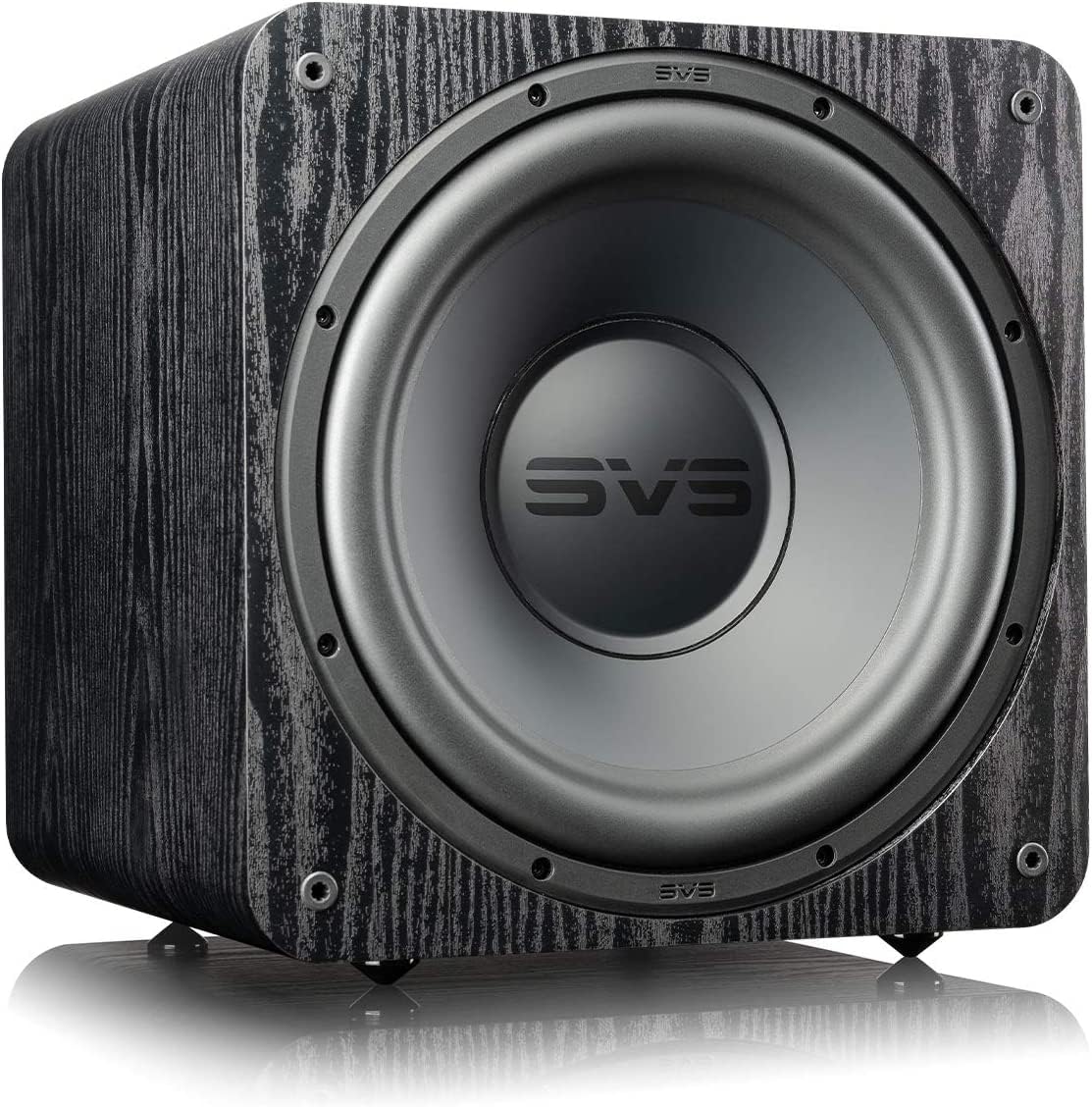
SVS PB-1000 Pro

91 /100
LBD Score Outstanding

Key details

Driver
12 inches
Control
SVS smartphone app
Amplifier
325 watts RMS
Enclosure
Ported, dual port
View on Amazon

The most expensive subwoofer here by a wide margin, and worth explaining. What the money buys is headroom and control: a 325-watt RMS Sledge amplifier rated above 800 watts peak, a dual-ported cabinet, and a 12-inch driver built for long excursion with the motor assembly to match.

The ports are the part that matters for film. A ported box gives more output in the 20-to-40 Hz octave than a sealed one of the same size, and that octave is where a lot of the physical sensation of a movie lives — the rumble under an engine, the pressure in a big reveal. We came away from the heaviest set pieces feeling the cabinet still had something in reserve.

The app is the feature we ended up using most. Volume, crossover, parametric EQ and presets all live on your phone, so you can adjust from the listening position instead of crawling behind the cabinet with a flashlight. The DSP does real work: both 1000 Pro models share this amplifier platform, and the app's room-gain control is what lets either of them settle into an ordinary living room rather than a treated one.

The cost is floor space. At 20 inches wide and nearly 19 tall it does not hide, and it wants a corner or at least a wall. Worth saying plainly: this is a sub for a room with volume to fill. In a big open basement it is transformative; in a small den you are paying for output the space cannot use, and the sealed model is the better spend.

Pros

  • Dual-ported cabinet for deep film output
  • 325W RMS with 800-plus watts of peak headroom
  • Full app control of volume, EQ and presets
  • Rated down to 20 Hz

Cons

  • The most expensive subwoofer in this group
Our verdict

For a genuinely large room and a real budget, this is the deepest, most controllable bass in the group, and the app tuning is worth part of the premium.

Check Latest Price
3

Best Sealed Design

SVS SB-1000 Pro

92 /100
LBD Score Outstanding

Key details

Driver
12 inches
Amplifier
325 watts RMS
Enclosure
Sealed
Dimensions
13"D x 14.76"W x 13.5"H
View on Amazon

Sealed cabinets are the quiet overachievers of subwoofer design. Without a port, the driver works against the air trapped in the box, which costs some output at the very bottom and gives back quicker decay and a cabinet you can actually fit into a room. The SB-1000 Pro is the clearest example of that trade here: a 12-inch driver and the same 325-watt Sledge amplifier as its ported sibling, in a box 13.5 inches tall.

At 14.76 inches wide it goes places the ported models cannot — beside a sofa, into the gap either side of a fireplace, under a console with clearance. That is a stronger argument than it sounds, because the best subwoofer is the one you can put where it sounds right, not the one with the biggest number on the box.

The amplifier and DSP carry over from the ported model, so app control is here too: volume, crossover, parametric EQ and presets, all from your seat. That matters more on a sealed sub, because with less output at the very bottom a small correction goes a long way — trimming a room bump can do more for the sound than moving the furniture ever will.

What it will not do is move air the way the PB-1000 Pro does. If your theater room is large and your reference is the rumble of a science-fiction soundtrack, the ported model is the one to stretch for. For music-led systems, and for rooms where the sub has to live among the furniture rather than in a corner of its own, this is the better-balanced buy of the two.

Pros

  • Sealed cabinet gives tight, quick bass
  • 12-inch driver in a 13.5-inch-tall cabinet
  • App control with parametric EQ and presets
  • Same 325W amplifier as the ported model

Cons

  • Less deep-bass output than the ported version
Our verdict

For music-first systems and rooms where a big ported box will not fit, this is our pick: sealed-cabinet accuracy and 12-inch depth in a 13.5-inch-tall box.

Check Latest Price
4

Best Midrange Pick

Polk Monitor XT12

87 /100
LBD Score Excellent

Key details

Driver
12 inches
Inputs
RCA and LFE
Warranty
5 years
Amplifier
100 watts, Class A/B
View on Amazon

On paper, 100 watts looks like a misprint next to the 200- and 325-watt figures elsewhere on this page. In a room the Monitor XT12 does not read that way: the 12-inch Dynamic Balance woofer and a braced MDF cabinet do more with those watts than the number suggests, and an action scene lands with a punch that makes you check where the gain is set.

The enclosure is doing a lot of that work. Polk braces the cabinet and fits a precision grille designed to let the driver move without the box joining in, and the result is bass that stays composed as you turn it up. The difference shows most in sustained low passages — a rolling score rather than a single explosion — where a rattly cabinet gives itself away.

Where it sits in this group is the middle: less output per dollar than the Dayton, less absolute depth than either SVS. What it has instead is a five-year warranty, an LFE input plus line-level RCA, and a variable crossover that makes blending with the speakers you already own straightforward. It is the pick for someone who wants a known name, long cover and a 12-inch driver without paying premium money.

For a first proper theater in a spare bedroom or a basement rec room, it is the least fussy way to get a big driver and a long warranty in one purchase. It is also part of Polk's Monitor XT speaker line, so if you are buying the rest of the system at the same time, the family match is a genuine tiebreaker.

Pros

  • Braced MDF cabinet resists rattle at volume
  • Five-year warranty
  • LFE plus line-level inputs and variable crossover

Cons

  • Modest 100-watt amplifier for the money
  • 39 pounds, and it needs a sturdy spot
Our verdict

A well-built 12-inch for the middle of the market: braced cabinet, five-year warranty, and more punch than 100 watts suggests.

Check Latest Price
5

Best Value

Dayton Audio CS1200

90 /100
LBD Score Outstanding

Key details

Driver
12 inches
Inputs
RCA, LFE, speaker-level
Warranty
5 years
Amplifier
200 watts Class D
View on Amazon

The CS1200 makes its case in two numbers: 200 watts of Class D power into a 12-inch driver, and a five-year warranty. Both are unusual near the bottom of this group's price range, and the warranty is the one we care about more — the amplifier is what fails in a subwoofer, and five years of cover on a budget cabinet is a real commitment from the maker.

The rating that surprised us is the low end: 26 Hz. That is a lower figure than any non-SVS subwoofer here publishes, and it lines up with what the sub does in a room — the deep material under a soundtrack is present and reasonably clean rather than merely implied. It is not the last word in grip; the SVS models keep individual bass notes separate in a way this one does not quite manage.

Dayton also thought about installation. Stereo RCA, an LFE input and speaker-level inputs cover almost any receiver or stereo amp, auto-on means it wakes with your system and sleeps afterwards, and the grille pops off and can be swapped for a gray one if black is not your thing. That auto-on detail matters more than it sounds: a sub with a manual switch means reaching behind the cabinet every time you watch something, and eventually you stop doing it.

What it does not have is sophistication — no app, no DSP, no parametric EQ. Two knobs and a switch is the entire interface, and for most people that is completely fine. The other thing to weigh is the badge: Dayton does not carry the recognition of Klipsch or Polk, so if you want a name you have heard of, that is the honest argument against it.

Pros

  • 200W Class D driving a 12-inch woofer
  • Five-year manufacturer warranty
  • Auto-on plus RCA, LFE and speaker-level inputs

Cons

  • Tuning is knobs only, with no app or DSP
Our verdict

We think it is the best bass-per-dollar here: 200 watts, a 12-inch driver rated to 26 Hz, and a five-year warranty.

Check Latest Price
6

Best for Small Rooms

Klipsch Synergy Sub-100

92 /100
LBD Score Outstanding

Key details

Width
12.5 inches
Driver
10 inches
Inputs
RCA
Amplifier
150W continuous, 300W dynamic
View on Amazon

At 12.5 inches wide this is the narrowest cabinet in the group — narrow enough to sit between a sofa and a wall, or beside a bookshelf without eating the walkway. That is why it is here, and in a small room it is not a compromise so much as the right answer: you get bass you can feel without giving up floor you do not have.

With 150 watts continuous and 300 dynamic behind a 10-inch spun-copper woofer, it plays louder than the cabinet suggests. The removable grille is a small thing that turns out to matter: the copper cone is either the reason you bought it or the reason you want it covered, and Klipsch lets you decide depending on taste and who else lives there.

Judged against its job, it does it well. In a den or a bedroom it produces a genuine low end rather than a mid-bass thump, and it does it without the cabinet announcing itself — the kind of bass you notice in the room rather than from the hallway.

Klipsch backs it with five years on parts and labor, the same cover Dayton and Polk give their 12-inch models, and that is worth something in a category where amplifiers are the usual failure. It is also the least expensive subwoofer on this page, which for a second room, a first apartment or a bedroom setup is the whole argument.

Pros

  • Narrowest cabinet here at 12.5 inches
  • 150W continuous with 300W dynamic
  • Five-year parts and labor warranty

Cons

  • Runs out of headroom in open, high-ceilinged rooms
Our verdict

For a den, bedroom or apartment living room, this is the compact pick: 12.5 inches wide, 300 watts of dynamic headroom, and real bass from a small box.

Check Latest Price
7

Tight 10-Inch Bass

Yamaha NS-SW100BL

91 /100
LBD Score Outstanding

Key details

Port
Twisted Flare Port
Driver
10 inches
Amplifier
100 watts
Dimensions
18.85"D x 20"W x 18.6"H
View on Amazon

Yamaha has been building subwoofers long enough that its budget models get judged on tone rather than muscle, and the NS-SW100BL fits that reputation. Its Twisted Flare Port — a tube whose flare is twisted along its length — smooths the airflow at the mouth and cuts the chuffing that ported boxes make when the driver is pushing hard.

Advanced YST II works the same problem from the amplifier side, keeping the amplifier's output corrected as the cone moves so the driver stays under control at higher excursions. In our listening that came through as bass with shape: notes had pitch and edges rather than arriving as one uniform thump.

Floor space is the thing to check. At 20 inches wide and 18.85 inches deep, the Yamaha is a bigger box than a 10-inch driver implies — as wide as the Klipsch R-12SW, which houses a 12-inch woofer. Set against that, it blends easily: it works with a range of receivers and with soundbars, which is not a given at this size.

We came away thinking of it as the most polite subwoofer here, and that is meant as praise. The limit is scale: 100 watts and a 10-inch driver will not pressurize a large room, and it does not pretend to. What it will do is make a small room sound bigger than it is, at volumes that stay inside your own walls — a real virtue in an apartment.

Pros

  • Twisted Flare Port keeps port noise down
  • Tight, musical 10-inch sound
  • Plays well with receivers and soundbars

Cons

  • No auto-on; the power switch is on the back panel
Our verdict

For music-led systems in modest rooms, this is the cleanest-sounding 10-inch here, and it blends with receivers and soundbars alike.

Check Latest Price
8

Very Large Rooms

Cerwin-Vega XLS-15S

80 /100
LBD Score Excellent

Key details

Driver
15 inches
Amplifier
250 watts RMS
Dimensions
22.9"D x 17"W x 24.1"H
Rated Response
40Hz-300Hz LFE (+/-3dB)
View on Amazon

Fifteen inches of woofer is a different proposition from twelve. The XLS-15S moves more air with less excursion, which is why it sounds relaxed at levels that have smaller subs working hard, and why it suits a large room or a dedicated theater space where bass is supposed to be felt through the floor.

The cabinet is the giveaway. It stands 24.1 inches tall, runs 22.9 inches deep and 17 wide, and it does not hide behind anything — this is furniture-sized, and it is a two-person job once it is in place. Plan where it goes before it arrives rather than after.

Here is the number that matters, though. Cerwin-Vega rates the LFE response at 40 Hz to 300 Hz, which makes the XLS-15S a mid-bass and impact specialist rather than a subsonic one. The Dayton and the Klipsch are rated lower, and both SVS models go deeper still. What you get in exchange is chest-thump at volume: kick drums, gunfire, the physical crack of an explosion.

For the right room it is genuinely entertaining, and the ease with which it makes impact is the point — nothing else here sounds this unbothered at high levels. It is also a specialist in the way it pairs: it is designed to sit with Cerwin-Vega's own XLS-series speakers, so if you already own a set of those, that match is the reason to choose it over anything else on this page.

Pros

  • 15-inch driver delivers big, easy impact
  • 250W RMS amplifier built in
  • RCA input works with any receiver's sub output

Cons

  • Two-year warranty at the top of the price range
Our verdict

For a big room and a taste for physical, chest-level impact, this 15-inch sub delivers — just do not expect it to plumb the deepest octave.

Check Latest Price

How We Tested the Best Home Theater Subwoofers

We started with a shortlist of roughly 30 subwoofers and cut it down by cabinet type, driver size, amplifier class, connection options, and footprint, since a subwoofer has to fit a real room and not a showroom. Twelve of them came home with us for eight months. They lived in living rooms and a finished basement, wired to both TVs and two-channel stereo setups, and we used them the way anyone would: movie nights, weekend playlists, and more than a few late-night games.

Every subwoofer got the same three scenes at matched volume — a depth-charge explosion, a walking acoustic bass line, and a low synth sweep — and we walked the room to find where the bass fell off and where it piled up in a corner. Then we pushed each one toward reference level and listened for port chuffing, cabinet rattle, and driver strain, with a hand flat on the top panel to feel how much the box was buzzing.

The controls got their own pass. We ran each sub through its full gain and crossover range in steps to see how much of the dial was actually usable, then left it running overnight at low volume to check whether the auto-on circuit woke up for quiet dialogue or let the bass drop out mid-scene. With nothing playing, we listened for transformer hum; with everything playing, we compared how each one handled music versus film, and whether the jump in power and price bought anything you could hear.

How to Choose a Home Theater Subwoofer

Start with the room, then pick the cabinet

Room volume is the constraint nothing else gets around. A large ported sub in a small den overpowers the space and is hard to blend; a compact 10-inch in an open-plan basement runs out of headroom before the film does. As a working map: dens, bedrooms and apartments suit a compact design like the Klipsch Sub-100; medium rooms are the sweet spot for a 12-inch like the Klipsch R-12SW or Dayton CS1200; large, open or dedicated theater rooms are where the ported SVS PB-1000 Pro and the 15-inch Cerwin-Vega earn their keep.

Measure the floor before you order. The R-12SW is 20 inches deep and 20 wide, which is a real commitment behind a sofa, while the sealed SVS SB-1000 Pro is under 15 inches wide and 13.5 tall. Depth is the dimension people forget.

Ported or sealed

A port is a tuned tube that uses the air in the cabinet to reinforce output near its tuning frequency, so for the same driver and money a ported box gives more bass in the 20-to-40 Hz region. That is why most home theater subwoofers are ported. Sealed cabinets give up some of that output in exchange for a gentler roll-off, quicker decay and a smaller box — the SVS SB-1000 Pro is the clearest example on this page.

If your listening is movies first and the room is medium-to-large, ported is the safer bet. If it is music first, or the sub has to live among the furniture, sealed is worth the trade.

What the wattage number actually means

Subwoofer amplifiers are rated on at least three different bases — continuous or RMS, peak, and dynamic — and they are not interchangeable. One pick here quotes 400 watts of dynamic power, another 250 watts RMS, another 100 watts from a Class A/B design. A 400-watt dynamic rating is not four times a 100-watt one in any meaningful sense, so don't rank the products by the figure on the front of the box.

What power buys is headroom: the ability to play a demanding passage without the amplifier clipping. A well-built 100-watt subwoofer can sound cleaner than a cheap 300-watt one, which is why the driver and cabinet matter more than the amplifier rating alone.

Inputs, controls and what your receiver can do

Any receiver with a subwoofer pre-out can drive every subwoofer here through a single RCA cable into the LFE input. If you are running a stereo amplifier with no subwoofer output, you need speaker-level inputs, and the Dayton CS1200 is the pick here that lists them.

Beyond connection, the controls you will actually use are gain, crossover and phase. Set the receiver's crossover where your main speakers roll off, then adjust the sub's gain until it disappears into the mix. App-based DSP, as on both SVS models, adds parametric EQ and presets — worth paying for mainly if your room has an obvious boom that placement cannot fix.

Placement and setup

Corner placement reinforces the lowest frequencies; moving a subwoofer a third of the way along a wall usually trades a little output for a smoother response, and it costs nothing to try. Leave a few inches behind a rear-ported cabinet so the port can breathe, and keep rugs and furniture clear of a down-firing driver.

Once it is placed, run your receiver's calibration and then trim the sub's own gain by ear. Every cabinet here is bigger in person than it looks in a product photo, so the practical step is to mark out the footprint on the floor before the box arrives.

Frequently Asked Questions

Final Verdict

The Klipsch R-12SW is the subwoofer we recommend to most people, because it delivers what a home theater actually needs — weight, depth and enough output to make a soundtrack physical — without the premium price of the SVS pair. If your room is genuinely large and the budget stretches, the PB-1000 Pro is the better long-term buy, and if you want the most bass for the least money with a five-year warranty behind it, the Dayton CS1200 is the quiet winner.

One thing holds for all of them: measure the space before you order, because every cabinet here is deeper in person than it looks on a spec sheet.