Best Cordless Soldering Irons of 2026

Soldering usually starts as a cord problem. The first time I tried to repair a broken wire under a car dashboard, I spent ten minutes feeding an extension cord over the fender, another five trying to persuade the iron to reach the harness, and then gave up. A cordless iron fixes that one specific thing beautifully: the tool goes to the wire instead of the wire coming to the tool. It also adds a new worry, because the heat now has to come from a battery or a fuel cell, and a weak one quits halfway through a joint.

I've used bench irons for years, and the cordless ones taught me something I didn't expect. Heat-up time gets all the attention, but tip reach and heat recovery decide whether you finish the job — a three-second claim means nothing if the tip is too fat to land on a PCB pad. We've run 12 of these for six months, from bare tools that borrow a power-tool battery to USB-C rechargeables and one butane model, and the difference between the satisfying ones and the infuriating ones lives in exactly those details. What follows is the short list I'd keep within arm's reach.

1

Best Overall

Milwaukee M12 Soldering Iron

91 /100
LBD Score Outstanding

Key details

Power
Milwaukee M12 battery (bare tool)
Tip Changes
Tool-free
Heat-up Time
18 seconds
Max Temperature
750 °F
View on Amazon

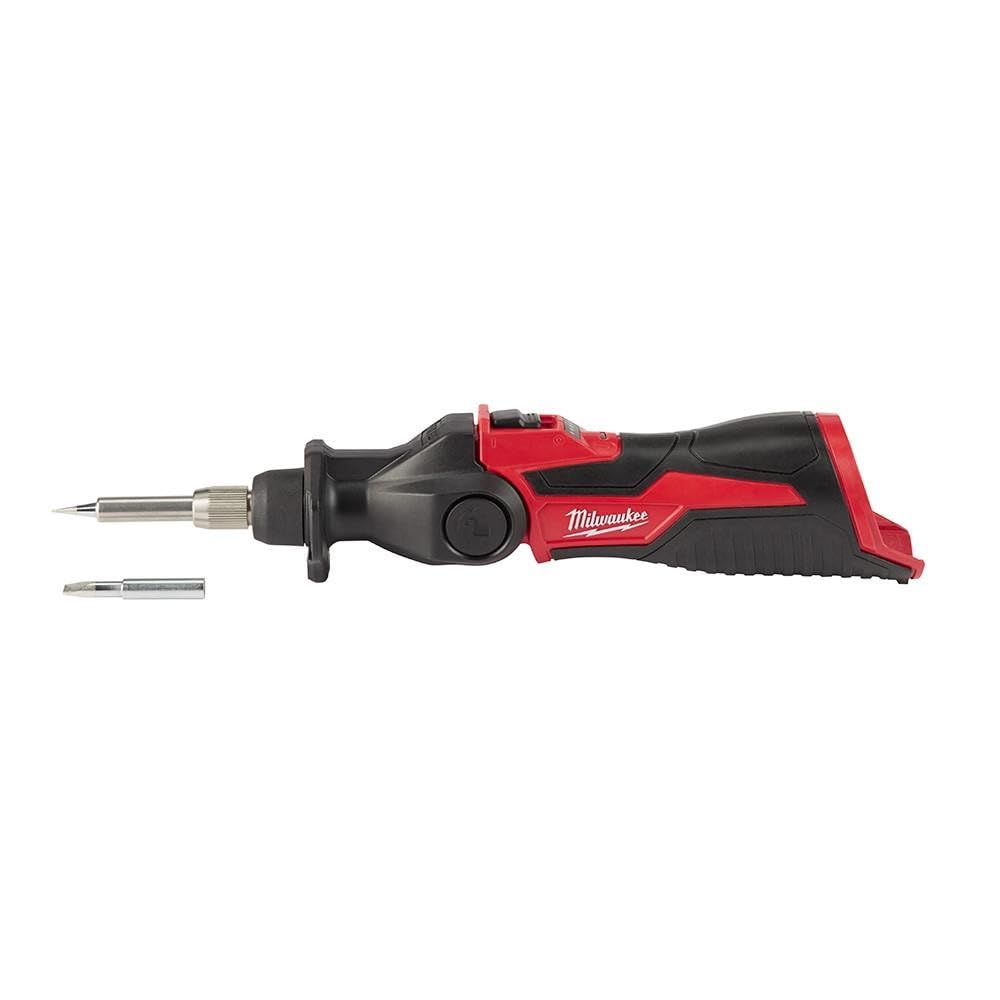
Eighteen seconds from cold to soldering is the number that settled this one for us. The M12 is the only purpose-built soldering pencil in this group — not a torch with a tip screwed onto it, not a kit with a soldering mode — and with a 90-watt element holding an optimized temperature, it works like a bench tool that happens to have no cord. On through-hole work and auto wiring, we never stood around waiting for it.

Two details earned their keep on real jobs. The head pivots through three positions, which lets you angle the tip into a connector you can't see straight on, and tips swap without tools — chisel for a splice, pointed for a pad. We changed profiles mid-repair more than once and lost seconds, not minutes.

The pack is the handle and the base here, so a compact M12 battery leaves it sitting less steadily on the bench than a larger one; we kept a bigger pack on ours for exactly that reason. Worth planning your pack choice around if the iron is going to live beside a project rather than in a bag.

Where it gives ground is sheer heat. A 750 °F ceiling is the lowest in this group — comfortable for leaded solder and ordinary joints, tighter for lead-free work on a big ground plane or heavy gauge wire. That's the one job where we reach for the butane kit or the 120-watt Ryobi instead.

Pros

  • 18-second heat-up keeps bench work moving
  • Pivoting head reaches awkward connectors
  • Tool-free tip changes mid-job
  • Holds an optimized temperature under load

Cons

  • Bare tool: pack and charger sold separately
  • 750 °F ceiling is the lowest in this set
Our verdict

If you already own M12 packs, this is the one to buy: 18-second heat, tool-free tip changes, and a pivoting head that reaches what a straight pencil can't.
Check Latest Price
2

Best for DeWalt Battery Users

QSDXNYDC DeWalt 20V Iron

91 /100
LBD Score Outstanding

Key details

Battery Fit
DeWalt 20V MAX (batteries not included)
Heat-up Time
8 seconds to 350 °C
Charging Ports
USB-C and USB, 5V 2A
Max Temperature
480 °C
View on Amazon

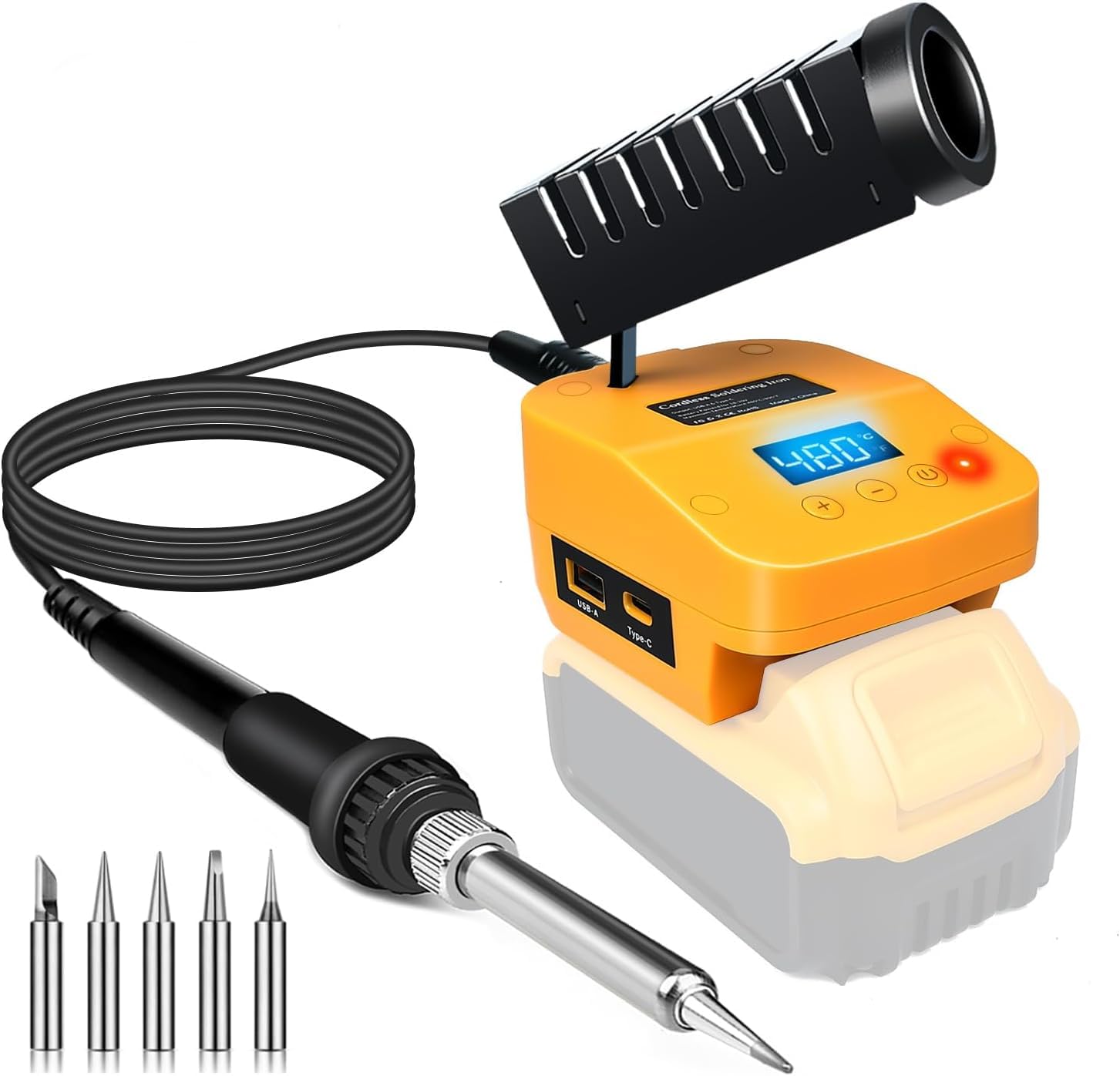
Per dollar this is the cheapest honest route into cordless soldering, and the honest part matters: it's a 60-watt station that climbs to 350 °C in about eight seconds and holds a set temperature, not a toy shaped like an iron. If your truck is already full of yellow packs, there's very little reason to look anywhere else.

We rate it the best value in this group for a plain reason — the heat arrives fast enough to be useful, the dial stays where you put it, and the memory function means you're not dialing a temperature in every time you switch it on. The iron parks in its own holder and the pack sits low, so the whole thing has a stable footprint on a bench or a tailgate.

The compatibility list is specific and worth checking before you order: the listing names the DeWalt pack numbers it keys into, so match your battery's model rather than assuming any 20V MAX pack will fit. The USB-C and USB-A ports run at 5V 2A, which is a phone-in-a-pinch trickle rather than fast charging.

The 480 °C ceiling is the highest here alongside the Ryobi, which makes heavy wire and big connectors fair game; the trade is low-end finesse, because this is not a board-level iron. For a trailer harness, an ATV, or a junction box in a cold garage, it earns its place in the toolbox.

Pros

  • Eight seconds to 350 °C
  • Remembers your last set temperature
  • 480 °C ceiling handles heavier wire
  • Built-in holder for the hot iron

Cons

  • Batteries and charger sold separately
  • USB ports charge at a slow 5V 2A
Our verdict

Fast heat, a temperature you set and forget, and a 480 °C ceiling — the value pick for anyone already loaded with DeWalt 20V packs.

Check Latest Price
3

Best All-In-One Kit

ANBES Cordless Soldering Kit

90 /100
LBD Score Outstanding

Key details

Battery
18,000 mAh built-in
Power Modes
30W battery / 75W PD
Heat-up Time
3 seconds
Max Temperature
896 °F
View on Amazon

If you don't own a tool battery platform and have no intention of starting one, this is the kit that closes the gap: the iron, three C210 tips, a stand, and an 18,000 mAh battery, charged over USB-C or dropped onto its own wireless stand.

What we liked is the friction it removes. Three seconds to heat means you stop planning around warm-up, the LCD shows set temperature and remaining charge in the same glance, and the silicone sleeve keeps the grip comfortable through a long session. The gravity sensor puts it to sleep when you set it down, the sort of thing you only notice when a tool lacks it.

Temperature control is the part to understand before you buy. The adjustment holds a setpoint usefully through the middle of its range, but at the extremes it behaves more like on-or-off than a smooth dial, so you find your working temperature and stay there rather than dialing in fine steps.

The cell is genuinely generous for the size of the tool, and it's why this one suits an evening of intermittent work rather than a single repair. It's a kit for someone who wants one purchase to cover soldering, and it earns that.

Pros

  • Three-second heat-up
  • Display shows temperature and charge left
  • Charges over USB-C or on its own stand
  • Everything needed arrives in one purchase

Cons

  • 30W on battery is modest for heavier joints
Our verdict

Everything in one purchase — three-second heat, a readable display, and an 18,000 mAh battery — for anyone who doesn't want to start a battery platform.

Check Latest Price
4

Best for Fine Board Work

FNIRSI HS-03

87 /100
LBD Score Excellent

Key details

Weight
4.8 oz
Battery
2600 mAh
Heat-up Time
3 seconds
Temperature Range
212–842 °F
View on Amazon

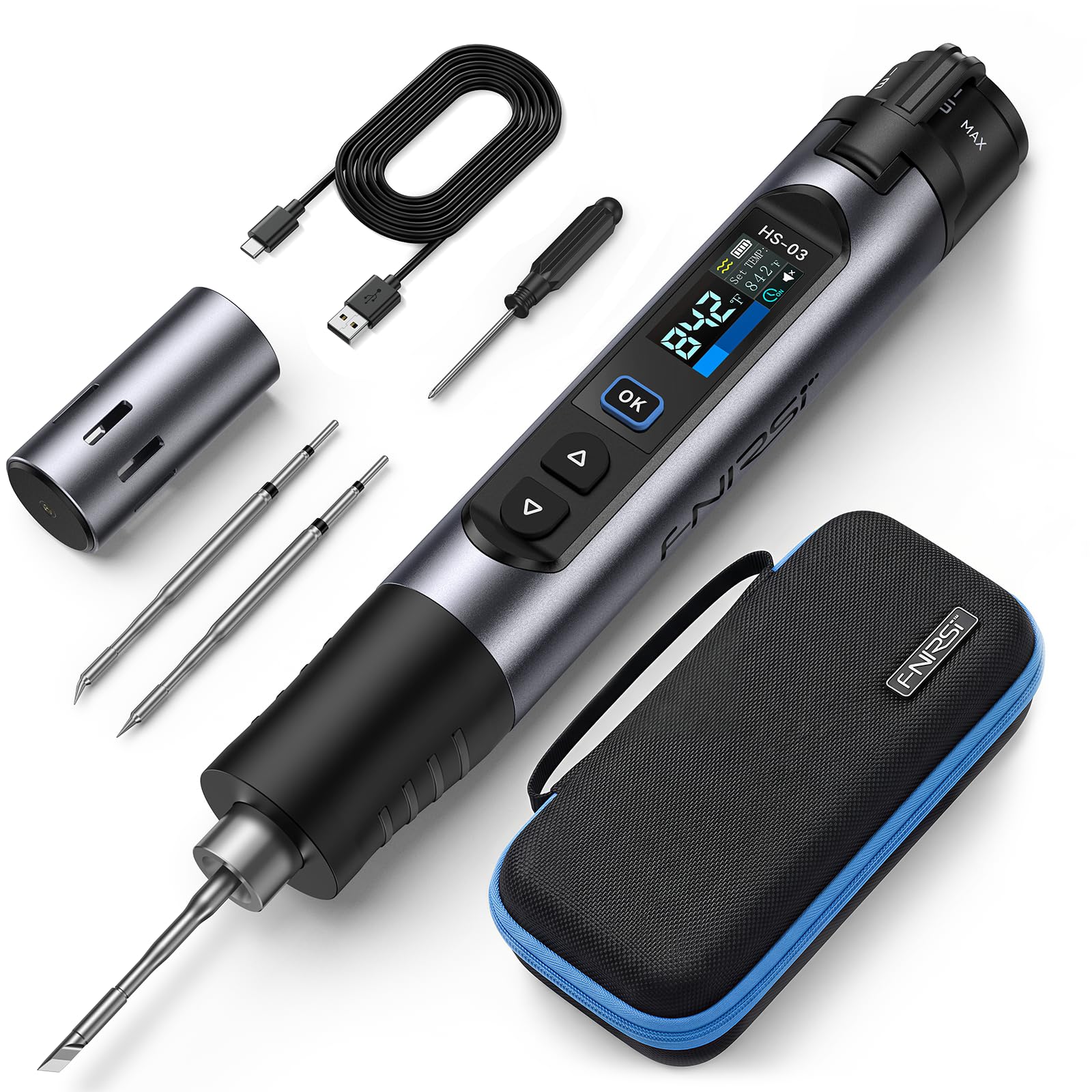
At 4.8 ounces this is the lightest iron here, and the detail we didn't expect to care about is a left/right hand mode that flips the screen so a left-hander can read it without rolling the tool over.

What it's built for is fine work. The 212 °F floor is the lowest in this group and makes heat-sensitive boards and small components far less nerve-racking than an iron that starts at 390 °F. Five preset levels cover the everyday jumps, the buttons trim in small increments, and the K, I, and IS tips swap without tools. Three seconds to heat means leaving it in sleep costs nothing.

In the hand it's the least tiring of the rechargeables — the contoured silicone grip and the light body mean you steer with your fingertips rather than your wrist, and the little IPS screen is legible at arm's length. The storage bag keeps the tips and the iron together, which matters more than it sounds when the alternative is hunting through a drawer.

The cell is what you trade for the size. You charge this iron rather than swapping a fresh pack into it, so a long session has a ceiling the tool-platform irons don't. For pads, headers, connectors, and 3D-print cleanup, that's a trade we made happily.

Pros

  • 212 °F starting point suits delicate boards
  • 4.8 ounces in the hand
  • Left/right hand mode flips the screen
  • Tool-free tip swaps among three profiles

Cons

  • 10-watt rating is for fine work, not heavy wire
Our verdict

The fine-work specialist: a 212 °F floor, tiny tips, and under five ounces in the hand, with a battery that suits a session rather than a shift.

Check Latest Price
5

Best Butane

Berkling BSG-568

90 /100
LBD Score Outstanding

Key details

Runtime
Up to 90 minutes
Functions
Soldering iron, heat gun, micro torch
Refuel Time
20 seconds
Included Tip
1.6 mm conical
View on Amazon

Butane answers a different question. No outlet, no pack, no charger: fill the tank, click the ignition, and you're soldering in a driveway, up a ladder, or in a barn. The BSG-568 does it with a 90-minute tank and a 20-second refill, a rhythm no rechargeable here can match.

It's also three tools in one body. Fit the heat-gun head and it shrinks tubing; pull the tip and it's a micro torch for a rusted fastener. The flame adjusts across a wide range, and the heat it puts into a splice will handle wire that would stall a small battery iron.

We liked it best as the second iron — the one that lives in a toolbox for the job that isn't at the bench. The self-igniter lit on the first click and held, the safety cap means it can go back in a bag while it's still warm, and at 8.27 inches it fits where a corded iron and an extension cord never would.

The tips are the running cost, and they wear faster than a temperature-controlled iron's: sustained heat on heavier wire will burn one out mid-job. Buy spares with the kit, keep the flame as low as the joint allows, and it earns its place.

Pros

  • No outlet, battery, or charger needed
  • 90-minute tank refills in about 20 seconds
  • Soldering iron, heat gun, and torch in one
  • Safety cap for warm storage

Cons

  • Heat is set by flame, not a temperature dial
Our verdict

Keep it in the toolbox for work away from an outlet: a 90-minute tank, a 20-second refill, and three tools in one body.

Check Latest Price
6

Precision Hobby Work

Fanttik T1 Max

88 /100
LBD Score Excellent

Key details

Battery
2600 mAh
Tips Included
4 C210 tips
Temperature Range
390–840 °F
Temperature Levels
6
View on Amazon

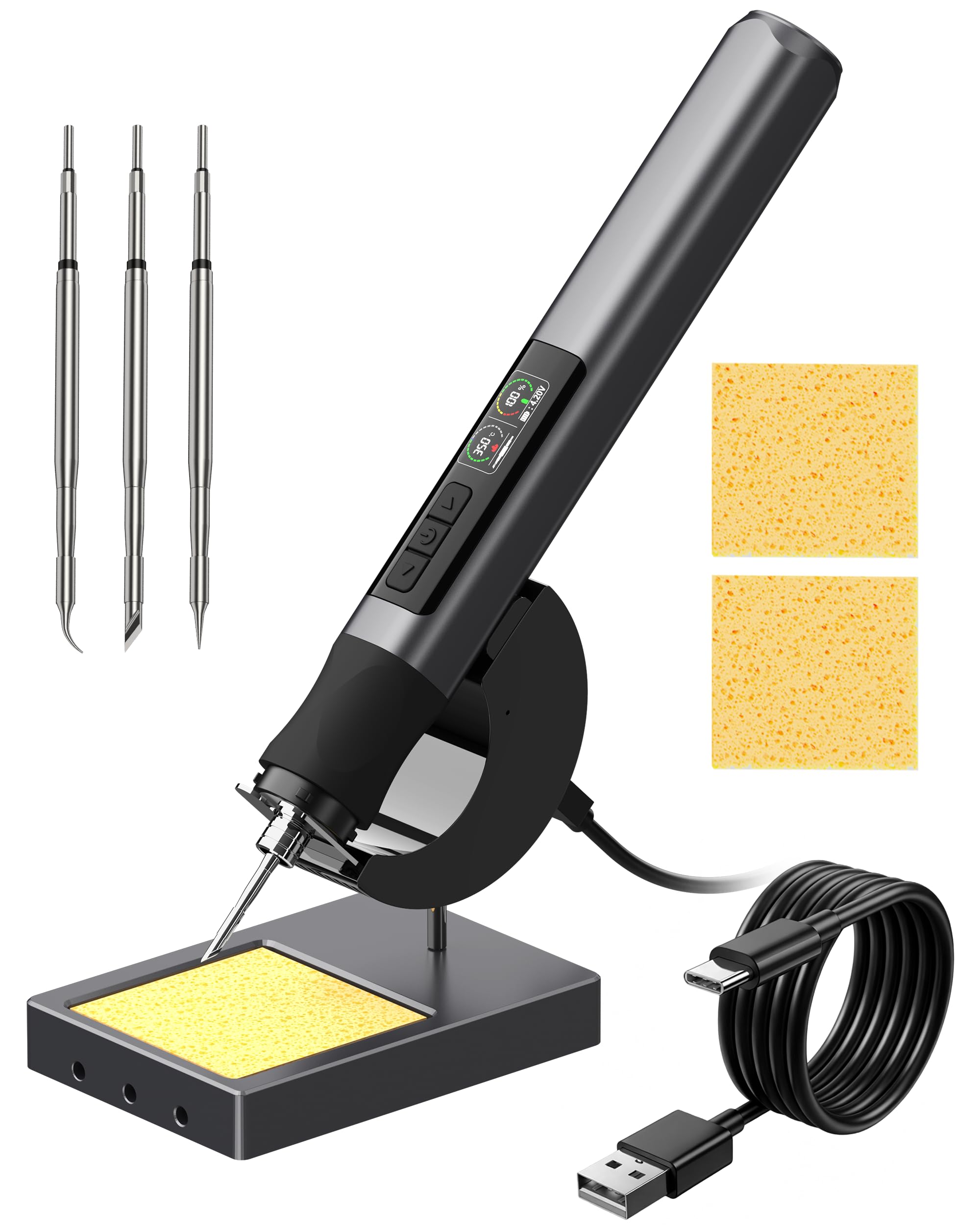
The T1 Max is the best-looking iron here: an aluminum body, six temperature steps on a tail knob, and a stand whose base tray presses open to hold tips. It's the one that looks like it belongs on a bench rather than in a toolbox.

Under the finish it's a precision tool. Four C210 tips come in the box, the range runs 390 to 840 °F across those six levels, and it's rated for about an hour at the top of that range from the 2600 mAh cell. Gravity sensing drops it into sleep after 30 seconds and it wakes at the temperature you left it.

Where it comes apart is power. The 12 watts it manages on its own battery is the lowest here, so heavy wire and big pads are out — this is a board iron, and a good one, but not a general-purpose one.

What the premium buys is the finish, the stand with its pop-up tip tray, the four-tip assortment, and the accessories — tweezers, a desoldering pump, sponges — rather than more heat. Choose between this and the cheaper rechargeables on that basis: if the work is small and you want the tool to feel like something, this is the one; if you need to move heat into a joint, it isn't.

Pros

  • Four C210 tips in the box
  • Stand with pop-up tip tray
  • Wakes at the temperature you left
  • Tweezers and desoldering pump included

Cons

  • 390 °F floor is high for delicate work
  • 30-second sleep can cut in mid-joint
Our verdict

Buy it for the finish and the four fine tips, not for power: the most polished board iron here and the least suited to heavy joints.

Check Latest Price
7

Ryobi Battery Users

RYOBI ONE+ Soldering Topper

85 /100
LBD Score Excellent

Key details

Battery
Ryobi ONE+ 18V (tool only)
Wattage
120 watts
Heat-up Time
Under 90 seconds
Temperature Range
400–900 °F
View on Amazon

One hundred and twenty watts is a lot of soldering iron, and it's the reason the Ryobi topper handles jobs the small rechargeables can't: automotive wire, battery cables, the bigger connectors.

The design is unusual. The iron sits at the end of a three-foot lead from a ONE+ pack, which keeps the weight out of your hand and leaves the pack, with its charge gauge, on the bench beside you. Heat is set on a dial from 400 to 900 °F, and a light on the body tells you heating, ready, or cooling without you going near the tip.

Tips are the quiet win. The mount takes the common T18 pattern, the same family as the Hakko FX-888, so the profile you want is easy to find and cheap to replace — from fine conical to a broad chisel.

The trade is time: under 90 seconds to heat is the slowest here by a wide margin, and on a dozen small joints in a row the waiting adds up in a way it doesn't on a single trailer repair. Where there's no outlet and the joints are big, none of that matters.

Pros

  • 120 watts for heavy wire and connectors
  • 400–900 °F dial with status light
  • Takes widely available T18 tips
  • Pack carries the weight, not your hand

Cons

  • Iron is tethered to the pack by a three-foot lead
Our verdict

For anyone already on the ONE+ platform, 120 watts, a 900 °F ceiling, and cheap T18 tips make it the heavy-wire specialist here.

Check Latest Price
8

Emergency Kit

Weller WLIBAK8

83 /100
LBD Score Excellent

Key details

Power
AA batteries
Wattage
6W / 8W
Warranty
7 years
Heat-up Time
38 seconds
View on Amazon

Four AA cells and a 38-second heat-up: the WLIBAK8 is the only iron here you can feed from a gas station, and that's exactly the job it's good at.

Where it earns its place is small work — thin wire, small terminals, a broken toy, a trailer light. It gets there with no pack, no charger, and no butane can, on cells you can buy at any counter.

The design has more thought in it than the power suggests. The cap closes over the tip into a locked position and shuts the iron off as it does, so it goes back in a drawer without a stand. The LED lights the joint rather than the ceiling, and the tip comes up to temperature in about the time it takes to strip and tin a wire.

Batteries are the running cost. It draws cells down at temperature, so rechargeable AAs with a spare set in the bag make far more sense than disposables, and the seven-year warranty is the longest of any iron here — a fair statement of what Weller expects it to survive.

Pros

  • Runs on AA cells you can buy anywhere
  • 38-second heat-up with an LED on the joint
  • Cap locks closed and cuts the power
  • Seven-year manufacturer warranty

Cons

  • 8W element struggles with anything heavier than light wire
Our verdict

The glovebox iron: AA cells, 38-second heat, and a cap that cuts power, for small repairs where a corded iron isn't worth dragging out.

Check Latest Price

How We Tested Cordless Soldering Irons

We started with a shortlist of about 40 cordless irons and cut it down using the details that decide whether a tool is actually usable: whether temperature adjusts in steps or is fixed, whether spare tips are sold for it, whether it runs on a battery system you already own or only its own cell, how it recharges, and whether it shuts itself off when you set it down. Twelve made the cut, and we've been using them for six months.

Each iron started cold, on a stopwatch, until solder actually flowed — not until the display claimed it was ready. Then came the real work: reattaching a broken wire in a motorcycle harness, replacing a cracked lamp socket, cleaning up a 3D print at the kitchen table, and dragging a row of joints across a practice PCB to see whether the tip kept up or fell behind.

Because these live in a drawer and come out for ten minutes at a time, wear showed up quickly. We counted joints per charge and noted where each iron sagged, watched for auto shut-off firing mid-joint, and checked whether temperature presets could be changed one-handed. Portability was tested by actually carrying them — pocketed, tossed in a tool bag, hauled up a ladder.

Durability came down to small things: whether a tip kept taking solder after repeated heat cycles, whether the collar threads galled, whether the body got too hot to hold bare-handed. Value meant total cost, including tips and the battery if the tool doesn't ship with one.

How to Choose a Cordless Soldering Iron

Start With the Power Source, Not the Wattage

Three families sit under the cordless label and they are not interchangeable. An internal rechargeable such as the FNIRSI, the ANBES, or the Fanttik is self-contained and ready out of the box, but the cell ages with the tool and you charge rather than swap. A bare tool that runs on a battery platform costs less up front and runs as long as your spare packs do, provided you already own them. Butane needs no electricity at all and refuels in seconds, at the cost of an open flame and coarser control.

We put power source first because it predicts the other three things you'll care about: runtime, recovery on a big joint, and the running cost of tips and cells. Decide that before you compare heat-up figures.

Heat Is About Recovery, Not the Seconds

The heat-up number is printed biggest and matters least. What decides whether an iron can solder a joint is how much heat it pushes in and how fast it recovers after the solder pulls heat away. That's why a 60-watt station with a stable tip beats a 16-watt pencil with a three-second warm-up on anything larger than a pad.

Match the element to the work: 10 to 16 watts is plenty for small tips and board work, while automotive wire, connectors, and big terminals want 60 watts and up, or butane. A four-second rise on an iron that sags the moment it touches copper isn't speed, it's theater.

Runtime, Refills, and the Charging Rhythm

At full temperature most of the rechargeables here manage roughly an hour of intermittent use, and less if you solder continuously. That's fine for a repair and frustrating for a project, so pick the rhythm you can live with: a tool-platform iron takes a fresh pack, a USB-C iron goes back on its stand or cable, and a butane iron refills from a can in about 20 seconds.

If you solder in short bursts, a small internal battery is no handicap at all. If a session runs to hours, a platform iron with two packs, or a butane tank with a spare can, will keep you working while everything else is on charge.

Tips: The Recurring Cost Nobody Mentions

Tips are consumable, and how easy they are to buy differs enormously between irons. Models that take a widely shared pattern — the T18 family, C210 profiles — stay cheap and easy to supply, while anything unusual becomes a hunt. Check the change method too: tool-free swaps sound like a luxury until you're mid-job with the wrong profile fitted.

Plan on spares from the start. A worn tip will stop you before the iron does, and the irons we've had the least trouble with are the ones whose tips we replaced early rather than late.

Bare Tools and the Real Total

A cordless iron sold as a bare tool or a topper is priced without its battery, and the battery is the expensive part. Anyone already on the Ryobi, Milwaukee, or DeWalt platform pays for the iron and nothing else; everyone else pays for the iron, a pack, and a charger, which can easily double the outlay.

The trap is comparing a bare-tool price against a complete kit and concluding the bare tool is the bargain. Add what you don't own, then compare — and if the answer is everything, a self-contained rechargeable or a butane iron is the cheaper way into cordless soldering.

Frequently Asked Questions

Final Verdict

The Milwaukee M12 is our pick: eighteen seconds to heat, tool-free tip changes, and a pivoting head make it the most usable iron here for anyone already in the M12 system, and the bare-tool price is the only reason that's true. Not in that system? The FNIRSI HS-03 is the one we hand to board workers — it goes down to 212 °F, weighs under five ounces, and needs nothing but a USB-C cable.

And where there's no outlet within reach at all, the Berkling butane kit is the one that still lights.