Best Helping Hands for Soldering of 2026

Anyone who has soldered a wire to a jack knows the moment: the joint shifts a half-millimeter just as the solder starts to flow, and you're chasing it with an iron in one hand and a frayed wire in the other. Helping hands exist to take that third job off you — hold the board, hold the wire, hold the part — but the cheap ones just add a second thing to fight, skating across the bench or drooping the second you look away.

I've repaired cables, pedals, and the odd keyboard port on my own bench for years. Over the past four months, my team and I worked through 14 stations, from simple two-clamp stands to magnetic setups with four flexible arms and PCB holders. What separates them is rarely the arm count — it's how much the base actually weighs, how strong the magnets really are, and whether the clamps grip a board without scarring it.

Heavy doesn't automatically mean stable, either: a tall base with a narrow footprint still tips when an arm is levered to full reach, and extra arms only help if they hold the position you set. The picks below are the ones that earned their bench space and kept it.

1

Best Overall

QuadHands Workbench

94 /100
LBD Score Outstanding

Key details

Arms
Four magnetic gooseneck arms, 16 in and 8 in
Base
6 x 9 in powder-coated steel
Clamps
360° rotating alligator clamps
Arm Mounting
Magnetic, repositionable on base
View on Amazon

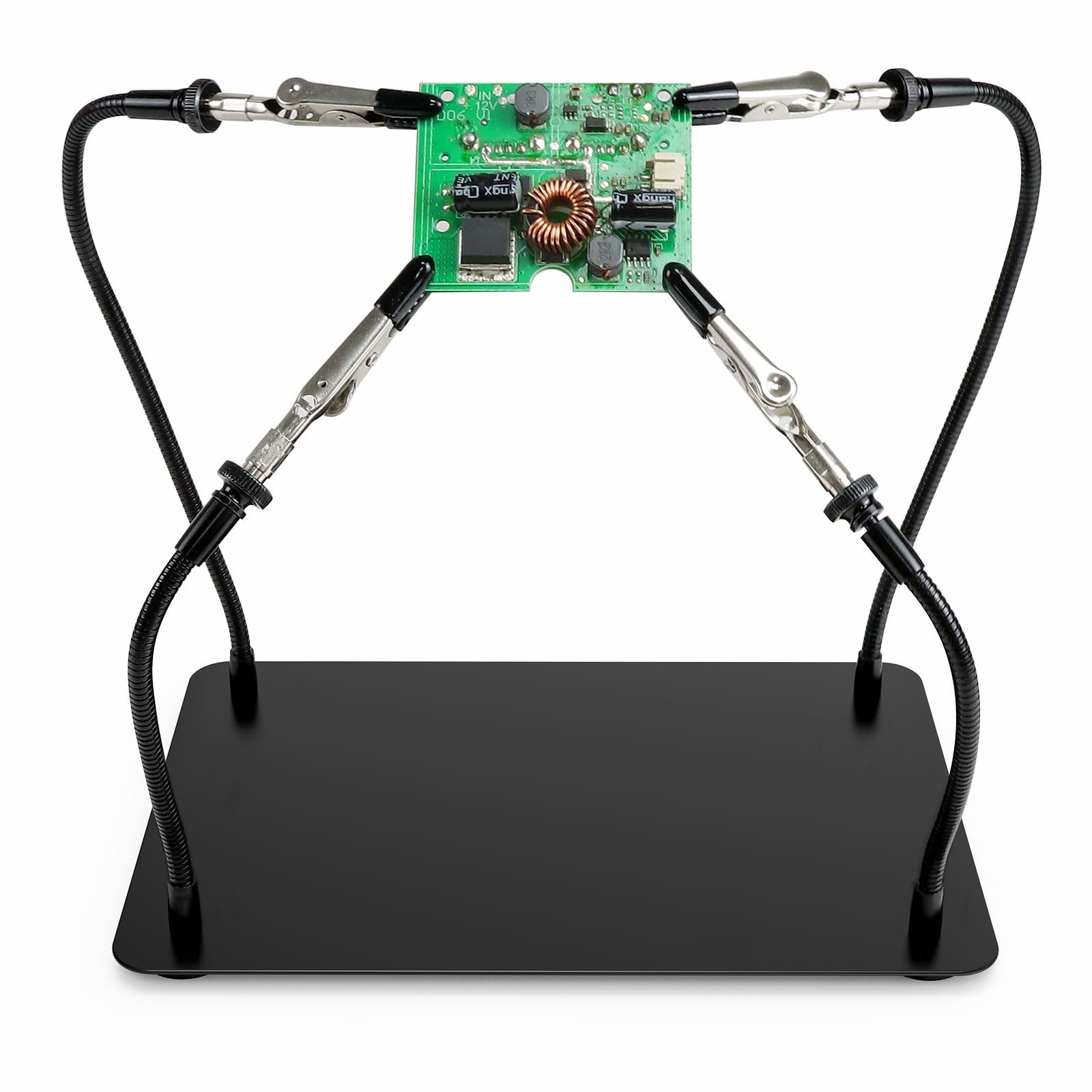
The QuadHands Workbench starts with a 6 x 9 inch powder-coated steel plate, and that plate does most of the persuading. It is heavy enough to stay put when we press down on a joint, and the rubber feet keep it from skating on a smooth bench. The four arms attach magnetically, so you can lift and reposition them anywhere on the plate instead of loosening a screw. That is the advantage we kept coming back to: the fixture adapts to the board, not the other way around.

The arm set includes 16-inch and 8-inch goosenecks, which gives you long reach for a board and shorter arms for close-in wire work. The 360-degree alligator clamps rotate and lock with thumb nuts, and the silicone covers are a welcome detail for delicate surfaces. We noticed some springback when bending the arms, so fine positioning takes a light hand, but the strong magnets mean the bases themselves do not wander.

For wire splicing, through-hole work, and general repair, that simplicity is why we recommend it first: there is less hardware between you and the joint, and the base stays where you put it. The plate is the part that sells it.

Pros

  • Large steel base resists sliding
  • Strong magnetic arms reposition anywhere
  • Four arms in two lengths
  • 360° rotating clamps lock with thumb nuts

Cons

  • No magnifier or PCB pillars
Our verdict

Our top pick is the QuadHands Workbench: its heavy steel plate and strong magnetic arms hold a joint steady and leave both hands free for the iron.

Check Latest Price
2

Best with Magnifier

SainSmart Magnetic Helping Hands

92 /100
LBD Score Outstanding

Key details

Arms
Four gooseneck arms, 7.5 in and 14 in
Base
11.1 x 7.1 in powder-coated steel
Magnifier
5X LED magnifying lamp
PCB Holders
Four magnetic PCB pillars
View on Amazon

The SainSmart station is the one we reach for when the work is small enough that eyesight becomes the limiting factor. A 5X LED magnifying lamp sits over an 11.1 x 7.1 inch steel base, and four magnetic PCB pillars hold a board off the plate so you can work on either side without chasing it around. The lamp puts light and magnification where the iron is going, which is a different experience from leaning in with a separate loupe.

What makes this our pick for magnified work is the combination rather than any one part. The pillars lift the board, the lamp lights it, and the four gooseneck arms handle wires and loose parts. We appreciated that the arms are magnetic, so they can be moved out of the way when the board is the main event. The 7.5-inch and 14-inch arms give a useful spread, and the base is over 2.4 pounds.

The base is large, though, and that is the first thing to check if your soldering happens on a fold-away table. It takes up real bench space. The plate and PCB pillars also add more setup decisions than a simple clamp, so this is a station for someone who does electronics work regularly rather than an occasional cable repair.

Pros

  • 5X LED magnifier lights tiny joints
  • Four PCB pillars hold boards off the plate
  • Magnetic arms move around the work
  • Large steel base stays planted

Cons

  • Arms can drift with heavier parts
Our verdict

We reach for the SainSmart station when tiny joints need light and board support; its 5X LED lamp and four PCB pillars make it a self-contained electronics station.

Check Latest Price
3

Best Value Four-Arm Station

KOTTO 4-Arm Helping Hands

92 /100
LBD Score Outstanding

Key details

Arms
Four adjustable arms
Base
Weighted non-slip steel base
Clips
Alligator clips
Weight
2.78 lb
View on Amazon

Four arms sound like overkill until you are trying to hold a board, a wire, and a connector at the same time. The KOTTO station spreads those jobs across four adjustable arms on a weighted steel base, and that is why we kept it in the mix: it gives you more holding points than a two-clip tool without turning into a full rework station.

The base weighs 1.26 kg, and it has a non-slip bottom that stayed put during our light soldering work. The arms screw into the plate, so assembly is straightforward, and the alligator clips grip wire ends and small components well. The extra arms proved useful for holding a board edge and a lead at the same time, especially on through-hole parts that want to fall out before you get the iron to them.

It is not the most precise station here. The arms can shift when you push a connector into place, and the joints need a firm hand to lock where you want them. For mixed soldering, jewelry, and model work, that is a fair trade for the extra holding points. Where it earns its keep is on a bench that handles more than one kind of job.

Pros

  • Four arms create multiple holding points
  • 1.26 kg weighted base resists sliding
  • Simple screw-on assembly

Cons

  • No magnifier or PCB holders
Our verdict

The KOTTO four-arm station is our value choice for mixed bench work, with enough holding points for a board and a wire without a full rework setup.

Check Latest Price
4

Best for Tight Benches

NOEVSBIG Dual-Head Clamp

93 /100
LBD Score Outstanding

Key details

Base
3.94 x 3.94 in iron base
Clamps
Dual rubber-coated jaws
Weight
10.6 oz
Arm Locking
Screw-lock articulating arms
View on Amazon

Small soldering jobs do not need a full steel plate, and the NOEVSBIG dual-head clamp is built for the opposite kind of bench. The iron base measures 3.94 x 3.94 inches, so it tucks into a corner or sits beside a keyboard, and the two clamps are arranged to hold a board in one and a wire in the other. At 10.56 ounces, it is light enough to move from shelf to desk.

What stands out is the screw-lock arm design. Instead of relying on a gooseneck to stay bent, each arm tightens into position, so a small board does not sag when you press the iron against it. The rubber-coated jaws are a thoughtful touch for delicate wires, and the quick-release clamps are easy to load. This is the one we reach for when the bench is shared and the job is small.

The trade-off is capacity. A compact base and two clamps are not the setup for a large board or a heavy cable, and the short arms limit how far you can reach across a project. That is the point of the design, but it means this is a companion tool rather than the only station on a serious electronics bench.

Pros

  • Small 3.94 in base fits tight benches
  • Screw-lock arms hold their position
  • Rubber-coated jaws protect delicate wires

Cons

  • No magnifier or PCB support
Our verdict

Our pick for a crowded bench is the NOEVSBIG dual-head clamp: the small magnetic base and screw-locking arms hold small work without taking over the desk.

Check Latest Price
5

Best Simple Budget Pick

Pro'sKit 900-015

93 /100
LBD Score Outstanding

Key details

Base
Weighted base
Clips
Two alligator-style clips
Adjustment
Several adjustment points
View on Amazon

The Pro'sKit 900-015 is the old-school shape: two alligator clips on adjustable arms and a small weighted base. That simplicity is the point. It takes up little space, sets up in seconds, and gives you two extra hands for a wire splice or a small jewelry joint without asking you to learn a workstation.

The arms have several adjustment points, so you can angle the clips toward each other or open them wide for a small assembly. The alligator clips proved useful for holding wire ends and small components, and the weighted base gives the unit a planted feel on a flat bench. It is a light-duty tool, best for small work rather than a heavy board that wants a lot of downward pressure.

Where it earns a place is as a backup or a second station. We liked having a compact unit we could leave set up for wire tinning while the main station held a board. If you need a base that shrugs off a heavy cable, this is not the one.

Pros

  • Compact two-clip footprint
  • Several adjustment points for angling clips
  • Weighted base for light-duty work

Cons

  • No magnification or board support
Our verdict

For light wire and jewelry work, the Pro'sKit 900-015 is the simple two-clip station we reach for when we do not need a full setup.

Check Latest Price
6

Best No-Frills Magnetic Station

Fstop Labs Magnetic Helping Hands

92 /100
LBD Score Outstanding

Key details

Arms
Four magnetic gooseneck arms
Base
Powder-coated weighted steel base
Clamps
Stainless steel alligator clips
Weight
2.98 lb
View on Amazon

The Fstop Labs station is a clean version of the magnetic-arm idea: a powder-coated steel base, four gooseneck arms, and stainless steel alligator clamps with thumb nuts. It is a magnetic-arm station and nothing else. What you get is a base that stays put and arms you can lift and reposition anywhere on the plate.

At 1.35 kg, the base has enough mass to feel planted, and the anti-split rubber feet help it stay on a smooth bench. The arms can be placed close together for a small connector or spread wide for a board. The clamps rotate 360 degrees and lock with thumb nuts, so you can angle the jaws without fighting the arm.

For straightforward soldering, that is often all you need. The magnetic arms reset faster than screw-on arms, and the lack of extra hardware means there is less to get in the way of the iron. The trade-off is precision: the goosenecks can spring back a little, so fine positioning takes a light hand.

Pros

  • Four magnetic arms reposition quickly
  • 1.35 kg weighted base with rubber feet
  • Stainless steel clamps rotate 360°

Cons

  • No magnifier or PCB holders
Our verdict

The Fstop Labs station is the no-frills magnetic pick we choose when flexible positioning matters more than magnification.

Check Latest Price
7

Best Large Magnetic Work Surface

NOEVSBIG Large Magnetic Station

93 /100
LBD Score Outstanding

Key details

Arms
Four magnetic gooseneck arms
Base
11.4 x 7.1 in powder-coated steel
PCB Holders
Four PCB holders and six pillar holders
Hot-air Mount
360° rotating hot-air gun frame
View on Amazon

The first thing you see is the base: 11.4 x 7.1 inches of powder-coated steel, with enough room to spread four magnetic arms around a board and still have space for a hot-air handpiece. At over 3.3 pounds, it is the heaviest work surface in this group, and that mass is the product's whole argument. A small clamp station can hold a wire; this one is meant to hold a project.

It comes with four gooseneck arms, four alligator clips, four PCB holders, and six pillar holders, plus a 360-degree rotating hot-air gun frame. The magnetic bases let you move the supports around the plate as the board changes. The pillar holders are useful for keeping a board off the steel, and the hot-air frame gives the handpiece a place to sit instead of rolling around the bench.

The steel plate is the stable part; the magnetic accessories are what you position and reposition. That is a lot of hardware to keep track of, and the base takes up a serious amount of bench space. If your work is mostly small wires, the compact NOEVSBIG is easier to live with. If you routinely work on larger boards, the extra surface earns its footprint.

What it offers is scale. Four arms, six pillar holders, and a hot-air mount turn the plate into a flexible rework surface, and the magnets make that surface quick to reconfigure. We recommend it for the bench where a board stays put for a long session, not for the occasional splice.

Pros

  • Large 11.4 x 7.1 in steel base
  • Four arms plus four PCB holders
  • Six pillar holders for board support
  • 360° hot-air gun frame

Cons

  • No built-in magnifier
  • Some joints can loosen over time
Our verdict

For large boards and hot-air rework, our pick is the NOEVSBIG large station, where the broad steel surface and extra PCB pillars are worth the footprint.

Check Latest Price
8

Light-Duty Soldering

XYK 4-Arm Helping Hands

90 /100
LBD Score Outstanding

Key details

Arms
Two 8.26 in and two 5.11 in goosenecks
Base
7.47 x 5.11 in painted steel
Feet
Four non-slip rubber pads
Clips
Insulated alligator clips
View on Amazon

The XYK station is the least expensive way here to get four arms and a steel base, and that is exactly how it behaves: useful, basic, and a little fussy. The base measures 7.47 x 5.11 inches and has four non-slip rubber pads, so it has a smaller footprint than the big magnetic stations while still giving you four holding points.

The arms come in two lengths: two at 8.26 inches and two at 5.11 inches. That split is handy for reaching across a small board with the long arms and holding a wire close in with the short ones. The insulated alligator clips are a sensible touch for electrical work. The extra holding points help with gluing and painting small parts, where two clips always seem to be one short.

Assembly is a matter of screwing the arms into the plate, and the painted steel base stays planted once the rubber pads are on a clean surface. The arms are metal goosenecks, and they hold their shape once set, though they take a firm hand to move. A heavy board or a lot of downward pressure is not its job; this is a light-duty station.

For a first helping-hands tool or a second station for craft work, it covers the basics. We reach for it when the job is light and the budget is tight, not when a fine-pitch board needs steady positioning. It is a starter station, and it makes sense as one.

Pros

  • Four arms on a small steel base
  • Two arm lengths for reach
  • Insulated alligator clips

Cons

  • Assembly hardware can be incomplete
  • No magnifier or PCB holders
Our verdict

We see the XYK station as a sensible first helping-hands tool for light soldering and crafts, as long as you expect to fuss with the arms.

Check Latest Price

How We Tested Helping Hands Stations

We built the shortlist from stations with a weighted or steel base and at least two adjustable arms, logging base dimensions and listed weight, arm count, whether the arms were magnetic or bolted on, and clamp jaw opening. That filtered a long list down to 14 stations, which we bought ourselves and kept on the bench for four months.

Most of the soldering happened at my workbench in the spare room: a Raspberry Pi header, a re-capped guitar pedal, a headphone jack replacement, a spliced bike-light wire. Two units went home with a colleague for jewelry and craft repairs, which is where the PCB holders and small clamps got their real workout.

We put each base on a kitchen scale, then nudged it with two fingers and again with the heel of a hand, noting whether it slid before the arms did. For magnet strength, we pulled an arm out to full reach with a small pair of cutters hanging from it and watched for creep. Each arm was set to hold a board at an angle, tapped, and checked for drift. Assembly was timed out of the box, including whether the hardware needed a screwdriver. Every clamp was closed on a PCB, a wire, and a piece of heat-shrink to see whether the jaws marred anything or twisted under load.

Four months in, we checked for drooping arms, cracked jaws, and threads that had gone loose, and counted which accessories actually earned their place. The best stations were the ones we stopped thinking about mid-job.

How to Choose Helping Hands for Soldering

Start With the Base

A soldering station is only as useful as the base under it. A heavy steel plate with rubber feet resists the sideways push you make with an iron; a small, light base is easier to tuck away but can slide or tip when the arms are extended. We look at the base before the arm count. If you work on large boards, the QuadHands Workbench's 6 x 9 inch plate is the more reassuring shape; if your bench is shared, the compact NOEVSBIG makes more sense.

Magnetic arms add a compatibility check. They need a ferrous plate to grab, so a station that includes a steel base works out of the box, while a bare magnetic arm on a wood or aluminum bench has nothing to hold. Check that the base and the arms are sold as a pair, or that your bench has a steel surface.

Choose the Arm Action You Can Live With

Gooseneck arms bend and hold their shape, which makes them quick to reposition; the trade-off is that they can spring back slightly when you push a connector into place. Screw-lock articulated arms are slower to set but hold a small board more firmly once tightened. We prefer magnetic goosenecks for mixed work and screw-lock arms for tiny, repetitive joints.

Reach matters as much as action. Short arms are fine for holding a wire close to the base; long arms let you work across a board without moving the plate. If you often hold a board and a wire at once, four arms are more useful than two, especially when two of them are shorter.

Decide Whether You Need Magnification and Board Support

A magnifier and light are not automatic upgrades. They help when you are working on fine traces, small connectors, or inspection, and the SainSmart station combines a 5X LED lamp with four PCB pillars for that kind of work. For wire splicing and larger through-hole parts, a plain magnetic station is quicker to set up and leaves more room around the joint.

Board support is a separate question. PCB pillars or edge clamps lift the board off the plate so you can work on both sides; a hot-air frame gives a rework handpiece a safe place to sit. If your projects are mostly bare boards or rework, pay for those holders. If you mostly hold wires, skip them.

Check the Clamp Jaws and Footprint

Alligator clips are strong, but bare teeth can mark soft wire insulation or jewelry. Rubber-coated jaws or a strip of heat-shrink over the teeth solves that without much fuss. Check the jaw opening against the largest connector you plan to hold, and remember that a clip gripping a heavy cable puts more leverage on the arm.

Finally, measure the bench. A large plate and long arms need clear space, while a compact clamp can live beside a keyboard and move when you need the desk back. Assembly is usually a few screws, but it is worth checking that the hardware is included before you clear a workspace for it.

Frequently Asked Questions

Final Verdict

For most soldering benches, we recommend the QuadHands Workbench. The 6 x 9 inch steel plate and four magnetic arms give you room to hold a board and wires without a lamp or PCB pillars getting in the way, and the base stays planted when you press on a joint.

If your work is small enough that you need magnification, the SainSmart station is the better choice because the 5X LED lamp and PCB pillars turn it into a self-contained electronics station. For a tight bench, start with the compact NOEVSBIG.