Best Butane Soldering Irons of 2026

The cord is what gets you. Soldering a wire harness under a dashboard, fixing a trailer light in a parking lot, repairing a headphone cable at the kitchen table — a plug-in iron decides where you can work. A butane soldering iron gives that back: fill the tank, click the ignition, and you have soldering heat, flameless air for shrink tubing, and a small torch, all in something that drops into a tool bag. You stop hunting for an outlet and start working where the broken thing actually is.

What separates these tools isn't the spec sheet. Over six months I've worked through 12 butane irons and kits — garage bench, driveway, craft table — and the gaps show up on the first use: some light on the first click while others take three, some hold heat through a whole joint while others fade halfway. Tips pit with oxidation. A catalyst tip gives flameless heat that's safe near wiring, where a torch tip is for rusted bolts, not delicate work. And a kit is only as good as whether the tips you'll actually reach for are in the box.

1

Best Overall

Power Probe PPSK

94 /100
LBD Score Outstanding

Key details

Weight
12.7 oz
Ignition
Electronic, self-starting
Runtime Per Fill
Up to 2 hours
Maximum Temperature
930 °F
View on Amazon

Two hours on a tank is what separates this kit from the rest of the group. The mid-priced irons here run 75 to 90 minutes before you go looking for a can of butane, which is long enough to get into a wiring harness and not always long enough to get back out. The PPSK keeps going through a second connector and a heat-shrink pass on one fill, and that margin is why it sits at the top of this list.

The rest of the tool is built for the same kind of work. Flame adjustment is gradual rather than a jump from nothing to a jet, so a small conical tip can be held at a working temperature instead of being cooked, and the 930 °F ceiling is well clear of what 60/40 solder needs. The accessory set covers the jobs that follow a joint, too — shrinking tubing, warming a fastener, light brazing — and that's what turns a soldering iron into something worth carrying in a van.

Weight is the price of the tank. At 0.36 kg it's a tool you set down rather than pocket, and the extra heft is what a two-hour tank costs you. On a bench that's a fair trade; on a ladder it's worth thinking about before you buy.

Order spare tips with it. The working end wears on any butane iron, and a spare turns a stalled job into a five-minute swap instead of a drive to the store.

Pros

  • Two-hour runtime beats the rest of this group
  • Gradual flame adjustment holds a fine tip steady
  • Torch and heat-shrink work from the same tool

Cons

  • No stand included in the kit
  • Tips wear and replacements are extra
Our verdict

For wiring in the field — autos, trailers, HVAC — this is the kit we point to first: two hours of runtime, a flame you can dial down, and a torch head for the heat-shrink that follows.

Check Latest Price
2

Best for Tight Spaces

Weller PSI100K

90 /100
LBD Score Outstanding

Key details

Weight
7.2 oz
Warranty
Limited lifetime
Tip Temperature
580 °C
Power Equivalent
125 watts
View on Amazon

Seven point two ounces is where the argument for this one starts. It handles like a fat pen rather than a torch, which is why it goes into a footwell, a door cavity, or the gap behind a dashboard where the bigger kits here simply won't fit and a corded iron can't follow.

Nothing about the size reads as a compromise. Weller rates it at 125 watts equivalent with a 580 °C tip, which is the same territory as the full-size kits in this group, and the pencil head puts that heat at the point instead of spreading it down a barrel. Warm-up is quick enough that it never becomes the thing you're waiting on.

A limited lifetime warranty sits behind it, which is more backup than most of the kits here offer, and it's the reason we're comfortable pointing a heavy user at a tool this small. For a body this light, that's a long relationship to have with an iron.

Pros

  • 7.2-ounce body reaches into tight spaces
  • 125-watt equivalent heat from a pencil head
  • Limited lifetime warranty
  • Heats fast enough that warm-up isn't a wait

Cons

  • Small tank means refilling mid-job
Our verdict

The lightest, most maneuverable kit here, with a lifetime warranty behind it — our choice when the joint is somewhere your hand barely fits.

Check Latest Price
3

Best Tip Selection

Portasol Super Pro 125

89 /100
LBD Score Excellent

Key details

Weight
13.8 oz
Refill Time
10 seconds
Tips Included
7: three soldering, hot air, deflector, hot knife
Tip Temperature
580 °C
View on Amazon

Seven tips is the most you get here, and the mix is what makes them useful: three soldering tips, a hot-air tip for heat-shrink, a deflector, and a hot knife. The knife is the one that changes what the tool is for — trimmed plastic and nylon webbing stop being a separate trip to the toolbox.

Heat runs to 580 °C at the tip, enough for heavier wire than the electronics-first irons here will manage, and a refill takes about ten seconds. The safety cut-off switch is a detail we didn't expect to care about as much as we do: on a tool that gets set down while you reposition a wire, a switch that ends the flame for you is worth more than another attachment in the case.

The honest catch is the cool-down. Tips change cold, so going from a solder joint to the hot knife means waiting rather than switching. Plan a job in the order it happens — solder, then shrink, then cut — and it costs you nothing. It also travels as one box, with room in the case for a tube of solder and a little braid, which is more than most of these kits manage.

Pros

  • Seven tips including hot knife and hot-air head
  • 580 °C tip handles heavier wire
  • Ten-second refill
  • Safety cut-off switch ends the flame

Cons

  • 390 g body is the heaviest here
Our verdict

The broadest tip selection in this group, and the one to buy when a single butane tool has to solder, shrink tubing, and cut.

Check Latest Price
4

Best for Heat-Shrink Work

Master Appliance UT-100SiK

89 /100
LBD Score Excellent

Key details

Power Equivalent
20-80 watts
Runtime Per Fill
About 2 hours
Hot Air Temperature
1,202 °F
Soldering Temperature
932 °F
View on Amazon

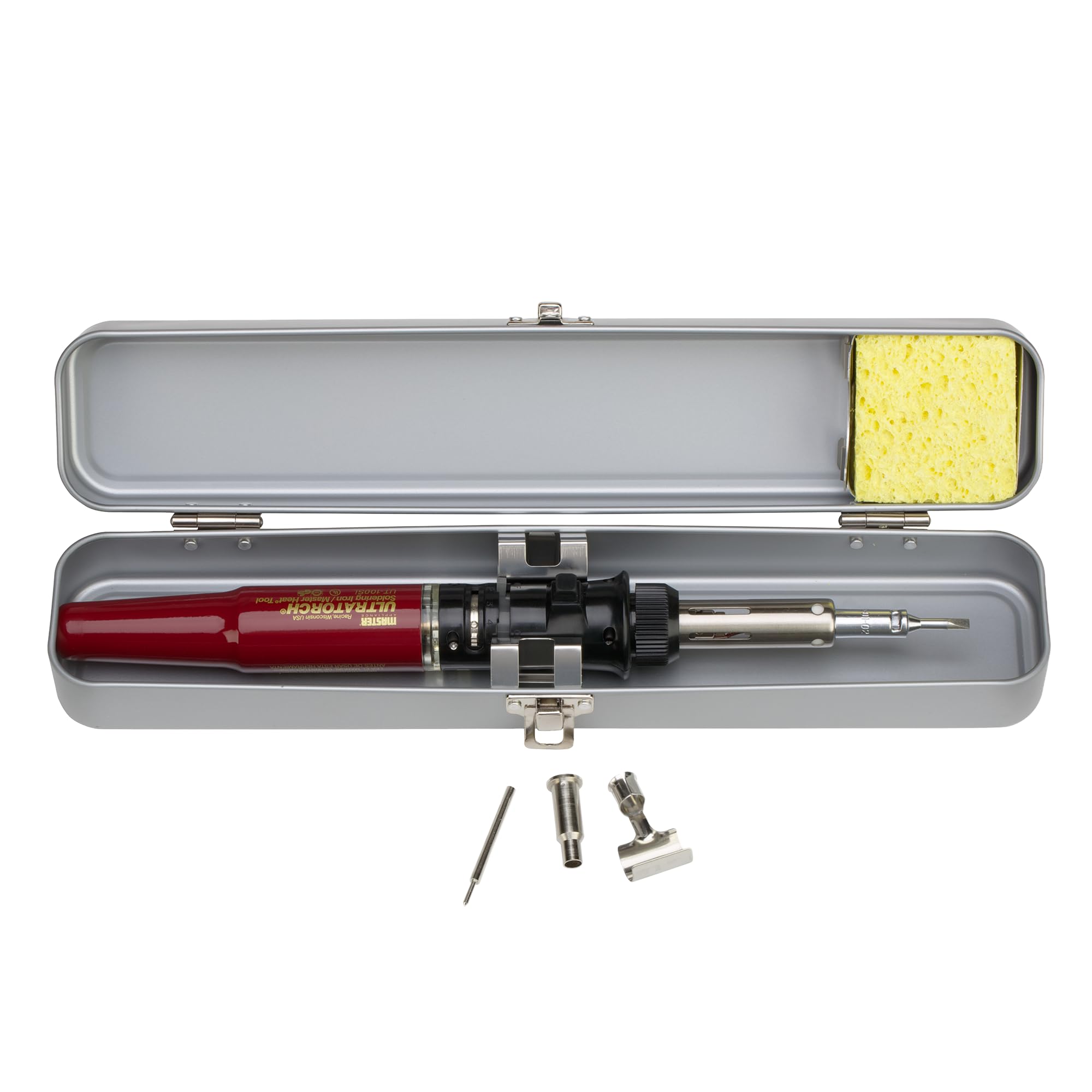
Heat without a flame is the whole idea here, and it's what separates this tool from everything else on the list. The UT-100SiK runs a catalytic element instead of an open burner, so you can work it beside a fuel line, a plastic connector shell, or a bundle of insulation without a flame doing damage you didn't ask for.

The numbers hold the pitch up: up to 932 °F at the soldering tip, 1,202 °F in hot-air mode, and roughly two hours of runtime on a tank. The hot-air side is why it earns a place. It's built around shrinking heavy-wall connectors and tubing, and it holds a soldering temperature on 10 to 20 gauge wire while it does it.

It's ready in about 30 seconds, and the metal case has a spot for a wet sponge, which sounds like a small thing until you're tinning a tip without one. Tool, tips, and sponge live in one box, and the box is the sort of thing you can leave in a truck without worrying about it.

Where it asks something of you is power: 20 to 80 watts equivalent means 10 to 20 gauge wire and small terminals, and a thick cable or a chassis ground wants a torch head or a bigger iron. For connectors and heat-shrink, it's the one we reach for, and it does that work with no flame in the room.

Pros

  • Flameless element is safer near fuel and plastic
  • Two hours of runtime per tank
  • Hot-air mode for heavy-wall connectors
  • Metal case holds the tool and a sponge

Cons

No notable drawbacks to flag.

Our verdict

A flameless heat tool that shrinks connectors and solders small terminals without an open flame, which is why we trust it near fuel lines and plastic.

Check Latest Price
5

Best Value 3-In-1

Berkling BSG-568

90 /100
LBD Score Outstanding

Key details

Weight
4 oz
Attachments
Five, including hot knife and heat deflector
Runtime Per Fill
Up to 90 minutes
Upper Temperature
1,300 °F
View on Amazon

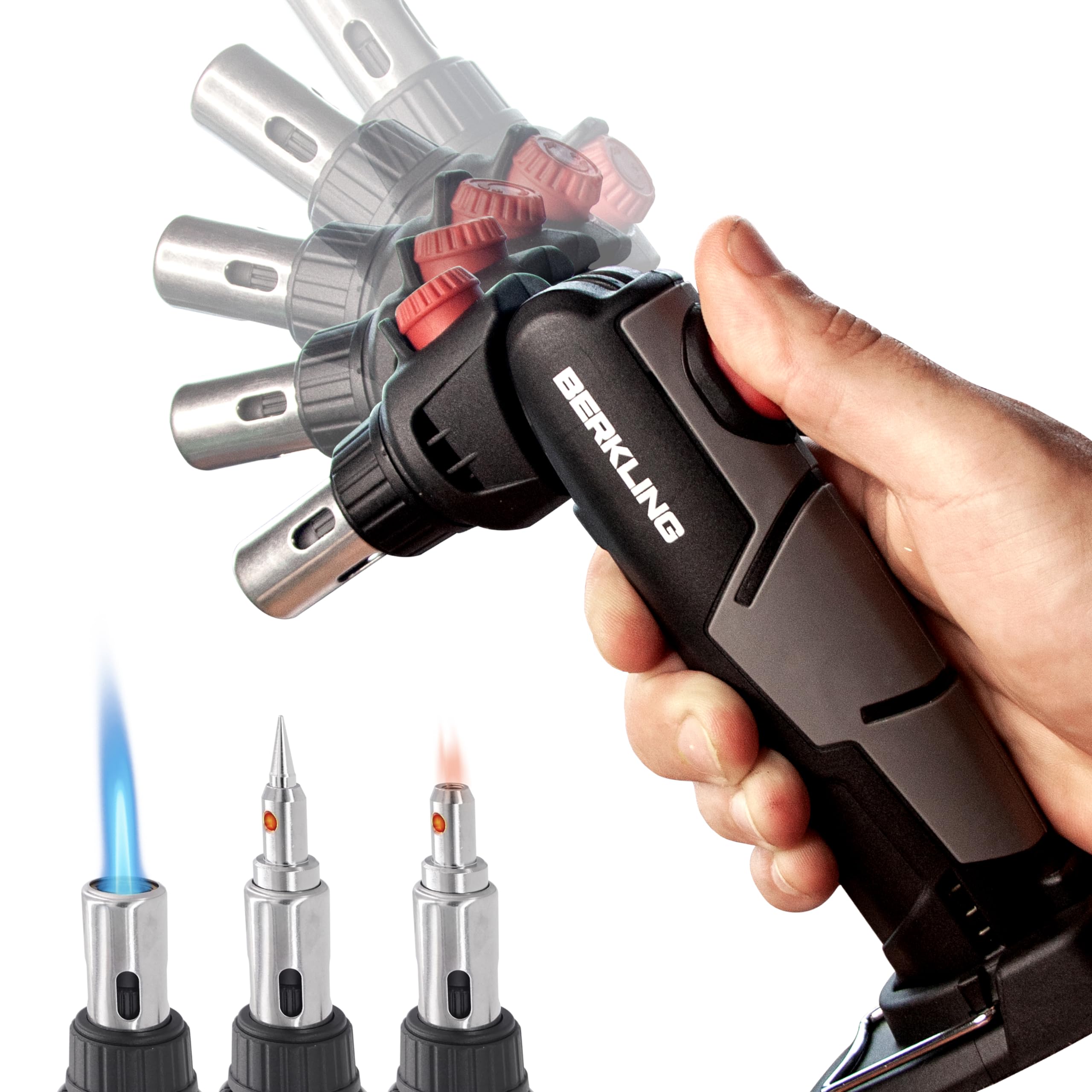
A heat-gun head is the attachment most of these kits leave out. The BSG-568 includes one, alongside three soldering tips, a heat deflector, and a hot knife, so shrinking tubing and warming a seized fastener belong to the same job as the joint — from a body that weighs four ounces.

Pound for pound this is the most tool in the group. It behaves like a 125-watt iron: ignition on the trigger, adjustable flame, up to 90 minutes of runtime, and a refill in under 20 seconds. The 1,300 °F top end is well past what wire work needs. Five attachments in a case that keeps them together is the difference between a kit you grab and a drawer of loose parts.

What it isn't is a precision instrument. The flame adjusts across a range built for connectors and harnesses rather than board work, and the 1.6mm and 2.4mm tips are right for wire and oversized for surface-mount anything. For automotive and household repairs we think that's a fair trade; for a circuit board it isn't.

Pros

  • Heat gun, torch, and iron in one kit
  • 90-minute runtime with a fast refill
  • Four-ounce body stays light at an angle
  • Five attachments including a hot knife

Cons

  • Tips wear out before the tool does
Our verdict

The best-value three-in-one here: a heat gun, torch, and soldering iron in one light kit, at well under what the pro-brand tools cost.

Check Latest Price
6

Best for Crafts

Dremel Versatip 2000

88 /100
LBD Score Excellent

Key details

Weight
3.39 oz
Functions
6-in-1
Tips Included
7 interchangeable
Temperature Control
Variable
View on Amazon

Dremel built this one for a different bench: pyrography, jewelry, plastic cutting, heat embossing, and paint removal, with soldering as one of six jobs. If you're buying a butane tool for craft stock rather than wiring, that orientation is the reason to pick it.

Seven interchangeable tips and a variable temperature setting do the work, and at around 96 grams the tool handles like a pen, which is what slow, controlled strokes in wood burning and hot cutting need. We stopped noticing it in the hand after a minute, which is the point. The ignition trigger is built into the body, so there's no separate sparker to lose in a drawer.

Two years of warranty, three if you register it, is more backup than most of this group offers, and coverage matters on a tool whose tip stays hot for long stretches. What you give up is the raw output of the plumbing-oriented kits here — this is a detail tool, and a good one.

The box includes two wrenches, a sponge, and a coil of solder, so it's usable the day it arrives apart from the fuel. That completeness is the difference between a tool that gets used and one that waits in a drawer for a trip to the hardware store.

Pros

  • Seven tips span wood, plastic, and solder
  • Variable temperature for slow craft work
  • 96-gram body handles like a pen
  • Two-year warranty, three with registration

Cons

  • Tip set is craft-first, not heavy-wire work
Our verdict

Buy this if your butane iron is going to spend its time on wood, plastic, and craft stock: seven tips, a pen-like body, and real warranty coverage.

Check Latest Price
7

Best for Detail Work

IRODA Pro-50K

83 /100
LBD Score Excellent

Key details

Length
6.1 inches
Heat-up Time
18 seconds
Power Equivalent
30-70 watts
Maximum Temperature
2,400 °F
View on Amazon

Six inches and a pencil grip: this is the smallest tool here, and for a certain kind of job that's the entire argument. Wiring a guitar cavity, working inside a model, reaching a rheostat behind a panel — the IRODA goes where a torch-bodied kit physically won't.

It's rated 30 to 70 watts equivalent with an 18-second heat-up, and the flame adjuster sits where your thumb lands. Of everything here, it's the tool that handles like a pen rather than a fuel tank with a tip bolted to it, and that's a real advantage when the joint is somewhere you can only get two fingers into.

Respect the size, though. Thirty to seventy watts is detail work — leads, small connectors, thin wire — and the way we use it, it's not the tool for a battery cable or a ground strap. Tips are small, the flame range is narrow, and the whole point is precision rather than power.

For confined jobs it earns its place. It's the least expensive tool in this group, it disappears into a drawer, and it heats in seconds — the right second iron for someone who already owns a bigger kit, and enough for anyone whose soldering never leaves small-gauge territory.

Pros

  • 6.1-inch body fits where nothing else will
  • 18-second heat-up
  • Handles like a pencil
  • Lowest price in this group

Cons

  • Flame can cut out mid-job
Our verdict

When the joint sits somewhere your hand barely fits and a full-size torch body won't go, this is the iron that gets there.

Check Latest Price
8

Best for Awkward Angles

Berkling BSG-2000

90 /100
LBD Score Outstanding

Key details

Attachments
Four tips and two torch heads
Fuel Capacity
30 ml
Head Adjustment
5 locking positions
Runtime Per Fill
90 min soldering, 40 min torch
View on Amazon

A head that locks in five positions is the feature you don't know you need until you're upside down under a dashboard. Rotate the barrel to the angle the space allows, lock it, and the tool works where your wrist can't — which is why this is our pick for awkward angles rather than the general-purpose kits here.

Fuel is the other half of the argument. A 30 ml tank gives up to 90 minutes as a soldering iron and refills in roughly 15 seconds — a working session rather than a quick fix. Four soldering tips, a heat deflector, a heat blower, and both jumbo and pinpoint torch heads travel in the case.

The tip shapes are chosen for wire: conical, chisel, angle, and knife. The angle tip is the unusual one and the one we like for reaching a terminal at an odd attitude, which is the same problem the rotating head solves from the other end. With the molded grip, it stays comfortable in a position you shouldn't have to hold for long.

What it doesn't change is the consumable. Four tips in the box will get most people through a season of repairs, but order a spare set with the tool — buying them one at a time costs more and always happens at the wrong moment.

Pros

  • Head locks at five working angles
  • 30 ml tank refills in 15 seconds
  • Two torch heads, jumbo and pinpoint
  • Molded grip stays comfortable at an angle

Cons

  • Torch mode cuts runtime to about 40 minutes
Our verdict

Our pick for work in awkward places: a head that locks at five angles, a 30 ml tank, and two torch heads in one kit.

Check Latest Price

How We Chose and Tested Butane Soldering Irons

We started with the kits sold by the names that dominate this category, then ruled out anything with a fixed tip, no built-in ignition, or no case, and kept the ones that paired an adjustable flame with a real spread of tips. That left 12 kits, which we bought at retail and used for six months rather than a single afternoon.

In a cold garage, we counted how many clicks each unit took to light, both first thing in the morning and again after it had been sitting overnight. We timed ignition to the moment solder actually flowed on a 14-gauge wire joint, then repeated it on the same unit while warm to see if recovery held up. Midway through longer jobs we checked whether the flame setting had drifted on its own.

Every tip in every kit got used: conical on circuit board work, chisel on wire, the heat-shrink attachment on butt connectors, the torch tip on a rusted bracket. After each session we inspected tips for pitting and oxidation and checked whether they still seated snugly. We also ran a unit from full to empty to see whether the heat faded before the fuel did.

Each kit was dropped from bench height, packed back into its case, and carried between jobs — into a pocket, into a bag, into a glovebox — so we know which ones travel well and which ones only look portable. Finally, we weighed what came in the box against what the kit cost, because a bargain whose tips die in a month is not a bargain.

How to Choose a Butane Soldering Iron

Soldering temperature is not torch temperature

A kit advertising 2,400 °F is quoting an open flame, and that flame is for brazing, heating, and shrinking — not for the joint. Solder flows somewhere around 370 to 400 °F, so the figure we look for first is the soldering-tip temperature, and the kits here state anything from 932 °F up to 580 °C at the tip depending on how the maker measures. Even the lower end of that spread is well clear of what 60/40 needs.

If a listing only gives you a flame temperature, you're being sold a torch and told about an iron on the side. Match the tip number to the work: fine connectors want a small conical tip held steady at a modest setting, while heavier wire wants the highest soldering temperature the tool will hold and a chisel tip to move the heat.

The igniter decides whether it's a tool or a paperweight

Every kit here uses a piezo trigger, and that trigger is where these tools earn or lose their place. Give the ignition a workout in the first week while the return window is open: light it, run it until the tip is hot, shut it down, then light it again from warm. A tool that lights cold and refuses hot is telling you something.

Buy from a maker whose warranty you can actually use, since ignition is the failure that ends ownership. A child-resistant stopper or a safety cut-off switch is worth having too, particularly if the tool lives in a drawer with other metal things.

Runtime, tank size, and how fast a refill goes

Runtime decides whether a cordless iron suits your work. The kits here run from about 75 minutes to two hours on a fill, and the fastest refills take ten to fifteen seconds, so a mid-job top-up is an inconvenience rather than a disaster. If your soldering comes in short bursts at a bench, a smaller tank keeps the tool light and costs you nothing.

If you're under a dash for an afternoon, buy the runtime. It's the one specification on this page that changes how a job goes rather than how a tool feels.

Tips, cases, and what's actually in the box

Tips are the consumable, and the working end is what fails first on any butane iron. Count shapes rather than tips: a conical for board work, a chisel for wire, and a hot knife or heat deflector if you want one tool to finish a whole job. A case with room for solder and a sponge is worth more than an extra tip you'll never fit, because the tools that live loose in a bag lose their attachments.

And budget for fuel. None of these kits ship with butane, so the first session includes a trip to the store unless you order a can with the tool.

Weight and shape decide where it goes

Body weight runs from about four ounces to nearly fourteen across these kits, and shape matters as much as the number. A pencil body reaches into cavities a torch body can't, while a bigger barrel holds more fuel and stays cooler under a long load. Think about the position you'll be holding it in before you commit: inline for pen-style work, pistol grip for pushing into a connector.

If you work at odd angles, a head that rotates is worth more than another tip in the box. It's the one feature here that solves a problem you can't work around with technique.

Frequently Asked Questions

Final Verdict

Buy the Power Probe PPSK if your soldering happens away from a bench. Two hours of runtime, a flame you can dial down to a working tip temperature, and a torch head for the heat-shrink that follows the joint make it the one kit here that finishes a field repair without a top-up, and it's the one we point to first for anyone who solders wiring for a living.

If the joint is behind a dashboard rather than under a hood, the Weller PSI100K gets there: 7.2 ounces, a pencil head, and a lifetime warranty, paid for with more frequent refills.