Best Blenders of 2026

A bad blender is a master of the almost-smoothie: one swallow of chalky greens, one frozen strawberry that never breaks down, one ice cube rattling around like a warning. A good one turns that same pile of fruit, ice, and spinach into something you want to drink—and then comes apart without a fight when you're done. I've learned the difference usually isn't a single wattage number. It's whether the motor holds speed under a frozen load, whether the jar pours cleanly, and whether the base stays put when things get loud.

We spent six months with 12 blenders, making weekday smoothies, crushing ice for cocktails, and pureeing Sunday soup. The most powerful models weren't always the easiest to live with: some pulverized kale but rattled the counter, while quieter ones left frozen fruit in chunks. We also noted how easily jars and blade assemblies came clean, whether plastic pitchers held onto garlic or smoothie smells, and whether the controls made sense at 6:30. The picks below held up, cleaned up, and earned their counter space.

1

Best Overall

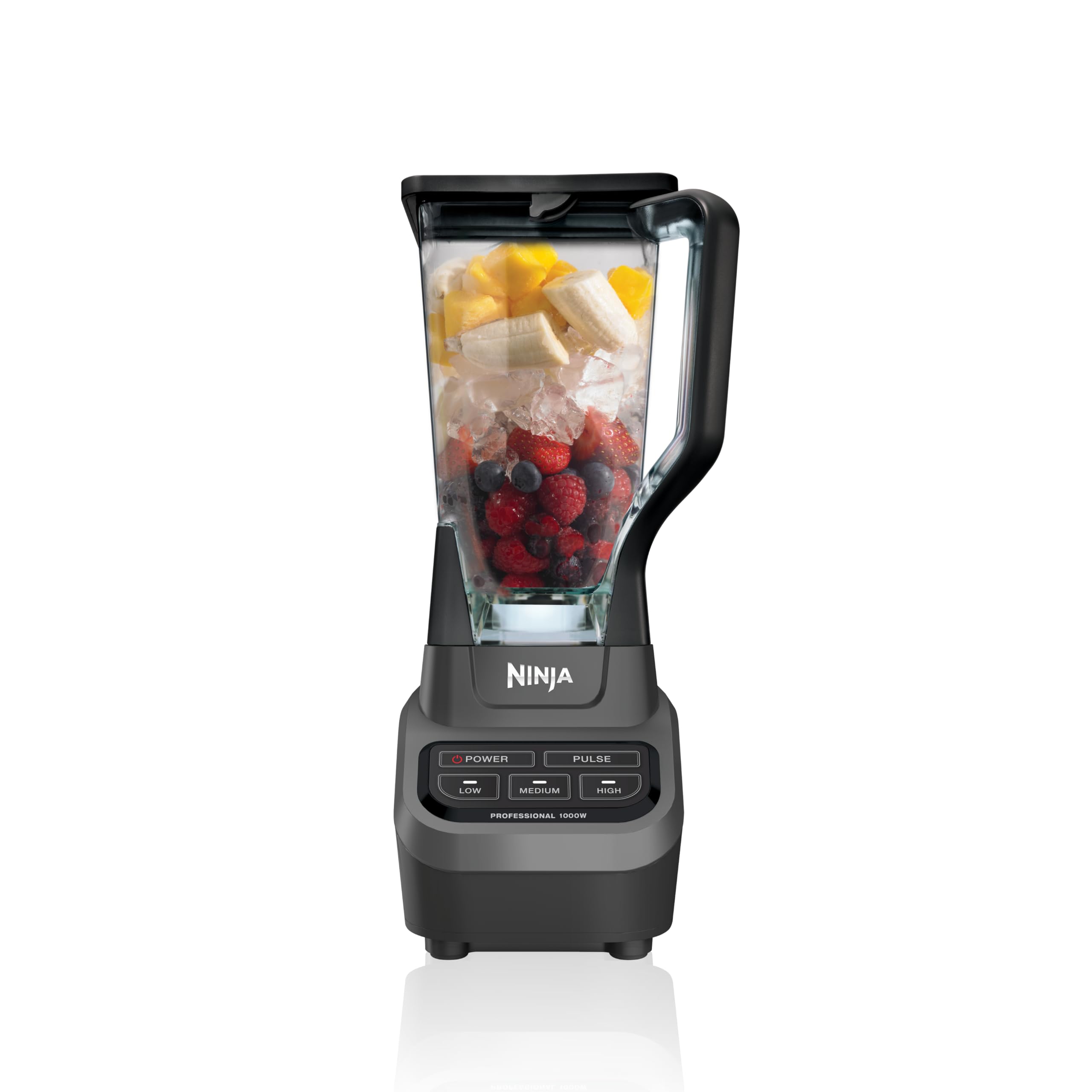
Ninja Professional BL610

93 /100
LBD Score Outstanding

Key details

Height
15.94 in
Speeds
4
Pitcher
72 oz (64 oz max liquid)
Motor Power
1000 watts
View on Amazon

Four push buttons — low, high, pulse, and off — under a 72-ounce pitcher, with 1,000 watts of Total Crushing blades doing the work. That plainness is exactly why we keep this one at the top: there's no program to scroll through at six in the morning, nothing to relearn after a month away from it, and no menu standing between you and a smoothie. The stacked blades pull the load down through the jar instead of letting frozen fruit spin in a pocket above them, which is the whole difference between a blender you keep using and one that ends up in a cupboard.

Capacity is the second reason it holds the spot. The 64-ounce liquid line leaves real headroom, so two large smoothies or a tray of ice and a bottle of margarita mix go in without a volcano, and the pitcher rinses clean at the sink because the blade assembly lifts out in one piece. At just under 16 inches tall it slides back under most upper cabinets — measure yours before you commit the counter space.

One detail worth knowing before you buy: the lid is also the safety switch. If its tabs or springs give out, the motor won't start, so treat the lid as a part to look after rather than a piece of packaging — seat it squarely, don't jam it on, because a lid that won't lock turns the whole machine into a paperweight. The pitcher itself is plastic, which is lighter and cheaper to replace than glass but takes on the color of turmeric and tomato over the years.

Pros

  • 1,000 watts and stacked blades handle ice and frozen fruit
  • 72-oz pitcher with a marked 64-oz liquid line
  • Four-button panel with nothing to program
  • Blade assembly lifts out for rinsing

Cons

  • One 72-oz jar only, so a single smoothie means washing the pitcher
Our verdict

For most kitchens, this is the blender we tell people to buy: 1,000 watts, a 72-ounce pitcher, and four buttons instead of a menu, so frozen fruit and ice get handled without ceremony.

Check Latest Price
2

Best All-In-One

Ninja Professional Plus Kitchen System

95 /100
LBD Score Outstanding

Key details

Height
18 in
Pitcher
72 oz (64 oz max liquid)
Motor Power
1400 watts (peak)
Also Included
8-cup processor bowl, two 24-oz cups
View on Amazon

Three containers sit on one 1,400-watt base: a 72-ounce pitcher for drinks, an eight-cup processor bowl with chopping and dough blades, and two 24-ounce cups you blend in and cap. Set it up once and the food processor leaves your counter for good, which is the trade it's offering — and it is a trade, because the assembled unit stands 18 inches tall and weighs close to nine pounds.

The bowl is what justifies the price. Onions, garlic, herbs, and nuts come out evenly chopped rather than half-pulverized at the bottom, and the dough blade handles a stiff bread dough that stalls a blender jar. We were also more taken with the Auto-iQ programs than we expected to be: the smoothie setting pulses and pauses on a timer, so you can step away instead of standing there feathering the speed. Five presets cover smoothies, frozen drinks, nutrient extraction, chopping, and dough, and the manual low, high, and pulse settings are there when a recipe needs your hand.

The cost is the footprint. Suction feet keep it planted through a 1,400-watt blend, which is reassuring, but they also mean you can't slide the base out to wipe under it — you lift. And a system this size makes dishes: three containers mean three lids, three blade sets, and a bowl to wash after one batch of salsa. If smoothies are the entire job, those extra pieces are cabinet clutter.

Pros

  • 1,400 peak watts with five Auto-iQ programs
  • Eight-cup processor bowl handles chopping and dough
  • Two 24-oz to-go cups included
  • Presets run on a timer so you can walk away

Cons

  • Plastic pitcher and processor bowl are the parts that crack
Our verdict

Buy it if you want one base to blend, chop, and knead — the eight-cup bowl is what you're paying for, and it's the most versatile machine in this roundup.

Check Latest Price
3

Glass-Jar Blending

Oster Classic Series 8-Speed

88 /100
LBD Score Excellent

Key details

Height
13.8 in
Speeds
8
Pitcher
6 cups, glass
Motor Power
700 watts
View on Amazon

A six-cup glass jar on a plastic base, with a stainless blade and no plastic anywhere in the path of your smoothie. That combination is rarer than it should be: glass doesn't hold the smell of garlic, doesn't take on the color of turmeric, and doesn't cloud after a hundred washes. You can also see what's happening at the bottom of the jar without tilting it toward a window, which sounds like nothing until you've spent a year guessing at a plastic pitcher.

Eight speeds and a dedicated ice-crush button give you more control than the price suggests, and at 13.8 inches it's the shortest machine here — it disappears under a cabinet and leaves the counter looking like a counter. But 700 watts is 700 watts. Frozen berries with no liquid, or a full jar of ice, need short pulses and the occasional stir, and the motor lets you hear when it's working hard. Keep batches to the bottom half of the jar and it behaves.

What we've landed on is that this is the right blender for someone who makes a smoothie a few times a week, wants glass, and isn't feeding four people out of one jar. Two practical notes before you order. A hot, plasticky smell can show up during a long run — stop, let it sit a minute, and finish in a second pass rather than pushing through. And the listing states 220 volts, so confirm you're getting the version that matches your outlet.

Pros

  • Glass jar won't stain or hold odors
  • Eight speeds plus a dedicated ice-crush button
  • Short 13.8-inch body fits under a cabinet

Cons

  • Bogs down on a full jar of frozen fruit
  • Glass jar is heavy to lift and rinse
Our verdict

We recommend it for the glass jar first and the price second — go in knowing that the six-cup capacity and 700-watt motor ask for smaller, more patient batches.

Check Latest Price
4

Light-Duty Blending

BLACK+DECKER Crush Master BL2010BP

86 /100
LBD Score Excellent

Key details

Speeds
10
Weight
2.5 lb
Pitcher
48 oz plastic
Motor Power
400 watts
View on Amazon

Two and a half pounds is the first thing you notice: this is the one blender here you can pull off a shelf with one hand while holding something else. The 400-watt motor is the second thing, and it's the one that decides what the machine is for. Ten speeds and a pulse button give you more range than the power can use, which is fine for batters, dressings, marinades, and shakes built on soft fruit.

Where it earns a place is as a second blender, or a first one in a small kitchen, where 12.9 inches of height and two and a half pounds make it the easiest machine here to put away. It's also the only one with a two-year limited warranty — twice what the Ninjas carry — and at the bottom of the price range that counts for something.

The lid insert is the detail we keep coming back to: a clear one-ounce cup set into the lid, which is exactly what you want when you're building a dressing or a cocktail by feel rather than by recipe. The spout is shaped to pour clean instead of running down the side of the jar. Small ideas, cheap to add, and easy to leave off.

Pros

  • 2.5 pounds, easy to lift and store
  • Two-year limited warranty, the longest here
  • One-ounce measuring cup built into the lid

Cons

  • Plastic jar base and lid are the wear points
Our verdict

Buy it as a light-duty machine for batters, dressings, and soft-fruit shakes — it is not an ice blender, and for the money that's a fair trade to accept.

Check Latest Price

How We Tested the Best Blenders

I started by pulling every blender I could find in the midrange—glass and plastic jars, manual dials and preset programs, models sold for smoothies, soups, and ice. I filtered out anything with a tiny jar, a flimsy lid, or a motor that seemed undersized for frozen fruit. The final shortlist was 12 blenders, all bought at retail so no brand could send us a 'good' unit. We then used them as our only blenders for six months.

Each blender went through the same morning smoothie: frozen berries, a handful of spinach, yogurt, and ice. I noted whether the greens disappeared or stayed flecked, whether the motor bogged down, and how many pulses it took to get a drinkable texture. On weekends we crushed ice for cocktails and pureed butternut squash soup, then watched for stalls, leaks, and whether the machine walked across the counter. We also loaded, locked, and poured one-handed to see whether the lid and spout fought back. And we ran a garlic and onion paste through each jar and smelled it after washing, because plastic pitchers can hold onto savory odors long after the smoothie is gone.

Cleaning was its own test: we disassembled every jar, gasket, and blade, washed by hand, then ran dishwasher-safe parts through a full cycle and checked for trapped pulp under the blades. We kept notes on scratches, cloudy plastic, loose lids, and any hot-motor smell after repeated ice crushing. Noise got a simple real-world check—could I hear a podcast from the next room? Value came last: a blender that costs more had to make visibly smoother smoothies, clean up faster, or feel sturdier than the cheaper ones.

How to Choose a Countertop Blender

Match the motor and blades to what you actually blend

A 400-watt motor with a four-point blade turns bananas and milk into a shake. It will not turn a cup of ice into snow, and no pulse pattern changes that. For frozen fruit and ice, the machines that work use a stacked blade assembly — two or more sets of blades at different heights — so the load gets pulled down through the jar instead of spinning in a pocket of air above the blades. Our top pick pairs that design with 1,000 watts; the all-in-one jumps to 1,400. If a bag of frozen berries goes in every morning, buy in that range and skip anything under 700 watts.

Choose the jar: plastic or glass, and a size you'll fill

Glass doesn't stain, doesn't hold the smell of garlic, and doesn't cloud after a year of washing. It's also heavier, and a full six-cup glass jar is a two-handed lift. Plastic is lighter, cheaper to replace, and what keeps a 72-ounce machine in the seven-to-eight-pound range. On size, read the maximum liquid line rather than the jar figure: a 72-ounce pitcher usually holds 64 ounces of liquid, and overfilling is how you end up with a smoothie on the ceiling. A big jar doesn't force big batches — it just takes more counter.

Controls, presets, and the noise you can't avoid

Every full-size blender in this group is loud enough that you won't run it at five in the morning in a small apartment without thinking about it. That's the honest argument for presets: a timed program pulses, pauses, and finishes while you step into the next room, where a manual panel asks you to stand there and listen. Manual control still wins for salsa, pesto, and anything you want to stop at a texture rather than a timer. Make the same smoothie daily and presets earn their keep; cook by eye and the buttons are what you want.

Cleaning, and the parts that wear out

Check two things before you buy: whether the blade assembly lifts out of the jar in one piece, and whether you're willing to hand-wash the pitcher. Hot dishwasher cycles are hard on plastic jars, and cracked pitchers are the recurring complaint in this category — usually at the seam where the jar meets its base, and usually after a year of daily use. Rinsing with warm water and a drop of soap right after you pour, then blending that for ten seconds, keeps most of the work out of the sink.

Frequently Asked Questions

Final Verdict

For most kitchens, we point you to the Ninja Professional BL610: 1,000 watts, a stacked blade that pulls frozen fruit down instead of letting it spin, and a four-button panel with nothing to program. Buy the Kitchen System instead if you also chop, grate, or knead — the eight-cup bowl is worth the extra money and the extra five inches of height.

The Oster is the one for a glass-only kitchen, provided you keep batches modest and confirm the voltage on the listing. The BLACK+DECKER earns its place only where frozen drinks aren't on the menu.