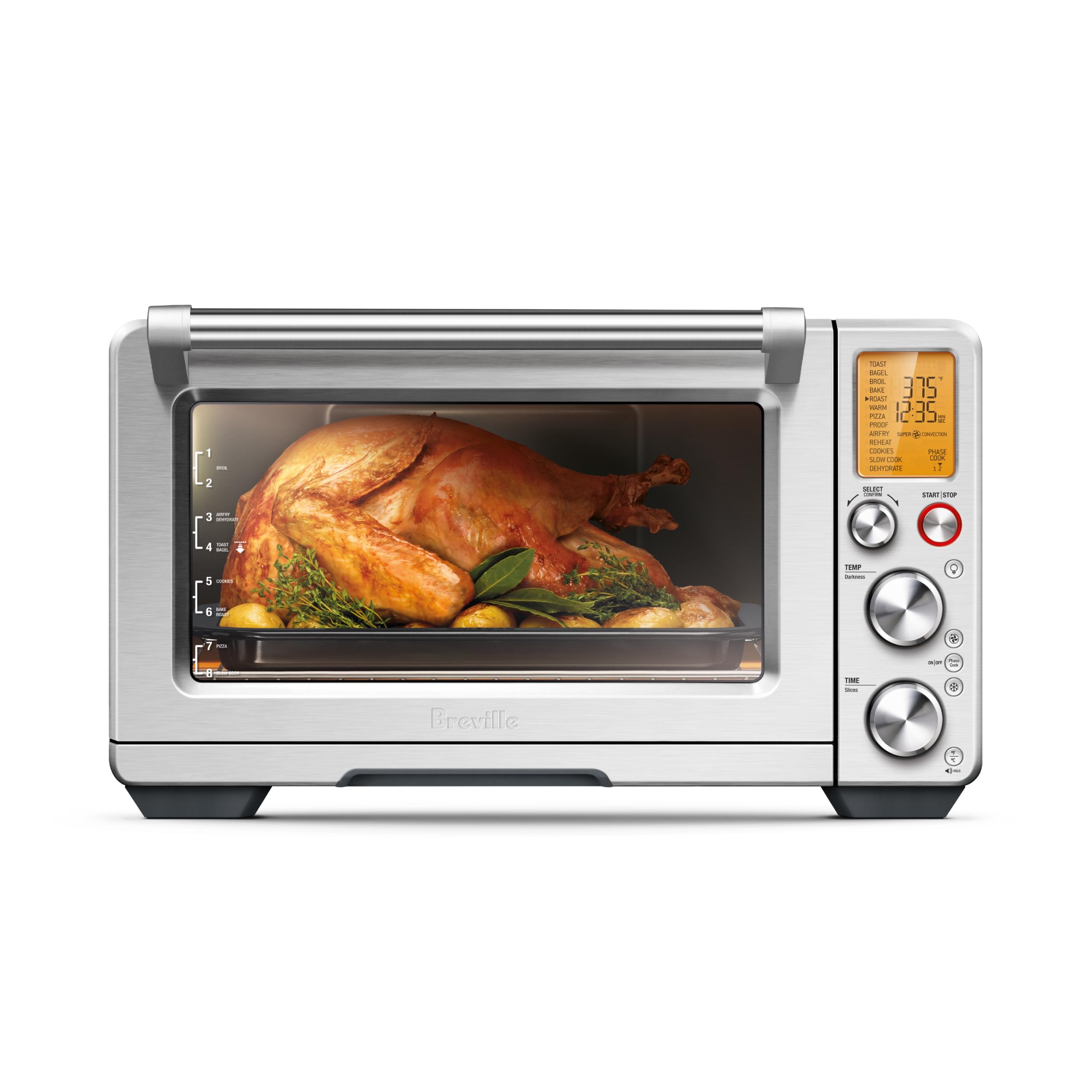
Best Smart Ovens with Air Fry of 2026

The pitch for a smart oven is that it replaces your toaster, your air fryer, and a good chunk of what your big oven does. The catch: a countertop appliance only earns its counter space if it heats evenly and doesn't bury what you need behind three menus. I've cooked on enough ovens that run 25 degrees cold to be fussy about temperature control.

Over the past six months, my team and I cooked in nine of these ovens — frozen fries, roast chicken, sheet-pan vegetables, the works. The divide wasn't the number of advertised functions. It came down to preheat speed, whether the air fry basket delivered an actual crunch, how closely each oven held the temperature we set, and how miserable the interior was to wipe down.

Worth knowing before you shop: the function count is mostly marketing, and most people lean on three or four settings, all of them with a fan behind them. Everything below earned its spot on cooking performance and value rather than a preset list, and there's a pick here for however you actually cook.

1

Best Overall

Breville Smart Oven Air Fryer Pro

91 /100
LBD Score Outstanding

Key details

Weight
30.2 lb
Capacity
1 cu ft
Cooking Functions
13
Temperature Range
80–480 °F
View on Amazon

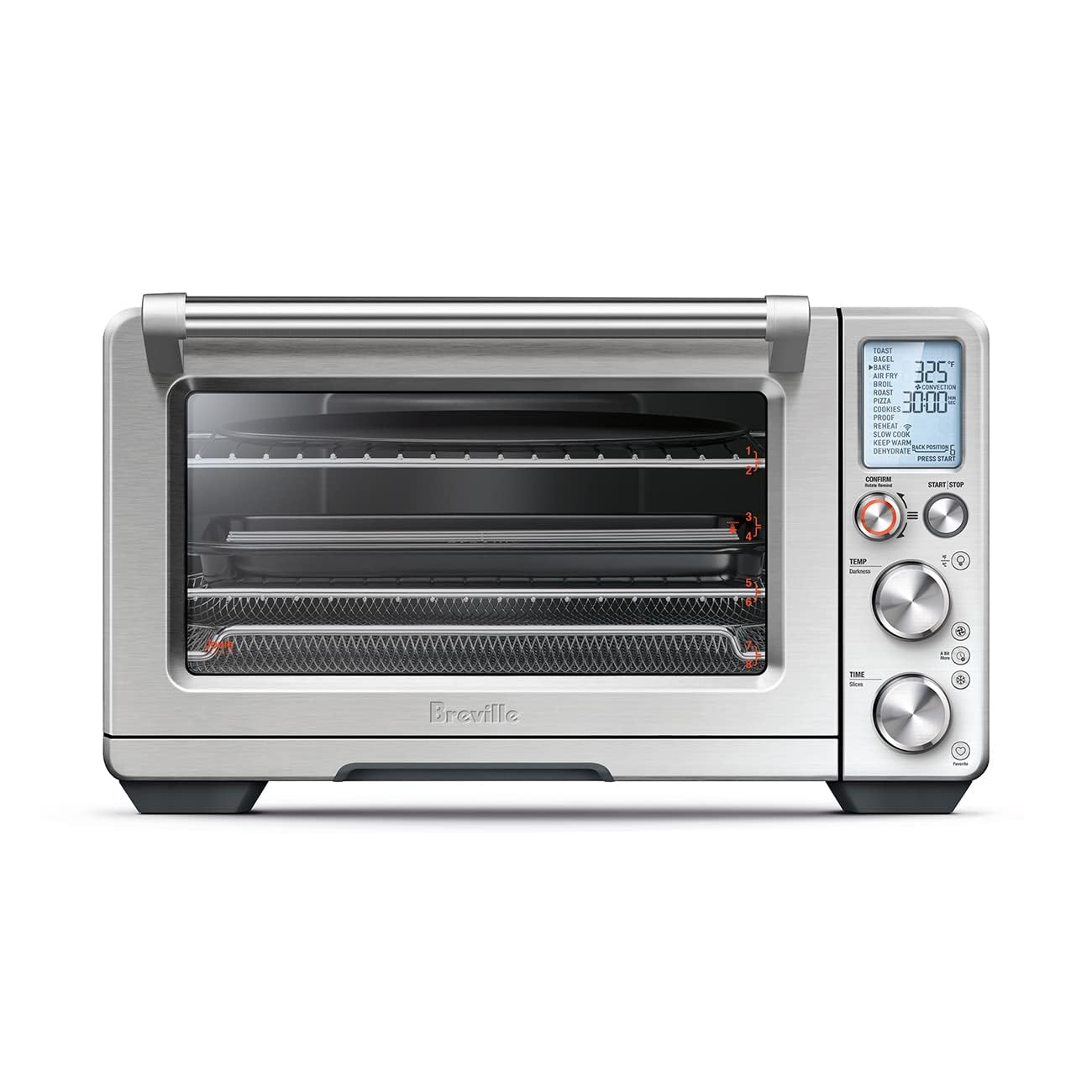
One cubic foot stops sounding abstract the moment you slide a 9-by-13 pan onto a rack and still have room above it for a second one. That's the case for the BOV900: 21.5 inches wide, 30.2 pounds, and it takes a real slice of counter, but in return it roasts, bakes, broils, proofs, dehydrates, and air fries without heating up the kitchen. We kept coming back to it because it never forced a choice between a big batch and a good result.

Behind that are five quartz elements the Element iQ system switches independently, plus a two-speed convection fan. The specifications we cared about most were the temperature range — 80 to 480 °F — and the accessories: a 13-inch pizza pan, a broil rack, an enamel roasting pan, and a mesh basket for air frying and dehydrating. A low floor means dough proofs and fruit dries; a high ceiling means pizza comes out with a blistered crust instead of a pale one.

The closest call in this guide is between this oven and the Joule. Same footprint, same 13 functions, same Element iQ guts; the Joule adds the app and asks noticeably more for it. Unless guided recipes are the reason you're shopping, the Pro is the better use of the money, and it's the one we point people toward when they want a second oven that earns its counter space.

Pros

  • Roasts, bakes, and air fries in a 1-cubic-foot cavity
  • 80–480 °F range covers proofing through high-heat pizza
  • Thirteen functions, from bagels to dehydrating
  • Pizza pan, roasting pan, and fry basket included

Cons

  • Toast mode is slower than a slot toaster
  • Elements can fail after a couple of years
Our verdict

We recommend the Smart Oven Air Fryer Pro as the default pick: 13 functions, a 1-cubic-foot cavity, and air frying that actually crisps, for less than the app-connected Joule.
Check Latest Price
2

Best Smart Controls

Breville Joule Oven Air Fryer Pro

87 /100
LBD Score Excellent

Key details

Weight
38.9 lb
Smart Controls
Joule app, voice activation
Cooking Functions
13
Temperature Range
80–480 °F
View on Amazon

The Joule is the only oven in this group that's smart in the connected sense. It pairs with the Breville+ app, carries more than a thousand guided recipes, runs a multi-stage Autopilot sequence that moves between cooking modes on its own, and takes voice commands. Underneath, it's the same 13-function, 80–480 °F Element iQ oven as our top pick, in the same body, at the top of this group's prices.

Whether the app earns that depends on how you cook. For a dish with stages — sear, then roast, then broil — Autopilot keeps you from standing at the dial, and the guided steps are genuinely useful the first few times you make something new. For toast, fries, and reheating, we never opened it. It's also a coach rather than a remote: you can't count on changing the temperature, adjusting the timer, or shutting the oven off from your phone, so you still walk to the counter.

The rest of the ledger is less tidy. Temperature control is the soft spot — preset cooks can come out underdone while other spots brown faster — so check doneness before the timer runs out rather than after. That's a real annoyance at this end of the price range, and it's why the Pro stays our default even though these two ovens share so much hardware.

Pros

  • Autopilot walks through multi-stage recipes
  • More than a thousand guided recipes in the app
  • Same 13 functions and 80–480 °F range as our top pick

Cons

  • The most expensive oven in this group
  • Heaviest here at 38.9 pounds
Our verdict

Buy the Joule if you want the oven to coach you through a recipe with guided steps, app notifications, and voice control — and you're willing to pay the most here for it.

Check Latest Price
3

Best for Small Counters

Ninja Foodi Dual Heat Air Fry Oven

90 /100
LBD Score Outstanding

Key details

Weight
21.5 lb
Storage
Flip-up design
Max Temperature
500 °F
Cooking Functions
13
View on Amazon

The Foodi Dual Heat stands up. The whole oven pivots on its base and stores vertically against the wall, which is the only real answer we've found for a kitchen where the counter is already full. It's 8.15 inches tall as listed and 21.5 pounds, so it isn't a small appliance — it's a full oven that happens to get out of the way.

The flip isn't a gimmick. We expected to use it once and leave the oven down, and instead it spent most of its time upright between cooks, which is exactly what a tight kitchen asks for. When it's flat, the Dual Heat setup is unusual: a directly heated SearPlate that reaches 500 °F works with cyclonic air at the same temperature, so a steak gets a crust underneath while the air crisps the top. Add 13 functions and the Foodi Smart Thermometer and there's more capability here than the footprint suggests.

Capacity is the trade. One rack means one level at a time, so a tray of cookies goes in as a single batch and a 9-by-13 pan is about the limit. If you cook for four most nights, the Breville's extra cubic foot is worth the counter it takes; this is the one for a two-person kitchen with a few inches to spare.

Pros

  • Flips up and out of the way between cooks
  • SearPlate and air both reach 500 °F
  • Smart thermometer takes the guesswork out of roasts

Cons

  • Drip pan and interior need real scrubbing
Our verdict

The Foodi Dual Heat is our pick for a cramped counter: it stands up out of the way between cooks, then sears at 500 °F when you need it to.

Check Latest Price
4

Best for Two Dishes

Ninja Smart Double Oven DCT451

89 /100
LBD Score Excellent

Key details

Ovens
Two, independent
Probe
Smart Cook thermometer
Weight
31 lb
Cooking Programs
12
View on Amazon

Two ovens, one box. The FlexDoor splits the front into a top and bottom cavity: open just the top for toast or a snack, or open the whole door and cook two different things, two different ways, at the same time. FlavorSeal keeps smells from crossing between the cavities, which matters more than it sounds like it should.

Smart Finish is the part that makes the two halves cooperate — it syncs top and bottom to finish at the same moment, so the roast and the potatoes land together instead of twenty minutes apart. The leave-in Smart Cook thermometer handles the protein side: set a doneness and the oven tracks it. One detail to plan around is that air frying lives in the bottom cavity, so the crisp component goes low and the quick one goes high.

For two people cooking a protein and a side on a weeknight, that second cavity is the most useful single feature in this guide, and it's why the oven earns a slot despite its size. If your household mostly toasts and reheats, you're paying for a cavity you'll never open, and a single-cavity oven does the same work for less.

Pros

  • Two independent ovens behind one door
  • Smart Finish lands two dishes together
  • Leave-in thermometer for roasts

Cons

  • Deep 21.5-inch footprint
  • Lower cavity collects grease and is hard to clean
Our verdict

Choose the Smart Double Oven if you cook two components at once — FlexDoor and Smart Finish are the reason, and they justify the counter depth.

Check Latest Price
5

Best Value

Nuwave Bravo 30 QT

89 /100
LBD Score Excellent

Key details

Probe
Integrated digital
Capacity
30 quarts
Cooking Functions
12
Temperature Range
50–500 °F
View on Amazon

Thirty quarts at the low end of this group's prices is the pitch, and the Bravo mostly lives up to it. It's a four-rack-position oven that runs from 50 °F to 500 °F in five-degree steps, weighs 20.8 pounds, and includes a probe that watches the food's internal temperature and shuts the oven down when it gets there. That combination is normally the expensive part of the category, which is why this one holds a slot.

The controls are where the money was saved. There's a touch panel with 12 cooking functions and a lot of on-the-fly adjustment — you can raise the temperature or add time mid-cook without starting over — but the menus take a few sessions to learn, and the toast setting sits deeper than it should for something you use every morning.

What you're actually buying is volume. Thirty quarts and four rack positions mean two trays at once, which the smaller ovens here can't do, and the probe makes a long roast genuinely hands-off. It's a wide, plain-looking box rather than a pretty one, so measure the width of the spot you have in mind before you order.

Pros

  • 30-quart cavity with four rack positions
  • Built-in probe monitors doneness and stops the oven
  • 50–500 °F in five-degree steps

Cons

  • Touch menus take a few sessions to learn
  • Temperature can drift from the set point
Our verdict

The Bravo is our value pick: 30 quarts, four rack positions, and a built-in probe that ends the cook for you, at the low end of this group's prices.

Check Latest Price
6

Tight Counters

Nuwave Bravo Pro 21 QT

86 /100
LBD Score Excellent

Key details

Weight
14.4 lb
Capacity
21 quarts
Cooking Functions
10
Temperature Range
50–450 °F
View on Amazon

One rack, one cavity, no probe. The Bravo Pro is the smallest full oven here and it doesn't pretend otherwise: 21 quarts, 14.4 pounds, and a body about 17.6 inches wide and 13 deep, which is why it fits on a short stretch of counter where the 30-quart models won't.

The feature that earns it a place is the heater split. You can dial the top and bottom elements anywhere from 0 to 100 percent and choose from three fan speeds, so a thick-crust pizza gets bottom heat while the cheese takes a blast from above — a level of control the bigger ovens bury inside a preset. The range runs 50 to 450 °F in five-degree steps, and the enamel pan is PFAS-free.

Two things to plan for. It throws heat — the top and door get hot enough that you'll want clearance on all sides and nothing stored above it. And one rack is one rack: no two-level baking, no tray of cookies plus a casserole. Within those limits it's the most control you can get on a narrow counter, and that browning dial is worth more day to day than the extra quarts you give up.

Pros

  • Top and bottom heaters adjust independently
  • 50–450 °F in five-degree steps with three fan speeds
  • 14.4 pounds, light enough to move

Cons

  • Single rack rules out two-level baking
  • Runs hot on some settings
Our verdict

Buy the Bravo Pro if counter space decides: 21 quarts, 14.4 pounds, and top-to-bottom heat control you dial yourself rather than pick from a list.

Check Latest Price

How We Tested Smart Ovens with Air Fry

I built the shortlist from spec sheets first — a convection fan, an included air fry basket, a food probe on the models that offer one, and an exterior that still clears a standard upper cabinet — then cut anything whose price didn't match what it promised. That left nine ovens, ranging from simple convection boxes to models with a built-in meat probe, and we cooked in every one of them for six months.

Each oven got the same opening test: I set it to 350 degrees, clipped a thermometer to the center rack, and logged the real temperature every few minutes for an hour. That's how I found the ones that overshoot during preheat and the ones that swing 30 degrees once they settle. Then came toast — six slices spread corner to corner — to see where the browning fell off. A pound of frozen fries went into each air fry basket, tossed once halfway, and I noted which batches came out crisp and which came out steamed.

After that we ran real meals: weeknight chicken thighs, weekend sheet-pan vegetables, reheated pizza. Where there was a probe, I used it and compared its reading against an instant-read thermometer. Ease of use was judged by handing the controls to someone who hadn't read the manual and seeing how far they got. I also let cheese bubble over onto the floor of each oven on purpose, then timed the cleanup and checked whether the crumb tray and basket could go in the dishwasher.

At the end of six months of near-daily use, I re-checked door hinges, knob and touchscreen responsiveness, and whether the interior coating had stained. The ovens that survived all of that without a workaround are the ones below.

How to Choose a Smart Oven with Air Fry

What 'Smart' Actually Buys You

Three different things get called smart in this category, and only one of them is a phone app. Sensor systems like Breville's Element iQ and Nuwave's Linear T steer power between elements to hold a temperature. Leave-in probes on the Ninja and Nuwave ovens track internal doneness and end the cook. The Joule adds a connected app with more than a thousand guided recipes and an Autopilot mode that walks through multi-stage dishes. Decide which of those you'll actually use; for most cooks a probe beats a phone.

When you read app claims, check what the app can do mid-cook. Plenty can send a notification and offer a recipe but can't change the temperature, adjust the timer, or shut the oven off — which makes them a cookbook on your phone rather than a remote control.

Measure the Cavity and the Counter

Capacity arrives in quarts on some listings and cubic feet on others, so don't compare those numbers directly. Compare what fits: a 12-inch pizza, a 9-by-13 pan, two trays at once. Then measure the counter rather than the oven. Our top pick needs roughly 21.5 inches of width and 17.5 of depth, and the door has to drop in front of it, so add that to the depth you have available.

The trap is the word compact, which usually describes the outside of the oven rather than the inside. Check the interior before assuming a small model holds dinner for four, and leave clearance at the sides and top — these appliances vent a lot of heat.

Air Frying Is a Fan and a Ceiling

Every oven here air fries; the difference is how hard the fan blows and how hot the cavity gets. Maximum temperatures in this group run from 400 °F on the compact Breville to 500 °F on the Ninja ovens and the 30-quart Nuwave, and that ceiling matters — fast, hot, moving air is what browns the outside while the inside steams.

Use the mesh basket rather than the baking pan so air reaches the underside, keep food in one layer, and let the oven preheat. A dedicated air-fry mode with a two-speed fan does more for crispness than a convection badge alone.

Temperature Accuracy Outranks Preset Count

Twelve presets are worth less than a cavity that holds the temperature you dialed. Ovens in this category can run hot or cool by a noticeable margin, and a preset assumes the thermostat is right — which is how a bake browns long before the timer says so. Buy an inexpensive oven thermometer, set it in the middle of the rack, and note the offset once. After that you know whether your oven wants 375 or 400 for anything you care about.

A leave-in probe does the same job for meat and takes most of the guesswork out of poultry and roasts. If precision is the reason you're upgrading, buy the probe before you buy the presets.

Cleaning, Noise, and How Long It Lasts

Grease is the recurring problem in this category, and the ovens that stay pleasant are the ones with a crumb tray or drip pan that slides out and an interior you can actually reach. Wipe the cavity after air frying instead of waiting for a deep clean; baked-on fat is what smokes the next time you run the oven hot. Fan noise is the other daily cost — convection in a small kitchen is loud enough to interrupt a conversation.

Check the warranty before you order. The Ninja ovens list one year, the Breville Smart Oven Air Fryer Pro lists two, and the Joule's listing doesn't state one at all, so ask. Element failures show up across this whole group over time, and the warranty is what separates an annoyance from a loss.

Frequently Asked Questions

Final Verdict

Buy the Breville Smart Oven Air Fryer Pro. It has the largest usable cavity in this group, the widest temperature range, and air frying that genuinely crisps, and it runs the same Element iQ hardware as the Joule for less money. Unless guided recipes are the reason you're shopping, there's no argument for paying more.

Two requirements change that. If counter space is the constraint, take the Ninja Foodi Dual Heat — it sears at 500 °F and then stands up out of the way. If you cook a protein and a side on the same night, the Ninja Smart Double Oven's second cavity is worth the depth it costs you.