Best Wide-Angle Lenses of 2026

An ultra-wide lens is how you fit a whole kitchen, a full aisle of pews, or a crowded dance floor into one frame without backing through a doorway. It's also the fastest way to find out where your pictures fall apart: straight lines bow toward the corners, and the edges of the frame reveal what a lens is really made of. That trade-off is the whole game in this category.

I shoot interiors and landscapes for work and for fun, and a spec sheet has never once told me how a lens would feel in hand. Over six months, my team and I shot with 10 wide-angle lenses — primes and zooms, autofocus and manual — on hikes, in dim living rooms, and along crowded streets at dusk, keeping an eye on sharpness, distortion, focus, and what each one actually gives you for the money.

The one thing I'd tell a first-time buyer: the mount comes before everything. A lens that doesn't match your camera's mount or sensor format is dead weight, no matter how good the glass is. The picks below are the ones we'd keep in our own bags.

1

Best Overall

Canon EF-S 10-18mm f/4.5-5.6 IS STM

94 /100
LBD Score Outstanding

Key details

Mount
Canon EF-S
Focal Length
10-18mm
Max Aperture
f/4.5-5.6
Stabilization
Optical IS
View on Amazon

Canon crop-sensor DSLR shooters have the easiest decision on this page. The EF-S 10-18mm is the lens we point Rebel and 90D users toward first, and it is the best value in this group: a 10-18mm zoom that behaves like a 16-29mm on an APS-C body, wide enough to swallow a room, a canyon, or a whole street in a single frame. It is also one of the least expensive lenses here, and nothing about how it shoots feels like a compromise.

Two details make it feel more expensive than it is. The stepping motor focuses quickly and silently, quiet enough that video sound stays clean, and the optical stabilizer steadies hand-held interiors — at 10mm you can hold the camera at dusk and still come away with a sharp frame. Close focus of a little over eight inches is the third gift: put the front element near a railing, a rock, or a café table and the foreground grows while the background stays put.

Optically it holds sharpness into the corners once you are a stop or so down, which is the first thing we check on an ultra-wide. At 10mm the edges stretch, as they do on every rectilinear lens this wide, and a correction profile tidies it up. The mount is the boundary: EF-S fits Canon crop DSLRs only, so if you have moved to an EOS R body, the RF16mm below is your version of this lens.

What surprised us was how little the plastic mount matters. The lens is light enough that it never levers against the body, and it still locks down firmly after a lot of swapping. That low weight is the real reason it ends up living on the camera instead of in the bag.

Pros

  • Sharp, near-silent STM focus suits video
  • Optical stabilization steadies hand-held interiors
  • Light enough to keep on the camera
  • Close focus of about nine inches

Cons

  • Slow f/4.5-5.6 aperture in dim light
Our verdict

The best value in this group and the lens we recommend to Canon crop-DSLR shooters first: sharp, stabilized, near-silent, and wide enough to change how you shoot interiors.

Check Latest Price
2

Best for Full-Frame Canon

Canon RF16mm F2.8 STM

92 /100
LBD Score Outstanding

Key details

Mount
Canon RF
Weight
5.75 oz
Focal Length
16mm
Max Aperture
f/2.8
View on Amazon

Where our top pick spreads its coverage across a zoom, the RF16mm does one thing: a single 16mm that weighs 163 grams and barely lengthens an EOS R body. On full frame that is 108 degrees and an f/2.8 aperture, roughly a stop and a half more light than the Canon zoom above — the difference between a usable frame and a smeared one in a dim room.

We reach for this one when the bag is small and the light is bad. It is also the easiest way to get close with a wide lens: focus down to 5.11 inches and the 0.26x maximum magnification fills a third of the frame with a flower, a hand, or a menu while the street stays behind it. Pocket size plus near-macro reach is why it earns a place next to bigger, faster glass.

Files straight out of the camera show strong vignetting and visible barrel distortion. On an R body the JPEGs are corrected automatically and raw files clean up with the built-in profile, so treat that as a workflow note rather than a reason to walk away. Focus is quick and quiet, if a beat slower to settle than the best here. On an APS-C R body it becomes a wide-normal of around 26mm-equivalent rather than an ultra-wide, so this pick is really for full-frame bodies.

Pros

  • 163 grams and pocketable on R bodies
  • f/2.8 aperture for dim interiors and night
  • Focuses to 5.11 inches at 0.26x

Cons

  • No lens hood in the box
Our verdict

A full-frame ultra-wide the size of a body cap: what we hand R8 and R6 shooters who want a wide prime that fits in a jacket pocket.

Check Latest Price
3

Best for Sony APS-C

Sony E 11mm F1.8

91 /100
LBD Score Outstanding

Key details

Mount
Sony E
Weight
10.6 oz
Focal Length
11mm
Max Aperture
f/1.8
View on Amazon

An f/1.8 ultra-wide is a different tool from the f/4-ish zooms that make up most of this list. Sony's 11mm gives an APS-C body a 16.5mm-equivalent view with 104 degrees of coverage, and the aperture is what you are paying for: interiors with the lights off, hand-held night shots, and enough separation to hold a face against a soft background at arm's length.

Two linear motors make focus fast enough to track, and the lens is corrected for focus breathing, which is exactly why it behaves on a gimbal. At 10.56 ounces it does not tip a small body forward, and internal focusing keeps the barrel from extending while it works. The outer frame does stretch — keep faces out of the edges unless the joke is the point.

For Sony APS-C video we take this over any zoom here: the aperture and the breathing correction are worth giving up a zoom ring. The fixed focal length is the real cost, and the price reflects the glass. One practical gift — the 55mm filter thread matches what most kit zooms use, so the polarizer you already own screws straight on.

Pros

  • f/1.8 aperture for available light and night
  • Fast, quiet linear-motor autofocus for video
  • Light at 10.56 ounces with minimal breathing

Cons

  • Fixed 11mm
  • Premium price for a single focal length
Our verdict

For Sony APS-C shooters who work in low light, this is the wide lens to buy — fast, quiet, and small enough to live on a gimbal all day.

Check Latest Price
4

Best Budget Ultra-Wide

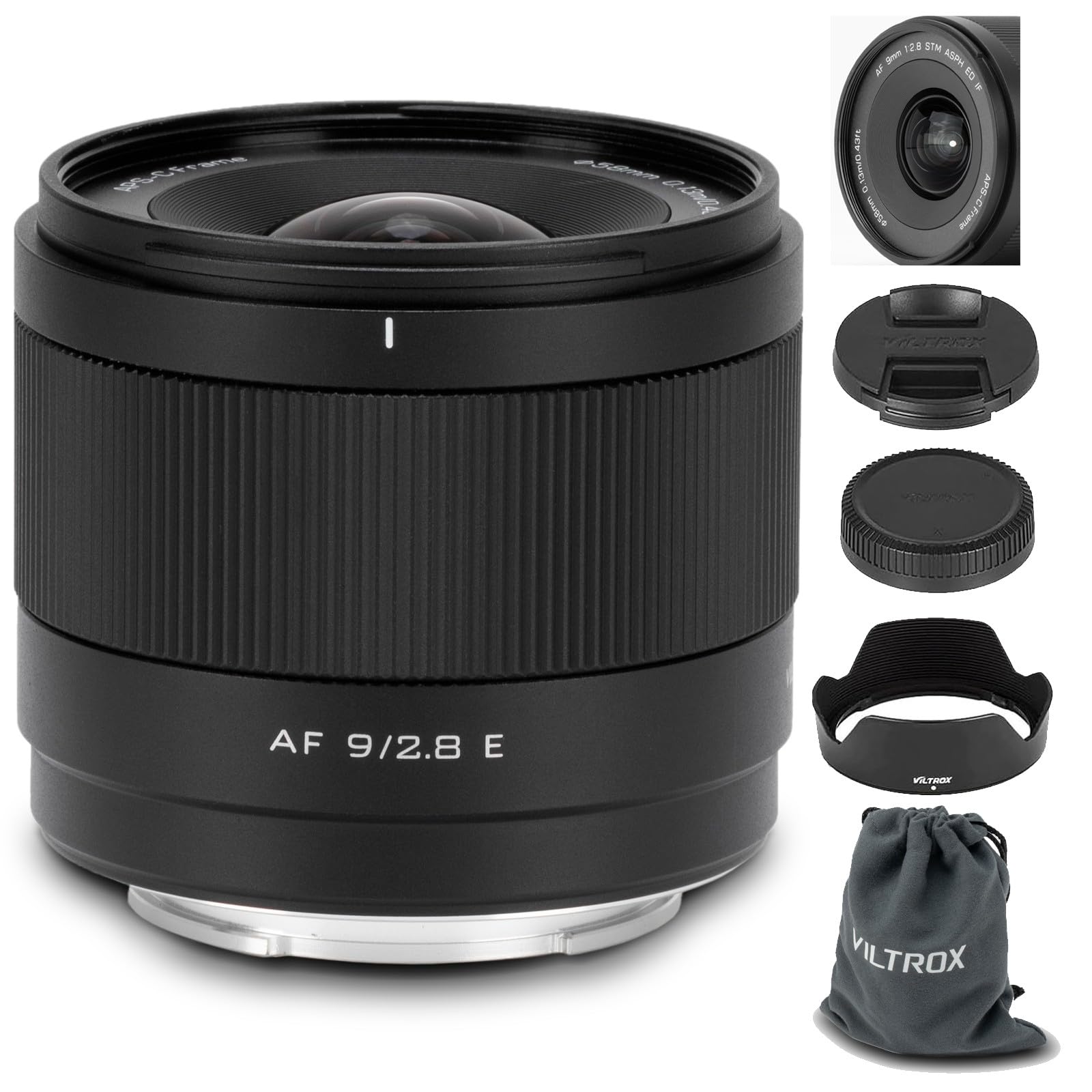
Viltrox 9mm F2.8

90 /100
LBD Score Outstanding

Key details

Mount
Sony E
Weight
6.17 oz
Focal Length
9mm
Max Aperture
f/2.8
View on Amazon

113.8 degrees is a strange and useful number. Viltrox's 9mm gives Sony APS-C bodies the equivalent of a 13.5mm full-frame lens — wide enough to pull a staircase, a car interior, or six people at arm's length into one frame, and wide enough that anything near the corners bends.

At 175 grams it disappears into a bag, and it is the cheapest lens here, a pairing that makes it the one we hand someone who wants to try ultra-wide without committing. Eye and face detection works, close focus at 0.13m lets you jam a foreground right up against the glass, and the 13-element design holds detail better than the price suggests. The hood and pouch come in the box, so you are not shopping for extras on day one.

The edges are what you pay for that extra field of view. At 113.8 degrees the corners stretch and smear, so keep people and straight lines out of the outer fifth of the frame or crop back toward a 12mm look. It is also APS-C glass: on a full-frame Sony body you are shooting in crop mode and throwing away most of the sensor.

Pros

  • 113.8-degree view for tight interiors
  • 175 grams, small enough to always carry
  • Eye and face detection autofocus
  • Focuses to 0.13m for dramatic foregrounds

Cons

  • Corners stretch and smear at the edges
  • No image stabilization
Our verdict

Our pick for anyone who wants to try ultra-wide without spending much: 113.8 degrees, 175 grams, and autofocus that actually works.

Check Latest Price
5

Best for Astrophotography

Rokinon 14mm F2.8

87 /100
LBD Score Excellent

Key details

Focus
Manual
Mount
Canon EF
Focal Length
14mm
Max Aperture
f/2.8
View on Amazon

There are no electronics in this lens at all. No autofocus, no camera-set aperture, no stabilization — just 14 elements in 10 groups, a metal mount, and a 115.7-degree view on a full-frame Canon body. For some photographers that ends the conversation; for the ones who shoot stars, it is the reason the lens is on this list.

Astrophotography is where it earns its keep. f/2.8 gathers light quickly and sharpness holds across the aperture range, which matters when you are wide open at midnight and cannot stop down without losing the sky. The technique is plain: zoom live view onto a bright star, focus by hand, then leave the ring alone until dawn. On a crop body it behaves like a 22mm, a comfortable wide rather than a dramatic one.

Manual everything costs you speed — this is a tripod lens, not one for a wedding or a toddler. What we appreciate is how deliberate the process becomes: set the aperture on the ring, watch the meter shift because the camera cannot set it for you, then expose. It is the only lens here where you do all the work, and for night skies that is the feature.

Pros

  • f/2.8 at 14mm for night-sky work
  • Sharp across the aperture range
  • Solid metal mount and sturdy feel
  • Widest full-frame view here at 115.7 degrees

Cons

  • Mustache distortion that needs correcting
Our verdict

The lens we take for star fields and empty landscapes: 14mm, f/2.8, sharp, and entirely manual, which is the whole point.

Check Latest Price
6

Best for Nikon DSLRs

Nikon 10-24mm f/3.5-4.5G

90 /100
LBD Score Outstanding

Key details

Mount
Nikon F (DX)
Focal Length
10-24mm
Max Aperture
f/3.5-4.5
Angle Of View
109° to 61°
View on Amazon

This is the only Nikon-fit lens in the group, and that makes it the answer for anyone whose bag holds a D500, D7500, or D3500: 10-24mm on DX works out to 15-36mm-equivalent, a 109-degree view at the wide end, and a zoom ring that takes you from a whole room to a portrait without a lens change.

The Silent Wave Motor focuses quickly and quietly, and the 0.8-foot close-focus distance lets you get near enough to fill the frame with a detail while the room stays behind it. Images come out sharp and clean, with the best of it around f/8 to f/11, and the barrel feels solid even though it is plastic.

One practical detail we liked: the 77mm filter thread matches the pro zooms, so a polarizer or graduated filter you already own from a bigger lens goes straight on. That is unusual for a crop zoom, and it saves you buying a second set of filters in a smaller size.

For DX bodies this is the wide zoom worth buying, and the mount does half the deciding for you. It is neither the widest nor the fastest lens here, but it covers the wide end and the normal end with no gap between them, and it does it quietly.

Pros

  • 109-degree view that zooms to a 61-degree normal
  • Silent Wave Motor focuses quickly and quietly
  • Sharpest around f/8 to f/11
  • Accepts 77mm filters shared with pro zooms

Cons

  • Corner distortion at 10mm
  • No vibration reduction
Our verdict

The straightforward answer for Nikon DX bodies: a 10-24mm that goes from very wide to normal and focuses quietly while it does.

Check Latest Price
7

Interior and Video

Sigma 10-20mm f/3.5 EX DC

87 /100
LBD Score Excellent

Key details

Mount
Canon EF
Focal Length
10-20mm
Max Aperture
f/3.5
Angle Of View
102.4°
View on Amazon

A constant f/3.5 across a 10-20mm zoom is unusual at this size, and it is the reason to look at Sigma's lens instead of the Canon zoom we recommend first. Zooming from 10mm to 20mm does not cost you light, which matters for interiors shot quickly and for video where you do not want exposure jumping as you reframe. It also feels like the more substantial lens: a metal mount, a petal hood in the box, and a barrel that takes a knock.

Two things to know before you buy. Wide open, the corners go soft and vignetting shows, so most architectural work here happens around f/8 where the lens is at its best. And the 10mm end carries the edge curvature all of these do — lines lean, and a profile straightens them at a small crop. For daylight architecture and slow interior work, none of that gets in the way.

Pros

  • Constant f/3.5 through the zoom range
  • Solid metal-mount build with hood included
  • Sharp, high-contrast results in daylight

Cons

  • Autofocus sometimes fails to engage
  • Heavier than the Canon zoom
Our verdict

Worth the money if you zoom while filming or shoot interiors in changing light — the constant f/3.5 is the whole argument.

Check Latest Price

How We Tested Wide-Angle Lenses

We started by pulling every current ultra-wide lens we could find for the major mirrorless and DSLR mounts — primes and zooms, autofocus and manual — then trimmed to the ones that fit a real camera bag: reasonable weight, a mount people actually own, and a price that isn't a second mortgage. Anything we couldn't mount on a body we had on hand came off the list immediately. That left 10 lenses, which we shot with for six months.

Each lens went through the same rounds. I photographed a brick wall and a tiled bathroom head-on to see how far the straight lines bent and whether the curve cleaned up when stopped down. I shot the same unlit living room at dusk, handheld, to compare how each one handled a dim room and whether stabilization actually bought me a stop. On hikes I paid attention to weight on a long climb and to how each lens handled sun flaring across the front element.

Back at the desk, we compared frames at 100 percent in the center and in the corners, because sharp is a meaningless word until you see where it stops being sharp. Autofocus got tested on moving subjects and in video, with an ear out for motors that creep onto the soundtrack; manual lenses were judged on how the focus ring felt and how easy it was to nail focus without confirmation. Then we weighed all of it against what each lens asks you to pay.

How to Choose a Wide-Angle Lens

Match the Mount Before the Focal Length

Canon splits its mounts twice — EF and EF-S for DSLRs, RF and RF-S for mirrorless — and an EF-S lens will not mount on a full-frame DSLR at all. RF-S glass is built for APS-C R bodies such as the R50 and R10. Sony's E mount covers both formats, but an APS-C lens like the 9mm or 11mm puts a full-frame body into crop mode and throws away most of the sensor.

Read the badge on your camera before you read anything else about a lens. If you are shopping for someone else, get the exact model name — Canon alone has four mounts in play here.

Work Out How Wide You Actually Need

Compare angle of view rather than focal length, because the same number means different things on different sensors: 10mm on a Canon or Nikon crop body gives roughly the view of a 16mm lens on full frame, and 16mm on a full-frame body covers about 108 degrees. If you want a room, a canyon, or a car interior in one frame, aim for the widest end of that range; a 28mm is a wide-normal, useful for street and environmental portraits but not for swallowing a space.

Expect the edges to bend. Straight lines near the corners of an ultra-wide lean outward; that is geometry, not a defect, and a correction profile fixes it by cropping slightly. Architectural shooters leave a little room in the frame so the correction has somewhere to go.

Choose an Aperture for the Light You Shoot In

Wide lenses get used indoors and after dark more than their specs suggest, so aperture matters. An f/2.8 prime gathers roughly a stop and a half more light than the f/4.5-5.6 zooms here, which is the difference between a hand-held room at dusk and a tripod. Stabilization helps with still subjects — it does nothing about people moving or wind in the trees.

For night skies, treat f/2.8 as the floor, manual focus as normal, and a small tripod as part of the kit.

Weigh Autofocus Against Weight

A manual lens like the 14mm has no electronic aperture, so you focus and stop down by hand while the meter follows. That is fine for tripod work and hopeless for events, family, and hand-held video. If your subjects move, pay for autofocus and for the motors that keep it quiet enough for video.

Then weigh what you will carry. The RF16mm at 163 grams is a lens you forget is mounted; a 520-gram zoom is one you plan the day around. For travel and vlogging, that difference decides which lens actually leaves the house.

Frequently Asked Questions

Final Verdict

The Canon EF-S 10-18mm is the lens we tell crop-DSLR shooters to buy, and nothing else here changes that: it is the rare ultra-wide that is inexpensive, stabilized, quiet, and light enough to leave on the body. If your camera is a full-frame EOS R, the RF16mm is the same idea shrunk to a pancake with a faster aperture.

For Sony APS-C shooters who mostly shoot video, take the 11mm f/1.8 and its aperture over any zoom here. And if your bag holds a Nikon DX body, stop reading — the 10-24mm is the only one that will mount.