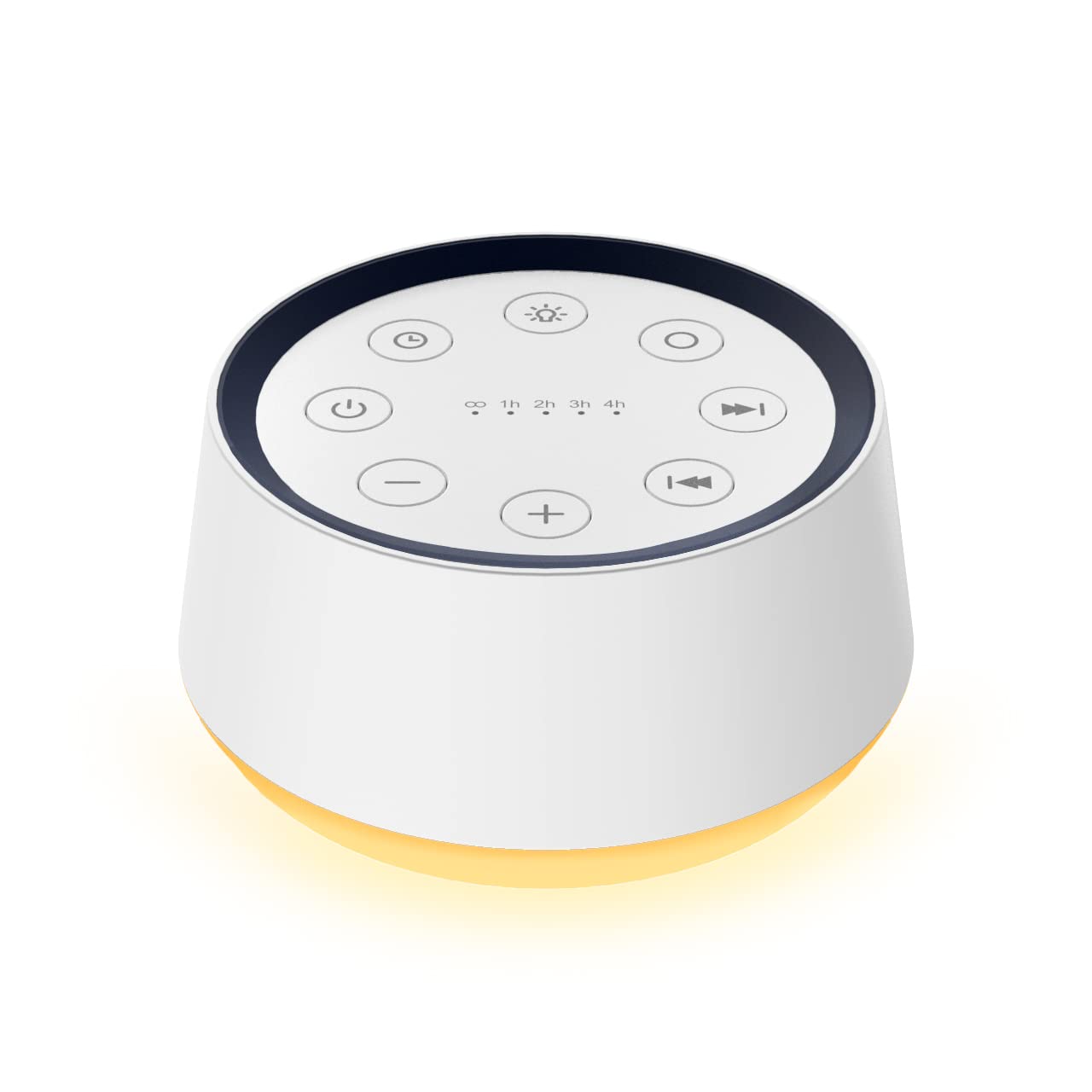
Best White Noise Machines of 2026

White noise machines make sound one of two ways: a small fan pushing air through a vent, or a speaker looping a recording. At 2 a.m. that difference is everything, because a short digital loop has a seam, and once your brain finds it you hear it every night. Either way the job is the same — cover the idling truck, the snoring, the neighbor's TV through a shared wall.

I've slept beside both kinds for four months now, and my team has run 14 machines in that time, on nightstands, in nurseries, and in hotel rooms. What surprised me is how little the sound count matters. Thirty sounds isn't better than six; two or three that don't loop audibly beat a menu you'll never scroll through.

What separated the field was duller stuff: how quiet the lowest setting goes, whether a machine remembers your settings after a power blink, whether the buttons are findable in the dark, and which units survived a knock off the nightstand. The picks below are the ones we'd keep plugged in at home, plus a couple that travel well.

1

Best Overall

Yogasleep Dohm Classic

93 /100
LBD Score Outstanding

Key details

Weight
1.6 lb
Dimensions
5.75 x 5.75 x 3.25 in
Sound Source
Real fan, dual speed
Tone Control
Twist collar
View on Amazon

The tone control on the Dohm Classic is a collar you twist, and it's the main reason this is the machine we recommend first. Turning it opens or closes the air intake, so the sound slides from a thin hiss toward a low, breathy rumble — a mechanical adjustment you can make in the dark without hunting for a button.

Because the sound comes from a fan pushing air, there's no clip to restart and no seam to catch your attention at 3 a.m. That's the difference between a machine you stop hearing after ten minutes and one you keep noticing. The body is a 5.75-inch cube at about a pound and a half, with a 7-foot cord that reaches an outlet from most nightstands.

The honest limit is volume. Two speeds plus the collar give you a workable range for a bedroom, a nursery, or an office, but a heavy snorer a couple of feet away or a thin wall to a busy street can still get through. If that's your problem, a digital machine with a higher ceiling is the safer buy. In an ordinary room, we never ran out of headroom.

The whole interface is a switch and a collar, which is why we never fumble with it half-asleep and why nothing glows at us from the nightstand. After a week it stops being a device you operate and becomes part of the room — which is what you want from the thing that's supposed to be helping you sleep.

Pros

  • Real fan sound with no audible loop
  • Twist collar tunes tone, not just volume
  • One switch and nothing to misconfigure at night

Cons

  • No timer, night light, or app control
Our verdict

We recommend the Dohm first for most bedrooms: a real fan, a twist-to-tune tone, and nothing else to fiddle with half-asleep.

Check Latest Price
2

Best for Sleep Schedules

SNOOZ Original

93 /100
LBD Score Outstanding

Key details

Dimensions
5.6 x 5.6 x 3.2 in
App Control
Schedule and remote
Sound Source
Real fan, non-looping
Volume Levels
10
View on Amazon

The SNOOZ is the machine here that starts before you get into bed. Set a schedule in the app and it comes on at bedtime and shuts down after your alarm, which sounds like a small convenience until you've spent a winter getting out of a warm bed to switch a fan on.

What it plays is one non-looping fan sound from a real fan, in ten steps, and the top of the unit is soft cloth rather than another plastic box. We appreciate that the indicator light goes dark a few seconds after you touch it — one less thing glowing in a room you're trying to keep boring.

Volume is the thing to check against your own noise. Ten steps run from nearly silent to loud enough to bother someone sharing the room, but the top step won't bury a subwoofer through the floor or a snorer a foot away. If you need the loudest mask in the house, look for a higher ceiling and more low-end content.

Where it justifies the premium is the schedule and the remote: a partner who comes to bed later, a toddler's nap window, a machine you want already running when you walk into the room. If you just want a fan sound and a switch, the Dohm covers the same ground for far less.

Pros

  • App schedules on and off, and works as a remote
  • Ten volume steps on a non-looping fan
  • Cloth-topped design that suits a nightstand

Cons

  • One sound only
  • Premium tier for a single fan sound
Our verdict

We think it earns its premium only if you'll use the schedule and the remote; for a plain fan sound and a switch, buy the Dohm instead.

Check Latest Price
3

Best Portable

Dreamegg D11 Max

91 /100
LBD Score Outstanding

Key details

Sounds
21
Battery
1800mAh, USB rechargeable
Warranty
1 year
Dimensions
4 x 3.7 x 1.8 in
View on Amazon

The 1800mAh battery is the whole argument for the D11 Max. It runs untethered through the night on a charge and refills over USB, which means it can hang from a hook, ride in a stroller pocket, or sit on a hotel nightstand where the outlet is behind the bed.

Twenty-one sounds, a hand-sized 4 x 3.7 x 1.8-inch body at 0.29 kg, and a button lock that stops a toddler from changing the track mid-nap — a small feature that matters more than any of the nature recordings. The timer eases the sound down rather than snapping it off, which is the difference between a nap ending and a nap being interrupted.

Our reservation is longevity. A cluster of these quit inside the first month, and a drop of a couple of feet has finished others. For a machine that lives in a diaper bag and gets knocked around, that's a real risk — buy it somewhere with a straightforward return window, and treat the battery as the reason to pick it over the cheaper corded models here.

Pros

  • Runs cordless on an 1800mAh battery
  • 21 sounds with a button lock for toddlers
  • Hand-sized and light enough to hang

Cons

  • Some units quit inside the first month
  • Buttons need a firm press
Our verdict

Our pick for travel and for a nursery that moves room to room, on the strength of a genuinely long battery — just buy it where returns are simple.

Check Latest Price
4

Best for Shared Bedrooms

Douni Sound Machine

93 /100
LBD Score Outstanding

Key details

Timer
30/60/90 min
Sounds
27
Dimensions
4.4 x 4.4 x 2.3 in
Headphone Jack
3.5mm
View on Amazon

A 3.5mm headphone jack on a sound machine looks like a gimmick until you share a bed with someone who doesn't want fan noise, or work nights and sleep at 2 p.m. The Douni is the only machine here with one, and it's why we keep it in the guide.

The rest of the package is generous: 27 sounds split between seven white noises, seven fan sounds, and thirteen nature recordings including womb, shushing, and a lullaby, plus 32 volume steps and a wood-grain finish that doesn't look like the usual plastic box. It's the sort of thing you can leave on a nightstand without apologizing for it.

Two things to know. The sound isn't uniformly good — the fan and white-noise tracks hold up better than the nature loops, and near the top of the volume range it gets strident. And it's a plug-in machine, so it stays where the outlet is. For a bedside or a home office that's fine; for a stroller it isn't.

Pros

  • 3.5mm jack for private listening
  • 27 sounds including womb and shushing
  • Wood-grain finish that doesn't read as plastic

Cons

  • Timer stops at 90 minutes
Our verdict

Buy the Douni if a headphone jack matters — a shared bed, a night-shift sleeper, a thin wall. It's the only one here that keeps the sound to yourself.

Check Latest Price
5

Best Budget

Easysleep Sound Machine

93 /100
LBD Score Outstanding

Key details

Sounds
25
Warranty
18 months
Night Light
4 brightness levels
Volume Levels
32
View on Amazon

Most of these machines get operated by feel at some point, and the Easysleep is the one whose controls we could work without turning toward it — clear, well-spaced buttons and a light that comes on at the base of the unit rather than in your eyes.

For the money you get a surprising amount of machine: 25 non-looping sounds, 32 volume steps, five timer settings, and a memory that returns to your last sound and level. The warm light has four brightness levels and switches off entirely, which is the part we ended up using most — a low glow for a night feed or a trip to the kitchen.

It also carries the longest stated warranty of the machines here at 18 months, which counts for something on a device that runs every night. Think of it as a bedside machine rather than a travel one: the plastic is light, the footprint is under four inches square, and it sits neatly on a crowded nightstand.

Pros

  • 25 sounds and 32 volume steps
  • Warm light with four brightness levels
  • 18-month warranty

Cons

  • Corded only
Our verdict

We point budget shoppers here: 25 sounds, a warm light you can dim to nothing, and a warranty that outlasts most of the field.

Check Latest Price
6

Best for Kids' Rooms

Soother Sound Machine

95 /100
LBD Score Outstanding

Key details

Sounds
30
Timers
1, 2, 3, 4 hr plus continuous
Brightness Levels
10
Night Light Colors
12
View on Amazon

When the Soother's timer runs down, the sound eases lower instead of stopping dead. It's a small piece of design that decides whether a machine wakes you at the end of its cycle, and it's the detail that keeps this one interesting.

The rest is aimed at a child's room: 30 non-looping sounds, 12 light colors across 10 brightness levels, large buttons, and a memory that returns to the last setting. The colors are the part children take to — picking the night's color becomes part of the routine — and the dimmest level is a glow rather than a light, which is what a nursery wants.

As an adult bedroom machine it's fine rather than special; where it earns its place is a kid's room, where the light and the buttons matter as much as the audio. Put it on a dresser within reach of an outlet, let a toddler choose the color, and the routine builds itself.

Pros

  • Sound eases down as the timer ends
  • 12 colors across 10 brightness levels
  • 30 non-looping sounds with memory

Cons

  • A few of the 30 tracks are thin
Our verdict

The one we put in a kid's room: colors a child chooses, buttons a child can work, and a timer that eases the sound down instead of cutting it.

Check Latest Price
7

Guest Rooms

Homedics SoundSleep

91 /100
LBD Score Outstanding

Key details

Power
AC adapter included
Sounds
6
Auto-off Timer
15/30/60 min
View on Amazon

Six sounds, a volume control, and a timer with three settings: the Homedics SoundSleep is the least ambitious machine here, and that's the appeal. It's small enough to drop in a purse or a suitcase, it ships with its own wall adapter, and there is nothing on it to learn.

Where it earns a place is the guest room, the second bedroom, the desk — somewhere you want masking without a menu. The six sounds cover the basics, the auto-off covers a nap, and it costs about as little as anything here, which makes it the easy one to buy for a room you don't sleep in every night.

Pros

  • Six sounds covering white noise, ocean, and thunder
  • 15, 30, and 60-minute auto-off
  • Small enough for a purse or suitcase

Cons

  • Wall adapter only, no battery
Our verdict

For a guest room, a desk, or a bag that already has a charger, six sounds and a timer are plenty. We keep this as the simple, inexpensive one.

Check Latest Price
8

Brown Noise Fans

BrownNoise Sound Machine

93 /100
LBD Score Outstanding

Key details

Sounds
30
Timers
1, 2, 3, 4 hr plus continuous
Brown Noise Tracks
3
Night Light Colors
12
View on Amazon

Brown noise sits at the deep end of the spectrum — closer to a distant waterfall than to the hiss of an untuned radio — and this machine puts three separate brown-noise tracks at the front of its menu.

The rest of the 30 are the usual spread: white and pink noise, two fan settings, rain, ocean, birds, a train. There are 12 light colors at 10 brightness levels, five timer settings including continuous play, and a memory that picks up on the track and volume you left it at.

Brown noise earns its following for two reasons. If standard white noise sounds sharp or leaves you with a headache by morning, a lower, rounder sound is easier to leave running all night. And it does better work on low-frequency noise — traffic, footsteps overhead, a neighbor's bass — because it has energy where those sounds live. The trade-off is that it can sound like a rumble in the pipes, so give it a night before you decide.

For one of the smaller outlays here you get a lot of machine: 30 sounds, a genuinely useful light, and memory that saves you from resetting it every night. It's corded and the design is anonymous, but for anyone who already knows they like brown noise, it's the one we point to.

Pros

  • Three separate brown-noise tracks
  • 12 light colors at 10 brightness levels
  • Memory returns your last sound and volume

Cons

  • Plug-in only, so it stays near an outlet
Our verdict

If white noise sounds sharp to you, this is the machine we point to: three brown-noise tracks, a useful light, and memory that saves your place.

Check Latest Price

What Four Months With 14 Machines Taught Us

We built a long list of roughly 50 machines from the models that keep turning up in sleep forums, nursery registry threads, and office-privacy discussions, then cut it to 14 based on how each one produces sound, how low its volume goes, whether it runs on batteries, and whether its sounds repeat on a short cycle. Over four months, every unit spent at least a week on a nightstand in a tester's bedroom; several moved into nurseries, one sat on a desk in a shared office, and the smallest ones got packed into carry-ons for hotel nights.

Sound quality and masking got the most attention, since that's what you're actually buying. At pillow distance we measured each machine at its lowest and highest settings with a decibel meter, then listened with headphones to find the seam where a loop restarts — a 30-second cycle announces itself around 2 a.m. We also ran each unit against a recording of snoring and against a television playing in the next room, and noted which noises disappeared and which cut through.

Sleep quality came down to tester logs: whether anyone woke when an auto-off timer cut the sound, whether the lowest setting was quiet enough to drift off to, and whether the machine returned to the same sound and volume after we pulled the plug. Adjustability we judged in the dark, reaching for the volume button at 3 a.m. without turning on a light and checking whether the memory held the next night.

For durability, we knocked each unit off a nightstand onto carpet and hardwood, stuffed the travel-sized ones into duffels alongside shoes, and ran the fan-driven models continuously for weeks to listen for bearing rattle. Value wasn't a count of sounds; it was whether the two or three we'd actually use were good ones.

How to Choose a White Noise Machine

Fan or digital

These machines split into two families. A real fan pushes air and makes its sound mechanically, which is why there's no loop and no seam; a digital machine plays recordings, which is why it can offer thirty of them. Fans tend to sound like a fan and nothing else, and their tone is adjusted by restricting airflow. Digital machines win on variety and on specific masking sounds — rain, brown noise, a train.

If you've slept with a box fan for years, buy the fan. A recorded fan track will sound slightly wrong to you, and more alternatives don't fix that. If you want choice, or you're masking one particular noise, go digital and plan to audition the tracks during the return window.

Volume is the specification nobody prints

Listings advertise 32 volume levels without telling you how loud the loudest one is, and that's the number that decides whether a machine covers your snoring partner or the truck outside. Level at your ear also drops with distance, which makes placement half the job: put the machine between you and the noise — near the door, the window, the shared wall — rather than beside your head.

A two-speed fan across the room can out-mask a 32-step digital machine on the nightstand. If you need the loudest possible mask, prioritize a high ceiling and low-frequency content, and expect to pay more for it.

Plug-in or rechargeable

A corded machine never needs charging and never dies mid-night, and the corded models here are the cheaper ones. A rechargeable earns its premium only if the machine travels or the crib-side spot has no outlet: it moves room to room, goes in a suitcase, and keeps running through a power cut.

Watch the wording. Portable in a listing often means small, not cordless — check whether the box contains a battery or just an adapter and a cable.

Timers, memory, and the 2 a.m. test

Continuous play is what most sleepers end up using; timers are for naps and for people who don't want sound all night. What separates a good timer from an irritating one is the ending — a machine that eases down over the last minute doesn't wake you the way a hard cut does. Memory matters for the same reason: you shouldn't be reselecting a track and a volume every night.

A night light is worth having only if the brightness goes low and the light switches off completely. A nursery light you can't darken is a bedside lamp you didn't ask for.

How long they last, and what covers you

These are small, inexpensive electronics running eight hours a night, and the failures across this category show up early: a unit that survives its first month usually keeps going, and one that doesn't tends to quit within weeks. That makes the return window more useful than any spec on the box. Buy somewhere with a straightforward return policy, run the machine nightly from the day it arrives, and note the stated warranty — among the picks here they run from one year to 18 months.

Frequently Asked Questions

Final Verdict

The Dohm Classic is the machine we point almost everyone to. A real fan, a tone control you work by feel, and a footprint small enough for a crowded nightstand — and it costs less than the other fan-based pick here.

Spend more only for a reason: the SNOOZ if you want the machine to schedule itself, the Dreamegg if it needs to leave the house, the Douni if someone in the bed doesn't want to hear it, and the Easysleep or the Soother if a night light is part of the point.