Best Weighted Keyboards for Beginners of 2026

The word "weighted" on a product page tells you almost nothing. Some keybeds are springy plastic with a metal slug glued inside; others are graded hammer actions that push back the way an acoustic piano does, heavier in the bass and lighter as you climb. A C major scale on both tells you which one you're playing within seconds.

I've spent the past six months with eight 88-key weighted keyboards set up around my house, and the differences that mattered weren't on the spec sheet. They showed up in week three, when a keybed that felt fine at first goes sluggish or a pedal begins to squeak.

Two things I'd tell any first-time buyer: make sure there's a headphone jack, because nobody in your house wants to hear "Hot Cross Buns" forty times, and check whether a sustain pedal is in the box or sold separately. The picks below run from slim portable boards to wood cabinets, and every one can carry a beginner past the point where most people quit.

1

Best Overall

Yamaha P71

95 /100
LBD Score Outstanding

Key details

Voices
10
Weight
25 lb
Included
Sustain pedal, power supply
Key Action
88 weighted hammer-action
View on Amazon

The P71's control panel is almost aggressively plain: a volume slider, a handful of buttons, and no screen. That plainness is exactly why we make it our top pick for beginners. You press one button to cycle through ten voices, plug in the included sustain pedal, and start playing; there is nothing to configure before the first lesson. The 88 hammer-action keys are the part that matters, and they feel properly weighted rather than springy, with a resistance that encourages you to use your arm weight instead of poking at the keys. We also appreciate that the ten voices cover the sounds a beginner actually needs, including a decent grand piano, electric piano, and strings, without turning practice into a menu tour.

The P71's built-in speakers are loud enough for a living room, and the 3.5mm headphone jack makes quiet practice easy. The USB port lets you connect to music software, though this is not a keyboard built for deep MIDI control. At 25 pounds, it is light enough for one person to move between rooms, and the included sustain pedal is a simple switch that does the basic job. What stays with us after playing it is how little friction there is: sit down, turn it on, and the piano is ready. That is a rare quality in a beginner instrument, and it is the reason the P71 remains the one we recommend first.

Pros

  • 88 hammer-action weighted keys
  • Simple one-button controls
  • Sustain pedal and power supply included
  • Light enough for one person to move

Cons

  • No stand, bench, or triple pedal included
  • Only 10 voices
Our verdict

The Yamaha P71 is the beginner keyboard we recommend first: 88 hammer-action keys, a simple panel, and a sustain pedal in the box.

Check Latest Price
2

Best Budget

STRICH SDP-120

84 /100
LBD Score Excellent

Key details

Voices
128
Weight
20.5 lb
Key Action
88 fully weighted
Connectivity
Wireless MIDI, USB
View on Amazon

Fully weighted keys and wireless MIDI are the two claims that make the STRICH SDP-120 worth a look at the budget end of this group. The 88-key action has a convincing downweight and return, and the 2x15W speakers give it more presence than a slab this light has any right to. The 128-tone library is broad enough to keep a beginner curious, and the wireless MIDI connection is a genuinely useful convenience if you practice with an app or a laptop.

We think this is the budget pick to beat for a beginner who wants weighted keys without paying for a cabinet. The catch is not the action; it is the fit and finish around it. The stand hardware and pedal assembly feel less settled than the piano itself, and the manual leaves some assembly details thin. We take our time with that part on arrival, because a wobbly setup makes any keybed feel worse.

What we like about the SDP-120 is that it does not ask a beginner to choose between weighted keys and a connectable instrument. The headphone jack and wireless MIDI make it easy to practice quietly and use teaching software, while the 9.3 kg body can move from a stand to a closet. It is not the piano for someone who wants a furniture piece or a triple pedal, but it is a lot of instrument for the money.

Pros

  • Fully weighted 88-key action
  • Wireless MIDI and USB connectivity
  • Lightweight 9.3 kg body

Cons

  • Pedal and speaker reliability is uneven
Our verdict

For a tight budget, we point to the STRICH SDP-120: fully weighted keys, wireless MIDI, and a light body make it the value pick to check first.

Check Latest Price
3

Best for Exploring Sounds

Donner DEP-20

92 /100
LBD Score Outstanding

Key details

Voices
238
Weight
25.6 lb
Polyphony
128 notes
Key Action
88 full-weighted hammer action
View on Amazon

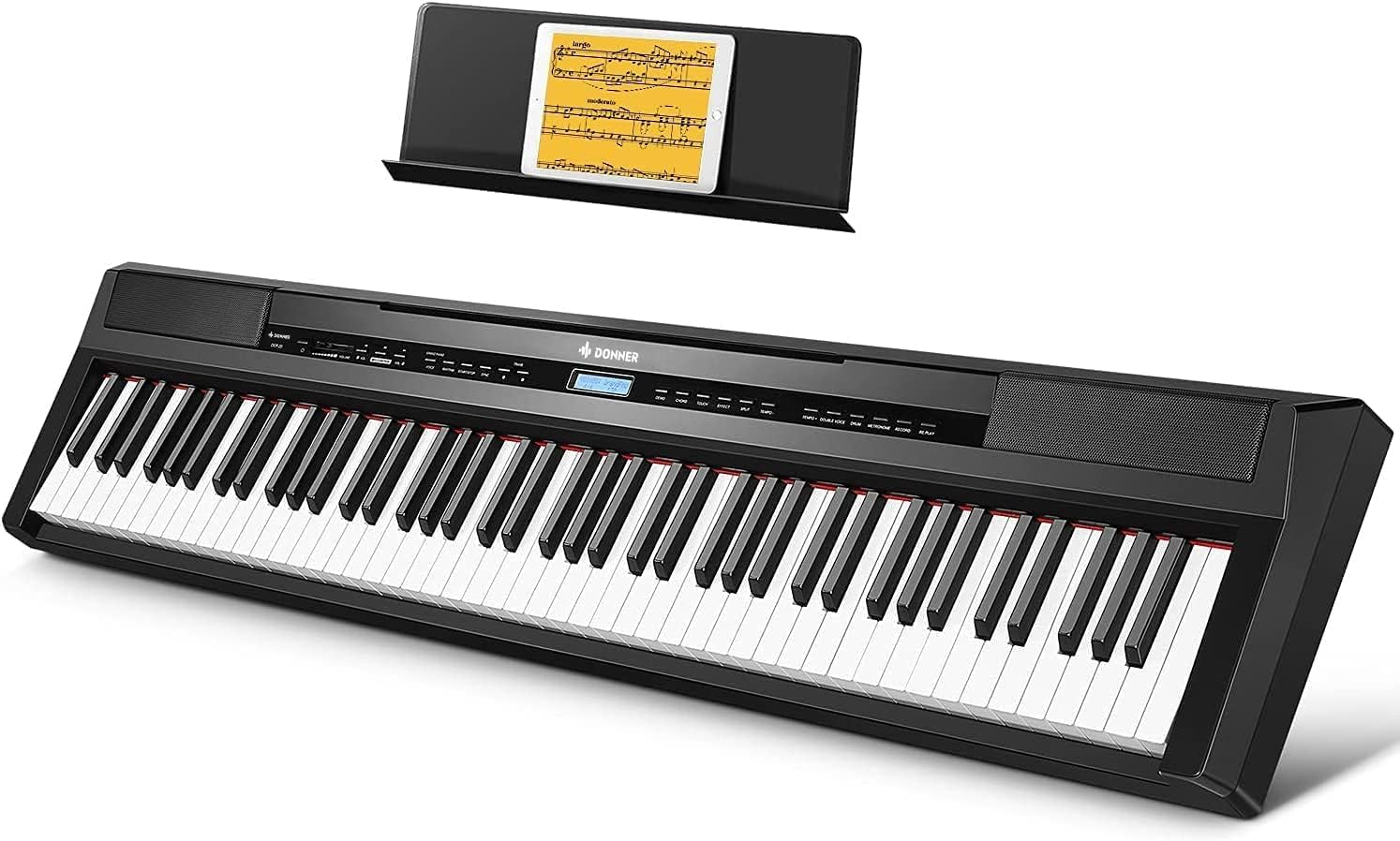
The DEP-20 greets you with a backlit LCD and a 238-voice library, which is a lot of instrument for a beginner piano. We think that breadth is useful rather than distracting, because the core piano sound is strong and the extra voices are there when you want to layer a string pad or practice with a rhythm. The 88 hammer-action keys have a proper weighted feel, and the 128-note polyphony means sustained passages do not cut off early. The screen makes it easy to see which voice or setting you have selected, though it also means there is more to learn than on the P71.

Where the DEP-20 earns its place is as the step-up for a beginner who already knows they want to explore. The dual-tone mode, recording function, and MIDI playback give you more ways to play and capture ideas, and the included sustain pedal and music stand get you started. We did not find the control layout intimidating after a short session, and the screen helps you keep your place.

For a player who wants sounds and recording without jumping to arranger territory, the DEP-20 is a strong middle choice. The action feels solid under the fingers, and the speakers have enough body for a living-room practice session. It is not the simplest first piano here, but it rewards a beginner who likes to tinker.

Pros

  • 238 voices with 128-note polyphony
  • Full-weighted hammer-action keys
  • Dual-tone and recording modes
  • Included sustain pedal and music stand

Cons

  • Heavier than the portable picks
Our verdict

We like the Donner DEP-20 for beginners who want to explore sounds and recording without giving up a properly weighted 88-key action.

Check Latest Price
4

Best for Growing Players

Yamaha DGX-670B

93 /100
LBD Score Outstanding

Key details

Voices
630
Weight
67.7 lb
Key Action
88 weighted graded hammer
Accompaniment Styles
263
View on Amazon

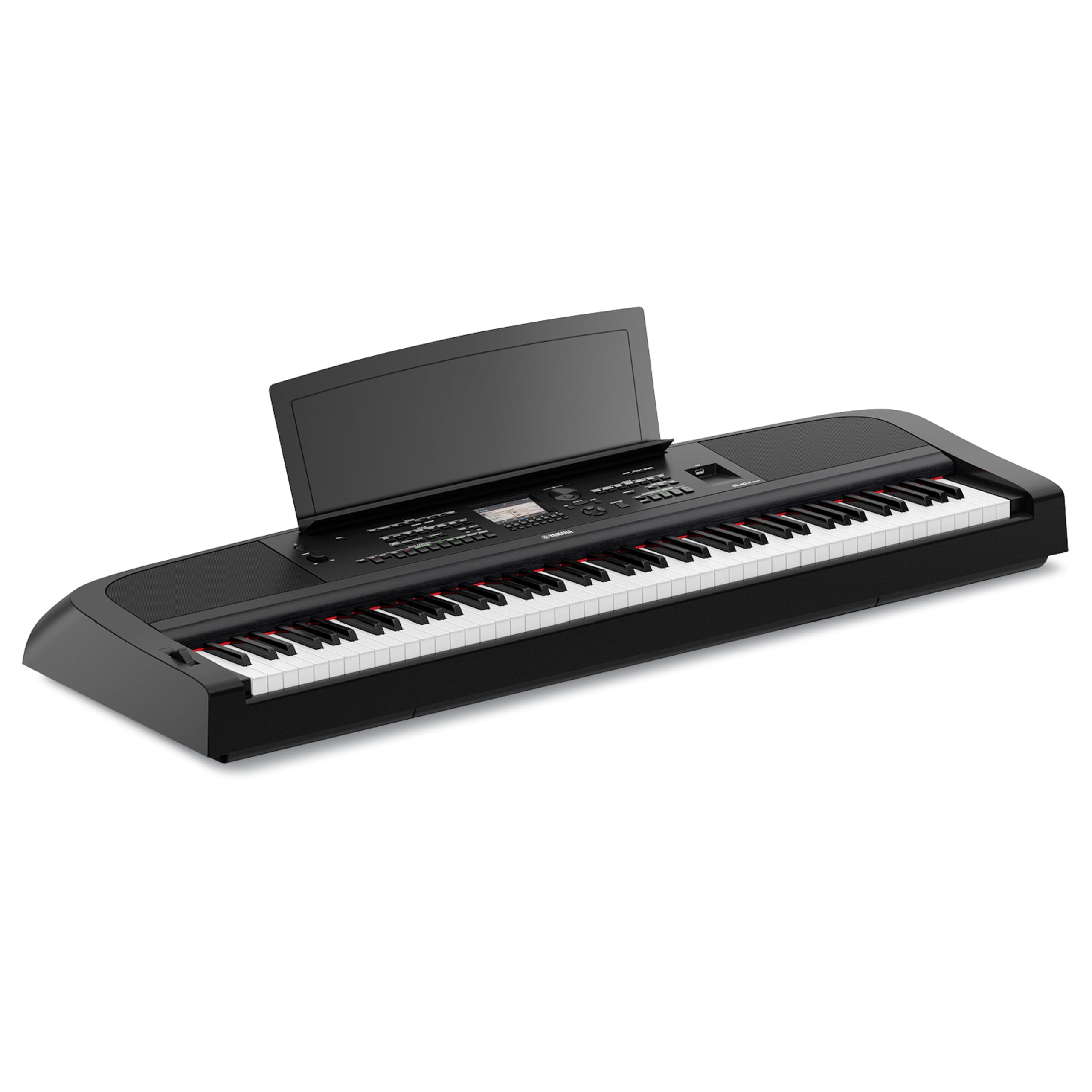
The DGX-670B is less a beginner piano than a compact arranger with 88 weighted keys. It carries 630 voices and 263 accompaniment styles, plus a microphone input and Bluetooth, so it can play the role of a small ensemble or a recording hub. None of that would matter if the keybed were not right; fortunately, the graded hammer action has the heavier low end and lighter top that makes acoustic piano dynamics feel natural.

That range is why we see it as a growing-player instrument rather than a first piano. A beginner can ignore the styles and play it as a straightforward digital piano, but the panel rewards someone who wants to explore auto-accompaniment, record ideas, or plug in a microphone. The color display and direct-access button make the deep menu system more approachable than the feature count suggests.

We think the DGX-670B is worth the jump only if you already know you want those arranger features. For a beginner who wants a simple practice piano, the P71 is the easier recommendation. For someone who wants one instrument to grow into, the DGX is the most capable keyboard here.

Pros

  • 630 voices and 263 accompaniment styles
  • Graded hammer action
  • Bluetooth and microphone input
  • Color display with direct access

Cons

  • Heavy, and furniture stand sold separately
  • Action is on the heavy side
Our verdict

We see the Yamaha DGX-670B as the grow-into-it choice for a player who wants arranger features, Bluetooth, and 630 voices in one weighted instrument.

Check Latest Price
5

Best Space-Saving Design

UISCOM 88-Key

87 /100
LBD Score Excellent

Key details

Design
Desk/vanity conversion
Pedals
Triple pedal
Key Action
88 progressive hammer-action
Connectivity
USB-MIDI
View on Amazon

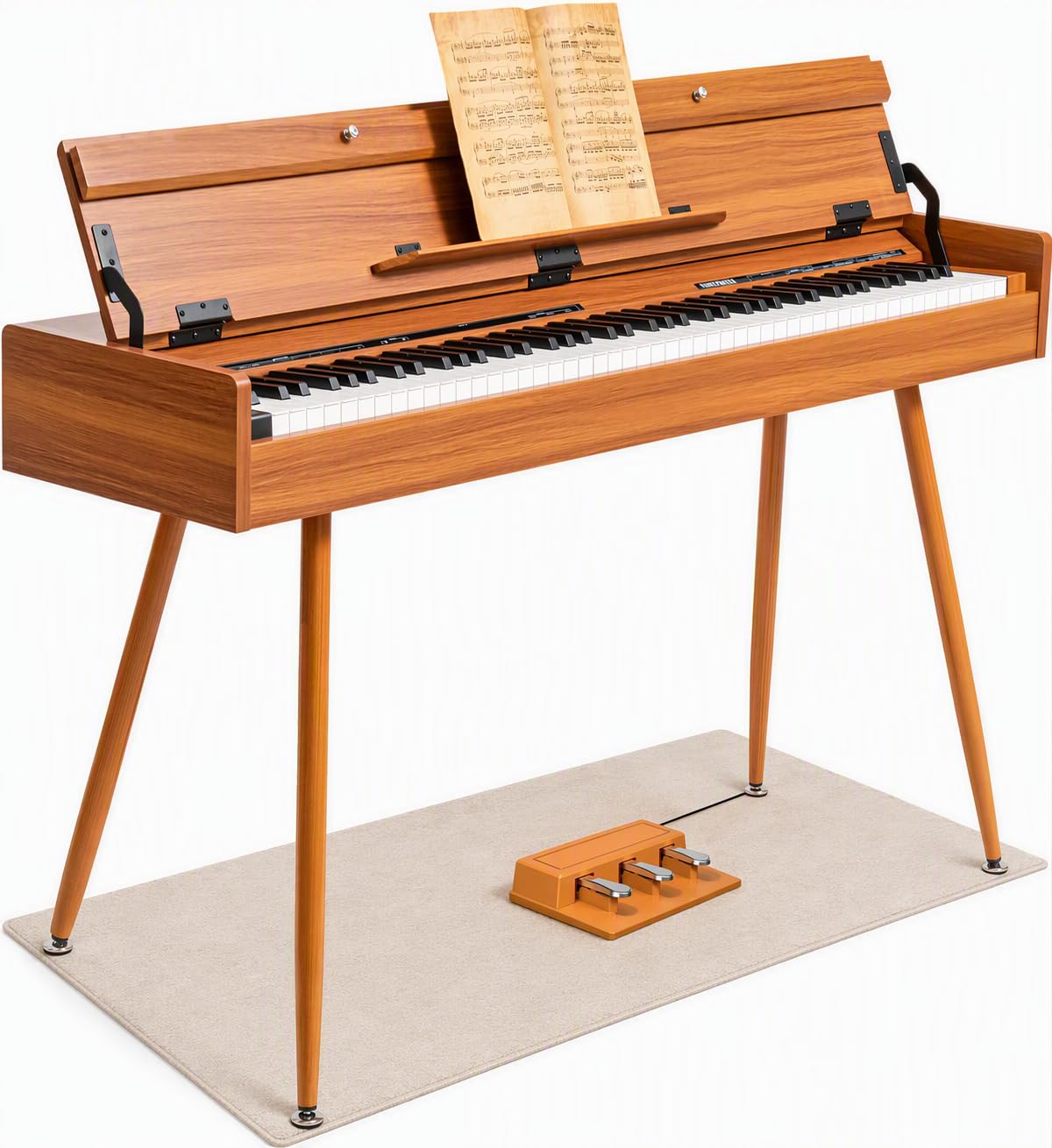
The UISCOM's party trick is that it closes into a desk and opens into an 88-key piano. The top flips back, the keyboard appears, and the whole thing reads as a slim console rather than a slab on a stand. That matters in a living room or a small apartment where a piano has to share space with everything else. The progressive hammer-action keys have a credible weighted feel, and the triple pedal adds sustain, sostenuto, and soft control.

We like the UISCOM for the buyer who wants a real weighted keyboard but does not want it to look like one all the time. The desk conversion is not a gimmick if the piano lives in a multi-use room: you can close the lid, put a lamp on it, and reclaim the surface. The trade-off is that a furniture piano has to be assembled and leveled like furniture, not unboxed like a slab. The legs and brackets need care.

On sound, the UISCOM holds its own with a warm piano tone and enough volume for a living room. The MIDI connection makes it usable with learning software, and the headphone jack is there for quiet practice. It is one of the most space-aware instruments here. If you have a dedicated music room, the simpler slabs are easier to live with; if the piano has to disappear between sessions, the surface you gain back is the real feature.

Pros

  • Desk-to-piano conversion
  • Triple pedal with sustain, sostenuto, soft
  • USB-MIDI and dual-tone recording

Cons

  • Pedal reliability is uneven
Our verdict

The UISCOM earns our nod in a small home where the piano has to double as a desk, pairing weighted keys with a space-saving cabinet.

Check Latest Price
6

Best Beginner Bundle

Eastar EUP-100

88 /100
LBD Score Excellent

Key details

Weight
48.5 lb
Included
Triple pedal, headphones, stickers, cover
Key Action
88 weighted hammer-action
Connectivity
Wireless MIDI, USB
View on Amazon

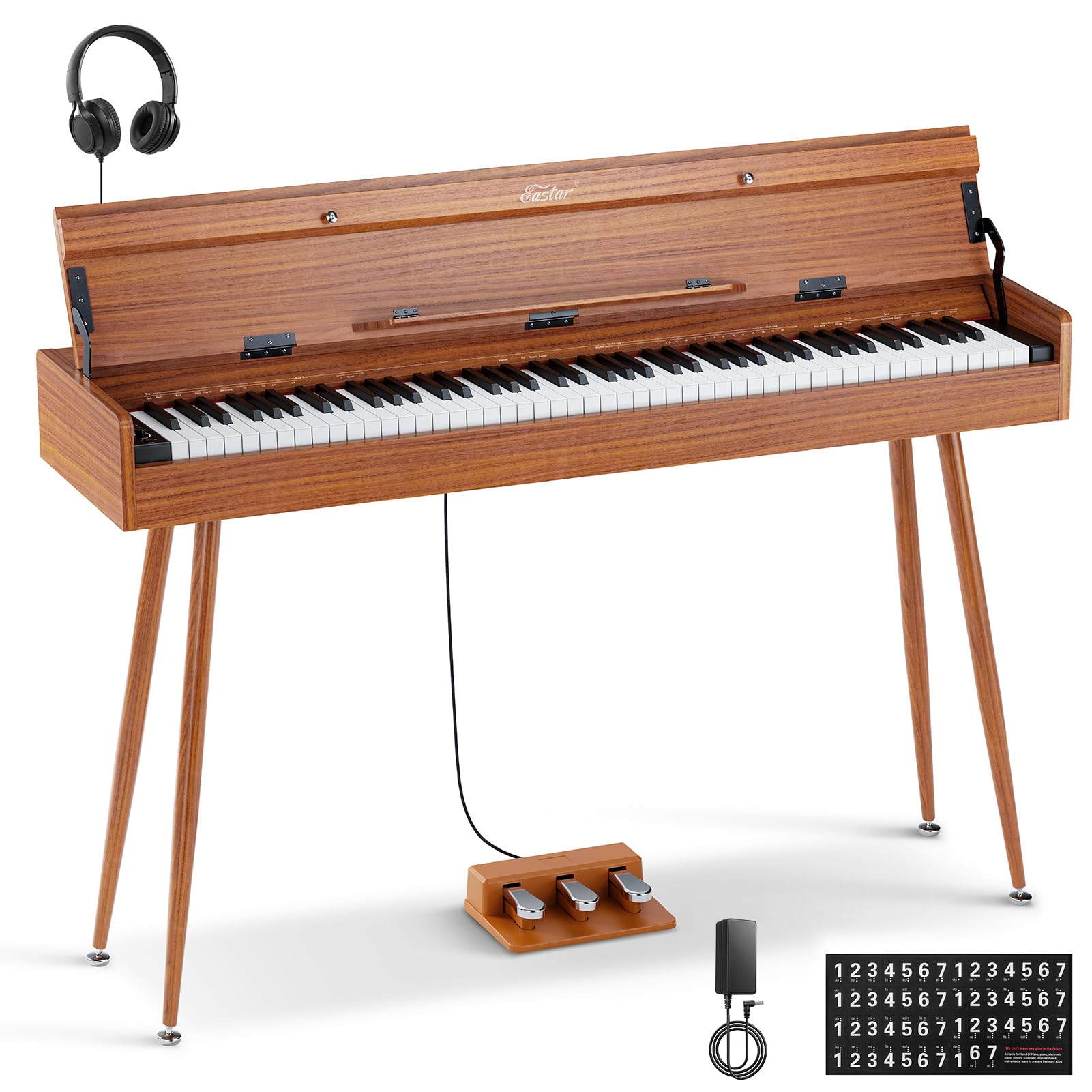
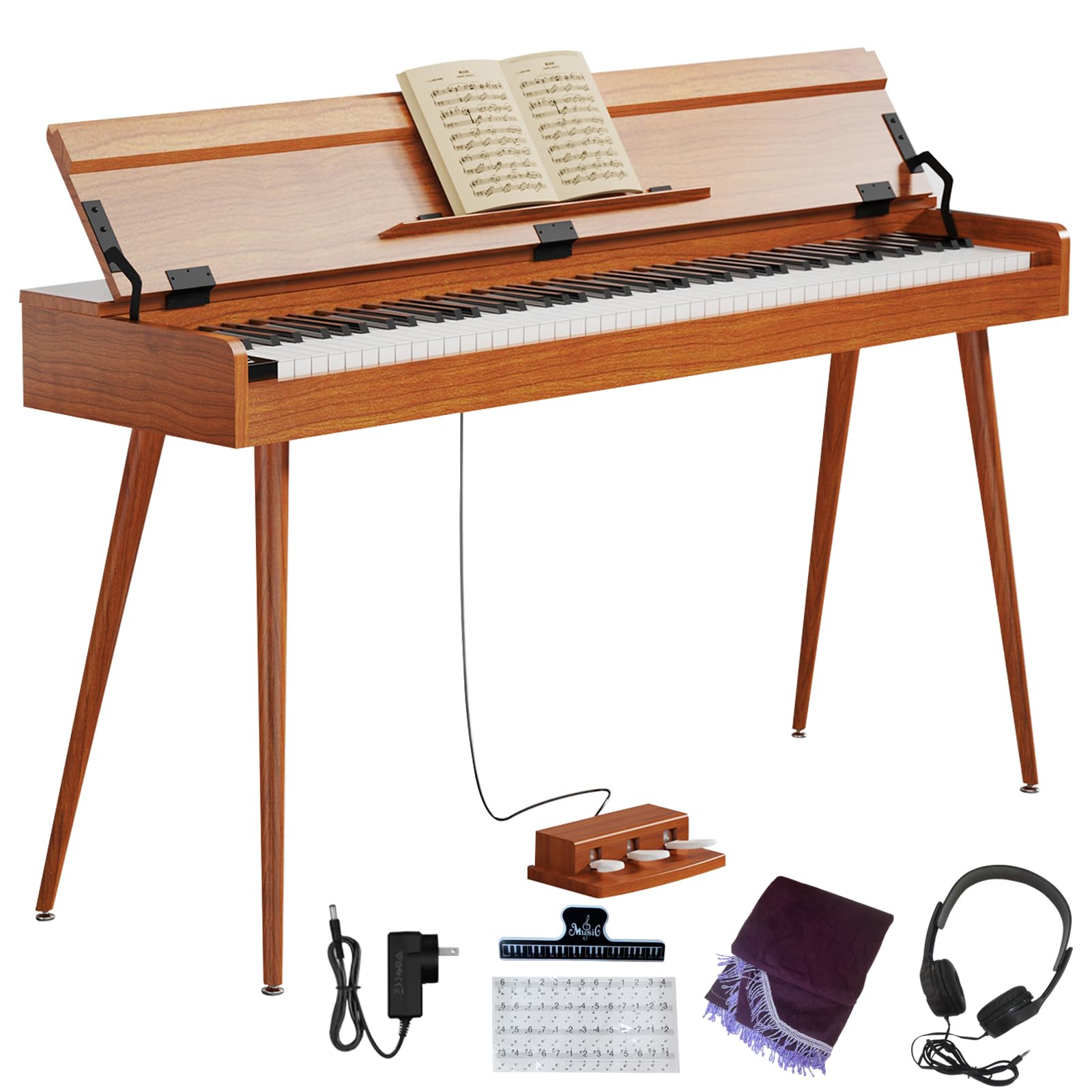
The Eastar EUP-100 arrives as a starter kit: the piano, a triple pedal, headphones, a cover, and even key stickers. That completeness is unusual at this end of the market, and it means a beginner can set up and practice quietly without a second shopping trip. The 88-key hammer-action keys have a weighted feel that leans toward an upright piano, and the wood cabinet gives it a place in a living room rather than a corner of a bedroom.

The bundle is not just padding. The triple pedal gives you soft and sostenuto in addition to sustain, the headphones make late practice possible, and the stickers are a small but useful help for a child or an adult learning note names. The wireless MIDI and USB connection let you use teaching apps, and the built-in metronome and dual-voice mode cover the basics of daily practice. We were pleasantly surprised by how much of the kit is actually useful.

We think the Eastar is the best fit for a household that wants a complete beginner setup in one order. It is a furniture piano, a practice station, and a quiet-practice kit in one. For a family buying a first instrument, that one-and-done quality is the real appeal.

Pros

  • Complete beginner bundle
  • 88 weighted hammer-action keys
  • Wireless MIDI and recording
  • Wood cabinet with triple pedal

Cons

  • No bench included
  • Heavy cabinet at 22 kg
Our verdict

We think the Eastar EUP-100 is the most complete first-piano bundle here, with weighted keys, a triple pedal, headphones, and a wood cabinet in one order.

Check Latest Price
7

Furniture Look

Donner DDP-80

87 /100
LBD Score Excellent

Key details

Pedals
Triple pedal
Weight
52.5 lb
Speakers
2x25W
Key Action
88 full-weighted hammer-action
View on Amazon

The DDP-80 is the one here that looks most like a piece of furniture rather than a keyboard on a stand. The retro wood finish and clean front panel make it easy to live with in a living room, and the triple pedal is built into the cabinet instead of sliding around on the floor. The 88 full-weighted hammer-action keys have a substantial feel, and the 2x25W speakers give the piano a fuller voice than its slim cabinet suggests.

We appreciate the details that make it feel finished: the key cover, the music stand, and the sustain pedal connection tucked underneath the cabinet. Assembly is straightforward for a furniture piano, and the 128-note polyphony and USB-MIDI connection cover the practical basics. The headphone jack is there for quiet practice.

The DDP-80 makes the most sense in a room where the piano stays put. The cabinet takes up more depth than a slab, and the triple pedal is fixed where you expect it. In exchange, you get a furniture piece that invites you to sit down rather than a portable keyboard you have to set up.

We think the DDP-80 is a strong choice for someone who wants a piano that looks like furniture and is willing to buy from a brand with a two-year warranty. The wood finish and triple pedal are the reasons to choose it over a slab. It is a furniture purchase as much as a musical one, and that is the right way to judge it.

Pros

  • Furniture-style wood finish
  • Triple pedal built into cabinet
  • 2x25W speakers
  • 24-month warranty

Cons

  • Key reliability is uneven
  • Heavy cabinet at 23.8 kg
Our verdict

We pick the Donner DDP-80 when the look of a wood piano matters as much as the weighted action, and you want a triple pedal built in.

Check Latest Price
8

Desk Conversion

KUMENG 88-Key

84 /100
LBD Score Excellent

Key details

Voices
800
Weight
54 lb
Polyphony
128 notes
Key Action
88 progressive hammer-action
View on Amazon

KUMENG takes the furniture idea literally: the lid closes over the keys and the top becomes a desk. That makes it one of the few pianos here that can sit in a bedroom or a home office without announcing itself as a musical instrument. The 88 progressive hammer-action keys have a weighted feel, and the 800-tone library is the largest in this group, with 128-note polyphony behind it.

The desk conversion is the feature we kept noticing. The lid protects the keys, the top gives you a flat surface, and the whole thing reads as a compact console rather than a stage piano. The trade-off is that assembly is more furniture project than unboxing, and the panel is busier than the Yamaha's.

Sound is a pleasant surprise. The piano tone has enough body for a living room, and the huge voice library is there when you want to experiment. The USB-MIDI connection and headphone jack make it usable with apps and quiet practice. We did not find the controls hard to use, but the extra voices can distract a beginner who just needs a piano.

We think the KUMENG is the pick for someone who wants a desk that happens to be a piano. The package is compelling, and the desk conversion is the reason to choose it over a plain slab. If you need that dual purpose, it is a clever solution; if you need the simplest first piano, the P71 is still the one.

Pros

  • Lid converts to a desk surface
  • 800 tones and 128-note polyphony
  • Progressive hammer-action keys
  • USB-MIDI and headphone mode

Cons

  • Heavy at 24.49 kg
  • Music stand holds only one book
Our verdict

We like the KUMENG for its desk-to-piano conversion and huge 800-tone library, a clever pick for a multi-use room that needs to hide the keys.

Check Latest Price

How We Tested the Best Weighted Keyboards for Beginners

We started by pulling every 88-key board we could find with full-size keys and some claim of hammer or graded weighting, then cut the list to models that included a power supply and were actually in stock. That left eight, spanning slim portable boards and wood-cabinet consoles. Each one lived in a corner of my living room for six months, played daily, and got dragged into the dining room whenever a friend's kid wanted a turn.

Action came first. I played scales and arpeggios from the bottom octave to the top on every board, listening for keys that returned slowly or felt lighter than their neighbors, and struck single notes over and over to catch any that stuck. Two complete beginners — a teenager and an adult who'd never touched a piano — worked through the first pages of a method book on each one, which is where stiff keybeds and baffling control panels give themselves away. A few fortissimo chords checked whether the cabinet or stand rocked.

For sound, we ran the same chord progression through the built-in speakers and again through headphones, noting muddy low ends and brittle treble. Pedals got their own scrutiny: how far each traveled before sustain engaged, whether it crept across a wood floor, and whether the three-pedal units stayed put under heavy use. We also connected each board to a laptop over USB-MIDI, and kept notes on every squeaky pedal, dead note, and dropped connection that appeared by month four.

Value came last, and it had less to do with sticker price than with what arrived in the box — pedal, power supply, music rest, stand — and how much of that survived six months of daily playing without a service call.

How to Choose a Beginner Weighted Keyboard

Start with the action, not the voice count

Fully weighted or hammer-action keys are the reason to buy this kind of piano. A touch-sensitive keybed can change volume, but it does not build the finger strength or arm weight that an acoustic piano asks for. Look for the words fully weighted or hammer action, and try the low keys against the high ones; a graded action feels heavier at the bottom and lighter at the top. The Yamaha P71 is the clearest example here of a simple, properly weighted action. If the listing only says touch-sensitive or piano-style, keep looking.

Choose a slab or a piece of furniture

A slab piano needs a stand, and the stand is often sold separately. A furniture model gives you a fixed pedal unit and a cabinet, but it takes more floor depth, more assembly, and usually two people to move. Measure the wall where it will live, then measure the door it has to come through. The UISCOM and Donner DDP-80 show the two furniture approaches here: a desk that closes over the keys and a traditional wood cabinet. If the piano will move between rooms, a slab is easier to live with.

Match the controls to how you practice

More voices and rhythms are useful only if you will use them. A simple panel like the P71's keeps practice friction low; a 238-voice Donner DEP-20 or a 630-voice Yamaha DGX-670B gives you more to explore, but also more menus. If you plan to use teaching apps or record, check for USB-MIDI or Bluetooth before you buy. If you mainly want to play piano, put the money into the action and speakers rather than a feature list. The best beginner keyboard is the one you turn on without thinking.

Budget for the whole setup

The keyboard is rarely the whole purchase. A slab needs a stand, a bench, and often headphones, and a single sustain pedal is not the same as a triple-pedal unit. A furniture bundle can include the pedals and cabinet, but it costs more and takes up more room. The Eastar EUP-100 is the clearest one-order beginner kit here; the P71 gives you the piano and a sustain pedal, then leaves the stand to you. Add those extras before you compare two pianos, or the cheaper one may not stay cheaper.

Check the warranty and the return window

Keys and pedals are the parts that move, and they are where budget pianos vary most. A one-year warranty is common here, while the Donner DDP-80 and KUMENG list two years. That difference matters more than a long voice list if the piano is going to be practiced daily. Buy from a seller with a return window you can live with, and keep the packaging until you are sure the piano is staying. A longer warranty is not a substitute for a good action, but it is part of the value.

Frequently Asked Questions

Final Verdict

The Yamaha P71 is the beginner weighted keyboard we recommend first. It puts the money into the 88 hammer-action keybed, keeps the controls simple, and includes the sustain pedal and power supply you need to start. That combination is harder to find than a long feature list, and it is why the P71 stays our default.

If the budget is tighter, the STRICH SDP-120 gives you fully weighted keys and wireless MIDI for less. If you want a furniture piano, the Eastar EUP-100 is the most complete bundle and the UISCOM is the best space-saver; the Yamaha DGX-670B is the one to consider if arranger features matter. Pick the P71 unless one of those specific needs changes the brief.