Best Digital Pianos for Beginners of 2026

The quickest way to lose interest in piano is a keyboard that fights you: keys that spring back like a toy, a tone that thins out the moment you press harder, a pedal that clicks instead of sustains. A beginner's instrument has to feel like the real thing, or the hour of practice you put in on Tuesday never shows up in your hands on Saturday. Weighted keys, touch-sensitive sound, and a pedal that behaves are what carry someone past month three.

I learned on a creaky upright, so the first thing I do with any new piano is press one key slowly and feel where the resistance sits. Over the past seven months my team and I have lived with 11 88-key pianos, from slim slabs that sit on a stand to full cabinets with triple pedals, running scales, sight-reading, and the same stubborn nocturne on each. One thing worth knowing before you shop: voice counts and polyphony are the easiest specs to compare and the least likely to change how a beginner feels about practicing.

What does change it is key weight, pedals that respond, and enough volume to fill a living room without distorting. The picks below cover the adult coming back after twenty years, the kid starting lessons, and the apartment player practicing at midnight in headphones.

1

Best Overall

Yamaha P71

95 /100
LBD Score Outstanding

Key details

Keys
88, weighted hammer action
Voices
10
Weight
25 lb
Dimensions
52.25 x 11.5 x 6 in
View on Amazon

The keys are the reason this is our default recommendation. Yamaha fits 88 full-size weighted, touch-sensitive keys with a hammer action that pushes back under your fingers, so a scale played softly comes out soft and the same scale played hard comes out loud — dynamics stop being a switch. That is the skill a beginner spends the first year building, and it is the one part of a cheap keyboard you can never upgrade later.

Everything around the action is deliberately plain, and we count that in its favor. Ten voices, one button handling most functions, a grand piano tone with weight in the low end, and dual mode if you want strings layered underneath. There is no screen to negotiate, so the instrument is ready before you sit down — which matters more than it sounds when the alternative is a menu system and a manual.

At 25 pounds and six inches deep it is a slab, not a cabinet, so it lives on a stand or a table and moves between rooms without a second person. We also appreciate the 3.5mm headphone jack, which takes ordinary earbuds instead of forcing an adapter, and the action is quiet enough that late-night practice stays in the room.

The compromise is at the pedals. There is one sustain pedal in the box rather than a three-pedal unit, so soft and sostenuto playing is off the table without adding hardware. For a first or second year that costs you nothing; if you are already working on exam repertoire, the Donner DDP-80 gives you all three.

Pros

  • Weighted hammer action feels like an acoustic
  • Grand piano tone with convincing dynamics
  • One-button controls, no menu to learn
  • 25 pounds, easy to move and store

Cons

  • No stand or bench in the box
Our verdict

We recommend the P71 to almost every beginner: the weighted hammer action, believable grand piano tone, and screen-free controls make it the easiest piano here to grow with.

Check Latest Price
2

Best Key Action

Roland FP-10

90 /100
LBD Score Outstanding

Key details

Keys
88, weighted ivory feel
Weight
27 lb
Connectivity
Bluetooth, USB
Sound Engine
SuperNATURAL
View on Amazon

Set against our top pick, the FP-10 is the upgrade you choose when the feel of the keys matters more than anything else on the page. The 88 weighted keys have an ivory-feel surface, and the hammer mechanism resists and releases rather than simply getting louder; Roland's SuperNATURAL engine changes the character of the tone with your touch, not just the volume. It is the closest thing to an acoustic action in this group.

It does not fully disguise itself as an acoustic — nothing at this price does — but the gap closes on anything with real dynamic range. What we noticed first was how little effort it took to control a quiet passage, which is exactly where a semi-weighted keyboard falls apart. Play a few of these back to back and that is the difference you remember.

The trade-off is the sound system. The onboard speakers are modest, so playing for a room means headphones or a line out to something bigger; for solo practice at home it never becomes a problem. Bluetooth MIDI is the extra worth having if you use a lesson app, since it pairs without a cable, and the whole thing weighs 27 pounds — light enough to carry into another room for a lesson.

Pros

  • Best key action of the picks here
  • Expressive SuperNATURAL piano tone
  • Bluetooth MIDI for app-based lessons
  • 27-pound body moves between rooms

Cons

  • Onboard speakers are modest for a room
Our verdict

If key feel is what you care about most, we think the FP-10's action is worth the extra money over our top pick, and Bluetooth makes it easier to live with.

Check Latest Price
3

Best Budget Weighted Action

Donner DEP-20

92 /100
LBD Score Outstanding

Key details

Keys
88, full-weighted hammer action
Tones
238
Display
Backlit LCD
Polyphony
128 notes
View on Amazon

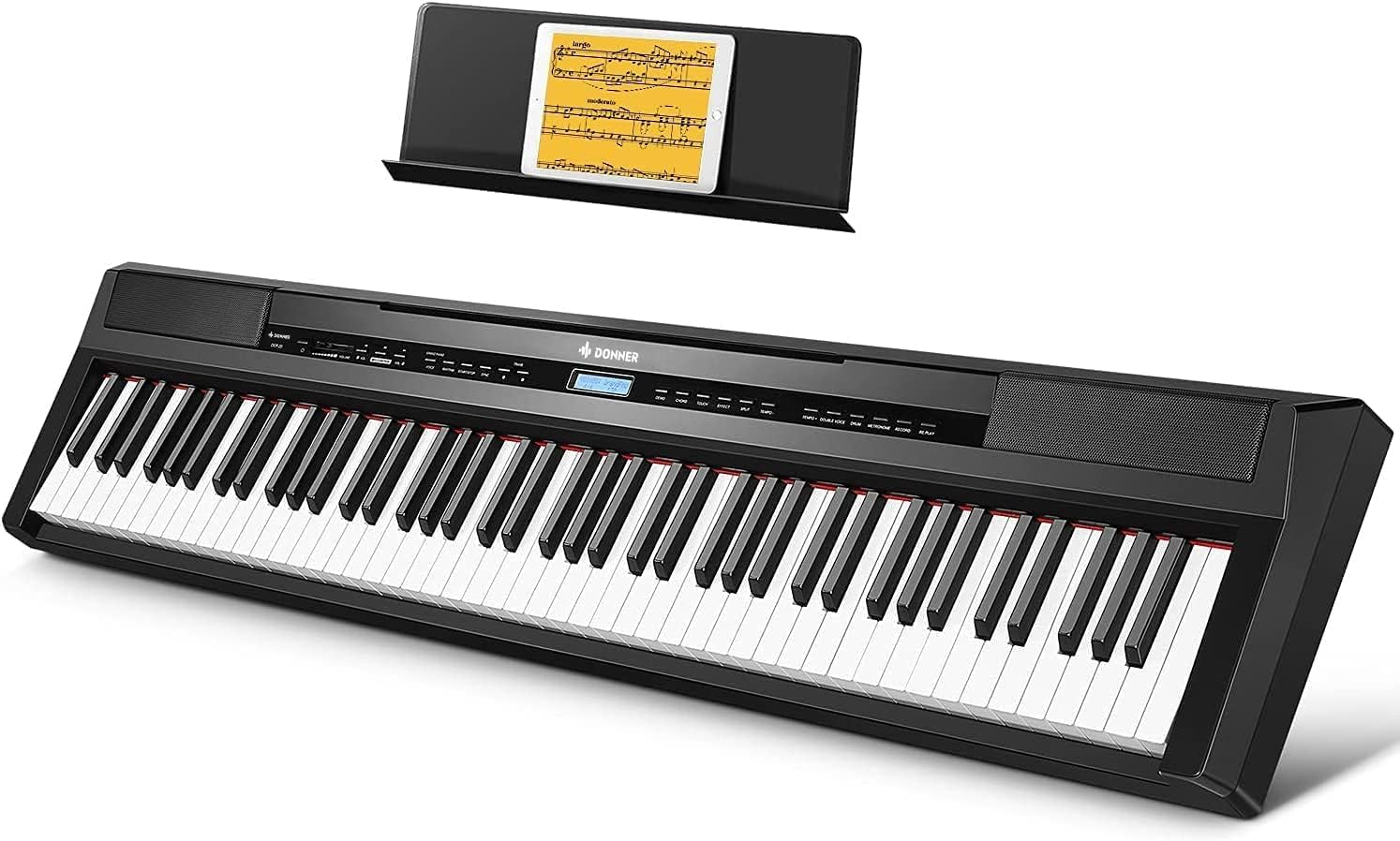
Weighted keys at the lowest price in this group is the whole pitch, and the DEP-20 delivers it: 88 full-size hammer-action keys with adjustable touch response, 128-note polyphony, and a price that undercuts both of our top picks. If the budget is firm and you refuse to learn on unweighted keys, this is the one to look at first.

The feature list is unusually deep for the money — 238 tones, a backlit LCD showing chord names and notation, dual-tone layering, recording, and MIDI or MP3 playback over USB. The chord readout is the piece we single out as genuinely useful for a beginner working through a method book: it turns the screen into a practice aid rather than decoration.

Two hundred and thirty-eight tones is a selling point and a distraction at once. Tone count is cheap to add and says nothing about the piano sample, which is the voice you will actually live in, so this is the pick to audition before committing — play its main piano sound beside a Yamaha or a Roland and decide whether the difference bothers you.

Setup is minimal. A sustain pedal and power supply come in the box, the keyboard itself is a slab, and the rest is a stand and a bench at the right height. For a household working out whether lessons will stick, that is a sensible place to put the money: the action is real, and everything else can be added around it.

Pros

  • Full hammer action at the lowest price here
  • 128-note polyphony for layered playing
  • Chord-and-notation display helps beginners

Cons

  • 238 tones distract from the one piano voice
Our verdict

We recommend the DEP-20 to anyone whose budget rules out our top picks but who refuses to learn on unweighted keys.

Check Latest Price
4

Best Furniture-Style Cabinet

Donner DDP-80

87 /100
LBD Score Excellent

Key details

Keys
88, full-weighted hammer action
Pedals
Three-pedal unit
Speakers
2 x 25W
Polyphony
128 notes
View on Amazon

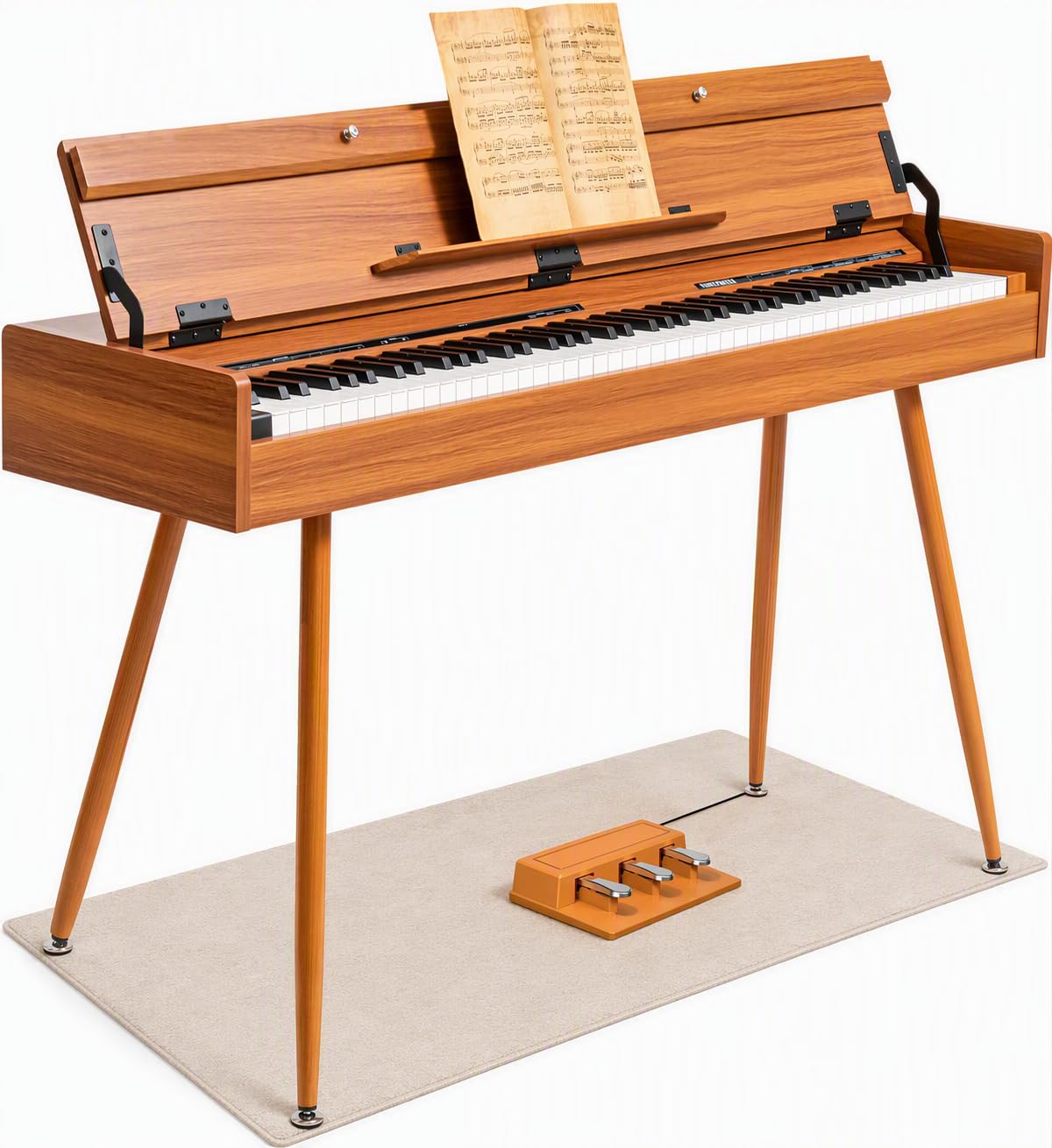
Most of the pianos here are keyboards that need a stand. This one is furniture. The DDP-80 arrives as a retro wood cabinet with a folding key cover and a pedal unit built into the base, and in a living room it reads as a piece of furniture rather than a piece of equipment — which changes how often you sit down at it.

The action needs saying plainly: the 88 hammer-action keys are genuinely weighted, and they run heavy — heavier than the uprights we are used to, heavy enough that a beginner with small hands will feel the work before they feel the music. Finger strength comes with time, but if a child or an adult with hand problems will be playing, try this one before you commit.

Sound is where it earns the space it takes. Two 25W speakers are the highest listed output in this group, the 128-voice engine holds together under a held sustain pedal, and the tone is warm rather than bright. Assembly is a flat-pack job that goes quickly, and the cabinet is solid once it is standing.

The failure worth knowing about is a key that stops responding. Play every key from the bottom of the keyboard to the top in your first week, while a return is still easy, and again after a month — it is the check worth running on any cabinet piano at this price.

Pros

  • Wood cabinet that looks like furniture
  • Three-pedal unit built into the base
  • Loudest speakers of the picks here
  • Straightforward flat-pack assembly

Cons

  • Heavy flat-pack cabinet needs two people
Our verdict

We like the DDP-80 for a living room where the piano has to look the part, as long as the heavier action suits the hands playing it.

Check Latest Price
5

Best for Small Spaces

UISCOM Flip-Top Digital Piano

87 /100
LBD Score Excellent

Key details

Keys
88, progressive hammer action
Pedals
Sustain, sostenuto, soft
Sound Chip
Dream 5704
Connectivity
USB-MIDI
View on Amazon

The problem this solves is the one that decides the purchase in a small apartment: where an 88-key piano actually goes. The UISCOM is a wooden console that opens into a full-size keyboard and closes back into something you can put a lamp on, with the pedals built into the base so nothing is loose on the floor between practices.

Under the lid it is a real instrument rather than a novelty. The keys are progressive hammer-action with adjustable sensitivity, the sound comes from a French Dream 5704 chip, and there are three pedals — sustain, sostenuto and soft — plus USB-MIDI for a laptop or a lesson app. The key weight surprised us: it is closer to an acoustic than the price and the furniture styling suggest.

Practical details are mostly right. The volume is a knob rather than a menu, which we appreciated at seven in the morning, and the cabinet is heavier and more solid in the room than the flat-pack look suggests. Setup means attaching the legs, and it does not need a second pair of hands.

Pros

  • Closes into furniture when not played
  • Progressive hammer-action keys with real weight
  • Three pedals built into the base

Cons

  • Three-pedal unit is the part to test on arrival
  • Needs a 1/4-inch adapter for earbuds
Our verdict

We recommend the flip-top UISCOM where floor space decides the purchase: it plays like a piano and then stops taking up the room.

Check Latest Price
6

Testing the Water

Alesis Recital

93 /100
LBD Score Outstanding

Key details

Keys
88, semi-weighted
Voices
5
Weight
15.7 lb
Speakers
2 x 20W
View on Amazon

Start with what these keys are not: a hammer action. The 88 keys are semi-weighted, which means they have some resistance and respond to how hard you play, but they lack the escapement and the graded push-back of an acoustic. Learn on this and move to a real piano later, and your fingers will have a transition to make — worth knowing before you spend the money, not after.

The rest of the package is why it still earns a place. Five voices with chorus and reverb, split and layer modes, a lesson mode that divides the keyboard between teacher and student, stereo RCA outputs, a quarter-inch pedal input, and a bundled stretch of Skoove lessons. The 128-note polyphony keeps sustained passages and layered voices from cutting off.

The speakers are the compromise. Two 20W drivers are enough for a living room at practice volume, but there is not much headroom left once someone else is playing an instrument in the same room, and turning it up does not buy clarity.

Where it fits is the household testing the water: an adult or teenager starting lessons, or a second keyboard for a child who already practices on an acoustic. It is also the only piano here that runs on six D batteries, which matters more than it sounds if the only free corner for it has no outlet nearby.

Pros

  • Full 88 keys at a budget price
  • Runs on batteries or mains power
  • Lesson mode plus three months of Skoove

Cons

  • Sustain pedal not included
Our verdict

We think the Recital earns a place as a cheap full-size keyboard with lesson features built in, provided you are not counting on it to build acoustic technique.

Check Latest Price
7

Complete Starter Kit

UISCOM URS25

85 /100
LBD Score Excellent

Key details

Keys
88, semi-weighted
Tones
600
Rhythms
800
Included
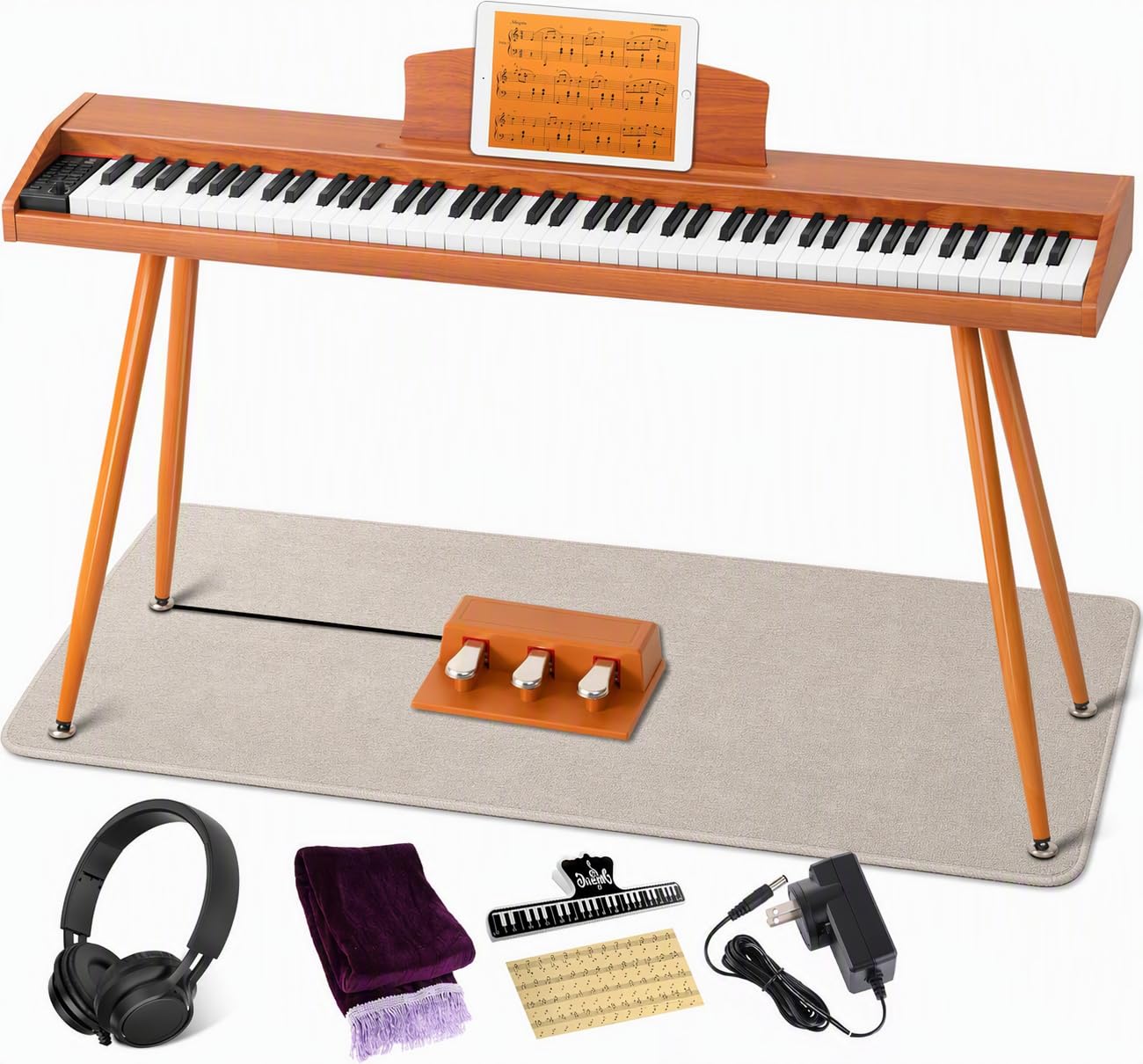
Stand, three pedals, headphones, cover
View on Amazon

The box is the pitch. This arrives as a complete setup — keyboard, wooden stand, three pedals, music rest, headphones, dust cover and key stickers — so nothing else has to be ordered before a first lesson. For a grandparent buying for a child, or anyone who does not want to research stands and pedals separately, that completeness is worth more than any single specification.

The action is the compromise. UISCOM calls the keys semi-weighted, and they are light — lighter than the semi-weighted Alesis and well short of anything with a hammer action here. It is a keyboard to learn notes and rhythm on, not one that trains your hands for an acoustic, and that distinction should decide the purchase.

There is more under the hood than the price suggests: 600 tones, 800 rhythms, 80 demo songs, a metronome, split and dual modes, and a wood-grain finish that looks better in a room than the price leads you to expect. Bluetooth audio lets you play along with tracks from a phone without a cable, and USB-MIDI does the same job for lesson apps.

What you are buying is a full-size instrument and a complete setup in one order; what you are not buying is an action that will carry you into intermediate repertoire. If the goal is to find out whether piano sticks in your house without a long shopping list, that is a fair trade.

Pros

  • Stand, three pedals, and headphones included
  • Bluetooth audio and USB-MIDI
  • Wood-grain cabinet finish

Cons

  • Music rest will not hold thick method books
  • Dead keys are the fault to check early
Our verdict

We recommend the URS25 as the cheapest complete setup here — a full 88-key instrument, stand, pedals, and headphones in one order.

Check Latest Price

How We Chose and Tested These Pianos

We began with a research pass over spec sheets and customer reviews, then narrowed to 11 pianos that cleared three filters: 88 full-size keys, some form of weighted action, and a sustain pedal in the box. We deliberately kept both fully weighted and semi-weighted models so we could judge that difference with our hands instead of trusting the label.

Each piano spent at least three weeks in a living room, played daily by two beginners, a 38-year-old returning after two decades away and an 11-year-old in her second year of lessons, plus me, usually late at night with headphones on. We ran scales, sight-read, and returned to one piece each of us knew well enough to notice immediately when something felt off.

To judge touch, I pressed every key from a whisper to a forte and then compared the bottom octave to the top, where a graded action should feel lighter. For sound, we held the same chord and let it ring to hear whether the decay went glassy or natural, and played one-handed melodies with the sustain down to see how quickly notes muddied. For volume, we turned each piano to full in a 14-by-10 living room and listened for breakup, then dropped to a third of the volume through headphones and listened for hiss.

Pedals got their own week: we held sustain through a full minute of playing, half-pedaled through slow passages, and noted squeaks, drift, or a unit that slid across the floor. For key reliability, we trilled the same note for two minutes at a stretch and then repeated the test at the end of seven months to catch sticking, clicking, or wobble in the cabinet. What came in the box went into a running note, since a stand, bench, and pedal included changes the real cost. The truest measure, though, was which one we sat down at without being asked.

How to Choose a Beginner Digital Piano

Key Action: Weighted, Hammer, or Semi-Weighted

Three different things get called weighted. A hammer action uses a mechanism close to an acoustic's, with weight that builds toward the back of the key; a semi-weighted key is a spring with extra resistance; an unweighted key simply moves. Only the first builds the finger control that transfers to a real piano, and it is the one feature you cannot add later.

The trap is the number 88. A keyboard can have 88 full-size keys and no weighting at all — the Alesis Recital Play is sold as a portable arranger keyboard with 88 touch-sensitive keys. Read the action description, not the key count. If a hammer action is the goal, the Donner DEP-20 is the least expensive way in here.

Cabinet or Slab: Space, Assembly, and Weight

A slab piano sits on a stand: lighter, easier to move, cheaper, but you supply the stand, the bench and often the pedal, and the cables end up on the floor. A cabinet piano is furniture, with pedals built in and a fixed footprint that takes a flat-pack hour and two people. The Donner DDP-80 is the clearest cabinet of the group.

Measure the wall before you decide, not after delivery. The UISCOM flip cabinet is the one design here that gives the floor space back when the lid closes, which is the difference between a piano that fits a small apartment and one that does not.

Speakers, Headphones, and Practicing Quietly

Most beginners practice with headphones most of the time, so the headphone jack matters as much as the speaker. Check the size before you buy: a 3.5mm jack takes ordinary earbuds, while 6.35mm needs an adapter, and several picks here use the larger one.

Speaker power is the usual weak point at this price. Two 20W drivers fill a living room at practice volume but run out of headroom beside a guitar or a singer; the Donner DDP-80's 2 x 25W is the highest listed output here. If you plan to play with others, budget for external speakers.

Pedals: What You Actually Need

Sustain is the pedal a beginner uses in the first month. A single pedal covers method books and most first-year repertoire; soft and sostenuto pedals matter later, and only the cabinet pianos here — the Donner DDP-80 and the UISCOM flip-top — include all three.

Read the box list closely. The Alesis Recital has a quarter-inch pedal input but no pedal at all, the Yamaha P71 includes one sustain pedal, and the UISCOM URS25 arrives with a full three-pedal unit. A pedal bought separately is the easiest cost to forget when comparing two pianos.

Connections and Lesson Apps

USB-MIDI is the connection that matters: it lets the piano drive a lesson app, a recording program or a virtual instrument on a laptop. Bluetooth MIDI on the Roland FP-10 removes the cable entirely, and Bluetooth audio on the UISCOM URS25 lets you play along with tracks from a phone.

Treat a bundled subscription as a trial rather than a reason to choose — three months of Skoove comes with the Alesis models, and it only helps if it runs on the tablet or phone you already own. Lesson apps are the part of a beginner's setup most likely to be abandoned.

Frequently Asked Questions

Final Verdict

The Yamaha P71 is the beginner piano we recommend by default: a weighted hammer action, a grand piano tone with genuine dynamic range, and controls simple enough to disappear. It puts the money where it decides whether you keep playing, and the stand and three-pedal unit you have to add later are the parts that are easy to add.

If the keys themselves are the priority, the Roland FP-10 has the best action in this group and Bluetooth on top. If the budget is fixed, the Donner DEP-20 still gets a real hammer action under your fingers. Both put the right thing first.