Best Slim Digital Pianos of 2026

A slim digital piano has one job before you press a key: it has to fit. The second job is harder — it has to feel and sound like a piano once it is there. I grew up with a bulky upright, so I notice when a compact keyboard has springy keys or a sustain pedal that only switches on and off. A good slim model gives you weighted keys with real tactile feedback, onboard speakers that fill a room without turning harsh, and pedals that behave like pedals.

Over eight months, my team and I tested seven slim digital pianos, playing the same beginner exercises, chord progressions, and late-night headphone sessions on each. We listened for sound quality at living-room volume, checked how the weighted keys felt after an hour, and noted whether pedals responded smoothly. Build quality and reliability mattered too — a piano can sound lovely in week one and develop a rattling speaker or sticky key by month three. The picks below are the ones we kept returning to for lessons, practice, and the plain fun of playing.

1

Best Overall

Yamaha P71

95 /100
LBD Score Outstanding

Key details

Keys
88
Action
Weighted hammer action
Weight
25 lb
Dimensions
11.5"D x 52.25"W x 6"H
View on Amazon

Six inches of cabinet, 52 inches of keyboard, 25 pounds: the P71 is a slab in the most literal sense, and that is exactly why we picked it. It stands against a wall, slides under a bed, or sits on an X-stand in a corner, and it still gives you 88 weighted, touch-sensitive keys with a hammer action underneath them.

What sold us on it as the default is how little it asks you to think. One button's worth of controls, a sustain pedal, a music rest, and a power supply in the box, plus USB for a computer; dual mode layers piano and strings if you want it. Nothing on this panel will distract a beginner, and nothing on it will embarrass someone two years in.

There is no stand or bench in the box, so budget for one. An X-stand or a low table both work, and at 25 pounds this is easy for one person to lift; a fitted wood stand turns it into furniture, but it costs as much as a small piece of furniture. The 3.5mm headphone jack is the other detail to plan for, since most studio headphones ship with a quarter-inch plug — add an adapter and you can practice at midnight.

Pros

  • 88 weighted, touch-sensitive keys with hammer action
  • 25 pounds and six inches tall
  • Grand piano voice with real dynamic range
  • Simple controls that stay out of the way

Cons

  • Only 10 voices, with nothing beyond piano tones
Our verdict

We tell most shoppers to start here: a real weighted hammer action, a 25-pound body, and a grand piano tone that stays convincing as you get better.

Check Latest Price
2

Best Key Action

Roland FP-30X

89 /100
LBD Score Excellent

Key details

Keys
88
Action
PHA-4 standard keyboard
Weight
32.7 lb
Connectivity
Bluetooth, USB
View on Amazon

Roland's PHA-4 Standard keyboard is the reason this piano costs what it does, and it is the part we noticed within a minute of sitting down: ivory-feel keytops with a light texture, firm resistance through the middle of the stroke, and a clean return on every key.

This is the action we kept coming back to. The SuperNATURAL engine responds to how hard you play rather than just how loud, and the whole instrument is still only six inches tall — the same shelf footprint as the Yamahas, with a much heavier cabinet underneath. Bluetooth is the practical bonus: pair it with the Roland Piano app, drive a soft synth, or send audio back through the piano's own speakers.

Weight is where the extra cabinet goes. At 32.7 pounds this is the heaviest piano here, and it is the one you will want a permanent home for rather than carrying to lessons. That is the trade for the action, and if the piano stays in one room and you practice most days, it is a trade worth making.

Pros

  • PHA-4 action with ivory-feel keytops
  • Bluetooth MIDI and audio streaming
  • Six-inch cabinet with a substantial build
  • SuperNATURAL tone that responds to touch

Cons

  • Bundled DP-2 pedal is a small basic switch
Our verdict

If the feel of the keys is what has been missing, this is the one we recommend stretching for — the PHA-4 action is the most convincing in this group.

Check Latest Price
3

Best Sound

Yamaha P225

89 /100
LBD Score Excellent

Key details

Keys
88
Action
Graded hammer action
Weight
25.4 lb
Dimensions
52.21 x 10.71 x 5.08 in
View on Amazon

The P225 is the priciest piano in this group, and most of what you are paying for sits above the keys rather than under your fingers: Yamaha's flagship CFX Full Concert Grand sample, and a resonance model that carries the sound of the strings on after you lift your hands.

The graded action is heavier in the low keys and lighter in the high ones, which is how an acoustic behaves and how most budget slabs do not. The Smart Pianist app, over USB, makes short work of settings you would otherwise hunt for through a button combination.

At 25.4 pounds and a little over five inches tall, it sits in the same slim class as the P71 — and it has two headphone jacks, which sounds like a small thing until you are teaching someone and both of you need to hear. A music rest, sustain foot switch, and power supply are in the box; a stand and bench are not.

Where it earns the premium is with the player who will hear the difference: a returning pianist, a household where the instrument is on all evening, or anyone buying once and wanting to be done. A beginner will not extract that difference in the first year, and the P71 will teach the same lessons for a lot less.

Pros

  • CFX concert grand sample with string resonance
  • Graded hammer action, heavier in the bass
  • 25.4 pounds in a five-inch cabinet
  • Two headphone jacks for lessons

Cons

  • Fewer sounds than the budget boards: 24 voices
Our verdict

We think the extra money is best spent here: the concert grand sample is the most satisfying tone in this group, and the graded action will outlast your beginner years.

Check Latest Price
4

Best Value Weighted

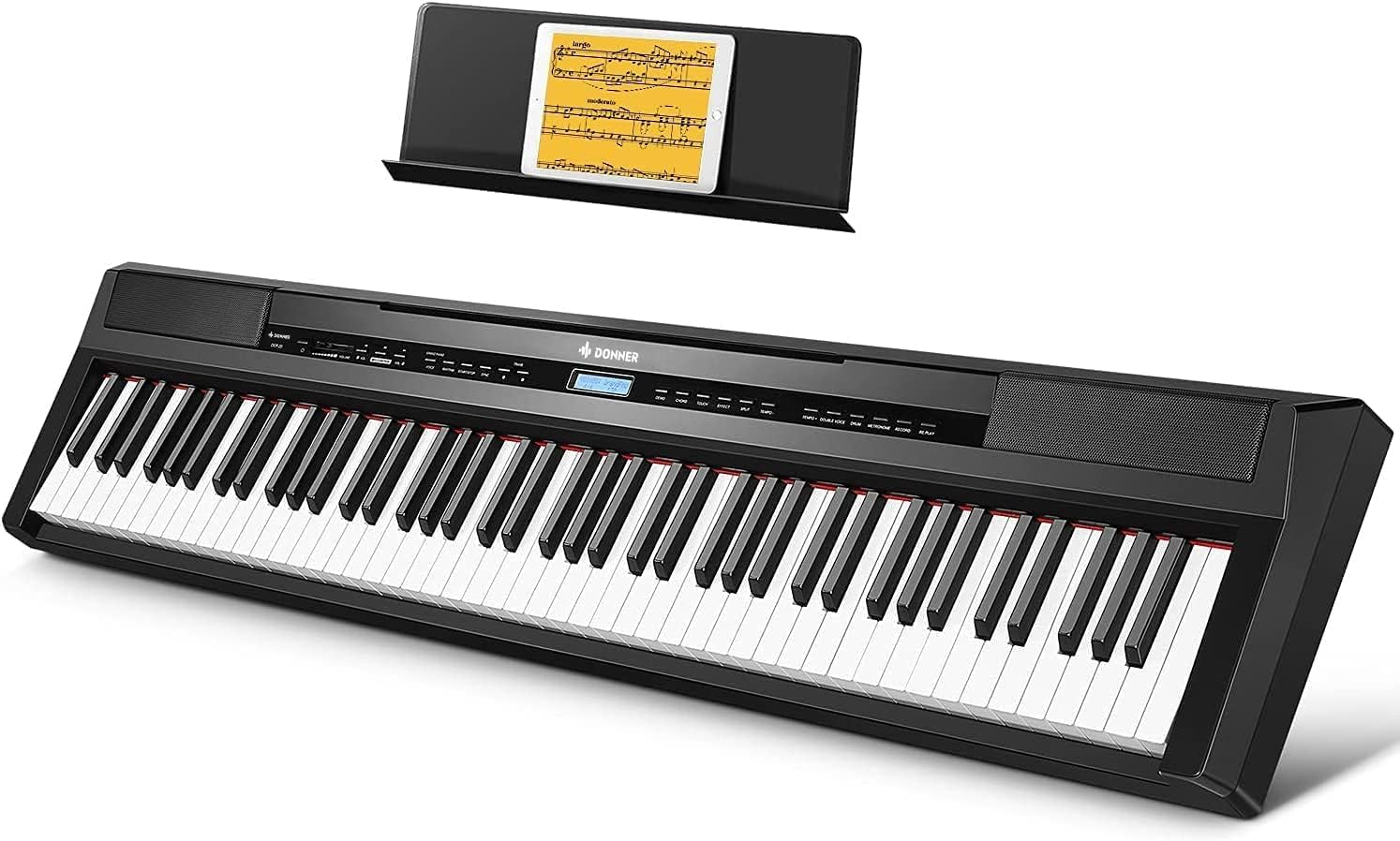
Donner DEP-20

92 /100
LBD Score Outstanding

Key details

Keys
88
Tones
238
Action
Full-weighted hammer action
Weight
25.6 lb
View on Amazon

The pedal is the piece of this package to plan around. A plain switch-style sustain pedal ships in the box, and the pedal is also the first place trouble shows up — a switch that stops registering, or an input that goes dead. Order a proper piano-style pedal alongside the keyboard and keep the bundled one as a spare.

Under your hands, this is the value pick of the group. Full-size hammer-action keys with adjustable touch response, 128-note polyphony, and a backlit LCD that spells out chord names and notation as you play — we think the display is the most underrated feature here, because it turns the DEP-20 into something you can learn from rather than just play.

At 11.6 kg it is a one-person lift, though not a nightly one, and a slab this wide wants a stand with some spread to it. The 238 tones and dual-tone layering cover far more ground than most people will use, and the panel stays legible — the LCD does most of the explaining, which matters more than any single voice in the list.

Pros

  • Full-size hammer-action keys with adjustable touch
  • 128-note polyphony and 238 tones
  • LCD shows chord names and notation
  • Dual-tone layering for practice and writing

Cons

  • Flimsy music rest
Our verdict

We chose it for the player on a budget who still wants hammer action: 128-note polyphony, a screen that teaches chord names, and a tone that holds up in a small room.

Check Latest Price
5

Best for Tight Spaces

STRICH SDP-120

84 /100
LBD Score Excellent

Key details

Keys
88
Action
Fully weighted hammer action
Weight
20.5 lb
Speakers
2 x 15W
View on Amazon

Four and a third inches tall and 9.3 kg is the whole argument. The SDP-120 is the slimmest piano here with genuinely weighted, hammer-action keys, and it is the least expensive of them — which makes it the one to look at when a piano has to live in a closet and come out for practice.

What you give up for the size is mostly polish rather than function. The 2x15W speakers are enough for a bedroom, the 128-note polyphony matches the Donner, and the library runs to 128 tones and 200 rhythms with wireless MIDI for a tablet. We were surprised by the keybed most: weighted keys with real resistance under the fingers, not the springy feel the price would lead you to expect.

Two practical notes. The headphone jack is 3.5mm, so keep a quarter-inch adapter nearby, and the wireless connection carries MIDI rather than audio — useful for driving a virtual instrument on a tablet, not for streaming a backing track through the speakers. Stay on the first few piano voices; the wider library is there for variety rather than realism.

Pros

  • Fully weighted hammer-action keys
  • 4.33 inches tall and 9.3 kg
  • 128-note polyphony with wireless MIDI
  • 2 x 15W speakers for a bedroom

Cons

  • Sparse manual leaves setup unclear
Our verdict

When the piano has to disappear between sessions, this is the one we point to: fully weighted keys in a body under five inches tall, at the lowest price here for that action.

Check Latest Price
6

Budget Apartments

Alesis Recital

93 /100
LBD Score Outstanding

Key details

Keys
88
Action
Semi-weighted
Weight
15.7 lb
Speakers
2 x 20W
View on Amazon

The speakers run out of steam before a living room does. Twenty watts a side looks generous on paper, but the Recital tops out at a volume that is fine for you and thin for anyone else in the room, which is why we treat it as a headphone piano first and a speaker piano second.

What you get for the money is more than the price suggests: 88 full-size keys with adjustable touch response, five voices with chorus and reverb, split, layer, and lesson modes, 128-note polyphony, and three months of Skoove lessons. It runs on the included adapter or six D cells, so it can go to a lesson or out into a garden without a cord.

Where it fits is an apartment, a dorm, or a teenager who practices with headphones on. The quarter-inch headphone output is there for exactly that, and the stereo RCA outputs let you run it into a powered speaker when the room is bigger than the built-in pair can fill. The sustain pedal is not in the box — the jack is, so add a pedal to the order.

Pros

  • 88 full-size keys at the budget end
  • Lesson mode with three months of Skoove
  • Runs on six D cells away from outlets
  • Stereo RCA outputs for an amp or speakers

Cons

  • Semi-weighted keys, not a hammer action
Our verdict

We rate it for a beginner in a small apartment: the cheapest credible route to 88 full-size keys, lesson tools, and a headphone jack for practicing at midnight.

Check Latest Price
7

Small Apartments

Alesis Recital Play

92 /100
LBD Score Outstanding

Key details

Keys
88
Action
Touch-sensitive, unweighted
Weight
12.1 lb
In The Box
Six accessories incl. stand and pedal
View on Amazon

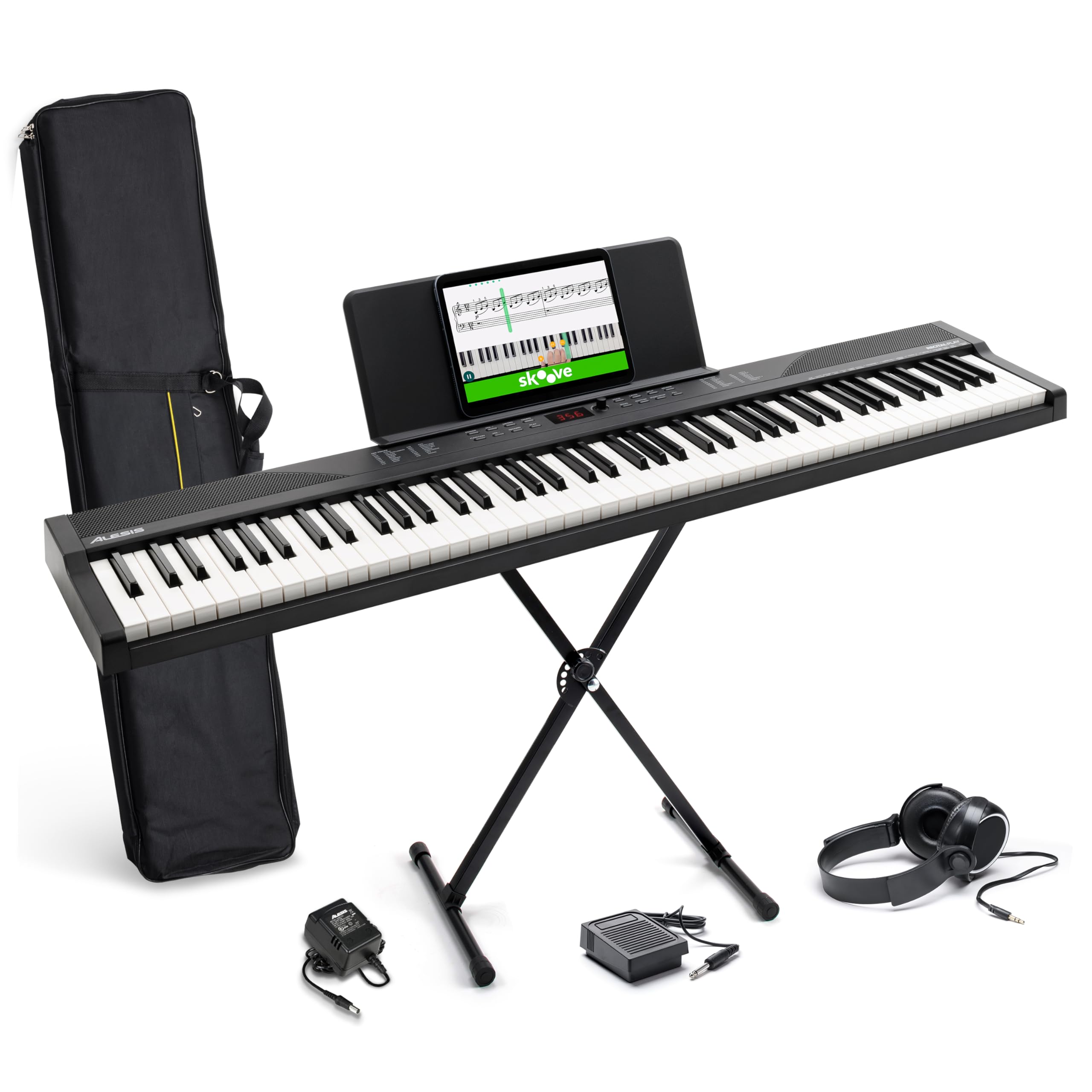
The box is the pitch: keyboard, stand, sustain pedal, headphones, carrying case, and a sheet-music stand, in one order. Nothing else in this group arrives ready to play like that, and it is the slimmest thing here at 2.88 inches, which is what turns the bundle from a pile of extras into a piano that fits in a closet.

At 5.5 kg it goes on a shelf or into the bag and comes out for a lesson, and the 480 voices, 160 rhythms, 140 built-in songs, split, lesson, and record modes, and USB-MIDI are far more than a beginner needs. We like that Alesis points it at a screen as happily as at sheet music: Skoove and Melodics lessons come with it, and USB-MIDI gets you into either.

Portability is where it beats everything else here. It is the one in this group you can take to a friend's house or a holiday let without thinking about it, the headphone jack means you can practice in a room with other people in it, and the stand comes apart with a couple of screws. Set it up once and you will leave it up.

Pros

  • Stand, pedal, headphones and bag included
  • 2.88 inches tall and 5.5 kg
  • 480 voices plus lesson and record modes
  • Skoove and Melodics lessons included

Cons

  • Unweighted touch-sensitive keys
  • Some units develop dead keys or power faults
Our verdict

The only setup here that arrives complete, and the easiest to fold away — we like it for a first piano where storage matters as much as keys.

Check Latest Price

How We Chose and Tested These Slim Pianos

We started by scanning the current market for 88-key slim cabinets that could sit on a desk or stand without dominating a room, then filtered by size, keybed type, price, and whether they included a sustain pedal and onboard speakers. From that shortlist, we brought in seven pianos and lived with them for eight months.

Testing happened where these pianos actually live: a living room, a bedroom, and a small studio corner. I played morning warmups before work, after-dinner practice, and weekend headphone sessions; I also moved each one between rooms to judge portability and how quickly it settled into place. To compare weighted keys, I played slow scales, repeated notes, and chord passages that require a clean key return, paying attention to tactile feel and any side-to-side key wobble. For volume and sound quality, I started at conversation level and pushed the onboard speakers until they either held together or distorted.

Pedal functionality got its own workout: sustained chords, half-pedal attempts, and quick repeated presses to see whether the response was smooth or merely on/off. I had a beginner follow the controls without help, noting how quickly they found a usable piano sound and whether lesson or split modes made sense without the manual. Build quality and durability came down to small things over weeks — loose jacks, cabinet flex, rattling speakers, keys that started clicking. We also weighed value by what came in the box, such as a pedal, power supply, stand, or carry bag, and kept a running note of which pianos we reached for when no one was testing.

How to Choose a Slim Digital Piano

Start with the action, not the footprint

Every piano here has 88 keys; what separates them is what sits underneath. Hammer-action keys use a weighted lever to imitate an acoustic's resistance, and they are what you want if you plan to learn properly. The STRICH SDP-120 and Donner DEP-20 are the cheapest ways into that here. Semi-weighted and touch-sensitive keys respond to how hard you play but do not push back, which is fine for casual playing and a dead end for technique.

Watch the word touch-sensitive in a listing: it describes volume response, not weight. Several boards use it while shipping keys with no weighting at all.

Measure the space, then the carry

Width barely varies — every slab here is 50 to 52 inches across — so height and weight are what actually decide where a piano lives. The range runs from 2.88 inches and 5.5 kg to six inches and 32.7 pounds, and that spread is the difference between a piano that comes out nightly and one that stays on its stand. Under about 25 pounds, one person can move it between rooms without thinking; past 30, it tends to stay put.

Check what slim is describing, too. A slim console with an integrated stand still takes the floor space of a small upright, however shallow its cabinet measures.

Speakers, headphones, and the room

Small cabinets hold small speakers, and the wattage on the box tells you very little about whether a piano will fill a room — the Alesis Recital's 20-watt pair runs quiet at full volume, while the Yamaha and Roland slabs get more out of their drivers. Assume you will practice with headphones most of the time and treat the onboard speakers as a bonus for playing to yourself.

If you genuinely need to project, plan on the line outputs and a powered speaker rather than paying for a bigger wattage claim.

Pedals, polyphony, and connections

Included sustain pedals are usually simple switches rather than continuous pedals, and a switch that slides away from your foot is the first thing to upgrade. A piano-style pedal with a polarity switch costs little and changes how the instrument feels underfoot. Polyphony matters more than the voice count: 128 notes covers pedaled piano music comfortably, and that is what the budget boards here offer.

For connections, USB-MIDI handles recording and most learning apps, while Bluetooth is a convenience. Check whether the wireless carries MIDI only or audio as well before you count on streaming a backing track through the piano.

Frequently Asked Questions

Final Verdict

Start with the Yamaha P71. It is the least compromised slab here: 25 pounds, a weighted hammer action, and a grand piano tone with enough dynamic range to keep you interested well past the beginner books.

If your hands are the reason you are buying, go straight to the Roland FP-30X. If your ears are, the Yamaha P225's concert grand sample is the one worth paying for. And if the piano has to vanish into a closet between sessions, the STRICH SDP-120 is the slimmest weighted board here and the easiest to put away.