Best USB Car Chargers of 2026

Four ports sounds like an upgrade until you're twenty minutes into a drive and your phone has gained one percent because three other things are plugged in. Total wattage gets shared across ports, and the number printed on the box tells you nothing about what a single device actually receives once everything's connected. A good car charger quietly fixes that: it delivers enough power that a short errand puts real percentage back on the battery, and it stays seated in the socket instead of loosening over every expansion joint.

I've accumulated a drawer of these over the years, most of them hand-me-downs from rental cars and gloveboxes. Over the past four months, my team and I ran 14 chargers through daily commutes, a couple of long highway hauls, and the usual errand loop, and the differences surfaced fast — a second device dragging the first one down, a plug that works itself loose, a body that gets uncomfortable to touch on a hot afternoon.

The ones that made the list held their rated power, gripped the socket, and offered a port mix people actually carry. Which one fits you comes down mostly to how many devices ride along and whether you want a spare for a second car.

1

Best Overall

Anker 323 52.5W

95 /100
LBD Score Outstanding

Key details

Ports
2
USB-A Port
22.5W max
USB-C Port
30W max
Total Power
52.5W
View on Amazon

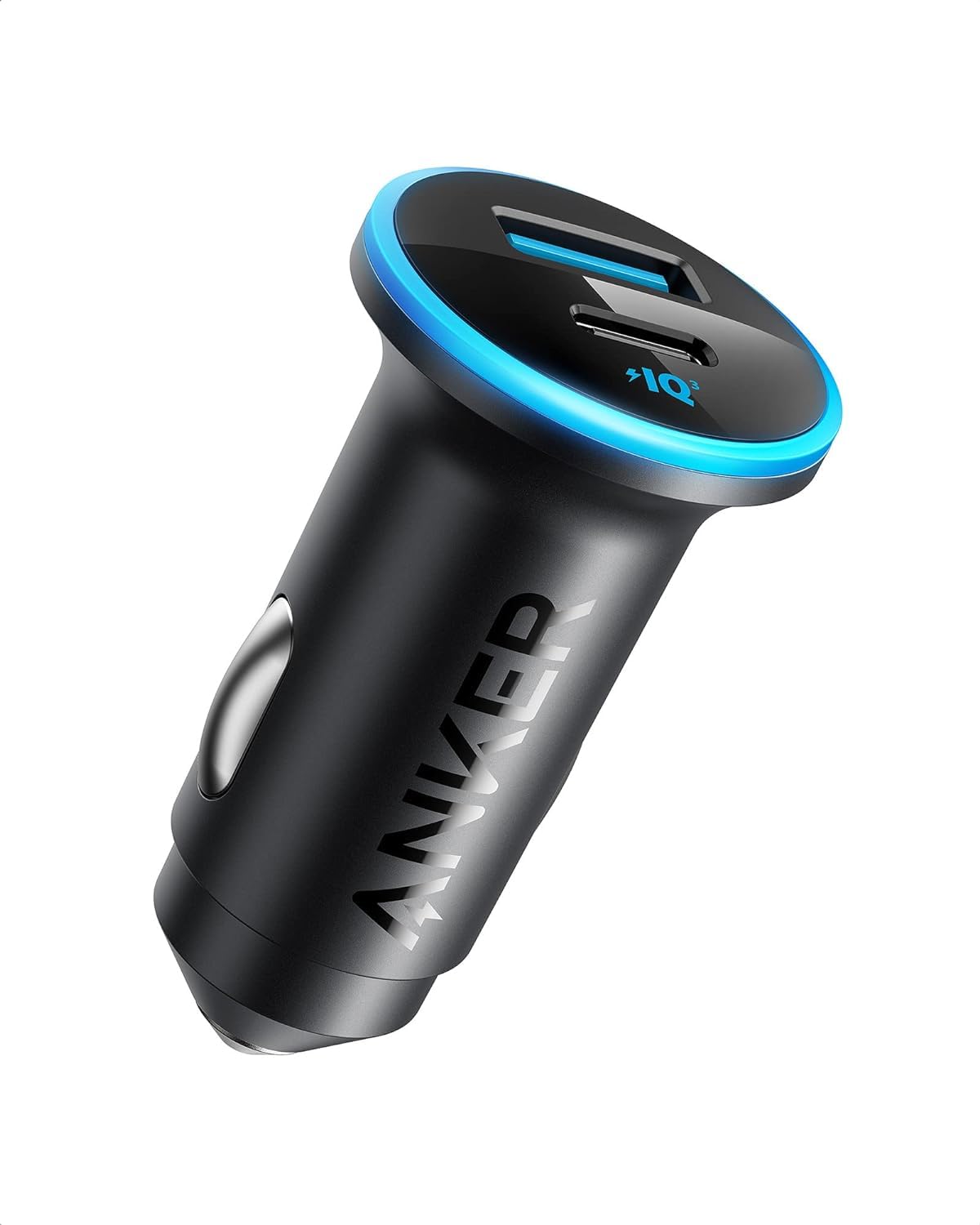
The 30W USB-C port and 22.5W USB-A port are the reason this is our default. That split covers a modern phone on USB-C and a second device on USB-A without forcing you to choose which one gets the faster charge. Anker's ActiveShield 2.0 temperature monitoring is the kind of quiet feature we appreciate in a charger that lives in a hot car.

The body is compact and light, so it sits close to the outlet instead of crowding the console. We paid attention to whether it blocked nearby buttons or trays, and the small footprint is the point. The blue ring around the ports is bright enough to find in a dark footwell, though it isn't a nightlight.

Two ports is the limit, so this isn't the charger for a back seat full of devices. For a daily driver with a phone and a dash cam or a passenger's phone, it's the easiest one to recommend. The 18-month warranty also gives it an edge over the shorter coverage on several budget picks.

Pros

  • Balanced 30W USB-C and 22.5W USB-A charging
  • Compact body sits close to the outlet
  • ActiveShield temperature monitoring
  • 18-month warranty

Cons

  • Only two ports
Our verdict

We recommend the Anker 323 as the default because it pairs 30W USB-C and 22.5W USB-A charging with a compact body that stays out of the way.

Check Latest Price
2

Best Two-Pack

LISEN 69W 2-Pack

93 /100
LBD Score Outstanding

Key details

Pack Count
2 chargers
USB-A Port
18W QC
USB-C Port
36W PD
Ports Per Charger
2
View on Amazon

The two chargers in the box are the practical appeal: one can live in the daily driver and the other in a second car, a travel bag, or a glovebox. The aluminum body is compact enough to sit nearly flush, and the single USB-C plus single USB-A layout covers a phone and a passenger's device.

We think the 36W USB-C PD port and 18W USB-A QC port make more sense than a bigger total-wattage claim for this kind of two-pack. You get fast charging for a phone on the USB-C side and a useful top-up for a second device, without paying for four ports you won't use. It is not a road-trip hub for tablets and rear-seat passengers.

The flush metal body has a downside: in a tight socket it can be hard to grip and pull out. That's a small annoyance, not a dealbreaker, and the pair still makes sense for two cars. Keep the second one in a travel bag; it's small enough to disappear into a side pocket.

Pros

  • Two chargers for two vehicles
  • 36W USB-C PD and 18W USB-A QC
  • Aluminum body with flush fit

Cons

  • Durability is the open question
Our verdict

We like this two-pack for households that need a charger in two vehicles, as long as you accept two ports and a short warranty.

Check Latest Price
3

Best for Cable Clutter

LISEN Retractable 84W

91 /100
LBD Score Outstanding

Key details

Ports
4
Total Power
84W
Cable Length
31.5 inches
Retractable Cables
USB-C and Lightning
View on Amazon

The retractable cables are the reason to pick this one: a USB-C cord and a Lightning cord pull out to 31.5 inches and wind back into the body, so the console doesn't fill up with loose cables. We think that's a real convenience if you drive with a passenger who never remembers a cable.

The layout is useful beyond the two built-in cables: there are two extra USB ports, and the USB-C side is rated for 45W PD. That's enough to fast-charge a phone or tablet, and the built-in Lightning cable is increasingly rare in a car charger. The 84W total gives you room for several devices at once.

The trade-off is bulk. The body is large enough that it won't disappear into a shallow console, and it takes a firm pull to seat. If you have a deep console or a free cupholder, that's a fair exchange for no cable clutter. The built-in Lightning cable is the detail that makes it useful for a mixed iPhone household.

Pros

  • Retractable USB-C and Lightning cables
  • Four ports with 45W USB-C PD
  • 31.5-inch cables reduce console clutter

Cons

  • No CarPlay or data support
Our verdict

We recommend the LISEN Retractable for anyone tired of cable clutter, provided you want charging only and can live with a bulky plug.

Check Latest Price
4

Best for Road Trips

JUNVANG 90W 4-Port

92 /100
LBD Score Outstanding

Key details

Input
12-24V
Total Power
90W
USB-A Ports
2
USB-C Ports
2 (45W max)
View on Amazon

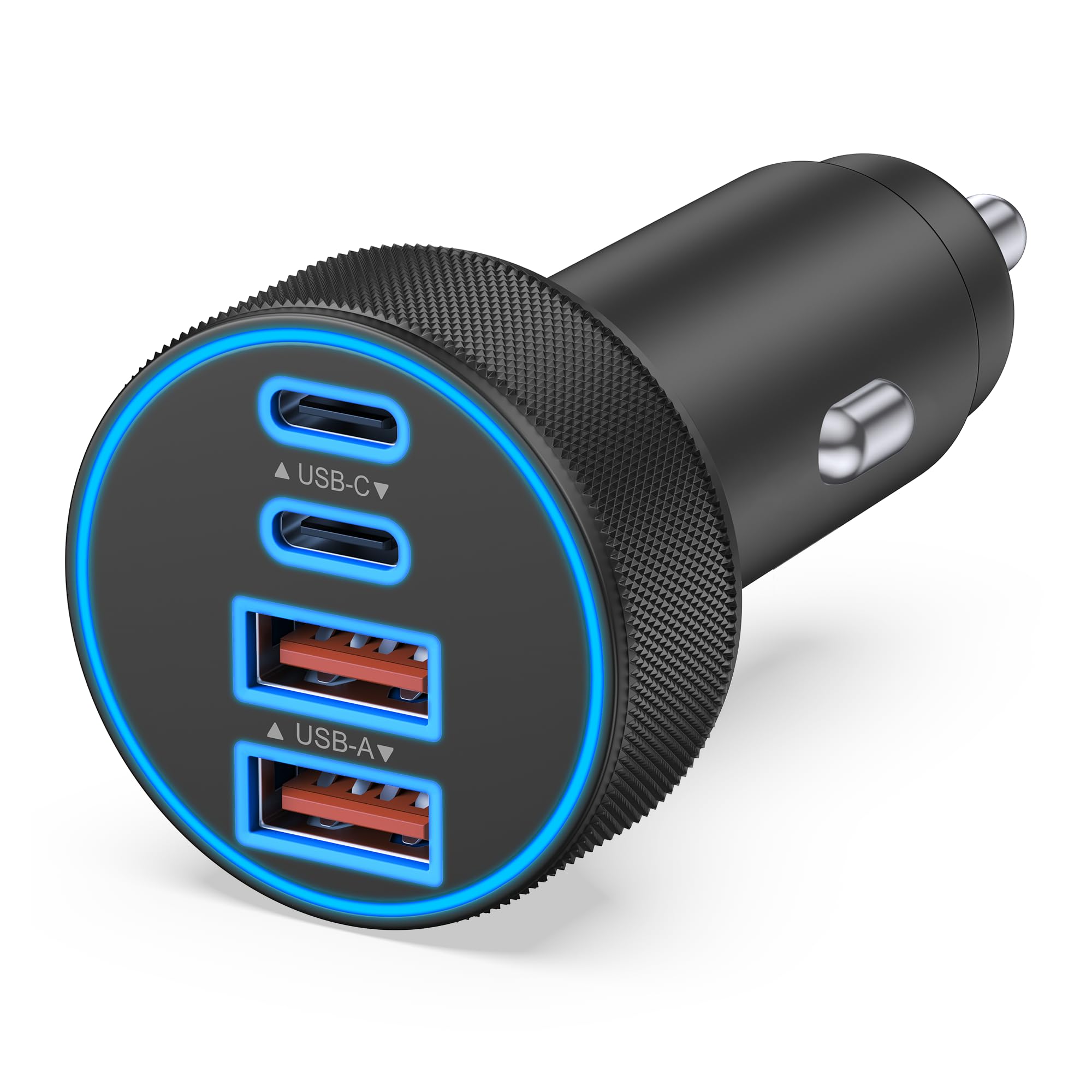
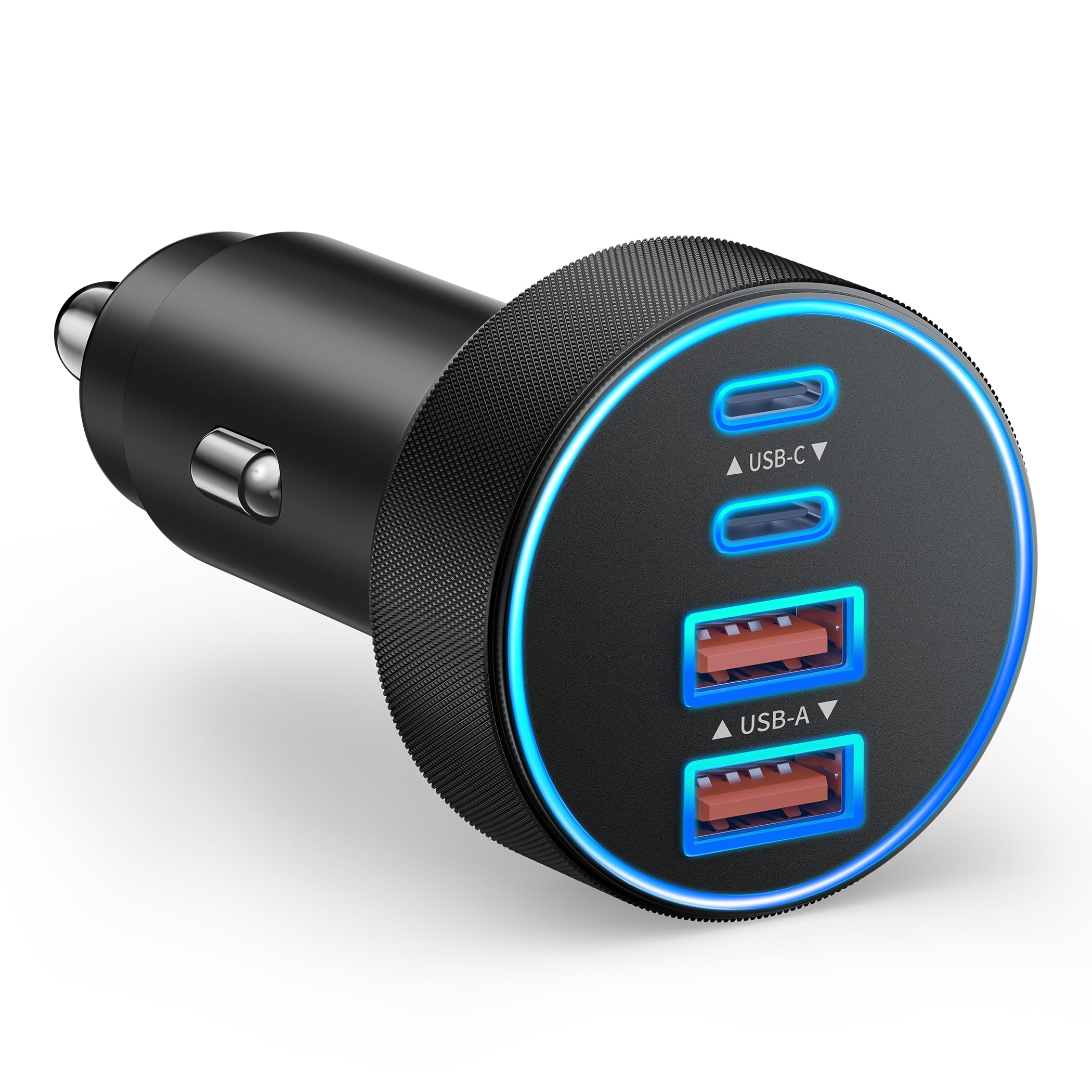
The four-port layout is the reason this charger exists: two USB-C and two USB-A outlets from one cigarette-lighter socket. For a road trip with a driver, a passenger, and a couple of accessories, that's a more useful shape than a compact two-port plug.

The 90W rating is shared across those ports, with 45W max on the USB-C side. That's enough to fast-charge a phone while slower devices top up, but it won't turn four phones into four fast-charging bays. The metal body feels more substantial than the plastic multi-port chargers, and the 12-24V input covers a wider range of vehicles.

We rate it as the best choice here for a packed car. The extra ports are worth the size if you routinely carry more than two devices. For a solo commuter, it's more charger than you need. Reserve the two USB-C ports for phones and use the USB-A ports for dash cams and older accessories.

Pros

  • Four ports from one socket
  • Two USB-C and two USB-A
  • 90W total with 45W USB-C max
  • 12-24V vehicle input

Cons

  • Durability is an open question
Our verdict

Our pick for a packed car is the JUNVANG four-port charger, which gives two USB-C and two USB-A outlets from one socket.

Check Latest Price
5

Best Budget 4-Port

WIDAQUO 90W 4-Port

91 /100
LBD Score Outstanding

Key details

Body
Aluminum
Total Power
90W
USB-A Ports
2
USB-C Ports
2 (45W max)
View on Amazon

The aluminum body is the first thing we noticed: it gives this four-port charger a more substantial feel than the plastic plugs around it, and it looks less like a throwaway accessory in an open console.

We think this is the budget route into the four-port, 90W layout. It gives you two USB-C and two USB-A ports, with 45W max on the USB-C side, and the aluminum shell is a nicer thing to leave visible than a plain plastic body. If you want the JUNVANG layout without the same outlay, this is the obvious alternative.

The LED ring is bright enough to find at night and adds a bit of color to the footwell. If you like a dark cabin, it's a small thing to live with. For a family that wants four ports and doesn't need laptop charging, it's a strong value.

Pros

  • Four ports with two USB-C
  • 90W total with 45W USB-C max
  • Aluminum body

Cons

  • 45W USB-C max limits laptop charging
Our verdict

We see the WIDAQUO as the budget route to a four-port, 90W charger, with an aluminum body and the same useful port mix.

Check Latest Price
6

Best 3-Port Two-Pack

power-7 70W 3-Port 2-Pack

90 /100
LBD Score Outstanding

Key details

Pack Count
2 chargers
USB-C Port
40W max
Total Power
70W
USB-A Ports
2
View on Amazon

The third port is the practical difference: one USB-C for the driver's phone and two USB-A for a passenger's phone and a dash cam, all from one socket. That's a useful middle ground between a compact two-port charger and a bulky four-port hub.

The pair is the real value: one charger for each car, so you're not moving the same plug between vehicles. The USB-C port is rated to 40W, and the two USB-A ports use QC 3.0; that's enough for phones and accessories, though the total is shared across all three.

We see it as a sensible second-car pick. The single USB-C port is the limitation if everyone in the household has a USB-C phone. The LED ring around the USB-C slot is a nice touch: it tells you the charger is powered without lighting up the whole console.

Pros

  • Three ports from one socket
  • 40W USB-C plus two QC USB-A
  • Two-pack for two cars

Cons

  • Charging speed can fall short
Our verdict

We recommend this power-7 two-pack for a two-car household that wants three ports in each without moving chargers between vehicles.

Check Latest Price
7

Fleets

Ancekoy 38W 6-Pack

89 /100
LBD Score Excellent

Key details

Pack Count
6 chargers
USB-A Port
18W max
USB-C Port
20W max
Total Power
38W
View on Amazon

Six chargers in one box is the whole pitch. This is for a fleet, a rental counter, a family with several vehicles, or a small business that hands chargers out and doesn't want to think about replacements.

Each charger is a simple two-port plug: 20W USB-C PD and 18W USB-A QC, with 38W total. That's enough to fast-charge a phone and keep a second device going, but it's not the charger for a tablet and a phone at full speed.

The plastic body is light and the layout is dead simple. There's no retractable cable or display to fail, which is the point for a bulk pack: you want a charger that works, not one that needs explaining.

We think it earns a place as the fleet pack. The per-charger cost is the lowest here, and the simple design is easy to hand out. If you need one charger for a high-power road trip, look at the four-port picks instead.

Pros

  • Six chargers in one box
  • 20W USB-C and 18W USB-A
  • Simple two-port design

Cons

  • Only two ports per charger
Our verdict

We recommend the Ancekoy six-pack for fleets and families equipping several cars, not for anyone who needs high power from one outlet.

Check Latest Price
8

Family Cars

Bangfun 36W 5-Pack

91 /100
LBD Score Outstanding

Key details

Pack Count
5 chargers
USB-A Port
QC 3.0
USB-C Port
20W PD
Total Power
36W
View on Amazon

The blue LED ring is the small detail that makes this five-pack easier to live with: it lights the ports so you can plug in at night without turning on the dome light.

Each charger has one USB-C PD port and one USB-A QC 3.0 port, with 36W total. The metal housing is a step up from the plastic bulk chargers, and the five-pack is enough to cover a family's cars or keep spares in a travel bag.

The power is modest. 36W total is fine for phones and a dash cam, not a tablet and a phone at full speed. For a family that mostly needs phone charging, that's a fair trade for the smaller metal body and the lower per-charger cost.

We rate it as the best of the multi-pack alternatives for a family that wants USB-C and USB-A in every car. The metal body and 18-month warranty are the reasons it edges out plainer bulk packs. The blue ring is a nice touch, but it won't replace a console light.

Pros

  • Five chargers in one box
  • USB-C PD and USB-A QC
  • Metal body and 18-month warranty

Cons

  • Only one USB-C port per charger
Our verdict

We like the Bangfun five-pack for family cars because it adds USB-C PD, USB-A QC, and a metal body to a simple bulk charger.

Check Latest Price

How We Tested the Best USB Car Chargers

We started with more than 60 listings and cut anything with vague wattage claims, a single charging port, or a visible pattern of reviews describing dead ports within a few weeks of purchase. That left 14 chargers — single bricks, four-port hubs, and multipacks — each of which spent four months moving between my car and a colleague's.

Most of the work happened where these things actually live: a 35-minute commute, school drop-off, a two-hour highway run, and the grocery store parking lot. We clipped a USB power meter between the charger and the phone and logged the wattage a phone genuinely drew at 5 percent and again at 60, since fast-charging claims usually describe the easy middle stretch of the battery. Then we plugged in a second device and watched whether the first phone's draw held or quietly fell off.

Durability got the crude treatment. We ran 50 rounds of plugging and unplugging, pulled a cable sideways out of each port, and left chargers in a cold car overnight for a week. After 20 minutes of charging two phones we checked surface temperature by hand, and we kept an iPhone, an older Android that doesn't negotiate the newest fast-charge standard, and an iPad in rotation to see which ones dropped to a slow trickle without complaint.

Value came down to what the box gives you — a multipack that covers two vehicles and a guest, or one charger with enough ports that you never reach for a second.

How to Choose a Usb Car Charger

Start with ports and cables

We start by counting the devices that actually ride with you, then look at the cable ends. A two-port charger with one USB-C and one USB-A is the sweet spot for a driver and a passenger; the Anker 323 is the balanced example here. If you routinely carry a back seat full of phones, a four-port model like the JUNVANG or WIDAQUO earns its extra size. More ports only help if the total power is shared sensibly.

Fast charging is a per-port number

We look at the wattage for the port you will use, not just the big total on the box. A 20W USB-C PD port is enough for many phones; 30W and up is better for larger phones and tablets. A 90W charger with four ports does not send 90W to each one. Check the USB-C rating, the PD or QC standard, and use a cable that supports the same speed. The power-7's 40W USB-C port is a good example of a focused rating.

Fit matters more than the spec sheet

We prioritize a secure seat over a flush look. A charger that sits proud of the socket can block a console lid or catch your hand; one that sits flush can be hard to pull out. In a worn socket, a compact metal body may feel loose or tight depending on the outlet. Test the fit before you route cables, and avoid forcing a plug that does not seat. If you move the charger between cars, a slightly taller body is easier to grip.

One charger or a pack?

We recommend a pack only when you have several vehicles, not because the per-unit math looks good. A two-pack suits a two-car household; a five- or six-pack suits a family fleet, a rental, or a small business. The Ancekoy six-pack and Bangfun five-pack make sense in that role. If you only drive one car, put the difference into a better single charger with the ports and power you need.

Cable management and longevity

We treat retractable cables as a convenience with a trade-off. They are the cleanest answer to console clutter, but they add bulk and may be power-only. The LISEN Retractable is the obvious example: its built-in cables are convenient, while it will not pass CarPlay or data. Durability is the weak spot across this category, so check the warranty and keep a spare if you depend on the charger daily. A simple plug with fewer moving parts is often the safer long-term buy.

Frequently Asked Questions

Final Verdict

Our default is the Anker 323 because it balances a 30W USB-C port, a 22.5W USB-A port, and a compact body that stays out of the way. If you regularly carry more than two devices, the JUNVANG 90W four-port gives you two USB-C and two USB-A outlets; if loose cables bother you, the LISEN Retractable 84W is the cleaner solution. Buy a pack only when you are equipping several vehicles, not because the per-unit price looks tempting.