Best Multiport USB Chargers of 2026

A multiport charger's wattage is a budget, not a promise. That number on the box gets shared across every port, and the charger decides who gets what, so a six-port brick with a laptop plugged in can leave your phone sipping. Understanding that one rule explains most of the gap between a charger you love and one you quietly stop using.

My own desk is a nest of cables, and my nightstand used to hold three separate bricks, so I had a personal stake in this. Over six months my team and I ran 12 multiport chargers through ordinary days — work laptops, school-night phone top-ups, a kitchen counter shared by four people — and kept track of which ones handled a full load without drama.

Two things surprised me. Port layout matters more than port count: a ten-port block with recessed, crowded sockets is miserable to live with. And the GaN internals now common in this price range mostly buy you a smaller, cooler brick — nice to have, but not the reason to pick one over another. The ones below earned a permanent spot in the house.

1

Best Overall

MGRNPONY 10-Port Charger

92 /100
LBD Score Outstanding

Key details

Ports
10 (5 USB-C, 5 USB-A)
Weight
12 oz
Top USB-C Output
65W
Listed Total Output
320W
View on Amazon

Ten ports is the headline; the number that actually decides whether this charger works for you is 65 — the wattage on its top USB-C port, which is what a laptop wants. Around that port sit four more USB-C and five USB-A, so two phones, a tablet, a watch cable, and a pair of earbuds all have a home without a second adapter.

That combination is why it's our top pick. A couple of chargers here have more ports, and one has a more solid feel in the hand, but none of them pairs a laptop-class port with ten connections in a body this small.

On a desk it behaves like a piece of equipment rather than an accessory. At 0.34 kg there's enough weight that pulling a cable one-handed doesn't drag it across the surface, and it stands on its edge when the space behind your monitor is tight. Five USB-A ports is more legacy capacity than most houses need now, and that's fine — the older cables are the ones that never got replaced.

Keep one figure in perspective. The 320W on the box is every port added together, and no single device ever sees that; the realistic picture is the 65W port carrying the laptop while the rest top up. That is how a household actually charges, and it's the whole argument for a station over a plug.

Pros

  • Ten ports, five of them USB-C
  • 65W USB-C port handles a laptop
  • Stands upright to save desk space
  • Weight keeps it planted on a desk

Cons

  • No charging cables in the box
Our verdict

We make it the default pick: ten ports, five of them USB-C, and a 65W port that charges a laptop while everything else tops up.

Check Latest Price
2

Best for a Bedside Table

Anker 112W 6-Port Charger

94 /100
LBD Score Outstanding

Key details

Size
3.0 × 3.2 × 1.3 in
Ports
6 (3 USB-C, 3 USB-A)
Total Output
112W
Max Single Port
30W USB-C, 18W USB-A
View on Amazon

Set this on a nightstand and it stays there. The 302 g body and rubberized feet mean it doesn't slide when you reach for a cable in the dark — a small thing until you've knocked a plastic hub off a bedside table for the third time.

Inside a 3.0 by 3.2 by 1.3 inch footprint are three USB-C and three USB-A ports, plus a silicone organizer that gathers the cables into one bundle. Phones, a tablet, and a watch charger fill up overnight without complaint, and the weight means a stiff cable doesn't tip the whole thing over when you unplug one.

Of the desktop units here, this is the one we left by the bed. It's the tidiest, it's the only pick that ships with something to corral the cables, and it's the one whose construction we stopped thinking about after the first week — which is the highest compliment a charger earns.

What you pay for here is the build and the calm rather than a big number on the box. If your evening load is phones, watches, and earbuds, that's the right trade, and the silicone organizer keeps the nightstand from turning into a nest.

Pros

  • Rubberized feet keep it planted
  • Three USB-C and three USB-A ports
  • Silicone cable organizer included
  • Compact for a six-port desktop unit

Cons

  • 30W ceiling on any single port
Our verdict

Our pick for a bedside table or shared desk: it stays put, corrals the cables, and fills phones and tablets overnight.

Check Latest Price
3

Best for an All-USB-C Household

MEKIOJEO 12-Port Charger

89 /100
LBD Score Excellent

Key details

Body
Aluminum alloy
Ports
12 (8 USB-C, 4 USB-A)
Top USB-C Output
65W
Listed Total Output
380W
View on Amazon

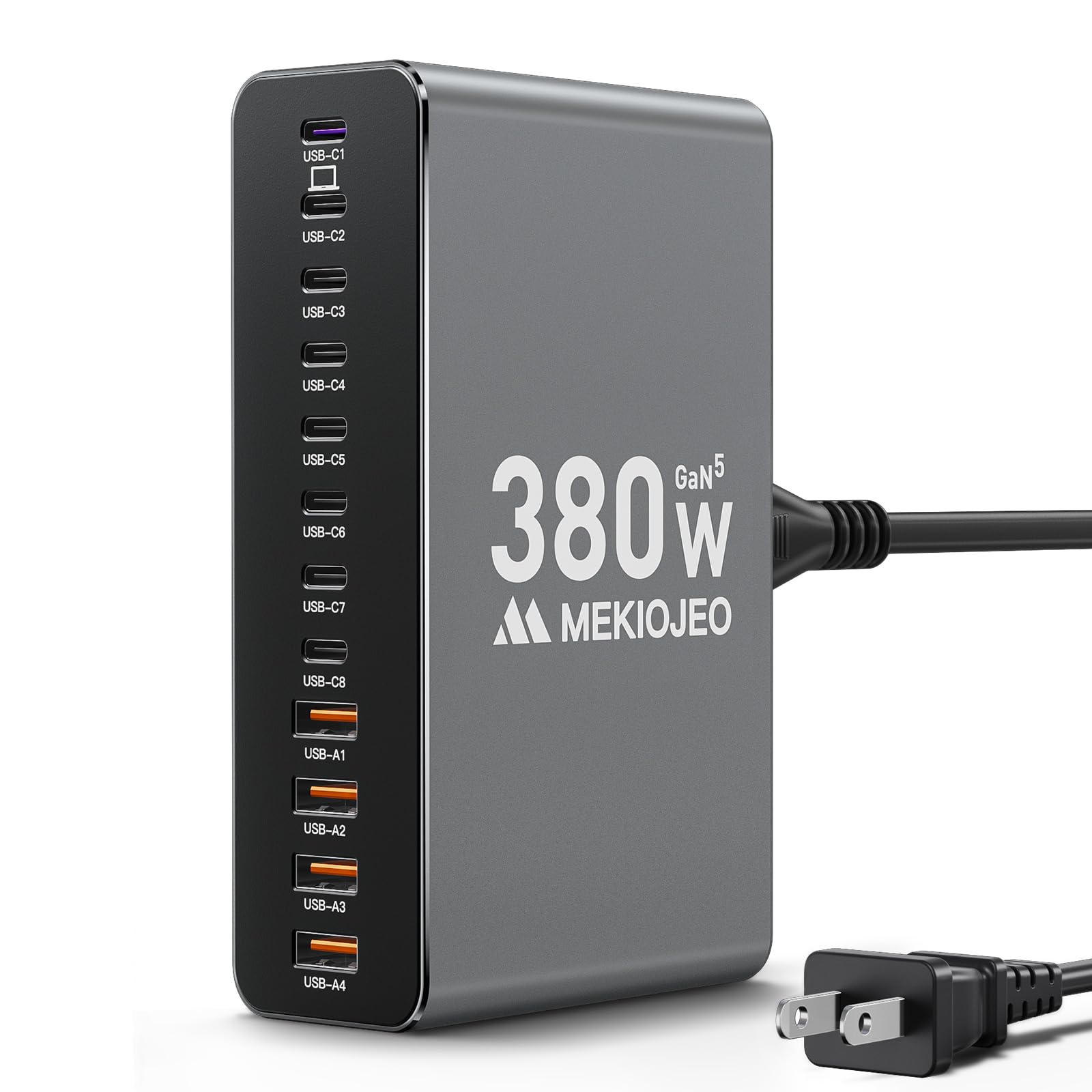
Eight of this charger's twelve ports are USB-C, which is the closest any pick here gets to the way a house actually looks now: a laptop, two phones, a tablet, and a handful of small things, nearly all of them USB-C. That ratio is why we rate it the best fit in this group for an all-USB-C household — it saves you the adapter shuffle rather than just adding outlets.

The aluminum case is the other reason to like it. Twelve ports in a plastic box run warm; this one spreads heat through the shell and stays merely warm under a full load, and the matte finish doesn't hold fingerprints the way glossy plastic does. The 5 ft cord is long enough to reach a floor outlet from a countertop.

The flat body wants a little clearance behind it so six or seven cables can bend away without straining, and it's the one pick here that looks like something you'd leave out on purpose rather than hide. Give it that clearance and twelve ports stop being a specification and become the reason nobody in the house hunts for a charger.

Pros

  • Twelve ports, eight of them USB-C
  • Aluminum body spreads heat
  • 65W port takes a laptop
  • Long 5 ft detachable power cord

Cons

  • Only one of the twelve ports is rated 65W
Our verdict

If everyone in the house is on USB-C, this is the charger we point to: twelve ports, eight of them C, in a case that stays cool.

Check Latest Price
4

Best Travel Kit

Roruite 10-Port Charging Station

87 /100
LBD Score Excellent

Key details

Ports
10 (6 USB-C, 4 USB-A)
Power Cord
5 ft, detachable
Included Cables
4 USB-C cables
Top USB-C Output
65W
View on Amazon

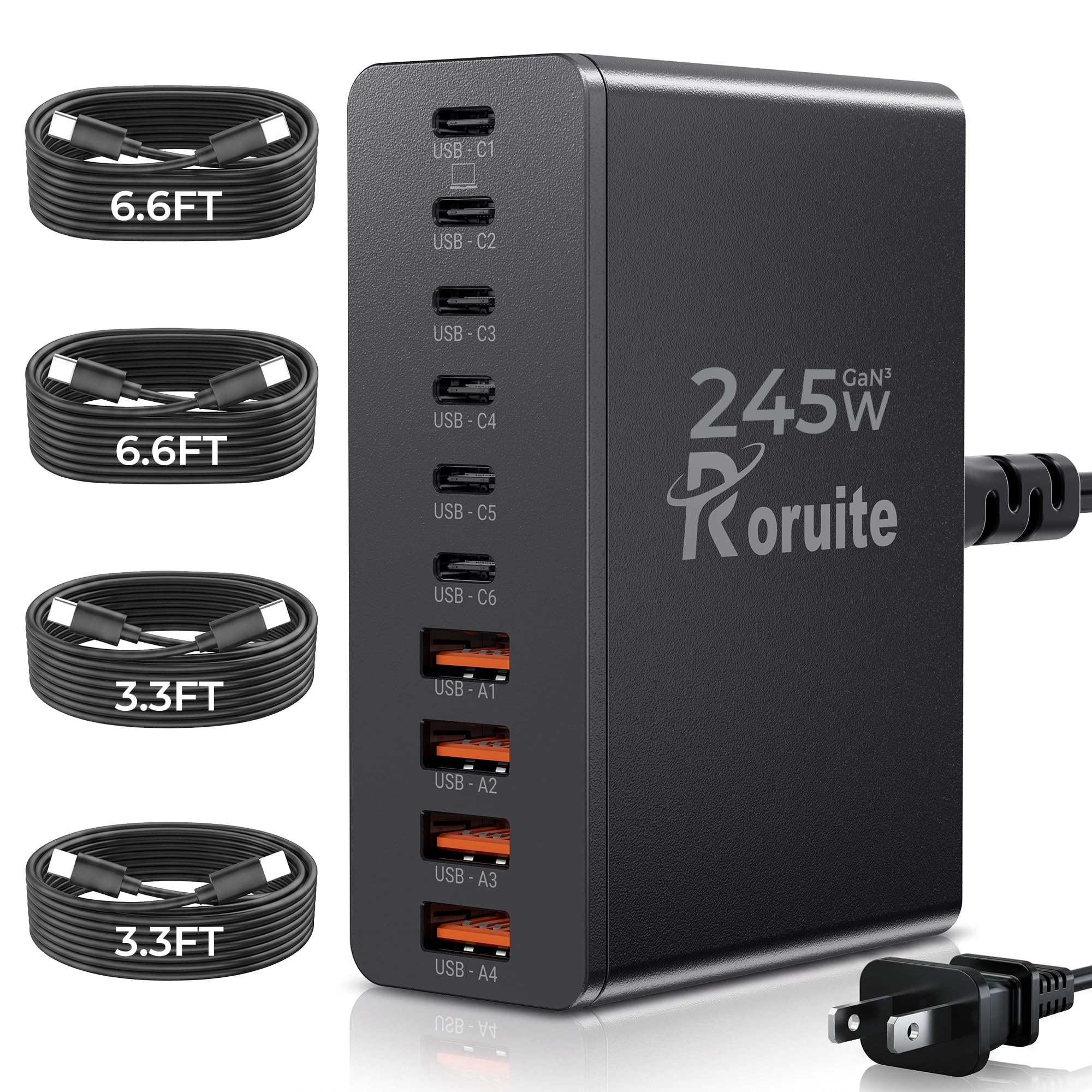
Four USB-C cables arrive in the box with this one — two at 6.6 feet, two at 3.3 — alongside a 5 ft detachable power cord. That reads like packaging detail until you're packing for a trip and realize the charger is the one thing you don't have to think about.

The station carries ten ports: one USB-C at 65W, five more USB-C at 20W, and four USB-A. A laptop goes on the 65W port, phones and earbuds on the rest, and the whole family's gear can sit on one nightstand without a power strip underneath it.

It's light and small enough to travel in a laptop bag, and the detachable cord means you can leave the long one at home. The C ports past the 65W one are 20W, which is a phone's speed rather than a tablet's, so plan the plugs accordingly on a heavy night.

For the bag, this is the one that leaves the house with us. Between the four cables, the ten ports, and the detachable cord, it's the closest thing here to a complete kit — the sort of thing that turns a hotel desk into something you can actually work from.

Pros

  • Four USB-C cables included
  • 65W USB-C port for a laptop
  • Detachable 5 ft power cord
  • Small enough for a laptop bag

Cons

  • Included cables are USB-C to USB-C only
Our verdict

We like it for the travel bag: ten ports, a 65W laptop port, and four USB-C cables so nothing gets left behind.

Check Latest Price
5

Best for Older USB-A Gear

Anker PowerPort 6

96 /100
LBD Score Outstanding

Key details

Ports
6 USB-A
Power Cord
5 ft, detachable
Max Per Port
2.4A at 5V
Total Output
60W
View on Amazon

Six USB-A ports, a 5 ft detachable cord, and a hook-and-loop strip for the bundle: this is the charger for the drawer nobody has cleaned out. It's the least fashionable product on this page and, for a lot of houses, the most sensible one.

What it does well is volume of ordinary gear. An e-reader, a fitness band, a watch cable, a couple of older phones, and a game controller can all sit on it overnight and be full in the morning. It's UL certified, it disappears behind a lamp, and the body can be mounted to a wall if you want it off the desk entirely.

We keep it for exactly that drawer. The build is the most solid-feeling of the desktop units here — six ports, 60W split between them, and a shell that doesn't flex when you push a cable in — so if everything you own still charges over USB-A, this is the calmest way to turn one outlet into six.

Pros

  • Six USB-A ports in a small body
  • Detachable 5 ft cord and cable strip
  • UL certified with layered protection
  • Solid, non-flexing build

Cons

  • USB-A only, capped at 2.4A per port
Our verdict

Our pick when the cable drawer is all USB-A: six steady ports, a detachable cord, and the most sorted build here.

Check Latest Price
6

Best Budget Wall Charger

Karhood 60W 5-Port Charger

92 /100
LBD Score Outstanding

Key details

Form
Wall plug, no cord
Ports
5 (3 USB-C, 2 USB-A)
Total Output
60W
Top USB-C Output
30W
View on Amazon

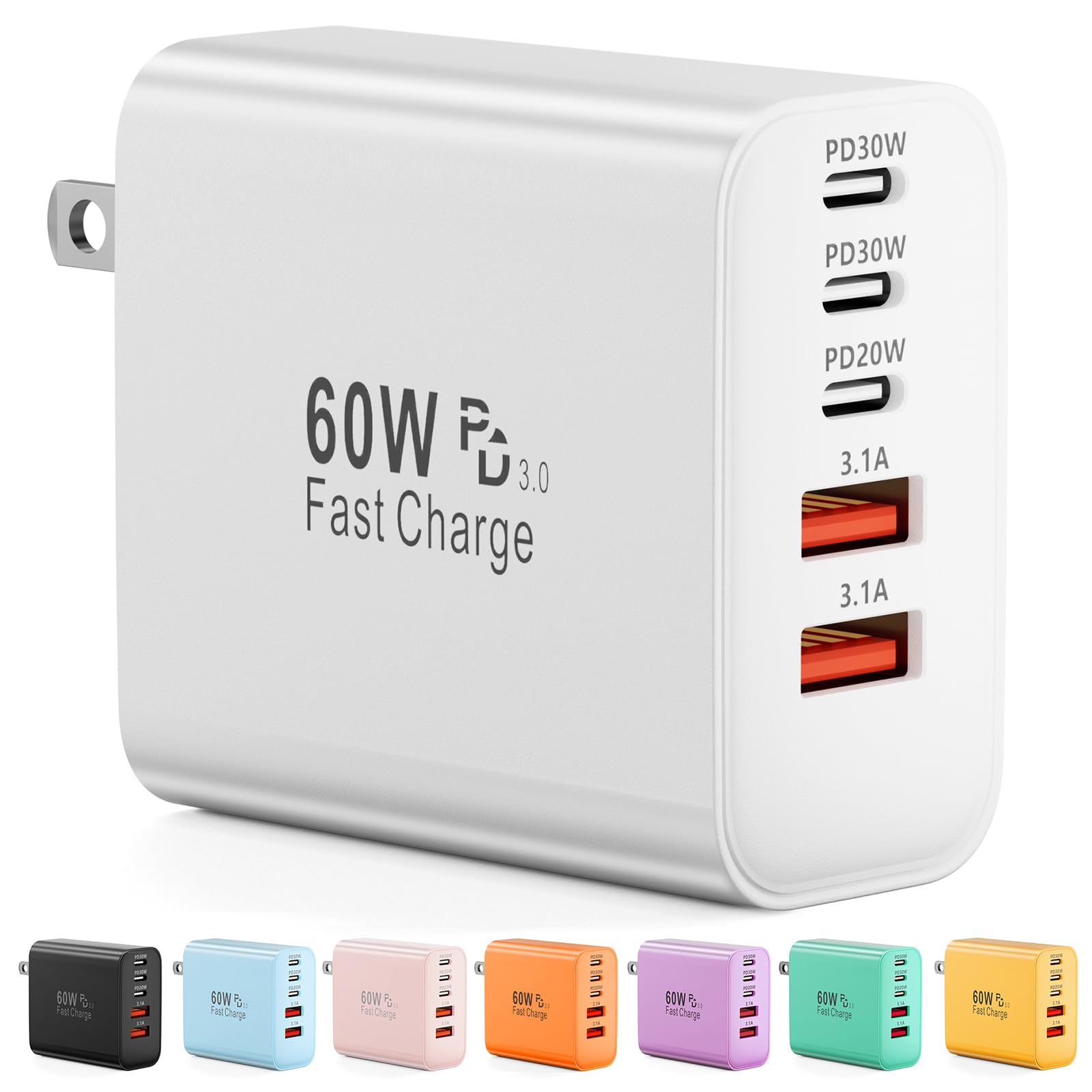
There's no cord here, just a compact white block that plugs straight into the wall with three USB-C and two USB-A ports on its face. For a kitchen counter or a bedside outlet that's all you want: nothing to route, nothing on the floor, and enough ports that the family's phones can all be plugged in before bed.

We treat this as the budget answer, and it earns the place on more than price. The 30W USB-C port is a real phone or tablet charge, the two USB-A ports take the older cables, and the whole thing is small enough to live in a travel bag without being noticed. If you have a spare outlet and three or four devices, it does the job of a desktop station with less furniture.

Pros

  • Five ports, three of them USB-C
  • 30W USB-C port for a phone or tablet
  • No cord, plugs straight into the wall
  • Small enough for a bag or a kitchen outlet

Cons

  • 60W is shared across all five ports
Our verdict

We reach for this one when there's a single outlet to spare: five ports, three of them USB-C, and no cord to route.

Check Latest Price
7

One-Outlet Travel

hibiker 65W 6-Port Charger

90 /100
LBD Score Outstanding

Key details

Form
Wall plug, no cord
Input
100–240V
Ports
6 (3 USB-C, 3 USB-A)
Total Output
65W
View on Amazon

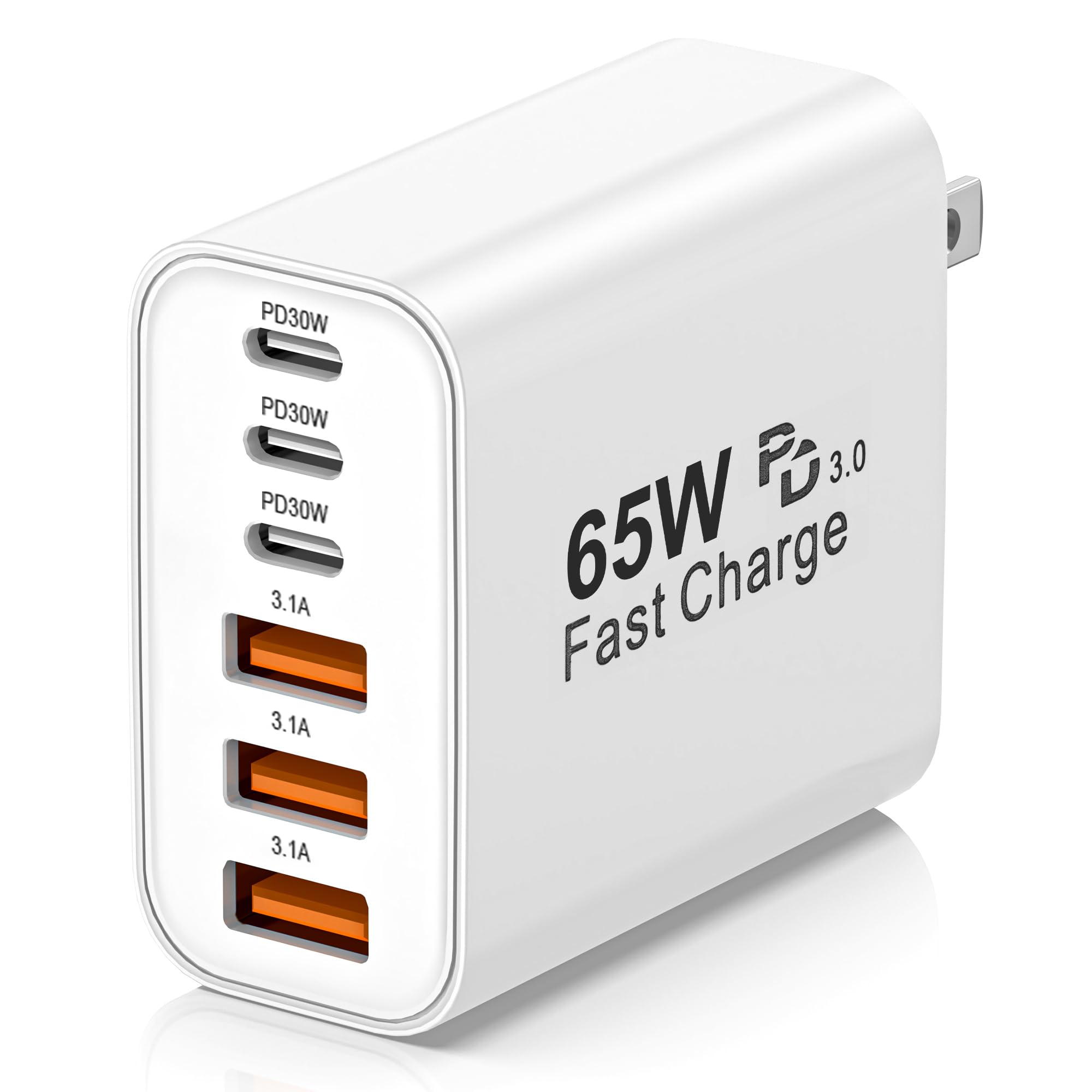
This is the one we pack for a trip: six ports — three USB-C, three USB-A — on a block that goes straight into the wall, with 100-240V input so a plug adapter is all you need in Europe or Asia. In a hotel room with one reachable socket, that matters more than any other feature on this page.

Around the house it does the work of four charging bricks. The C ports take the phones and a tablet, the A ports take the older cables and the watch charger, and the GaN internals are there to keep heat down when six things are drawing at once — a real consideration in a block this small.

Two things to know. It hangs off the outlet with six cables pulling on it, which is fine in a firm socket and annoying in a loose one. And the 65W is the total for the block rather than a guarantee for the port your laptop is on, so a phone on one port and a laptop on another split what's available. For a night of phone charging, neither changes much.

Pros

  • Six ports from a single wall plug
  • 100–240V input for overseas travel
  • Power Delivery and Quick Charge 3.0 support

Cons

  • Hangs off the outlet with six cables attached
Our verdict

We pack this one for travel: six ports on a single wall plug, with 100–240V input that covers overseas outlets.

Check Latest Price
8

Guest Rooms

AILKIN 4-Port USB Charger

93 /100
LBD Score Outstanding

Key details

Form
Wall plug, no cord
Ports
4 USB-A
Total Output
24W (5V/4.8A)
Listed Warranty
Lifetime
View on Amazon

A small white cube with four USB ports on its face and nothing else: no cord, no display, no switches. What it gets right is the shape. It sits compactly enough that the second wall outlet stays usable, which is the difference between charging four things and charging four things plus a lamp.

The honest arithmetic is modest. Twenty-four watts is the whole budget for four ports, so one phone on its own gets a reasonable trickle and four devices at once get a slow one. That's the trade for a block this small, and it's the right trade for devices that sit for hours rather than minutes.

Where it earns a place is the guest room, the kitchen counter, the cabin: somewhere people arrive with their own cables and need a place to plug in overnight. The four ports take the connectors everyone still has, and the listed lifetime warranty is unusually generous for a block in this tier.

We keep one in the guest room for exactly that reason. Nobody has ever asked where the fast charger is; they ask where to plug in, and this is the answer.

Pros

  • Four USB-A ports in a small cube
  • Leaves the second wall outlet free
  • Lifetime warranty listed

Cons

  • USB-A only, with no USB-C port
Our verdict

We keep one in the guest room: four ports in a small cube that leaves the second outlet free for the lamp.

Check Latest Price

How We Tested Multiport Chargers

We started by gathering every multiport charger we could find that promised laptop-level USB-C power, then read the spec sheets the way a shopper would: total wattage, the mix of USB-C and USB-A ports, whether the sockets were spaced for real cables, and how much desk or outlet space the thing would eat. From that shortlist we bought 12 chargers and lived with them for six months.

Testing happened where chargers actually live. Each one spent a week on my desk, a week on the nightstand, and a week on a busy kitchen counter, and a few came along in a backpack for weekend trips. For speed, I timed a drained phone from zero to fifty percent with nothing else plugged in, then repeated the run with every port occupied to see how far the numbers fell. A wattage meter confirmed the draw at the wall, and I checked case temperature by hand after an hour at full load.

Durability came down to repetition: every port got plugged and unplugged daily, and I noted which ones loosened or stopped clicking in. I nudged chargers off the desk edge, lifted them by a connected cable, and packed them loose in a bag to see which picked up scratches or caught on their prongs. Reliability meant watching across the six months for ports that stopped negotiating a fast charge — and noticing which units simply kept every device topped up without being thought about.

How to Choose a Multiport Usb Charger

Read the Single-Port Number First

Total output is the biggest number a manufacturer can print, and it's the least useful one. A block rated 100W across six ports is not a 100W charger: spread evenly that's roughly 16W a device, and a laptop that wants 65W will crawl. Find the rating for the port that will feed your hungriest device — 65W for a laptop, 20 to 30W for a phone or tablet — and expect that figure only when the rest of the ports are quiet.

If a laptop is part of the load, buy the unit that names a 65W USB-C port rather than the one with the largest total. That single decision separates our top pick from the wall plugs in this group.

Count USB-C Ports, Not Ports

A high port count often means a row of USB-A. Those are useful for older gear, but USB-A caps out around 12 to 15W and can't do Power Delivery, so a current phone will charge slowly on one no matter what the charger claims. Before you're impressed by ten of anything, count how many devices in your house actually charge over USB-C — two phones, a tablet, a laptop — and make sure the charger has that many C ports.

The mix tells you who the product was designed for. Twelve ports with eight of them USB-C is a household in 2026; six USB-A ports is a drawer that hasn't been cleaned out.

Wall Plug or Corded Station

A wall plug is the neater answer for a kitchen outlet or a single bedside socket: nothing to route, nothing on the floor, and it goes in a bag. A corded station earns its keep where several people charge at a desk or counter, because the cord puts the ports where you can reach them and keeps the weight off the socket. Most of the corded picks here come with a 5 ft cord, which is enough to reach from a countertop to a floor outlet.

If you travel, check two things on the label: the input range, where 100-240V means a plug adapter is all you need abroad, and whether the cord detaches. A detachable cord is the difference between packing a charger and packing a charger plus a tangle.

Heat, Build, and the Second Year

Every charger warms up; a small body pushing ten ports warms up more. Gallium nitride components run cooler than the older silicon designs and are the reason a 65W charger now fits in a palm, and an aluminum case spreads heat better than a plastic one. Practical version: leave it somewhere air can move, keep it out from under papers, and stop using anything that smells hot or has a port that has quietly died.

Look for a UL or ETL marking on the label. It's the cheapest assurance available that the thing on your nightstand won't be the reason you're standing in the street at midnight.

Frequently Asked Questions

Final Verdict

Buy the MGRNPONY ten-port for the main charging spot in the house. The 65W USB-C port is what makes it the default: plug a laptop in and it charges at laptop speed, with nine other ports for everything else.

If the laptop never comes to that desk, the Anker 112W is the better-mannered choice — heavier, tidier, and the only pick here that hands you a cable organizer. And if the problem is outlets rather than ports, the Karhood plug turns one socket into five with no cord on the floor.