The Best Tripods for Heavy Telephoto Lenses

A long telephoto lens has a way of finding out a tripod. Let go of the camera for a moment and you'll watch the rig dip, or catch it humming in a breeze, and suddenly one set of legs is not interchangeable with another. For years the choice was joyless: haul something heavy enough to hold a big lens, or carry something light and babysit it. I've spent eight months with 12 tripods to see how far that trade-off has actually moved.

The load rating printed on the box is a ceiling, not a promise. What keeps a big lens steady is the diameter of the top leg section, how the locks behave once there's real weight on them, and whether the head can be balanced so the lens stays where you point it. Carbon fiber saves your shoulder, aluminum saves your budget, and either can be rock-solid or miserable depending on the build.

The picks below run from carbon legs light enough to hike with to video rigs that plant themselves and refuse to move.

1

Best Overall

SLIK PRO 700 DX

93 /100
LBD Score Outstanding

Key details

Weight
5.5 lb
Leg Diameter
1.19 inches
Load Capacity
44 lb
Maximum Height
70.1 inches
View on Amazon

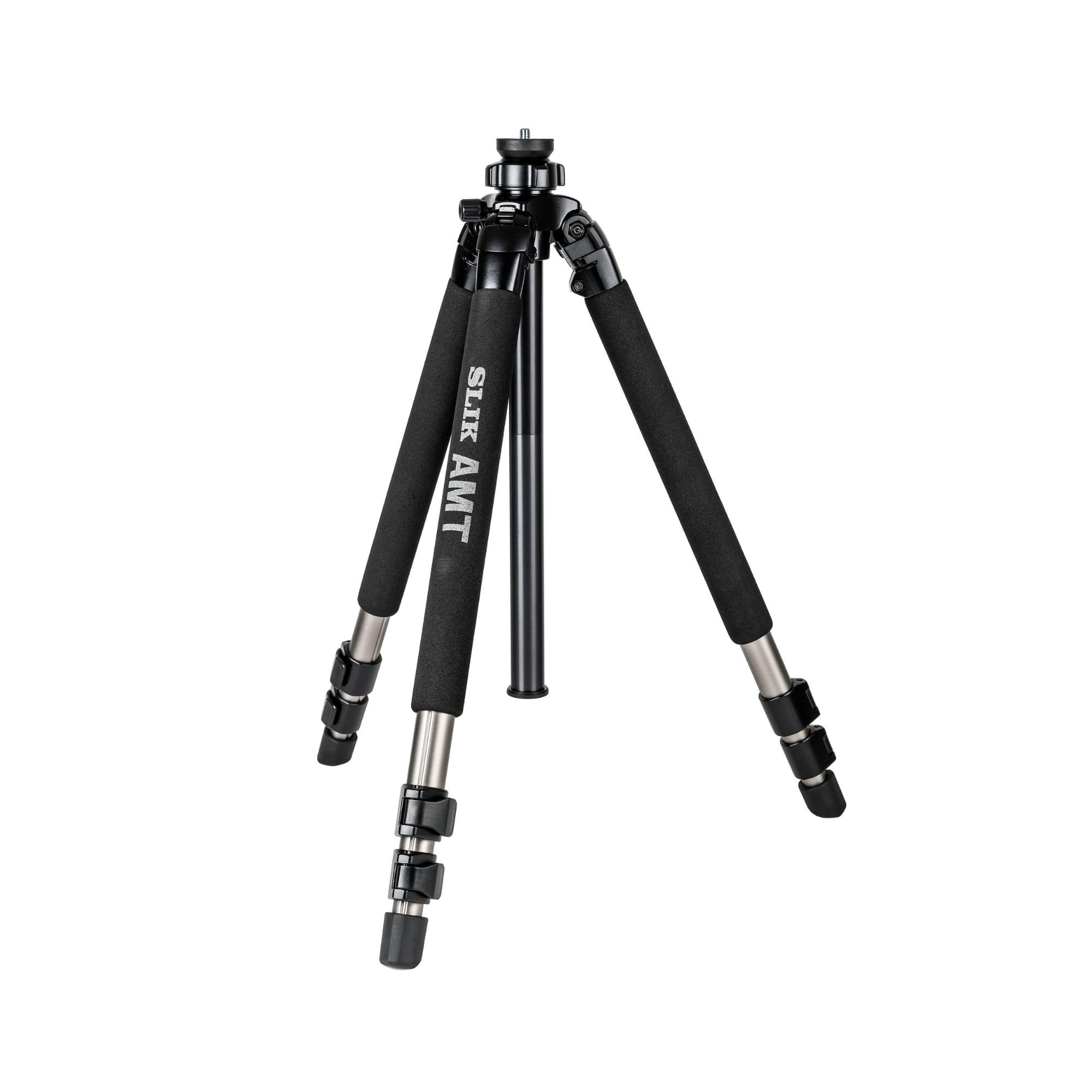
Forty-four pounds is the number to start with. A full-frame body, a 600mm prime and a gimbal head land somewhere in the mid-teens, so this set carries that rig at roughly a third of what it is rated for, and the leftover capacity is what keeps a long lens from shivering every time the wind moves. The upper legs measure 1.19 inches across, with dual alignment grooves that take the twist out of each section, and once the locks are down the whole thing feels bolted to the ground rather than standing on it.

Part of why we recommend it is what it leaves out. There is no head in the box, so you fit the gimbal or ball head you already trust, which for a 500mm or 600mm prime is exactly the arrangement we want — the head matters more than the legs once the lens gets long, and bundling one would only raise the cost of a part you would replace anyway.

The one thing we check every session: the head mounts on a plain stud, and nothing beyond thread tension stops it backing off. With a long plate levering on it, a locking washer is cheap insurance. Height is generous too — 70.1 inches puts the viewfinder at or above eye level for most adults, the two-part center column drops the set to 16.1 inches when you want to get under a subject or out of the wind, and each leg locks at three angles independently, so a rock or a slope doesn't turn into an argument. At 5.5 pounds it is lighter than several of the head-and-legs kits here, which is the payoff for buying legs alone.

Pros

  • 44-pound rating leaves the most load margin here
  • 70.1-inch working height for eye-level framing
  • Only 5.5 pounds for the capacity it carries
  • Three leg angles handle uneven ground

Cons

  • Sold as legs only
  • Legs can bind before they slide freely
Our verdict

For a long telephoto on a gimbal head of your own choosing, this is the set we steer you toward: the biggest load margin here on a frame that weighs just 5.5 pounds.

Check Latest Price
2

Best Complete Video Kit

NEEWER TP74

92 /100
LBD Score Outstanding

Key details

Weight
10.9 lb
Folded Size
36 inches
Load Capacity
17.6 lb
Maximum Height
74 inches
View on Amazon

The SLIK above gives you legs and nothing else; this one arrives ready to shoot. Seventy-four inches of aluminum, a fluid drag head, and — the detail we care about most — a plate system that takes both Manfrotto 501PL and 504PL plates and DJI RS2 and RS3 gimbal plates. Own plates for a gimbal or a video head already and they drop straight in, with no accessory shopping before your first shoot.

Sturdiness is where it earns its place. A 200-600mm zoom sits on the plate without the head creeping or the legs walking, pan and tilt are damped enough to follow a bird across a field without a snatch at the end of the arc, and the flip locks hold height without a re-check halfway through the afternoon. The trade is weight: 10.9 pounds, roughly double the SLIK, and you feel it on the walk in from the car. Treat 17.6 pounds as a ceiling rather than a target, too — a big prime and a long plate put you close to it, and close is where the vibration starts.

Pros

  • Fluid head and quick-release plate included
  • Takes Manfrotto and DJI gimbal plates
  • Holds a 200-600mm zoom without creep
  • 74-inch height on flip-lock sections

Cons

  • 17.6-pound rating leaves little margin for a big prime
  • 10.9 pounds to carry to the location
Our verdict

Buy this if you want one box that arrives with a usable fluid head; it is the steadiest complete kit here under a long zoom, though a heavy prime pushes its rating.

Check Latest Price
3

Best Lightweight Hauler

SIRUI AM-324

88 /100
LBD Score Excellent

Key details

Weight
3.09 lb
Leg Diameter
32 millimeters
Load Capacity
39.8 lb
Maximum Height
57.1 inches
View on Amazon

The spec sheet looks like a misprint: 39.8 pounds of rated capacity on a tripod that weighs 1.4 kg. It isn't a typo. The top leg sections are 32mm across, wider than most of the aluminum legs in this group, and carbon fiber is what lets SIRUI keep the tubes fat and the frame light.

What that buys you is a support that goes where you go. Folded to 52 cm and dropped in its case, it disappears into a daypack; the twist locks take a half turn, so you can level it by feel in the dark. The legs splay to three angles and down to a 3.1-inch minimum height, and with no center column there is nothing to flex — the height you set is the height you get. The case is cut for bare legs, so plan on pulling the head off before it goes in the bag.

For a long lens you carry rather than wheel, this is the set we reach for. A 100-400mm or a 300mm f/4 on a compact ball head sits comfortably inside its rating, and the 1.4 kg frame is the difference between bringing a tripod and leaving it in the car. What it isn't is the budget route — you are paying for carbon tubes and a six-year warranty, and if the tripod lives in your trunk, aluminum does the same job for less.

Pros

  • 39.8-pound capacity in a 1.4 kg frame
  • Half-turn twist locks are quick by feel
  • Splays to 3.1 inches for low and macro work
  • Six-year manufacturer warranty

Cons

  • Topped out at 57.1 inches
Our verdict

Pick this when the tripod has to travel on your back: it carries a serious lens at 1.4 kg, as long as you can work from 57 inches.

Check Latest Price
4

Best for Tall Shooters

SIRUI AM-25S

89 /100
LBD Score Excellent

Key details

Weight
8.82 lb
Folded Size
96 cm
Load Capacity
22 lb
Maximum Height
190 centimeters
View on Amazon

Seventy-four point eight inches is the figure that decides this one, and it is the reason we hand it to anyone who shoots standing up all day. Behind it, the head comes to eye level for most adults — the height you want for a scope on a ridge or a camera pointed into a tree — and the leg knobs are oversized, which counts for more than it sounds when you are setting up in the cold.

The rest of the package is built for the same kind of work. The fluid head pans a full 360° and tilts from −75° to +90° with a tension ring at the base, it sits in a 75mm bowl with a mid-level spreader, and retractable metal spikes give you something to bite into on grass while the rubber feet handle a gym floor or a deck. A cinema rig with a long lens sits on it without complaint. Where it stops is travel: 4 kg and a 96 cm fold mean it rides in a trunk, and the listing doesn't pretend otherwise.

Pros

  • 74.8-inch height puts the head at eye level
  • 75mm bowl and mid-level spreader for stability
  • Metal spikes and rubber feet both included
  • Tension-adjustable fluid pan and tilt

Cons

  • Folds to 96 cm
Our verdict

For standing work with a head in the box, this is our pick: near eye-level height, a spreader that keeps the stance wide, and a pan that moves without a snatch.

Check Latest Price
5

Best Budget Kit

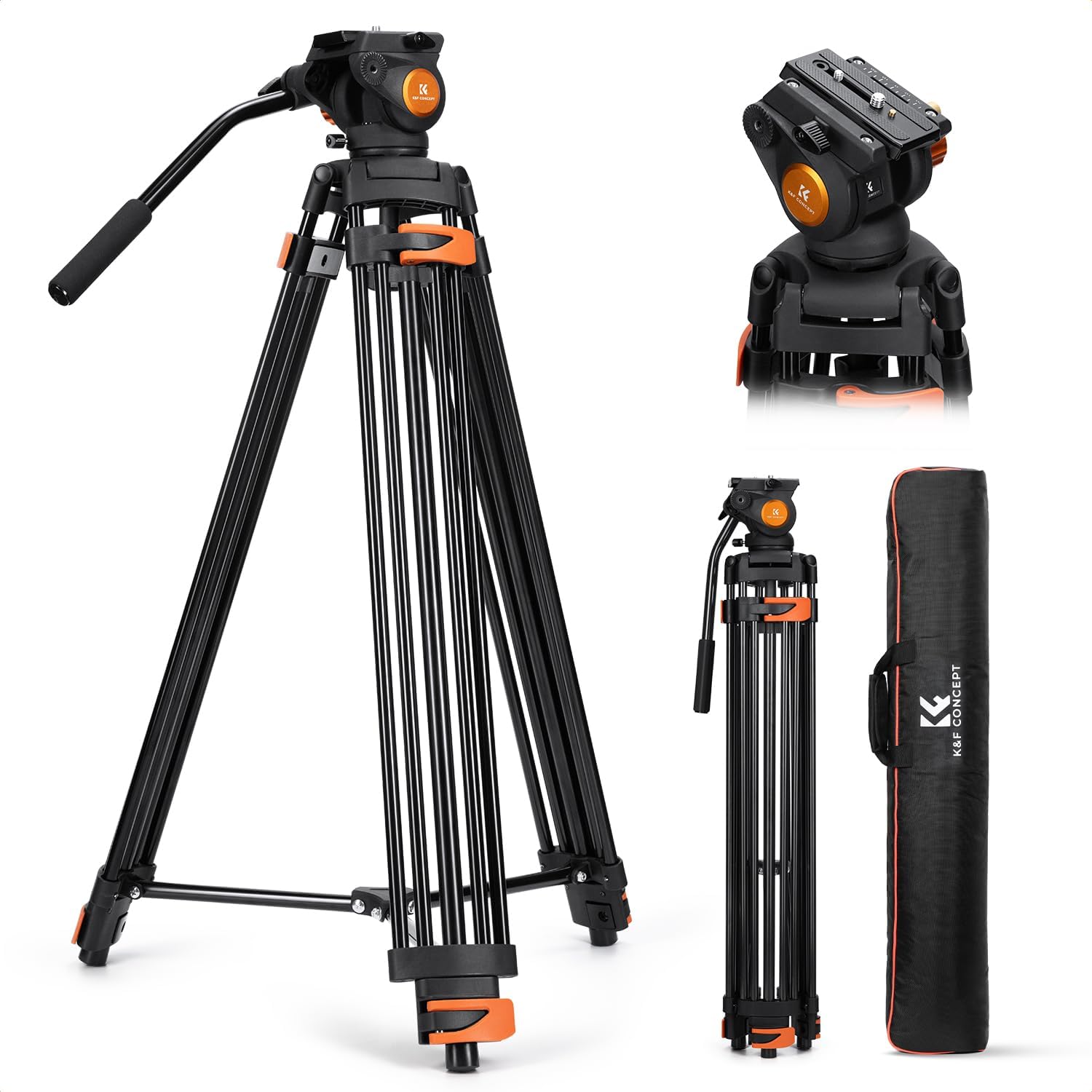
K&F Concept VA3+BV70

88 /100
LBD Score Excellent

Key details

Weight
12.3 lb
Folded Size
36.2 inches
Load Capacity
17.6 lb
Maximum Height
79.5 inches
View on Amazon

It is the least expensive complete kit here and it still climbs to 79.5 inches — taller than anything else in this group. The three-section legs use flip locks, the head pans a full 360° and tilts from −70° to +90°, the legs are built from paired tubes, and a triangular spreader keeps the stance wide once the feet are set.

Panning is where it caught us out. Damping at the affordable end usually means the head moves, roughly, and you fix it later; this one tracks a slow follow across a stage cleanly enough that we stopped noticing it, which is the highest compliment a budget fluid head can get. Set it up and leave it in one place and it works well beyond its position in the price list. Carry it any distance and the mood changes: 5.6 kg is a lot of tripod for a 17.6-pound payload, and you feel every kilo on the second trip from the car.

Pros

  • 79.5-inch maximum height
  • Damped pan that tracks smoothly
  • Head, plate, bag and tools included
  • Flip locks make height changes quick

Cons

  • 5.6 kg is heavy for a 17.6-pound payload
  • Legs stop around 35 inches, so no low angles
Our verdict

This is the kit we suggest for a first video setup on a tight budget: full height, a smooth head and a bag, with weight as the trade-off.

Check Latest Price
6

Camera and Scope

CAMBOFOTO TA60

86 /100
LBD Score Excellent

Key details

Weight
9.1 lb
Folded Size
38 inches
Load Capacity
20 lb
Maximum Height
74 inches
View on Amazon

Two quick-release plates come in the box, one 3/8-inch and one 1/4-inch, which sounds like filler until you are swapping between a camera and a spotting scope on the same head. Leave a plate on each device and the changeover takes seconds instead of a hunt for an adapter in the dark.

The rest is conventional and none the worse for it: 74 inches of three-section aluminum, a 20-pound rating, two releases per leg so it goes up quickly, and a head whose horizontal joint runs in oil, which pans without graunching. At 9.1 pounds it is light enough to move around a venue on your own, and the folded length of 38 inches means it travels in a trunk without a fight.

Where it gives ground is the fittings. The build mixes engineering plastic in with the aluminum, and those are the parts we trust least once a long lens starts levering on the plate — 20 pounds of rating is comfortable for a scope or a compact rig, less so for a 500mm on a gimbal. As a support for a second body, a scope mount, or a backup at a wedding, it earns its place.

Pros

  • Two quick-release plates for camera-to-scope swaps
  • 20-pound rating at 9.1 pounds of tripod
  • Oil-damped pan that moves smoothly
  • Just two clamps per leg, so setup is fast

Cons

  • Plastic fittings mixed into the aluminum build
  • Folds to 38 inches
Our verdict

Buy it if two devices share one head: the second plate and a 20-pound rating do real work, and 9.1 pounds is easy to move around a venue.

Check Latest Price

How We Tested Tripods Built for Heavy Glass

Every tripod here started as a spec sheet. We pulled more than 40 models sold for cameras, spotting scopes, and video work, and filtered for load capacity in the range a long telephoto demands, a top leg section thick enough not to flex, eye-level height without raising the center column, and a head that either pans smoothly or comes off entirely. Twelve tripods made the cut, spanning aluminum and carbon fiber, flip and twist locks, and the full spread of prices.

Testing ran eight months and looked like ordinary use. Each tripod spent time on my back deck, on an exposed ridge where the wind rarely quits, and on a concrete driveway where passing trucks put the legs' vibration damping to the test. Most sessions ran with a heavy telephoto zoom mounted; a few used a spotting scope, whose angled eyepiece loads a head differently.

The locking mechanism got the most scrutiny. I extended every leg to full height, locked it, and leaned on the joint to watch for slip, then repeated it with cold, damp hands, which is where cheap flip locks give themselves away. On uneven ground I ran the leg-angle stops through every position and checked whether the legs still splayed evenly under load. Build quality showed up in the small things: play in the center column, wobble at the leg hinges, a casting that stayed tight after months of use.

With a lens mounted I tilted to the extremes and let go to measure how far the head drifted, then dialed friction to its lightest setting to see whether pans stayed smooth or went sloppy. Portability was a one-mile walk with the head attached, plus a check of folded length against a car trunk. And we counted the extras, since second plates, spikes, and a case are usually where a fair price turns into a good one.

How to Choose a Tripod for a Heavy Telephoto Lens

Size the Rating to Your Rig, Then Add Margin

A full-frame body with a 500mm or 600mm prime and a gimbal head runs into the mid-teens in pounds, and a teleconverter or a flash bracket nudges it higher. Our rule of thumb is to look for roughly twice the weight you plan to mount. That is why the SLIK's 44-pound rating matters more than the 17.6 pounds on most of the video kits here: with a heavy prime those kits are running at their ceiling, and the ceiling is where creep and vibration begin.

If your longest lens is a 100-400mm or a 300mm f/4, a 17-to-20-pound rating is plenty and the money is better spent on the head.

Working Height Beats Maximum Height

Maximum height is usually quoted with the center column up, and a raised column is the least stable part of any support. Look at the height you get with the column down, and at the minimum height if you shoot from the ground. For standing work you want the head near eye level — around 70 inches of leg for most adults — which the SLIK, the NEEWER TP74 and the K&F all reach, with the SIRUI AM-25S a little higher still.

The AM-324 stops at 57.1 inches, so anything above the horizon means crouching behind it. That is a fair trade for a set this light, as long as you know it going in.

Locks and Feet Decide How It Feels at Dawn

Flip locks snap open and shut and you can see from a distance whether they are closed; twist locks are more compact and less likely to snag on a bag strap. Both work. The difference shows up in the cold, when you are working with gloves on and can't see your hands.

Feet matter as much: rubber holds a gym floor or a deck, metal spikes hold wet grass and gravel. The SIRUI AM-25S is the one here that gives you both without buying anything extra, and the mid-level spreaders on it and on the K&F are what stop a tall set from walking across a smooth floor.

Weight and Folded Length: Where Does It Live?

A 5.6 kg tripod with a fluid head is a studio and car-trunk tool; a 1.4 kg carbon set is the one that goes up a hill. Neither is better in the abstract — decide from the distance between your trunk and where you actually shoot.

Folded length settles the rest. Anything near a meter rides across the back seat, not in a daypack, and check whether the folded figure assumes the head is off, because a video head adds length that the spec sheet doesn't count.

Legs Alone or a Kit With a Head

This is a genuine fork in the road. A legs-only set like the SLIK 700 DX or the SIRUI AM-324 lets you fit the gimbal or ball head you already trust, which is what most long-lens stills shooters want. A complete kit is quicker into video, where a damped fluid head does most of the work, and it is usually less than buying the two pieces separately.

Either way, check the head's own rating rather than just the legs'. A 44-pound tripod under an 8-pound head is an 8-pound support.

Frequently Asked Questions

Final Verdict

The SLIK PRO 700 DX is the tripod we point most long-lens shooters toward, because capacity is the one thing you can't add later. Forty-four pounds of rating puts a 600mm and a gimbal head at a third of the limit, and 5.5 pounds of legs is easy to live with on the walk in.

If you would rather have a head in the box, the NEEWER TP74 is the steadiest complete kit here under a long zoom. And if the tripod has to travel on your back, the SIRUI AM-324 is the one we take — provided you can work from 57 inches.