Best Travel Tripods of 2026

Travel tripods live on a bad tradeoff: the light ones wobble in a breeze, and the steady ones stay home because nobody wants to carry them. I've hauled a heavy one up a hill and regretted every step, and I've watched a flimsy one shiver through a sunset shot I cared about. What you want is a tripod that disappears into a bag and still behaves like a real tripod once it's standing — which comes down to how the legs lock, how the head clamps, and how much of it folds away.

We've spent six months with 12 of them — aluminum and carbon fiber, flip locks and twist locks, a couple that convert into a monopod — packed into carry-ons and daypacks and set up on trails, breezy overlooks, and crowded footbridges. Setup speed separates them fast: if a tripod takes three minutes to level in the cold, you stop bothering. We also weighed price against what each one actually delivers, since a tripod that skimps on a clamp or a leg lock shows it within a season.

1

Best Overall

K&F Concept 64-inch Tripod

93 /100
LBD Score Outstanding

Key details

Weight
2.54 lb
Max Height
64.1 in / 163 cm
Folded Size
15.5 in / 39.5 cm
Load Capacity
17.6 lb / 8 kg
View on Amazon

A 15.5-inch folded length is the number that makes the K&F Concept 64-inch the tripod we recommend first. It slips into a carry-on or daypack, yet it opens to 64 inches, so you are not crouching to frame a shot. At 1.15 kg, it is light enough to carry all day without feeling like a dedicated photography trip.

The 36 mm ball head and 17.6-pound load rating give it more headroom than most budget travel tripods. We like that the center column inverts for low-angle work and that the head takes Arca-Swiss plates; those are the details that make a cheap tripod feel less cheap. The flip locks are simple to operate with one hand, which matters when you are setting up in a hurry.

The compromise is at full height. A 64-inch aluminum tripod with a raised center column is not the steadiest place for a heavy telephoto, and we treat the top section as a fair-weather position. Lower the column a few inches in wind and it settles. The Arca-Swiss plate is the quiet win: it moves between a camera cage and a quick-release clamp without adapters.

Pros

  • Folds to 15.5 inches for carry-on bags
  • Reaches 64 inches with a 17.6-pound load
  • Arca-Swiss ball head and invertible column
  • Flip locks are quick to operate one-handed

Cons

  • Full-height stability is the weak spot
Our verdict

Our default travel tripod: it packs to 15.5 inches, reaches eye level, and carries a mirrorless or DSLR kit without the premium markup.

Check Latest Price
2

Best Premium

Peak Design Travel Tripod

89 /100
LBD Score Excellent

Key details

Material
Aluminum
Max Height
60 in / 152.4 cm
Folded Size
15.35 in
Load Capacity
20 lb
View on Amazon

The Peak Design is the tripod we pack when the trip matters more than the budget. Its legs fold into a water-bottle shape, the ball head tucks into the center, and the whole thing deploys with a quarter-turn motion rather than a sequence of clips. That speed is the point: you can set it up while your subject is still deciding where to stand.

The aluminum version supports 20 pounds, reaches about 60 inches, and has a built-in mobile mount that pops out of the center column. We appreciate the single-ring ball head for stills, and the Arca-compatible plate keeps it in the same ecosystem as most camera cages and straps. It is not the lightest tripod here, and the premium is real, but the design earns its keep every time you set up in a crowd.

The leg clips are the part to watch. They are smooth when new, but a few can loosen with hard use, so check them before a trip and tighten as needed. If you mostly shoot from a car or a studio, a cheaper aluminum tripod makes more sense. Compared with the K&F Concept, you are paying for setup speed and a smaller packed footprint, not more load capacity.

Pros

  • Deploys faster than any other pick here
  • Water-bottle packed shape
  • 20-pound capacity with built-in phone mount

Cons

  • Leg clips can loosen with hard use
Our verdict

The premium travel tripod for photographers who value speed and packed size over budget; its quick-deploy design is the reason to choose it.

Check Latest Price
3

Best Carbon with Leveling

Neewer LITETRIP LT32

88 /100
LBD Score Excellent

Key details

Weight
2.6 lb / 1.18 kg
Max Height
62 in / 157 cm
Folded Size
17 x 2.6 in
Load Capacity
22 lb
View on Amazon

A leveling base is usually the first thing to disappear when a tripod gets travel-friendly. Neewer keeps one on the LITETRIP LT32, and that is why we like it for landscapes and video: you can fine-tune the horizon without fussing with all three legs.

The carbon-fiber build weighs 2.6 pounds, folds to 17 by 2.6 inches, and still carries a 22-pound load. The spring-loaded flip buckles are quick to open, and the center column detaches for low work. The 360-degree pan base and Arca-type plate make it easy to move between a camera and a phone holder.

The head is the compromise. Its tilt range is not as free as a full ball head, so steep vertical framing takes more thought. The 17-inch folded length is compact, but it is not as short as the K&F Concept's 15.5 inches, so check your bag before you commit.

Pros

  • Leveling base speeds horizon adjustments
  • 2.6-pound carbon build
  • 22-pound load capacity
  • Quick flip buckles and detachable column

Cons

  • Head tilt range is limited for steep angles
Our verdict

A light carbon tripod with a leveling base and high payload; it is the pick for landscape and video shooters who want quick horizon control.

Check Latest Price
4

Best Ultralight

K&F Concept A225C2

79 /100
LBD Score Very Good

Key details

Weight
2.0 lb / 920 g
Max Height
60 in
Folded Size
16.5 in / 42 cm
Load Capacity
13.2 lb / 6 kg
View on Amazon

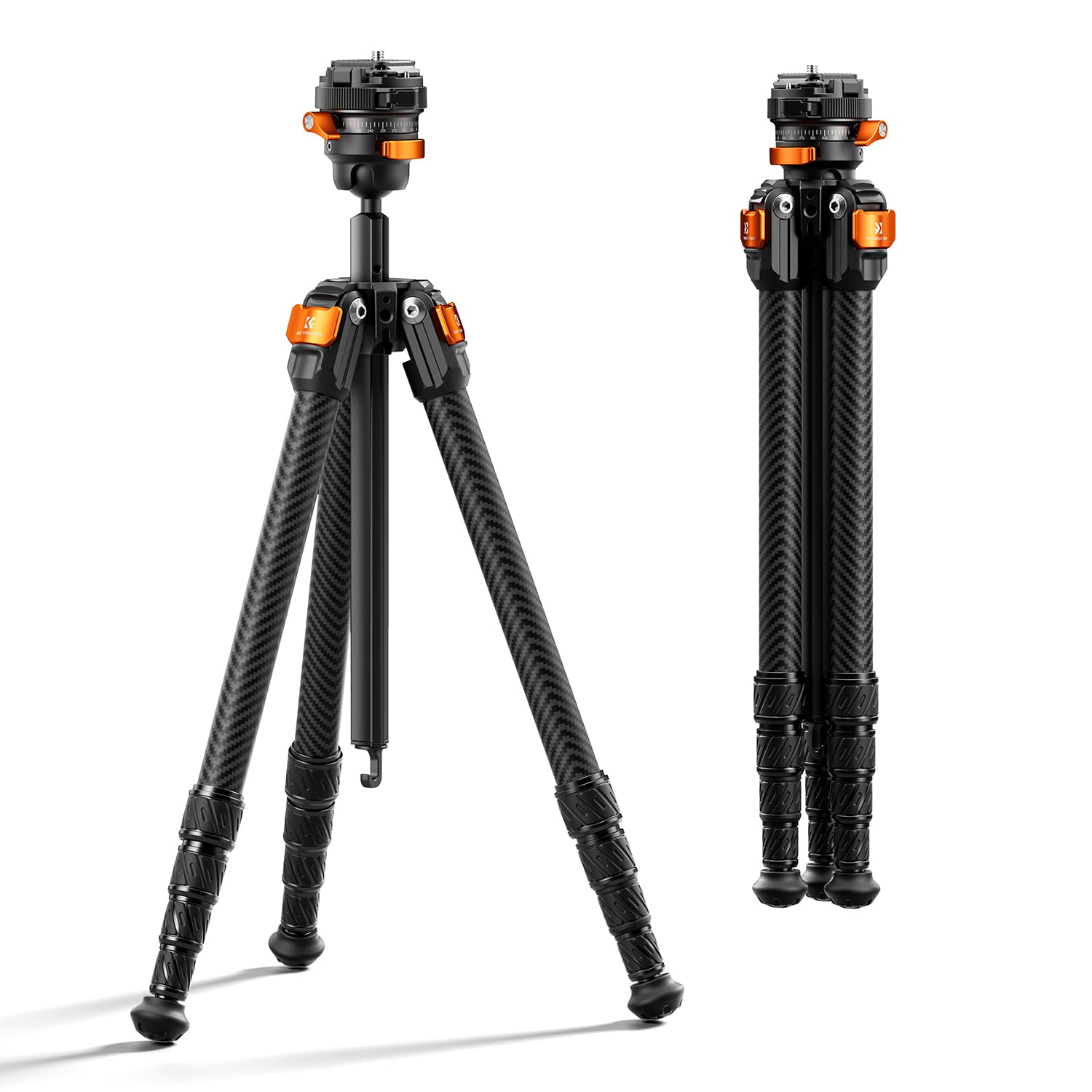
At 2.0 pounds, this is the tripod for the trip where every ounce gets argued over. The carbon legs fold to 16.5 inches and the whole package is small enough to live in a daypack, which is the difference between carrying a tripod and leaving it at home.

The 60-inch top height is tall enough for most standing shots, and the 13.2-pound load rating covers a mirrorless body with a standard zoom. We like the flexible center axis for low angles, the Arca-compatible quick release, and the built-in hook for hanging a backpack as ballast. The rubber feet switch to metal spikes for soft ground, a detail that matters on wet hikes.

The screw locks are the part we watch. They need a firm twist to stay put, and the 13.2-pound ceiling is not the place for a full-frame body with a long telephoto. The 16.5-inch fold is a half-inch longer than the top pick, but it saves more than half a pound.

Pros

  • Weighs 2.0 pounds
  • Folds to 16.5 inches
  • Arca-compatible quick release and invertible column

Cons

  • Screw locks need firm tightening
  • 13.2-pound limit rules out long telephotos
Our verdict

The ultralight carbon choice for mirrorless hikers: 2 pounds, a 60-inch top height, and enough capacity for a standard zoom kit.

Check Latest Price
5

Best Budget Full-Size

Neewer Basics TP12

92 /100
LBD Score Outstanding

Key details

Head
40 mm ball head
Weight
2.9 lb / 1.33 kg
Max Height
66.5 in / 169 cm
Load Capacity
11 lb / 5 kg
View on Amazon

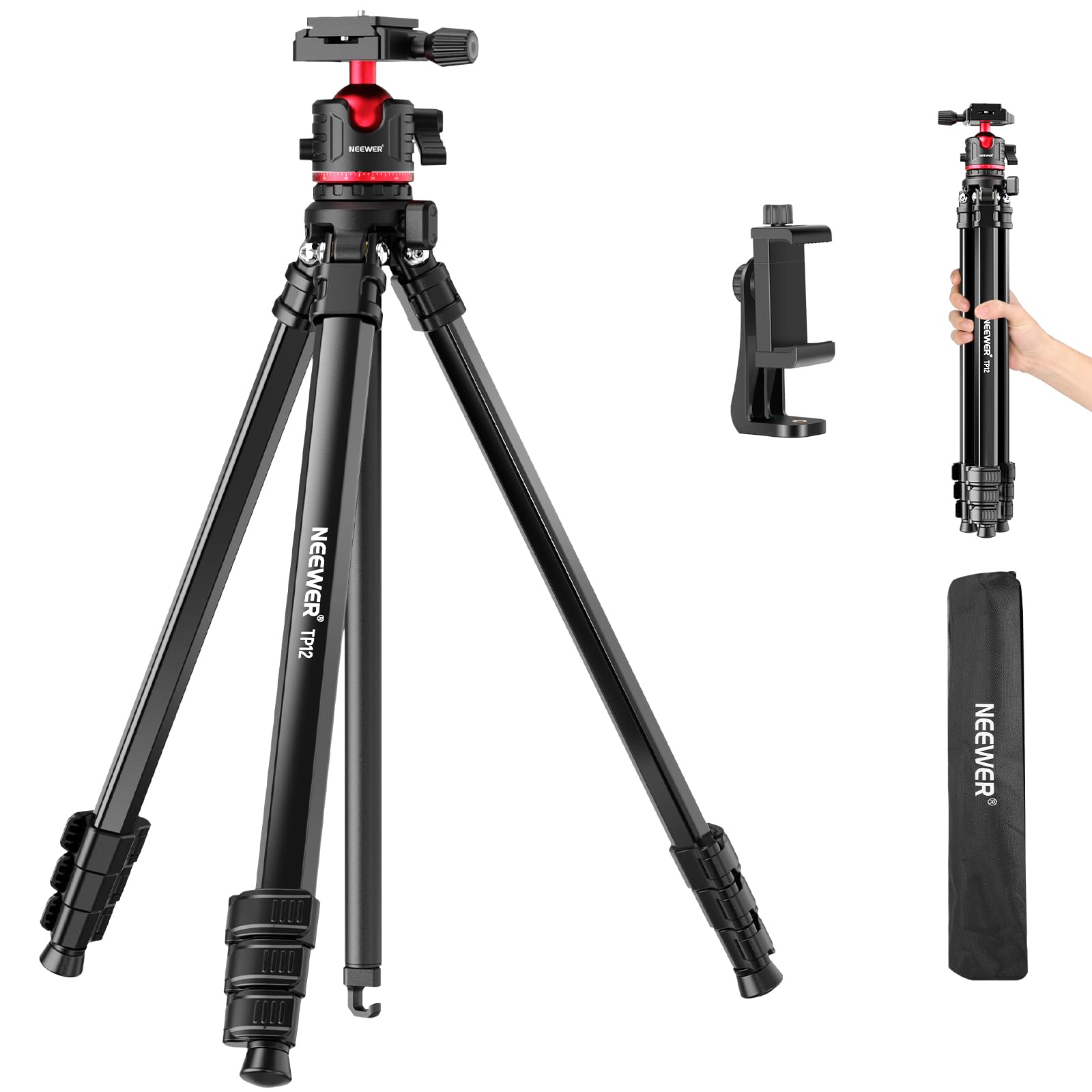
The TP12 is what we hand someone who wants a full-size travel tripod without paying for carbon. It reaches 66.5 inches, packs down for travel, and weighs 2.9 pounds, so it covers the basic travel job without making a production of it.

The 11-pound load rating is the honest limit. A mirrorless body and a compact zoom sit comfortably; a full-frame camera with a 70-200 is near the ceiling, and we prefer more headroom for that kit. The 40 mm ball head has an Arca-type plate and a panning base, and the included phone holder makes it a practical one-tripod solution for stills and phone video.

We like the height adjustment and the leg-angle locks for uneven ground, but the ball head can creep when you tighten it down hard. Check that the plate screw is snug before you walk away. It sits between the XXZU's tall, remote-ready package and the K&F Concept's more polished ball head.

Pros

  • Reaches 66.5 inches
  • 2.9 pounds with 11-pound capacity
  • Arca-type ball head and phone holder

Cons

  • Ball head can creep under load
  • 11-pound limit is tight for heavy rigs
Our verdict

A budget full-size travel tripod for a mirrorless kit and phone work; it reaches 66.5 inches without the carbon-fiber cost.

Check Latest Price
6

Best for Solo Video

XXZU 75-inch Tripod

93 /100
LBD Score Outstanding

Key details

Weight
2.18 lb
Max Height
75 in
Folded Size
14.37 in / 36.5 cm
Load Capacity
17.64 lb / 8 kg
View on Amazon

The remote is the detail that makes the XXZU more than another cheap tall tripod. It pairs with your phone for solo video, and the detachable center column turns into a monopod or selfie stick when you need to move fast. That combination is why it earns a place for travel content rather than serious landscape work.

At 75 inches, it is the tallest tripod here by a wide margin, yet it weighs just 991 grams and folds to 14.37 inches. The three-section legs set up quickly, and the 360-degree ball head handles horizontal and vertical framing. The 17.64-pound load rating is generous for a tripod this light, though we treat that as a fair-weather figure at full height.

The trade-off is stiffness. A tall, sub-kilogram tripod has less margin in wind, and the three-section legs are not as rigid as a four- or five-section carbon design. Keep the center column low when you can, and use the remote rather than tapping the camera. Compared with the Neewer TP12, it trades some load capacity for a much taller top height and a remote.

Pros

  • 75-inch top height
  • Weighs 991 grams
  • Bluetooth remote and detachable monopod

Cons

  • Full-height stiffness is the weak point
Our verdict

A tall, light budget tripod with a remote and phone holder; it is built for solo video and travel content, not heavy camera rigs.

Check Latest Price
7

Heavy Camera Rigs

SmallRig CT-10

88 /100
LBD Score Excellent

Key details

Weight
3.4 lb / 1,530 g
Max Height
71 in / 180 cm
Folded Size
16.9 in / 43 cm
Load Capacity
33 lb
View on Amazon

A 33-pound load rating is the reason to look at the SmallRig CT-10. That is more capacity than most travel tripods here, and it is the one we consider when the kit includes a heavy DSLR, a telephoto zoom, or a small video rig. The 2-in-1 monopod conversion is a useful extra when you need to follow action rather than lock off a shot.

The aluminum build reaches 71 inches and folds to 16.9 inches, so it is a travel tripod in packed length rather than in featherweight feel. The 36 mm ball head pans smoothly, and the legs have three angle positions for low or uneven ground. Tall shooters will appreciate the height, and the 33-pound rating gives more margin than the K&F or Neewer picks.

The 3.4-pound weight is the first trade-off. It is fine strapped to a pack for a short hike, less pleasant on a long one. The leg locks are the second: they need a firm set, and the ball head can shift if you do not clamp it down. That is a real annoyance on a tripod meant for heavier gear, so we treat it as a support for controlled setups rather than quick run-and-gun work.

The 33-pound rating is the reason it stays in the conversation; the K&F Concept and Peak Design are easier to live with every day.

Pros

  • 33-pound load capacity
  • Converts to a monopod
  • Reaches 71 inches

Cons

  • Leg locks need firm setting
  • 3.4 pounds is heavy for long hikes
Our verdict

A high-capacity travel tripod for heavier camera rigs; its 33-pound rating and monopod mode make it a useful support for controlled setups.

Check Latest Price
8

Light Camera Kits

Amazon Basics 50-inch Tripod

91 /100
LBD Score Outstanding

Key details

Weight
1.23 lb / 640 g
Max Height
50 in / 127 cm
Folded Size
16.9 in
Load Capacity
4.4 lb
View on Amazon

The Amazon Basics 50-inch is the tripod we mention when the camera is light and the budget is tight. It weighs 1.23 pounds, folds to about 16.9 inches, and has a three-way head with a quick-release plate, so it covers the basics of travel photography without pretending to be a pro support.

The catch is capacity. The 4.4-pound load rating is fine for a small mirrorless camera or a point-and-shoot, but it is not the tripod for a full-frame DSLR with a zoom. The 50-inch top height is also low for eye-level shooting; tall photographers will crouch.

We like the bubble level and the simple leg locks for casual use. The three-way head pans more naturally than a cheap ball head, which makes it a decent choice for video on a phone or compact camera. In wind, keep a hand on the camera and keep the center column down.

For a first tripod, a travel companion for a compact camera, or a backup that lives in the car, it does the job. The quick-release plate is the one accessory to keep track of; it is small enough to lose in a camera bag.

Pros

  • Weighs 1.23 pounds
  • Folds to about 16.9 inches
  • Three-way head with quick-release plate

Cons

  • 4.4-pound limit rules out most DSLR kits
  • 50-inch top height is low for eye-level shots
Our verdict

A light, low-cost tripod for compact cameras and casual travel; it is not built for a full-frame DSLR or tall shooters.

Check Latest Price

How We Tested the Best Travel Tripods

We started by pulling every model we could find that had a real ball head, an Arca-compatible plate, and a folded length short enough to ride in a carry-on, then cut anything with a plastic head, a fixed center column, or a load rating that looked invented. That left 12 tripods, which we tested over six months.

Each one went into a carry-on and a daypack and came out wherever we were shooting: a windy overlook at sunrise, a footbridge that shuddered whenever someone walked past, a rocky trail with uneven ground. We timed setup and takedown solo — once in daylight, once in the dark with a camera already mounted — and ran every leg from its lowest splay to full height to see how the adjustability held up in practice. Each tripod was carried for a full day to see where it dug into a shoulder.

On location we shot long exposures and watched for drift, tapping the head and then a leg to see how much the frame moved and whether the ball head crept after we locked it down. We splayed the legs independently on uneven ground and checked that each lock held its angle under weight, then loosened and tightened every clamp a few dozen times. Plates got swapped between a camera and a phone mount, and where a tripod converts to a monopod we timed the changeover. At the end, we looked for scratches, joint play, and anything that had stopped feeling tight — which is usually where value shows itself.

How to Choose a Travel Tripod

Packed Size and Weight Come First

Folded length is the number that decides whether a tripod goes in your carry-on or stays home. For most travelers, 14 to 17 inches is the practical range; the K&F Concept 64-inch and Peak Design both land there, while a 20-inch tripod can be a struggle in a small daypack. Check the packed diameter too, especially if you use a side pocket.

Weight matters just as much, but the trade-off is not linear. A 2-pound carbon tripod is a joy on a long hike; a 3.4-pound aluminum one adds stability and capacity. We prefer a slightly heavier tripod that holds the camera still to saving a few ounces and fighting wobble all day.

Match Height and Capacity to Your Camera

Height is a comfort spec until it is not: a 50-inch tripod forces tall shooters to crouch, while a 64- to 71-inch model lets most people frame at eye level. If you shoot low angles, look for an invertible or detachable center column. The K&F Concept A225C2 and Neewer LT32 both offer flexible column options.

Capacity is not just about the camera body. A 13-pound rating may cover a mirrorless body and standard zoom but not a full-frame camera with a long telephoto. Leave headroom: if your loaded kit is close to the limit, choose a tripod rated higher than you think you need.

Stability Is More Than a Load Rating

Three-section legs are quick and stiff; four or five sections pack smaller but add joints that can flex. A center column helps height, but raising it puts the camera on a mast. In wind, lower the column, hang a bag from the hook if the tripod has one, and avoid the top extension unless you need it.

Leg locks matter as much as leg count. Flip locks are fast with cold hands; twist locks are compact but need a firm set. Whichever you choose, check that every lock is tight before you walk away from the camera. The most stable setups here tend to pair a modest center-column extension with a weight rating well above the actual kit.

Choose the Head for How You Shoot

A ball head is compact and fast for stills; a three-way head is easier to pan smoothly for video. Arca-Swiss compatibility is worth having if you already use plates or capture clips, and a leveling base saves time on horizons. The Neewer LT32 is the clearest example of a travel tripod built around leveling; the Peak Design's single-ring head is the fastest to operate.

Phone holders and remotes are useful for solo video, but they add parts to check. If you shoot both camera and phone, a model with a standard 1/4-inch screw and an included holder, like the XXZU, saves you from carrying a separate mount.

Frequently Asked Questions

Final Verdict

We recommend the K&F Concept 64-inch for most travelers: it packs short, reaches eye level, and carries a mirrorless or DSLR kit without the premium markup. If you want the fastest setup and the most polished design, the Peak Design is worth the step up.
If every ounce counts, the K&F Concept A225C2 is the carbon alternative, as long as your kit stays within its 13.2-pound limit.