Best Tripod Heads of 2026

A tripod head is the part of the setup you only notice when it fails. A heavy lens settles a degree or two while you wait for the light, the pan handle drifts during a slow zoom, and suddenly you're re-framing every thirty seconds. The fix usually isn't a beefier tripod — it's a head whose locks actually hold, whose movement stays smooth under load, and whose quick-release plate fits the camera you already own.

Spend time with a dozen of these and you learn that no single design wins: ball heads frame fast but fight you on video, fluid heads pan beautifully but add bulk, geared heads are surgical and slow. My team and I spent the past six months mounting 12 heads on tripods, monopods, and sliders — in the studio, in the backyard after dark, and on a few long walks — checking how each one adjusted, locked, and held. The picks below are the ones that earned a permanent spot in the bag: the light ones for travel, the precise ones for the studio, and the ones that simply felt like more money than they cost.

1

Best Overall

NEEWER 360 Ball Head

92 /100
LBD Score Outstanding

Key details

Type
Ball head
Weight
15.5 oz
Load Capacity
17.6 lb (8 kg)
Quick Release
1/4 in Arca-type plate
View on Amazon

The 17.6-pound load rating is the number that earns this NEEWER a place on the shortlist: it covers a full-frame body with a midrange zoom, and the all-metal body and Arca-type plate keep it familiar to anyone who already uses a quick-release system. The three-knob layout is simple enough to learn in an afternoon, and the dual bubble levels help reset a horizon without swapping gear.

We think it is the best all-around ball head in this set because it does the basic job without fuss: the pan base has a scale, the clamp takes a standard plate, and the ball moves smoothly enough for stills. The 8 kg ceiling leaves headroom for a battery grip and a 70-200, but not a supertelephoto. The main lock is the part to watch. It can let the ball shift slightly as you tighten it, so the camera needs support until the knob is fully down.

For video, it pans, but it is not a fluid head: there is no long handle or true drag, so a slow pan takes more care. We kept it for stills and for panoramas, where the index marks on the base do more for us than a handle. If you shoot moving subjects, the GM27 is the better tool.

Pros

  • 17.6 lb capacity covers full-frame kits
  • All-metal Arca-type ball head
  • Dual bubble levels and scaled pan base
  • Three knobs are simple to learn

Cons

  • 439 g adds weight to a travel kit
Our verdict

We recommend it as the default ball head for stills shooters who want Arca compatibility, an 8 kg ceiling, and a low-cost entry into a solid metal head.
Check Latest Price
2

Best for Precision Work

K&F Concept GD-3W PRO

85 /100
LBD Score Excellent

Key details

Type
3-way geared
Weight
1,135 g
Adjustment
0.1° micro-adjust
Load Capacity
13.2 lb (6 kg)
View on Amazon

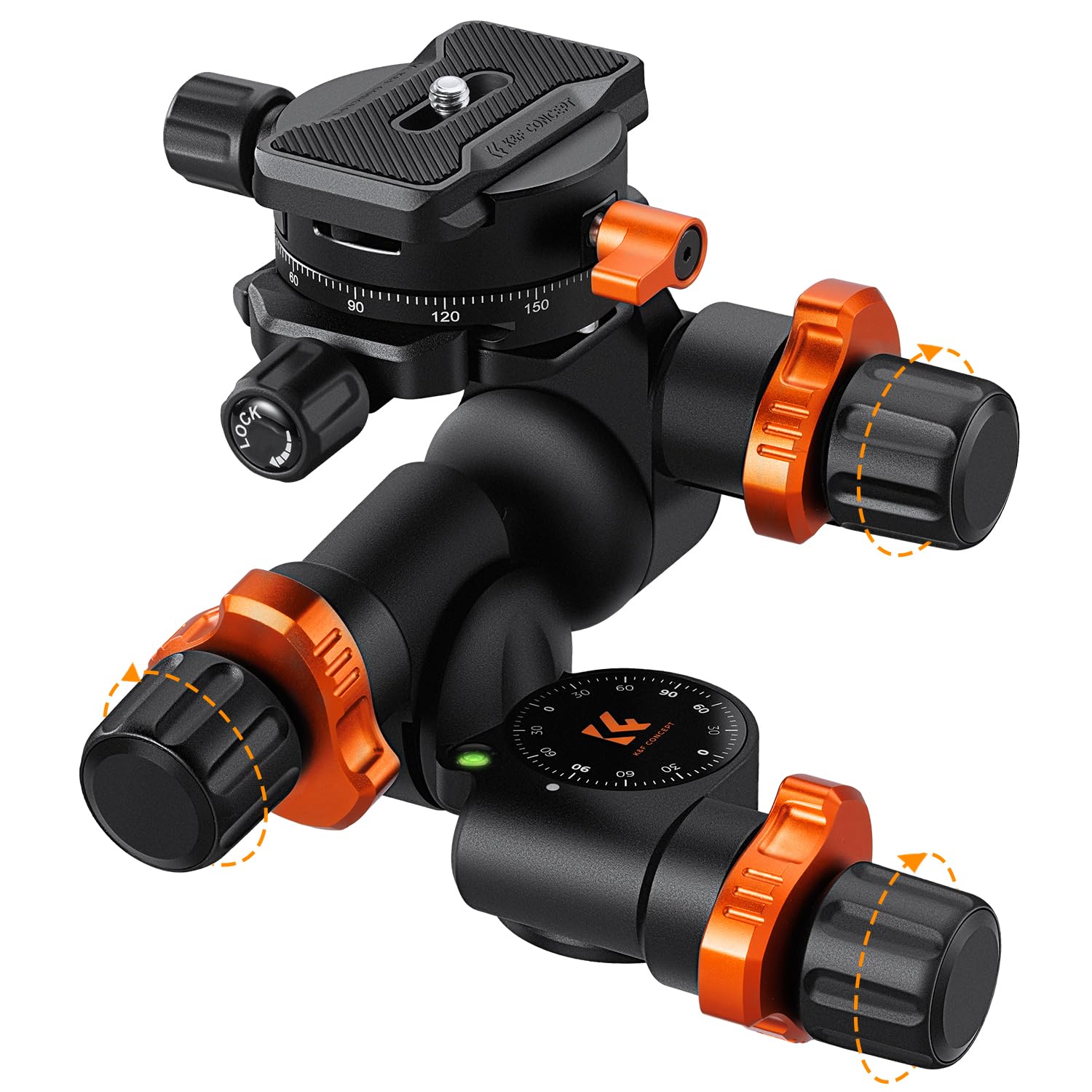
The 0.1-degree micro-adjustment is the reason this K&F costs more than a ball head. The three geared axes move in coarse and fine steps, and the four bubble levels and angle scales give you repeatable reference points for architecture, macro, and astro work. The coarse knobs get you close; the fine knobs do the last fraction.

The body is aluminum with hardened steel gears, and it carries up to 6 kg. The dual 360-degree panoramic design lets you rotate the base and the clamp independently, which is useful when you stitch a room or a skyline. The quick-release clamp takes Arca-Swiss plates, so it fits a kit that already uses that system. A 6 kg ceiling is enough for a DSLR and a tilt-shift lens, but not a supertelephoto.

We think it is the precision pick in this group because it turns framing into a series of small, repeatable adjustments instead of one hopeful clamp. It is slower than a ball head for a moving subject, and that is the trade: speed for control. The four bubble levels are the detail we did not expect to use as often as the knobs.

Pros

  • 0.1° geared micro-adjustment
  • Four bubble levels for alignment
  • Dual 360° panoramic scales
  • 6 kg capacity with metal build

Cons

  • 1,135 g is heavy for travel
  • Geared knobs can be stiff to turn
Our verdict

We recommend it for architecture, macro, and astro shooters who need repeatable fine framing and can accept a slower, heavier setup.

Check Latest Price
3

Best Compact Video Head

NEEWER GM27 Fluid Head

86 /100
LBD Score Excellent

Key details

Type
Fluid head
Weight
13.1 oz
Leveling
±10° base
Load Capacity
8.8 lb (4 kg)
View on Amazon

The plus-or-minus 10-degree leveling base is the feature that separates the GM27 from the other small fluid heads here. We think it is the best compact video head in this group for run-and-gun setups because you can fix a horizon without unclamping the camera and starting over.

The head pans 360 degrees and tilts from -55 to 90 degrees with fixed friction damping. The two-section handle extends from 5.7 to 9.5 inches, and the 37 mm base and 370 g body keep it easy to pack. The Arca-type plate is standard, so it works with the same plates as many stills heads. The scaled pan base gives you a reference point for repeatable moves. It is a compact head, so check that your tripod's platform is wide enough to support the 37 mm base.

The 8.8 lb capacity is enough for a mirrorless body and a compact zoom, not a fully rigged cinema camera. We like the leveling base most when moving between setups: one twist gets you close, and the bubble finishes the job. The quick-release is a little fiddly to seat, so keep a hand on the camera until it clicks. For a travel tripod and a small camera, that is a useful trade.

Pros

  • Integrated ±10° leveling base
  • 360° pan and -55° to 90° tilt
  • 370 g with a telescopic handle
  • Arca-type quick-release plate

Cons

  • No adjustable drag for repeatable pans
Our verdict

We recommend this compact fluid head for video shooters who want a leveling base without carrying a full-size tripod head.

Check Latest Price
4

Best for Long Lenses

K&F Concept Gimbal Head

88 /100
LBD Score Excellent

Key details

Type
Gimbal head
Weight
3.2 lb
Rotation
360° pan and vertical arm
Load Capacity
44 lb (20 kg)
View on Amazon

A 44-pound load rating on a 3.2-pound gimbal is the headline, but the useful part is how the K&F balances a long lens: the vertical arm and rotating base let you put the center of gravity over the pivot instead of fighting a ball head. The sealing is meant to keep the grease where it belongs, which matters if you shoot in dust or salt air.

The 6061 aluminum body uses sealed bearings and a calibrated scale on the arm. The pan base rotates 360 degrees, and the lens platform moves horizontally and vertically. For a 600mm lens, that combination is what makes a heavy rig feel like it floats. The load rating is a ceiling, not a target; a 600mm f/4 with a pro body is the kind of rig this head is built for.

We think it is the long-lens pick in this set because it turns a telephoto setup into something you can pan with your fingertips. It needs careful balancing before you trust it hands-off, and that setup time is the cost of the stability. We appreciate the scale on the arm most when swapping a teleconverter, because you can return to a balanced position without starting over.

Pros

  • 44 lb load capacity
  • Smooth 360° pan and vertical arm
  • Calibrated scale for repeatable balance
  • Sealed bearing design

Cons

  • 3.2 lb is heavy for travel
Our verdict

We recommend this gimbal for wildlife and sports shooters balancing long telephoto lenses who want smooth movement without a flagship price.

Check Latest Price
5

Best Ultralight Fluid Head

SmallRig CH3

89 /100
LBD Score Excellent

Key details

Type
Fluid head
Weight
9.56 oz
Tilt Range
+90°/-70°
Load Capacity
6.6 lb (3 kg)
View on Amazon

At 271 g, the CH3 is the head we reach for when the tripod bag is already full. It is a fluid head that weighs less than many ball heads, but it still pans 360 degrees and tilts from +90 to -70 degrees. The head is 75 mm tall, with a 44 mm base, so it sits low on a travel tripod and does not add a long lever arm.

We think it is the best ultralight video head here for travel because the pan is smooth enough for a slow reveal and the handle can move to either side. The 3 kg capacity suits a mirrorless body and a compact lens, not a heavy rig. The spring action that returns the camera toward level is the detail that makes it feel more expensive than it is. The fixed damping is predictable, and the removable handle stows easily. We also like that the plate can be mounted from either direction, which helps with a cage or an L-bracket.

For a phone or a compact camera, the CH3 is more head than you need; for a mirrorless body with a kit zoom, it is about right. The Arca-Swiss plate is the same style many stills shooters already use, so you can keep one plate on the camera.

Pros

  • 271 g ultralight build
  • Smooth panning for its size
  • Arca-Swiss quick-release plate
  • Handle mounts on either side

Cons

  • Tilt tension can be hard to set
Our verdict

We recommend this ultralight fluid head for travel shooters who need smooth pans from a small tripod or monopod.

Check Latest Price
6

Best Budget Video Head

Avella V502

84 /100
LBD Score Excellent

Key details

Type
Fluid head
Height
2.75 in
Weight
0.55 lb (250 g)
Load Capacity
6.6 lb (3 kg)
View on Amazon

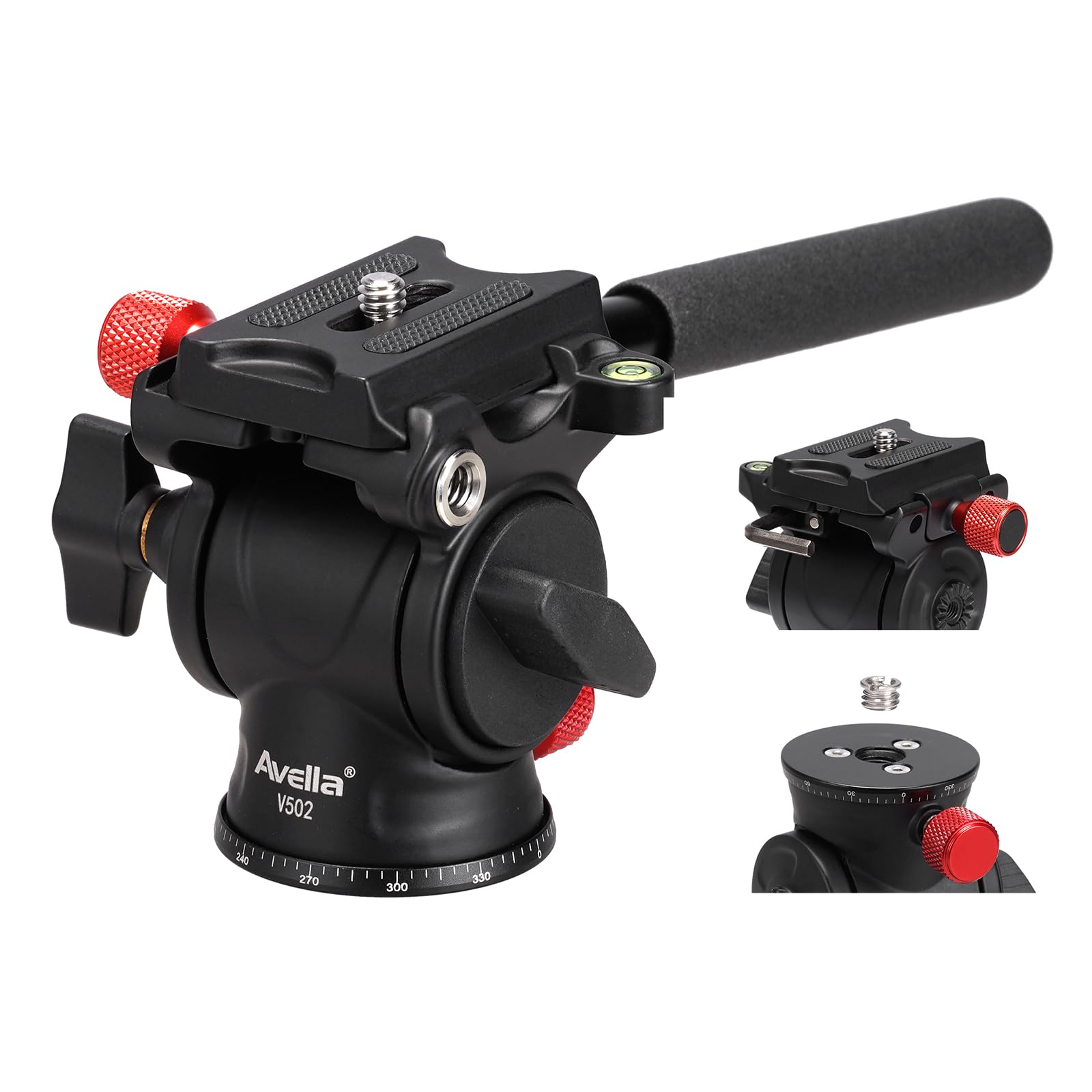
The V502 is only 2.75 inches tall, so it adds almost nothing to a compact tripod. We think it is the budget video pick in this group because it gives you a fluid pan, a tilting plate, and an Arca-type clamp without asking you to rebuild your kit. It is the kind of head you keep on a second tripod for casual video so you do not have to swap your stills setup. The 45 mm base is sized for small tripods.

The head weighs 0.25 kg, pans 360 degrees, and tilts from -45 to 90 degrees with fixed friction damping. The handle is detachable and magnetic, so it stows against the body instead of swinging loose in a bag. The Arca-type plate is easy to swap between cameras. We like the magnetic handle more than we expected: it stays with the head and does not rattle around in the bag. The pan and tilt locks are separate, so you can level the horizon and then lock the tilt without moving the pan. A two-year warranty is a nice reassurance for a budget head. For a phone or a small mirrorless camera, that is enough.

Pros

  • Only 0.55 lb (250 g)
  • 2.75 in tall, packs small
  • Reversible magnetic handle
  • Arca-type quick-release plate

Cons

  • 6.6 lb capacity limits heavier rigs
  • Fixed damping offers no drag adjustment
Our verdict

We recommend this budget fluid head for casual video and small cameras where low weight matters more than heavy-lens support.

Check Latest Price
7

Heavy Camera Rigs

ARTCISE NB46F-LS

81 /100
LBD Score Excellent

Key details

Type
Low-profile ball
Weight
14.4 oz
Load Capacity
55 lb
Quick Release
Arca Swiss lever clamp
View on Amazon

A 55-pound load rating is more than most stills photographers will ever need, but the ARTCISE earns its place for the rigs that do. The 46 mm ball sits in a low-profile body with the locking structure moved to the side, which drops the center of gravity by 15 percent compared with a conventional ball head.

The body is CNC-machined aluminum with an anodized finish, and the clamp uses a lever release instead of a screw knob. That lever makes it quicker to slide a camera in and out, and the 46 mm ball gives you a broad surface to lock against.

The head weighs 14.4 ounces and has a 3/8-inch bottom thread, so it fits standard tripods and monopods. The 55-pound ceiling is the reason to choose it over the NEEWER ball head if you shoot a heavy body with a long lens or a video rig that needs a rock-solid lock.

We think it is the heavy-duty ball head to choose when the camera is the heaviest thing in the bag and you want a fast clamp. The safety lock on the plate is the detail we appreciate most: it gives the lever a second line of defense when you carry the tripod over your shoulder. For a light travel kit, it is more head than you need.

Pros

  • 55 lb load capacity
  • Low-profile locking structure
  • Lever-release Arca clamp
  • CNC-machined aluminum body

Cons

  • Larger body than a travel ball head
Our verdict

We recommend this low-profile ball head for heavy camera rigs that need a high load ceiling and a fast lever clamp.

Check Latest Price
8

Compact Accessory Rigs

ULANZI H28

92 /100
LBD Score Outstanding

Key details

Type
Mini ball head
Mounts
1/4 in screw and dual hot shoe
Weight
3.53 oz
Load Capacity
5.5 lb (3 kg)
View on Amazon

The dual hot shoe mount is what makes the H28 more than another tiny ball head. It gives you a place to hang a microphone, a light, or a monitor on top of the camera while the 1/4-inch screw holds the head to a tripod, clamp, or cage.

The head is 100 g and 2.44 inches wide, with a 3 kg load rating. The ball rotates 360 degrees and the base pans for panoramic shots, and the aluminum and stainless steel body is made to resist corrosion and knocks.

The knob locks the ball and the pan separately, so you can set the angle and then rotate the whole rig without losing it. The 2.44-inch width keeps it out of the way on a small camera, and the 1/4-inch screw is standard for a cage or clamp.

We think it is the best accessory-rig pick here because it solves the small-camera problem without a cage: the hot shoe and the 1/4-inch screw cover both ends of the mount. It is not a replacement for a full-size head on a heavy camera, but for a phone, action cam, or compact mirrorless setup, it is the one we keep in the bag. The rubber pad is the detail we did not expect to care about, but it keeps a camera body from sliding.

Pros

  • Dual hot shoe mount
  • 100 g and 2.44 in wide
  • 1/4 in screw plus 360° pan
  • Aluminum and stainless build

Cons

  • Ball can loosen over time
Our verdict

We recommend this mini ball head for compact camera, phone, and accessory rigs that need a hot shoe and a 1/4-inch mount in one small piece.

Check Latest Price

How We Tested 12 Tripod Heads in the Studio and the Field

We started with a shortlist of about 40 heads, then filtered hard: current listings only, load ratings that could plausibly hold a camera and lens, removable quick-release plates, and prices that made sense next to the tripod most people would mount them on. Proprietary plates got cut early — an Arca-type plate you can swap between heads, cages, and clamps is worth more than any single spec. That left 12 heads, which we bought ourselves and used for six months.

Testing happened where these things actually live. In the studio they carried a full-frame body with a 70–200mm through portrait and product sessions; outdoors one went on a monopod at a soccer game and a couple went on tripods for backyard star trails; three came along on hikes and got packed and unpacked a dozen times to see how the weight and the knobs held up after a mile. We framed a target on a wall, locked everything down, and checked two hours later for creep — the slow droop that ruins a timelapse. We also panned across a horizon line at 200mm and watched for stutter and for lash at the start of the move.

Adjustability got timed rather than judged: how many turns from locked to loose, how long a plate swap took in cold hands, whether the pan scale and bubble level were usable or just decoration. Every level got checked against a machined reference square, and two were off enough to ignore. Each head went on a kitchen scale and then into a daypack, since one that's heavier than advertised is one you leave at home. Fit mattered too — plates that snag on a cage, handles that block a port, knobs crammed so close to the pan lock you can't turn one without the other.

Six months in, all 12 are still in rotation; we'll update if a lock loosens or a plate stops seating.

How to Choose a Tripod Head

Match the movement to the subject

For general stills, we start with a ball head: one knob frees the camera, and the whole thing packs small. A fluid head earns its place when you shoot video, because the drag and handle make a slow pan look deliberate. Geared heads trade speed for repeatable fine adjustment, which is why they suit architecture, macro, and astro work. A gimbal is the specialist for a long telephoto lens, where balance matters more than a small packed size. If you only need to angle a phone or a light, a mini ball head with a hot shoe can do the job.

Read load capacity as a ceiling

Load ratings include the camera, lens, plate, cage, monitor, and anything else hanging off the head. Running at the maximum leaves no margin for a heavy lens or a sudden knock, so add up your kit and leave some headroom. The NEEWER ball head's 8 kg rating covers a full-frame body and a midrange zoom; the K&F gimbal's 20 kg rating is about balancing a long lens, not just holding it. A compact fluid head with a 3 kg rating is a small-camera tool, even if the number sounds generous.

Check the plate and the base thread

Most heads here use an Arca-type clamp, but Arca-type is not a promise that every plate fits. Test your plate before a shoot, and give the clamp a tug before you let go of the camera. The base thread matters too: 3/8 inch is the common tripod fitting, while some compact heads use 1/4 inch. If you switch between a tripod and a monopod, keep the matching plate on the camera and check that the head sits flat on both.

Decide how much control you need

Fixed friction damping is fine for casual video, but adjustable drag lets you repeat a pan speed. A scaled pan base and a bubble level are worth more than an extra knob if you shoot panoramas or architecture. Geared heads add coarse and fine controls for framing that has to be exact, while a ball head's single lock is faster for stills. We care most about a clamp that holds, a pan base that moves smoothly, and a level you can see without crouching.

Balance weight against stability

A light head is easier to carry, but it can feel nervous with a long lens or a tall camera. Low-profile ball heads lower the center of gravity, and a wider base spreads the load on a small tripod. Check the base diameter against your tripod's platform, and make sure the handle does not foul the camera when you tilt. For travel, a 271 to 370 g fluid head is a reasonable compromise; for a heavy studio rig, the extra weight of a 46 mm ball head or a gimbal is doing real work.

Frequently Asked Questions

Final Verdict

For most people, the NEEWER 360 Ball Head is the one to buy: it covers a full-frame body and a midrange zoom, accepts Arca-type plates, and keeps the cost low enough to leave room for a decent tripod. If your work is long-lens wildlife, the K&F gimbal is the better tool; if you need repeatable architectural alignment, the K&F GD-3W PRO earns its extra weight and cost.