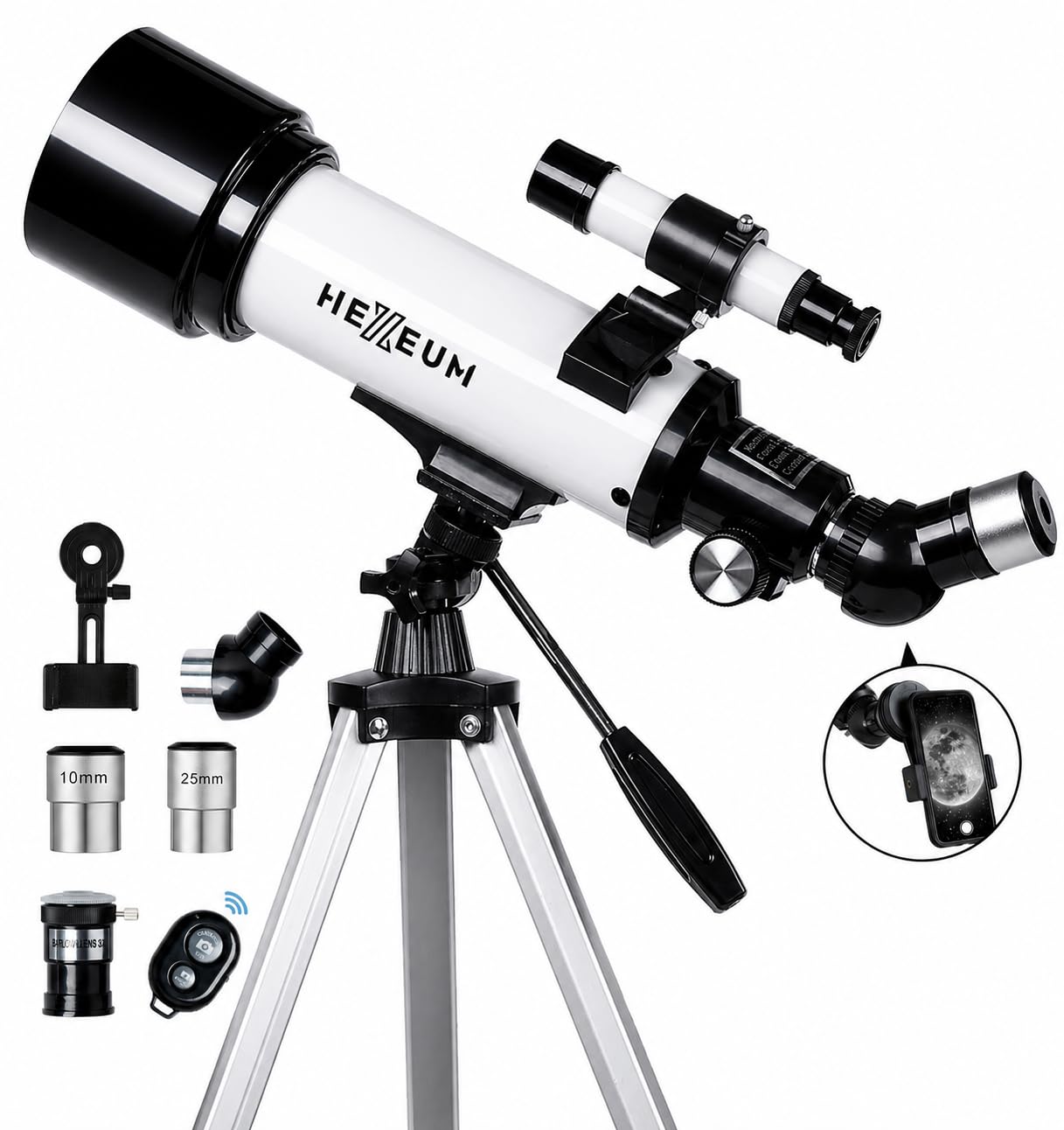
Best Telescopes Under $500 of 2026

A telescope can turn a clear night into a scavenger hunt if the mount wobbles, the finder is off, or the eyepiece won't focus. The right one under $500 gets you from carry bag to first look without a fight, then holds a sharp image long enough to enjoy it. That mix of clear optics, steady support, and beginner-friendly setup is what separates a scope you'll use from one that ends up in the closet.

Over eight months, my team and I tested 10 telescopes in backyards, driveways, and a nearby park, setting each up solo, aligning the finder, and passing the eyepiece to friends who had never used one before. The keepers focused cleanly, stayed steady when we bumped the tripod, made setup feel obvious, and felt worth the money. One thing I wish every first-time buyer knew: aperture matters more than the magnification on the box—a steady 70mm or 80mm scope will show more than a shaky 90mm one. The picks below got that balance right for beginners and families without asking you to spend like an astronomer.

1

Best Overall

MEEZAA 90800 Refractor

85 /100
LBD Score Excellent

Key details

Mount
Altazimuth
Aperture
90mm
Eyepieces
10mm and 25mm
Focal Length
800mm (f/8.9)
View on Amazon

An 800mm focal length behind a 90mm lens works out to f/8.9, and that long, slow ratio is the reason this telescope tops our list. Slow refractors are kind to modest eyepieces: the Moon's limb stays clean instead of fringing purple, and Jupiter's two darkest belts hold together at powers where a short f/5 tube smears into a blur. The 25mm and 10mm Kellners plus a 3x Barlow spread from 32x to 240x on paper, though the lower half of that spread is where the image earns its keep.

That steadiness is what we keep coming back to. The stainless tripod extends from roughly 28 to 46 inches, so an adult can stand or sit, and the accessory tray bolts across the legs and braces the whole assembly — a small design choice that does more for the view than any eyepiece upgrade. Setup ran about ten minutes the first time and less after that, and the carry bag takes the tube, mount, and eyepieces together.

The mount is manual altazimuth, so nothing tracks: at 90x the Moon drifts out of the field every minute or so and you nudge it back. We didn't mind, because the slow-motion rod makes the correction smooth, but it is the rhythm you're signing up for. And the 3x Barlow is the piece we left in the box — stacking it on the 10mm asks more of the sky than most nights give.

Where it earns its place is the Moon and the bright planets: crater walls and long shadows along the terminator, Saturn's rings separated cleanly from the disk, four Galilean moons strung out in a line. Deep-sky hunting works from a dark site, but 90mm is a modest net for galaxies. For the class and the money, this is the most planted first telescope of the group.

Pros

  • Long f/8.9 tube keeps high-power views clean
  • Stainless tripod and braced tray damp vibration
  • 90mm aperture shows lunar detail and Saturn's rings
  • Carry bag holds tube, mount, and eyepieces

Cons

  • The 240x claim needs an unusually steady night
  • Straight-through finder is awkward aimed overhead
Our verdict

We recommend this one to most first-time buyers: a long 90mm tube on a steel tripod gives the steadiest, sharpest view here of the Moon and planets.

Check Latest Price
2

Best Budget

Gskyer AZ 70400

88 /100
LBD Score Excellent

Key details

Mount
Altazimuth
Weight
5.7 lb
Aperture
70mm
Focal Length
400mm (f/5.7)
View on Amazon

The Gskyer is working almost as soon as it's out of the bag: a few thumbscrews, a finder to bolt on, and a tube light enough to lift one-handed. That speed is the whole case for it. A first telescope that sits in pieces until someone has a free afternoon is a telescope that doesn't get used, and this one asks almost nothing of you before it shows you the Moon.

Seventy millimeters at f/5.7 makes a short, wide tube, and that is a real advantage on the first night: the 25mm eyepiece gives a generous field, so finding the Moon is easy and finding it again after a bump is easier. Crank to the 10mm and the image still holds up on the Moon and Jupiter; add the 3x Barlow on top and it goes dim and soft. The phone adapter and wireless remote are worth more than they sound — the remote fires the shutter without your finger touching the phone, so the shot doesn't smear.

The aluminum tripod is the compromise. It's light because it's thin, and a light tripod shivers in a breeze and takes a second to settle after you focus. We kept the magnification moderate and stopped noticing. As a gift for a kid, or a scope that lives in the car for camping trips, that trade is the right one.

Pros

  • Assembles in minutes without a learning curve
  • 5.7 pounds with a bag for one-hand carrying
  • Wide field makes targets easy to find
  • Wireless remote keeps phone shots sharp

Cons

  • Thin aluminum tripod shivers in a breeze
  • 70mm runs out of light on faint nebulae
Our verdict

We hand this to anyone who wants a working telescope the evening the box arrives; nothing here goes from bag to first look faster.

Check Latest Price
3

Best Value

Dianfan 90800 Refractor

85 /100
LBD Score Excellent

Key details

Mount
Altazimuth
Weight
10.4 lb
Aperture
90mm
Focal Length
800mm
View on Amazon

Same aperture, same focal length, same long working ratio as the MEEZAA — the Dianfan is the other 90mm/800mm refractor in this roundup, and it costs less. On paper you give up nothing: two Kellners and a 3x Barlow covering 32x to 240x, fully coated optics, a phone adapter, and a bag that swallows the whole kit.

What differs is the weight. At 4.7 kg, roughly ten pounds, it's the heaviest refractor here, and most of that is the stainless tripod that keeps the image steady. Carrying it out to a dark corner of the yard is a two-hand job, and hauling it up and down stairs is something you plan around rather than do on a whim.

We recommend it without hesitation when the top pick is unavailable or the budget is tight, because you give up nothing at the eyepiece. Assembly took about fifteen minutes the first time, the 90mm lens throws a bright lunar image, and the focuser moves smoothly enough to fine-tune at 90x. The eyepieces live in their own pockets in the bag, which sounds trivial until the first night you can't find the 10mm in the dark.

Pros

  • 90mm f/8.9 optics for less than the top pick
  • Stainless tripod holds the image steady
  • Bag takes tube, mount, and eyepieces together
  • Smooth focuser at high power

Cons

  • 4.7 kg is a two-hand carry to the yard
Our verdict

We point budget-conscious buyers here: the same 90mm aperture and long focal ratio as our top pick, with a steel tripod and nothing important missing.

Check Latest Price
4

Best for Travel

Celticbird 80600 Refractor

85 /100
LBD Score Excellent

Key details

Mount
Altazimuth
Weight
5.8 lb
Aperture
80mm
Focal Length
600mm (f/6.7)
View on Amazon

The Celticbird arrives as a complete travel kit: an 80mm f/6.7 refractor, a 20mm and a 9mm Kellner, a moon filter, a phone adapter, and a backpack sized for all of it. Nothing here feels like an afterthought, and the bag has room for the tripod — the part most travel scopes leave you carrying separately.

Eighty millimeters at 600mm sits between the short 70mm tubes and the long 90mm refractors, and that middle ground suits it. The 20mm gives 30x with a field wide enough to sweep the Moon and land on Saturn; the 9mm gives 66x, enough to separate the rings from the disk on a steady night. The moon filter is the accessory people skip and then regret at full moon, when glare rather than optics is what ruins the view.

The altazimuth mount carries altitude degree markings and an azimuth scale, which is more useful than it sounds: note the numbers on a target, look away, and you can come back to roughly the same spot instead of hunting. The aluminum tripod is light and behaves like it — settle time after a focus tweak is real, so brace the tube before you look.

Where this earns its place is the car. A telescope that packs into one bag on your back, with your hands free for a chair and a thermos, is a telescope that actually leaves the driveway, and that is worth more than a slightly larger aperture that never travels. The Kellners and the light legs are the corners cut to hit the travel brief, and both are things you can improve later.

Pros

  • Everything packs into one backpack
  • 80mm f/6.7 balances light grasp and size
  • Moon filter included for bright lunar nights
  • Altitude and azimuth markings help you return

Cons

  • Kellner eyepieces are the first upgrade
  • Light tripod needs a calm night at high power
Our verdict

We keep this one packed: tube, tripod, eyepieces, and a moon filter all ride in the included backpack, so it goes to dark skies instead of staying home.

Check Latest Price
5

Lightweight Backyard Use

Koolpte AZ80600

87 /100
LBD Score Excellent

Key details

Mount
Altazimuth
Weight
5 lb
Aperture
80mm
Focal Length
600mm
View on Amazon

Five pounds is the number that matters with the Koolpte 80mm. That's the listed weight for the outfit, and it's why this one comes out on clear nights when a heavier scope would stay inside. Tube, tripod, and a bag you can sling over a shoulder.

It's also the least demanding 80mm here. Assembly is tool-free and stays assembled, the 25mm and 10mm Kellners cover the Moon and the bright planets, and the 3x Barlow gets you a bigger, dimmer image that's worth trying on the Moon and not much else. We liked the phone adapter and wireless remote as a pair for group viewing, because everyone gets a turn at the screen without fighting over the eyepiece.

The aluminum mount is where the money wasn't spent, and at high power it transmits every tap on the focuser. Keep the magnification inside the eyepieces' own range and the view settles nicely. If the scope has to travel, the Celticbird's backpack kit is the better buy; if it lives by the back door and goes out one-handed, this is the lighter lift.

Pros

  • Five pounds makes it a one-hand carry
  • Tool-free assembly that stays assembled
  • Phone adapter and wireless remote included

Cons

  • Aluminum tripod transmits every tap at high power
Our verdict

We like it as a light backyard rig or a second scope: five pounds, no tools, and 80mm of aperture that's easy to live with.

Check Latest Price
6

Lowest-Cost Entry

Koolpte AZ50070

87 /100
LBD Score Excellent

Key details

Mount
Altazimuth
Weight
5 lb
Aperture
70mm
Focal Length
500mm (f/7.1)
View on Amazon

This is the cheapest telescope in the roundup that we're still glad to recommend, and the reason is the focal ratio. At 500mm behind a 70mm lens it runs at f/7.1, a longer and gentler ratio than a short f/5 tube gives you, so the eyepieces behave and the Moon holds detail instead of washing out at the edges.

The 25mm eyepiece gives 20x and a wide field for finding things; the 10mm gives 50x for the Moon, and the 3x Barlow pushes those to 60x and 150x when the night allows. In practice the Moon is excellent, Jupiter shows as a disk with moons alongside, and Saturn is small but unmistakably ringed. Galaxies and nebulae are beyond it — 70mm doesn't gather enough light, and no eyepiece fixes that.

Everything packs into the included case, the tripod is aluminum and shakes when you focus at high power, and the phone adapter works if you're patient with it. As a first scope for a curious eight-year-old, or a cheap way to find out whether the hobby sticks before spending more, it does what the expensive scopes do — just less of it.

Pros

  • Cheapest scope here that we recommend
  • f/7.1 ratio is gentle on cheap eyepieces
  • Case holds tube, tripod, and eyepieces

Cons

  • 70mm caps you at the Moon and bright planets
  • Tripod shakes while focusing at high power
Our verdict

We recommend it as the least expensive scope worth buying here — 70mm of honest aperture for the Moon and a kid's first look at Saturn.

Check Latest Price
7

Finding Deep-Sky Objects

Celestron StarSense LT 114AZ

82 /100
LBD Score Excellent

Key details

Mount
Altazimuth
Weight
10.4 lb
Aperture
114mm
Focal Length
1000mm
View on Amazon

Finding objects is the part of astronomy that loses beginners, and the StarSense app is the only thing in this roundup that solves it. You dock the phone on the mount, the app works out where the tube is pointing by matching the sky, and arrows walk you toward whatever you picked. When it locks on, the target lands in the eyepiece with far less hunting than a finder scope gives you, though it needs a reasonably open view of the sky to work.

The rest is a 4.5-inch Newtonian: 114mm of aperture and 1000mm of focal length, more light than any refractor here. Nebulae and clusters that are faint smudges in the 70mm scopes show real structure, and the Moon at 100x is spectacular. The 25mm and 10mm eyepieces plus a 2x Barlow cover low and high power — start with the 25mm and let the app do the finding.

Our reservation is the mount. It's light for a ten-pound scope, the altitude axis can slip and drop your target, and the assembly gets shaky at exactly the magnifications the app encourages. We treat that as the price of the guidance: re-aim, tighten, keep going. Buy it because finding things is your obstacle, not because you want the steadiest view.

If what you want is a telescope that sits still while you study the Moon, the 90mm refractors here are the calmer instrument. If what you want is to see the Ring Nebula tonight without learning the sky first, nothing else in this group does that.

Pros

  • StarSense app walks you to real targets
  • 114mm mirror out-gathers every refractor here
  • Mount and tripod arrive preassembled
  • 1000mm focal length gives planets room

Cons

  • Mount can slip and lose your target
  • Reflector needs collimation and inverts the image
Our verdict

We hand this to the person who can't find anything: the app solves the hardest beginner problem, and the mount is what you live with.

Check Latest Price

How We Tested Telescopes Under $500

We started by pulling together the most promising scopes under $500, then narrowed by aperture, mount type, included accessories, and whether the tripod looked sturdy enough for high-power viewing. We eliminated listings that leaned on magnification claims without a usable aperture or a stable base. That left 10 telescopes—mostly 70mm to 90mm refractors plus one larger reflector—that we tested over eight months.

On clear nights, I carried each scope to a backyard, driveway, or park, timed solo setup from bag to first view, and had a first-time user repeat the process while I watched. We aligned the finder on a distant chimney, then centered the Moon, swapped eyepieces, and checked how much the image shook when we nudged the tripod or turned the focus knob. We also tried every included accessory—phone adapters, carry bags, remotes—to see whether it actually helped or just added clutter.

To judge value, we compared what came in the box against what we actually used and whether the extras made the first nights easier. We noted quality where it counts: focuser smoothness, tripod flex, lens cleanliness, and how well the scope held alignment after being packed and moved. The scopes that scored best were not the ones with the longest feature list; they were the ones a beginner could set up, aim, and focus without losing the target—and that still showed a crisp Moon after a season of use.

How to Choose a Beginner Telescope

Refractor or reflector?

A refractor puts the eyepiece at the back of a sealed tube, needs no adjustment, and survives being carried in and out of a car. Every pick here except one is a refractor, and for a first scope that is the low-risk choice. A reflector, like the Celestron, gives you more aperture per dollar, but the mirrors need collimating and the image arrives upside down.

If you want the simplest possible ownership, buy a refractor between 80mm and 90mm. If you want the most light you can get and don't mind tinkering, a 114mm reflector earns its keep on nebulae and clusters that a refractor shows as faint smudges.

Spend your money on the mount

The most common mistake in this price range is buying the tube and accepting whatever tripod comes with it. A light aluminum tripod transmits every tap, shivers in a breeze, and turns a sharp 90mm lens into a blurry one. Stainless legs, and an accessory tray that ties them together, do more for the image than any eyepiece you can add.

Here is the trap: the magnification printed on the box is computed from the eyepieces, not from what the mount can hold steady. A scope advertising 240x on a thin tripod may only be usable at half that. When two scopes cost about the same and one has steel legs, buy the steel legs.

Ignore the magnification on the box

Magnification is just focal length divided by eyepiece focal length: an 800mm tube with a 25mm eyepiece gives 32x, and the 10mm gives 80x. The 3x Barlow lens triples whatever you have, which is how manufacturers reach the big numbers — and stacking a Barlow on the shortest eyepiece asks more of the atmosphere and the mount than most nights allow.

A useful ceiling is roughly twice the aperture in millimeters on a good night, so around 140x for a 70mm and 180x for a 90mm. Our advice: buy a second eyepiece before you buy a bigger Barlow. It changes the view more, and it doesn't dim the image.

Weigh it before you buy it

The best telescope is the one that gets used, and that is a weight question more than an optical one. Five or six pounds with a bag comes out in one trip; a ten-pound scope on a steel tripod is a two-trip setup, and on a cold night that difference decides whether you bother.

Decide where the scope will live before you order. If it can stay assembled by a back door, a heavier 90mm is no burden at all. If it has to go into a closet or up a flight of stairs every time, favor the lighter tube, the backpack-style bag, or both.

What should be in the box

You need a finder you can adjust, two eyepieces covering low and moderate power, and a bag big enough for the tripod as well as the tube. A phone adapter is genuinely useful for the Moon, and a moon filter makes a full moon comfortable instead of blinding.

One thing to do before your first night: align the finder in daylight on a distant object such as a telephone pole. Doing it in the dark, with the Moon sliding out of the field, is the single most common reason a new telescope gets put away unfinished.

Frequently Asked Questions

Final Verdict

The MEEZAA 90mm is the telescope we point most people to, and the mount is as much the reason as the optics. A long f/8.9 tube on stainless legs is the difference between a view you can study and one that shivers, and 90mm is enough aperture to keep a beginner busy for years.

If the budget is tighter, the Dianfan delivers the same aperture and focal length with more weight and nothing important given up. Buy the MEEZAA unless the money says otherwise.