Best Subwoofers of 2026

Big bass and small rooms have always been at odds. A subwoofer takes everything below roughly 80 Hz off your main speakers and handles it in a cabinet built for the job — done well, dialogue gets cleaner, music gains weight, and movie effects finally land with real impact instead of a thin pop.

I've had a sub in the same corner of my living room for years, and the lesson never changes: wattage on the spec sheet tells you far less than cabinet volume, driver size, and whether the box is sealed or ported. Over eight months, my team and I rotated a dozen subwoofers through a living room, a small den, and a converted garage, playing the same scenes and albums each time. The good ones vanished into the room; the bad ones announced themselves with port chuff, cabinet buzz, and a low boom that smothered everything above it.

The surprise was how little price correlated with satisfaction — a well-placed smaller sub beat a louder one more often than not, and connectivity quietly separated the keepers from the rest. The picks below stayed composed at the volumes people actually listen at, grouped by the rooms and systems they suit.

1

Best Overall

SVS SB-1000 Pro

92 /100
LBD Score Outstanding

Key details

Dimensions
13"D x 14.76"W x 13.5"H
Driver Size
12 inches
Amplifier Power
325 watts RMS
Frequency Response
20 Hz
View on Amazon

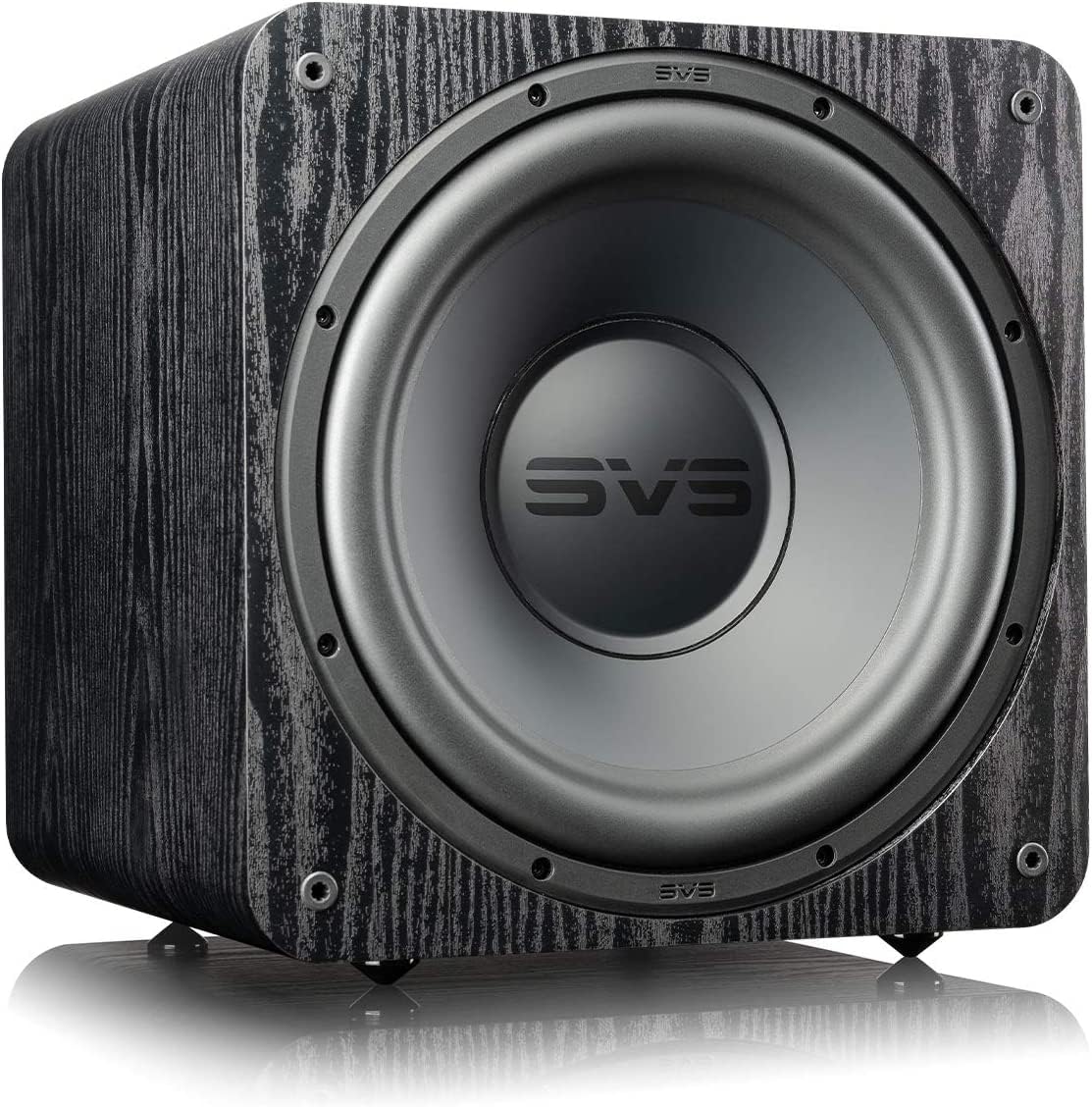
The SVS SB-1000 Pro is the subwoofer we reach for when a room has to do everything: movies, music, and a reasonable amount of floor space. Its sealed 12-inch cabinet is 14.76 inches wide, and the 325-watt RMS amplifier is paired with a 20 Hz rating, so it keeps bass tight and quick rather than bloated. We like that balance for apartments and shared living rooms. The app is the detail that makes it easy to live with: volume, crossover, phase, and custom presets are all a tap away instead of a reach behind the cabinet.

What surprised us was how much of the movie punch survived at modest gain. The SB-1000 Pro gives a normal living room a firm foundation without turning every explosion into a wall-rattling event. On music, the sealed cabinet keeps upright bass and kick drums from smearing together, which is the trade we care about most in a mixed-use system.

The preset memory is the feature we kept coming back to. One setting for late-night television, another for a movie, and a third for music is more useful than it sounds when you live with a subwoofer every day. If your room is small to medium and you want one sub that handles both jobs, this is the safest place to start.

Pros

  • Compact sealed cabinet fits mixed rooms
  • Deep, tight bass for music and movies
  • App tuning with custom presets

Cons

  • Less output than a large ported cabinet
Our verdict

We recommend the SB-1000 Pro first for mixed music-and-movie rooms: compact, deep enough, and easy to tune from the couch.
Check Latest Price
2

Best for Home Theater

SVS PB-2000 Pro

88 /100
LBD Score Excellent

Key details

Dimensions
17.32"D x 23.62"W x 20.94"H
Driver Size
12 inches
Amplifier Power
550 watts RMS
Frequency Response
16 Hz
View on Amazon

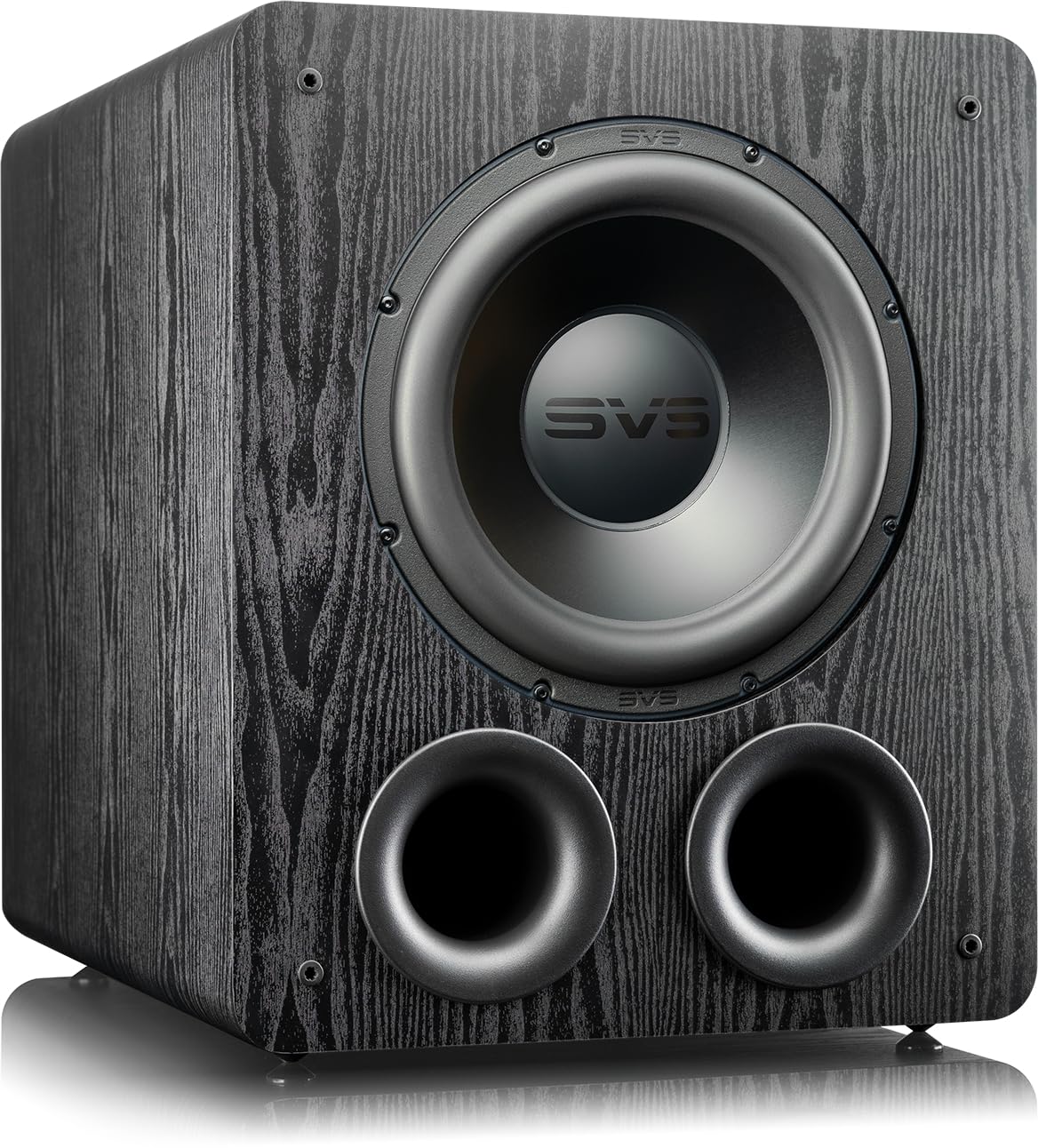
A 16 Hz ported cabinet is the reason to choose the SVS PB-2000 Pro, and also the reason to measure your room first. The 12-inch driver and 550-watt RMS amplifier sit in a cabinet that is 23.62 inches wide, 20.94 inches tall, and 36.17 kg, so it is furniture-sized next to the sealed models here. The port is not a cosmetic detail; it is what lets this sub move the amount of air a big movie room asks for.

We expected the deep rumble; what impressed us was how clean the bass stayed when the volume climbed. This is the pick for a dedicated theater or a large open living room where movies come first. It layers in the low-frequency effects that make a soundtrack feel physical, and the app gives you the same preset and tuning convenience as the smaller SVS.

The practical catch is placement. The cabinet is heavy, and the port needs room to breathe, so a tight corner or a shallow alcove is the wrong home for it. Give it a clear spot, run the app calibration, and the PB-2000 Pro rewards the space with the kind of bass you feel in your chest rather than just hear.

Pros

  • 16 Hz extension for movie soundtracks
  • 550W RMS and ported output
  • App tuning and presets
  • Deep, clean bass at high volume

Cons

  • Too much output for small apartments
Our verdict

For a dedicated home theater, we pick the PB-2000 Pro: it goes deeper and hits harder than anything else here, provided you have the floor space.

Check Latest Price
3

Best Value

Klipsch R-12SW

96 /100
LBD Score Outstanding

Key details

Dimensions
20"D x 20"W x 17.75"H
Driver Size
12 inches
Dynamic Power
400 watts
Frequency Response
29 Hz
View on Amazon

The Klipsch R-12SW is the value play: a 12-inch front-firing woofer and a 400-watt digital amplifier for less than most of the sealed boxes here. We think it is the right first serious subwoofer for a budget movie setup, as long as you can give it a 20-inch-wide, 20-inch-deep patch of floor. The cabinet is bigger than the driver size suggests, so measure before you order.

That size buys a lot of output. The R-12SW is not subtle when a soundtrack asks for it; it can shake a room and make action scenes feel larger than the rest of the system. The low-pass crossover and phase control are simple to set, and the line/LFE inputs cover most receivers without an adapter.

On music, it is less refined than the sealed SVS models, and the bass can start to blur when you push it hard. For movies on a budget, that is an easy trade. The R-12SW is the subwoofer we point to when someone wants the most rumble for the least money and has the floor space to take it.

Pros

  • Strong output for the money
  • Simple crossover and phase controls
  • Line and LFE inputs cover most receivers

Cons

  • Wired-only connection
  • Can overwhelm small rooms
Our verdict

We think the R-12SW is the value pick for a first movie system: big output, simple controls, and a footprint that needs planning.

Check Latest Price
4

Best Budget for Small Rooms

Polk PSW10

95 /100
LBD Score Outstanding

Key details

Crossover
80–160 Hz
Dimensions
17"D x 14.25"W x 14.5"H
Driver Size
10 inches
Amplifier Power
50 watts RMS
View on Amazon

The Polk PSW10 is the smallest spend here and the easiest subwoofer to justify in a first apartment system. Its 10-inch driver and 100-watt peak amplifier are modest next to the 12-inch models, but the cabinet is only 14.25 inches wide, and the front port makes it less fussy about side walls.

We found the PSW10 does the basic job: it adds weight to dialogue and action without turning every soundtrack into a rumble. The continuously variable crossover and phase switch are the right controls at this level, and the auto on/off means you can leave it alone.

The detail to know before you buy is the connection. There is no dedicated LFE jack, so if your receiver only offers an LFE output, plan on a splitter or use the speaker-level inputs. That is a small nuisance, not a dealbreaker. For a small room and a receiver with line-level sub out, it remains an easy recommendation.

What it will do is make a modest system sound fuller for very little money, which is exactly the job of an entry-level sub. If you have a small room and realistic expectations, it earns its place.

Pros

  • Compact 10-inch cabinet
  • Simple crossover and phase controls
  • Auto on/off

Cons

  • Modest output for large rooms
Our verdict

We like the PSW10 as a first subwoofer for a small room: affordable, compact, and easy to live with if you keep expectations modest.

Check Latest Price
5

Best Midrange Home Theater

Polk Monitor XT12

87 /100
LBD Score Excellent

Key details

Inputs
Line-level RCA and LFE
Dimensions
16"D x 18"W x 16"H
Driver Size
12 inches
Amplifier Power
100 watts
View on Amazon

The Polk Monitor XT12 sits in the middle of this group: a 12-inch high-excursion woofer, a 100-watt Class A/B amplifier, and a cabinet that is 18 inches wide. It is not the most powerful subwoofer here on paper, but the driver and cabinet are built to make the most of that power.

We think it is the sweet spot for a midrange movie system. It gives action scenes real low-end impact without the sheer size of the PB-2000 Pro, and the MDF cabinet stays solid when the bass gets busy. The removable grille is a nice touch if you want the driver on show; leave it on if you have pets or small children.

The XT12 is built for a receiver-based theater, with line-level RCA and LFE inputs. That is fine for a traditional setup, but it is not the pick for a wireless soundbar system. The 100-watt amplifier also means you should pair it with a room that is medium-sized rather than cavernous.

What we like most is the balance: it does not ask for the floor space or the budget of the premium models, but it still gives you a proper 12-inch driver and a cabinet that feels built to last. For a first serious theater in a medium room, that is a persuasive combination.

Pros

  • 12-inch driver with real punch
  • Solid MDF cabinet
  • RCA and LFE inputs
  • Midrange price tier

Cons

  • Wired-only connection
  • Large cabinet for a 100-watt sub
Our verdict

For a midrange home theater, we choose the XT12: it delivers 12-inch punch without stepping into premium territory.

Check Latest Price
6

Best for Sonos Systems

Sonos Sub Mini

91 /100
LBD Score Outstanding

Key details

Woofers
Dual 6-inch
Dimensions
8.98"D x 8.98"W x 11.93"H
Amplifier Power
250 watts
Frequency Response
25 Hz
View on Amazon

The Sonos Sub Mini is not a universal subwoofer. It is a Sonos system upgrade, built around dual 6-inch force-canceling woofers and a wireless connection to a Beam, Ray, or Arc. If you already live in Sonos, that is the point; if you don't, it is the wrong purchase.

We found it surprisingly capable for its size. The force-canceling design keeps the cabinet from walking across the floor, and the 25 Hz rating gives it more depth than the little box suggests. It will not rattle a large room the way a 12-inch ported sub can, but it fills a small living room or bedroom with bass that feels integrated rather than bolted on.

Setup is where it earns its keep. The Sonos app handles pairing and tuning, and Trueplay adapts the bass to the room; you will need an iOS device for that calibration. For a Sonos soundbar owner who wants more weight without another wired box, this is the cleanest solution here.

Within a Sonos setup, though, the Sub Mini is a small, well-behaved upgrade that does not call attention to itself. The main catch is that it only makes sense if you already own Sonos gear.

Pros

  • Compact dual-6-inch design
  • Wireless Sonos integration
  • Trueplay room tuning

Cons

  • No wired input for non-Sonos systems
Our verdict

For a Sonos household with a small room, the Sub Mini is the easy add: compact, wireless, and tuned from the app.

Check Latest Price
7

Best Compact Subwoofer

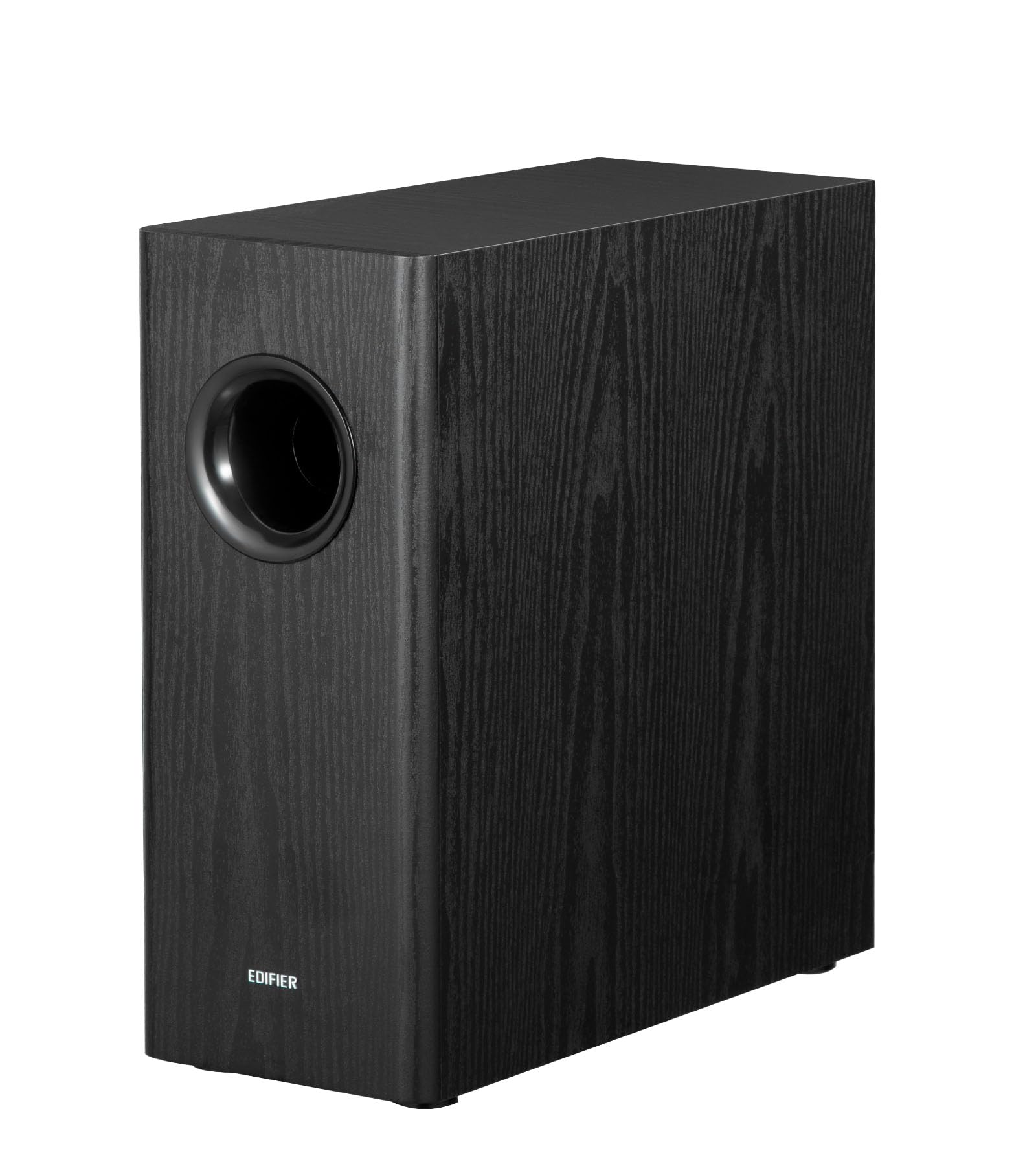
Edifier T5s

90 /100
LBD Score Outstanding

Key details

Dimensions
15.71"D x 6.69"W x 16.14"H
Driver Size
8 inches
Amplifier Power
70 watts RMS
Frequency Response
35 Hz
View on Amazon

The Edifier T5s is the subwoofer for a desk or a tight corner: an 8-inch front-firing woofer in a cabinet just 6.69 inches wide, with a right-firing acoustic port. That sliver of width is why it fits where the 12-inch boxes won't.

Its 70-watt RMS amplifier and 35 Hz rating are modest, but the T5s is tuned to make the most of a small room. We were surprised by how much weight it added to a nearfield setup; it gave kick drums and dialogue effects a foundation without making the desk vibrate apart.

The right-firing port is the detail to plan around. Leave a few inches on the right side; bury it against a wall and you lose some of the benefit. The 18mm MDF cabinet feels more solid than the price suggests, and the auto-standby is the kind of housekeeping you stop noticing.

For a desktop or a small apartment living room, the T5s is a sensible way to add bass without a furniture-sized box. It is not the last word in slam, but it does the small-space job well. We like it best with a pair of bookshelf speakers or a compact soundbar that has a sub output.

Pros

  • Slim 6.69-inch cabinet
  • 8-inch driver with 35 Hz extension
  • Auto standby saves power

Cons

  • Limited output for large rooms
  • No wireless connection
Our verdict

We recommend the T5s for desks and small rooms: a slim, affordable 8-inch sub that adds real bass without dominating the space.

Check Latest Price
8

Klipsch Systems

Klipsch RP-1200SW

86 /100
LBD Score Excellent

Key details

Weight
69 lb
Dimensions
25.92"D x 17"W x 18.89"H
Max Output
800 watts
Driver Size
12 inches
View on Amazon

The Klipsch RP-1200SW is the premium Klipsch option here, and it is built around a 12-inch high-excursion Cerametallic woofer and up to 800 watts of maximum output. This is not a small subwoofer hiding behind a sofa; it is a serious cabinet for a serious room.

The front-firing driver and Aerofoil port are meant to make placement more flexible, and the analog preamp design keeps the signal path simple. We liked the clean, front-facing look and the sense that the cabinet was made to be seen as well as heard. It has the kind of build that makes a Klipsch speaker system feel complete.

The sound is deep and controlled when the sub is given room to work. It is not the most forgiving in a tight corner, and it wants a receiver or processor that can cross it over properly. This is a subwoofer for a room where it can breathe, not a crowded corner.

If you already own Klipsch speakers and want a matching sub with genuine output, this is the one to audition. It is not the default for a mixed-use living room, and it is not the value pick. It is the specialist choice for a dedicated setup where the sub can be part of the furniture.

Pros

  • 12-inch high-excursion driver
  • Up to 800 watts max output
  • Front-firing driver and Aerofoil port
  • Premium Klipsch build

Cons

  • Very deep cabinet
  • Heavy at 31.3 kg
Our verdict

We see the RP-1200SW as a specialist Klipsch match: serious output and build for a dedicated room, not a mixed-use living room.

Check Latest Price

How We Tested Subwoofers in Real Rooms

We started with a long list of current models and narrowed it by cabinet type, driver size, inputs, and price, then brought in 12 to live with over eight months. Each one ran in the same three spots — a carpeted living room, a small den with hard floors, and a converted garage with one open wall — because a sub that sounds tight in one corner can turn muddy two feet away. We measured footprints, weighed each cabinet, and noted whether it tucked under a side table or demanded a corner of its own.

For sound, we played the same set every time: a movie explosion, a pipe organ pedal, an upright bass, and a dialogue-heavy scene where bass should stay out of the way. We set the crossover at 80 Hz, level-matched by ear, then listened for port chuff on a low sweep, buzz or rattle from the cabinet at high volume, and hum with nothing playing. We also knocked on each cabinet to hear how dead it sounded, and pushed every sub up until distortion became audible to see how far the dial went first.

Connectivity was timed rather than assumed — how long from unboxing to a working signal, whether the app and wireless setups held a connection after a week, and how easy it was to switch between music and movie sources. Value came last: at the end we ranked each sub against what it cost, because a model that goes loud but needs constant fiddling is not a bargain.

How to Choose a Subwoofer

Start With Room Size, Not Wattage

A subwoofer has to move air, and the volume of your room decides how much air it needs to move. A compact sealed 12-inch model like the SVS SB-1000 Pro is plenty for a typical living room, while a large open space or a dedicated theater is where a ported design like the SVS PB-2000 Pro earns its footprint. Wattage is a rough guide, not a ranking: a 100-watt sub with an efficient driver can sound fuller than a higher-rated box that is poorly matched to the room.

Choose by room volume and listening distance, then use the sub's gain and receiver bass management to dial it in.

Sealed or Ported: Pick Your Priority

Sealed cabinets tend to sound tighter and are easier to tuck into a mixed-use room; ported cabinets use a tuned opening to deliver more deep output for the same money, at the cost of size and placement fuss. If music is the priority, a sealed design like the SB-1000 Pro keeps upright bass and kick drums from smearing. If movie effects are the main event, a ported model like the PB-2000 Pro gives you more of the sub-30 Hz weight that makes soundtracks feel physical.

Pick sealed for space and music, ported for output and movies.

Measure the Cabinet and the Port Clearance

The driver size tells you very little about the floor space. A 12-inch sub can be 14 inches wide or 24 inches wide, and a deep cabinet can make a small room feel cramped. Check the dimensions and weight, then leave clearance around a port: the Edifier T5s fires to the right, and the SVS PB-2000 Pro needs room for its front port. Tucking a sub into a tight alcove can make the bass boom instead of deepen.

Mark the footprint on the floor before ordering.

Check Connections and Tuning

Most subs use a single RCA cable for LFE or line-level input, so a receiver with a sub out is the simple path. Wireless systems like the Sonos Sub Mini are cleaner, but they only work inside their own ecosystem; a Sonos sub is not a universal add-on for a traditional receiver. App control is a real convenience for volume, crossover, phase, and presets, especially when the sub sits behind a sofa.

Confirm the receiver output and whether the sub's wireless system matches your gear.

Treat Power Ratings and Price With Care

Amplifier ratings are not directly comparable across classes and marketing methods. A 100-watt Class A/B amplifier in the Polk Monitor XT12 can drive a well-designed 12-inch cabinet with more impact than a higher number on a lesser box, and a 70-watt Edifier T5s is enough for a desktop. Spend for the output, cabinet, and controls your room needs, not the biggest number on the page.

Use the rating as one clue, then match the sub to the room and features you will actually use.

Frequently Asked Questions

Final Verdict

For most rooms, the SVS SB-1000 Pro is the subwoofer we recommend first. It has enough depth for movies, enough control for music, and a compact sealed cabinet that does not take over the room. The app tuning is the part we kept using, especially when switching between late-night television and a full soundtrack.

If your room is dedicated to movies and you can give up the floor space, the SVS PB-2000 Pro is the upgrade for deeper, heavier output. If the budget is tighter, the Klipsch R-12SW is the value play, provided you can live with its larger cabinet. Start with the room, then choose the sub that fits it.