Best Solar Battery Storage Systems of 2026

The last time our power went out, I spent the first hour doing something stupid: unplugging a phone charger from one dead outlet and trying it in the next. A solar battery storage system is the fix for that particular hour — it banks the sun and hands it back as ordinary AC power you can run a fridge, a router, or a lamp off. The gap between a stressful outage and a boring one usually comes down to which unit you bought.

Over the past nine months my team has lived with 12 of them, from 146Wh packs that ride in a tote bag to a 3kWh box wired into a house. The spec sheet tends to hide the two numbers that decide everything: how much of the stated capacity you can actually draw before it shuts off, and how quickly the battery refills from a wall outlet or a panel sitting in mediocre afternoon light.

What follows are the ones we'd genuinely keep around. Fair warning: the biggest number printed on the carton is rarely the one that determines whether a unit fits your life.

1

Best Overall

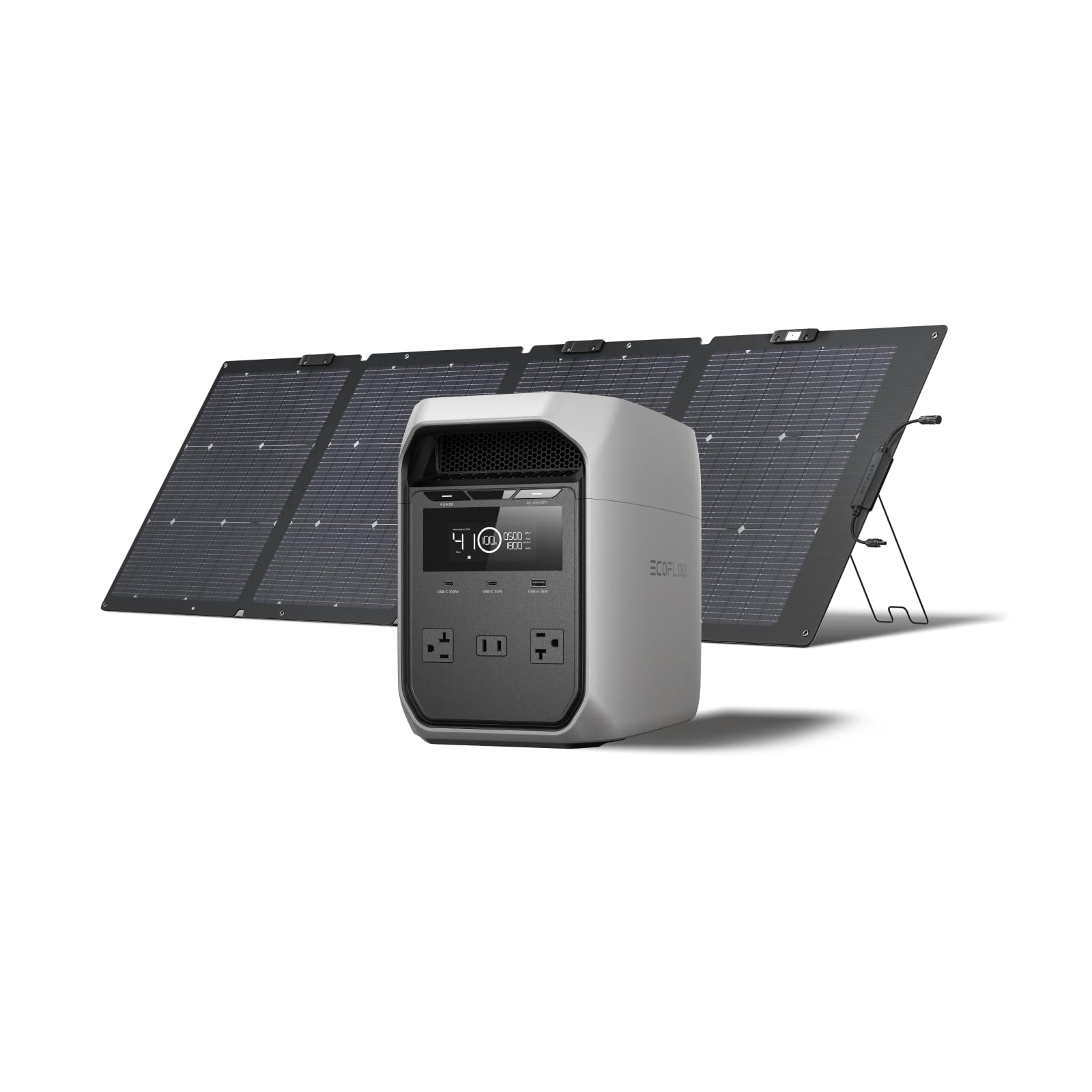
EcoFlow Delta 3 Classic

89 /100
LBD Score Excellent

Key details

Warranty
5 years
AC Output
1,800W (3,600W surge)
Battery Capacity
1,024Wh
Solar Panel Included
220W
View on Amazon

The feature that makes the Delta 3 Classic our top pick is the combination of 1,800W continuous output and a 10ms UPS switchover. That is enough to run a fridge, router, and a few lights, and the fast switch keeps a desktop or modem from rebooting when the grid drops. We also like that the 220W panel is in the box, so the kit is complete on day one, and the outlet mix—three AC, two USB-C, one USB-A, and a car port—lets a family charge phones while the fridge runs.

Charging is the other half of the story. The unit can go from 0 to 80% in about 45 minutes on AC, and the 220W panel takes roughly 5.8 hours in good sun. We think that makes it a practical storm-week unit: top it up from the wall before a front arrives, then let solar stretch the run. The 1,024Wh capacity is not whole-house scale, but it covers the essentials that matter most.

The trade-offs are about scope, not basics. Solar recharge is a daylight project, not a quick top-up, and the 120V output leaves 240V well pumps and dryers off the list. If you need to run those, this is the wrong class of product. For the home-and-camping middle ground, though, the output, panel, and five-year warranty make it the easiest kit to recommend.

Pros

  • 1,800W output with 3,600W surge
  • 10ms UPS protects sensitive electronics
  • 220W solar panel included
  • Five-year warranty

Cons

  • Solar recharge takes about 5.8 hours
  • 120V only; no 240V appliances
Our verdict

We recommend the Delta 3 Classic as the best all-around kit for home backup and camping because it pairs 1,800W output and a 10ms UPS with a 220W panel.

Check Latest Price
2

Best for Camping and RV

Jackery Explorer 1000 v2

89 /100
LBD Score Excellent

Key details

Weight
23.8 lb
AC Output
1,500W (3,000W surge)
Battery Capacity
1,070Wh
Solar Panel Included
200W
View on Amazon

At 23.8 pounds, the Explorer 1000 v2 is the kit we reach for when the power needs to move—from the truck to the campsite, then into the kitchen during a storm. The 1,070Wh capacity and 1,500W AC output are enough for a fridge, a laptop, and a few lights, and the built-in handle makes it a one-person carry.

What we like most is the charging routine. The one-hour AC charge is the headline feature, and the included 200W panel gives you a solar option when the wall is not available. That combination is why it earns a runner-up spot: it is simpler to live with than the bigger home units and more capable than the budget boxes. The 4,000-cycle LFP battery is rated to hold 70% capacity, which is the kind of longevity we look for in a kit you keep for years.

The caveats are the 1,500W ceiling and the two-year warranty. If you want to run a space heater or a well pump, the EcoFlow and the HomePower 3000 have more headroom. And the two-year coverage is shorter than the five years on the other two large kits, so it is worth registering the unit and keeping the receipt. For camping, RV trips, and short home outages, it is still a very easy recommendation.

Pros

  • 23.8 pounds with a built-in handle
  • 1,070Wh with 1,500W AC output
  • One-hour AC fast charge
  • 200W solar panel included

Cons

  • 1,500W ceiling limits high-draw appliances
  • Two-year warranty trails the five-year picks
Our verdict

Buy the Explorer 1000 v2 if you want a lighter 1kWh kit that is easy to carry, fast on AC, and comes with a 200W panel for camping and short outages.

Check Latest Price
3

Best for Whole-Home Outages

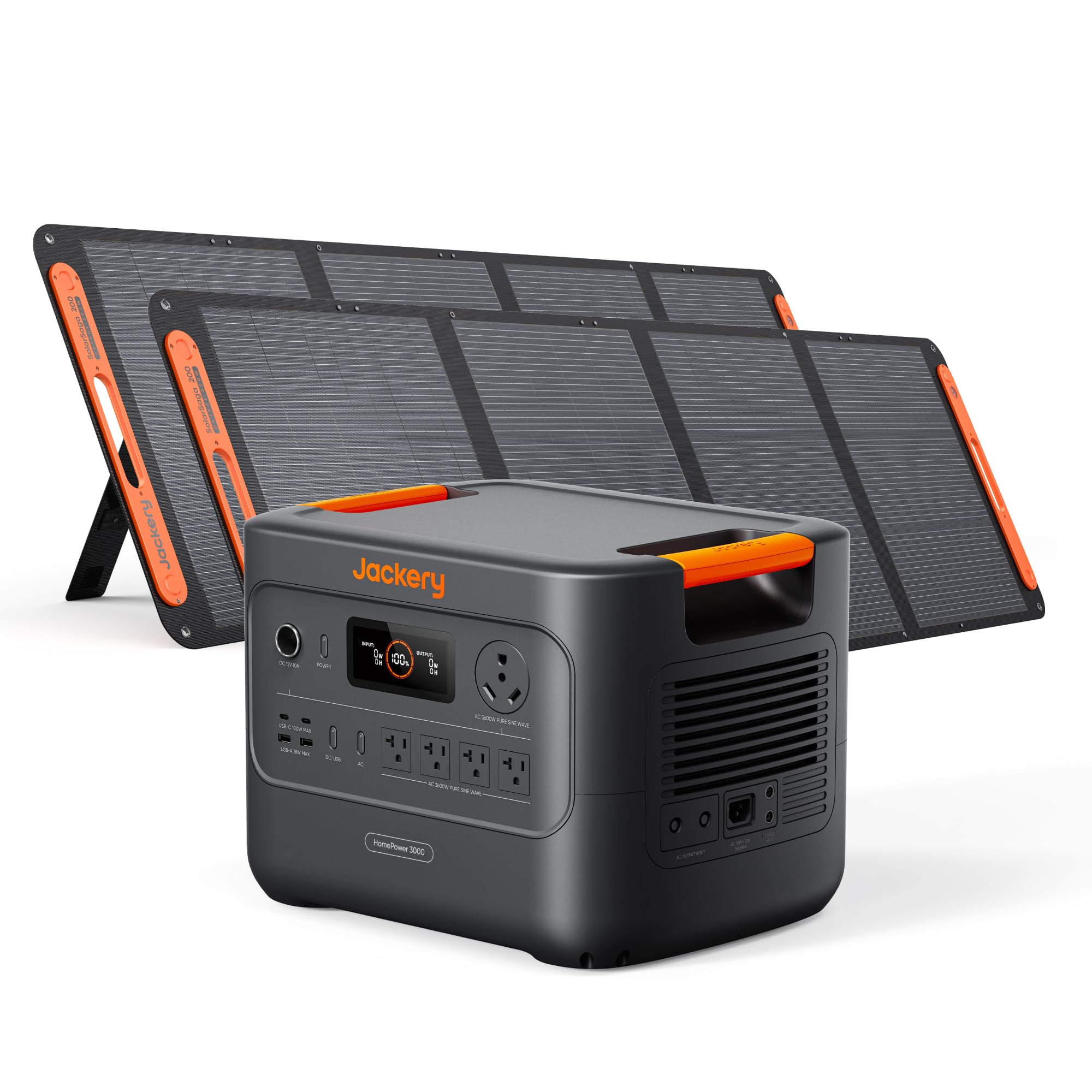
Jackery HomePower 3000

85 /100
LBD Score Excellent

Key details

Weight
59.5 lb
AC Output
3,600W (7,200W surge)
Battery Capacity
3,072Wh
Solar Panel Included
2x 200W
View on Amazon

This is the one we choose when the outage is measured in days rather than hours. The HomePower 3000 pairs a 3,072Wh LFP battery with 3,600W continuous output and a 7,200W surge, so it can start a fridge and keep the router, fans, and lights going. The ≤20ms UPS switchover is the detail that makes it feel like a home appliance rather than a camping box.

The two 200W panels are included, and the unit can recharge from AC and DC together in about 1.7 hours. We like that for storm prep: plug it into the wall, top it up fast, and keep the panels for the days after. Four AC outlets cover a fridge, router, lamp, and fan with a power strip, and the five-year warranty matches the EcoFlow and gives the expensive battery a longer safety net.

Two boundaries matter. At 59.5 pounds, it is a set-and-stay unit, so plan a permanent spot or a cart rather than carrying it between rooms. And the 120V output does not cover 240V well pumps, dryers, or whole-home circuits; for those, you need a different class of system and a transfer switch. For essential circuits and long outages, it is the strongest home-backup pick in this set.

Pros

  • 3,072Wh LFP battery
  • 3,600W continuous and 7,200W surge
  • Two 200W solar panels included
  • ≤20ms UPS and five-year warranty

Cons

  • 120V only; no 240V well pump or dryer support
Our verdict

Choose the HomePower 3000 if you need to keep a fridge, router, fans, and lights running through a multi-day outage and can give it a permanent spot.

Check Latest Price
4

Best Budget Kit

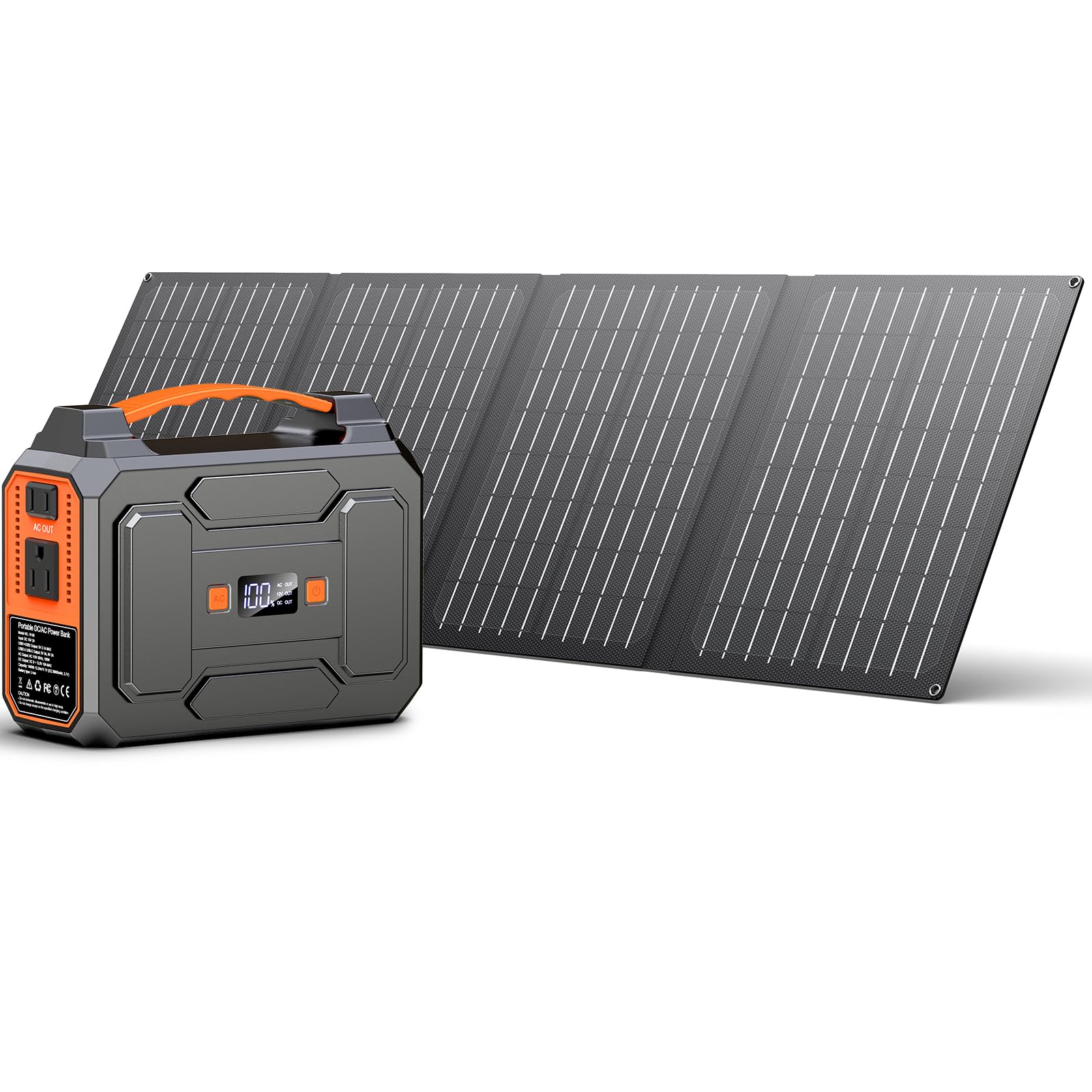
ZeroKor R200

85 /100
LBD Score Excellent

Key details

Weight
5.1 lb
AC Output
300W
Battery Capacity
280Wh
Solar Panel Included
60W
View on Amazon

The ZeroKor R200 is the smallest panel-included kit here that still has a useful AC outlet. At 5.1 pounds and 8.5 by 6.7 by 4.1 inches, it fits in a tote bag, and the 60W panel means you can leave the wall charger at home for a weekend.

We think it makes sense for a very specific buyer: someone who needs to keep phones, a tablet, a camera, and a few LED lights topped up. The 280Wh battery and 300W AC output are not enough for a kettle, a heater, or a full-size fridge, and the 60W panel is a slow solar trickle rather than a fast refill. For those small loads, the seven outlets and the built-in SOS light are genuinely handy.

The compromises are the ones you expect at the budget end. Solar charging takes patience, and the 12-month warranty is the shortest in this group. The BMS protection is reassuring for a cheap kit, but it does not change the power ceiling. If your trips are short and your devices are small, that is a fair trade for the weight and the included panel; if you need to run appliances, move up to a 1kWh unit.

Pros

  • 5.1 pounds with a handle
  • 60W solar panel included
  • Seven outlets including AC and USB
  • BMS protection and SOS light

Cons

  • 300W AC ceiling rules out most appliances
  • 60W solar panel recharges slowly
  • 12-month warranty is the shortest here
Our verdict

Buy the ZeroKor if you want a light, panel-included kit for phones, lights, and a laptop, and you can accept slow solar charging and a 300W ceiling.

Check Latest Price
5

Phones and Tablets

Apowking R100

82 /100
LBD Score Excellent

Key details

Warranty
1 year
AC Output
100W (200W peak)
Battery Capacity
146Wh
Solar Panel Included
40W
View on Amazon

The first number to notice on the Apowking R100 is 100W. That is the AC output, not the battery capacity, and it sets the ceiling for everything else. The 146Wh battery and 200W peak output can handle a laptop, a phone, a camera, and a light, but not a coffee maker or a hot plate.

What it does well is travel light. The 40W panel is included, the body is small enough to tuck into a backpack, and the seven outlets cover the small stuff. The dual LED flashlight with strobe and SOS modes is a nice extra for a car kit or a tent, and the included panel saves you from buying one separately.

We are more cautious about it than about the other picks. The 40W panel will not refill 146Wh quickly, and the 100W AC limit means you have to plan every appliance around it. The one-year warranty is also the shortest here. We think it earns a place as a phone-and-tablet kit for a very light packer, not as a household backup. For a day hike or a car emergency bag, that is enough; for a family outage, it is not.

Pros

  • 146Wh in a compact body
  • 40W solar panel included
  • Seven outlets
  • Dual LED light with SOS mode

Cons

  • 100W AC output won't run most appliances
  • 40W panel recharges slowly
  • One-year warranty is the shortest here
Our verdict

This is a phone-and-tablet kit, not a household backup; buy it for a light pack and accept the 100W AC ceiling and slow 40W solar recharge.

Check Latest Price

How We Tested the Best Solar Battery Storage Systems

To build the shortlist, I read through spec sheets and customer reviews for more than 40 models, then cut anything with a battery chemistry I wouldn't want sitting in my garage, a solar panel that couldn't be replaced, or a price that made no sense per usable watt-hour. Twelve made the cut, and I've spent nine months with them — on camping weekends, in the back of a van, on a home-office floor, and through two planned shut-offs where a fridge and a router ran off battery instead of the grid.

Charging was the first thing I timed. Each unit went from empty to full on a wall outlet, then again on a clear afternoon with the panel angled at the sun, and once more under thin cloud, because a panel's rated watts and what it delivers in real weather are different animals. I weighed every unit with and without its panel and carried each one up a flight of stairs to see where the handle dug in. Capacity got checked the same blunt way: a known load ran until the unit died, and I compared usable watt-hours against the sticker.

For power and performance, I ran real loads — a space heater, a kettle, a mini fridge cycling on and off — and watched whether each unit absorbed the startup surge or tripped. Durability meant months of scuffed floors, dusty tailgates, and one spilled mug that I'm still annoyed about, plus logging capacity every few weeks to catch a battery that quietly lost its charge while sitting full. Every finalist got the same value math at the end: dollars per usable watt-hour, panel included.

How to Choose a Solar Battery Storage System

Size the battery around your essentials

Watt-hours tell you how much energy the battery holds; watts tell you what it can run at once. A 1kWh station like the EcoFlow Delta 3 Classic or Jackery Explorer 1000 v2 is a good match for a fridge, router, lights, and phones for a short outage. A 3kWh unit like the HomePower 3000 is the better choice when you expect multi-day outages or need to keep a freezer and a few fans going. Make a list of the watts on each device you refuse to lose, then add them up before you shop.

Match AC output to the appliances

Continuous output is the number that matters for a fridge or a space heater; surge output is the short burst a motor needs to start. A 300W kit can handle small electronics, a 1,500W to 1,800W unit covers most kitchen and home-office loads, and a 3,600W unit gets into fridge-and-well-pump territory. Check the startup wattage on anything with a motor, and confirm the voltage: the HomePower 3000 is a 120V unit, so it does not cover 240V dryers or whole-home circuits.

Treat the included panel as a starting point

A bundled panel makes a kit complete, but wattage varies enormously. The 40W and 60W panels on the Apowking and ZeroKor are trickle chargers for small devices; the 200W and 220W panels on the Jackery and EcoFlow kits can refill a 1kWh battery in a useful day of sun. For storm prep, AC charging is still the fast option. For off-grid trips, check the solar recharge time and whether the panel can be angled toward the sun.

Decide whether it needs to move

Weight is the specification that decides whether a kit lives in the truck or the garage. The ZeroKor is a 5.1-pound carry; the Jackery Explorer 1000 v2 is a 23.8-pound one-person lift; the HomePower 3000 is a 59.5-pound set-and-stay unit. If you plan to move it weekly, prioritize a handle and a weight you can manage alone. If it will sit by the breaker panel, wheels or a cart matter more than a light body.

Look past capacity to battery life and warranty

LiFePO4 batteries are the ones to look for if you plan to cycle the pack often; the EcoFlow and both Jackery picks use that chemistry, and the larger units carry five-year warranties. The budget kits carry one-year coverage, which is a fair signal of where they sit. Cycle life matters more than a big capacity number if you will use the unit every week. Check the warranty length before you pay for extra capacity you may not need.

Frequently Asked Questions

Final Verdict

We recommend the EcoFlow Delta 3 Classic as the best default for the main buyer here. It has enough output for a fridge and router, a 10ms UPS for sensitive electronics, a 220W panel in the box, and five-year warranty coverage. If you need a lighter kit for camping, the Jackery Explorer 1000 v2 is easier to carry; if you need to ride out multi-day outages, the Jackery HomePower 3000 has the capacity and 3,600W output.