Best Solar Battery Chargers of 2026

A car battery rarely dies because something broke. It dies because nothing happens — the truck sits for three weeks, the alarm and the clock keep drawing, and one cold morning there's just a click. A solar charger fixes that: a small panel, 7 to 30 watts, that feeds a maintenance current into the battery so it stays topped up between drives.

I've run one on my own truck for a year, and what separates a good panel from a cheap one isn't the number on the box. It's whether the built-in controller backs off at the right voltage, whether the housing survives a winter bolted to a bumper, and whether the connectors match what your vehicle actually has.

We spent four months with 14 of these on a boat, an RV, a lawn tractor, and a few vehicles that mostly sit. Wattage is the most oversold spec here: a bigger panel won't revive a flat battery, and a small one can't outrun a heavy parasitic draw. Match the panel to the drain, not the marketing — the ones that held a charge are below.

1

Best Overall

Voltset 20W Solar Charger

90 /100
LBD Score Outstanding

Key details

Controller
10A MPPT
Maximum Power
20 watts
Operating Range
-40°F to 185°F
Waterproof Rating
IP67
View on Amazon

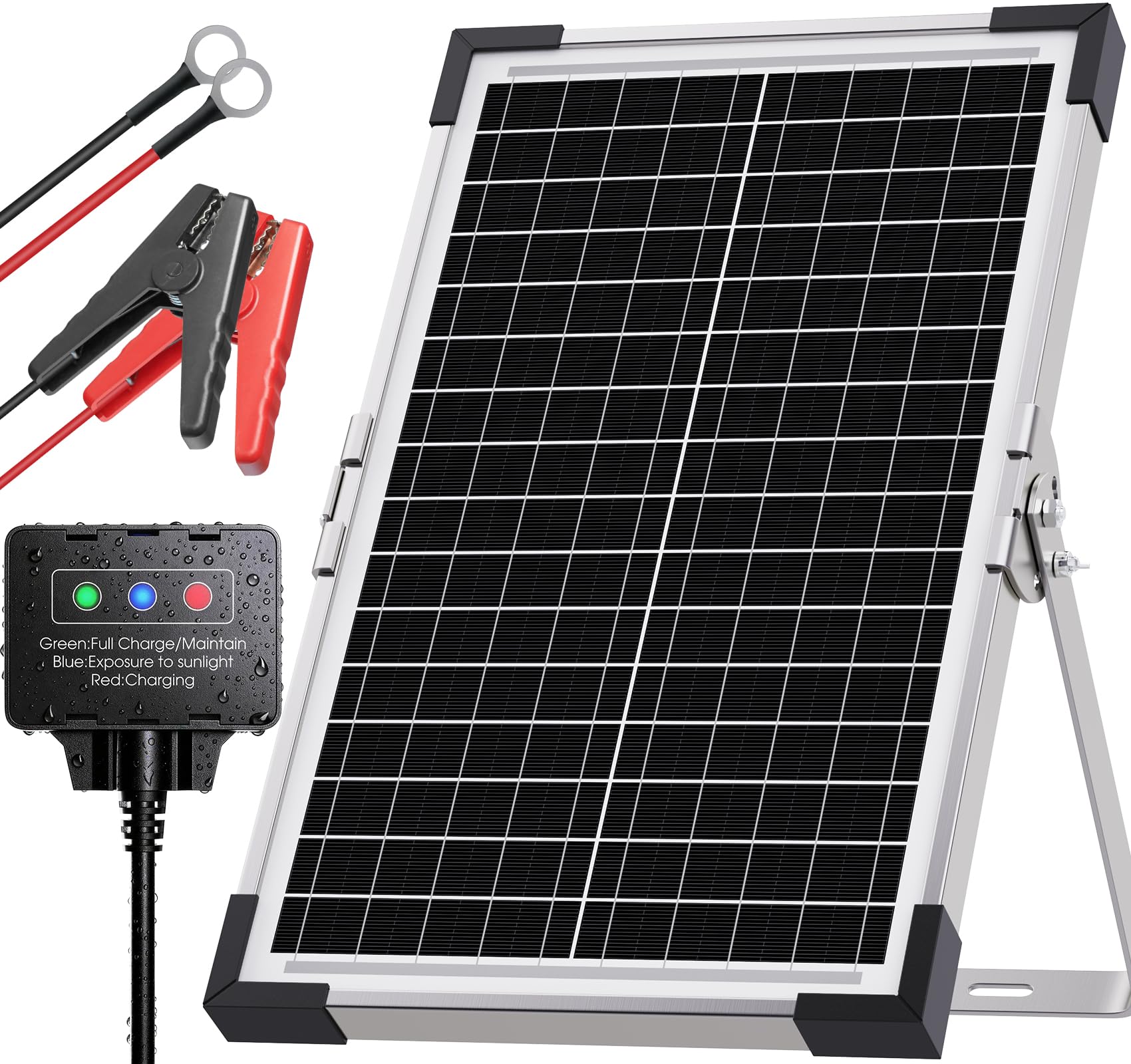
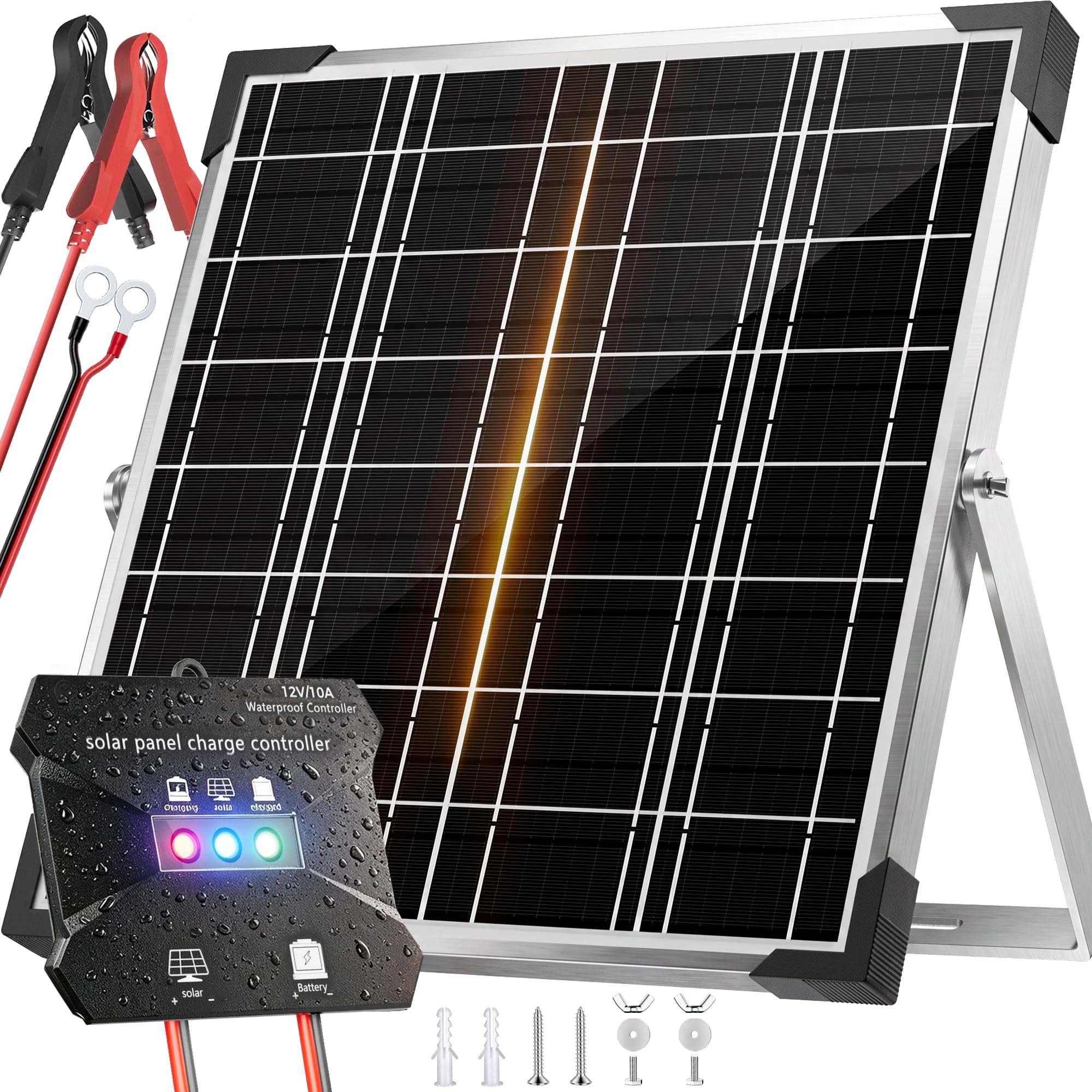
Twenty watts is the point where a solar maintainer stops being a token gesture. On a truck or an RV that sits for weeks, a panel this size can replace what the vehicle drains without anyone remembering to drive it, and the Voltset gets those watts through a 10-amp MPPT controller instead of the simple pass-through circuit most cheap panels rely on. The controller tracks the panel as light changes, stops charging at full, and starts again when voltage drops.

Compared with the other 20-watt kits here, this is the one we kept coming back to, because the kit arrives ready to install. The aluminum frame and tempered glass feel like a small solar panel should, the 360-degree bracket lets you aim the face at the sun rather than at the hood, and pre-drilled corner holes take screws without a template. IP67 sealing and an operating range from minus 40 to 185 degrees Fahrenheit cover the weather that kills cheaper panels.

It works best as a maintainer, not a rescue tool. Put it on a healthy battery and it holds it at full through a winter; put it on one that's already flat and 20 watts takes days to do anything useful. That's true of every panel here, and it's the easiest way to end up disappointed in a panel that's working exactly as designed.

The cable is the thing to plan around. It's short enough that you may need an extension to get from a windshield or shed wall to a battery in a trunk or under a seat, so measure the run before you commit to a mounting spot. Everything else in the box is ready to go.

Pros

  • Genuine 10-amp MPPT controller with auto cutoff and resume
  • IP67 sealed for permanent outdoor mounting
  • 360-degree bracket aims the panel at the sun
  • 20 watts at a midrange price, with clips included

Cons

  • Not enough panel to recharge a flat battery
Our verdict

Our pick for most people and most batteries: 20 watts, real MPPT charging and IP67 sealing for less than several 12-watt kits here.

Check Latest Price
2

Best Value

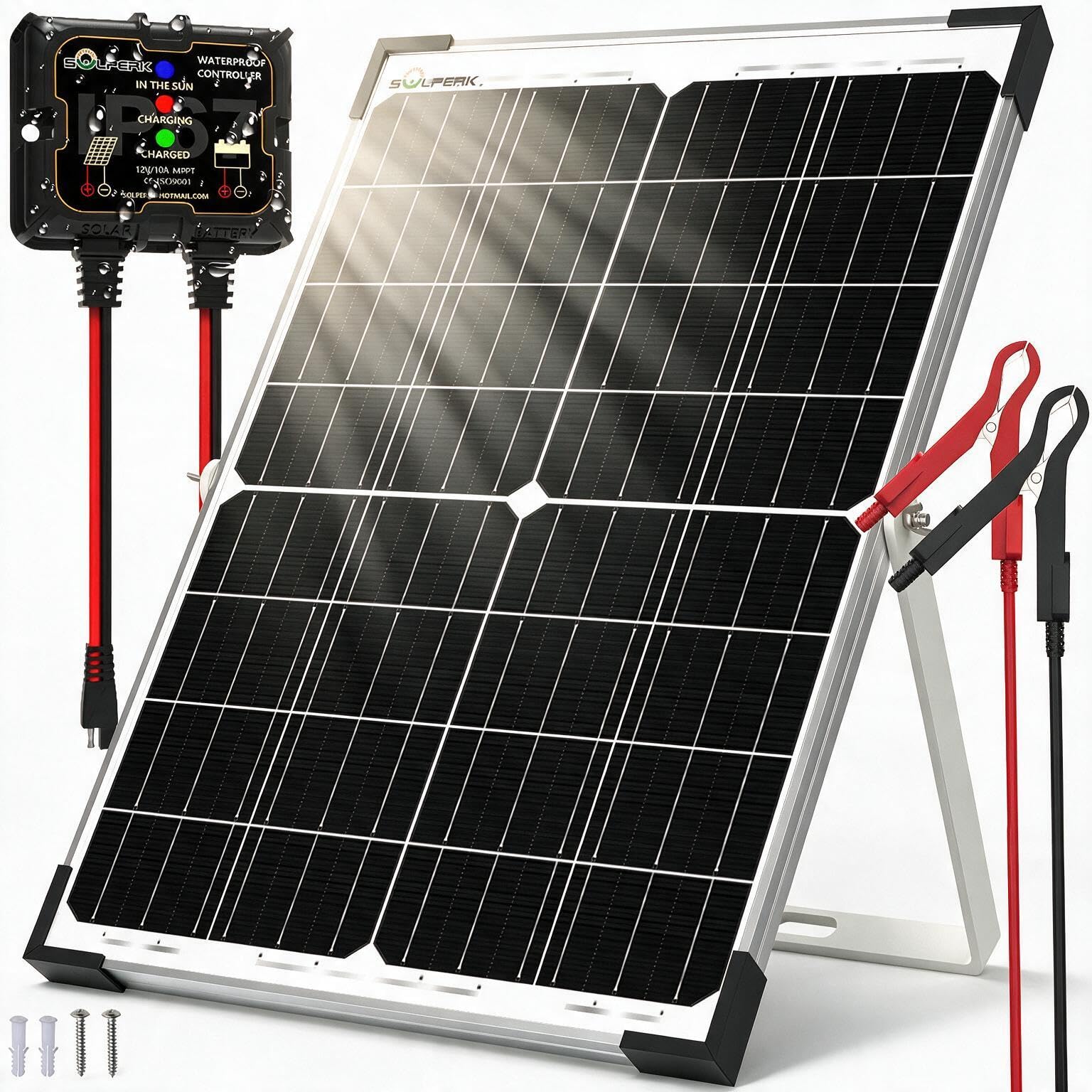
SOLPERK 20W Solar Panel Kit

91 /100
LBD Score Outstanding

Key details

Mounting
360° adjustable bracket
Controller
10A MPPT
Maximum Power
20 watts
Cell Efficiency
21%–30%
View on Amazon

Same 20 watts, same 10-amp MPPT controller class, less money — we think it's the better buy for anyone who doesn't need every accessory in the box. The two panels are close enough on paper that the decision comes down to connections and mounting rather than output.

Construction follows the same recipe as the pricier kits: A+ monocrystalline cells behind low-iron tempered glass, a corrosion-resistant aluminum frame, and a panel rated waterproof and rustproof. The bracket is the part that earns its keep, because a fixed panel pointed at the wrong slice of sky is a smaller panel than the one you bought. Loosen it, turn the face toward the sun, lock it again.

What the kit is built around is a set of alligator clips on an SAE lead, which go straight onto the posts. That's the right answer for a trailer, a boat or a lawn tractor, and it's the wrong answer for a car whose battery lives under a back seat. If you want to charge through a dash socket instead, confirm the box contents before ordering, because running clips under the hood of a weekly driver gets old fast.

Pros

  • 20 watts and MPPT charging for less than our top pick
  • 360-degree bracket lets you aim it properly
  • Tempered glass over a corrosion-resistant aluminum frame

Cons

  • Built around alligator clips rather than a dash socket
Our verdict

The value pick: the same 20 watts and MPPT charging as our top choice, in a kit built around clipping straight to a battery post.

Check Latest Price
3

Best for Boats and Docks

SUNER POWER 12W Maintainer

88 /100
LBD Score Excellent

Key details

Protections
8 built-in
Certification
UL, CE
Maximum Power
12 watts
Charging Stages
Bulk, absorption, float
View on Amazon

Twelve watts from a panel about sixteen and a half inches tall isn't the headline; the controller is. This one charges in three stages — bulk, absorption and float — instead of pushing whatever the panel makes straight into the battery. On a battery that sits for months, that staging is the difference between a top-up and a charge cycle that keeps the plates healthy.

The protection list is the longest in this group: overcharge, over-discharge, over-voltage, over-current, overload, short circuit, reverse polarity and over-temperature. Reverse polarity is the one that earns its keep, since clipping onto the wrong post is the classic way to ruin a maintainer on installation day. It's also the only panel here listed as meeting both UL and CE.

We were struck by how much of the price sits in that electronics package rather than the panel, and that's the trade: 12 watts for more money than 20-watt kits on this page. For a boat, a dock box or a piece of equipment parked where you can't easily jump-start it, that's a fair trade. For a car in a driveway, you're paying for safeguards you'll probably never trigger.

Two practical notes. At 3.3 pounds it's the heaviest panel here, which rules out suction mounting and argues for a bracket screwed into something solid. And the leads cover clips, a cigarette-lighter plug and bare wire ends, so the same kit can go on a battery post, a dash socket, or a hardwired run to a fuse block.

Pros

  • Three-stage bulk, absorption and float charging
  • Eight protections, including reverse polarity
  • Listed to both UL and CE
  • Clips, dash plug and bare wire in one kit

Cons

  • Status light can blink red without showing a clear full charge
Our verdict

The choice for a boat, dock box or remote equipment: three-stage charging and the most complete protection set here, at a premium over 20-watt panels.

Check Latest Price
4

Best for Curved Glass

FlexSolar 20W Flexible Panel

86 /100
LBD Score Excellent

Key details

Weight
1.7 lb
Connections
Lighter plug, clips, OBDII, ring terminals
Maximum Power
20 watts
Panel Thickness
0.11 in
View on Amazon

Eleven hundredths of an inch is thin enough that the panel disappears against glass. That's the case for the FlexSolar: it lies on a curved windshield, a sunroof or the cambered deck of a boat without a bracket, and at 1.7 pounds four suction cups are enough to keep it there. Park under a carport with a wall to screw into and a rigid panel does the same work with less fuss.

What we like most is the connector set. Cigarette lighter, alligator clips, OBDII and ring terminals all come in the box, and it's the only kit here with an OBDII adapter — which means you can leave the panel plugged into the diagnostic port and keep the dash socket free for a phone charger. Ring terminals turn it into a permanent trailer install in about ten minutes.

The trade-off is that a flexible panel can't shade itself or angle toward the sun. Laid flat on a windshield it gets what the glass passes, and its 20 to 25 percent cell efficiency is a standard-test figure rather than a dashboard number. Treat it as a trickle charger for places a rigid panel won't fit, and it does exactly what you want.

Pros

  • Only kit here with an OBDII adapter
  • 0.11-inch panel conforms to curved glass
  • 1.7 pounds, so suction cups can hold it
  • Four connection types in the box

Cons

  • Lies flat, so it can't be angled toward the sun
Our verdict

Buy it for the shape: a 20-watt panel thin and light enough for a curved windshield or boat deck, with four connector types in the box.

Check Latest Price
5

Best for Large Battery Banks

SOLPERK 30W Solar Charger

85 /100
LBD Score Excellent

Key details

Weight
4.5 lb
Controller
MPPT
Maximum Power
30 watts
Cell Efficiency
30%
View on Amazon

Thirty watts answers a specific problem: more battery than a maintainer can hold. Two deep-cycles on a trailer, a boat with a bilge pump cycling, an RV that sits between trips — that's where a 7.5-watt panel is a rounding error and even 20 watts is working hard. This is the biggest panel in the group, and it's the one we point to when the bank, not the vehicle, is the deciding factor.

The rest of the kit follows the formula SOLPERK uses on its smaller panel: A+ monocrystalline cells behind low-iron tempered glass, a corrosion-resistant aluminum frame, a 360-degree bracket and an MPPT controller with three indicator lights. Waterproof and rustproof, which matters when the mount is a trailer tongue or a dock post rather than a garage wall.

At just over two kilograms it's the heaviest panel here, so it wants a real mount, and its peak output is a fair-weather number — a 30-watt panel behind shade behaves like a much smaller one, which is why the adjustable bracket earns more here than on a car-sized panel. If you're maintaining a single car battery, the 20-watt picks do the same job for less.

Pros

  • 30 watts, the highest output in this group
  • MPPT controller with three status lights
  • Aluminum frame and tempered glass, waterproof and rustproof

Cons

  • Heaviest panel here, so it needs a solid mount
  • More capacity than a single car battery needs
Our verdict

The pick for a multi-battery bank: 30 watts of monocrystalline panel with MPPT charging, sized for trailers, boats and RVs rather than one car.

Check Latest Price
6

Best Budget

Callsun 7.5W Solar Charger

86 /100
LBD Score Excellent

Key details

Glass
3.2mm low-iron tempered
Mounting
360° adjustable bracket
Maximum Power
7.5 watts
Waterproof Rating
IP68
View on Amazon

Seven and a half watts doesn't sound like much, and it isn't. What it is, is enough to hold a healthy battery at full charge on something small — a lawn tractor, an ATV, a motorcycle, a generator that gets started twice a year. On a full-size truck with a lot of parasitic draw it's overmatched, and no amount of sun changes that.

The build is better than the price suggests. Three-point-two-millimeter low-iron tempered glass over a corrosion-resistant aluminum frame is the construction we expect from panels further up this page, and IP68 is the highest water rating in the group. The 360-degree bracket handles a wall, a shed roof or an odd angle on a trailer frame. The one thing to check on arrival is polarity: a reversed SAE lead is a five-minute fix with a meter and an afternoon of confusion without one.

The three-color light is a small thing that turns out to matter: blue for sunlight on the panel, red while it's charging, green at full. On a panel bolted to a shed you can't see from the kitchen window, a glance that tells you it's working is the whole reason to have an indicator at all.

What keeps it out of the top tier is ceiling, not quality. Seven and a half watts is a fixed limit, and if your battery is bigger than a lawn tractor's you want twice the panel. As a first solar maintainer for something cheap that sits around, we were pleased to find this much glass, sealing and bracket at the bottom of the price range.

Pros

  • IP68 rated, the best water sealing here
  • 3.2mm tempered glass on an aluminum frame
  • Three-color light shows charging state at a glance
  • Cheapest panel in this group

Cons

  • 7.5 watts only suits small batteries
Our verdict

The budget pick and the best value here: IP68 sealing, tempered glass and a proper charge light on a panel that suits ATVs, mowers and motorcycles.

Check Latest Price
7

Best for a Spare Vehicle

POWOXI 7.5W Solar Charger

89 /100
LBD Score Excellent

Key details

Frame
ABS + PC
Weight
2.2 lb
Warranty
1 year
Maximum Power
7.5 watts
View on Amazon

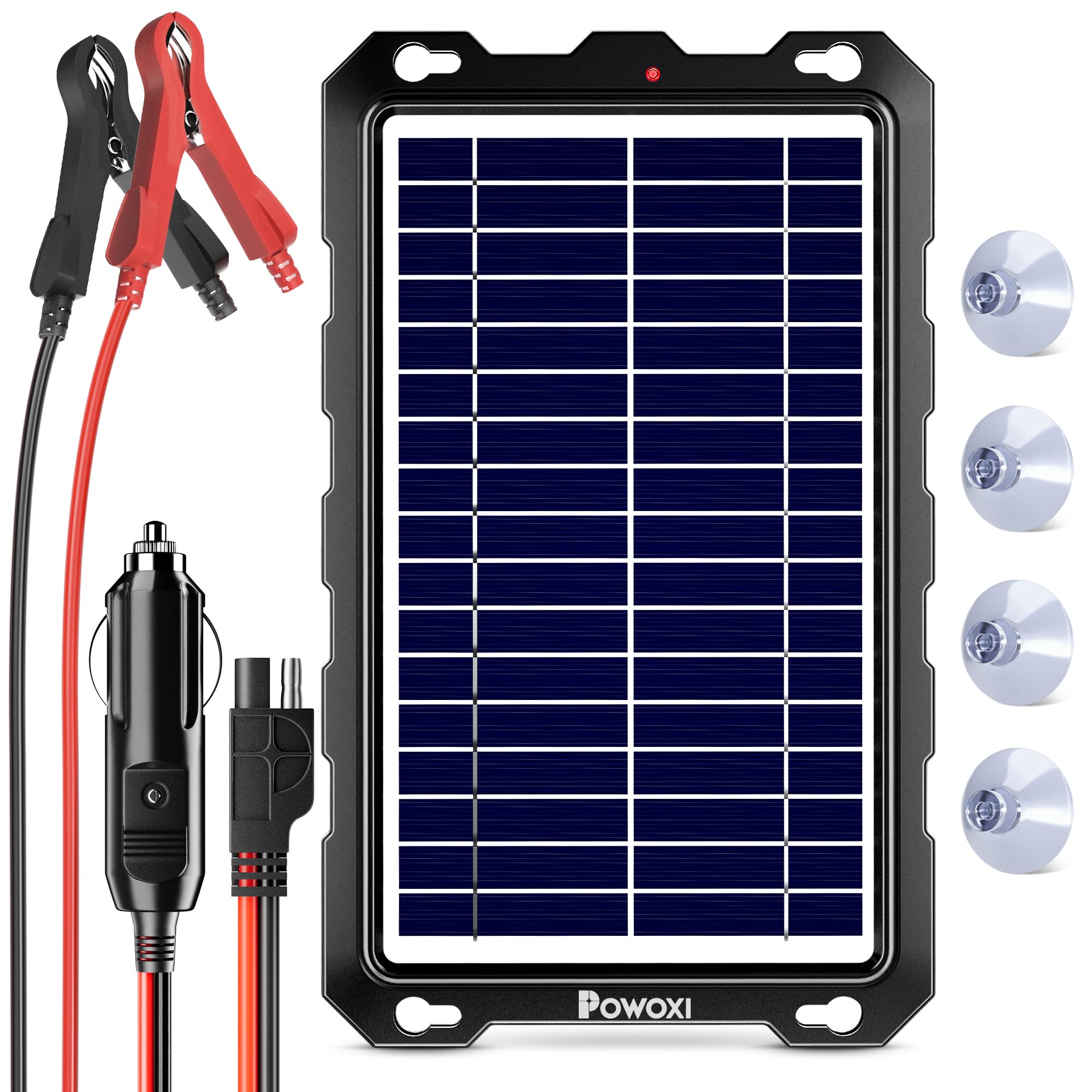
Leave a solar panel on a dashboard in a hot climate and you find out what the frame is made of. This one wraps the glass in ABS and polycarbonate rather than aluminum, and that choice has a practical payoff: an aluminum frame resting on paint or a dash can scuff it, while plastic won't. It also won't flex, which is the point of a rigid panel.

The kit is complete in the way that matters: a cigarette-lighter plug for the dash socket and alligator clips for the battery posts, both included, plus a blocking diode so the panel can't drain the battery overnight and a controller that stops charging at full. A one-year warranty is stated, which not every panel here offers. It isn't the cheapest route to 7.5 watts — the Callsun holds that — but it's the more complete kit.

Where we hesitate is heat, and it's why this sits below our top picks rather than beside them. Rigid frames and glass are the parts that give out when a panel bakes in constant sun, and durability is the weakest dimension for this pick in the group. Put it on a carport wall rather than a dashboard and you get the same charge with far less cooking; the stated warranty covers the first summer either way.

Pros

  • Rigid ABS frame won't scuff paint like aluminum
  • Both a dash plug and alligator clips included
  • Blocking diode and controller fitted as standard
  • One-year warranty stated

Cons

  • 7.5 watts won't keep up with a big truck's parasitic drain
Our verdict

A sensible kit for a spare car: a rigid frame that won't scuff paint, both connection leads, a stated warranty — as long as you mount it somewhere other than a dashboard.

Check Latest Price
8

Trucks and Trailers

ECO-WORTHY 10W Solar Charger

88 /100
LBD Score Excellent

Key details

Weight
10.6 oz
Connector
SAE
Maximum Power
10 watts
Current Rating
0.58 A
View on Amazon

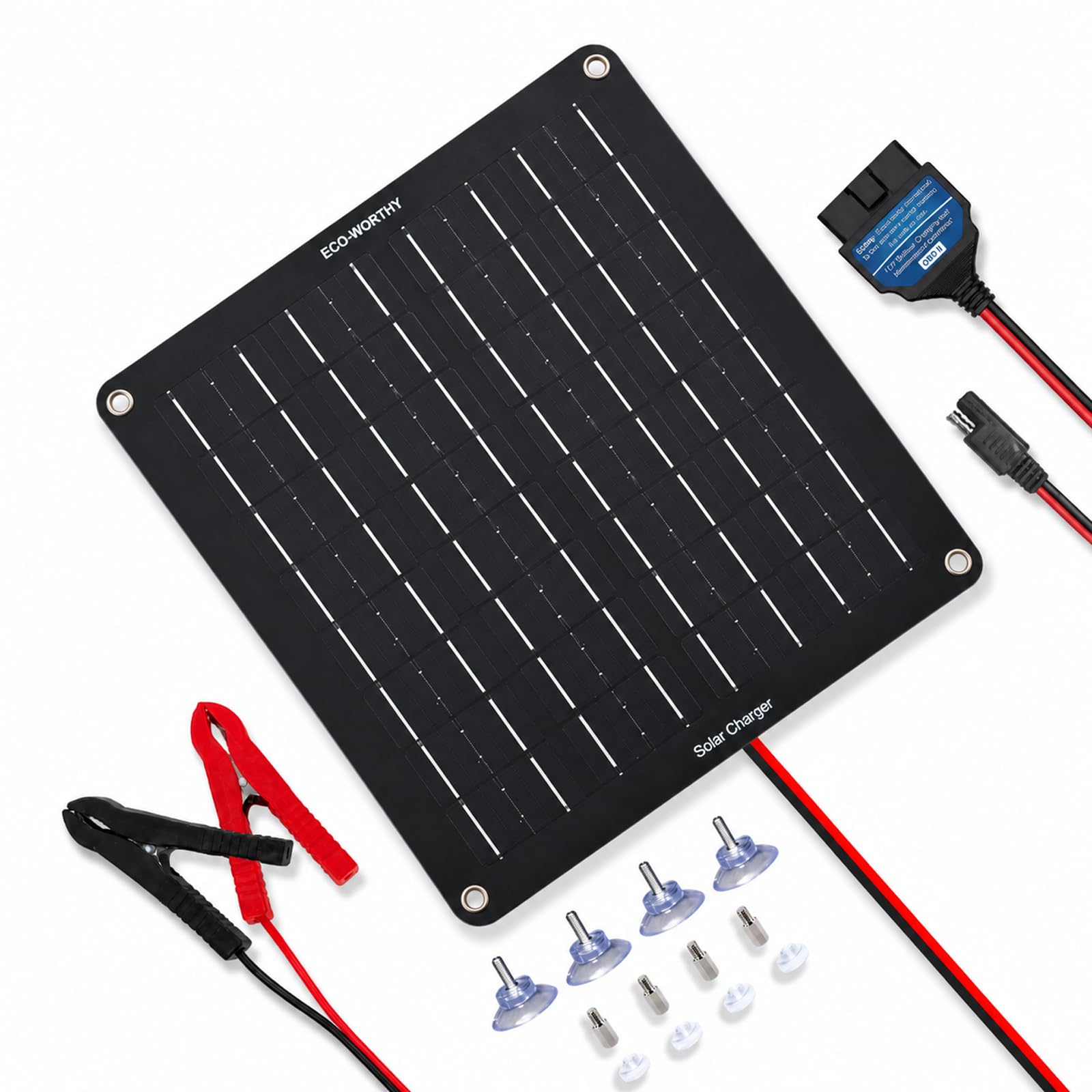
Ten watts of monocrystalline panel at the low end of this group's prices is a sensible starting point for a maintainer, and the kit is as simple as it should be: an SAE lead, a cigarette-lighter plug, alligator clips, a blocking diode so it can't drain the battery overnight, and reverse and overcharge protection in the controller.

Setup takes minutes. Plug into the dash socket or clip onto the posts, and there's nothing to program. For a trailer, a dump bed or a truck that sits between jobs, that's the whole requirement — the panel collects, the diode stops the backflow, and you get on with something else.

It's also light enough to move, which matters more than it sounds. At three hundred grams you can chase the sun around a driveway through the day instead of committing to one mounting spot, and a small panel that gets moved into the light beats a bigger one left in the shade.

What costs it a place higher is the hardware around the panel. The suction cups are fiddly to seat in the corner holes and don't hold well once the glass heats up, so plan on a bracket or zip ties instead. And cheaper picks here now match it on construction while including a proper mount, which is why it lands at the bottom of this list rather than the middle.

Pros

  • Blocking diode plus reverse and overcharge protection
  • Light enough to move and re-aim through the day
  • Plug-in or clip installation with nothing to program

Cons

  • Suction cups don't hold once the glass heats
  • 10 watts can't revive a discharged battery
Our verdict

A cheap, simple 10-watt maintainer that does the job if you bring your own mounting — the panel is light, the kit is basic, the suction cups are not.

Check Latest Price

How We Tested Solar Battery Maintainers

We started by pulling every trickle charger we could find with a built-in charge controller, then narrowed by wattage (7.5 to 30 watts), ingress rating, mounting hardware, and the connectors in the box. Anything that shipped as a bare panel with no controller came off the list — a panel that can't regulate itself will overcharge a battery left connected for weeks. That left 14 units, which we ran for four months.

Each went onto something that sits: a pickup that goes weeks between drives, a boat on a trailer, a lawn tractor parked for the winter, and a motorcycle in an unheated garage. We read voltage at the terminals before hookup, at day three, and at two weeks, noting whether it climbed into a maintenance range and stayed there or plateaued below it. We also metered output at noon on a clear day and again on a gray one, since an overcast morning costs more than most listings admit.

Durability was tested by weather rather than a spec sheet: four panels stayed mounted outdoors through rain and a stretch of nights below freezing, and we opened the housings afterward to check for moisture. We tugged every cable at the strain relief, felt whether the controller ran hot, and tried each connector end on the vehicles that fit them — cigarette plug in an always-on outlet, clips on a side-terminal battery, ring terminals bolted to a frame ground.

Ease of use came down to whether we could hook one up without the instructions and whether the indicator lights told us anything the multimeter hadn't. Value was judged against the wattage step, and more than once the bigger panel cost more without holding a charge any better.

How to Choose a Solar Battery Charger

Match Watts to the Battery, Not the Vehicle

Five to eight watts holds a motorcycle, ATV, lawn tractor or a small car battery that's already charged. A single car, truck or RV battery in normal health wants 10 to 20 watts. Two deep-cycle batteries, or a boat with something cycling on the bank, calls for 30.

The trap is buying for the worst case. A 7.5-watt panel on a truck with a heavy parasitic draw loses ground all winter, and a 30-watt panel on a lawn mower is money sitting in the sun. Think about what drains the battery between drives, not the size of the thing it's bolted to.

Spend on the Controller

A panel is glass and silicon; the controller decides whether your battery is actually looked after. The minimum is a blocking diode so the panel can't drain the battery at night, plus automatic cutoff at full charge and resume when voltage drops. Three-stage charging — bulk, absorption, float — is worth paying for on anything that sits for months, and MPPT controllers get more out of a panel in changing light than a simple regulator.

If you're weighing a bigger panel with a basic controller against a smaller one with MPPT and three stages, and the battery sits for months at a time, take the smaller panel.

Rigid, Flexible, or Somewhere In Between

Rigid glass-and-aluminum panels last longer outdoors and suit a shed wall, a dock post or a trailer tongue. Flexible panels win where nothing flat exists — a curved windshield, a boat deck, a camper shell — and they weigh enough less that suction cups become a real option.

Check the water rating against where it's going. IP67 and IP68 mean the panel can take rain; neither means the connector can sit in a puddle, and neither protects it from baking on a dashboard in hot country. A carport wall gets the same light with far less heat.

Connectors, Cable, and Where It Plugs In

Alligator clips go straight to the posts and suit anything with a reachable battery. A cigarette-lighter plug is the fastest install of all, but plenty of cars cut power to the socket when the ignition is off — test that before you rely on it, because a dead socket looks exactly like a dead controller. OBDII adapters keep the dash socket free on vehicles that keep the port live, and ring terminals are the only honest answer for a permanent trailer install.

Whichever you choose, measure the run before you mount anything. A windshield-to-trunk run needs an extension on almost every kit here.

Frequently Asked Questions

Final Verdict

For most people and most batteries, the Voltset 20W is the one to buy. Twenty watts through a real MPPT controller, IP67 sealing, a 360-degree bracket and both connection leads in the box — it holds a healthy car, truck, boat or RV battery and asks nothing of you after installation. The SOLPERK 20W is the same job for less if you're clipping straight to a post.

If your bank is bigger than one battery — two deep-cycles on a trailer, a boat with a bilge pump — go to the SOLPERK 30W, because the extra panel is what keeps up. And for a lawn tractor or an ATV, the Callsun does it for the least money here, with better sealing than anything else at that price.