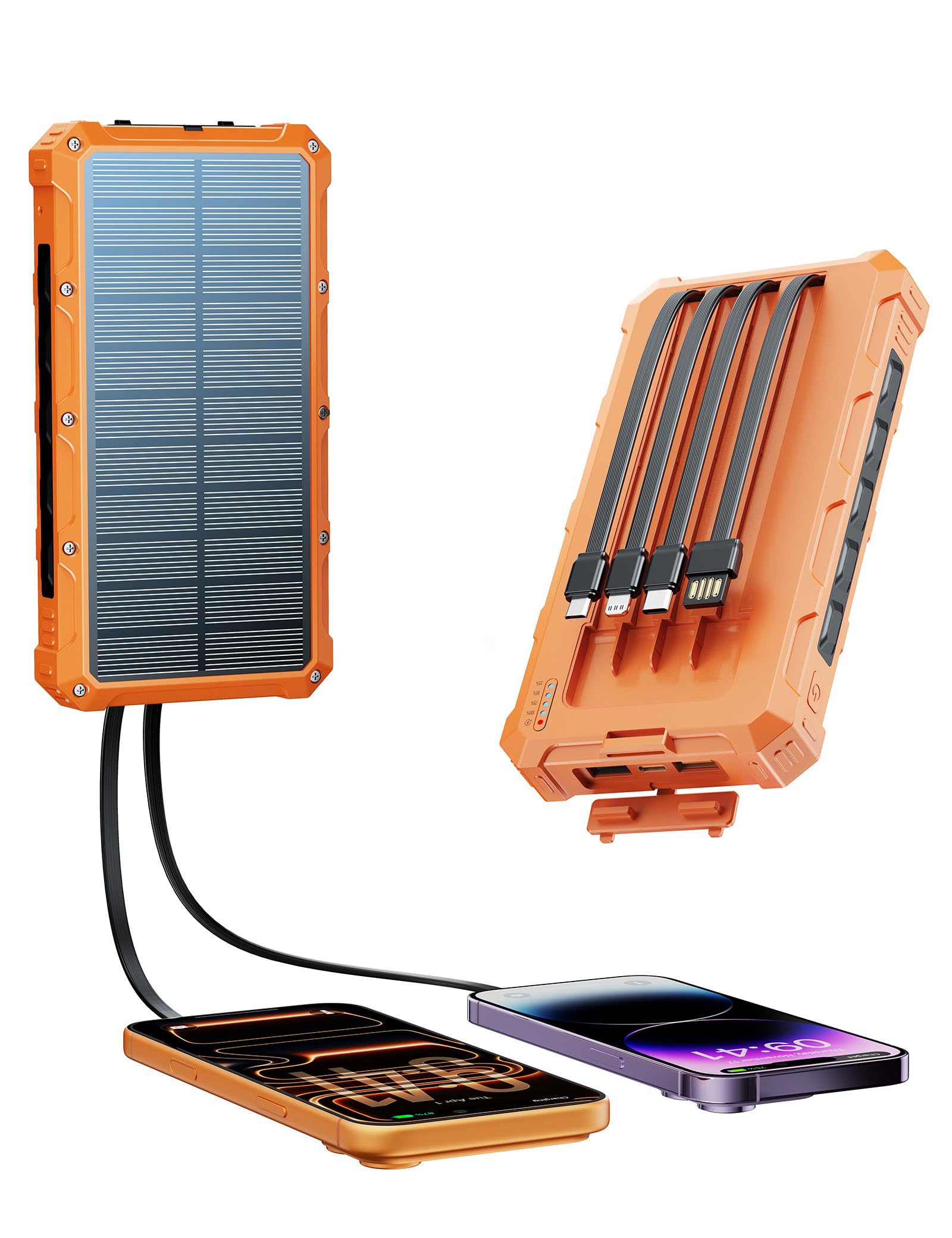
Best Portable Solar Chargers of 2026

Every solar power bank makes a promise it can't quite keep: that the sun will keep it topped up. A palm-sized panel takes days of direct sun to replace what a single phone charge drains, so on most of these the panel is a backup for the backup. What separates a good one from dead weight in your pack is everything else — how fast it refills a phone, how much it weighs, and whether it survives a drop onto rocks.

We've spent four months carrying 14 of them, from slim 10,000mAh packs to bricks with four foldable panels. A panel that unfolds to several times the size of the battery is the only kind that harvests meaningful sun; the little strip glued to the back is mostly there for the product photo. Built-in cables matter nearly as much, since a charger is only as portable as the cord you didn't lose.

Wireless charging is a genuine convenience on the few that offer it, and the flashlight earns its keep more often than you'd guess. Value, it turns out, comes down to a battery that's honest about its capacity and a panel that actually does something. The picks below are the ones we'd carry again.

1

Best Overall

BLAVOR 4-Panel Solar Power Bank

88 /100
LBD Score Excellent

Key details

Dimensions
7 x 3.5 x 1.6 in
USB-C Output
PD 18W
Solar Charging
4 foldable panels
Battery Capacity
20,000mAh
View on Amazon

The BLAVOR PN-W12-Pro's four solar panels fold out from the back like a little roof, and that is the detail that makes it more than another 20,000mAh bank. The extra panel area is the difference between a solar feature that looks good in a product photo and one that can add a useful trickle while you are sitting around camp. The lanyard is also a USB-C cable, so you can leave one cord at home.

That combination is why this is the pick we recommend first. It stores enough for several phone charges, yet it can also take advantage of direct sun without a separate panel. The built-in camping light is brighter than we expected for a bank this size, with three brightness levels, and the compass and thermometer are small extras that make sense in a pack. At 7 x 3.5 x 1.6 inches, it is a pack item, not a pocket item, and the solar panel is a top-up rather than a fast recharge. We think that is the right trade for camping and emergency use.

The 18W USB-C PD output is quick enough for a phone, and the four ports let you charge a couple of small devices at once. We wish BLAVOR had added wireless charging at this price, but the cable lanyard partly makes up for it. For a weekend bag, the combination of stored power, fold-out panels, and a real light makes this the most complete solar charger here.

Pros

  • Four folding panels add useful solar surface
  • 20,000mAh stores several phone charges
  • Built-in USB-C lanyard cable reduces clutter
  • Camping light is bright and adjustable

Cons

  • Too bulky for pocket carry
Our verdict

The BLAVOR PN-W12-Pro is the solar bank we hand to campers who want one device for stored power, panel charging, and a real camping light.

Check Latest Price
2

Best Foldable Panel for Backpacking

BigBlue 28W Foldable Solar Panel

88 /100
LBD Score Excellent

Key details

Ports
Dual USB-C, USB-A
Weight
1.48 lb
Folded Size
11 x 6 x 1.4 in
Solar Output
28W
View on Amazon

There is no battery inside the BigBlue 28W, and that is exactly why we like it for backpacking. It is a panel, not a bank: you unfold it, angle it at the sun, and plug a phone or power bank into one of its three ports. That makes it useless after dark, but it also means you are not carrying a second battery up the trail. The folding body is 11 x 6 x 1.4 inches when packed, and the 671-gram weight is the price of a panel this size.

The 28W rating is a clear-sun number, not a promise on a cloudy afternoon. We found the output is best when the panel is moved every hour or so to follow the sun, and the dual USB-C and USB-A ports let you charge a bank and a phone at the same time. The shadow-free surface is a nice detail because it reduces the hotspots that can cut output when a branch or strap crosses the panel. For a long hike, we pair it with a small 10,000mAh bank: charge the bank during the day, charge the phone at night.

The BigBlue's advantage is direct solar power without the weight of a built-in battery. Its disadvantage is that you need sun and attention to get it. If you want a charger that works from a wall and can top up from the sun, the BLAVOR four-panel bank is the more forgiving choice. If you already carry a bank and want the most solar surface for the weight, this is the panel we take.

Pros

  • 28W folding panel for direct solar
  • Dual USB-C and USB-A ports
  • No battery weight to carry

Cons

  • Needs direct sun and repositioning
Our verdict

We recommend the BigBlue 28W for backpackers who already carry a power bank and want to refill it from direct sun.

Check Latest Price
3

Best Compact Everyday Carry

BLAVOR 10,000mAh Solar Power Bank

86 /100
LBD Score Excellent

Key details

Weight
9.3 oz
USB-C Output
20W
Battery Capacity
10,000mAh
Water Resistance
IPX5
View on Amazon

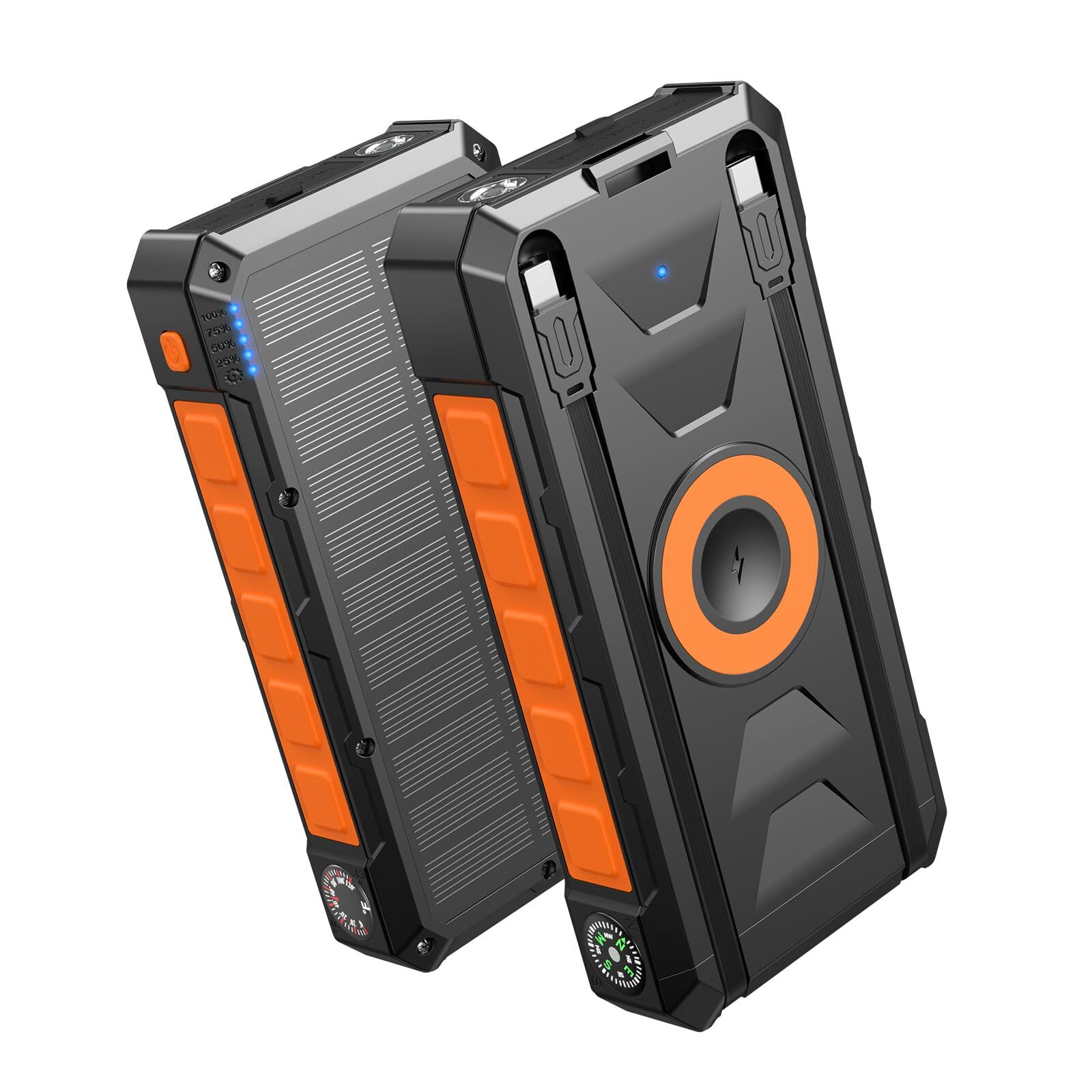
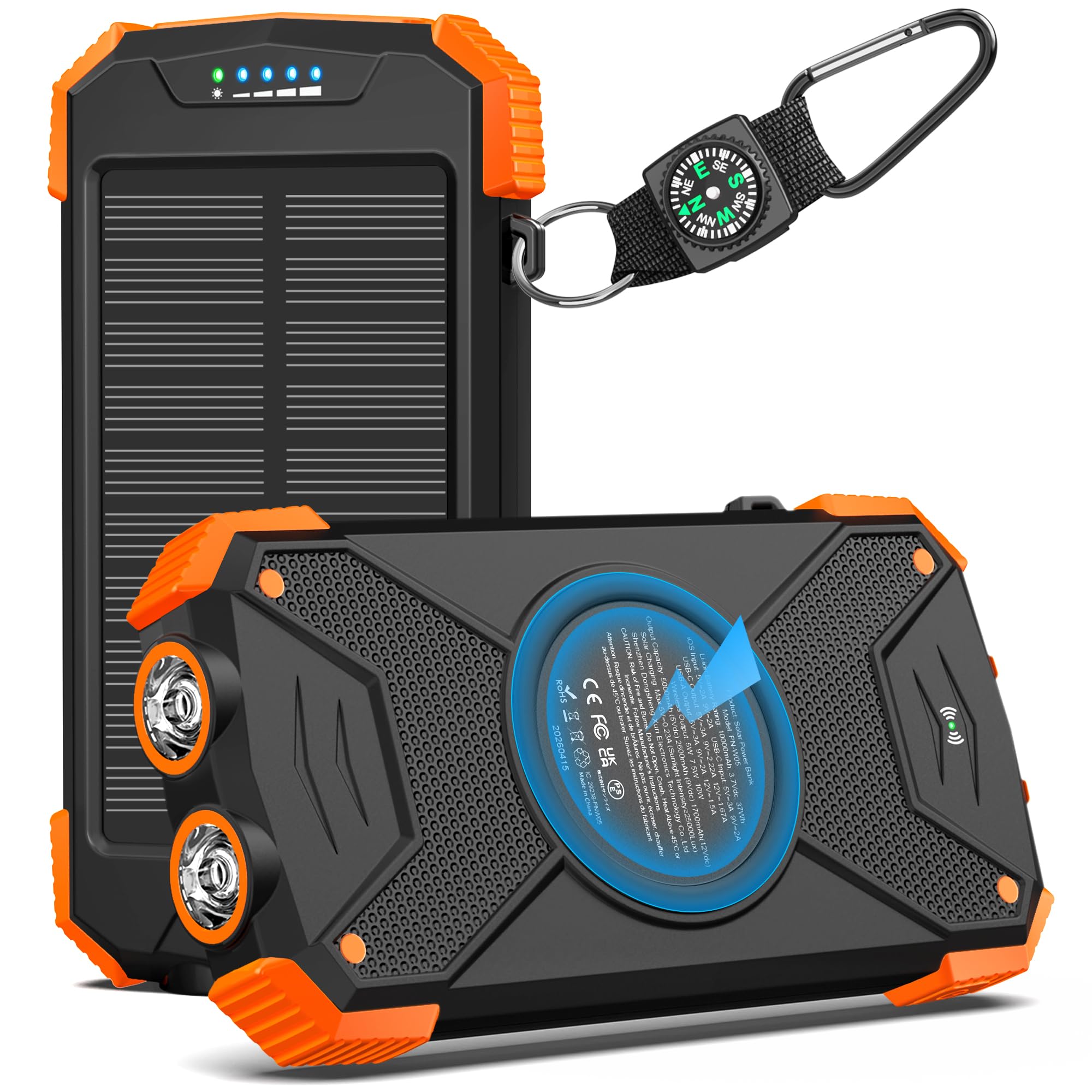
The BLAVOR PN-W05 is the one that disappears into a jacket pocket. At 9.3 ounces and just under an inch thick, it is small enough to carry every day, and the wireless pad means you can drop a phone on it without hunting for a cable. The two flashlights are genuinely handy, with a bright beam for a bank this size.

The 10,000mAh battery is good for a couple of phone top-ups, and the 20W USB-C output is quick enough to matter when you are moving. We like the rubber-sealed ports and IPX5 protection for a day pack. The solar panel is the weak link: it is a trickle charger for emergencies, not something we count on to refill the bank. Charge it from a wall before you leave, then use the panel to slow the drain if you are stuck outside.

For a day pack, this is the one we reach for. It is not the bank for a week off-grid, and the 10,000mAh capacity will not cover a long weekend. What it does well is stay out of the way, add a wireless option, and give you a solar fallback when you forgot to charge. If you want more capacity for a basecamp, the SOARAISE or MINRISE makes more sense; if you want a pocketable everyday bank, this is the size to beat.

Pros

  • 9.3-ounce body fits a jacket pocket
  • 20W USB-C output with wireless pad
  • IPX5-sealed ports and dual flashlights

Cons

  • 10,000mAh will not cover a long weekend
  • Solar panel is emergency-only
Our verdict

We recommend the BLAVOR PN-W05 for day trips: a wireless pad and 20W USB-C in a 9.3-ounce body.

Check Latest Price
4

Best Budget High-Capacity

YELOMIN 38,800mAh Solar Power Bank

84 /100
LBD Score Excellent

Key details

Ports
2 USB-A, 1 USB-C
Weight
9.9 oz
Dimensions
5.9 x 2.95 x 0.98 in
Battery Capacity
38,800mAh
View on Amazon

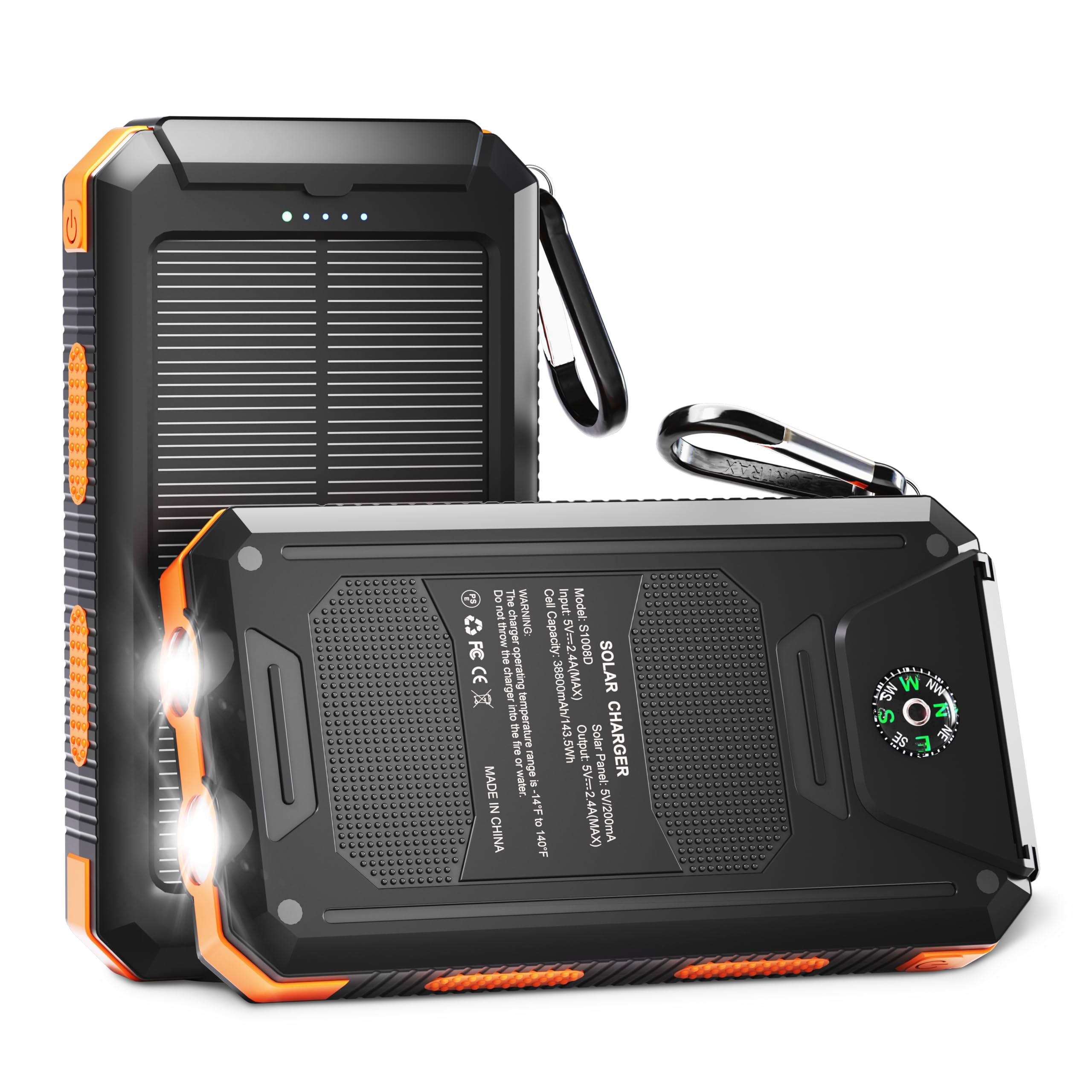
The YELOMIN's pitch is simple: a 38,800mAh battery in a body listed at 9.9 ounces, at the budget end of this group. That is a lot of capacity for a pack, and the built-in carabiner is a small detail we appreciate: it hangs from a pack loop instead of disappearing into the bottom. The dual LED light has steady, strobe, and SOS modes, and the three ports cover a phone, a cable, and a small accessory.

It makes sense when capacity matters more than charging speed or extras. The 2.4A output is modest compared with the 20W USB-C banks here, so a phone will charge steadily rather than quickly. The solar panel is a slow top-up, not a primary charger, and YELOMIN's own instructions say to charge by USB-C before a trip, so treat the panel as backup. The case feels more utilitarian than premium, which is fair for the price.

For a budget weekend bank, that is a fair set of compromises. It is not the charger for someone who wants fast PD charging, but it is the one to grab if you want maximum reserve for the least money.

Pros

  • 38,800mAh capacity at 9.9 oz
  • Three ports and dual LED light
  • Carabiner makes it easy to hang

Cons

  • Output is modest at 2.4A
  • Solar charging is slow
Our verdict

We recommend the YELOMIN when you want the most milliamp-hours for the least money and can live with slower charging.

Check Latest Price
5

Best for Long Weekends

SOARAISE 50,000mAh Solar Power Bank

88 /100
LBD Score Excellent

Key details

Weight
16 oz
USB-C Output
22.5W
Battery Capacity
50,000mAh
Wireless Charging
15W
View on Amazon

The SOARAISE 50,000mAh is the capacity play in this group. The 6 x 3 x 1-inch body is smaller than some 20,000mAh banks here, which is the number that made us look twice; at 16 ounces it is still a pack item, but it is an easy one to justify for a long weekend.

Two built-in cables, three ports, and a wireless pad give it a lot of ways to charge without a pouch of cords. The 22.5W USB-C output is quick enough for a phone, and the 15W wireless pad is convenient at night when you do not want to find a cable. It can charge up to six devices at once, though do not expect full speed on every port at the same time.

The flashlight, compass, and thermometer are the kind of extras that can look gimmicky, but the light has three modes and enough output to be useful in a tent. The case is sealed against splashes and dust, which matters if it lives in a boat bag or at the bottom of a pack. The solar panel is not the reason to buy this one; it is a backup for when you are stuck away from a wall outlet.

What makes it a runner-up is the reserve. If your trips run long and your phone is also your camera and map, the extra capacity is worth the weight. If you want a pocketable everyday bank, this is too much charger; for a basecamp or a weekender, it is the one we pack.

Pros

  • 50,000mAh capacity for long weekends
  • 22.5W USB-C and 15W wireless
  • Two built-in cables plus three ports
  • Sealed case and useful flashlight

Cons

  • Heavy at 16 ounces for daily carry
  • Battery size can exceed airline watt-hour limits
Our verdict

We recommend the SOARAISE 50,000mAh for basecamp and vehicle kits, not as a pocket charger for a day hike.

Check Latest Price
6

Multi-Device Charging

MINRISE 40,000mAh Solar Power Bank

83 /100
LBD Score Excellent

Key details

Weight
1.1 lb
USB-C Output
20W PD
Built-in Cables
4
Battery Capacity
40,000mAh
View on Amazon

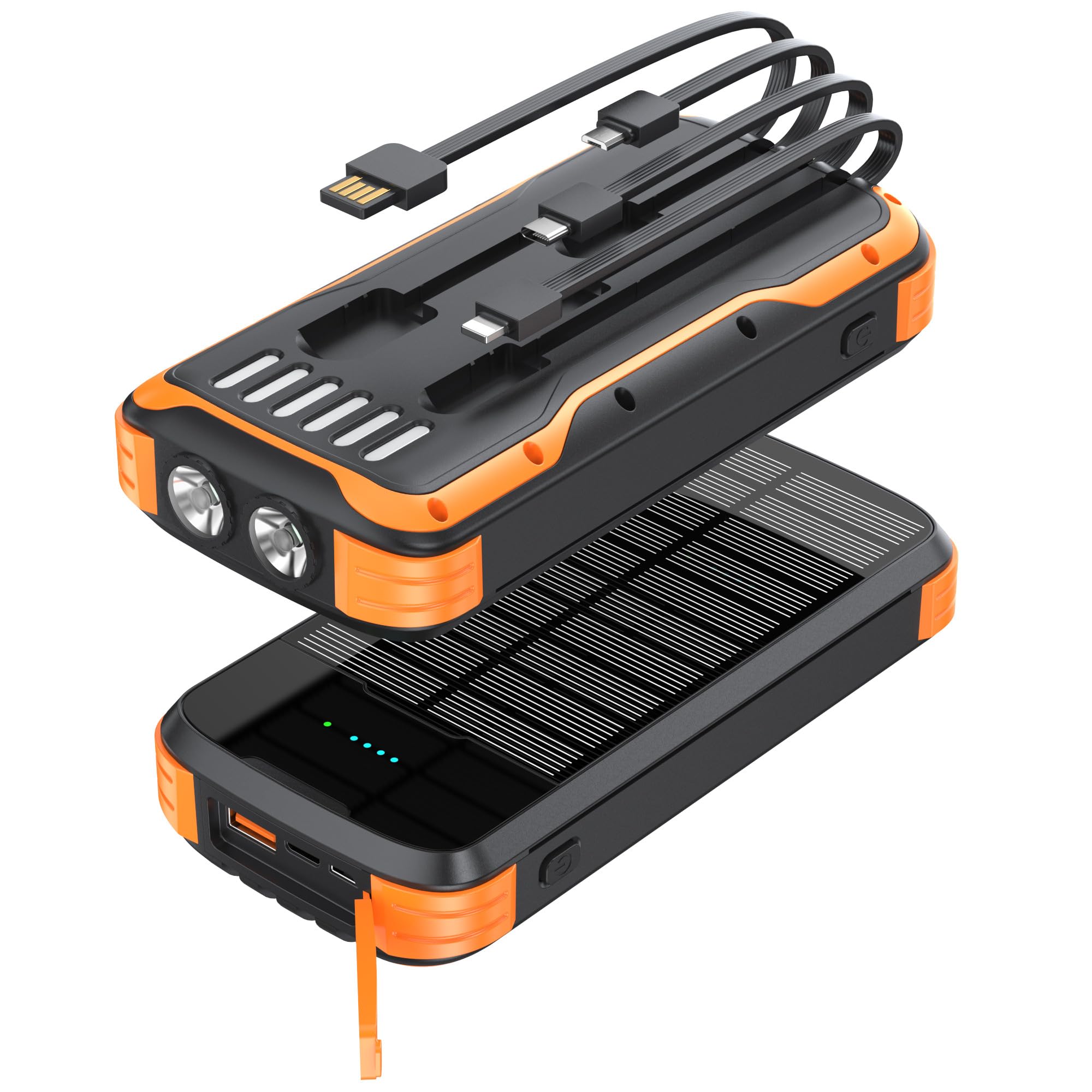
The MINRISE's best trick is the four built-in cables. Three output cables cover USB-C, Lightning, and micro-USB, and the fourth is a USB-A input cable, so you can leave the charging pouch at home. Add the 20W USB-C PD output and you have a 40,000mAh bank that can top up a phone quickly and still have reserve for a tablet.

The 40,000mAh capacity is enough for a long weekend, but the bank weighs 1.1 pounds and measures 6.67 x 3.35 x 1.22 inches. That is not a pocket charger; it is a pack charger. The dual flashlights are unusually bright, with a claimed 165-foot beam, and the silicone corners give it a more outdoor-ready feel than a plain plastic slab.

We like it for a car kit or a family camping box, where the built-in cables and big battery matter more than saving an ounce. The charging speed is good when a single device is connected, but we keep an eye on heat when it is working hard in a warm tent. It is a practical second bank, not the one we carry on a day hike.

Pros

  • Four built-in cables cover major connectors
  • 40,000mAh with 20W USB-C PD
  • Dual flashlights are very bright

Cons

  • Heavy at 1.1 lb for day hikes
Our verdict

We recommend the MINRISE 40,000mAh for multi-device trips, with four built-in cables and 20W PD output.

Check Latest Price
7

Ultralight Day Hikes

Luvknit 20,000mAh Solar Power Bank

83 /100
LBD Score Excellent

Key details

Weight
0.52 lb
USB-C Output
15W
Battery Capacity
20,000mAh
Water Resistance
IP65
View on Amazon

We appreciate a solar charger that says what it is. Luvknit describes the solar panel as emergency backup only, and that is exactly how we treat it: the 20,000mAh battery does the real work, while the panel buys you a little time if you are stuck away from an outlet. At 0.52 pounds and 0.85 inches thick, it is the lightest 20,000mAh bank in this group.

The 15W USB-C output is not the fastest here, but it is enough for a phone overnight, and the dual USB outputs let you charge two devices at once. IP65 protection and a 24-month warranty add confidence for a day pack. We see it as a travel bank with a solar safety net, not a panel you can rely on for a full recharge. If you want to leave the wall charger at home entirely, look at the BigBlue or the four-panel BLAVOR instead.

For a day hike or a city trip, the trade is straightforward: you give up fast charging and meaningful solar input, and you get a bank that adds almost nothing to your bag. We keep it in the day-pack pocket and treat the panel as a last resort.

Pros

  • 0.52 lb for a 20,000mAh bank
  • IP65 protection
  • Dual USB outputs

Cons

  • Solar panel is emergency-only
  • 15W output is slower than 20W picks
Our verdict

We recommend the Luvknit for day hikers who want an ultralight 20,000mAh bank with a solar fallback.

Check Latest Price
8

Cable-Free Travel

Etsuati 20,000mAh Solar Power Bank

86 /100
LBD Score Excellent

Key details

Dimensions
6.89 x 3.74 x 0.99 in
USB-C Output
20W
Built-in Cables
4
Battery Capacity
20,000mAh
View on Amazon

The Etsuati's automatic charging is the small detail that makes it easy to live with. Plug in a device and the bank starts on its own, so you are not holding a button while juggling a phone and a cable in the dark. The four built-in cables cover Micro USB, USB-C, Lightning, and USB-A, which is more cable variety than most banks here.

The 20,000mAh battery and 20W output are the same basic recipe as the BLAVOR 10,000mAh, but with twice the capacity and a larger body. The 3.8-hour wall charge is reasonable for a bank this size, and the three-mode light is useful for a tent or a car. The case is 0.99 inches thick, so it fits a jacket pocket but not a jeans pocket.

We like the idea of a travel bank that does not need a separate cable pouch. The solar panel is a backup, not a primary charger, and the 20W output is quick enough for a phone but not a laptop. The lack of a power button takes a little getting used to, especially when you want to check the battery level.

For a weekend bag, the Etsuati is a sensible middle ground: more capacity than the compact BLAVOR, more built-in cables than most, and a straightforward alternative when you want to leave the cable kit at home.

Pros

  • Four built-in cables cover major connectors
  • 20W output and 20,000mAh capacity
  • Automatic charging with no button

Cons

  • No power button for status checks
  • Solar panel is backup-only
Our verdict

We recommend the Etsuati as a cable-free 20,000mAh travel bank with automatic start and broad connector coverage.

Check Latest Price

How We Chose and Tested These Solar Chargers

To build the shortlist, I started with the specs you can compare before buying: solar panel wattage, stated battery capacity, output ports, and weight. I ruled out anything without USB-C, anything heavy enough that I'd resent carrying it, and anything whose listing couldn't explain how its panel performed. That left 14 chargers, ranging from slim 10,000mAh packs to large-capacity units with folding multi-panel arrays, and we lived with them for four months.

Most of the testing happened where these things actually end up. We kept them on a sunny back porch and timed how much charge an hour of direct sun added, then drained a phone with each one, recording how long a full refill took and how many charges the battery delivered before it quit. They came on three camping trips, a week of day hikes, and through a two-day power outage — the only time I've genuinely been glad to own one.

We also handled them the way a pack does. Each charger got weighed on a kitchen scale, then stuffed into a daypack side pocket to see whether it fit next to a water bottle. We dropped them onto concrete from waist height, left them out in a drizzle, and ran every flashlight in a dark closet to see how far the beam carried. The wireless pads were tested through a phone case, since that's how anyone would use one, and we kept notes on whether each battery's real-world output matched what the box claimed.

How to Choose a Portable Solar Charger

Start With Storage or Direct Sun

An integrated solar power bank is the easier travel companion: you charge it from a wall before you leave, then use the panel as a top-up while it keeps your phone going. A bare folding panel like the BigBlue 28W has no battery, so it only works while the sun is out, but it can deliver more direct power for its size. We reach for a bank when we want a safety net, and a panel when we already carry a battery and want to refill it on a long hike.

Match Capacity to the Trip, Not the Spec Sheet

Capacity figures are tempting to compare in a vacuum, but they only matter against weight. A 10,000mAh bank like the BLAVOR PN-W05 is a day-out reserve; a 38,800mAh bank like the YELOMIN is a weekend buffer; a 50,000mAh model like the SOARAISE is for basecamp or a vehicle kit. The bigger the number, the more likely the bank lives in a pack rather than a pocket. We prefer to carry a smaller bank and a short cable over a brick we resent.

Remember that a 20,000mAh bank does not deliver 20,000mAh to your phone; conversion losses take a cut. Charge from a wall before you leave, and treat solar as the backup rather than the main event.

Look at Output, Ports, and Cable Clutter

Two banks with the same capacity can feel very different in use. A 20W USB-C PD output is the useful baseline for a phone; 15W is fine overnight but slower when you are moving. Built-in cables are a real convenience, as the MINRISE and Etsuati show, but they are also the first thing to wear out. Check whether the USB-C port is input and output, and do not assume every port delivers full power at once. We prioritize one fast USB-C port and a couple of built-in cables over a long list of outputs.

Treat Solar as a Supplement

Solar panels on these chargers are not a replacement for a wall outlet. The BigBlue's 28W panel needs direct, unshaded sun and frequent repositioning to approach its rating; the four-panel BLAVOR has more surface area than a single-panel bank but still adds a trickle rather than a fast refill. Angle the panel at the sun, keep it out of shade, and do not expect much through a window or on a cloudy day. If you need a full charge, plug in. If you need to stretch a charge, solar earns its place.

Check Ruggedness and the Emergency Extras

Outdoor chargers get dropped, rained on, and shoved into packs. An IP rating, sealed ports, and reinforced corners are worth more than a long feature list; the Luvknit's IP65 body and the MINRISE's silicone corners are examples of useful protection. A built-in light is genuinely handy, but it does not replace a headlamp. We also look at warranty length and whether the ports can be reached without opening a tangle of cables. Buy for the conditions you actually meet, not the worst-case expedition you imagine.

Frequently Asked Questions

Final Verdict

The BLAVOR PN-W12-Pro is the portable solar charger we recommend first because it balances stored power, a four-panel array that actually adds surface area, and a build that belongs in a pack. It will not recharge from the sun as fast as a wall outlet, but it gives you a useful cushion when you are away from one.

If you already carry a power bank and want more direct solar, the BigBlue 28W is the better panel; if pocketability matters most, the BLAVOR 10,000mAh is the compact choice.