Best Portable Video Lights for Vlogging of 2026

The difference between footage that looks like a real video and footage that looks like a phone call is usually just light, and the fix is smaller than most people expect. A pocket-size LED on a cold shoe or a phone clip puts a controllable little sun exactly where you need it, even in a dim kitchen at nine at night. What it can't do is forgive a weak battery or a plastic mount.

We've spent the past four months carrying 14 of these lights through ordinary shooting days — desk setups, walk-and-talks, a lot of evening footage lit by one sad lamp — and the details that mattered weren't on the spec sheet. Smooth dimming, steady color as you drop the brightness, a clamp that doesn't creep, a battery that stays bright past the half-hour mark.

Nearly every light here promises adjustable color temperature and a high color accuracy rating, and both are worth having — right up until the mount rattles or the output sags. The picks below run from a tiny pocket fill light to a panel that sits on a desk, and none of them ask you to pay for features you'll never touch.

1

Best Overall

Ulanzi VL-81

94 /100
LBD Score Outstanding

Key details

Mounts
3 cold shoes plus 1/4-inch thread
Battery
3000mAh, 150 min at max brightness
Diffusion
Clip-on softbox
Color Temperature
3200K–5600K
View on Amazon

The softbox is what sold us. A clip-on diffuser at this size is unusual, and the effect on a face is immediate: the VL-81 spreads light evenly instead of leaving a bright patch on the forehead and a shadow under the nose. Behind the diffuser sit 81 LEDs, 41 white and 40 warm, and two dials run color temperature from 3200K to 5600K and brightness across its range — enough to match a tungsten-lit room or lean cool under a window.

Three cold shoes are more useful than that sounds. One holds the light on a camera, a cage, or a small tripod; the other two take a wireless mic receiver or a second VL-81, which is how we double output for a two-person shot without buying a bigger panel. There's a 1/4-inch thread and a cold-shoe foot, so most rigs already have a home for it. If you shoot on a phone, plan on a clamp or a mini tripod to hold it — that's the one piece of kit the VL-81 doesn't solve for you.

The 3000mAh cell is rated at 150 minutes at full brightness and up to 480 at minimum, and it charges over USB-C in about three hours. Set the dial halfway and it covers a shoot day of short takes; keep it at full and it won't outlast a long interview. At 120 grams it doesn't pull a small rig off balance either.

Two of them side by side make a better key-and-fill than one larger panel, and that's the configuration we keep coming back to for sit-down shoots.

Pros

  • Clip-on softbox softens light on faces
  • 3200K–5600K bi-color on two dials
  • Three cold shoes for mics and second lights
  • 3000mAh with 150 minutes at full output

Cons

  • Plastic shell and folding legs are the wear points
Our verdict

The light we hand most vloggers: the snap-on softbox flatters faces, 3200K to 5600K matches any room, and three cold shoes leave room for a mic.
Check Latest Price
2

Best Pocket Light

Ulanzi VL49

93 /100
LBD Score Outstanding

Key details

Mounts
3 cold shoes plus 1/4-inch thread
Battery
2000mAh, up to 300 min
Brightness
5 steps, 20% to 100%
Color Temperature
5500K
View on Amazon

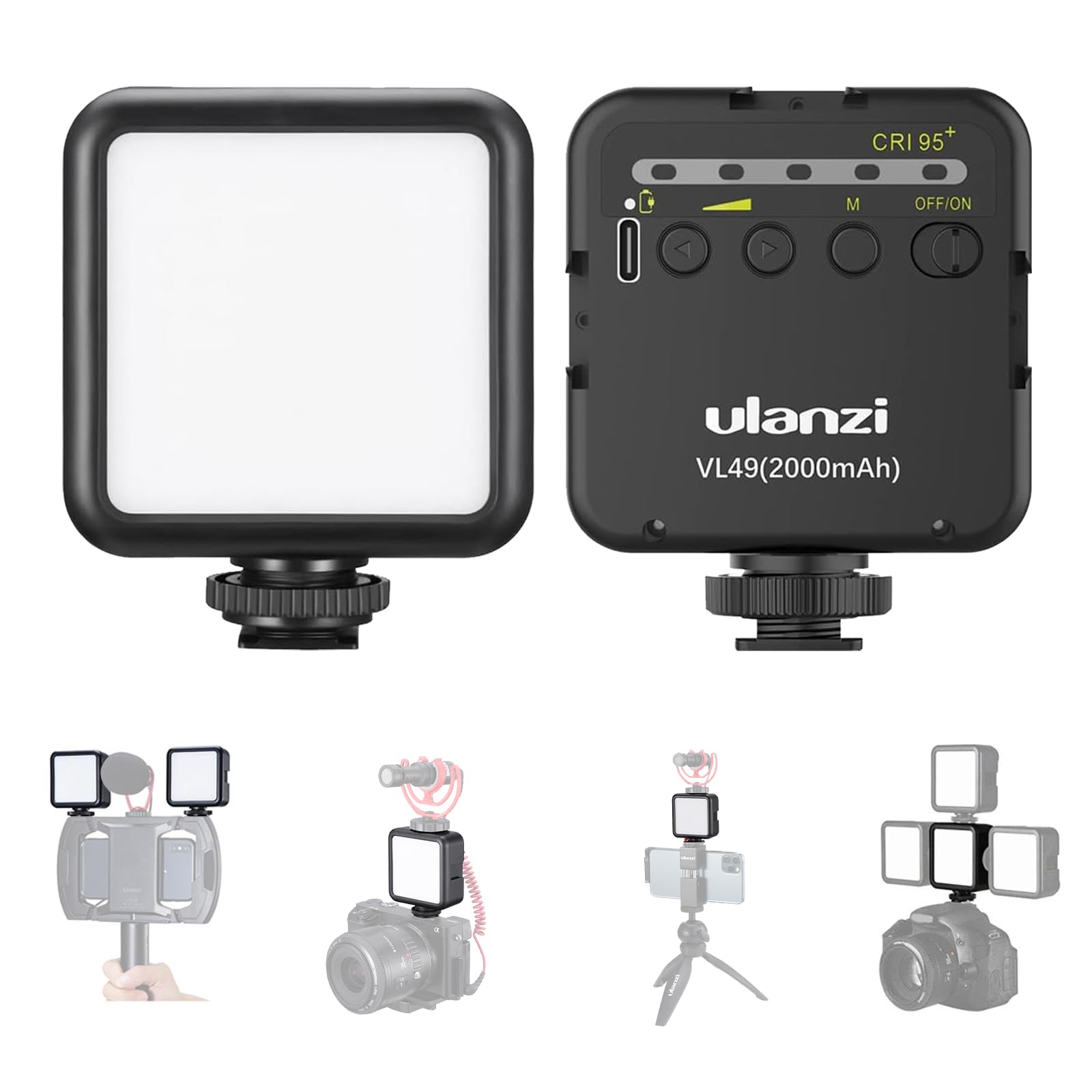
One color temperature, 5500K, and no way to warm it. That's the trade with the VL49, and for a lot of vlogging it's the right one: daylight-balanced output matches a window, a soft white bulb, or an overcast afternoon, and you never have to think about it. Point it at your face and shoot.

What keeps it in our bag is the shape. It's a small cube with three cold shoes of its own, so it can carry a mic on top while it sits on a camera, and it takes a 1/4-inch thread when you want it on a mini tripod or a clamp. Five brightness steps from 20 to 100% cover most rooms. The 2000mAh cell is rated up to 300 minutes, and it runs off a USB-C cable while it charges, which is how we shoot anything longer than a few minutes.

Paired with the VL-81 it makes a tidy two-light rig — one dialed warm, one left cool, both on cold shoes — and on its own it's the light that goes in whatever bag you're carrying. Two of these on a small rig cost less than one of the panels here, which is the calculation that keeps us buying them.

Pros

  • Small enough for a jacket pocket
  • Three cold shoes for mics and stacking
  • Up to 300 minutes, and runs while charging
  • Fixed 5500K that matches daylight rooms

Cons

  • Five brightness steps, no stepless dimming
  • Plastic shell is the wear point over a couple of years
Our verdict

A 5500K pocket cube that clips, mounts, and runs for hours — and the one that disappears into a jacket pocket when the shoot is over.

Check Latest Price
3

Best Upgrade

SmallRig RM120

93 /100
LBD Score Outstanding

Key details

Output
1580 lux, 7W max
Battery
5000mAh, up to 180 min
Color Accuracy
CRI 98+ and TLCI 98+
Color Temperature
2500K–8500K
View on Amazon

1,580 lux out of a 7-watt panel is the number that explains the price. It's a lot of light from something that slips into a jacket pocket, and it's why the RM120 is the light we reach for when there's no window and no time to build a setup.

The rest of the spec sheet is unusually complete for the size: 2500K to 8500K, 360 degrees of hue, 100 steps of saturation, a dozen effects, and an OLED screen that shows exactly where everything is set, so there's no counting button blinks. The metal frame feels like a tool rather than an accessory, and the diffuser in the box takes the edge off for a talking head. The 5000mAh battery is rated up to 180 minutes at full brightness and charges over USB-C.

It mounts by cold shoe or 1/4-inch thread, so it goes on a camera, a cage, or a tripod. At 7.2 ounces it's the heaviest pocket light here; on a bare phone clamp that weight is noticeable, and the VL-81 or the Zecti are kinder to a phone. On a camera or a rig, the weight buys you the metal body and the output, and that's the trade that makes sense to us.

Pros

  • 1580 lux from a 7W metal panel
  • 2500K–8500K with full hue control
  • OLED screen shows exact settings
  • Up to 180 minutes at full brightness

Cons

  • Premium price for a pocket light
Our verdict

Our upgrade pick for color control: 1580 lux from a metal 7W panel, 2500K to 8500K, and an OLED screen that shows exactly what you have set.

Check Latest Price
4

Best for Phone Creators

Zecti ZT-103

87 /100
LBD Score Excellent

Key details

Output
12W, 135 LEDs
Battery
4000mAh, about 2 hours
Effects
21 scene presets
Color Temperature
2500K–9900K
View on Amazon

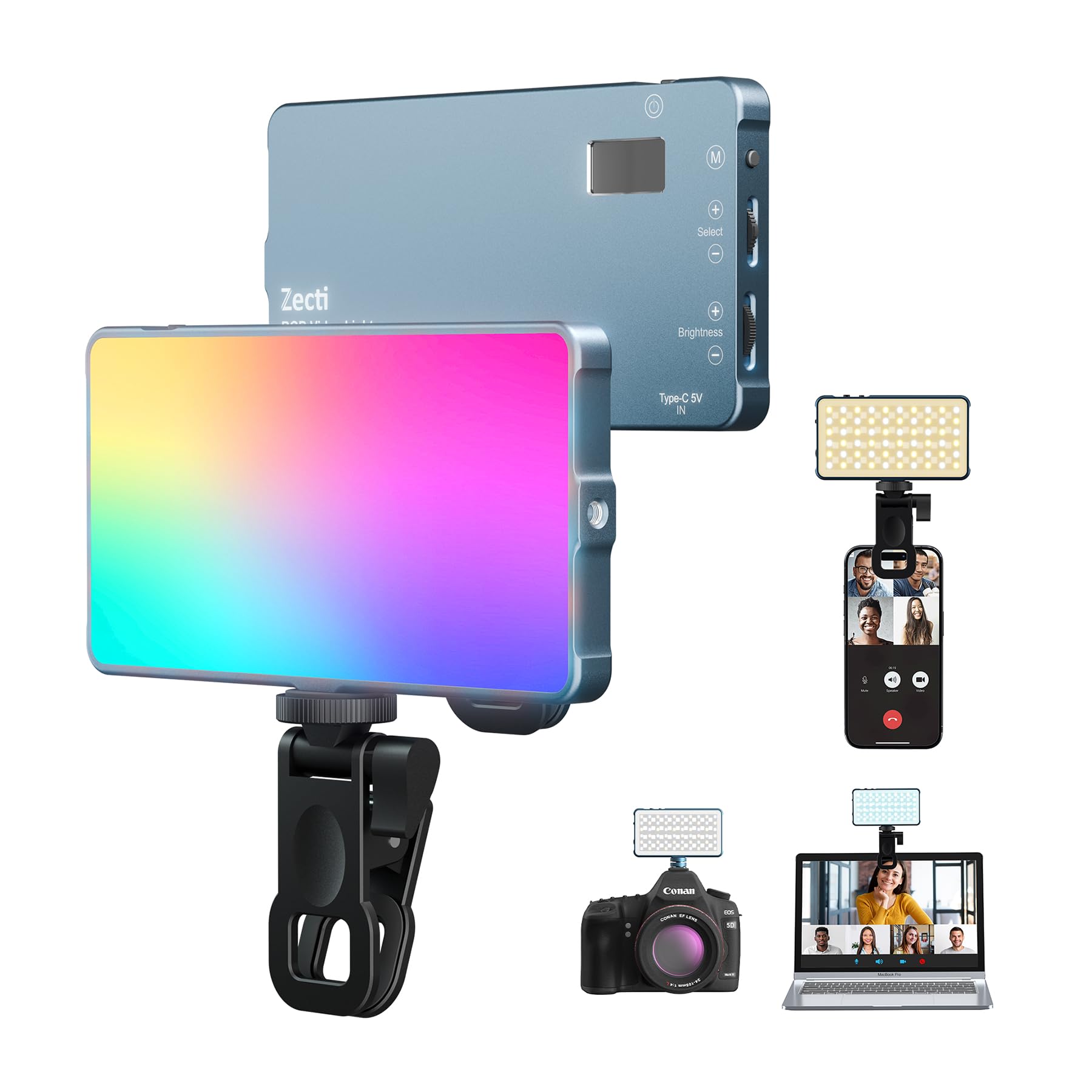
The ZT-103 is the one we point phone-first creators to, because it arrives with both a metal hot shoe and a phone clip — you can move it between a camera and an iPhone without buying a bracket. The clip holds the panel flat against the back of the phone, and output runs from 1% to 100% across a 2500K to 9900K range, the widest here.

That range is the point: white and CCT for ordinary vlogging, then 21 scene presets and full hue control for colored backgrounds and product shots. Twelve watts across 135 LEDs is bright for its size, and the 4000mAh cell is rated at about two hours.

The catch is weight. At 7.5 ounces it's heavy enough to make a bare phone nose-heavy, so brace the phone on a tripod or move the light to the hot shoe of a camera when you can. The bare panel is also harsher up close than the VL-81's softbox; back it off a few feet or dim it for a face.

Pros

  • Phone clip and metal hot shoe included
  • 2500K–9900K, the widest range here
  • 1%–100% dimming with 21 scene presets
  • 12W across 135 LEDs

Cons

  • 7.5 oz makes a bare phone nose-heavy
  • About two hours at full output
Our verdict

The one we point phone-first creators to: a metal hot shoe and a phone clip in the box, plus the widest color range in this group.

Check Latest Price
5

Best Desk Panel

RaLeno PLV-S116

90 /100
LBD Score Outstanding

Key details

Output
12W, 600 lux at 0.5 m
Battery
4000mAh, about 80 min
Diffusion
Edge-lit with 4-layer diffusers
Color Temperature
2500K–6500K in 1% steps
View on Amazon

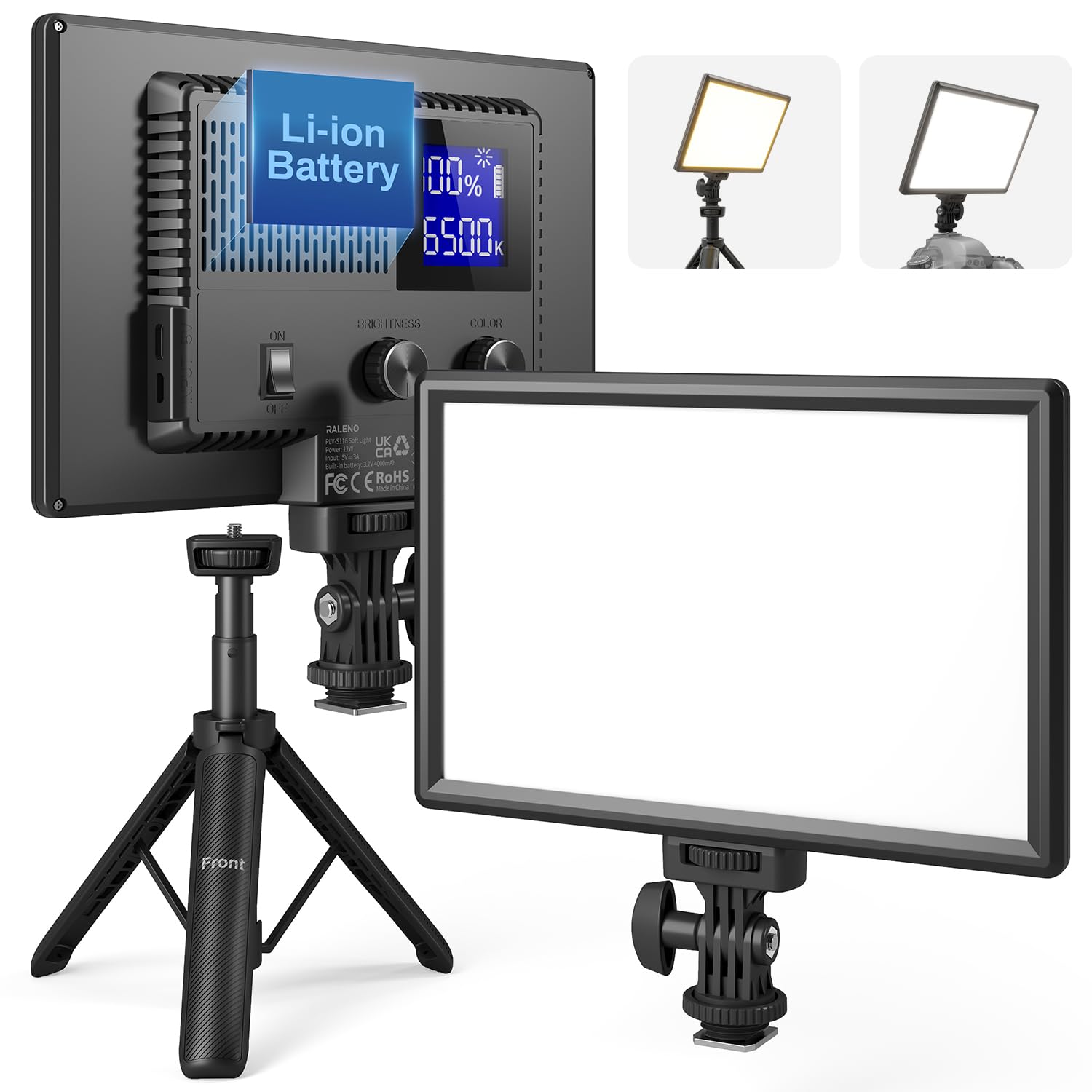
Edge-lit LEDs behind four layers of diffusion is how television panels are built, and RaLeno has done the same at nine inches. The output is even across the face of the light, with no hot center and no glare bouncing off a forehead, so it reads as a soft source rather than a lamp.

Two knobs do the work: brightness from 0 to 100% and color temperature from 2500K to 6500K, both in 1% steps. We like that you can find a setting by feel while you're watching the preview instead of the light, and that the included mini stand runs from about 3.7 to 7 inches — high enough to sit above a laptop screen.

The 4000mAh battery is rated at about 80 minutes at full brightness, the shortest full-power run of the panels here, and the cell is the part of this light we trust least. Run it on USB-C where there's an outlet and runtime stops being the question; the battery then covers a power cut rather than the whole session.

For a desk or a fixed corner of a room this is the pick. At 388 grams and nine inches across it isn't going in a pocket, but a long recording at a desk is where a lot of vlogs actually get filmed, and the light you never have to think about is the one that stays set up.

Pros

  • Edge-lit and four-layer diffused
  • Two knobs with 1% steps and no menus
  • 12W and 600 lux at half a meter
  • Mini stand included

Cons

  • Nine-inch panel: bag or desk only
Our verdict

For a desk or a fixed corner, this diffused nine-inch panel gives even, glare-free light and two knobs you can adjust without looking away from the preview.

Check Latest Price
6

First Setup

ALTSON 60 LED Selfie Light

91 /100
LBD Score Outstanding

Key details

Size
3.9 by 2.8 by 0.78 in, 95 g
Battery
2200mAh, 4 hours at 50%
Color Accuracy
CRI 97+
Color Temperature
2500K–6500K
View on Amazon

The cheapest light here is also the most familiar shape: a pocket-sized clip with 60 LEDs, a CRI of 97+, and a panel that rotates 160 degrees so you can aim it while the clip stays on the phone. For someone working out whether they want to vlog at all, that's a hard combination to argue with.

The battery numbers need reading carefully. The headline is 15 hours, and that's at 10% brightness; at 50% it's four hours, so at a brightness you can actually film with, you're budgeting a couple of hours rather than a day. Four honest hours is a fair trade in a light this small, and the 2200mAh cell charges over USB-C.

The hinge is the part we use most. With the clip on the back of a phone, the panel tilts to put light where the lens is looking, or up at a ceiling in a dim room for a soft bounce instead of a hard hit. That's a stand, a reflector, and a fill light collapsed into something the size of a card case.

Pros

  • CRI 97+ at the lowest price here
  • 160° hinge aims without moving the clip
  • 2500K–6500K with 10 brightness steps
  • 95 g, small enough for a pocket

Cons

  • Plastic clip and dimmer are the wear points
Our verdict

If you are not sure you need a light, start here: a clip-on with CRI 97+ and a panel that tilts to aim, for less than the other phone lights here.

Check Latest Price
7

On-Camera RGB

NEEWER SL90C

90 /100
LBD Score Outstanding

Key details

Body
Aluminum alloy
Output
1090 lux at 0.5 m, 9W
Battery
4000mAh, up to 113 min
Color Temperature
2700K–7500K
View on Amazon

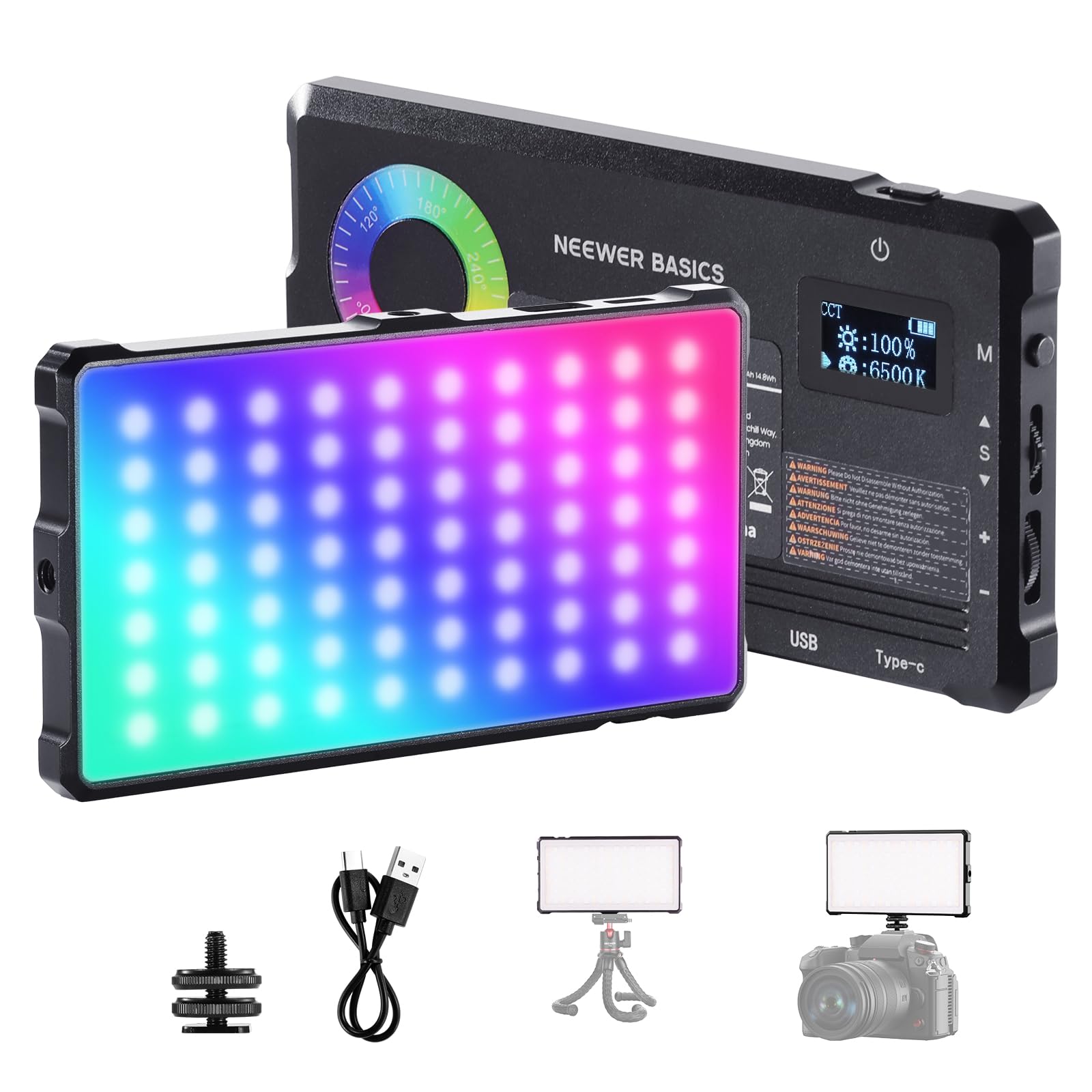
A 5.9-inch aluminum panel, 9 watts, 1,090 lux at half a meter, and a 4000mAh cell rated at 113 minutes at full brightness: the SL90C reads like the on-camera light a working shooter keeps in a bag, and it's priced between the pocket lights and the premium panel here.

It covers 2700K to 7500K, adds HSI color and scene effects, and renders at CRI 97. Mounting is the usual pair — a cold shoe for a camera, 1/4-inch threads for a tripod or clamp — and charging is USB-C. The aluminum body is the reason to expect it to survive knocks that crack plastic shells.

This is the newest light in the group and the one we've spent the least time with, so we're judging it on design and numbers rather than months of use. What those say: if you want an on-camera panel that takes a hit and puts color and CCT on the same controls, this is the sensible middle. If a phone clip matters more than a metal body, the Zecti is the better fit.

Pros

  • Aluminum body with 9W and 1,090 lux
  • 2700K–7500K plus HSI color
  • Up to 113 minutes at full brightness
  • CRI 97

Cons

  • Phone needs a separate clamp or bracket
Our verdict

An aluminum on-camera panel with 1090 lux, 2700K to 7500K, and 113 minutes at full power — a sensible middle for shooters who mount on a camera.

Check Latest Price

How We Tested the Best Portable Video Lights

We started with roughly 60 listings, read the reviews before ordering anything, then narrowed to lights with adjustable color temperature, a built-in rechargeable battery, and at least one real mounting option — a cold shoe foot, a phone clip, or a stand thread. Anything that needed a separate battery door, looked top-heavy in the product photos, or made no claim about color accuracy got cut early. Fourteen lights made it through to testing.

Testing looked like actual shooting days. Each light spent time clipped to a phone on a tripod for talking-head videos, mounted on a camera cold shoe for walk-and-talks at dusk, and propped on a desk for calls and livestreams. We ran every one at full output until it died, then did it again, noting how much the beam faded in the final half hour — a light that dims to candle strength at minute 30 is not a 30-minute light.

We shot the same white shirt at each color temperature setting to see whether warm went orange and cool went blue, then dropped every light to its lowest step to watch for green or pink shifts and jumpy dimming. Mounts were clamped and released a few dozen times and jostled in a tote bag next to a laptop; the ones that crept or stripped showed it fast. Finally, we compared what came in the box against the price, since a light that needs a mount bought separately is never the bargain it looks like.

How to Choose a Portable Vlogging Light

Start with the mount, not the lumens

Where the light attaches narrows the field faster than any brightness figure. A cold-shoe foot slides onto a camera, a cage, or a tripod head; a 1/4-inch thread takes a clamp or a mini stand; a spring clip grabs a phone. Only two lights here arrive with a phone clip — the Zecti and the ALTSON — so if a phone is your main camera, check for that first or plan on a clamp.

The other trap is weight. A panel of seven ounces or more hanging off the top edge of a phone makes it nose-heavy and hard to hold steady, so heavy lights belong on a camera, a cage, or a tripod rather than a bare handset.

Fixed daylight or adjustable color

Plenty of small lights are fixed at 5500K. That's daylight, and it looks right under a window, an overcast sky, or a soft white bulb — which is why the VL49 gets away with it. Point the same light at your face in a room lit by warm lamps and the mismatch shows: you go blue while the background stays orange, and no amount of grading fully separates the two.

Bi-color lights let you dial from roughly 3200K to 5600K and meet the room instead. RGB is a separate purchase: rarely needed for a talking head, genuinely useful for a colored background or a set you're matching.

Read runtime at full brightness

Nearly every battery claim on these lights is an "up to" measured at the dimmest setting. The Ulanzi VL-81 makes the gap plain: 150 minutes at full output, up to 480 at minimum. Plan from the full-brightness number and treat anything longer as a bonus.

If you film for long stretches, pick a light that can run from a USB-C cable while it works — the VL49 does — or one with a cell big enough that a two-hour session doesn't end early, like the 5000mAh pack in the SmallRig RM120.

Soft light beats more light

An undiffused LED a foot from a face leaves a hotspot on the forehead and a shadow under the nose, however many lumens it has. Diffusion is why the VL-81's clip-on softbox and the RaLeno's four-layer panel win their places ahead of brighter bare panels here.

If you buy a bare panel, bouncing it off a nearby wall or dimming it does some of the same work. That's the difference between footage that looks lit and footage that looks like someone turned on a lamp.

Frequently Asked Questions

Final Verdict

The Ulanzi VL-81 is the one we recommend first. Its snap-on softbox does more for a talking head than another few hundred lux, the 3200K to 5600K range works in a kitchen, a hotel room, or outdoors without a gel, and the three cold shoes mean you can add a mic without a second rig.

Want more output and real color control? The SmallRig RM120 is the upgrade worth paying for. Need something that vanishes into a pocket and mounts on a tiny rig? Take the VL49. The rest of the list is a good light for a narrower job, and the buying guide above tells you which job is yours.

One last decision: if a phone is your only camera, start with the mount. A light without a clip is a light you can't use until the clamp arrives.