Best Portable Recorders for Interviews of 2026

An interview is a one-shot take — nobody repeats the best sentence they said all afternoon. Which is why the thing most likely to ruin a good conversation isn't a bad question; it's audio that clips when the subject laughs, hisses in a loud café, or quits at minute 90 when the battery goes. A portable recorder should take that risk off the table.

I've recorded interviews on a phone, a laptop, and a cheap recorder that ate two conversations before I stopped trusting it. Over the past six months we've carried 12 recorders into real interviews — kitchen tables, noisy cafés, hallways — judging sound quality against battery life, pocketability, and whether the price is honest.

One piece of buying wisdom: the enormous storage numbers on the box are measured with voice activation on at the lowest quality setting, so a device promising a thousand hours holds far less at the quality you'd actually use. Newer 32-bit float models solve a different problem: they make clipping nearly impossible when someone gets loud. The picks below are the ones that held up.

1

Best Overall

EVIDA 128GB Voice Recorder

88 /100
LBD Score Excellent

Key details

Memory
128 GB
Weight
3.35 oz
Recording Time
54 hours
Recording Quality
1536 kbps PCM
View on Amazon

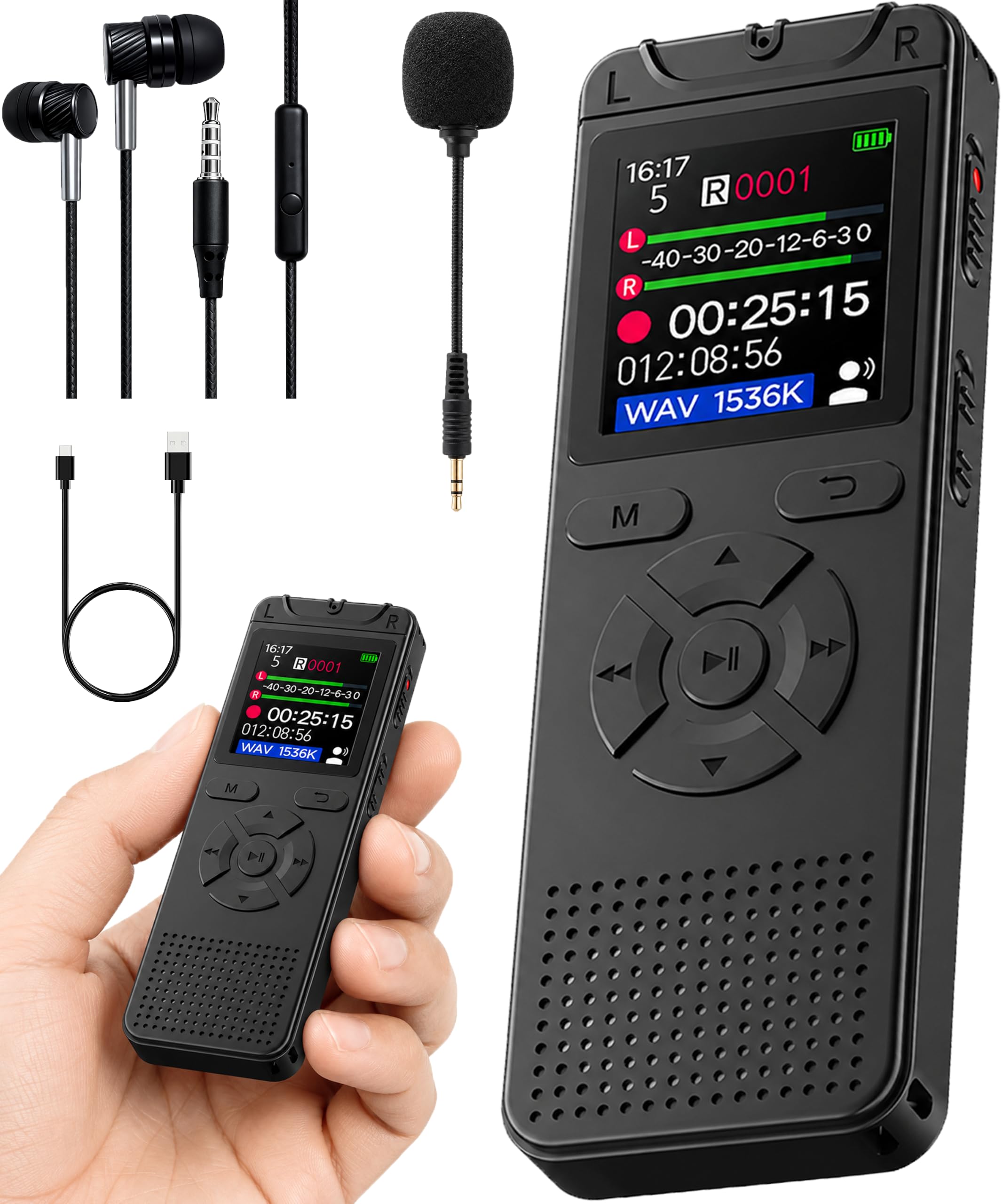
What settled it for us was how little attention the EVIDA V618 asks for. Set it on the table between two chairs, press record, and the noise-cancelling mic gives back a voice that sounds like the person who spoke it rather than a PA announcement, which is the whole job in a sit-down interview. Of the picks here, it's the one we hand to a colleague who has never used a dedicated recorder.

The numbers behind that first impression are the ones that matter on a trip. It's rated for 54 hours of continuous recording and holds 128GB, so a week of hour-long interviews fits without a charger or a laptop, and the files come off over USB as plain WAV. Four folders — A, B, C and D — turned out to be the detail we used most: one folder per interviewee keeps a day's work from becoming a single long scroll.

In use it's forgettable in the right way. Recording at 1536 kbps PCM produced WAVs clean enough to transcribe from without any processing, playback on the device is quick enough to check a name before you pack up, and the 1.5-inch screen tells you what mode you're in without a manual. It charges over a standard USB cable rather than a proprietary dock, which matters more on the road than any feature list suggests.

Against the Zoom H1essential, the EVIDA trades stereo and 32-bit float for battery life and simplicity, and for interview work that is the right trade. Add an 18-month warranty and the fact that nothing else needs buying before your first interview, and it's the easiest recommendation in this group.

Pros

  • Clear pickup of ordinary speaking voices
  • 54 hours of recording per charge
  • Four folders keep separate interviews apart
  • Drag-and-drop WAV files over USB

Cons

  • No headphone jack, so no live monitoring
  • Mono microphone rather than stereo
Our verdict

We recommend it without a caveat for ordinary interview work: it makes a normal voice sound like itself, records for days, and asks nothing of you in the room.

Check Latest Price
2

Best Sound in a Hard Room

Zoom H1essential

82 /100
LBD Score Excellent

Key details

Weight
3.25 oz
Battery
10 hours, 2 AAA
Microphones
X/Y stereo
Recording Format
32-bit float WAV
View on Amazon

One specification explains the price: 32-bit float. In practice it means the recorder captures so much headroom that a whispered answer and a sudden laugh land in the same file without either clipping, and you can raise the quiet parts afterwards without dragging the noise floor up with them. A fixed-gain voice recorder can't do that, however high its bitrate climbs.

That changes how an interview feels. We put it on the table, pressed record and stopped thinking about levels — no gain to guess at before the first question, no second take because someone leaned in. The X/Y mics give a natural stereo picture of the room, and when the room itself was working against us this was the pick that still produced something usable. Of the all-in-one recorders here, it's the one we trust most with a difficult space.

Portability is the other half of the story: 92 g, two AAA cells you can buy at any gas station, and a USB-C port that turns the whole thing into a microphone for a laptop, which is how we handled interviews conducted over video calls. Press record with confidence and sort the levels out in the edit — that's the pitch, and for a conversation you can't repeat, it holds up.

Pros

  • 32-bit float means no clipped answers
  • Stereo X/Y mics capture the room naturally
  • Doubles as a USB microphone for calls
  • AAA batteries, 92 g, genuinely pocketable

Cons

  • Records to a microSD card you supply
  • Menus take an evening to learn
Our verdict

Buy this one if the interview matters more than the budget, because 32-bit float means a whispered answer and a loud laugh both survive to the edit.

Check Latest Price
3

Best for Transcripts

Plaud Note Pro

91 /100
LBD Score Outstanding

Key details

Memory
64 GB
Weight
1.06 oz
Microphones
Four, 5 m reach
Recording Time
30 hours
View on Amazon

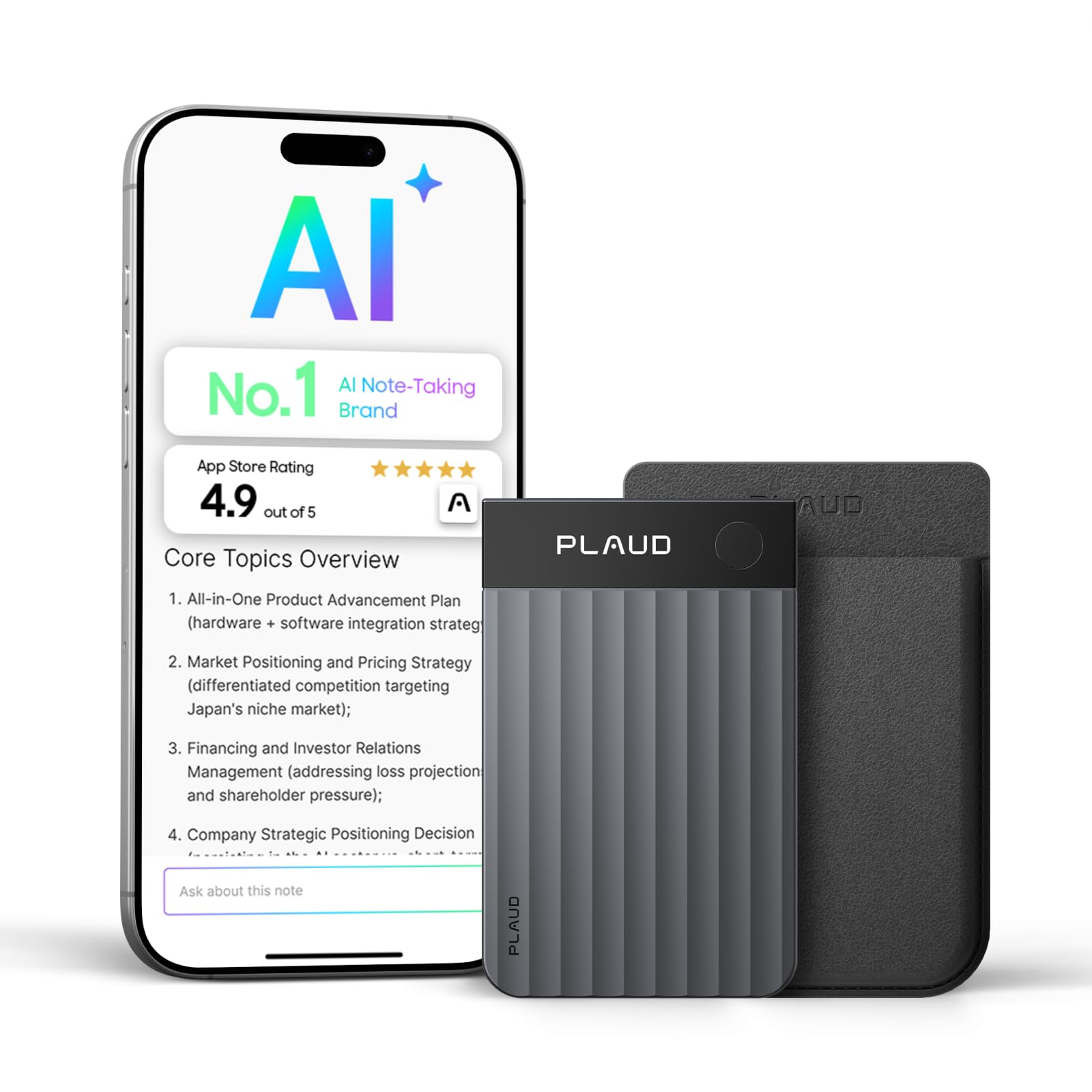
The Plaud Note Pro doesn't hand you a recording so much as a document. Four microphones pull voices from up to 5 meters away, and the app turns the audio into a transcript, a summary and a list of next steps in any of 112 languages. At 2.99 mm and 30 g it disappears into a pocket, or snaps onto the back of a phone with the magnetic case in the box.

Your hands stop working. You stop writing and start listening, because the notes are arriving anyway, and the 30 hours of recording time covers a conference day without a charge. It also picks up phone calls, which matters more than it sounds when half your interviews arrive on a handset.

Accuracy is where devices like this usually fall apart, and the transcripts we checked held up on names, numbers and the shape of a discussion. The summaries are the part that saves an evening — a page you can edit instead of an hour you have to replay — and long briefings come back broken into something you can skim.

The catch is that you're buying a service as much as a device: 300 transcription minutes a month come with it, and a working interviewer will pass that and start paying monthly. If your interviews end up as written copy, that's still the best trade on this page. If you need a broadcast-ready audio file, this is the wrong tool entirely.

Pros

  • Transcript and summary with no extra work
  • Four mics pick up voices across a table
  • 30 hours of recording per charge
  • 2.99 mm and 30 g, easy to carry

Cons

  • Charging faults can appear within months
Our verdict

Our pick when the words, not the waveform, are the deliverable — it hands you a transcript and a summary and takes the notepad out of your hands.

Check Latest Price
4

Best Budget

Cappsu 32GB Voice Recorder

80 /100
LBD Score Excellent

Key details

Memory
32 GB
Weight
1.6 oz
Battery
20 hours
In The Box
External mic, earphone, USB-C cable
View on Amazon

The cheapest recorder in this group also ships with an external microphone, which is not a combination we expected. The Cappsu V02 arrives with a 3.5mm mic, a USB-C cable and an earphone, and for a student recording a handful of interviews or a first-timer who isn't ready to spend Zoom money, that bundle is the entire argument.

It's also the simplest thing here to start. Power on, press record once, press again to stop and save — no menu tree between you and the first question — and the 32GB of memory is built in, so there's no card to lose or buy. Recording at 1536 kbps gives a file clean enough to transcribe from, and the voice-activated mode is there if you want it to sit through a lecture unattended.

It's the recorder we hand out when someone wants to try interview recording without committing to the idea, and ours has behaved exactly like the spare that lives in a drawer for months and then works first time. The two-year warranty is unusually generous at this end of the market and covers the part that worries us.

Pros

  • External mic included in the box
  • 32GB built in, so no card to buy
  • One press starts and saves a recording
  • Two-year warranty at a budget price

Cons

  • Sealed battery can't be swapped mid-day
Our verdict

The cheapest sensible way into interview recording: it ships with a microphone, records at a click, and won't strand you without storage.

Check Latest Price
5

Best for Long Sessions

Tonfarb A20 136GB Recorder

84 /100
LBD Score Excellent

Key details

Memory
136 GB (8 + 128)
Formats
MP3, WAV
Recording Time
68 hours
Recording Quality
1536 kbps PCM
View on Amazon

Two numbers tell you what this one is for: 136GB and 68 hours. That's 8GB inside the recorder plus a 128GB card already fitted, and a battery rated for 68 hours of continuous recording — a week of conferences, site visits or dissertation fieldwork without a laptop or a charger.

The switch is the detail we ended up appreciating most. It slides up to start recording even when the device is off, so there's no boot sequence between you and a conversation that has already begun. That is the thing that matters when an interview starts in a corridor rather than across a table.

Voice quality is where it gives ground. In a quiet room it's perfectly serviceable, but in a noisy one the noise reduction works hard and voices can come back with a slightly processed edge, and of the mid-priced picks here it's the one we trust least with a difficult room. That's the trade: the longest-running, biggest-capacity recorder in this group, not the cleanest.

The rest is housekeeping that turns out to matter. The 1.44-inch screen does its job without crowding the front, the password lock is worth setting on a device that travels with other people's words on it, and A-B repeat makes checking a quote on the way home a two-minute job.

Pros

  • 136GB including a fitted 128GB card
  • 68 hours of continuous recording
  • Starts recording with the power off
  • Password lock for sensitive files

Cons

  • Sealed battery, with no AA fallback
  • Thin manual for a feature-heavy device
Our verdict

For a week of back-to-back interviews away from a charger, its capacity and battery are the reason we keep it in the case.

Check Latest Price
6

Own XLR Mics

Zoom H1 XLR

87 /100
LBD Score Excellent

Key details

Media
microSDXC to 1 TB
Inputs
2 locking XLR/TRS
Battery
10 hours, 2 AA
Recording Format
32-bit float, 96 kHz
View on Amazon

There are no microphones inside the H1 XLR. In their place: two locking XLR/TRS inputs, a 3.5mm stereo input, 32-bit float recording up to 96kHz, and an OLED waveform display that shows you what's arriving before you commit to it. It's a small interface that fits in a coat pocket — 6.4 oz, two AA batteries, and a card slot that takes up to 1TB.

Used as an interview rig it produces the best sound in this article, provided you bring a microphone. A handheld dynamic on the table, or a lavalier on the subject, into a 32-bit float recorder is the most forgiving setup here: nothing clips, there's no gain to guess at, and anything that needs lifting in the edit can be lifted cleanly. It's also the neatest way to take a feed from a conference mixing desk.

The catch is that it's a system rather than a purchase. A mic, an XLR cable, a card and two AA cells all have to arrive with it, and the total lands well past what the pocket recorders cost. If you already own a decent dynamic mic, that arithmetic changes completely: this becomes the pick we reach for first.

Pros

  • Two locking XLR inputs for real mics
  • 32-bit float at up to 96kHz
  • Waveform display confirms levels at a glance
  • Compact despite the inputs, at 6.4 oz

Cons

  • No built-in mics, so you supply everything else
Our verdict

If you already own a decent XLR microphone, this turns it into the cleanest interview rig here; without one, budget for the mic too.

Check Latest Price
7

Backup in a Bag

EVIDA 64GB USB Recorder

83 /100
LBD Score Excellent

Key details

Memory
64 GB
Weight
0.52 oz
Charge Time
2 hours
Recording Time
15 hours
View on Amazon

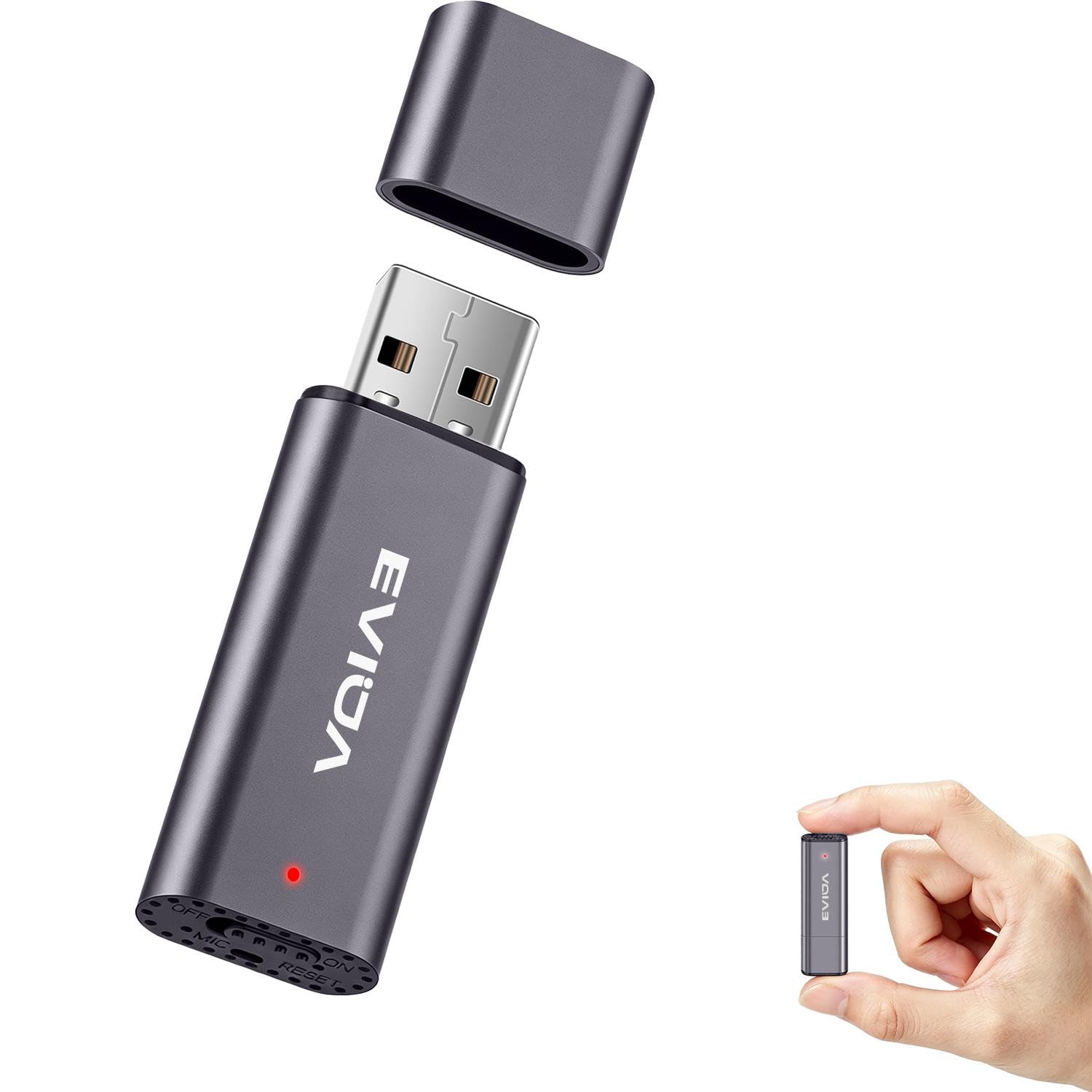
Shaped like a USB stick and not much bigger, the 64GB EVIDA has one slide switch and a USB connector: slide to record, slide to stop, then plug the body into a laptop like a flash drive. The audio is on it as a file, and the whole device doubles as removable storage, which is the sort of unglamorous usefulness that keeps a recorder in a bag.

What it holds is the surprise. 64GB is more interview audio than most people record in a year, a full charge takes about two hours, and the whole thing weighs 14.7 g — light enough that we've found it in a jacket pocket weeks after the last trip. Nothing about it invites fiddling, which is exactly why we keep it in the laptop bag.

That makes it a second recorder rather than a first one, and a good second recorder is worth owning: it's the thing that comes out when the main device is full, flat, or in another bag entirely. The 18-month warranty is the other reason we don't mind relying on it.

Pros

  • 14.7 g and shaped like a flash drive
  • One slide switch starts recording
  • 64GB built in, with nothing else to buy
  • Two-hour recharge over USB

Cons

  • 15-hour battery keeps it to backup duty
Our verdict

A 15-hour thumb-drive recorder we treat as the spare that lives in the laptop bag — cheap insurance when the main recorder is full or flat.

Check Latest Price

How We Tested the Best Portable Recorders for Interviews

We started with a list of nearly 40 models and cut anything without playback, a visible screen, or a battery that could plausibly survive a two-hour session. That left 12 recorders, bought at retail price and used for six months. Each one went through the same three sessions: a two-hour sit-down interview across a kitchen table, a 45-minute conversation in a busy café at lunch, and a walking interview outdoors with the recorder in a jacket pocket. Any unit small enough to disappear on a desk also went to a lecture hall.

Ease of use we judged by skipping the manual: every recorder went from box to recording with only what was printed on the buttons, and we timed that first press and noted whether it took one hand or two. Screen visibility got checked at noon outdoors and again in a dim room, because half these devices are illegible in daylight. For battery life we ran each unit from full charge to shutdown on continuous recording and compared the number with the manufacturer's claim.

Sound quality we compared by recording the same scripted passage on every unit, then listening for hiss, room echo, and what happened when a subject laughed or a dish clattered. Two units record in 32-bit float, so we deliberately ran those sessions far too hot and tried to rescue them in post. Reliability meant re-running the café session twice on anything that produced a dropped or corrupted file; durability was a waist-high drop onto pavement and a week loose in a bag with keys. Value was the last pass — what the file actually sounded like against what it cost.

How to Choose a Portable Recorder for Interviews

Start With the Microphone, Not the Bitrate

A 1536 kbps recording of a voice three feet away in a reverberant room is still a recording of a room. Every pocket recorder here has a built-in mic that works well at arm's length across a table, and every one of them thins out at the far end of a boardroom, so treat the bitrate as a ceiling rather than a guarantee.

Where an external input earns its keep is when you can't sit close. A 3.5mm lavalier puts the microphone on the speaker's collar, and the Cappsu V02 ships with one in the box. If you already own XLR microphones, the Zoom H1 XLR is the only pick here that takes them.

Match the Hours to Your Longest Day

Running time across these picks runs from 10 hours to 68, and the honest question is whether you'll be near a charger at the end of the day. The trap is the other number: advertised hours of storage are always quoted at the lowest quality setting, so a big-capacity recorder that boasts thousands of hours will hold a small fraction of that in the top-quality WAV mode you want for transcription.

For speech, a mid-level setting is plenty and keeps files a sensible size. Check the remaining-time readout before a long session rather than afterwards.

Buy Controls You Can Work in a Hurry

Interviews rarely start at a convenient moment. The recorders here that earn their keep start in one press — the Tonfarb A20 will even start with the power off — while the more capable Zoom H1essential asks you to learn a menu system first. A 32-bit float recorder removes the level setting altogether, which is worth real money when you get one take.

Whatever you buy, make a 30-second test recording and play it back before the interview begins. Printed instructions are the weakest part of nearly every device in this roundup, so learn by doing, at home, not in the room.

Plan How the Audio Leaves the Device

Drag-and-drop over USB is the least dramatic and most reliable route: the EVIDA, Tonfarb and Cappsu recorders all mount as a drive on a laptop, and the Zoom pair write to a card you can hand to an editor. The AI recorders work differently — the value of the Plaud Note Pro lives in the app, so the transcript, not the audio file, is what you carry away.

Decide which of those two you actually need before paying for the other one.

Frequently Asked Questions

Final Verdict

The interview you can't repeat is what decides which recorder you need. For most people that's the EVIDA V618: it makes an ordinary speaking voice sound like itself, runs for the better part of a week, and asks nothing of you in the room. Pay for the Zoom H1essential when the audio has to survive an edit, and go to the Plaud Note Pro when the transcript, not the recording, is the deliverable.