Best Photography Umbrellas of 2026

A photography umbrella is the cheapest way to turn a bare flash into something that looks like window light: bounce it off a silver interior or push it through white fabric, and the hard edges of a shadow soften out. What the listings don't tell you is which ones spread that light evenly across the whole canopy and which ones give up after a season of setups.

I've been shooting portraits in a spare bedroom with one speedlight for years, so I judge these by whether they flatter a face, not by the spec sheet. My team and I spent four months with 16 umbrellas, from 20-inch minis up to a 70-inch monster, across shoot-through, reflective, and parabolic styles — and the differences showed up inside a single session.

One thing worth knowing before you shop: umbrella sizes are usually measured across the arc, not across the opening, so the real spread is smaller than the number suggests. Bigger light is softer light, but only if the umbrella still folds into your bag and stays put on a stand. The picks below are the ones that earned their place.

1

Best Overall

Neewer 41-Inch Parabolic Umbrella

94 /100
LBD Score Outstanding

Key details

Weight
1.9 lb
Diameter
41 in (104 cm)
Included
Diffuser cover and carry bag
Interior
Silver parabolic
View on Amazon

Two modifiers in one box is what put this Neewer at the top of our list: a 41-inch silver parabola with a white diffuser that clips over the front. Bare, the silver lining throws bright, contrasty light with crisp catchlights and a shadow edge you can actually shape. With the diffuser on, the same umbrella flattens out into something close to a softbox. We appreciate that the decision gets made on set, with the light in front of you, rather than at checkout.

The parabolic cut earns its keep beyond the headline diameter. A deeper canopy sends light out more directionally than a shallow umbrella, so you can feather the edge across a face instead of flooding the whole room. Sixteen ribs hold that shape, and the built-in handle slips straight into a bracket's umbrella hole with no adapter to lose. It folds like an ordinary umbrella into the included bag, which is why it goes to location shoots as readily as it stays set up in a studio.

There is a real jump between this and the 33-inch pairs in this guide, and you feel it in the quality of the light: at the same distance, the bigger source wraps further around a face. At 1.9 pounds it is steady on a decent stand, though a sandbag on the base is still the right habit.

Where it gives ground is at the edges of what an umbrella can do. A 41-inch canopy wants a few clear feet behind and beside it, which is easy in a studio and tight in the corner of a living room, where the 33-inch pairs fit more comfortably. And it is an umbrella only: stand, bracket, and sandbag are separate purchases, as they are with every pick here.

Pros

  • Silver parabola and diffuser in one
  • Quick umbrella fold with built-in handle
  • 16 ribs hold the parabolic shape
  • 1.9 lb, so a normal stand holds it

Cons

  • Umbrella only; stand and bracket are extra
Our verdict

Our default pick: a 41-inch silver parabola that turns soft the moment you clip the diffuser on, for one-light portraits anywhere.

Check Latest Price
2

Best Large Light Source

Godox 70-Inch Umbrella

91 /100
LBD Score Outstanding

Key details

Diameter
70 in (180 cm)
Included
Diffuser cover
Interior
White reflective, black backing
Compatible Lights
Godox MS300, SK400, DP/QT and AD series
View on Amazon

Seventy inches of white nylon with a black backing is the largest canopy in this set, and it behaves like it. Put it close to someone and the falloff is gentle enough that the floor and the back wall stay lit along with the person, with no hotspot to flag on a cheek. The black exterior keeps that light off the walls behind the umbrella, which matters more than it sounds in a small studio.

That coverage is why it earns a place here. A white interior bounces a more neutral light than silver, and the included diffuser softens what is already a big source, so you can shoot maternity, couples, or a standing portrait on one light and stop worrying about the shadow side. If the room allows it, nothing else in this guide covers a whole body as evenly.

Compared with our top pick it trades control for reach: the Neewer's parabola lets you shape an edge, where this one simply floods. The useful move is to pair it with something smaller as a fill and let the big canopy be the key, and it is lighter in the hand than the footprint suggests when you are moving it around.

Pros

  • Enormous source for full-body and groups
  • White interior keeps skin tones neutral
  • Diffuser cover included
  • Pops open and packs down fast

Cons

  • Center rod is the weak point at this size
  • Needs a heavy stand and real floor space
Our verdict

Buy this one when you need to cover a whole body in soft light and have the floor space and a heavy stand to do it.

Check Latest Price
3

Best Budget Pair

Neewer 33-Inch Umbrella Pair

92 /100
LBD Score Outstanding

Key details

Type
Translucent white
Count
2 umbrellas
Diameter
33 in (83 cm)
Folded Length
57 cm
View on Amazon

Two matched 33-inch umbrellas arrive as a pair, and that is the whole appeal: a key and a fill that behave identically, for roughly what one of the larger modifiers here costs. Each folds to 57 cm and rides on an 8 mm shaft, so they disappear into a light stand bag and go up in seconds.

Translucent white is the most forgiving way to start. Shoot through the fabric and a bare flash becomes a soft, low-contrast source; spin it around and bounce into the same material for a slightly harder, more directional result. Two of them let you light both sides of a face at once, which is the fastest way to learn what moving a light actually does.

We hand these to a beginner without hesitating, and we keep a pair around as backups long after upgrading. Against the 43-inch combo in this guide they give up size; against the 41-inch parabola they give up control. What they do not give up is usefulness, because matched pairs make two-light portraits simple and there is no learning curve to the hardware.

Pros

  • Two matched umbrellas in one order
  • Shoot-through or bounce from the same fabric
  • Folds to 57 cm
  • Lowest-cost route to a two-light setup

Cons

  • Light frames do not take rough handling
Our verdict

Two matched 33-inch shoot-throughs for about the price of one bigger modifier is the most sensible way to start lighting with a pair.

Check Latest Price
4

Best Starter Combo

Hahawalker 43-Inch Umbrella Combo

85 /100
LBD Score Excellent

Key details

Count
2 umbrellas
Diameter
43 in (109 cm)
Included
1 translucent white, 1 black/silver
Material
Nylon with aluminum shaft
View on Amazon

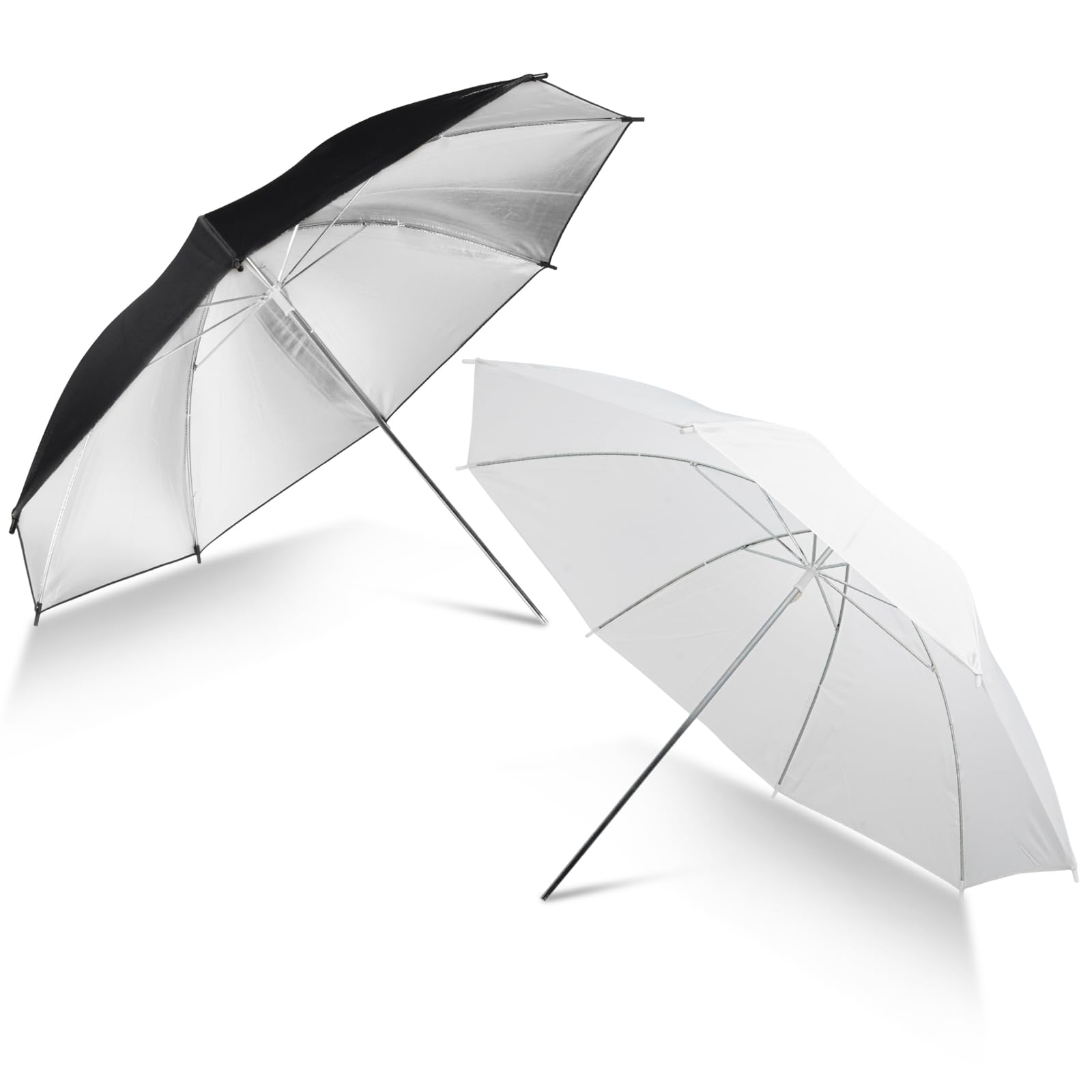
One 43-inch translucent white umbrella and one 43-inch black/silver in the same order is the smartest first purchase we can point to for anyone who has not decided on a look. You get the soft shoot-through and the punchy bounce side by side, at the same size, so the comparison is honest.

At 43 inches (109 cm) these are the largest translucent canopies in this guide, and the extra span over a 33 is more noticeable than the numbers suggest, because the source sits wider and the shadows open up. Nylon over aluminum shafts keeps them light enough to reposition one-handed while you are working out where the light belongs.

Used together, the white makes a soft key while the silver adds a brighter fill that keeps some snap in the shadows. Use the white alone for flattering headshots, the silver alone when you want the background to fall away. Both fold like any umbrella and both drop into a standard bracket, so nothing about the kit needs special handling.

Pros

  • One translucent and one silver at matching size
  • 43-inch canopies open up the shadows
  • Nylon over aluminum keeps it light

Cons

  • No diffuser cover for the silver umbrella
Our verdict

If you have not settled on a look yet, this pair lets you shoot both styles at the same size before you commit to either.

Check Latest Price
5

Best for Shooting on Location

Godox UB-85D Parabolic Umbrella

88 /100
LBD Score Excellent

Key details

Type
Translucent white parabolic
Frame
16 stainless-steel glass fiber ribs
Diameter
33.5 in (85 cm)
Included
Carry bag
View on Amazon

Depth is what separates this from a cheap shoot-through. The 33.5-inch canopy is cut deeper than a standard white umbrella, so the light leaves it with more direction and a faster falloff behind your subject, which is how you get a background to go dark without flagging anything.

It is also the one that travels. Sixteen stainless-steel glass-fiber ribs hold the shape, the canopy collapses into the included bag, and the 33.5-inch span fits beside a speedlight in the car. On a single flash at close range the light is soft enough for a headshot, and we take it on location ahead of the larger picks for exactly that reason.

Mounting is standard: the shaft drops into any bracket with an umbrella hole, though none is included, and the canopy is light enough that a modest stand is fine indoors. Against the 41-inch picks here it is the smaller source, so treat it as a headshot and half-body tool rather than something for a full-length pose.

Pros

  • Parabolic depth shapes the falloff
  • 16 stainless-steel glass-fiber ribs
  • Carry bag included
  • Fast to set up on location

Cons

  • Small source for full-length portraits
Our verdict

A travel-friendly 33.5-inch shoot-through with real shape control, and the one we pack for speedlight work away from the studio.

Check Latest Price
6

Tight Rooms, Products

Cosmos 20-Inch Mini Umbrella Pair

82 /100
LBD Score Excellent

Key details

Type
Translucent white
Count
2 umbrellas
Diameter
20 in (50 cm)
Folded Length
14.5 in
View on Amazon

Twenty inches across and fourteen and a half inches stowed: this is the pair for someone working in a spare bedroom, a basement corner, or over a table of products. Each stows shorter than most lenses and adds nothing worth noticing to a bag.

The fabric is translucent white over an alloy frame, so they work shoot-through or bounced, and two of them will build a small setup in a space where a 43-inch canopy would be touching the walls. The handle is a standard 0.3 inch, so any bracket with an umbrella hole takes them.

Where they shine is a two-source tabletop setup: one at each side, both shot through, gives an even wrap on a product or a pet with no hard shadow on either side. That is a job the bigger picks struggle with in a small room, and it is the use we get out of them most.

Pros

  • Compact enough for a camera bag
  • Two umbrellas for a small two-light setup
  • Standard bracket fit

Cons

  • Coverage runs out at portrait distance
Our verdict

Perfect for tabletop, pets, and headshots in tight rooms; it simply does not have the coverage for a standing subject.

Check Latest Price
7

Starter Two-Light Kits

FIEWSZIHU 33-Inch Four-Pack

84 /100
LBD Score Excellent

Key details

Count
4 umbrellas
Diameter
33 in (84 cm)
Included
2 translucent white, 2 black/silver
Material
Nylon with aluminum shaft
View on Amazon

Four umbrellas arrive in one order: two 33-inch white translucent and two 33-inch black/silver reflective, nylon over aluminum shafts, all folding down into a stand bag.

That is a complete two-light setup plus spares. White shot through as a soft key, silver bounced for a crisper fill, and a second pair standing by if one gets bent or you want a hair light. For someone about to buy two lights who has not worked out what goes on the stands, it removes the decision entirely.

The two styles do genuinely different work, and having both at the same size makes that obvious fast. The translucent pair gives the softer, more forgiving light; the silver pair throws further and harder, which suits a background or a rim where you want the light to carry.

This is the kit we point to for learning on, for equipping a first two-light setup, or for keeping spares in a small studio, not the last umbrellas you will own. Once the work starts paying, one of the better-built picks here will last longer and light better.

Pros

  • Four umbrellas: two white, two silver
  • Covers both looks in one order
  • Nylon over aluminum shafts

Cons

  • Frames feel light; finish is basic
  • 33 inches is the size ceiling here
Our verdict

The least expensive way to equip two lights with both umbrella styles, as long as you accept lighter hardware.

Check Latest Price

How We Tested Photography Umbrellas

We built the shortlist by pulling umbrellas in the sizes and styles photographers actually buy — 20 to 70 inches, shoot-through white, silver reflective, and a couple of parabolic cuts — then filtering out anything with a plastic shaft, a bare hub, or no carry bag. Sixteen made the cut.

Testing ran four months. Most sessions happened in a spare bedroom I use as a studio, with a single speedlight on a stand and a subject sitting a few feet away; the rest came from a garage tabletop setup for product shots and a handful of breezy afternoons outdoors to see how each one handled wind.

We set each umbrella up alone and timed it, noting whether the shaft locked down flat or spun on the mount, and measured the open canopy both across the arc and across the opening to see how the claimed sizes held up. Then we shot the same portrait and the same still life under every one, comparing center brightness against edge falloff, how soft the shadow edges stayed, and whether a diffuser cover slipped or sat tight.

Build got the same treatment: we opened and closed each umbrella repeatedly and watched the stitching at the rib tips and the rivets at the hub, checked the reflective coating for flaking and the fabric for creases that never came out, and weighed every one on a kitchen scale before folding it back into its own bag. The best earned their keep on reinforced tips, even coverage, and a fold that didn't fight back.

How to Choose a Photography Umbrella

Start with the lining, not the size

A translucent white umbrella is shot through: the flash fires past the fabric into your subject, spreading into a soft, low-contrast source. A reflective umbrella bounces the flash off its interior first, white for a neutral bounce and silver for more output and a crisper shadow edge. Parabolic versions are cut deeper so the beam stays more directional, which puts falloff under your control.

The trap is buying silver for the brightness and expecting soft portraits. Silver without a diffuser is contrasty, and a highlight on a forehead shows it; the Neewer 41-inch settles this by including the diffuser, where the Hahawalker silver umbrella does not, so plan to add one or use it as a fill.

Match the canopy to your subject

Softness comes from the size of the source relative to the subject, so a 20-inch umbrella close in can be softer than a 43-inch one across the room. Roughly: 20 to 24 inches for tabletop, pets, and headshots in tight rooms; 33 inches for head-and-shoulders and half-body work in a normal room; 41 to 43 inches for standing portraits; 70 inches when a whole body and the wall behind it have to stay lit.

Buy the biggest canopy you can physically set up and still get close to someone, and check the folded length as well as the diameter, because that is the number that decides whether it travels with you.

Frames, ribs, and what fails first

These umbrellas share a basic anatomy: a thin shaft, folding ribs, and a sliding collar that locks the canopy open. The collar and the rib hinges carry the load and are what give out first. A canopy that will not stay open, a bent rib, or a kinked shaft below the collar ends the umbrella's working life, so handle it by the shaft rather than the fabric when you open it.

Rib count is your best proxy for shape: 16 ribs hold a rounder, more even canopy than 8. And weight the stand, because a big canopy on a light stand is a lever waiting for a breeze.

Packing, mounting, and what is not in the box

None of the umbrellas here come with a stand or a bracket, and that is normal for the category: the umbrella is the modifier and the holder is separate kit. Budget for an umbrella bracket with a 1/4-20 thread and an umbrella hole, plus a stand rated for the canopy you chose.

Check the shaft diameter and the folded length before ordering. The Neewer pair folds to 57 cm, the mini Cosmos pair to 14.5 inches, and a 70-inch canopy packs down longer than either, which matters if the car is small.

Frequently Asked Questions

Final Verdict

The Neewer 41-inch parabolic is where we start anyone buying a first serious umbrella. The silver interior gives you a controlled, contrasty light, the diffuser turns it soft for faces, and the whole thing folds into a bag you can carry. It is the one purchase here that answers both the punchy and the flattering version of the question.

If your subjects are standing and you have the room, the Godox 70-inch buys coverage nothing else in this set matches, provided you also buy a stand heavy enough to hold it. And if you are equipping two lights on a tight budget, the matched Neewer 33-inch pair is the sensible place to begin.