Best Photography Backdrops of 2026

The first time I taped a bedsheet to my living room wall for a product shoot, it sagged in the middle, caught every bit of window light, and photographed the color of a rainy sidewalk. A real backdrop fixes that in one move: a controlled, evenly lit surface behind your subject so the camera stops arguing with the room. The trouble is that backdrops look identical online and behave very differently once they're hanging.

Over the past six months, my team and I hung, clamped, steamed, and re-hung 12 of them — fabric sheets with rod pockets, multi-panel curtain sets, seamless paper, and a booklet of palm-size double-sided cards for tabletop shots.

Two things surprised me. Light colors are the hardest to get right: a thin white fabric turns gray in front of a window and shows every crease as a shadow. And a wrinkle-free claim is a starting point, not a promise — most of what I hung needed steam. The picks below cover studio work, party draping, and tabletop, so there's a fit for however you shoot.

1

Best Overall

GFCC 8 x 10 ft White Backdrop

88 /100
LBD Score Excellent

Key details

Size
8 x 10 ft
Weight
2.23 lb
Material
100% polyester
Rod Pocket
3.2 in
View on Amazon

Plain white, 8 by 10 feet, one rod pocket, no stand: this is the most ordinary backdrop in the group, and that is the reason it leads. The size covers a standing subject head to toe without a second panel, and white is the most cooperative color to light. Bounce a strobe into it and it reads bright, pull the light back and it falls toward grey, gel it and you have a color nobody had to stock.

Two details earn it more than the size does. It is finished on both sides, so a scuff on the front does not end a shoot; flip it and keep working. And at about a kilogram it is light enough to hang from a tension rod in a doorway when the stand stays in the closet, which is how a lot of home sessions actually start.

Creases are the tax on any folded fabric, and this one arrives folded, so we give it a pass with a steamer or a low iron before the first session and hang it rather than stuffing it back in the bag between shoots. White also shows every fingerprint and floor mark, so keep the hem off the ground until the frame is set.

Buy the white first. A black or a warm grey is a look; white is the one that can become any of them, and it is one of the least expensive full-size ways to start.

Pros

  • Covers full-body shots at 8 x 10 ft
  • Reversible and machine washable
  • 3.2-inch pocket fits most stands
  • Light 1.01 kg for a doorway rod

Cons

  • Arrives folded and needs steaming
  • No stand or clamps included
Our verdict

We recommend it as the default backdrop: an affordable 8 x 10 white that covers full-body shots, reverses when it gets marked, and washes clean.

Check Latest Price
2

Best for Portraits

Kate 5 x 7 ft Microfiber Backdrop

92 /100
LBD Score Outstanding

Key details

Care
Machine wash
Size
5 x 7 ft
Weight
1.32 lb
Material
Microfiber
View on Amazon

The microfiber is the first thing we noticed. It hangs like a light velour, soft enough to drape over a chair back, and it absorbs light rather than throwing it back, so there is no sheen and no hot spot where the key light lands.

At 5 by 7 feet it is a portrait backdrop, not a studio wall. That is head-and-shoulders or seated framing with a little room to spare, which is what most home shooters actually need; it hangs from a single top pocket, weighs 0.6 kilograms, and goes through the washing machine when a shoot gets messy.

Two things temper it. Folded shipping creases in microfiber can be stubborn, so steam it or tumble it on low with a damp towel the night before rather than the morning of. And the grey runs cool, closer to blue-grey than a warm neutral, so test it under your own lights before a session you are being paid for.

Where it stops is anything below the waist. For headshots, newborns, and a corner of a living room, it is the fabric we hand people first.

Pros

  • Velvet-soft microfiber kills reflections
  • Machine washable and just 0.6 kg
  • Soft grey flatters skin tones

Cons

  • Too small for full-body shots
  • Ships folded with stubborn creases
Our verdict

Buy it for headshots and seated portraits: a soft, light-absorbing 5 x 7 that steams flat, washes clean, and asks very little of a small room.

Check Latest Price
3

Best Large Backdrop

CPLIRIS 10 x 20 ft Black Backdrop

92 /100
LBD Score Outstanding

Key details

Size
10 x 20 ft
Color
Black
Material
Thickened polyester
Mounting
Dual rod pockets, 10 ft or 20 ft
View on Amazon

Two rod pockets, one along each long edge, are the whole idea. Hang it from one and you have a 20-foot-wide wall; hang it from the other and the same cloth becomes a 20-foot drop that is 10 feet wide. Nothing else in this group gives you two backdrops from one piece of fabric, and we like that flexibility best for group setups.

For group photos, a full-body setup, or covering a bad wall in a rental, that choice is worth more than any finish. The thickened polyester holds most backlight at bay, folds into a bag smaller than a sleeping bag, and can be washed and steam-ironed on the back when it creases.

Handling a panel this size alone is the real cost. Drape it with a helper or a couple of clamps, and give yourself time to steam the fold lines, because this much fabric holds a crease longer than a small drop. A bright window directly behind it can still lift the black toward grey.

It is a workhorse rather than a precision tool: buy it for coverage, not for a seamless studio sweep.

Pros

  • Hangs 20 ft wide or 20 ft tall
  • Thick polyester blocks most backlight
  • Folds small and washes clean

Cons

  • Awkward to hang without a helper
  • Fold lines need a long steam
Our verdict

Pick it when one backdrop has to cover a group or a whole wall: it hangs 20 feet wide or 20 feet tall and blocks most backlight.

Check Latest Price
4

Best Seamless Paper

Kate Seamless Paper Roll, Arctic White

88 /100
LBD Score Excellent

Key details

Width
106.8 in
Weight
13 lb
Material
Seamless paper
Roll Length
32.8 ft
View on Amazon

Every other pick here is cloth. This is a 106.8-inch-wide roll of seamless paper, 32.8 feet of it on a cardboard core, and it does the thing fabric cannot: an unbroken sweep from wall to floor with no hem, no seam, and no fold lines.

For full-body studio work, that sweep is the difference between a background and a set. The matte surface kills glare, the roll is wide enough to fill a frame edge to edge, and the color holds from the first foot to the last. It is also the heaviest thing here at 13 pounds and the priciest by a wide margin, so it wants a proper stand and somewhere to stand upright between shoots.

Paper is a consumable. A scuff, a tape mark, or a crease running the wrong way can retire a section of the roll, and once it tears there is no washing it back, so we plan on replacing it rather than cleaning it. The arctic white also runs cool rather than neutral, reading slightly blue next to warm props or warm skin.

For a fixed studio with a permanent stand, that trade is easy to justify; for a backdrop that lives in a closet, it is not.

Pros

  • Seamless floor-to-wall sweep
  • Matte, glare-free surface
  • Wide 106.8-inch roll fills full-body frames

Cons

  • Tears and scuffs retire the roll
  • 13 lb roll needs a sturdy stand
Our verdict

Buy the roll if you shoot in a fixed studio and want a fold-free sweep; treat it as a consumable, because that is what it is.

Check Latest Price
5

Best for Events

NSSONBEN 4-Panel Black Curtain Backdrop

90 /100
LBD Score Outstanding

Key details

Panels
4 panels, 5 x 10 ft each
Material
Silky polyester
Rod Pocket
4 in
Total Size
20 x 10 ft
View on Amazon

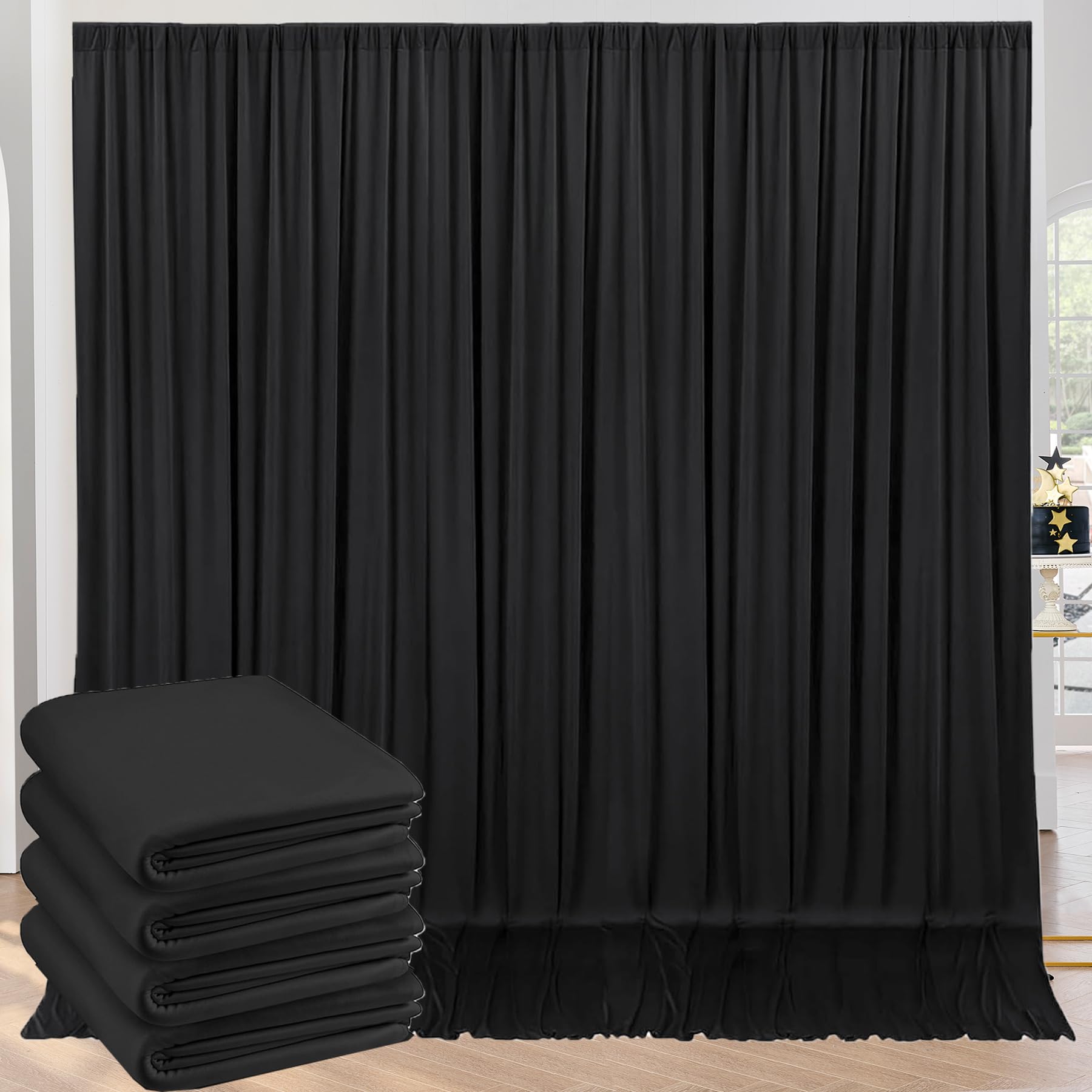
Four panels, twenty feet across, all in black: this is the backdrop you buy when the room itself is the problem. Each panel measures 5 by 10 feet with a 4-inch rod pocket, so all four can run across a wall, or two can sit behind the cake while the rest wait in the bag.

What we appreciate most is that they hang ready. The silky polyester comes out of the package with almost no creasing, drapes in soft verticals instead of stiff folds, and photographs as a deep, even black rather than a grey haze. At a birthday, a graduation, or a photo booth at a reception, that saves the hour you would otherwise spend steaming.

Seams are the trade-off: where two panels meet you get a visible join, which matters if you need one continuous field rather than a draped wall. The fabric is light, too, so keep the light in front of it, because a bright window behind will show through.

Pros

  • Four 5 x 10 ft panels cover 20 ft
  • Hangs smooth straight from the bag
  • Soft drape, not stiff plastic

Cons

  • Visible seams where panels meet
  • Light fabric shows backlight
Our verdict

For parties and events rather than studio work: four wrinkle-free black panels that turn a plain room into a photo wall.

Check Latest Price
6

Best for Product Photography

MDAOCRY 12-Sheet Product Backdrop Kit

89 /100
LBD Score Excellent

Key details

Sheets
12 double-sided, 24 patterns
Surface
Wipe-clean matte
Includes
2 T-stands, 2 clamps, tote
Sheet Size
16 x 11.5 in
View on Amazon

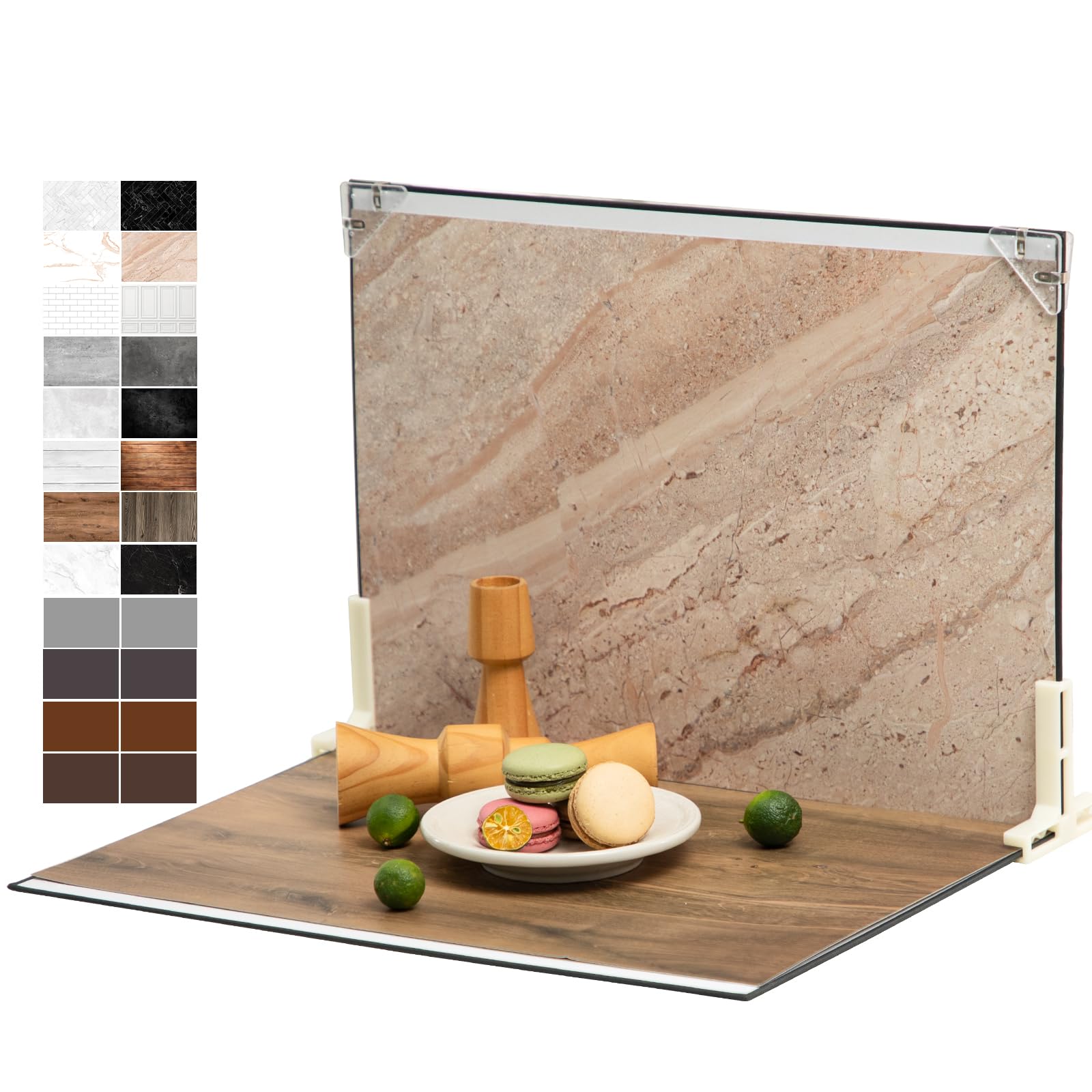
Open the tote and you get twelve printed sheets, a foldable black-and-white board, two small T-stands, and two corner clamps. That is a floor-and-wall corner you can build on a kitchen counter, which is exactly what small-product photography needs.

The prints are the pleasant part. Every sheet is double-sided, so twelve boards give you twenty-four scenes, and the marble, wood, and plaster patterns photograph as texture rather than as flat printed color. The matte surface wipes clean with a damp cloth after a shoot, which matters the first time a sauce bottle leaks.

Scale is the honest limit. At 16 by 11.5 inches, a candle, a watch, or a jar of cream fits comfortably; a full place setting does not. The stands are light, so keep them on a stable surface and out of a draft.

Pros

  • 24 patterns across 12 double-sided sheets
  • Stands, clamps, and tote included
  • Wipe-clean matte surface

Cons

  • 16 x 11.5 in limits you to small items
  • Lightweight stands need a steady surface
Our verdict

For jewelry, cosmetics, and other small items, this is the kit to get: twenty-four scenes, stands and clamps included, all in one bag.

Check Latest Price
7

Best Warm Grey

HABOKE 8 x 10 ft Grey Microfiber Backdrop

90 /100
LBD Score Outstanding

Key details

Size
8 x 10 ft
Weight
1.76 lb
Material
Microfiber
Rod Pocket
Fits up to 3.1 in
View on Amazon

Grey is where most portrait work lives, and this one has a surface rather than just a color: a soft microfiber with a faint mottle that photographs closer to painted canvas than to flat cloth.

At 8 by 10 feet it covers a standing subject, the rod pocket takes a stand up to 3.1 inches, and 0.8 kilograms hangs from almost anything. Steam it once out of the fold and store it on the rod rather than folding it back into a bag.

Two things to know. The fabric is thin, so keep the key light in front of it; a bright window behind will lift the grey and soften the edge of your subject. And the color is a warm neutral that shifts under different light, reading beige under tungsten and cooler in daylight, which is fine for portraits and awkward if you need an exact match across sessions.

Where it earns its place is skin. The low-sheen grey flatters faces without the cold cast a bluer grey throws, and the faint texture makes the floor-to-wall transition look deliberate rather than improvised.

Pros

  • Mottled grey reads like painted canvas
  • Light 0.8 kg and easy to hang
  • Rod pocket fits stands up to 3.1 in

Cons

  • Thin fabric lifts in backlight
  • Warm grey shifts under different light
Our verdict

Choose it for portraits when you want a warmer, textured neutral than a flat grey sheet, and light it from the front.

Check Latest Price
8

Wedding Decor

ESGOTBME Ivory Curtain Backdrop, 2 Panels

91 /100
LBD Score Outstanding

Key details

Panels
2 panels, 5 x 10 ft each
Weight
100 GSM
Material
Nylon tulle, polyester lining
Rod Pocket
6.2 in circumference
View on Amazon

These hang like a curtain rather than a studio drop, which is the point. Two 5-by-10 panels of nylon tulle with a polyester lining, light enough to move when someone walks past, soft enough to puddle slightly where they meet the floor.

The wrinkle story is what sells us on them. Pull them from the bag, hang them, and give them a day; the packing creases fall out on their own, which is more than most fabric here can claim. The ivory is warm without going yellow, and the roomy rod pocket slips over a standard curtain rod, a backdrop stand, or a length of rope in a pinch.

Studio work is where they stop. Two panels give you ten feet of width, not twenty, and the tulle is delicate enough that metal clamps and a hurried assistant are a bad combination. They are decor that photographs beautifully, not a seamless surface.

For a wedding, a shower, or a soft corner behind a portrait, the fabric reads dimensional rather than like a flat painted wall, and guests treat it as part of the room instead of as equipment.

Pros

  • Hangs wrinkle-free within a day
  • Warm ivory that does not yellow
  • Soft, light drape for events

Cons

  • Two panels cover 10 ft, not 20
  • Delicate tulle needs gentle handling
Our verdict

Buy them for weddings and showers where the backdrop is part of the decor: two ivory panels that hang wrinkle-free and drape beautifully.

Check Latest Price

How We Chose and Tested Photography Backdrops

We started with a list of about 40 backdrops and cut it down by what matters when you're standing behind a camera: the size once it's actually unrolled, whether it hangs from a rod pocket, grommets, or nothing at all, fabric versus seamless paper, and price per square foot. Twelve made the cut, from a single small portrait sheet up to a 20-foot-wide panel set, plus that booklet of palm-size cards for tabletop work.

Each one got hung the way you'd hang it at home — over a stand with clamps, threaded through a rod pocket, taped to a wall — and we watched how it sat in the first 30 minutes. We photographed the surface straight out of the package, after hanging, after steaming, and after a pass with a low-heat iron, which told us whether a crease was cosmetic or permanent. Panel sets and paper rolls got extra scrutiny at the seams and rolled edges, since that's where a lump shows up in the frame.

For color and appearance, we shot a gray card and a set of paint swatches against each backdrop and compared the files on a calibrated monitor, watching for a cast or a shift from what our eye saw in the room. We held every backdrop in front of a bright window to see how much of the frame behind it bled through — the real test for white and ivory. Thickness we judged by folding, unfolding, and hefting a few in hand, because a heavier fabric wrinkles less but is a nuisance to carry to a shoot.

Durability came last: we folded and unfolded each one repeatedly, stuffed it back into its bag, and checked hems, seams, and corners for fraying or separation. Value wasn't the sticker price alone but whether the thing still looked clean after being packed, hung, and packed again. Most of these are still in rotation, and the ones that stayed on the stand are the ones below.

How to Choose a Photography Backdrop

Match the Size to the Frame, Not the Room

Measure the widest pose you plan to shoot, then add a foot on each side. A 5 x 7 backdrop covers a head-and-shoulders or seated subject; 8 x 10 is the smallest size that fits a standing adult with room to crop; 10 x 20 is for groups, or for turning a whole wall into a background.

The listed figure is the fabric itself, and you lose width to the rod pocket and to any cloth draped at the sides. A 5-foot panel gives you closer to 4 feet of clean background, which is the single most common surprise when a backdrop arrives.

Fabric Folds, Paper Sweeps

Fabric is what most people want: foldable, washable, and it travels. Polyester and microfiber read differently under light, with microfiber softer and less reflective, which is why it flatters skin. Seamless paper gives an unbroken wall-to-floor curve with no hem and no fold, and nothing in fabric matches that.

Paper also scuffs, tears, and cannot be cleaned, so it suits a stand that never comes down rather than a bag in the closet. We treat it as a consumable purchase, not a one-time one.

Opacity Matters More Than Thickness

A thick fabric is not automatically opaque, and a thin one is not automatically sheer. What decides it is whether light is coming from behind: a window, a bright wall, a second flash. Hold a phone flashlight behind a swatch before you commit.

In practice, hang every backdrop against a wall when you can, and flag any window with a blackout cloth. White shows a glow first, grey next, and black last.

Check the Pocket and the Hardware

Most listings sell the cloth alone, so read the rod pocket measurement and match it to your stand's crossbar. Around 3 to 3.2 inches is common and fits most kits; a 4-inch pocket is generous enough to slide over a curtain rod.

With no stand, plan for a tension rod in a doorway or clips on an existing rail, and keep the load light. A fabric sheet is fine on a tension rod; a 13-pound paper roll is not.

Expect a Color Shift

White backdrops are not all the same white. Arctic white runs cool, ivory runs warm, and grey can lean blue or beige depending on the dye and the light hitting it. A backdrop that looks neutral in the listing may read blue next to warm skin.

Shoot a test frame with something known in it before a client session, and decide whether the shift is acceptable or something to correct. If you match backdrops across sessions, stay with one product rather than one color name.

Frequently Asked Questions

Final Verdict

Start with the GFCC 8 x 10 in white. It covers a standing subject, reverses when it picks up a mark, and washes clean, which is the smallest set of compromises for a general-purpose backdrop and one of the least expensive full-size options here.

If you shoot headshots in a small room, the Kate 5 x 7 microfiber absorbs light better in half the space. If you are building a studio around a sweep that never comes down, the Kate paper roll is where the extra money goes.