Best Phone Holders for Running of 2026

A phone that thumps against your hip for 10 miles can make a good run feel like a chore. The right running phone holder should disappear—phone secure, keys quiet, nothing chafing—so you can think about your pace instead of your gear. I've tried enough flimsy pouches to be skeptical of anything that promises a bounce-free fit, especially once sweat, rain, and a loaded pocket get involved. Over the past three months, my team and I ran with 16 running belts, chest vests, and armbands to see which ones actually stay put.

The differences came down to fit and stability first, then comfort and capacity: could it hold a larger phone plus keys, a card, and a gel without turning into a brick? Did the strap or Velcro stay tight after repeated adjustments? And would the material survive regular sweat and wipe-downs without fraying or losing its shape? A few looked promising on the kitchen counter and failed by mile three. The ones below earned their place on real runs, from easy mornings to rainy intervals.

1

Best Overall

Fitgriff Running Belt

93 /100
LBD Score Outstanding

Key details

Size
M–L
Pockets
2
Strap Length
47 inches
Water Resistance
Water repellent
View on Amazon

Two pockets sounds like a small thing until you've run a mile with a key fob grinding against your phone screen. The Fitgriff splits them: the main compartment takes the phone, the smaller front pocket takes keys, cash, or a card. The reflective strips run the length of the zipper instead of sitting in a token patch at the back, and the fabric is water repellent enough for sweat and light rain.

We made it the top pick because it's the belt we stopped noticing. The elastic is infinitely adjustable and holds tension at the small of your back instead of creeping down over your shorts, and it sits flat enough to wear under a looser shirt. Against the rest of this set, it's near the top on staying put through a long run, and on comfort with it.

Two things to know before you order. It's sold by size, so measure your waist and buy from the chart rather than guessing — the strap has plenty of adjustment, but the range itself is fixed. And it's hand wash only, which is the price of the coated fabric that keeps sweat off your phone. Neither is a reason to skip it; both are reasons to read the listing properly.

Pros

  • Two pockets keep keys off the screen
  • Elastic strap holds tension without creeping
  • Reflective strips run the full zipper
  • Sits flat enough to wear under a shirt

Cons

  • Water repellent only, not waterproof
  • Hand wash only
Our verdict

The belt we reach for on everyday runs: two pockets, a strap that stays where you set it, and enough splash protection for sweat and drizzle.
Check Latest Price
2

Best Buckle-Free Belt

FlipBelt Classic

91 /100
LBD Score Outstanding

Key details

Size
Medium
Strap Length
48 inches
Pocket Openings
4
Water Resistance
Not water resistant
View on Amazon

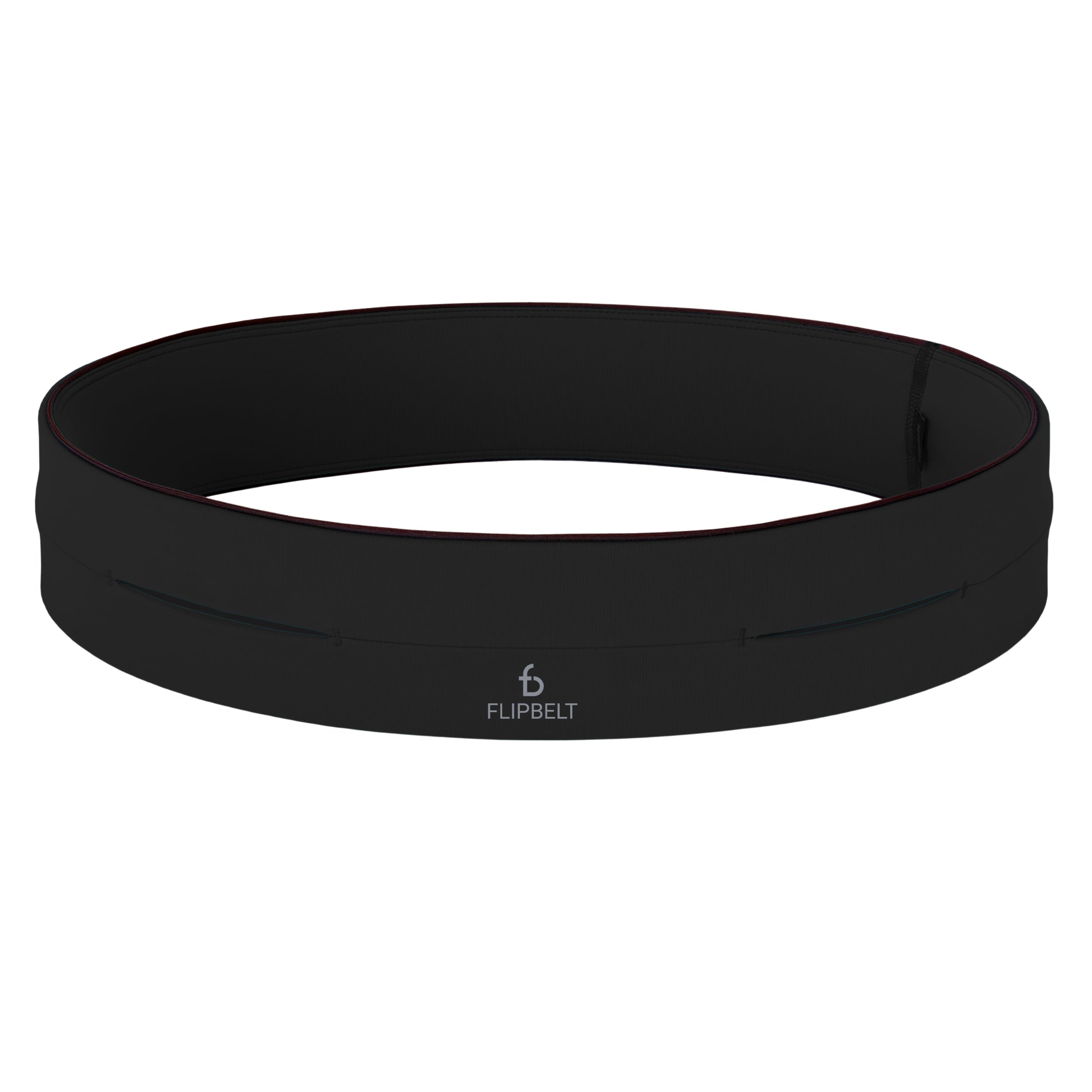
The most expensive belt here is also the one with the least to break. There's no zipper, no buckle, and no Velcro — the FlipBelt is a flat tube of moisture-wicking stretch fabric with four slot openings you push a phone, keys, and cards into, plus an internal key hook so nothing settles at the bottom. We like that trade: hardware is what fails on inexpensive belts, and there is almost none of it here.

It pulls on in a second, lies flatter than anything else on this page, and goes in the washing machine, which is not true of most of the others. What it doesn't do is seal. The fabric isn't water resistant and sweat works its way through to whatever is inside, so on hot days a phone in a thin zip bag is the sensible pairing.

Sizing is the whole purchase. Measure your waist and follow the belt's own advice: go up a size if you want it low on the hips, stay true if you want it at the waistband. Between sizes, go down — a loose pull-on band slides. Get it right and it's the most comfortable option here; get it wrong and you'll spend the run hitching it up.

Pros

  • No zipper, buckle, or Velcro to fail
  • Lies flat under clothing
  • Machine washable
  • Four openings and an internal key hook

Cons

  • Not water resistant; sweat reaches what's inside
  • The priciest belt in this set
Our verdict

For runners who don't want to trust a zipper, this is the one: flat, washable, and hardware-free, as long as you size it carefully.

Check Latest Price
3

Best Vest-Style Holder

ZelaFit Run Vest

91 /100
LBD Score Outstanding

Key details

Size
Small–Medium
Material
Neoprene nylon
Water Resistance
Waterproof phone pouch
View on Amazon

ZelaFit makes this in small–medium only, and that's the first thing to check: the vest is cut close to the chest and adjusts at the waistband, so a broad ribcage is the case it doesn't cover. On the right frame it sits like a light layer rather than a pack.

The phone rides high on the sternum in a waterproof pouch with a pull-cord zip you can open one-handed, which is the whole argument for a vest over a belt — the phone is in front of you, not behind your back. There's a separate key pocket so a fob never touches the screen, and reflective trim runs across the front and back for early starts.

It suits tempo runs and race day, when the phone needs to be reachable and nothing else needs to come along. It holds a phone, a key, and earbuds and stops there: no flask, no more than a gel or two. So the fit is the purchase. On the right frame, we think it's the neatest phone holder here; if you're broad across the shoulders, it's the one to skip.

Pros

  • Phone sits high on the chest
  • Pull-cord zip opens one-handed
  • Separate key pocket
  • Waterproof phone pouch

Cons

  • Small–medium only, cut close to the chest
  • Holds a phone and keys, little else
Our verdict

For smaller frames, the tidiest way to keep a phone in front of you and reachable mid-run — check the chest fit before you commit.

Check Latest Price
4

Best for Smaller Waists

USHAKE Ultra Light Running Belt

92 /100
LBD Score Outstanding

Key details

Weight
3.52 oz
Pockets
2
Waist Fit
25.9–42 inches
Water Resistance
Water resistant
View on Amazon

A small earphone port above the main zip is the detail that explains the USHAKE: it's built for people who run with a wired headset and a phone rather than a watch and a streaming app. The port sits over the larger pocket so the cable drops straight in.

Two zippered compartments do the work — phone in the bigger one, a card, key, or gel in the smaller — and the nylon is thin enough that the whole belt lies flat against the small of your back instead of standing away from it. The buckle and zip closure is more hardware than a pull-on band and less to go wrong than a plain slot, and the fabric is water resistant for sweat and drizzle.

Where it gives ground to our top pick is range and room. The elastic is rated to 42 inches, the shortest maximum here, so a larger waist runs out of adjustment before it runs out of belt. The phone pocket also gets snug once a case is on, and a Plus or Ultra in a rugged case is worth measuring against the listing before you commit.

Pros

  • Earphone port for wired headsets
  • Two zippered pockets on a budget belt
  • Thin nylon lies flat on the back
  • Water resistant for sweat and drizzle

Cons

  • Waist range stops at 42 inches
  • Phone pocket tight with a thick case
Our verdict

A flat, inexpensive two-zip belt that suits smaller waists and wired headphones; check the pocket if your phone lives in a rugged case.

Check Latest Price
5

Best Budget

Molarun Slim Running Belt

91 /100
LBD Score Outstanding

Key details

Weight
3 oz
Pockets
3
Waist Fit
24–46 inches
Water Resistance
Water resistant
View on Amazon

The Molarun adjusts from 24 to 46 inches, the widest span of any belt here, and that number is the reason to start with it if one-size elastic has let you down before. It's also the least expensive belt in the set, which makes it the low-risk way to find out whether you actually like running with a pouch on your waist.

Three pockets: a main zip compartment for the phone and two smaller ones for keys, a card, or earbuds. The Lycra blend has more give than the nylon belts here, so it hugs the body rather than sitting on it. There's an earphone hole, a reflective strip up the front, and water-resistant fabric for sweat and light rain.

The stretch that makes it comfortable is also the thing we kept an eye on. Tension is all that holds it in place, so it can ride up on longer efforts, and the pockets are shallower than the capacity suggests — a phone plus a passport or a soft flask is optimistic. For a phone, a key, and a card on a 5K, it's all you need.

Pros

  • Adjusts from 24 to 46 inches
  • Three pockets, including two side ones
  • Least expensive belt in this set
  • Stretch fabric sits close to the body

Cons

  • Can ride up on longer runs
  • Pockets shallow for a phone plus extras
Our verdict

The cheapest way to try running with a belt, and the one to pick if you sit near either end of the usual size range.

Check Latest Price
6

Best Armband

HAISSKY Running Armband

89 /100
LBD Score Excellent

Key details

Weight
2.08 oz
Arm Fit
8–18 inches
Pockets
Zip pouch plus card slot
Phone Capacity
Up to 6.9 inches
View on Amazon

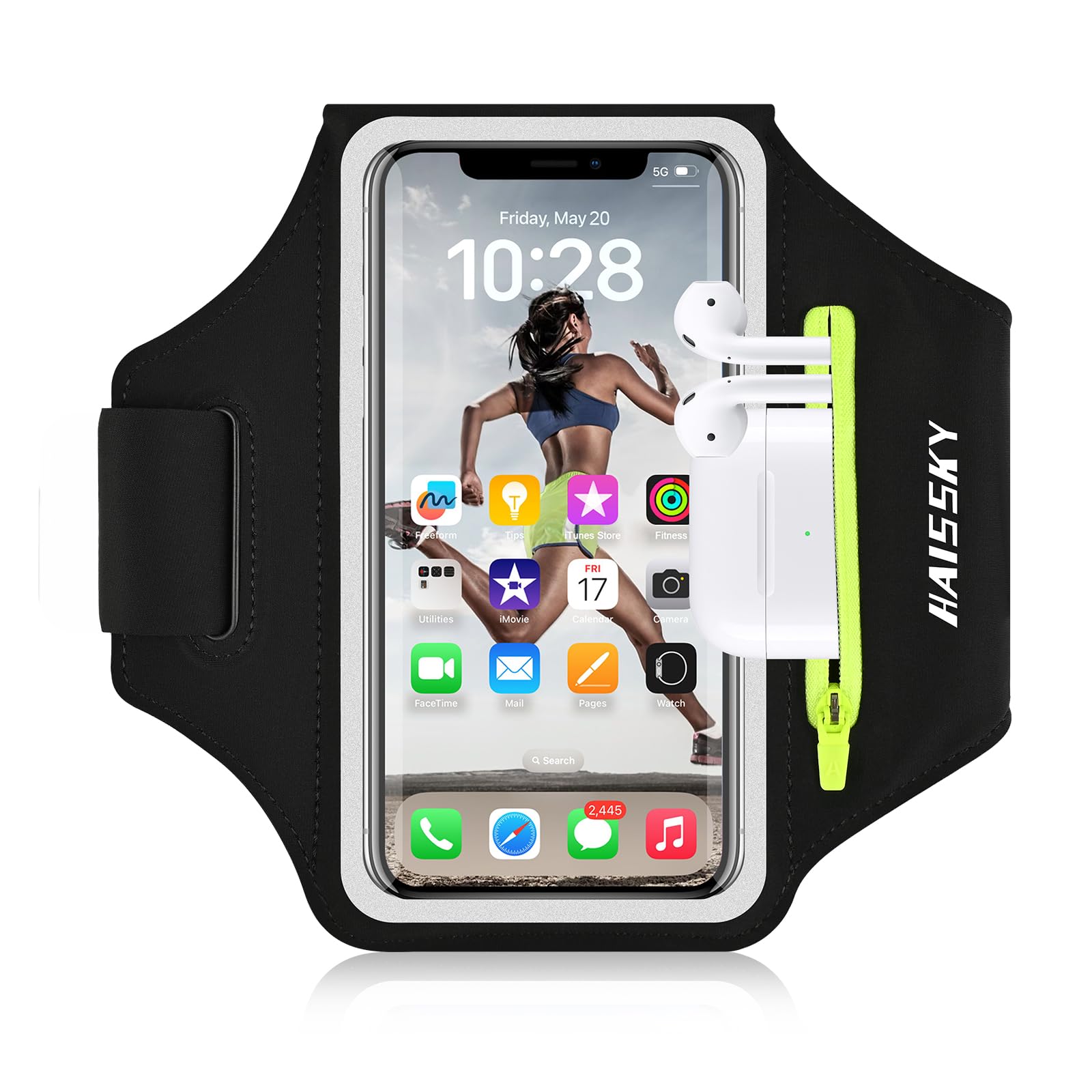
An armband answers a question the belts don't: do you want to see and tap your phone while you run? The HAISSKY's clear window says yes — you can skip a track or check a split without stopping — and the zipped pouch on the strap takes a key, a card, and a pair of earbuds.

We still send most runners to a belt, and the reason is where the weight sits. A 6.9-inch phone strapped to an upper arm swings; the same phone flat at the small of your back doesn't. The armband also only works if the band is genuinely tight, and that's the weak point: on thinner arms it can slide down mid-run. Set it high on the biceps, over fabric rather than bare skin, and test it before a long effort.

The window is a compromise too. Plastic sits between your finger and the glass, so skipping tracks is fine and typing a message is a fiddle, and the phone stays fully enclosed rather than quickly grabable. For the gym, the bike, and short runs, that's a fair trade; over distance, the belt wins.

Pros

  • Touch window for mid-run controls
  • Zip pouch for key and cards
  • Fits arms from 8 to 18 inches
  • Reflective frame for low light

Cons

  • Band can slide on thinner arms
  • A large phone swings more than in a belt
Our verdict

The pick here for gym sessions and short runs where you want the screen visible and tappable; over distance, a belt is steadier.

Check Latest Price
7

Low-Cost Backup

U·LANARO Slim Running Belt

91 /100
LBD Score Outstanding

Key details

Weight
2.4 oz
Pockets
1
Waist Fit
27–46 inches
Water Resistance
Water resistant
View on Amazon

Cheap enough that trying it costs almost nothing, the U·LANARO is the belt we hand to someone who wants a phone off their hands without researching zips and linings. One expandable pocket takes the phone and a key, the inside is TPU-lined so sweat doesn't soak straight through to the screen, and two reflective strips run down the front.

The single pocket is the compromise. Everything shares one space, so keys ride against the phone unless you keep them in a small pouch, and there's no second compartment for a gel or a card. The strap covers 27 to 46 inches, and the elastic is thinner than our top pick's, so set it snug rather than comfortable.

Durability is where the saving shows. Clips, stitching, and zips are the parts that let these belts down generally, and the hardware here is light. Treat it as a good first belt or a spare that lives in the gym bag, not the one you take through a marathon block.

Pros

  • TPU-lined pocket resists sweat
  • Adjusts from 27 to 46 inches
  • Reflective strips front and back
  • Costs about as little as these get

Cons

  • Single pocket mixes phone and keys
  • Light hardware is the weak point
Our verdict

A low-risk first belt or a gym-bag spare: one pocket, real sweat protection, and hardware that won't outlast a hard training block.

Check Latest Price
8

Walks and Hikes

Muserise Sports Chest Bag

92 /100
LBD Score Outstanding

Key details

Weight
11.8 oz
Pockets
3
Dimensions
9.5 x 5.5 x 1.2 inches
Water Resistance
Water resistant
View on Amazon

Worn on the chest, this Muserise bag keeps a phone, wallet, and keys where you can see and reach them without breaking stride. It carries far more than any belt here: a 9.5-by-5.5-inch front panel with three pockets, straps adjustable at all four corners, and reflective material front and back.

We like it most away from the running track — hiking, dog walks, markets, travel — where the anti-theft angle actually counts and the load doesn't have to stay still. At running pace a loaded chest bag moves against your sternum in a way a flat belt doesn't, and the straps want re-tuning to keep it from swinging. Set all four points while it's empty, then add weight, and it settles down; load it heavily and run hard and you'll feel it.

The build is reasonable for the money: water-resistant polyester, tidy seams, and pockets that keep small items from migrating. Empty, it weighs 11.84 ounces, several times the belts here, and that's the trade — you get storage and organization for a weight you notice on a long run.

Pros

  • Three pockets for phone, wallet, keys
  • Four-point strap adjustment
  • Reflective front and back
  • Doubles as a walking and travel bag

Cons

  • Bounces when loaded and run at pace
  • Heavy at 11.84 ounces empty
Our verdict

Buy it for the trail and the commute rather than the track: it holds far more than a belt, and it swings when you run fast with it loaded.

Check Latest Price
9

Minimalist Chest Carry

MVRK Running Chest Pack

90 /100
LBD Score Outstanding

Key details

Pockets
3
Material
Cordura nylon
Phone Capacity
Up to 5.5 inches
Storage Volume
28 cubic inches
View on Amazon

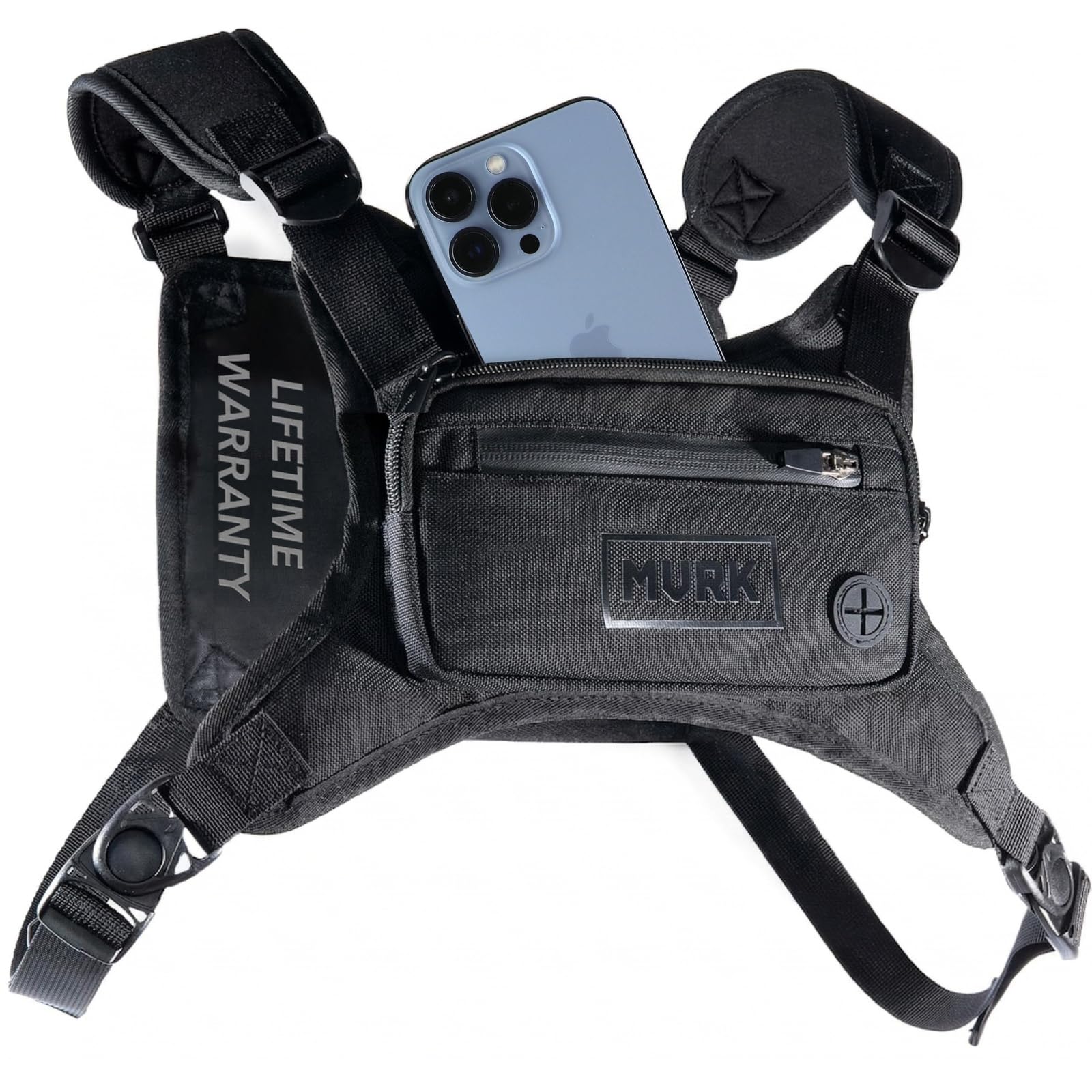
The listing gives this chest pack a 5.5-inch maximum device size in one place and an iPhone Plus fit in another, which is exactly the kind of thing to settle before ordering. Measure your phone in its case; a recent Pro Max or an Ultra is likely to be tight.

What you're paying for is Cordura nylon, a tougher and more abrasion-resistant fabric than the polyester and spandex used elsewhere on this page, cut into a small 7-by-4-inch pack with three zipped compartments and a slim pocket against the body. It sits high on the chest and close, which is what you want under a shell on a wet morning.

It makes most sense for short, hard efforts — a 5K, a gym session, a run to the shop — where the phone needs to be tight to the sternum and nothing else comes along. Over distance the trade shows: we noted that the straps are thin, the pack has to be cinched firmly to stop it shifting, and the seams are the part to watch. It's a well-made small pack rather than a load carrier, and it's priced like one.

Pros

  • Cordura nylon is tougher than most here
  • Three zipped compartments
  • Sits high and close to the chest
  • Reflective detail for low light

Cons

  • 5.5-inch device maximum in the listing
  • Thin straps need firm cinching to stay put
Our verdict

The toughest small chest pack here and the most limited on phone size — check your device, then wear it for short, fast runs.

Check Latest Price

How We Tested Running Phone Holders

We started with a shortlist of more than 40 belts, vests, and armbands pulled from retailer listings and running forums, then narrowed it by specs and price. We ruled out anything that couldn't fit a current large phone in a case, anything with pockets too small for a key and a card, and anything whose straps looked impossible to adjust one-handed. That left 16 models, which we tested over three months on easy morning jogs, tempo intervals, long runs, treadmill sessions, and a few rainy runs.

Each tester adjusted the holder over a t-shirt and a long-sleeve layer, then ran intervals and checked whether the phone shifted, thumped, or sagged. We loaded every model with a phone, keys, a card, and a gel to see whether it bulged or became hard to open mid-run; we also practiced pulling the phone out one-handed. We weighed each holder empty and packed to judge how much bulk it added. On waist belts, we watched for ride-up; on chest vests, for shoulder pressure and heat; on the armband, for slipping and chafing.

Comfort got a longer test: one 10-mile run per holder, with notes on rubbing, pressure points, and whether the fabric stayed breathable in warm weather. We wiped each one down after sweaty runs, tugged seams and zippers, and on Velcro closures opened and closed them repeatedly to see whether the hooks clogged or lost grip. We also checked reflective details on evening runs, and misted each holder with water to see whether the phone compartment stayed dry.

How to Choose a Running Phone Holder

Where the Phone Rides

Waist, arm, or chest is the first decision, and it changes everything after it. A belt keeps the phone at your center of mass, where it moves least, which is why all but two of our picks sit there. An armband keeps the screen visible and tappable but hangs weight on a swinging limb. A chest pack puts the phone in front of you and carries the most, at the cost of bulk.

Most runners are best served by a belt. The armband earns its place at the gym and on short efforts; the chest pack is for walking, hiking, and days you're carrying more than a phone and a key.

Fit Is What Stops the Bounce

Bounce is a sizing problem before it's a padding problem. Measure your waist rather than ordering your usual clothing size, and buy at the snug end of the range: an elastic belt only stays at the small of your back while it's under tension, and a loose one slides however wide the band is. The trap is sizing up for comfort.

Where a maker gives guidance, take it. The FlipBelt, for one, says go up a size to wear it low on the hips and stay true at the waistband. Also notice that waist and hips are an inch or two apart — that difference is the gap between a belt that holds and one you're hitching up all run.

Check the Closure First

The zipper, buckle, or Velcro is the load-bearing part, and it's where inexpensive belts fail. A zip that opens at mile three doesn't merely inconvenience you; it puts your phone on the pavement, which is why we treat closure hardware as a deciding feature rather than a detail. Look for a substantial pull with fabric behind it, a buckle that's stitched rather than bonded, and Velcro that still grabs after hundreds of cycles.

If you don't want to think about it at all, a pull-on slot design removes the hardware question entirely — at the cost of any seal against rain and sweat.

Match the Pocket to Your Phone and Your Keys

Check the pocket against your phone with the case on. Fits-all-phones is a claim, not a measurement, and a rugged case on a large handset turns a comfortable fit into a squeeze — at least one pack here lists a 5.5-inch device maximum while its own copy promises an iPhone Plus.

Two pockets are worth more than one. Keys and a fob riding against a screen will mark it, and a separate compartment means you aren't digging past your keys every time the phone rings.

Sweat, Rain, and What Stays Dry

Water resistant on these products means sweat and drizzle, not a downpour. A coated or TPU-lined pocket keeps perspiration from soaking through to the phone; a plain stretch fabric doesn't, and everything inside gets damp on a hot day. If you sweat heavily or run in rain, put the phone in a thin zip bag inside the pocket, and treat reflective trim as a dusk visibility aid rather than a light.

Frequently Asked Questions

Final Verdict

The Fitgriff is the one to buy first. It separates your phone from your keys, holds tension at the small of your back without re-adjusting mid-run, and shrugs off sweat and drizzle — and it's sold by size, so measure your waist before you order. If a zipper is the part you don't trust, the FlipBelt takes the hardware out of the equation; size down if you're between sizes, and bag the phone on hot days. For the phone on your chest and nothing else, the ZelaFit vest is the neatest version of that idea, provided you're small-framed.