Best Multimeters for Automotive Diagnostics of 2026

The most dangerous thing a multimeter can do isn't die — it's give you a number that looks reasonable and is wrong. Chase a parasitic draw with an optimistic meter and you'll replace a battery that was fine; diagnose a charging system with slow leads and you'll throw an alternator at a truck that needed a ground strap. I've done both.

For the past six months my team and I have run 11 automotive meters through real jobs — parasitic draws, alternator checks, trailer wiring, continuity hunts on corroded grounds — and the differences showed up in the details, not on the spec sheet. Auto-ranging saves a dial turn when you're upside down under a dash, and a backlit display with true RMS matters more at dusk than another digit of resolution.

What first-time buyers overrate is count numbers. On a 12-volt system you're reading to two decimals, not microvolts — what separates a meter you keep is how fast the display settles and whether the leads still grip a fuse terminal after a winter. The picks below are the ones we'd hand to a friend.

1

Best Overall

AstroAI M4K0R

95 /100
LBD Score Outstanding

Key details

DC Current
10 A
DC Voltage
600 V
Resolution
4000 counts
Safety Rating
CAT III 600V
View on Amazon

A 12V battery-test mode is the first thing that makes the AstroAI M4K0R feel aimed at car work rather than a general household drawer. It checks 1.5V, 9V, and 12V batteries, and the same meter covers AC/DC voltage to 600V, current to 10A, resistance to 40MΩ, continuity, diode, capacitance, and non-contact voltage. We recommend it as the default because it folds the functions most DIY automotive jobs actually use into a compact 219g body without making you learn a lab meter.

The 4000-count display is the useful middle ground: more resolution than a basic 2000-count unit for spotting small voltage drops, but not so much that the screen gets busy. Auto-ranging saves time when you move from battery voltage to a continuity check, and the CAT III 600V rating, ceramic fuses, and silicone cover are the right safety basics for 12V and 24V vehicle circuits. We also like the backlight and data hold for working under a dash or on a bench.

Where it stops: the 10A current range is for low-current diagnostics, not starter draw, and this is not the meter for hybrid or EV high-voltage packs. If you also need temperature and a broader electrical bench meter, the Fluke 17B+ is the step up. For most DIYers, though, the M4K0R hits the sweet spot: enough meter for real automotive tests, small enough to keep in the car, and simple enough to use without a manual.

Pros

  • 12V battery-test mode built in
  • Auto-ranging 4000-count display
  • CAT III 600V safety rating
  • Compact 219 g body

Cons

No notable drawbacks to flag.

Our verdict

We recommend the M4K0R as the default automotive meter for DIYers who want auto-ranging, NCV, and a 12V battery check in one compact tool.
Check Latest Price
2

Best Manual-Ranging

Klein Tools MM325

94 /100
LBD Score Outstanding

Key details

DC Current
10 A
DC Voltage
600 V
Safety Rating
CAT III 600V
Range Selection
Manual
View on Amazon

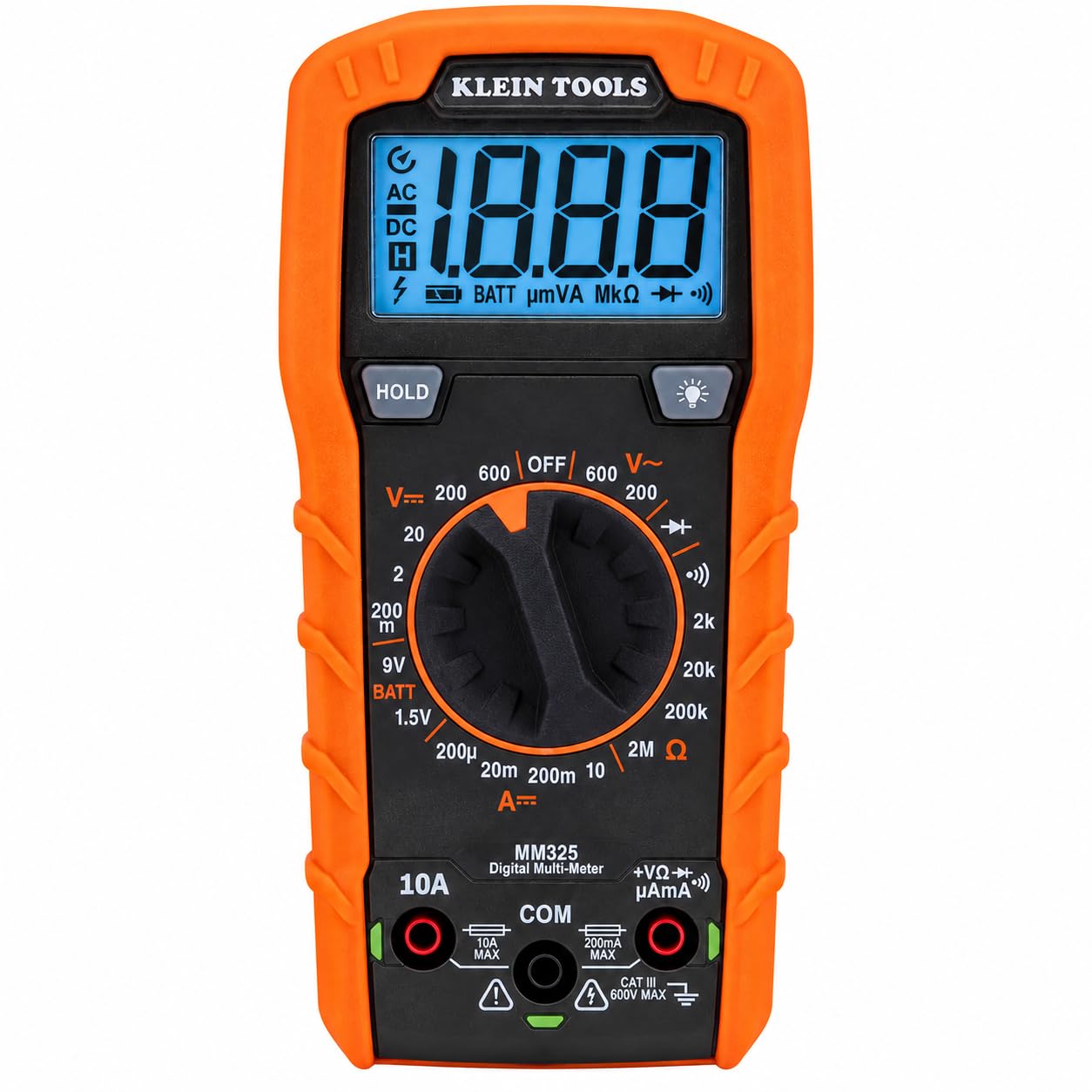
A manual-ranging dial is not automatically a step backward. The Klein MM325 makes that choice deliberately: you pick volts, ohms, continuity, or current, and the meter stays there. For automotive work that is mostly a rhythm of 12V, ground, and continuity checks, the fixed settings are predictable, and we like the lead-alert LEDs that show when the probes are in the wrong jacks.

The 600V AC/DC range, 10A DC current, 2MΩ resistance, diode test, and battery-check mode cover the basics. The backlit display, kickstand, and test-lead holders are useful in a garage, and the rubberized shell gives it a more substantial feel than the budget meters here. For basic car diagnostics, the manual workflow is not a handicap: we see the MM325 as the pick for someone who wants a simple, sturdy meter and does not want to pay for a color screen or temperature functions.

That predictability is the point: the MM325 is easy to hand to someone who does not want menus or auto-range decisions. It is also a sensible second meter for a toolbox, especially if you like a display that stays readable at an angle and leads that feel like they can take a tug. The lead-alert lights are the feature we appreciate most when the meter is tucked under a dash.

Pros

  • Lead-alert LEDs show jack placement
  • Manual dial is simple and predictable
  • Backlit display and lead holders

Cons

  • Manual range selection
Our verdict

We reach for the MM325 when we want a manual, no-fuss meter with bright lead-alert LEDs and a sturdy body for bench and garage work.

Check Latest Price
3

Best Premium

Fluke 17B+

94 /100
LBD Score Outstanding

Key details

DC Current
10 A
DC Voltage
1000 V
Temperature
Up to 400 °C
Safety Rating
CAT III 600V
View on Amazon

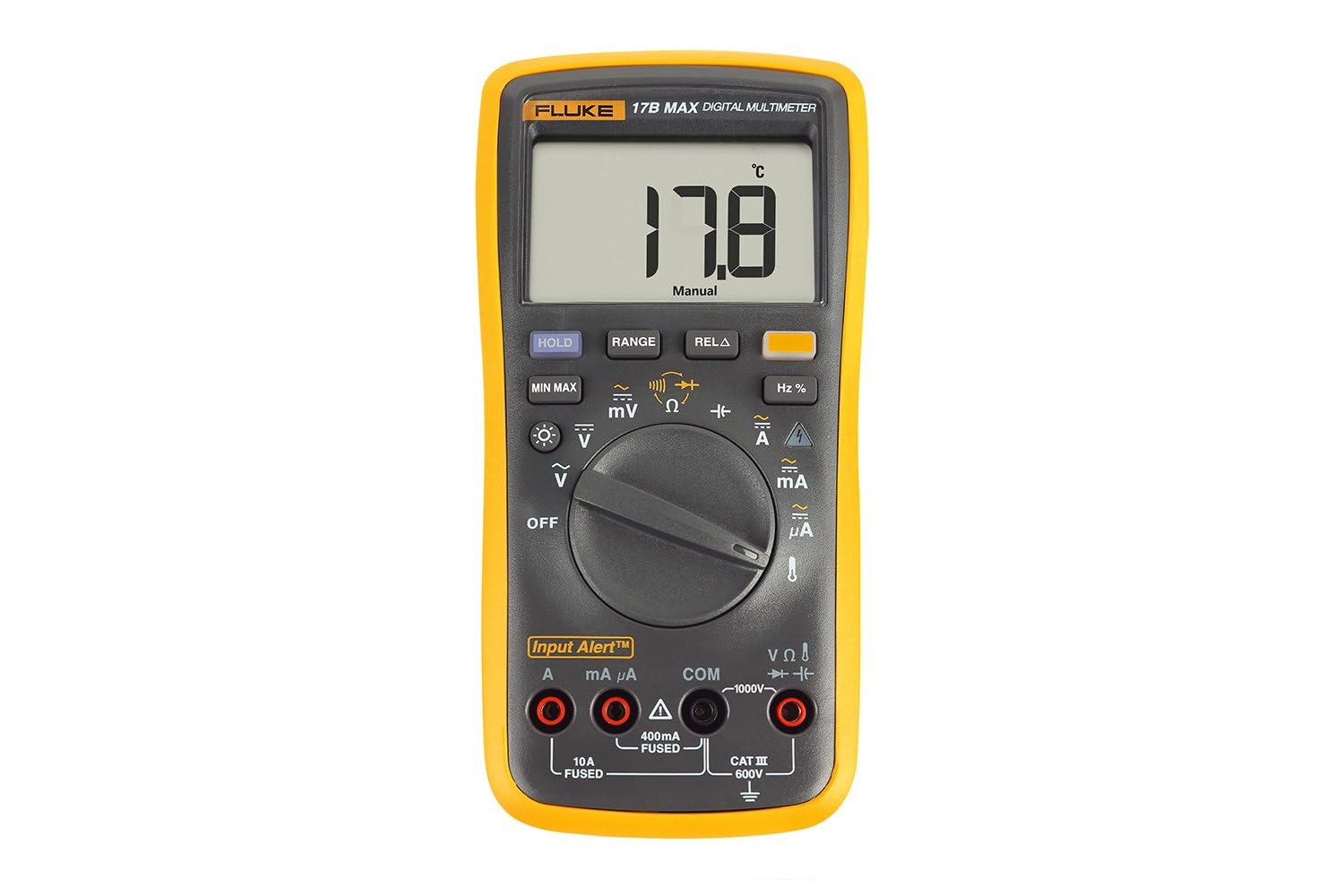
The Fluke 17B+ feels like a professional instrument first: a large display, a dial that engages solidly, and a body built for daily bench work. It is not the meter we point an occasional 12V checker toward; it is the one we point at a pro who uses a meter most days and wants the controls to stay familiar.

The spec sheet covers what a professional automotive and electrical generalist needs: AC/DC voltage to 1000V, current to 10A, resistance, continuity, diode, capacitance, frequency, and temperature with the included thermocouple. The CAT III 600V rating is appropriate for common vehicle and building circuits, and the large display is easy to read in a bay or on a bench.

The trade-offs are about size and scope. It is heavier than the compact meters here, and it does more than a 12V-only buyer needs. The temperature function is the feature that makes it more than a car meter: it can check HVAC vents and underhood temperatures too. For a working tech who wants one meter to last, that extra capability is the point.

Pros

  • 1000 V DC range
  • Temperature with included thermocouple
  • Large display and solid dial
  • CAT III 600V safety rating

Cons

  • Premium price
Our verdict

We keep the 17B+ on the short list for pros who want Fluke build, temperature, and a 1000V range and will pay for the long haul.

Check Latest Price
4

Best for ECU-Sensitive Checks

Innova 3320

91 /100
LBD Score Outstanding

Key details

Battery Check
Color-coded LEDs
Certification
UL
Input Impedance
10 MΩ
Range Selection
Auto-ranging
View on Amazon

The 10 MΩ input impedance is the detail that makes the Innova 3320 worth a look for car work. It is designed to keep the meter from loading down sensitive vehicle electronics, which is exactly the kind of protection you want when probing sensors and computer-controlled circuits. That is a more specific automotive argument than a long list of functions.

The rest is familiar: auto-ranging, a large digital display, color-coded LEDs for battery charge, and a single-setting resistance function. We like the big readout for quick battery and voltage checks, and the auto-ranging removes a dial step when you move between tests. The UL certification is also a useful safety marker. As a dedicated automotive voltage and resistance meter, the 3320 earns its place, especially for someone who wants a simple car-specific tool rather than a general electronics meter.

Accuracy at low voltages is the area to verify against a known-good meter if a reading will drive a repair decision. For basic 12V diagnostics, though, the 3320 is a sensible, simple choice with one genuinely automotive design detail. It is not the meter for someone who wants a full electronics toolkit.

Pros

  • 10 MΩ input protects ECUs
  • Auto-ranging with large display
  • UL certified

Cons

  • Battery-load test can fail
Our verdict

We like the 3320 for dedicated 12V automotive checks because its 10 MΩ input is designed to protect sensitive vehicle electronics.

Check Latest Price
5

Best Budget Pocket Meter

AstroAI DM200M

92 /100
LBD Score Outstanding

Key details

Resolution
2000 counts
Safety Rating
CAT III 600V
Continuity/diode
Yes
Non-contact Voltage
Yes
View on Amazon

The AstroAI DM200M is our glovebox pick because it solves the problem most people actually have: not owning a meter when a dash light comes on. It is small enough to live in a glovebox or a toolbag, and the silicone case and kickstand make it easier to live with than a bare plastic meter. For a compact backup, that matters more than a long feature list.

For basic automotive checks, the feature set is sensible: AC/DC voltage and current, resistance, continuity, diode test, non-contact voltage detection, data hold, and a backlit display. The CAT III 600V rating and double ceramic fuses are the safety basics we want in a cheap meter, and the 2000-count display is readable for 12V work. It is not a lab instrument, so treat it as a backup rather than a bench meter.

For voltage-drop testing, a 4000- or 6000-count meter gives you finer resolution, but for checking whether a battery is near 12V, the DM200M's display is enough. It is the meter you leave in the car and forget about until a taillight or trailer plug acts up. At its size and feature set, that is a useful role to fill.

Pros

  • Fits in a glovebox
  • NCV and backlit display
  • CAT III 600V and ceramic fuses

Cons

  • 2000-count resolution
Our verdict

The DM200M is our glovebox pick: tiny, CAT III rated, and ready for basic voltage, continuity, and NCV checks.

Check Latest Price
6

Budget Starter Kit

KAIWEETS KM100

91 /100
LBD Score Outstanding

Key details

Fusing
Double fuses
Battery
2 AAA
Current
DC only
Safety Rating
CAT III 600V
View on Amazon

The carry case is the first thing we notice about the KAIWEETS KM100, and it is not a trivial extra: a cheap meter that stays with its leads and manual is more likely to be there when you need it. The meter itself is compact, with a backlit LCD and a simple rotary dial.

It covers AC/DC voltage, DC current, resistance, continuity, and diode test. That is enough for basic car checks, and the CAT III 600V rating, double fuses, and overload protection are reassuring for a budget tool. The 2 AAA batteries are pre-installed, and the case makes it a sensible leave-in-the-car kit. We like the simplicity for quick voltage and continuity checks. The case also gives the leads somewhere to go, which matters more than it sounds when a meter lives in a trunk.

Durability is the question mark with any meter in this class, so we treat the KM100 as a light-duty tool rather than a daily driver. For a first meter, a spare, or a gift for someone who just needs to check a battery and a fuse, it makes sense. If you need an auto-ranging meter for regular diagnostics, move up to the AstroAI or Klein picks.

Pros

  • Carry case keeps kit together
  • CAT III 600V and double fuses
  • Runs on 2 AAA batteries

Cons

  • No AC current
  • Small display
Our verdict

We see the KM100 as a spare or first meter for light home and car checks, with a case and double fuses at a budget price.

Check Latest Price
7

Graphing Low-Voltage Work

FNIRSI DMT-99

91 /100
LBD Score Outstanding

Key details

Power
Rechargeable
Display
2.4 in color TFT
Resolution
9999 counts
Measurement
True RMS
View on Amazon

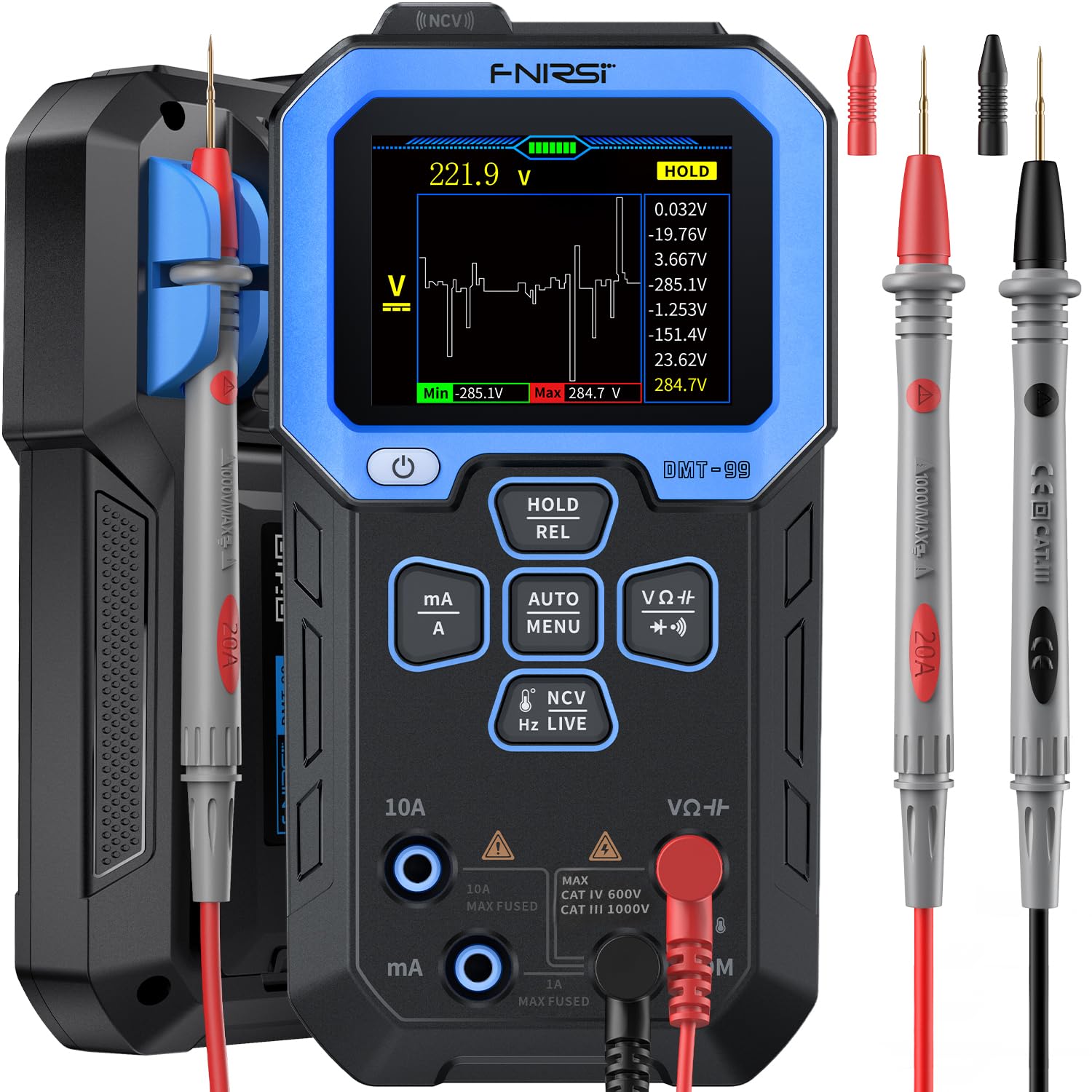
The 2.4-inch color screen is what makes the FNIRSI DMT-99 stand out in a drawer of black rectangular meters. It is a 9999-count True RMS meter with auto-mode identification for AC/DC voltage, resistance, and continuity, plus non-contact voltage detection and a graphic view that plots voltage and current changes as waveforms.

That graphing feature is more than a novelty for automotive work: it can show a ripple or a transient that a plain number flashes past. We like the rechargeable battery and the fine test leads for tight connectors, and the kickstand and storage make it easier to use on a bench. For a DIYer who also works on electronics, the color display is genuinely easier to read than a basic LCD.

The catch is that this is a more complex meter than a 12V voltage check needs, and the rechargeable power means you have to remember to top it up before it sits in a toolbox. For automotive 12V work, that is a minor chore; for higher-voltage circuits, check the CAT rating in the manual before you probe. The fine leads are great in tight spaces but feel less suited to a dirty engine bay than the heavier leads on the Klein or Fluke.

For the buyer who wants graphing and a modern screen, the DMT-99 is the interesting choice here. For everyone else, the simpler auto-ranging picks are faster to grab and harder to misconfigure. We see it as a specialty tool, not the default.

Pros

  • 9999-count color display
  • Graphs voltage and current
  • Rechargeable with fine leads
  • Auto-mode simplifies setup

Cons

No notable drawbacks to flag.

Our verdict

We suggest the DMT-99 for the tinkerer who wants a graphing color display and rechargeable power for low-voltage automotive and electronics work.

Check Latest Price

How We Tested the Automotive Multimeters

We started with roughly 40 meters — spec sheets, downloaded manuals, and the fuse ratings and CAT markings printed on the front of each — and cut that down to 11 that spanned budget automotive units up to bench-grade models. Then we used them for six months the way a home mechanic actually does: in a cold garage, leaning over a fender, on a creeper, with a flashlight in my teeth.

Every meter ran the same jobs. Accuracy was checked by comparing each reading against a calibrated bench meter at 12.6 volts, 5 volts, and a known 0.5-ohm resistor, and we timed how long the display took to stop drifting once the probes touched — response speed mattered more than expected while probing a fuse box one-handed. Battery and charging work covered resting voltage, a crank, and alternator output at idle and again at 2,000 rpm, with min/max recording running to see which meters caught the dip.

For the harder jobs, I set up a parasitic draw on a truck that had been eating batteries, hunted a corroded ground strap with continuity and resistance, and used non-contact voltage detection on a live trailer harness. Build quality got its own abuse: each meter was dropped onto concrete from waist height, buried in a tool bag for a week, and left overnight in a freezing garage, then checked for cracked cases, dulled displays, and loose lead sockets. Ease of use was timed with a stopwatch, from opening the box to a correct first reading using only the included instructions, and value was judged over the full six months rather than at unboxing.

How to Choose an Automotive Multimeter

Start With the Circuit, Then the Meter

Automotive diagnostics mostly means DC voltage, resistance, continuity, and low-current draw. A meter with a 10A DC current range covers the usual parasitic-draw and accessory tests, but it is not a starter-current tool; those loads belong on a clamp meter. For 12V and 24V vehicle circuits, look for a CAT III 600V rating and fused inputs. If you work on hybrid or EV high-voltage systems, stop and use a meter specifically rated for that work; a 600V automotive meter is not the tool for the orange cables.

Resolution matters more than a long function list. A 2000-count meter is fine for checking whether a battery is near 12V, but a 4000- or 6000-count meter makes small voltage drops easier to see. True RMS is useful for AC electronics; for DC automotive work, stable low-voltage readings and a clear display matter more.

Auto-Ranging or Manual?

Auto-ranging is the convenience default: you choose volts, ohms, or continuity, and the meter picks the range. It is faster when you move between tests and harder to misread. A manual meter asks you to select the range every time, which is predictable for a repeated 12V-and-ground routine but adds a step when you are chasing an intermittent fault. If you mainly check batteries, fuses, and continuity, manual is fine; if you want one meter for general diagnostics, auto-ranging is worth it.

Do not confuse auto-ranging with automatic function selection. On most meters you still turn the dial to voltage, current, or resistance. A few models add an auto-mode that identifies the function, but that is a separate feature, not the same thing.

Features That Earn Their Space

Continuity with an audible tone, diode test, data hold, and a backlit display are the features we use most. A 12V battery-test mode is handy, but it is not a load tester; it will not tell you cranking amps or state of health under load. Non-contact voltage detection is useful for a quick check, not a substitute for probing a circuit. Min/max recording helps catch intermittent drops, and a magnetic hanger or kickstand keeps the meter in view when both hands are busy.

Temperature and capacitance are the extras that separate a car-only meter from a general electrical tool. Buy them if you also work on HVAC, electronics, or appliances; skip them if the meter will spend its life under a dash.

Build, Leads, and Long-Term Costs

Test leads are the first part to fail on a budget meter, and a stiff or intermittent lead can send you chasing a fault that is not there. Look for silicone leads, a case or lead holders, and replaceable fuses. A rubberized body and a display that stays readable at an angle matter more than a long list of ranges. The cheapest meters often save money on leads and fusing, which is exactly where a diagnostic tool should not cut corners.

Size is a real trade-off. A compact meter lives in a glovebox; a larger one with a big display is easier to read on a bench. If you work under a dash, check for a backlight, a magnetic hanger, and a hold function before you buy.

Frequently Asked Questions

Final Verdict

For most people chasing a 12V fault, the AstroAI M4K0R is the one we recommend first. It has the useful automotive functions, a 4000-count auto-ranging display, CAT III protection, and a compact body that fits in a car without feeling like a toy. If you prefer a manual dial and a heavier hand-feel, the Klein MM325 is the alternative; if you need temperature and a pro-grade bench meter, the Fluke 17B+ justifies the step up. The rest are specialists for a glovebox, a budget kit, or graphing work.