Best Auto-Ranging Multimeters for Beginners

A multimeter is a simple idea wearing a complicated face: two probes, a dial, and about eighteen symbols, half of which look like they were drawn for somebody else. The real fear for a first-time buyer is ending up with a meter that does too much to learn from or too little to trust — then standing at a dead outlet holding the wrong setting. A good auto-ranging model closes that gap, so your attention stays on where the probes go.

I've poked at enough household wiring and 12-volt projects to have opinions about which meters actually help. Over the past four months, my team and I ran 14 auto-ranging models through dead outlets, battery drawers, and questionable soldering jobs, timing how quickly each one settled on a reading.

Worth knowing before you shop: the counts figure in the title is resolution, not accuracy, and past a few thousand it stops mattering for household work. What separates these meters is how fast they settle, how clearly they explain themselves, and how gracefully they survive being set to the wrong function — so the picks below run from plug-and-play to a little more capable than you strictly need.

1

Best Overall

Crenova MS8233D

93 /100
LBD Score Outstanding

Key details

Display
6000-count backlit LCD
Ranging
Auto and manual
Included
Hard case, test leads, alligator clips
Safety Rating
CAT III 600V
View on Amazon

A hard-shell case, a set of alligator clips, and a meter that switches between auto and manual ranging make the Crenova MS8233D the one we recommend first. For a beginner, the useful part isn't the 6000-count display by itself; it's that the meter arrives ready to be stored, carried, and used without a second shopping trip. We think that complete-kit feeling is the difference between a meter that gets used and one that gets put away.

The 6000-count display and true-RMS measurement are more resolution than many household checks need, but they earn their place when you're comparing small voltage differences or working on electronics. Auto-ranging chooses the scale for you, while the manual mode is there when you want to lock a range. The non-contact voltage detector, backlight, data hold, and max/min recording are the functions that turn a reading into a useful diagnosis, especially in a dim closet or behind an appliance.

What we appreciate most is the safety package: a CAT III 600V rating and two built-in fuses. That rating is a sensible default for someone who may move from an outlet to a fixed appliance circuit. The alligator clips are equally practical; clipping onto a battery terminal or a ground leaves both hands free to turn the dial. The case keeps the leads from becoming a tangled mess in a toolbox.

It isn't a pocket meter. The body takes up real drawer space, and the dial has more labels than a first-timer will use in week one. But those are the costs of having one meter that can grow with you, and they don't get in the way of the basic checks.

Pros

  • True RMS and 6000-count display
  • Auto and manual ranging
  • CAT III 600V with two fuses
  • Hard case, leads, and alligator clips included

Cons

  • Bulkier than pocket meters
Our verdict

The Crenova MS8233D is the beginner meter we recommend first because it pairs true auto-ranging and CAT III safety with the case and clips that make it a complete first kit.

Check Latest Price
2

Best for Total Beginners

TESMEN TM-510

93 /100
LBD Score Outstanding

Key details

Display
4000-count backlit LCD
Ranging
Smart auto mode
Included
Storage bag, two test leads
Safety Rating
CAT II 600V
View on Amazon

One dial position is the whole pitch: the TESMEN TM-510's smart auto mode figures out whether you're measuring AC volts, DC volts, resistance, or continuity, so a first-time user can concentrate on where the probes go. It is a small meter with a backlight, a flashlight, a storage bag, and a non-contact voltage alert, and it runs on two AAA batteries. For someone who wants a glovebox or kitchen-drawer meter, that is a persuasive package.

We recommend it to the person who wants to check an outlet, a lamp cord, or a car battery and does not want to study a dial full of symbols. The display is compact but legible, and the non-contact alert is a useful first pass before you touch a terminal. We also like that the storage bag is included; loose test leads are the quickest way to lose them.

The boundary is safety rating. CAT II 600V suits household outlets and plug-in appliances, but it is not the meter for work inside a distribution panel. The other quirk is documented in the smart mode: below 0.8V the meter switches to resistance, which is fine for a dead-cell check but can confuse anyone chasing a small signal. If your work stays at the household level, those limits are easy to live with.

The TM-510 is not the most precise meter here, and the low-voltage behavior is worth remembering. But it removes the biggest beginner obstacle: deciding which range to choose. We hand it to someone who wants an answer, not a lesson in meter settings.

Pros

  • Smart auto mode simplifies function selection
  • Non-contact voltage alert
  • Compact body with storage bag
  • Backlight and flashlight

Cons

No notable drawbacks to flag.

Our verdict

For quick household checks with almost no learning curve, the TESMEN TM-510 is our pick, provided your work stays at CAT II outlets and appliances.

Check Latest Price
3

Best for Automotive and Appliance Work

AstroAI AST-6000-D

93 /100
LBD Score Outstanding

Key details

Safety
Double ceramic fuses
Display
6000-count backlit LCD
Ranging
Auto-ranging
Key Measurements
AC/DC voltage, current, resistance, capacitance, frequency, duty cycle, diode, continuity, temperature
View on Amazon

Temperature, frequency, duty cycle, and capacitance are the reasons to step up to the AstroAI AST-6000-D instead of a simpler beginner meter. The 6000-count true-RMS display is backlit, and the meter includes the expected voltage, current, resistance, continuity, diode, and capacitance checks. It is a full troubleshooting tool rather than a one-job outlet tester.

The extra functions are not filler. Temperature is useful for checking a vent, a motor housing, or a battery pack; frequency and duty cycle matter when you are looking at automotive signals rather than household wiring. The magnetic strap is the detail we kept coming back to, because it lets you hang the meter on a metal panel while you work, and the kickstand does the same job on a bench. Data hold and auto shutoff round out the practical side.

We rank it as a runner-up rather than the top pick because it asks more of a beginner. The dial and function set are broader, so it is a less natural fit for someone who mainly wants to check outlets. The two ceramic fuses are welcome, but the meter's real home is a garage, an appliance repair, or an electronics bench where temperature and frequency will actually get used.

What we like most is that it does not make you buy a second meter when a job turns automotive. If you know your first multimeter will be used on a car, an HVAC unit, or a small electronics project, the AST-6000-D gives you room to grow without changing brands.

Pros

  • Temperature, frequency, and duty cycle
  • 6000-count true-RMS backlit display
  • Magnetic strap and kickstand
  • Double ceramic fuses

Cons

  • Heavier than pocket meters
Our verdict

The AstroAI AST-6000-D is the pick for beginners who know they'll need temperature, frequency, and capacitance, not just basic voltage checks.

Check Latest Price
4

Best Modern Display

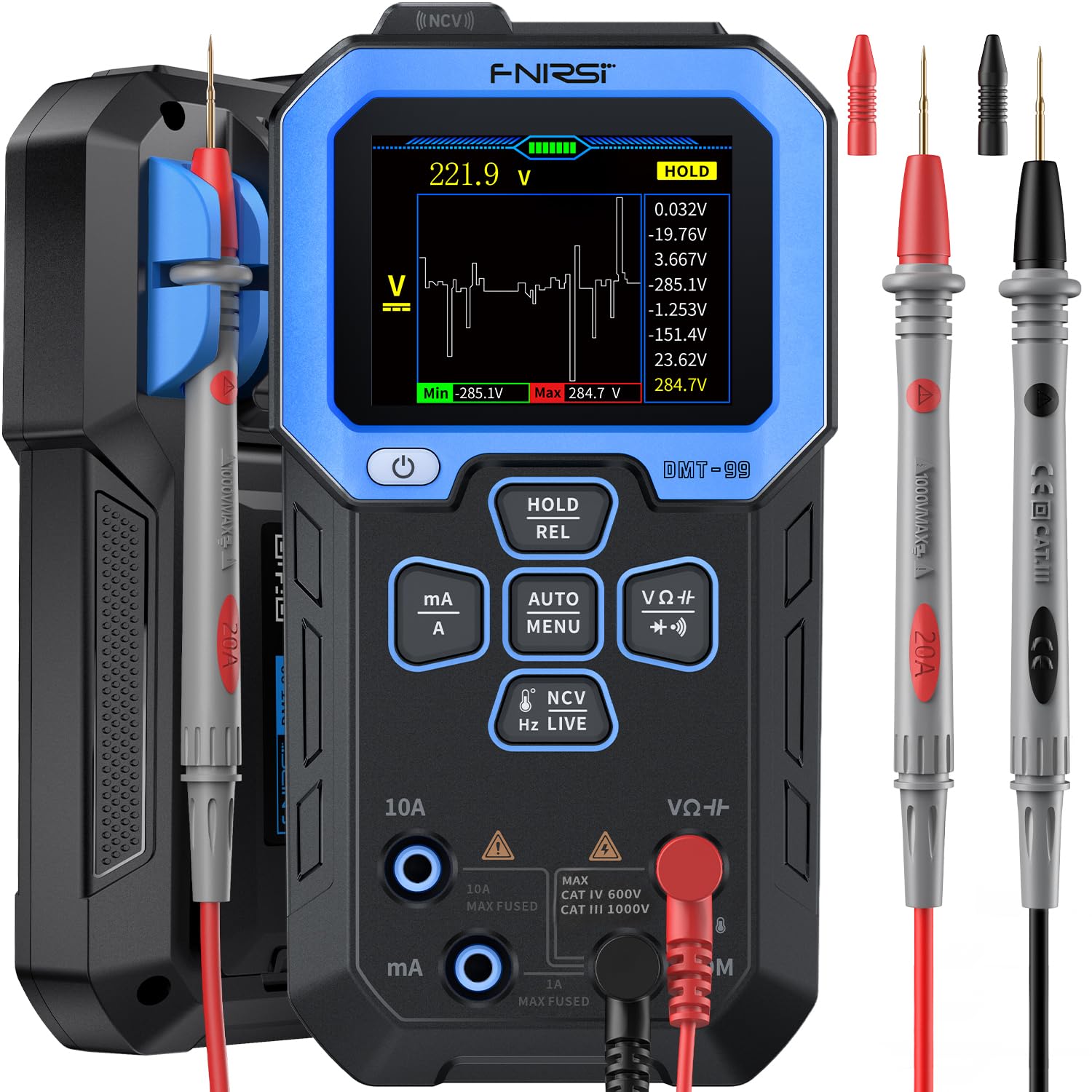
FNIRSI DMT-99

91 /100
LBD Score Outstanding

Key details

Power
USB-C rechargeable
Display
2.4-inch color TFT
Ranging
Auto-ranging, auto mode
Resolution
9999-count True RMS
View on Amazon

A color TFT screen and an internal rechargeable battery make the FNIRSI DMT-99 feel more like a piece of consumer tech than a workshop tool. It is a 9999-count true-RMS meter with auto-ranging, non-contact voltage detection, and a graph view that plots a measurement over time. The USB-C port means you don't have to keep a supply of 9V batteries in a drawer.

We see it as a strong second meter for a tech-minded beginner, or a first meter for someone who likes visible data. The auto mode covers the basics, the screen is easy to read, and the fine test leads are a real plus for crowded circuit boards, where standard probes can feel like chopsticks. The caution is measurement confidence: voltage and capacitance monitoring are the areas where this meter is less consistent, and for a beginner that matters more than a pretty screen. It is not the model we reach for first when the job is verifying a live circuit.

If you're drawn to the display and USB-C convenience, the DMT-99 is a likable tool. It is at its best on a bench, tracing a signal or watching a small voltage change, and the rechargeable battery keeps it ready. Just keep a simple meter or a known-good outlet check for the moments when the reading has to be beyond doubt.

Pros

  • 9999-count True RMS auto-ranging
  • USB-C rechargeable battery
  • 2.4-inch color TFT screen
  • Fine test leads for tight boards

Cons

  • More menu-heavy than a dial meter
Our verdict

The FNIRSI DMT-99 is a good fit for a tech-minded beginner who values a rechargeable color-screen meter, provided live-voltage readings are cross-checked.

Check Latest Price
5

Best Budget with CAT III

AstroAI DM130B

93 /100
LBD Score Outstanding

Key details

Display
4000-count backlit LCD
Ranging
Auto-ranging
Included
Test leads, alligator clips
Safety Rating
CAT III 600V
View on Amazon

A CAT III 600V rating and dedicated 1.5V, 9V, and 12V battery modes make the AstroAI DM130B more useful around a house than its position in the lineup suggests. It is a 4000-count auto-ranging meter with AC/DC voltage and current, resistance, continuity, capacitance, diode testing, and non-contact voltage detection. The backlight and kickstand are the kind of small conveniences you notice every time you use them.

We recommend it to the beginner who wants a safe household meter without paying for temperature or frequency they will never use. The battery modes are the feature we appreciate most: they let you sort a drawer of batteries without guessing at the auto range, and the results are easier to interpret than a raw voltage number. The CAT III rating and double fuses also mean it can handle fixed appliance circuits, not just a wall outlet.

The alligator clips are the weak spot. Their mechanical connection can make them awkward to attach, so treat them as a bonus rather than the reason to choose this meter. For a first meter that mostly lives in a kitchen drawer, the clips are an occasional annoyance rather than a dealbreaker.

What sells it is the combination of safety and simple battery checks at the budget end of this group. If you want one compact meter for outlets, cords, and household batteries, the DM130B covers the basics without a confusing feature set.

Pros

  • CAT III 600V safety with double fuses
  • Dedicated 1.5V, 9V, and 12V battery modes
  • Non-contact voltage and backlit display
  • Includes test leads and alligator clips

Cons

  • Early failures have occurred
Our verdict

The AstroAI DM130B is our budget pick for beginners who want CAT III safety, non-contact voltage, and easy battery testing in one compact meter.

Check Latest Price
6

Quick Battery Checks

INNOVA 3320

91 /100
LBD Score Outstanding

Key details

Display
Large digital LCD
Ranging
Auto-ranging
Certification
UL
Input Impedance
10 MΩ
View on Amazon

The INNOVA 3320's display is the first thing you notice, and for a beginner that is the right priority: large digits and color-coded battery LEDs let you read the result from arm's length. It is an auto-ranging meter with a 10 MΩ input impedance, a specification that matters when you are checking automotive electronics because it reduces the chance of loading the circuit you are testing.

It measures AC/DC voltage and resistance, and the battery-test LEDs turn a voltage number into a quick charge-status check. The oversized readout is genuinely easier to see than the compact displays on several picks here, especially when you are kneeling beside a car or reaching behind an appliance. The missing piece is current measurement. If you want to check a parasitic draw, a motor's draw, or a charging circuit, this is the wrong tool.

We see it as the meter for a car owner who wants a fast battery and outlet check without a lot of setup. The battery-status LEDs are the detail that makes it useful in that role, and the big screen is the reason to choose it over a smaller meter with similar functions. It just should not be the only meter in a beginner's kit if current matters.

Pros

  • Large, easy-to-read display
  • Auto-ranging with 10 MΩ input impedance
  • Color-coded battery-status LEDs
  • UL certified

Cons

  • Battery-test LEDs may stop working
Our verdict

The INNOVA 3320 is a good choice for quick voltage and battery checks, but beginners who need current measurement should choose a full-function meter.

Check Latest Price

How We Tested the Best Beginner Multimeters

We started by pulling every auto-ranging meter we could find in the beginner price range, reading the spec sheets and manuals side by side, and cutting anything that skipped auto-ranging, stayed vague about its safety rating, or shipped a manual that never explained which jack does what. Fourteen made the cut, and they've been in rotation for four months.

Testing happened where meters actually live: outlets and switches around the house on a Saturday morning, a car battery and fuse panel in the driveway, and a bench session with loose resistors and capacitors. Every meter got the same jobs in the same order, and we compared its readings against a calibrated reference on the identical outlet and resistor, so accuracy was something we watched rather than took on faith. We also timed how long each one took to settle; a few bounced between numbers for a second or two, which gets old when you're chasing a flickering circuit.

Then we were deliberately careless: wrong dial settings on a live circuit to see what the protection did, a few drops onto concrete, a week riding loose in a tool bag. We read every manual cover to cover and had our least experienced tester unbox and set up each meter with no help, noting where the instructions lost him. We checked the small things too — whether the alligator clips bit into a terminal or slid off, whether the leads stayed put in their holders, and whether a min/max or hold function made it easier to watch a voltage drift over an hour.

Price came at the end rather than the start. Once the readings were in, we asked what True RMS, non-contact voltage detection, temperature, and battery test modes were actually worth on household and automotive work, and whether the cheaper meters gave any of it up.

How to Choose an Auto-Ranging Multimeter for Beginners

Decide How Much the Meter Should Think for You

Auto-ranging and automatic function selection solve different problems. A true auto-ranging meter lets you choose volts, ohms, or continuity and then picks the scale; a smart auto meter may also guess the function, which is faster for outlets and batteries but can be confused by very low voltages. If you plan to work on electronics, look for a manual range lock so you can pin the meter to a range. For household checks, one smart auto mode is usually enough, and we treat a manual override as a useful bonus rather than a requirement.

Put Safety Rating Before Function Count

Before counts or temperature, check the CAT rating and fusing. CAT II covers household outlets and plug-in appliances; CAT III is the better match for fixed distribution, panel work, and anything you cannot unplug. For a beginner who may move from an outlet to an appliance circuit, we treat CAT III 600V as the sensible default. Two fuses and a spare set of test leads matter too, because a damaged lead is an easy weak link in a cheap meter.

Choose a Display You Can Read Where You Work

Resolution is less important than legibility for a beginner. A 4000-count meter is plenty for household voltage, continuity, and battery checks; 6000 counts gives finer resolution but will not fix a dim screen or a cramped dial. Look for a backlight, large digits, a stand or magnet, and controls you can work with one hand. If you often work in a dark closet or under a dashboard, the display decides whether the meter gets used.

Match the Functions to the Jobs You Actually Do

Start with voltage, resistance, continuity, and non-contact voltage. Add capacitance, temperature, or frequency only if you have a specific job in mind. Current measurement is the function that separates a general meter from a voltage checker, and it requires a dedicated current jack and fused protection. If current is your main interest, look for a meter with a clearly marked current jack and fused protection; if you mostly check outlets and batteries, a voltage-and-resistance meter can be enough.

Budget for the Whole Kit, Not Just the Meter

Accessories are part of the purchase. A hard case, alligator clips, and a second set of leads can cost as much as the difference between two meters, and they make the meter easier to keep together. Check the battery type too: a 9V is easy to find, while AAA cells are cheaper and lighter. We prefer a case and clips included over a longer function list, because a meter you can store and clip in place gets used more often.

Frequently Asked Questions

Final Verdict

The Crenova MS8233D earns our top recommendation because it gets the beginner fundamentals right: true auto-ranging, a clear 6000-count display, CAT III safety, and a hard case with clips that keeps the kit together.

If you want the simplest possible meter for outlets and plug-in appliances, the TESMEN TM-510 is the easier first step. If temperature, frequency, or automotive signals are part of your plan, the AstroAI AST-6000-D is the better fit.