Best Micro Four Thirds Lenses of 2026

Mount a 25mm lens on a Micro Four Thirds body and you get the view a 50mm gives on full frame — the format's 2x crop factor doubles everything you attach to it. That's a gift for reach and a tax on light, since a smaller sensor has less room to gather it. Good glass is how you buy that light back.

I've shot the same farmers market with a kit zoom and a fast prime, and the difference isn't subtle — one made me work for the picture, the other just took it. My team and I spent six months with 12 Micro Four Thirds lenses, from budget manual primes to a professional zoom.

Here's what nobody tells a first-time buyer: on this system a wide maximum aperture does double duty, buying both the blurred background and the shutter speed to shoot in a dim room. The trade-off is that the fastest glass is often the slowest to lock focus, and a lens that hunts costs you shots no amount of sharpness recovers. The picks below are the ones that held that balance.

1

Best Overall

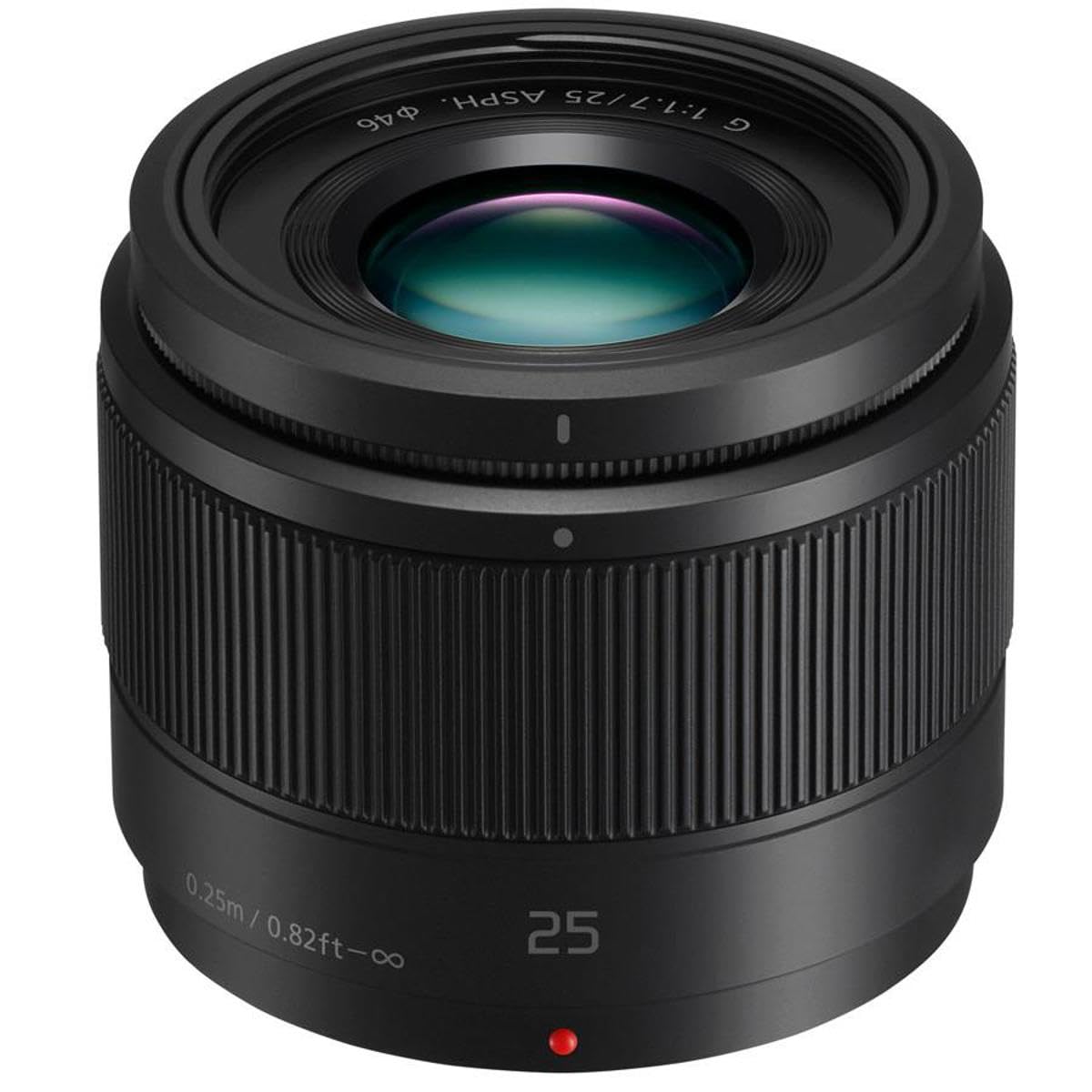
Panasonic Lumix G 25mm f/1.7

95 /100
LBD Score Outstanding

Key details

Weight
4.4 oz (125 g)
Focal Length
25mm (50mm equiv.)
Max Aperture
f/1.7
Stabilization
None; relies on the body
View on Amazon

If a Micro Four Thirds body arrives with only a kit zoom, this is the lens that changes what the camera can do. Twenty-five millimeters on this sensor gives the 50mm view that matches how a room looks when you walk into it, and the f/1.7 aperture means a birthday party or a restaurant table no longer requires a flash. It is the first lens we reach for, and the one that stays mounted when we do not know what we will be photographing.

What makes it easy to live with is the size: 4.4 ounces and about two inches long, so it balances on the smallest bodies and vanishes into a jacket pocket. The stepping motor focuses quietly and smoothly, which is why it doubles as a video lens, and the seven-blade diaphragm keeps backgrounds soft instead of busy. Sharpness holds up wide open in the center, and that matters more than a corner chart when the subject is a person.

Two things to know before ordering. There is no optical stabilization in the barrel, so it leans on the camera's sensor stabilization, which is fine on most bodies and less fine on the oldest ones. And autofocus is the one place this lens divides people: it snaps in good light, but in a dim room it can hunt and occasionally land a little soft, so take two frames when the light drops. Neither is a reason to skip it at this price.

Pros

  • Fast f/1.7 aperture for indoor light
  • 4.4 ounces and about two inches long
  • Quiet stepping motor suits video too
  • Sharp wide open in the center

Cons

  • Autofocus can hunt in dim light
  • No optical stabilization or weather sealing
Our verdict

This is the lens we tell every new Micro Four Thirds shooter to buy first: a fast, tiny 50mm view that makes indoor photos possible without a flash.

Check Latest Price
2

Best for Portraits

OM SYSTEM M.Zuiko 45mm f/1.8

92 /100
LBD Score Outstanding

Key details

Weight
4.1 oz (116 g)
Close Focus
0.20 m
Focal Length
45mm (90mm equiv.)
Max Aperture
f/1.8
View on Amazon

Zoom a kit lens out to 45mm, take a portrait, and the background usually stays stubbornly legible: a fence, a parking lot, someone else's umbrella. The fix weighs almost nothing and costs less than most people expect. At f/1.8 on a 90mm-equivalent view, a face comes forward and the rest of the frame falls away, which is the entire reason to own a second lens.

We came away impressed by how little it asks of you. The seven-blade diaphragm is rounded, so highlights stay circular rather than turning into polygons, and the lens focuses down to 0.20 meters, close enough for hands and flowers. Eyes and lashes are crisp wide open, which means you do not have to stop down and give back the light you paid for. Autofocus is quick and near silent, so it handles video interviews as comfortably as stills, and at 116 grams it disappears on a small body.

The compromises are about construction rather than pictures. The barrel is plastic where the Pro lenses are metal, there is no weather sealing, and the hood is a separate purchase, the LH-40B, which stings on a bright afternoon. On a body with sensor stabilization you will not miss optical stabilization; on an older one, brace your elbows and shoot in bursts.

Pros

  • 90mm-equivalent f/1.8 for portraits
  • About four ounces, so it goes everywhere
  • Sharp wide open with creamy bokeh
  • Focuses to 0.20 m for close detail

Cons

  • Lens hood sold separately
  • Plastic barrel, no weather sealing
Our verdict

For anyone who photographs people, we think this is close to essential: a 90mm-equivalent f/1.8 that weighs about four ounces and blurs a busy background into softness.

Check Latest Price
3

Best Standard Zoom

Panasonic Leica DG 12-60mm f/2.8-4

86 /100
LBD Score Excellent

Key details

Weight
1.3 lb
Sealing
Splash, dust, and freeze resistant
Focal Length
12-60mm (24-120mm equiv.)
Max Aperture
f/2.8-4.0
View on Amazon

At 1.3 pounds this is the heaviest lens in our group, and it is the one we carry when the plan is unknown: a market, a hike, a wedding where we are a guest rather than the photographer. The 12-60mm range covers 24-120mm in full-frame terms, wide enough for a room and long enough for a face across a table, and the barrel is splash, dust, and freeze resistant, so a passing shower is not the end of the day.

We came away impressed by how little it gives up to the primes. Sharpness runs edge to edge, the nine-blade diaphragm keeps out-of-focus areas smooth, and the 240 fps linear motor focuses fast and silently enough for video work. The f/2.8 aperture at the wide end is the part that matters indoors, since it is brighter than a kit zoom at the focal lengths where most indoor pictures happen, tapering to f/4 as you zoom in. On a Lumix body, Power O.I.S. works alongside the camera's stabilization through Dual I.S. 2.0.

The barrier is price, plain and simple, and value is the one point that splits opinion on this lens. Our view is that it replaces two lenses and keeps shooting through weather that would send you home, which is the trade we prefer. It also makes a small body feel front-heavy, so pair it with a G9-sized camera rather than a GM1.

Pros

  • 24-120mm equivalent in one lens
  • Splash, dust, and freeze resistant barrel
  • Edge-to-edge sharpness and a silent linear motor
  • Dual I.S. 2.0 pairs with Lumix bodies

Cons

  • Heavy and expensive for a small body
Our verdict

One lens that covers a whole day of shooting, with weather sealing and a fast wide end — we recommend it to anyone who prefers not to swap lenses outdoors.

Check Latest Price
4

Best Budget Telephoto

OM SYSTEM M.Zuiko 40-150mm f/4-5.6

88 /100
LBD Score Excellent

Key details

Weight
6.7 oz (190 g)
Focal Length
40-150mm (80-300mm equiv.)
Max Aperture
f/4.0-5.6
Max Magnification
1:6.25
View on Amazon

Six and three-quarter ounces is the number that matters. That is what this lens adds to a bag for an 80-300mm equivalent range, and it is why we take it on trips where a serious telephoto stays in the hotel. Reach is the thing this format does more cheaply than any other, and this lens is the best illustration of it in this group.

Optically it gives more than the price suggests. Pictures are sharp, the near-silent autofocus is quick enough for outdoor action, and the 0.9-meter close-focus distance with 1:6.25 magnification turns it into a passable flower and detail lens when nothing distant is interesting. The barrel is plastic, which is how the weight got down there, and there is no sealing, so treat it as fair-weather gear.

The limit is light. At f/5.6 on the long end you are pushing the ISO in late-afternoon shade, and the lens does not pretend otherwise. Plan on outdoor use, brace against a railing at 300mm, and expect to trade some shadow detail indoors. Even so, nothing else here gets you within reach of a bird for the money.

Pros

  • 80-300mm equivalent at 6.7 ounces
  • Sharp images for the price
  • Close focus to 0.9 m for detail shots

Cons

  • f/5.6 at 150mm limits low light
  • Plastic barrel with no weather sealing
Our verdict

The least expensive way to reach 300mm here, and light enough that you stop noticing it in the bag.

Check Latest Price
5

Best Manual Prime

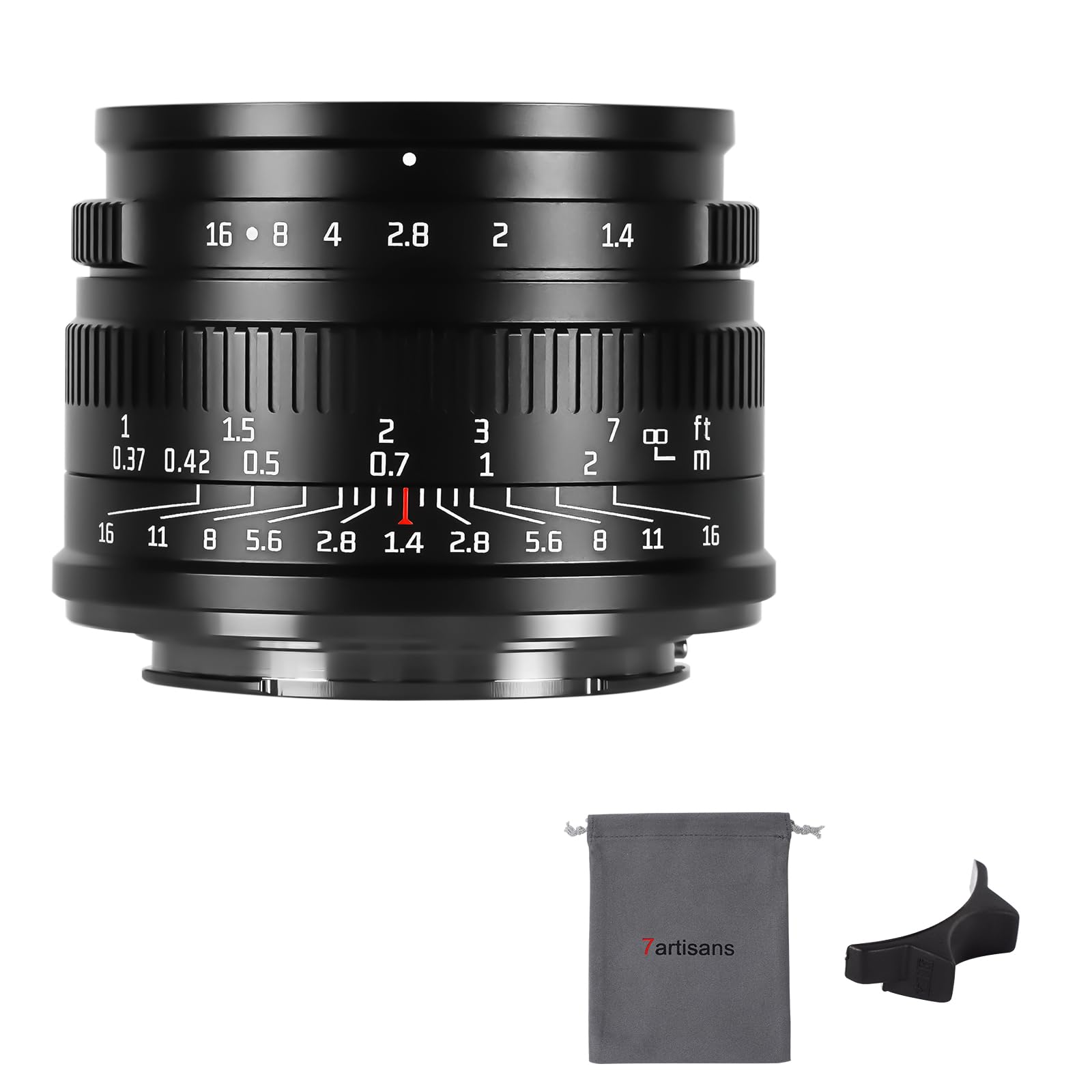
7artisans 25mm f/1.8

84 /100
LBD Score Excellent

Key details

Weight
5 oz (143 g)
Diaphragm
12 blades
Focal Length
25mm (50mm equiv.)
Max Aperture
f/1.8
View on Amazon

Same focal length as our top pick, a fraction of the cost, and a completely different experience: there is no autofocus here at all. You turn a ring, watch focus peaking light the edges in the viewfinder, and take the picture. That single fact decides the purchase before any other specification gets a vote.

What the money buys is metal. The barrel and mount are aluminum rather than plastic, the focus ring turns smoothly, and twelve diaphragm blades keep out-of-focus highlights round instead of polygonal. At five ounces it disappears on a small body and slips into a jacket pocket, and the aperture ring is clickless, which videographers like for smooth exposure changes and stills shooters find harder to read at a glance.

Our reservations are about focusing, not about glass. The throw is short, so nailing a face at f/1.8 takes a deliberate hand, and the ring sits close to the body where fingers crowd it. Images come out sharp in the center wide open with softer corners and tighten up nicely by f/5.6, which is the classic behavior of a fast budget prime and easy to work with once you know the lens.

Pros

  • All-metal body and mount
  • Twelve blades for round highlights
  • Five ounces with a 50mm-equivalent view

Cons

  • Manual focus only, with a short throw
  • Clickless aperture ring
Our verdict

If you can focus by hand, this is the most fun you can have for a pittance: an all-metal 50mm-equivalent prime with twelve aperture blades.

Check Latest Price
6

Cheap F/1.4

7artisans 35mm f/1.4 Mark II

82 /100
LBD Score Excellent

Key details

Weight
8 oz (228 g)
Diaphragm
9 blades
Focal Length
35mm
Max Aperture
f/1.4
View on Amazon

f/1.4 is normally the most expensive aperture a photographer can buy, which is what makes this lens interesting: it is the least expensive glass in this guide and the fastest. On a Micro Four Thirds body the 35mm focal length frames between our 25mm pick and the 45mm portrait lens, tight enough to compress a face and short enough to still work indoors.

The design is deliberately old-fashioned: an eight-element double-Gauss formula in a metal barrel, nine aperture blades, and a focus ring you turn by hand. No motor, no electronics to think about. At about eight ounces it has enough heft to feel planted on a small camera, and the all-metal construction is exactly why it is the heaviest of the budget primes here.

Focus is the work. Wide open at f/1.4 the depth of field is thin enough that you will miss a few frames before your hands learn the ring, and nothing automatic steps in to rescue the shot. Stop down to f/8, set the focus distance once, and it becomes a point-and-shoot for street and travel. That trade, attention for aperture, is the reason to buy it and the reason we keep it away from a toddler's birthday party.

Pros

  • f/1.4 aperture at the lowest price here
  • All-metal barrel with nine blades
  • Frames between our 25mm and 45mm picks

Cons

  • Manual focus and manual aperture only
  • 8 ounces, the heaviest budget prime here
Our verdict

A fast, all-metal short telephoto for anyone who wants f/1.4 bokeh and does not mind turning a focus ring to get it.

Check Latest Price

How We Tested Micro Four Thirds Lenses

We built the shortlist by mapping the mount's native focal lengths to what people actually shoot — street, portraits, travel, a little wildlife — then filtered by aperture, size, weight, and price, and read through owner reviews to see which lenses still held up after a year of use. That left 12 lenses, shot over six months on the same two bodies so nothing but the glass changed.

Most of the testing happened where these lenses live: a dim restaurant, a Saturday farmers market, a friend's wedding reception, a back-porch portrait session, a cold morning hike. At each spot we shot the same scene wide open and again stopped down, then compared the corners at 100 percent to find where sharpness fell off. For bokeh, we looked at how out-of-focus highlights rendered — round and clean, or ringed and busy — and whether the background stayed soft at mid distances. We also weighed and measured every lens and checked whether it fit in a jacket pocket, since a lens you leave at home is worth nothing.

Autofocus got its own pass: tracking a dog running at the camera, a kid on a swing, a friend moving through a crowded room, then counting keepers out of each burst. With the manual lenses we focused on the same moving subject and timed ourselves, which is where the value question gets answered honestly. We noted whether the aperture ring clicked into stops or turned silently, and whether the focus ring moved smoothly enough to pull focus on video. Low light came last: the same evening street scene on every lens, compared side by side for color, noise, and how quickly focus locked.

How to Choose a Micro Four Thirds Lens

Fill the gap you already have

Every focal length on this mount doubles, so the math is simple: 12mm is 24mm, 25mm is 50mm, 45mm is 90mm, and 150mm is 300mm. If you already own a 12-60mm kit zoom, the real question is which end you keep pushing against.

Photographs that come out too dark indoors call for a fast prime in the 17-25mm range. Photographs where the subject is a dot call for the 40-150mm. Scroll through your last hundred pictures and notice what you cropped toward. That is the lens to buy next.

Aperture buys light first, blur second

The f-number sounds like a bokeh specification, and on this sensor it is mostly a light specification. Moving from an f/3.5-5.6 kit zoom to an f/1.7 prime is more than two stops, the difference between a usable indoor frame and a noisy one.

Blur is the second prize, and this format gives less of it than the number suggests: an f/1.8 lens here separates a background about like f/3.6 on full frame. That is exactly why the 45mm f/1.8 earns a place, because a long focal length plus a fast aperture is what actually isolates a face.

Autofocus: quiet matters as much as quick

Stepping motors and linear motors move focus silently and smoothly, which is why the 25mm f/1.7 and the 12-60mm work for video as well as stills. Older screw-drive designs and manual lenses do not, and you hear them on the soundtrack.

For stills, the practical question is behavior in the dark. Contrast-detect systems hunt in dim rooms, so a lens that snaps outdoors can feel hesitant at a candlelit table. If you shoot indoors often, budget for a fast prime and accept that a frame or two will miss.

Carry weight is a real specification

The whole point of this system is that a bag of lenses weighs less than one full-frame zoom, and that advantage evaporates the moment a lens stays home. Our heaviest pick, the 12-60mm at 1.3 pounds, balances a G9-sized body and feels wrong on a GM1. Our lightest telephoto adds under seven ounces and comes along by default.

Weather sealing follows the same logic. A sealed lens only helps if the body is sealed too, so match the two rather than paying for protection that half the pair cannot use.

What a manual lens actually costs you

Manual glass is cheap for a reason, and the reason is not optical. You focus by turning a ring, the throw on a small lens is short, and a clickless aperture ring means you set exposure by feel rather than by counting clicks.

That is fine, even good, for landscapes on a tripod, video on a gimbal, and posed portraits where you have time. It is the wrong purchase for a birthday party, where the shot is gone before the ring gets there.

Frequently Asked Questions

Final Verdict

The Panasonic 25mm f/1.7 is the lens we point people to first, because it changes more pictures than anything else here: a 50mm view, an f/1.7 aperture that works indoors, and four ounces that never feel like a decision. Start there and the rest of the kit becomes a matter of what you shoot.

If you photograph people, the OM SYSTEM 45mm f/1.8 is the next lens we recommend. If you want one lens for a whole trip rather than a set, the Leica 12-60mm is the better single purchase, weight and price included.