Best Marine Radios of 2026

The day you actually need a marine radio is the day everything else has already gone wrong — fog, a dead engine, no cell signal. A VHF reaches the Coast Guard, the harbor patrol, and the boat a hundred yards over, and that's why my team and I have spent the past eight months carrying a dozen of them onto docks, kayaks, and small skiffs.

The number on the box barely predicts range: VHF is line of sight, so antenna height and a clean, sealed speaker matter more than a watt or two of transmit power. Floating isn't the same claim as submersible, either. What separates a radio you trust from one that lives in the locker is duller — how it sounds over a running outboard, whether the battery survives a long day, if it charges over USB-C, and whether a wet, gloved thumb can find channel 16 without looking.

The picks below are the ones still working months in, still worth what they cost, and easy enough that we didn't think twice before handing one to a guest.

1

Best Overall

Uniden Atlantis 275

90 /100
LBD Score Outstanding

Key details

Warranty
3 years
Flotation
Floats
Transmit Power
6W, selectable
Waterproof Rating
IPX8
View on Amazon

Half the boats people actually use — a 16-foot skiff, a kayak, a friend's center console — have no dash to cut, no antenna to run, and no appetite for a wiring project. The Atlantis 275 is the radio we hand over for those boats: 6 watts of transmit power in a body rated IPX8 and designed to float, with a big dual-color screen that goes paper white in daylight and red after dark.

What earns it the top spot is how few conditions it comes with. Several picks here ask for a helm, a 12-volt feed, or a taste for one brand's menu system; this one works clipped to a life jacket, dropped in a ditch bag, or carried onto a rental. It also clears its own speaker after a dunk, which is the kind of feature you do not think about until the first wave comes over the bow and the radio goes quiet.

Power is selectable, so you can drop down for harbor chatter and save battery for the run home, and you get all USA, Canadian, and international channels plus NOAA weather alerts. The emergency strobe and built-in flashlight are the two details we expected to ignore and now treat as part of the safety kit, because a floating radio with a light on it is a radio you can find in the dark. Three-year cover matches the longest warranty here.

The one thing to know is the battery gauge: it can sit near full and then fall away quickly toward the end of a charge, so top it up at the dock before every trip rather than trusting the last bar. Do that and there is very little this radio asks of you.

Pros

  • 6 watts in a handheld that floats
  • Clears its own speaker after a dunk
  • Strobe and flashlight built in
  • Three-year warranty, the longest here

Cons

  • Belt clip is the weak point on the body
Our verdict

We recommend the Atlantis 275 to anyone who wants one radio that works on any boat: 6 watts, IPX8 sealing, and a body that floats. Clip it on and go.

Check Latest Price
2

Best Fixed-Mount

Uniden UM725G

88 /100
LBD Score Excellent

Key details

GPS
Built in
Display
68mm (w) x 38mm (h)
Transmit Power
25W / 1W
Waterproof Rating
IPX8
View on Amazon

A fixed VHF with a red distress button sounds like the safest thing you can bolt to a console, right up until you learn how DSC works: the radio transmits your identity and your position only if it has a position to send, and plenty of sets need a GPS feed wired in from somewhere else on the boat. The UM725G carries its own GPS, so the button does what you bought it for on day one instead of after a winter of wiring projects.

The rest of it is what we want at a helm. Twenty-five watts for the long haul and one watt for marina calls, IPX8 sealing so a boarding wave is not the end of the trip, and the biggest screen in this group — 68mm (w) x 38mm (h) — which is the size that matters when you are reading it from the helm seat rather than from six inches away.

It also does things the cheaper sets here cannot, like text messaging boat to boat — genuinely useful when you are passing a fuel dock's hours to a friend without tying up channel 16 — plus NMEA 0183 and NMEA 2000 connections for a chartplotter. We think the GPS alone justifies the premium; the rest is a bonus.

Two practical notes before you order. The flush-mount bracket is not included, so budget for one or plan a surface mount, and the warranty runs a single year where most handhelds here get three. It still needs the usual fixed-set support: a fused 12-volt feed, a decent antenna mounted as high as you can get it, and a clear cable run.

Pros

  • Built-in GPS so DSC sends a position
  • 25 watts, switchable to 1 for marinas
  • IPX8 sealing and the biggest screen here

Cons

  • Flush-mount bracket sold separately
  • One-year warranty
Our verdict

For a boat with a helm and a 12-volt feed, this is the fixed radio we point to: GPS inside means the distress button sends a position, and IPX8 means spray does not end the trip.

Check Latest Price
3

Best for Noisy Water

Retevis RM21

83 /100
LBD Score Excellent

Key details

Battery
1800mAh Li-ion
Runtime
10 hours
Transmit Power
5W/3W/1W
Waterproof Rating
IP67
View on Amazon

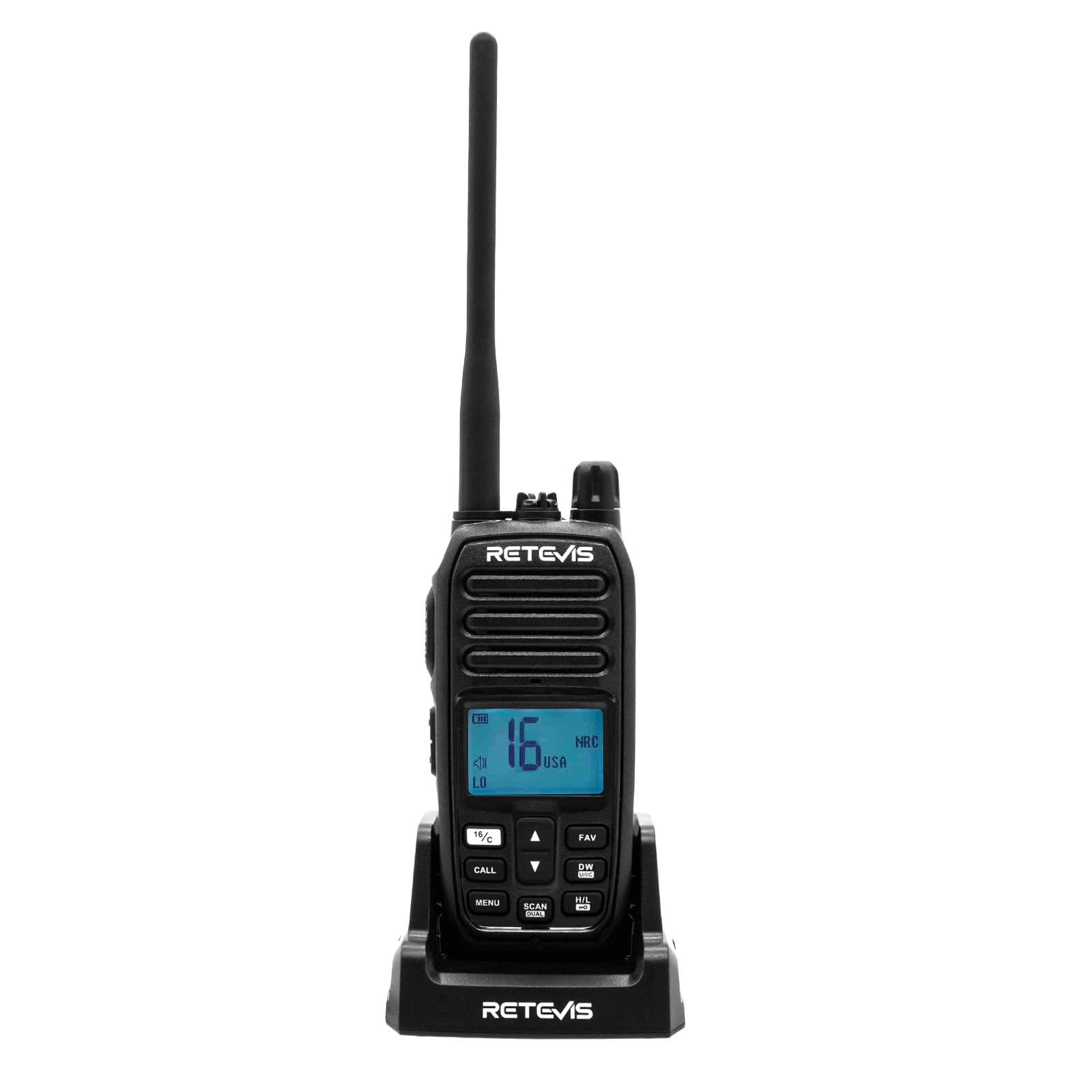
An outboard at cruise, a wet deck, and a radio held in one hand is a hard combination for anybody's ears. The RM21's answer is a single noise-cancellation button that goes after engine drone, wind, and wave slap on both transmit and receive, and it is the difference we noticed most when we compared handhelds side by side — you catch more of the transmission, and the person on the other end catches more of you.

Underneath the button it is a sensible 5-watt set: IP67 sealing and a floating body with a red water-activated warning light, 88 channels with NOAA weather alerts, a dual watch that keeps channel 16 within reach, and an 1800mAh lithium-ion pack rated for 10 hours of operation with 60 on standby. The seven-color backlight is more fun than functional, but nobody complains about it at dusk.

It is also the least expensive radio in this set, which matters for something that lives in a tackle box and gets replaced every few seasons. The trade is weight: at 620 g it is the heaviest handheld here, heavy enough that a jacket pocket feels it. Clipped to a console or a belt it is a non-issue; carried in a shirt pocket all afternoon, it is not.

Pros

  • One button cuts engine and wind noise
  • Floats with a red warning light
  • Least expensive radio in this set

Cons

  • 620 g is heavy for a pocket radio
Our verdict

The RM21 is our pick for noisy water: one button cuts engine drone, it floats with a warning light, and it is the least expensive radio here. Just do not expect it to disappear in a pocket.

Check Latest Price
4

Best for Long Days

Standard Horizon HX210

89 /100
LBD Score Excellent

Key details

Battery
1850mAh Li-ion
Charging
110V AC and 12V DC cradle
Transmit Power
6W / 2.5W / 1W
Waterproof Rating
IPX7
View on Amazon

A 110-volt cable, a 12-volt cable, and a three-hour desktop cradle all come in the HX210's box. That reads like small talk until you have owned a handheld that ships with a cigarette-lighter plug and nothing else, and it is the main reason this radio is on the list: the 1850mAh lithium-ion pack plus a charger you can actually use make it the easiest set here to keep ready.

For a compact radio it is well equipped. Six watts on high power, IPX7 sealing with a floating body, a water-activated strobe, and a dot-matrix screen larger than the case suggests. It also receives FM broadcast between 76 and 108 MHz, which is a nicer thing to have on a slow afternoon than we expected it to be.

The controls take some learning: the menu runs on programmable keys rather than a knob, and a first afternoon with the manual is part of the purchase. Spend it at the dock, and the payoff is a radio that lives in its cradle, charges off the boat or the kitchen wall, and is ready whenever the boat is.

Where it beats the Atlantis 275 is at the dock — this is the one to leave in a cradle on a boat that has a spot for one, and the one you can hand a guest without explaining a charging routine. Where it loses is in the hand: the Uniden is simpler to pick up cold and get on the air.

Pros

  • AC and DC cables plus a cradle included
  • 1850mAh lithium-ion pack
  • Receives FM broadcast radio

Cons

  • Charging faults can leave a pack flat
Our verdict

If you want a handheld that is always topped up and sitting ready in a cradle, this is the one we hand over: 6 watts, IPX7, an 1850mAh pack, and both charging cables in the box.

Check Latest Price
5

Best USB-C Charging

Cobra BlueBound 350

86 /100
LBD Score Excellent

Key details

Charging
USB-C
Battery Life
12 hours
Transmit Power
1/3/6W
Waterproof Rating
IPX7
View on Amazon

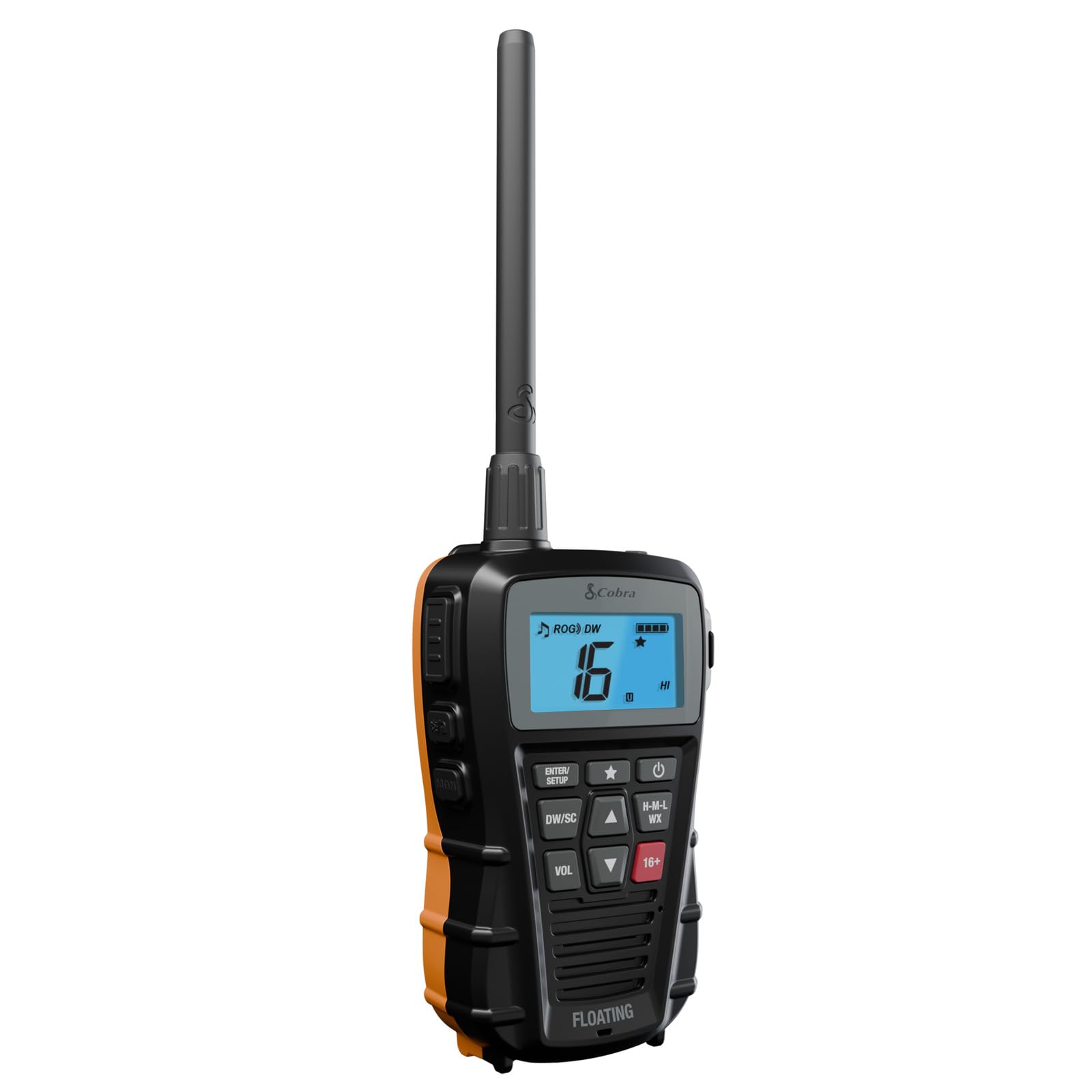
Charging a marine radio from a USB-C cable should not be worth a paragraph, and yet the BlueBound 350 is the set that treats its battery like a phone's: a cable in the console, a power bank in a dry bag, or the socket in the truck on the way to the ramp all work, and you are not hunting for a cradle at the end of a long weekend.

There is a capable radio under the cable. Six watts, switchable down for close work, 98 channels, tri-watch that keeps channels 9 and 16 and one channel of your choosing live at once, and NOAA weather alerts across 12 channels. The floating core is high-visibility orange — the right color for the one item you most want to spot bobbing beside the boat.

What we appreciate most is that Cobra did not save the good parts for a more expensive model: 6 watts, IPX7 sealing, a twelve-hour battery rating, and a three-year warranty, which is three times the cover on the cheaper BlueBound 150 in this guide. The display also switches between day and night modes, which matters more than it sounds when you are running home after dark and do not want a white screen wrecking your night vision.

It does cost more than the Atlantis 275, and for most buyers the Uniden's strobe, bigger screen, and longer track record here are the better trade. Where the Cobra wins is the boat with no charger wired in and a dry bag full of USB-C cables — which, on small boats, is most of them.

Pros

  • Charges over USB-C from any cable
  • Three-year warranty, three times the 150's
  • Day and night display modes

Cons

No notable drawbacks to flag.

Our verdict

The BlueBound 350 is for the boat with no charger wired in: USB-C recharging, 6 watts, and a three-year warranty in a set you can top up from the truck.

Check Latest Price
6

Dunk-Prone Use

Retevis RM15

83 /100
LBD Score Excellent

Key details

Battery
2000mAh
Charging
USB-C on radio and charger
Transmit Power
1W/3W/6W
Waterproof Rating
IP68
View on Amazon

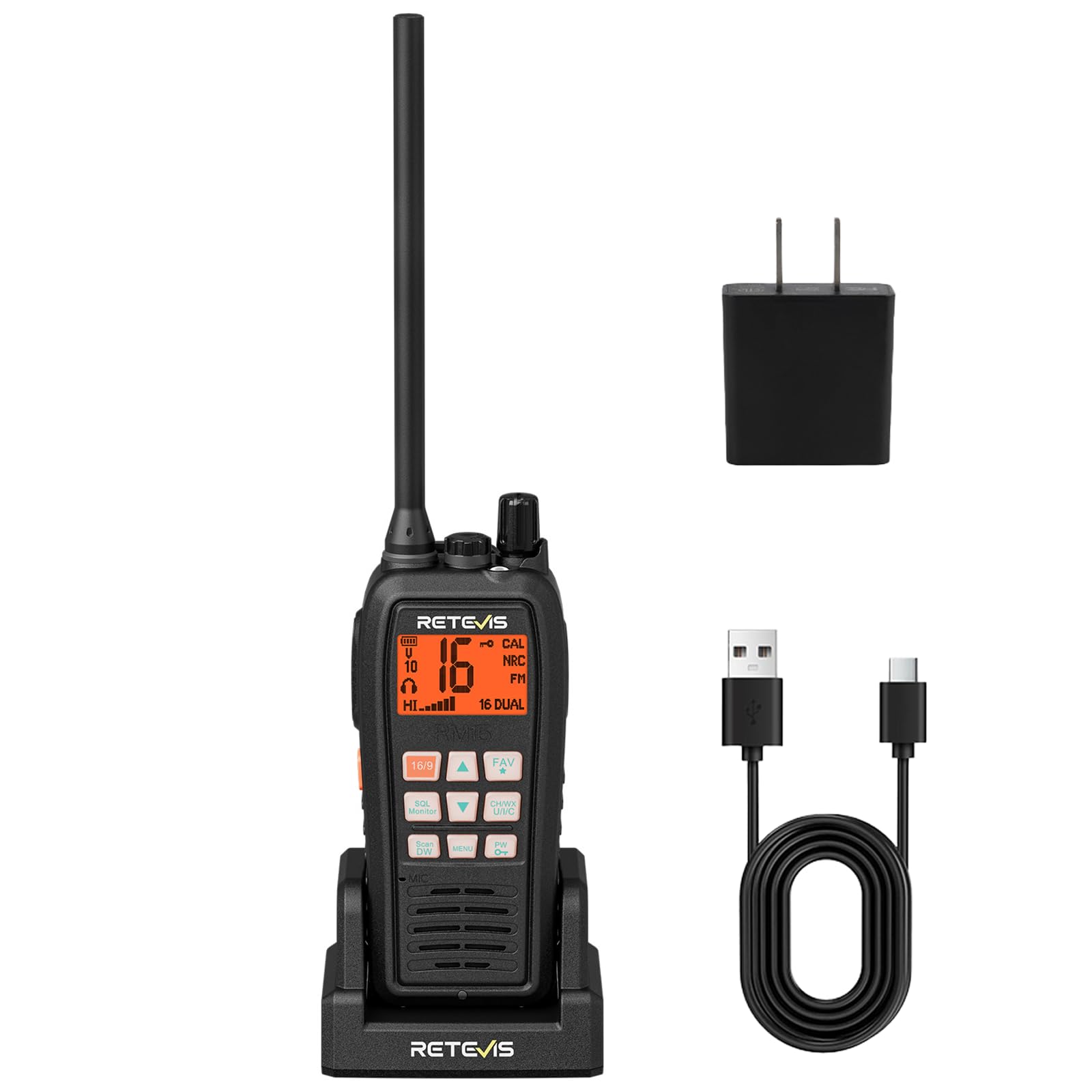
IP68 is the number to notice on the RM15: rated for immersion to 1.5 meters for 30 minutes, which is deeper and longer than the IPX7 sets here, and paired with a floating body and a water-activated emergency strobe. On a kayak deck or a wet foredeck, that is the specification we care about most, because it is the one that decides whether a dunk ends the trip.

The rest of the package is sensible. Six watts selectable down to one, a 2000mAh pack with a 10-hour rating, USB-C on both the radio and the charger so a single cable covers the kit, 88 channels, NOAA alerts, tri-watch, and noise reduction on transmit and receive. The charging contacts are built to resist saltwater corrosion, which is the slow failure that takes most marine electronics out of service.

What keeps it out of the top tier is history: Retevis is a newer name in this corner of the market, and there is less long-term use behind this model than behind the Uniden and Standard Horizon picks. For a tender, a paddle craft, or a spare that lives in a wet locker, that is a trade we are happy to make. Just know the battery pack is nonstandard, so a spare comes from Retevis rather than the corner store.

Pros

  • IP68 rated to 1.5 m for 30 minutes
  • USB-C on both the radio and charger
  • Water-activated emergency strobe

Cons

  • Nonstandard pack, so spares come from Retevis
Our verdict

Buy the RM15 if your radio gets wet more than it gets used: IP68 to 1.5 meters, a floating strobe body, and USB-C everywhere, for a kayak or a tender.

Check Latest Price
7

Budget Pocket Radio

Cobra BlueBound 150

82 /100
LBD Score Excellent

Key details

Weight
8.64 oz
Charging
USB-C
Transmit Power
.5/1/3W
Waterproof Rating
IPX7
View on Amazon

Three watts is the honest headline on the BlueBound 150, and it tells you most of what you need to know: this is the radio for inland lakes, rivers, and harbor chatter where the other boats are a couple of miles away, not the one for a run offshore. The rest is the BlueBound 350's design shrunk down — the same 98 channels, the same floating orange core, the same USB-C charging.

At 8.64 ounces it is the lightest set here, which is rather the point: it disappears into a dry bag or a jacket pocket and you forget it until you want it. Battery life is listed at 11 hours, NOAA weather alerts are included, and the belt clip and lanyard come in the box.

The compromises show up in the details that do not fit on a spec line. Three watts gives you less margin when the other boat is far off, and this is the only radio here with a one-year warranty — the 350, its closest sibling, gets three.

For a dinghy, a duck boat, or a second radio that lives in the truck, that is a fair swap: you give up reach and warranty cover, not basic function, and you get a set light enough that it actually comes along. Keep a USB-C cable in the same bag and it will handle everything an inland boat asks of it.

Pros

  • 8.64 ounces, the lightest here
  • USB-C charging without spending much

Cons

  • One-year warranty, against three on the 350
Our verdict

For lakes, rivers, and a radio that lives in a gear bag, the BlueBound 150 is enough: light, USB-C charged, and honest about its 3 watts.

Check Latest Price

How We Tested Marine Radios on the Water

We started with spec sheets for roughly 40 VHF radios, handheld and fixed-mount, and filtered for transmit power, IP rating, floating versus submersible construction, NOAA weather access, and charging method. From that pool we bought 12 and put them through eight months of real use, from spring dock prep straight through a full summer and into fall.

Each radio came out on the water at least a dozen times — on a skiff in a chop, in a kayak, clipped to a PFD while wading, and sitting in an open dock box through rain. We ran range checks by transmitting from the same spot to a fixed receiver at known distances and logging whether the audio came through clean or shredded. Back on the dock, we played recorded transmissions over a speaker with an outboard idling beside it, then dunked every floating model in a bucket of salt water for half an hour, dropped a few over the side on purpose, and checked the seals and speaker grille afterward.

Button by button, we counted how many presses it took to reach channel 16 and the weather channel — bare-handed, in wet gloves, and in the dark. We ran batteries from full to dead with a stopwatch at full transmit and noted which ones could be topped up from a power bank. Belt clips got clipped and unclipped a few dozen times onto PFD straps and belt loops, then shaken hard to see whether the radio stayed put. Along the way we dropped a couple on the dock, left them in the sun, and watched the contacts for corrosion, because a radio that quits in season two is worse than no radio at all.

How to Choose a Marine Vhf Radio

Handheld or Fixed-Mount Comes First

Start with the boat, not the spec sheet. A fixed-mount set needs a fused 12-volt feed, depth behind the mounting spot for the bracket, and an antenna with a cable run to somewhere high. That is a satisfying weekend on a boat with room for it, and a non-starter on a kayak or a tiller-steered skiff.

Our rule of thumb: if the boat stays in the water and has a helm, fit a fixed set and treat a handheld as the backup; if you trailer, paddle, or borrow boats, a handheld is the entire system.

Watts, Antenna Height, and What Range Really Means

A 25-watt fixed set with a masthead antenna out-talks a 6-watt handheld every time, and the watts are only part of the reason. VHF is line of sight, so antenna height does most of the work; a rubber antenna at chest height is the real limit on a handheld. That is why we do not shop by wattage alone.

Five or six watts covers boat-to-boat and marina traffic comfortably. The fixed set starts earning its price when you want a shore station from further out, which is a job for height and a good cable as much as for power.

Waterproofing, Flotation, and the Overboard Case

IPX7 means roughly a half hour at about a meter; IPX8 and IP68 rate deeper or longer. The difference matters most for the radio that goes into the water rather than the one that gets splashed, so if the set rides an open boat or a paddle craft, buy one that floats and carries a strobe — a floating radio with a light is findable after dark, and a submersible one that sinks is simply gone.

Check the battery door seal each season. That is the part that lets water in.

DSC, MMSI, and the Position Problem

Digital Selective Calling turns a VHF into a distress device: hold the button and the radio transmits your identity and, if it has one, your position. The second half is the catch. Many fixed sets need a GPS feed wired in from a chartplotter, which is why we rate a set with the GPS inside its own case so highly.

Whatever you fit, register for an MMSI number and program it. An unprogrammed radio sends a distress call that nobody can identify.

Batteries, Chargers, and What Is Actually in the Box

Read the accessory list before you commit. Plenty of handhelds ship with a 12-volt cigarette-lighter charger and nothing else, which is fine on a boat with a socket and useless in a kitchen. A cradle with both AC and DC cables, as on the HX210, or USB-C charging, as on the Cobras and the RM15, is far easier to live with.

Lithium-ion packs run longest. AAA cells charge slowly but can be swapped in an emergency, which some boaters value more than runtime.

Frequently Asked Questions

Final Verdict

Buy the Uniden Atlantis 275 first. It is the radio that works on whatever boat you are standing on — 6 watts, IPX8 sealing, it floats, and it has a strobe — and it lands in the middle of this group on price. Charge it at the dock each trip and it asks nothing else of you.

If your boat has a helm, a 12-volt feed, and a place to run an antenna, the UM725G is the fixed set to fit, because its built-in GPS turns the distress button into something that reports where you are. And if engine noise is the reason nobody can hear your radio, take the RM21 instead.