Best Two-Way Radios of 2026

A two-way radio has one job: to work when nothing else does — when the cell signal quits, when the group splits on a trail, when the power's been out for a day. Cheap sets still trip over it: a battery that dies on the second afternoon, a range claim that shrinks to a quarter mile once there are trees between you, a channel nobody else in your group can reach. I spent five months with 14 sets finding the ones that don't.

Range in particular is measured line of sight, so two radios a ridge apart won't do what the box promises. What separates a good set from a frustrating one is duller: battery life you can predict, audio that holds up whether someone whispers or shouts, a channel setup that reaches radios you didn't buy.

What you're carrying matters too — a two-pack for a family hike is a different animal from a waterproof set on a job site. We weighed, clipped, dropped, and recharged every one of them, and the picks below are the sets we kept reaching for.

1

Best Overall

Midland GXT1000VP4

89 /100
LBD Score Excellent

Key details

Band
GMRS
Channels
50
Max Range
36 miles
Battery Life
10 hours
View on Amazon

The GXT1000VP4 arrives as a kit rather than a pair of handsets: two radios, two headsets, a desktop charger, an AC adapter and a DC adapter for a car socket. The car cord is the piece we did not expect to care about, and it is why this set earns a place in the truck between trips, topping up from the dash while the radios stay clipped where they belong.

What makes it our default is the power arrangement. The included packs are rated for about 10 hours, and when they run flat the radios drop to AA cells, so a long day does not end with a dead battery and a group shouting across a valley. Fifty channels and 142 privacy codes give you somewhere to move when a campground channel fills up, and the NOAA weather scan is the feature we were gladdest to have when the sky turned on a ridge.

The 36-mile figure needs translating. That is a line-of-sight best case over open water or flat ground, and between trees and houses you should expect something closer to a mile or two, which is what a handheld of this size delivers anywhere. At 7.9 inches and 4.8 ounces it is a radio you notice on a belt, though not one you want to take off.

One practical note: these transmit on GMRS, which in the U.S. calls for an FCC license, and the guide above explains what that involves. Beyond that, the extras are the difference. Three years of parts and labor is the longest cover in this group, the headset lets a call arrive at a whisper on a windy ridge, and the belt clip holds on a pack strap. Small things, all of them, and together the reason the box never gets put back in the closet.

Pros

  • Headset and belt clip for each radio
  • Switches to AA cells when the pack dies
  • NOAA weather scan and alert built in
  • Three-year parts and labor warranty

Cons

  • Two radios only, so a family of four needs two sets
  • Ten-hour packs need topping up on long days
Our verdict

Our pick for most people: the GXT1000VP4 pairs real GMRS reach with NOAA alerts, a headset in the box and AA backup when the pack dies.
Check Latest Price
2

Best for Tough Conditions

Retevis RB48

88 /100
LBD Score Excellent

Key details

Channels
22
Max Range
3 miles
Battery Life
18 hours
Waterproof Rating
IP67
View on Amazon

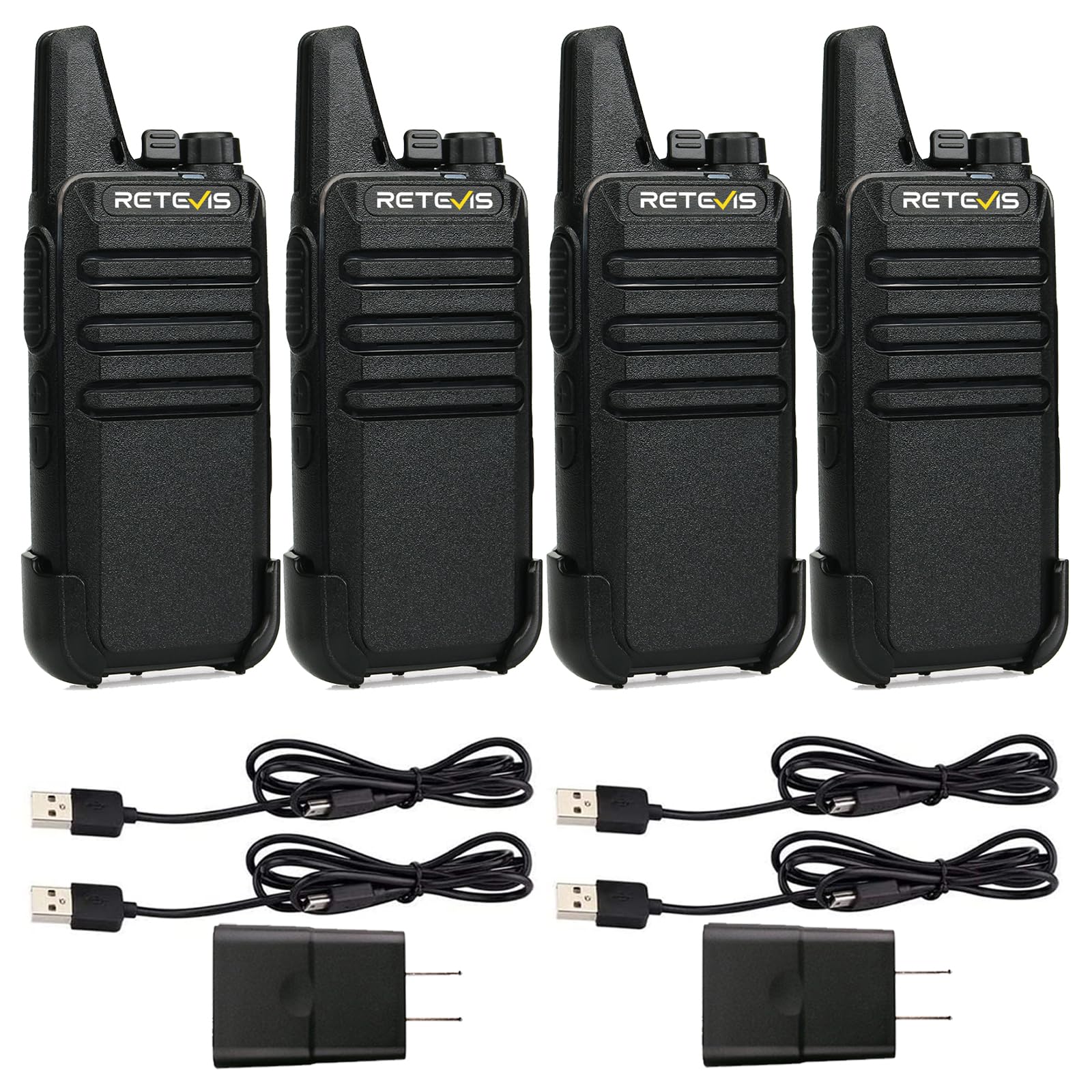
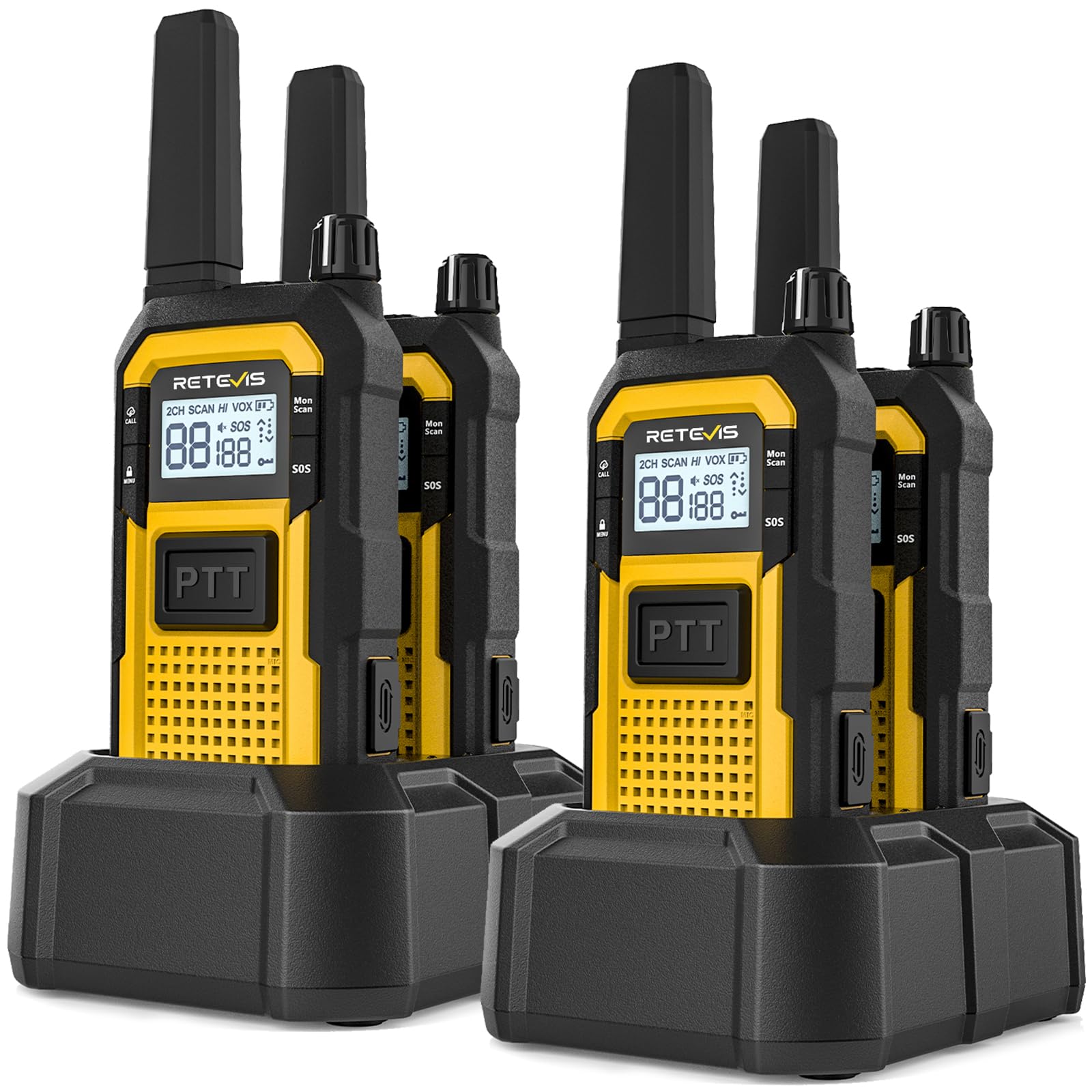
MIL-STD-810H is the claim printed on the front of the box, and for once it carries weight: the RB48 is tested against nineteen conditions, from salt fog and sand to vibration and immersion, and it holds an IP67 rating on top of that. Retevis warrants the body for five years, which is the longest cover of anything in this group.

The details are where the rating turns into something useful, and they are the ones we kept noticing. The front PTT is big enough to find with a glove on, there is a second PTT on the side for a left-handed grip, and a vibration alert means a call gets felt rather than missed in a loud plant. The 2000mAh pack is rated for 18 hours, the radio floats, and a NOAA scan plus an SOS siren round out the parts you hope never to need.

Add up the box — four radios, belt clips, charging docks and that warranty — and the cost per radio lands below the waterproof two-pack from Motorola. What the money buys is the part that fails first on a job site: the shell. On scaffolding, in a boat locker or on a tractor, this is the set we point at. Behind a desk, the same money buys toughness you will never test.

Pros

  • IP67 body tested to MIL-STD-810H
  • Front and side PTT work with gloves
  • Five-year warranty on the radio body

Cons

  • Only sold as a four-pack
Our verdict

We recommend the RB48 for anyone whose radios get dropped or soaked: IP67 sealing, glove-sized buttons and a five-year body warranty.

Check Latest Price
3

Best for Large Crews

SAMCOM FPCN30A

88 /100
LBD Score Excellent

Key details

Band
UHF
Channels
20
Max Range
5 miles
Radios Included
6
View on Amazon

The feature that decides this one is a single button. Press GROUP on the FPCN30A and the transmission goes out to every team on the system at once, including the ones sitting on different channels, which is the difference between rounding up a crew channel by channel and making one announcement everyone hears. In a warehouse, a campus or a construction site, we think that is worth more than any range figure on the box.

The hardware backs it up. Twenty channels over UHF and 5 watts of output is more power than any FRS set here can offer, and SAMCOM rates the radios for three to five miles in open country or a 300,000-square-foot building indoors. The shell is built for drops and scuffs, the dual PTTs suit either hand, and the 1500mAh pack is meant to cover a shift with overtime on the end of it.

Compatibility is the catch, and it is a big one: the only devices on the compatible list are other FPCN30As. Hand one to a visitor carrying a drugstore walkie-talkie and you have two people talking to nobody, so the whole crew has to be on your radios rather than just the ones who forgot theirs. Do that and the sums work — six radios, a one-year replacement and support that outlasts it.

Pros

  • One-key group call reaches every team
  • 5 watts of UHF output indoors and out
  • Outfits a six-person shift in one box

Cons

  • Only works with other FPCN30A radios
  • One-year replacement is the shortest warranty here
Our verdict

Six 5-watt radios with a group-call button make the FPCN30A the set we trust across a large site, as long as you buy them for the whole crew.

Check Latest Price
4

Best Compact

Retevis RT22

91 /100
LBD Score Outstanding

Key details

Charging
USB-C
Max Range
2 miles
Battery Life
12 hours
Waterproof Rating
IP65
View on Amazon

The antenna on the RT22 is barely longer than a thumb and blunt at the tip, which is a deliberate piece of design rather than a shortcut. Retevis shaped it that way so a radio clipped to a child's belt is not a spike waiting to happen, and it is the sort of detail that never shows up in a spec block but shows up every time somebody bends over.

Nothing on the radio invites fiddling. There is a channel knob, a volume dial and a PTT, no front keypad to knock out of settings, and a lock that keeps a pocket from changing the channel. That simplicity is why it is our pick for everyday carry and for small hands: four radios, four belt clips, four USB-C cables and two dual-port adapters, and nobody needs the manual.

The trade is range. Two miles is the shortest claim in this group, and this is a radio happiest within a few hundred yards — a campground loop, a store floor, a cruise deck, a neighborhood. IP65 means it shrugs off rain and splashes, the 12-hour pack charges from the same cable as a phone, and the whole set is light enough that four of them vanish into a daypack.

Pros

  • Short blunt antenna is safer on a belt
  • Charges over USB-C, no dock needed
  • IP65 and a 12-hour pack per radio

Cons

  • Two miles is the shortest claimed range here
  • Charges over four separate cables, with no dock
Our verdict

For everyday carry, the RT22 is the one we reach for: a blunt stub antenna, USB-C charging and four radios simple enough for a child.

Check Latest Price
5

Best Budget

MOICO T5

88 /100
LBD Score Excellent

Key details

Battery
4 AAA
Channels
22
Max Range
3 miles
Waterproof Rating
IP65
View on Amazon

This is the pair you hand a kid without wincing. Two radios, a backlit green screen, a flashlight on the side and buttons that each do one thing, with no menu to get lost in. That is why it is the set we recommend to families who want the radios to be the fun part of the walk rather than the reason it stops.

Twenty-two FRS channels and 99 privacy codes give you somewhere to go when a campground channel fills with other people's conversations, VOX means a child can talk without hunting for the button, and the flashlight earns its keep on the walk back to the tent. It is small, too, at under six inches tall, and the detachable belt clip frees a hand for a bike or a dog lead.

Power is the trade. Each radio takes four AAA cells, and heavy use eats them, so a pack of rechargeables is the first accessory to buy and the thing that settles the running cost. For a first radio, a gift, or a pair that lives in a kitchen drawer for trips to the park, the MOICO is a sensible place to start and an inexpensive mistake if the interest does not last. It is not the radio for an eight-hour shift.

Pros

  • Simple enough for a child to work alone
  • Backlit screen and built-in flashlight

Cons

  • Roughly half a mile to a mile of range in town
Our verdict

The cheapest pair that still works properly: easy enough for a kid, clear enough for a campground, as long as you feed it AAA cells.

Check Latest Price
6

Family Four-Packs

BAOFENG T18

84 /100
LBD Score Excellent

Key details

Battery
1500mAh Li-ion
Channels
22
Charging
USB-C
Max Range
3 miles
View on Amazon

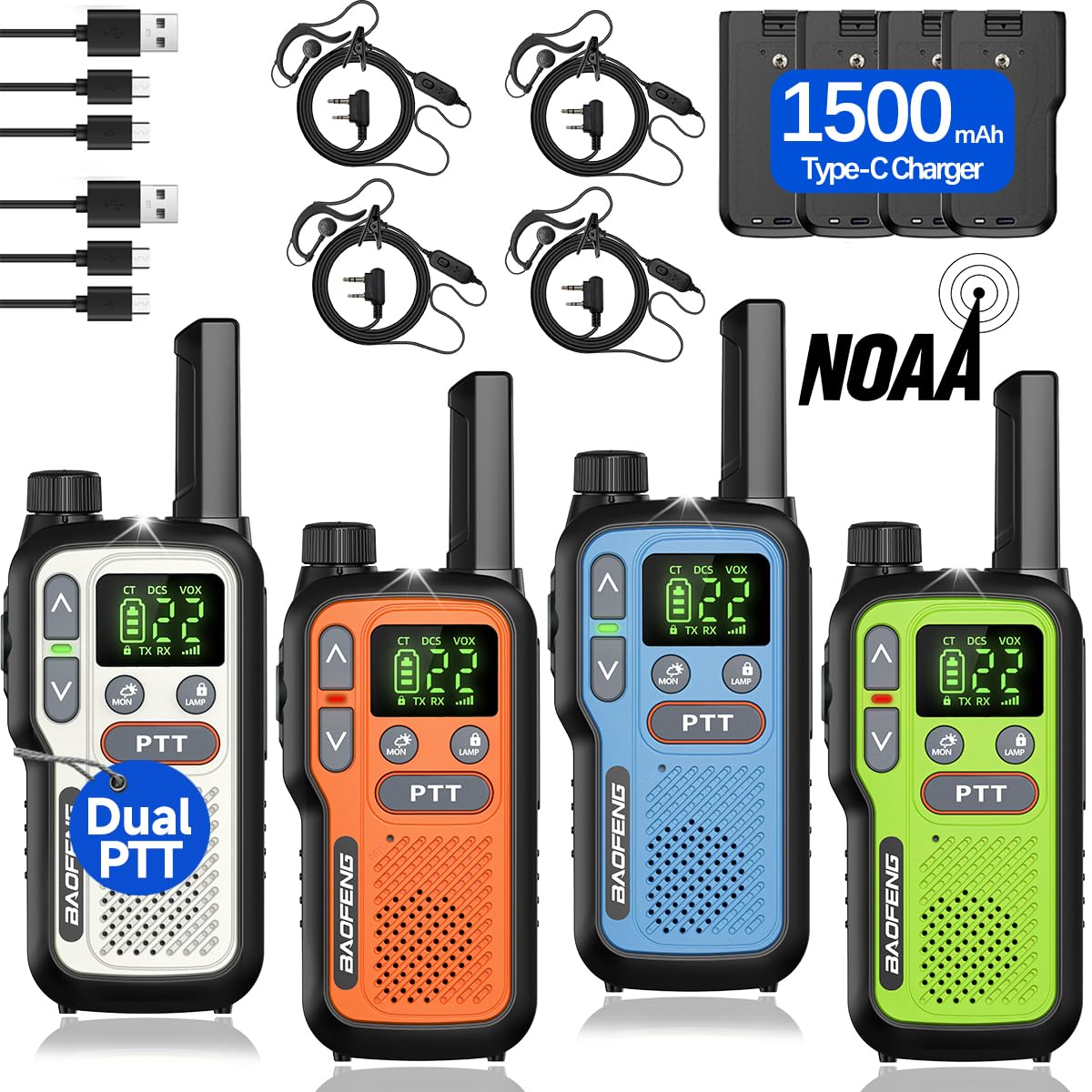
Four rechargeable radios, four headsets, NOAA weather alerts and USB-C charging: the T18 is the set to look at when a family needs four radios rather than two, and wants them to charge like a phone. It is the least expensive route here to a rechargeable radio in every backpack.

The dual PTT is the detail we like. One button sits on the side and one in the middle of the face, so the radio works in either hand and with gloves on. There is a backlit LCD, a flashlight, VOX and a 1500mAh pack, and BAOFENG publishes a distance ladder instead of one big number: about 0.6 miles around houses, a mile in the suburbs, up to three miles over flat open ground. That is more useful than most of the claims in this category.

The case for the set is straightforward: four radios, one power strip's worth of USB-C charging the night before a trip, and a weather band for the days that turn. They come in four colors, which matters more than it should when you are handing them out, and the headsets are the part most likely to end up lost in a drawer.

Pros

  • Four rechargeable radios in one box
  • USB-C charging from any socket or bank
  • NOAA weather receiver built in

Cons

  • Not water resistant
  • No manufacturer warranty stated
Our verdict

A family four-pack with rechargeable cells, NOAA alerts and headsets for about what two radios cost elsewhere, fine in dry weather and not in rain.

Check Latest Price
7

Water and Weather

Motorola T605 H2O

80 /100
LBD Score Excellent

Key details

Channels
22
Max Range
35 miles
Battery Life
9 hours
Waterproof Rating
IP67
View on Amazon

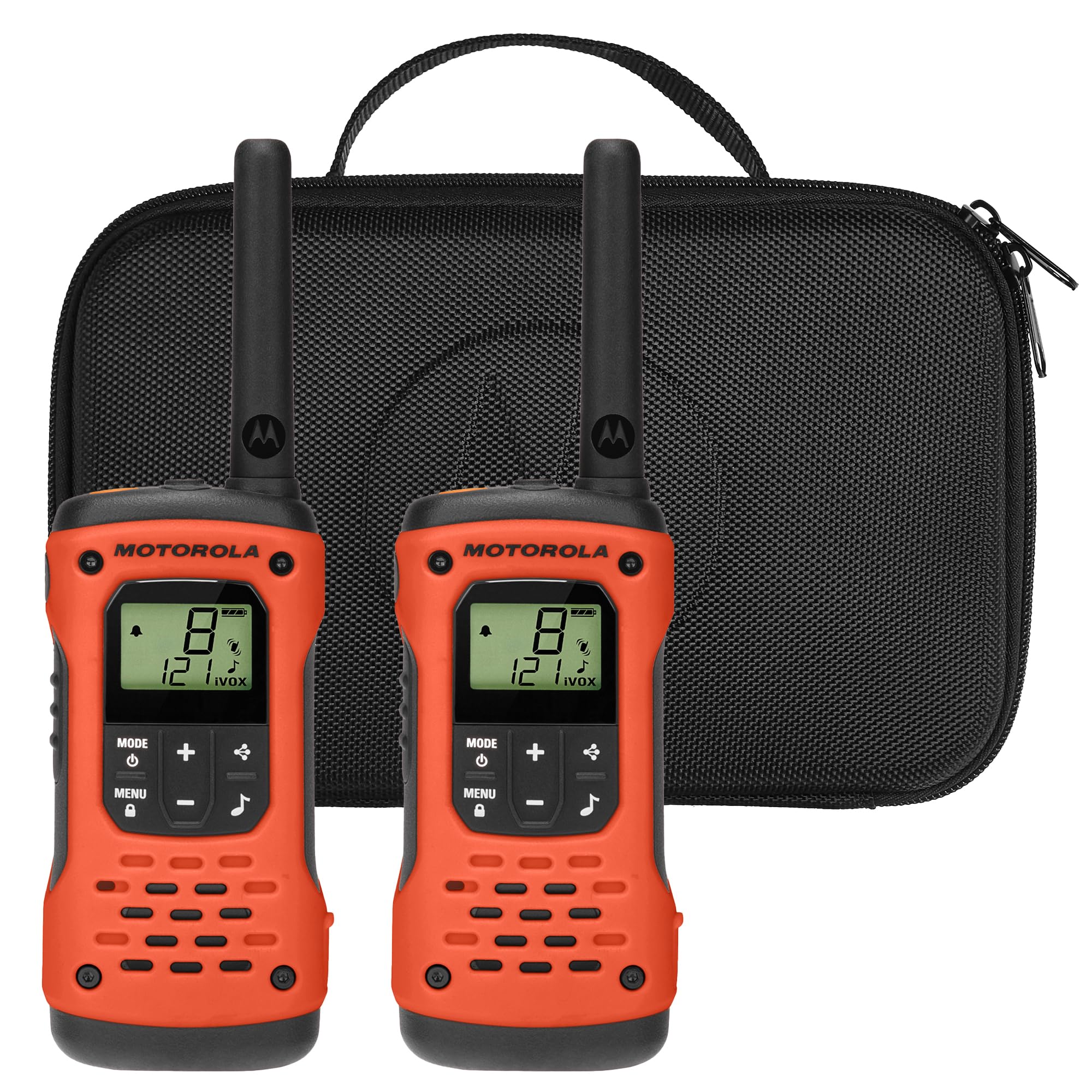
Drop the T605 in the lake and it comes back up floating face up, and the flashlight switches on the moment it hits the water. It is that water-activated light which makes the design: at dusk, a floating radio is a small lit target rather than a guess.

On dry land it behaves like a good FRS pair — 22 channels, automatic squelch that keeps the hiss down, clear audio, and USB-C charging on each handset. IP67 sealing means a dunking does not end the trip, and we found it substantial in the hand at 7.8 inches and 7.84 ounces without being a burden on a life jacket.

Pairing is simple: hold the button and the two handsets find each other. It will also talk to any other FRS radio on the same channel, so it slots into a mixed group of borrowed handsets without a conversation about brands, which for a guest arriving with their own walkie-talkie matters more than any feature list.

Two years of cover on the electronics, a shell that survives the mistake and a light that works when your hands are full: a narrow brief, executed properly. It is the only pick here with an answer for the moment a radio goes over the side other than buying another one.

Pros

  • Floats face up with a water-activated light
  • Charges over USB-C on each handset
  • Talks to any FRS radio on the channel

Cons

  • Nine-hour rating is short for a full day
  • The most expensive per radio here
Our verdict

Buy the T605 for water: it floats face up, lights up when it gets wet and recharges over USB-C from a boat or a power bank.

Check Latest Price

How We Tested the Best Two-Way Radios

We built the shortlist by reading through owner reviews, spec sheets, and the complaints that show up again and again, then filtered by pack size, price, and whether a radio could be recharged without a steady supply of disposable batteries. That left 14 sets, which we rotated through five months of ordinary use: wooded hikes where we walked apart until contact broke, a ski hill, a cruise deck full of steel, a warehouse store, a school parking-lot event, and a two-day power outage.

Range we measured honestly — two people walking apart with a landmark in between, once across an open field and once through trees and around buildings, marking the exact spot where the signal dropped out. We repeated the test on the water-resistant models after soaking them, since a wet antenna changes the math.

Battery life was a stopwatch exercise: full charge, radio on at moderate volume, check-ins every 15 minutes until the audio started clipping or the unit shut off, then timing the recharge and noting whether it needed a proprietary cradle or a plain USB-C cable. For sound, we read numbers back and forth from 20 feet away and listened for the garbling that turns a six into a five.

Ease of use we judged by handing a set to a 10-year-old and to a grandparent and timing how long it took them to reach each other with no instructions, then by working every button with ski gloves on. Durability meant drops onto pavement, a dunk and a float test, and a week riding in a coat pocket with keys. We checked compatibility by trying to reach other FRS and GMRS radios we had on hand, and we ran the bundled headsets and earpieces on a windy day to see whether they were usable or just padding in the box.

How to Choose a Two-Way Radio

Work Back From Real Distance

Every range claim in this category is a line-of-sight maximum measured over open ground or water with nothing in between. Trees, houses, a hill and the steel of a car all eat into it. One set here advertises 36 miles and another 2, and in the same patch of woods they will be closer than those numbers suggest.

So start from the gap you actually need: a campground loop, two floors of a warehouse, the dock to the mooring, the far fence line. Buy for that with room to spare. A compact FRS pair handles a few hundred yards comfortably; a mile through timber asks for more power than a pocket radio usually offers.

Settle the Power System Before the Features

Sealed packs with a dock suit a crew that returns to the same shelf every night, because everyone drops a radio into a slot and walks away. USB-C is the better road design, since the cable that charges a phone charges the radio. AA or AAA cells are the backstop for the day nothing else is charged, and a set that offers both is the easiest to live with on a long trip — the Midland GXT1000VP4 is the clearest example, with rechargeable packs and an AA fallback in the same body.

The trap is the multi-bay charging station. A six-way dock is only convenient if all six radios come back to it every evening; if they live in six different trucks, individual charging wins. Count the radios you need before you fall for the dock.

Know Which Band You Are Buying Into

FRS is the license-free service most family radios use, and it is the safe default for a first set. GMRS shares those channels with more power and repeater capability, and it requires an FCC license — no exam, but a real one, so budget for it if you want the extra reach. A programmable UHF business radio is a third thing again: more output, group-call features, and almost always a closed ecosystem.

That last point is where buyers get caught. Before you buy, check the compatible-device list, because some sets are programmed to work as their own fleet and will not open a channel with a neighbor's walkie-talkie. If you are adding to radios you already own, stick with mainstream FRS.

Check Water, Drops and the Controls

IP ratings are the one shortcut worth memorizing: IPX4 or JIS4 means rain is fine, IP67 means a dunking is survivable, and a few radios here float as well. If the radio rides on a belt all day, a channel lock matters more than channel count, because a bumped knob moves the whole group off the agreed channel.

Gloves change the calculation too: a large front PTT you can find by feel beats a row of small buttons. Look at the antenna as well — a short, blunt stub on a set aimed at children is a deliberate safety choice, not a cost cut, and it is the friendlier shape on a small belt.

Frequently Asked Questions

Final Verdict

Start with the Midland GXT1000VP4. It covers more of what a handheld radio is asked to do than anything else here — GMRS reach, weather alerts, a headset for each handset, an AA fallback and three years of cover — without asking you to learn a menu system. The GMRS license is the one condition; if you want to stay license-free, an FRS set does the same short-range work.

If the radios will live somewhere wet and careless, the Retevis RB48 is the better buy and worth the extra. If they are for kids, the MOICO pair is the cheapest way in.