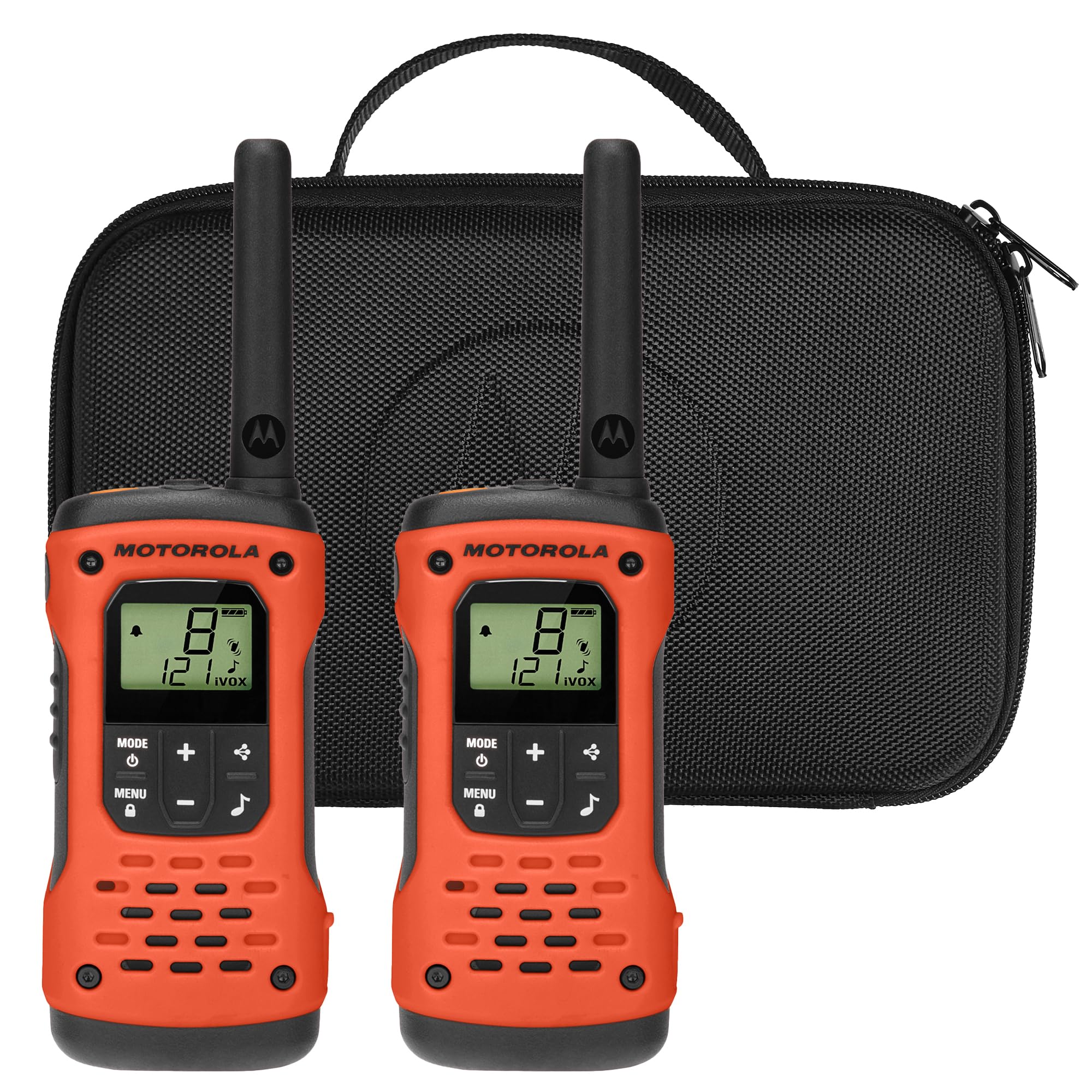
Best Two-Way Radios for Camping of 2026

Every walkie-talkie box promises a range that sounds like a small miracle — 20 miles, 35 miles, sometimes more. Those numbers come from a lab setup with one radio on a ridge and nothing in the way, and they mean very little when you're trying to reach a kid at the far end of a canyon. Two things trip up first-time buyers: privacy codes don't make a channel private, they only filter out other people's chatter, and a pair that runs on ordinary batteries will save a trip when the charger stays home.

I've carried radios into the woods for years, and over the past eight months my team put 12 of them through a full season of camping — wet hikes, a river float, and plenty of shouting across a group site. The ones worth packing share a few traits: voices that stay clear when someone mutters from inside a tent, buttons you can work by feel in the dark, and a battery that lasts a weekend. Some of the 12 earned a permanent spot in the gear bin; those are the ones below.

1

Best Overall

Retevis RB48

89 /100
LBD Score Excellent

Key details

Battery
2000mAh, up to 18 hours
Channels
22 (FRS)
Pack Size
2 radios
Water Resistance
IP67, floats
View on Amazon

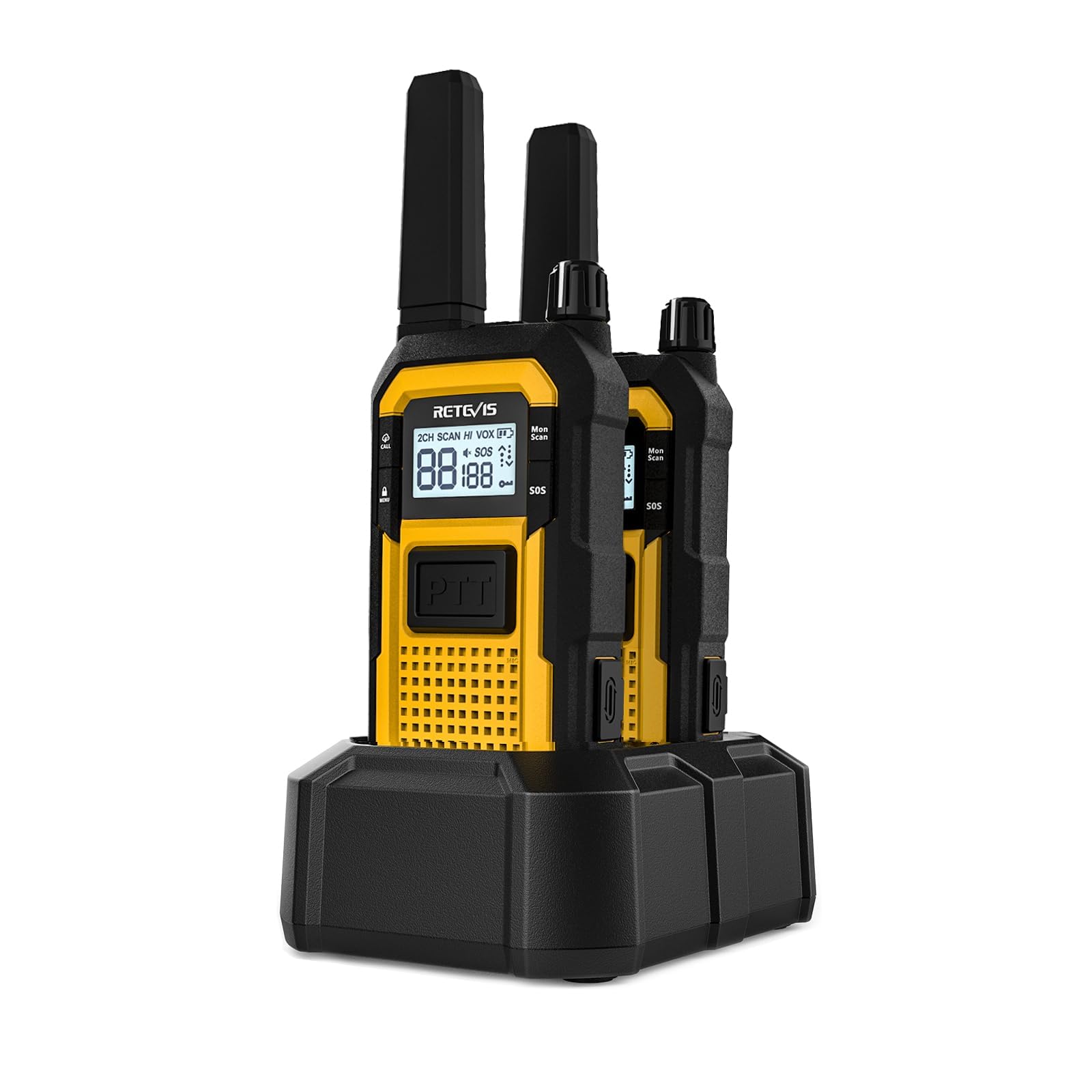
Two ratings do most of the persuading: IP67, which means the radio survives being submerged, and MIL-STD-810H, which covers the drops, dust, and temperature swings a campsite hands out. It floats, too, and the body is bright yellow, so a set that goes over the side of a canoe is one you fish out rather than replace. Of everything in this group, it's the pair we hand to whoever is hardest on gear.

Battery is the second reason it earns the top spot. The 2000mAh pack is rated at up to 18 hours, and there are two ways to refill it — a USB-C port on the radio itself or the two-bay dock in the box — so a single power bank covers a long weekend. The controls are built for cold, wet hands: dual PTT buttons, silicone-covered switches, and a vibration alert that lets you keep the volume down at a quiet site and still feel a call coming in.

On the air it's a 22-channel FRS radio, license-free, and happy to talk to other FRS sets on the same channel. Range lands where the rest of this group lands: about a mile in timber and hills, further over open water. NOAA weather scan is built in, which matters a good deal more in a tent than it does on a job site.

The one habit worth forming is a glance at the volume knob before you key up. It sits proud of the top edge and gets spun down against a pack strap or a jacket, and there's nothing more useless on a ridge than a radio turned to mute.

Pros

  • IP67 sealing, and it floats
  • Up to 18 hours from a 2000mAh pack
  • USB-C plus a two-radio charging dock
  • Glove-friendly dual PTT and vibration alert

Cons

  • Heaviest pair here at 730 grams
Our verdict

We recommend the RB48 to anyone whose camping involves water, weather, or a group that wanders — it's the most protected pair here and it still runs a full day.
Check Latest Price
2

Best for Families and Groups

Retevis RT22

91 /100
LBD Score Outstanding

Key details

Battery
Up to 12 hours, USB-C
Channels
16 (FRS)
Pack Size
4 radios
Water Resistance
IP65
View on Amazon

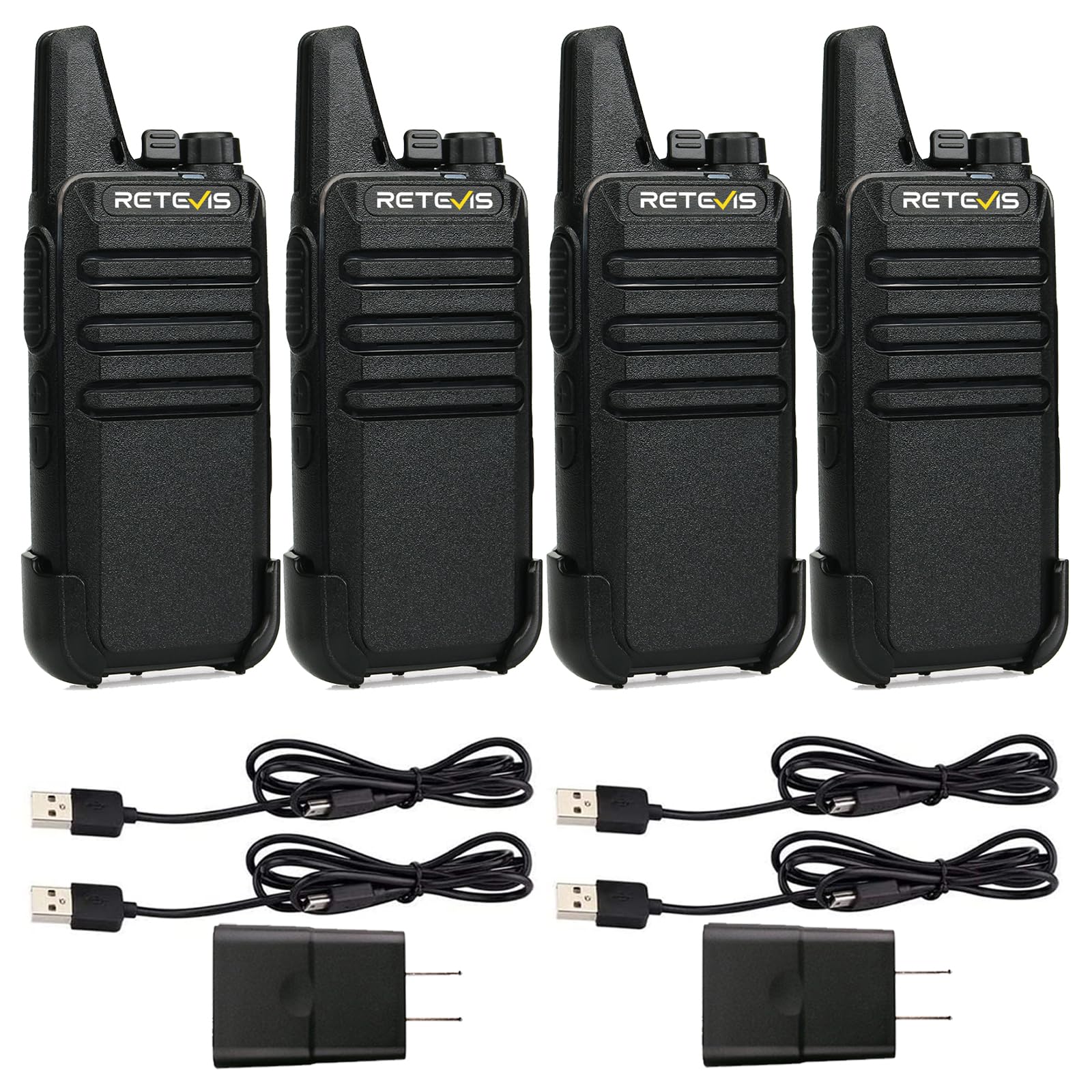
The antenna is the first thing you notice: barely longer than a thumb and blunted at the tip. That's a deliberate choice on a radio aimed at households, and it pays off over a weekend — nothing digs into a hip when you sit down, and there's less to snap off when a set gets dropped on rock.

Four radios in the box is the real argument. Each one has its own USB-C port, so four people can top up from a single power strip or a couple of power banks, and the separate belt clip means the radio slides out of the holster without the clip coming off your waist. The controls run to channel and volume plus a lock, which is why this is the set we point at when kids are doing the carrying: there is nothing to misconfigure.

Battery is rated at 12 hours and the 300 mW speaker is loud enough to hear over a camp stove. Range is what a compact FRS radio gives you — a mile or two in the open, less in timber. Retevis lists other Retevis models as the compatible devices, so plan on the four-pack covering your group rather than mixing brands mid-trip. Audio is clear in still air and loses out to wind and engine noise, which is the one place the RT22 gives ground.

Pros

  • Four radios in a single box
  • USB-C charging on every radio
  • IP65 sealed and genuinely pocketable
  • Controls simple enough for a child

Cons

  • Audio gets lost in wind and background noise
Our verdict

Buy the RT22 four-pack if the radios are going to be carried by a family rather than one careful adult — four sealed, USB-C sets that anyone can operate.

Check Latest Price
3

Most Capable

Midland GXT1000VP4

89 /100
LBD Score Excellent

Key details

Battery
Up to 10 hours, rechargeable
Channels
50 (GMRS)
Pack Size
2 radios plus earpieces
Water Resistance
JIS4
View on Amazon

Fifty channels, 142 privacy codes, a siren, and earpieces in the box: the Midland GXT1000VP4 is the most capable pair in this group, and it arrives with a catch that isn't printed across the front of the package. These are GMRS radios, and GMRS channels are licensed in the United States. Sort that out before the trip and you get the widest channel list here; skip it and you're transmitting outside the rules. That's the whole decision on this one.

The kit itself is generous. A desktop charger, AC and DC adapters, earpieces with boom mics that tuck under a helmet or a cold-weather hat, eVOX hands-free transmission, vibrate mode, keypad lock, an SOS siren, and NOAA weather scan all come with it. Dual power is the feature we appreciate most — the rechargeable packs are backed by eight AA cells, so a pack that dies on day three doesn't take a radio out of service.

The 10-hour rating is on the short side and the rechargeable packs are the component to keep an eye on, which is exactly why that AA fallback earns its place. Sealing is JIS4, enough for rain and splashes but not a dunking, and at 7.9 inches tall it's the longest radio here, so it wants a pack strap rather than a belt loop.

Pros

  • 50 channels and 142 privacy codes
  • Earpieces plus AC and DC adapters included
  • Dual power: rechargeable pack or 8 AA
  • NOAA scan, SOS siren, and vibrate mode

Cons

  • JIS4 splash rating only, not submersible
  • Long 7.9-inch body hangs low on a belt
Our verdict

Choose the GXT1000VP4 if you want the widest channel list here and will handle the GMRS license before you transmit — otherwise a license-free FRS set serves you better.

Check Latest Price
4

Best Budget Pick

Midland T10 X-Talker

82 /100
LBD Score Excellent

Key details

Battery
3 AAA each, not included
Channels
22 (FRS)
Pack Size
2 radios
Water Resistance
IP65
View on Amazon

No charger, no dock, no battery pack: the Midland T10 arrives with two radios, two belt clips, and a manual, and expects three AAA cells per radio from your own supply. For a set that lives in a camp box between trips, that reads less like a corner cut than a design decision — there's nothing proprietary to lose, and nothing to replace when a pack stops holding charge.

What you get instead is weather coverage. NOAA weather scan walks the ten weather channels, locks onto the strongest, and alerts you when something severe is heading in, which is a feature we care about a great deal more in a tent than in a driveway. Around that: 22 FRS channels, 38 privacy codes, eVOX hands-free transmission, IP65 sealing, and a 10-hour rating. Voice comes through clearly and setup takes about a minute.

Range and clarity land mid-pack — fine to the far end of a campground, thinner once a ridge is in the way. The T10 is the radio we point at people who want a weather radio and a way to reach the kids from the water, not a comms system for a group strung out across a mountain. In that role, plain AAA power is a feature rather than a compromise: the batteries are easy to find and nothing needs an outlet.

Pros

  • NOAA weather scan and alert built in
  • IP65 sealed and very simple to run
  • No charger or dock to lose

Cons

  • AAA cells drain fast in heavy use
Our verdict

The T10 is the set for a camp box that sits in the garage between trips — cheap, weather-alert equipped, and free of any dock or pack to lose.

Check Latest Price
5

Paddling Trips

Motorola T605 H2O

80 /100
LBD Score Excellent

Key details

Battery
Up to 9 hours, USB-C
Channels
22 (FRS)
Pack Size
2 radios
Water Resistance
IP67, floats face up
View on Amazon

A flashlight that switches on when it hits water sounds like a gimmick until you're the one who fumbled a radio off a dock at dusk. The Motorola T605 H2O floats face up, so the light points at the sky and the radio stays where you can see it. The body is IP67 rated and covered by a two-year manufacturer warranty, which is the longest coverage in this group.

On dry land it's a plain 22-channel FRS radio: license-free, with easy pairing to copy settings between the two units, a USB-C cable for each, and a 35-mile line-of-sight claim to read exactly the way you read every other range claim on this page. Sound is clear and the controls work by feel in the dark. Our verdict is that it earns its place on water and not much else — the Retevis RB48 floats too, costs less, and handles a dry campsite better.

Pros

  • Water-activated flashlight and floats face up
  • IP67 waterproof body
  • Two-year manufacturer warranty

Cons

  • Shortest rechargeable runtime here at 9 hours
  • Early failures are the longevity concern
Our verdict

Worth the premium only if your camping happens on water — the T605 H2O is the one set here that turns a dropped radio into a findable one.

Check Latest Price
6

Kids at Camp

MOICO T5

88 /100
LBD Score Excellent

Key details

Battery
4 AAA, 12 hours rated
Channels
22 (FRS) plus 99 codes
Pack Size
2 radios
Water Resistance
IP65
View on Amazon

The MOICO T5 is what people buy when a campsite full of kids needs radios and the budget is thin. It's the least expensive pair in this group, and it delivers the features that matter to that crowd: 22 FRS channels with 99 privacy codes, a backlit green LCD you can read at night, three levels of VOX for hands-free use, an LED flashlight, and a detachable belt clip.

IP65 sealing handles rain and a dropped-in-a-puddle moment, though not a dunking, and the speaker is loud enough to cut through a campground at dinner. The flashlight and the big screen are the two things that get used most around a tent, and the buttons are simple enough that nobody needs a briefing. It's small enough for a jacket pocket, which is more than you can say for most of this group.

For a cheap second set — the ones the kids carry, the ones left on a picnic table — that's plenty, and a lost radio isn't a crisis. It isn't the set to build a week in the backcountry around; the Retevis sets and the Midland GXT1000VP4 are for that.

Pros

  • 22 channels with 99 privacy codes
  • Backlit LCD and built-in flashlight
  • IP65 sealed at the lowest price tier

Cons

  • Runs through AAA cells quickly
  • Budget build: a dead unit is the failure to watch for
Our verdict

Buy the MOICO T5 as a cheap second set for kids around a campground, not as the pair you stake a backcountry trip on.

Check Latest Price

How We Tested the Best Camping Radios

We started with a spreadsheet of roughly 30 radios — license-free FRS pairs alongside GMRS models that require an FCC license — and narrowed it by reading spec sheets and manuals before anything shipped. Battery type, weather-seal ratings, channel and privacy-code counts, weight, and price per radio did most of the sorting. Twelve radios made the cut, and we used them for eight months.

Testing happened where these radios actually live: a group campsite where six people split off for firewood and water, a rainy hike, a slow river float where one radio went into the water on purpose, a rental cabin with the kids on another floor, and a few evenings of bike laps around the campground loop. To find real usable range instead of the box's, one person walked a treeline until the signal broke, then noted what was between us when it did.

Between trips we timed each battery from full charge to the first low-battery chirp under normal talk traffic. We dropped every radio onto gravel from waist height, ran the waterproof ones under a faucet for a few minutes, and listened for how much wind and crackle mushed the voices. We also worked every button wearing winter gloves, checked whether voice activation tripped on wind or a smoking campfire, and tuned to the weather channel to hear how clearly the alert broadcast came through. Anything that felt flimsy in the hand lost points no matter how well it performed.

How to Choose a Two-Way Radio for Camping

FRS, GMRS, and the License Question

Most of the radios here are FRS sets: 22 shared channels, no license, no fee, no paperwork. The Midland GXT1000VP4 is the exception — it's a GMRS radio, and GMRS channels are licensed in the United States. GMRS buys you more channels, more privacy codes, and the option of higher power; FRS buys you the ability to hand a radio to a friend without a legal footnote.

If staying license-free matters, buy FRS and don't look back. If the GXT1000VP4's channel list is genuinely what you need, sort the license out before the trip rather than at the trailhead.

Real Range Is Measured in Trees

The number on the box is measured over open water or ridge to ridge with nothing in between, which is why a set advertised at 30 miles delivers about one in the woods. FRS power is capped, and every hill, tree, and tent wall between two radios eats into it. Plan for roughly a mile in timber, a bit more across a lake, less in a canyon.

The fix is technique rather than hardware: get high, keep the antenna upright and away from your body, and leave someone on the ridge as a relay when the group splits.

Sealing: What IP65 and IP67 Actually Buy You

Treat the IP number as a camping specification, not a marketing one. IPX4 shrugs off rain from any direction but won't survive a puddle. IP65 adds dust-tightness and water jets, which covers most three-season car camping. IP67 survives being dropped in a lake, and the two sets here that float — the Retevis RB48 and the Motorola T605 H2O — are the ones for canoe and kayak trips.

MIL-STD-810H, which the RB48 carries, is a drop and temperature standard rather than a water one, but it's a fair proxy for how a radio survives being thrown in a tote at the end of the weekend.

Batteries Decide Your Second Day

Two philosophies run through this group. The rechargeables — RB48, RT22, GXT1000VP4, T605 H2O — charge over USB-C or a dock, and a power bank in the car keeps a pair going all weekend. The AAA sets never need an outlet, but they eat cells, especially in the cold, so budget for rechargeable AAAs and a spare set kept somewhere warm.

The most forgiving arrangement is dual power. The GXT1000VP4 runs on its rechargeable pack or eight AA cells, which is what stops a dead pack from turning a two-radio set into one.

How Many Radios, and Whose Hands

Buy for the group rather than the pair. Two radios cover a couple, four cover a family or a small party, and the four-packs spread the cost across more people instead of charging per handset. One spare radio is cheap insurance against a flat battery or a unit left on a picnic table.

Then think about hands. A stubby antenna and a simple belt clip matter for kids, dual PTT buttons and silicone-covered controls matter for gloves, and a keypad lock matters any time the radio is going into a pocket rather than onto a strap.

Frequently Asked Questions

Final Verdict

The Retevis RB48 is the set we point almost every camper toward. It's the only pair here that combines full IP67 sealing with floating, an 18-hour pack, and controls you can work in gloves, and it does all of that on license-free FRS channels — nothing to register and nothing to remember at the trailhead.

If four people are carrying, the Retevis RT22 four-pack covers the same campsite for less per radio and is simple enough for kids to run. If you want the widest channel list in this group and will sort out the GMRS license, the Midland GXT1000VP4 is the one.