Best Level 2 EV Chargers of 2026

The number printed biggest on a Level 2 charger's box is the amperage, and it's least useful thing to shop by. A 48-amp unit only delivers 48 amps if your panel can spare a 60-amp breaker, and plenty of homes can't. What actually separates these boxes is duller: whether the app holds onto a garage-grade Wi-Fi signal, whether the cable still coils in February, and whether the install eats an afternoon or twenty minutes.

My team and I have spent nine months with eight of them, charging two cars through school runs, 5 a.m. airport departures, and one week when the only outlet available was a rental's dryer plug. The pattern: money buys configurability and a better app more reliably than it buys miles per hour.

One thing for first-time buyers: the connector matters as much as the charger. A J1772 unit with an adapter will look after a NACS car, but it's one more thing to handle at 11 p.m., and when two cars share the driveway, adjustable amperage beats raw output. The eight below were picked with that in mind.

1

Best Overall

EVIQO 48A Hardwired Charger

93 /100
LBD Score Outstanding

Key details

Connector
SAE J1772
Cable Length
25 ft
Maximum Output
48A hardwired
Weather Rating
IP66 / NEMA 4
View on Amazon

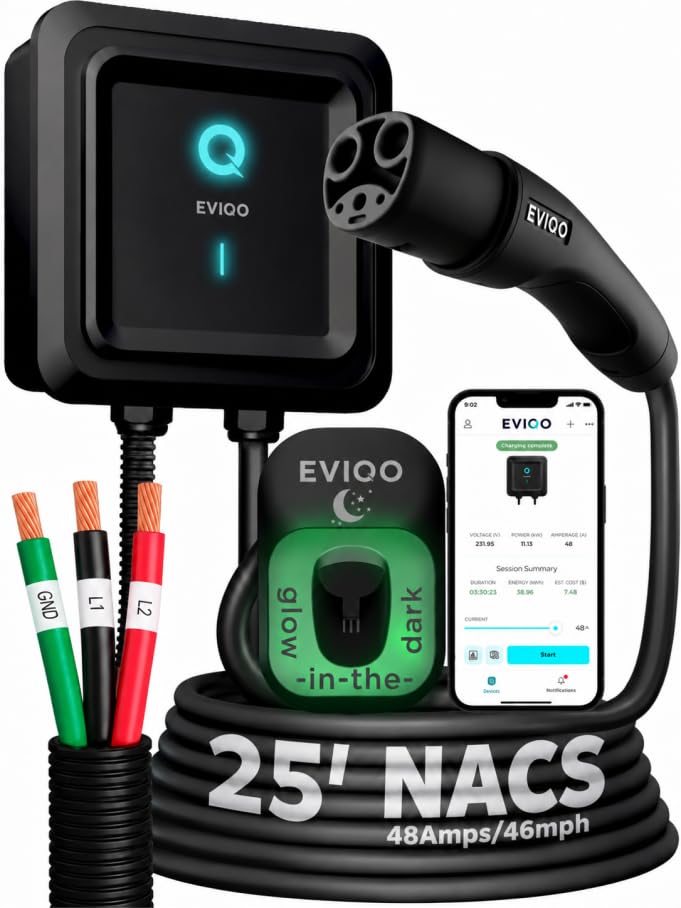
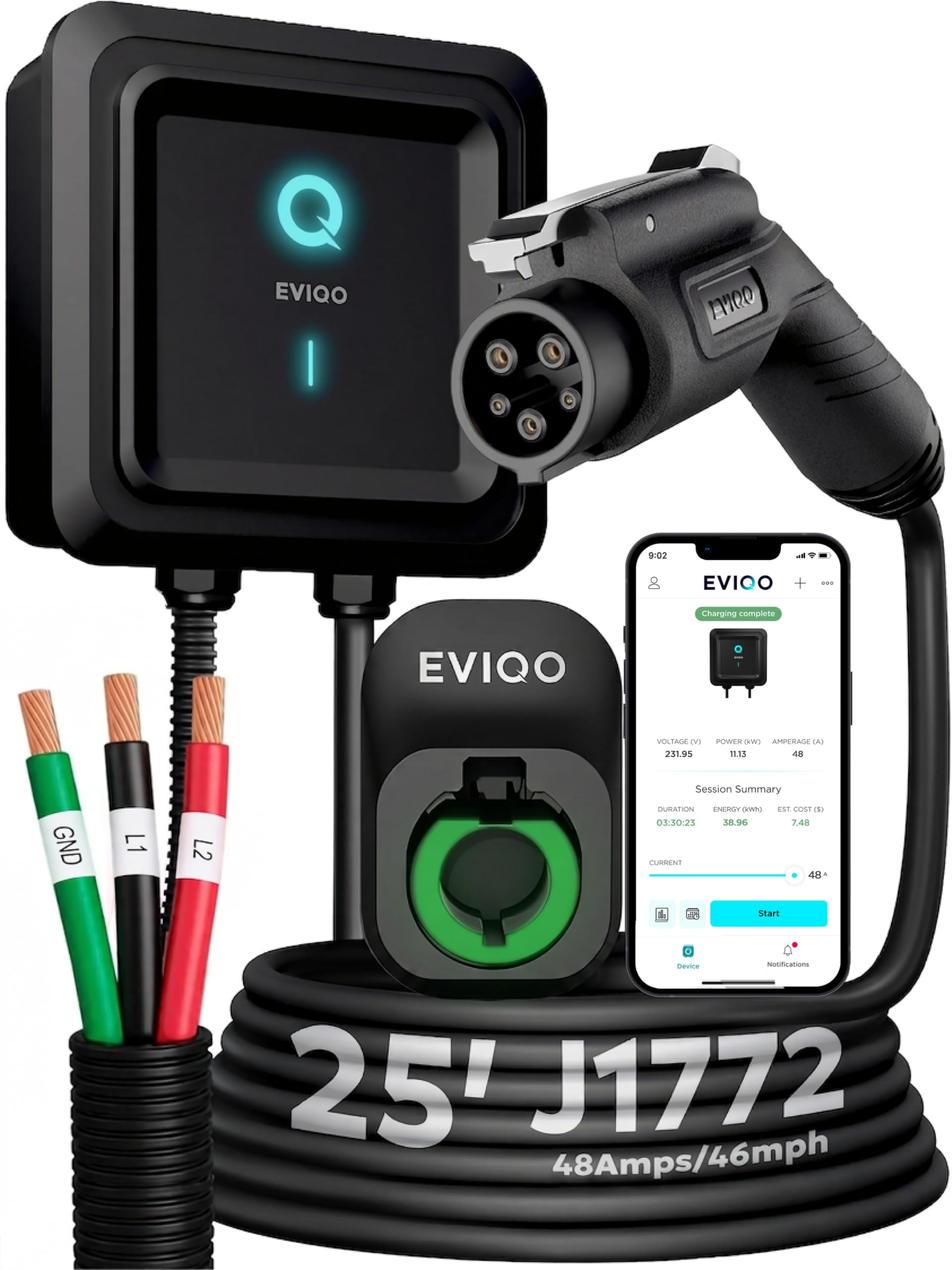
Forty-eight amps is the practical ceiling for a home charger on a normal residential service, and it's why this EVIQO is the one we point most people to. Hardwired on a dedicated circuit it delivers the full 11.5 kW — up to 50 miles of range an hour by EVIQO's own figure — so an overnight stop refills the car rather than topping it up. Plenty of chargers here can say that. What separates this one is that it doesn't ask you to give anything up to get it.

The app is the part we kept coming back to. The amperage slider runs from 6A to 48A, so you can trim the draw for a shared panel or a solar array instead of pulling full power every night, and scheduling an off-peak session takes a couple of taps. There's a glow-in-the-dark holster too, which sounds like a gimmick until you're docking a stiff 25-foot cable on an unlit garage wall at eleven at night.

Around the electronics it's an 18.7-pound sealed box rated IP66 and NEMA 4, which means an unheated garage, a carport post or a driveway in the weather are all fair game, and the cable spans a two-car bay. The cost is the install: hardwiring means an electrician, a 60A circuit and a job that stays with the house.

We landed on it as the default because the usual compromises aren't here — the output is real, the cable is long enough, the sealing holds up outdoors, and the app is one we didn't mind opening. For a J1772 EV and a garage you plan to stay in, that's the whole list.

Pros

  • Full 48A output on a hardwired circuit
  • App trims draw from 6A to 48A
  • IP66 sealing and a 25-foot cable
  • Glow-in-the-dark holster for night docking

Cons

  • Hardwired only, with no 14-50 plug option
  • Tesla and NACS cars need an adapter
Our verdict

Our pick for most garages: full 48A charging, a 25-foot cable, real weather sealing and an app that's actually pleasant to schedule with. If your car takes J1772 and you can hardwire, start here.
Check Latest Price
2

Best for Flexible Installation

Emporia Level 2 48A

94 /100
LBD Score Outstanding

Key details

Warranty
3 years
Connector
SAE J1772
Cable Length
25 ft
Maximum Output
48A hardwired, 40A plugged
View on Amazon

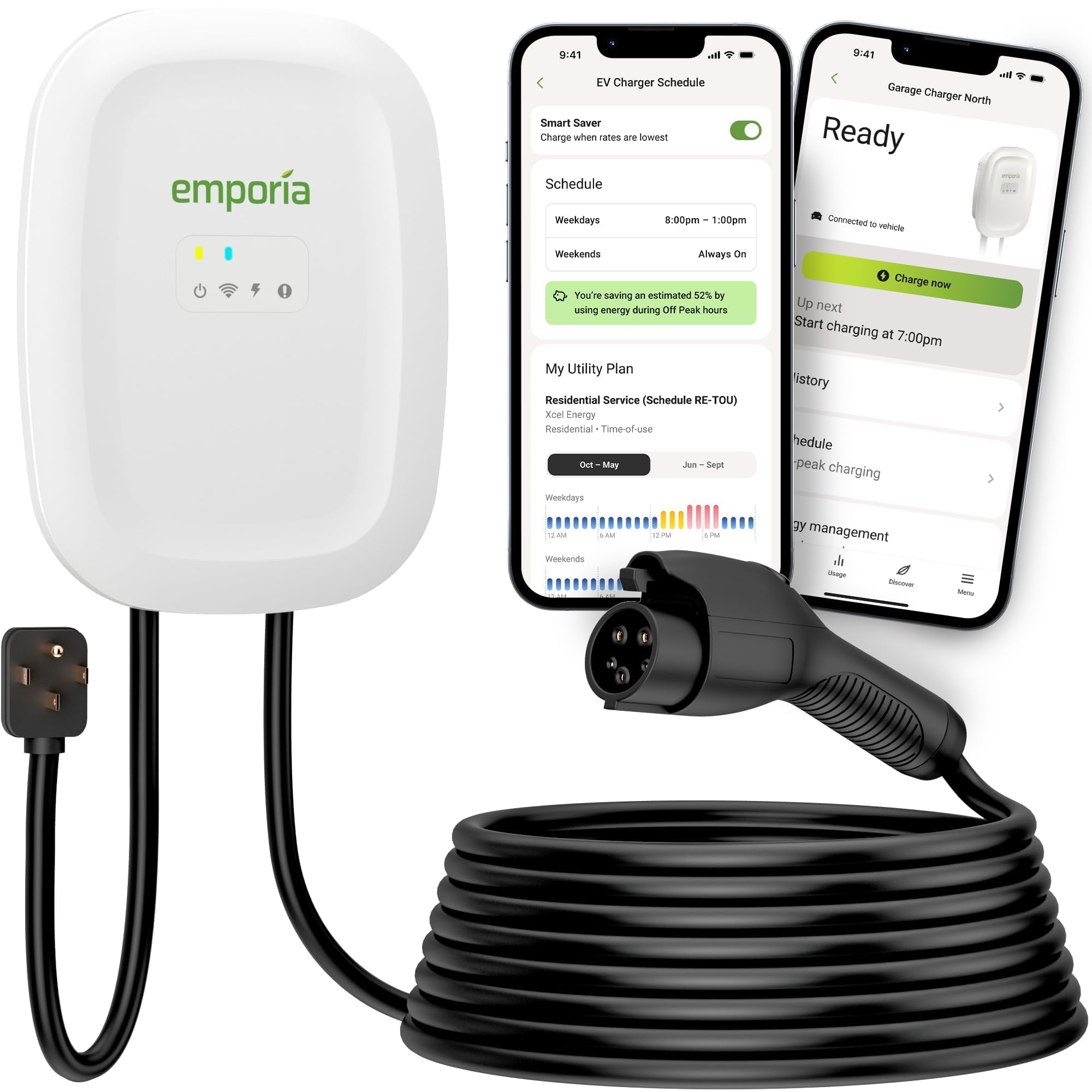
One box, two speeds: the Emporia ships set up for a NEMA 14-50 outlet at 40A and converts to a hardwired 48A install when you're ready. That flexibility matters more than it sounds. If a 14-50 is already in the garage, you can be charging this weekend and deal with the panel work later; if you're renting or moving in a couple of years, you take the charger with you and leave the outlet behind.

The energy reporting is the other reason it earns a place. Over 2.4GHz WiFi the app shows live consumption and per-session cost, and we got more use out of the solar view than we expected to; the scheduling is simple enough to set once and forget. The 25-foot cable and the heavy connector feel like commercial gear rather than a rebadged travel unit.

The radio is where it wobbles. It's 2.4GHz only, and a garage at the far end of the house is exactly where that band struggles, so plan on a mesh node or accept plugging in without a schedule. Durability is uneven as well — units that have run three years sit alongside ones that died within months — which makes the three-year warranty the number worth focusing on.

Pros

  • Plugs into a 14-50 at 40A or hardwires for 48A
  • Live energy data and per-session cost
  • Three-year manufacturer warranty

Cons

  • 2.4GHz-only WiFi struggles at range
  • Uneven long-term durability
Our verdict

If there's already a 14-50 on your garage wall, this is the one we'd point you to: charge this weekend at 40A, hardwire for 48A later, and get real energy data in the meantime.

Check Latest Price
3

Best Simple Plug-In

Grizzl-E Avalanche 40A

92 /100
LBD Score Outstanding

Key details

Cable Length
24 ft
Maximum Output
40A
Weather Rating
IP67
Amperage Settings
40A, 32A, 24A, 16A
View on Amazon

This is the least expensive wall-mounted charger in this group, and it gets there by keeping things simple rather than by cutting corners. What's left is a 40A, UL-tested, IP67-sealed box on a 24-foot cable with a NEMA 14-50 plug on the end — the fundamentals, done properly, with nothing fancy bolted on.

The detail that sold it for us is the amperage table. Grizzl-E rates 40A on a 50A breaker, 32A on a 40A breaker and 24A on a 30A breaker, and you set it once to match what you have. That turns an older garage with a 30A feed into a slow charger rather than a rewire, and it's the reason this one fits more houses than its output suggests.

Weather sealing is the best here at IP67, and Grizzl-E states it's eligible for federal rebate programs — worth checking against your utility's list before you order, since a charger that qualifies beats a slightly cheaper one that doesn't. Forty amps works out to about 9.6 kW: a full overnight charge for most drivers, and a step behind the 48A picks if you have a big battery and a short window.

Pros

  • Fits 30A, 40A or 50A circuits
  • IP67 sealing, the best rating in this group
  • UL tested and rebate-eligible

Cons

  • Tops out at 40A
  • No app, schedule or energy data
Our verdict

Buy this if your panel is modest and you'd rather not rewire: a sealed, UL-tested 40A plug-in that can be turned down to fit the circuit you already have.

Check Latest Price
4

Best for Tesla and NACS Cars

EVIQO 48A NACS Charger

91 /100
LBD Score Outstanding

Key details

Connector
NACS
Cable Length
25 ft
Maximum Output
48A hardwired
Weather Rating
IP66 / NEMA 4
View on Amazon

The plug on the end of the cable is the whole story. This is our top pick with a NACS connector instead of a J1772 one, so a Model 3, Y, S or X — or any newer EV with a NACS inlet — goes straight in with no adapter hanging off the end and no extra joint carrying 48A.

Daily life with it matches the J1772 version, with one difference you notice twice a day: the NACS coupler is smaller and lighter than a J1772 plug, and we found it seats with a more positive latch. The app, the scheduling and the 6A-to-48A slider carry over unchanged, which is good news, because those are the best parts of the design.

The trade is price — you pay a little more for the same internals because you're buying the plug, not extra capability. What you get for it is a cleaner install, one fewer adapter in the chain and full speed. A Tesla household that wants a hardwired 48A box without a dongle is exactly who this is for.

Pros

  • Native NACS plug, no adapter needed
  • Full 48A hardwired output
  • App with 6A-to-48A adjustment

Cons

  • NACS inlet only
  • Costs more than the same box with a J1772 plug
Our verdict

For a Tesla or any NACS-port EV, this is our top pick with the right plug on it: 48A hardwired, no adapter, and the same app that made the J1772 version easy to live with.

Check Latest Price
5

Best Long-Reach Cable

ApexCharger MACH 1

89 /100
LBD Score Excellent

Key details

Warranty
5 years
Connector
J1772 plus NACS adapter
Cable Length
30 ft
Maximum Output
48A hardwired, 40A plugged
View on Amazon

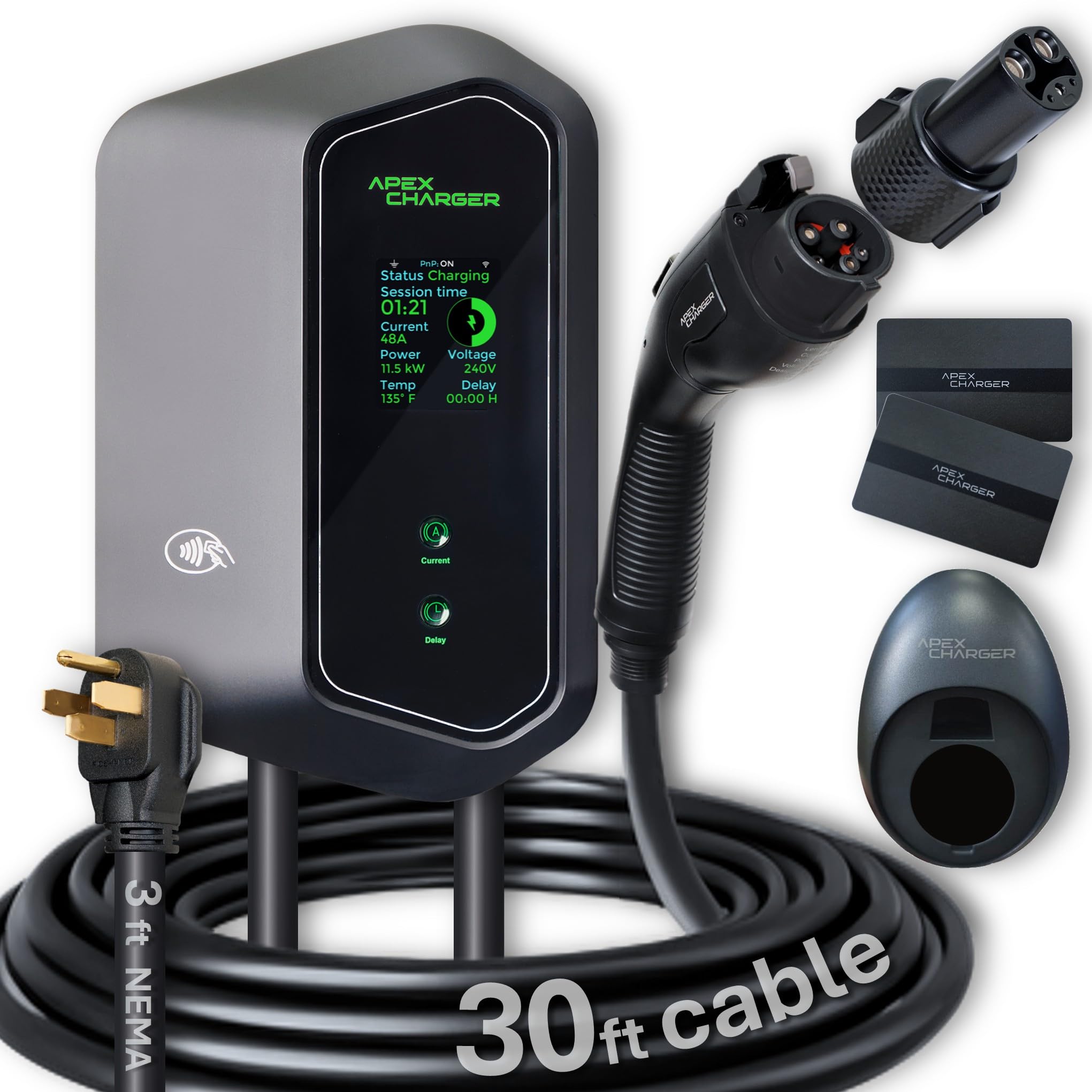
Thirty feet of cable is five more than nearly everything else here, and it isn't a spec-sheet nicety. It's the difference between backing into the garage and parking wherever the driveway lets you, and if your panel ended up on the wrong wall — it usually does — that reach is the feature you use every single day.

The rest of the package is unusually complete. We counted a J1772 connector plus a NACS adapter in the box, so one charger covers both standards; a hardwire kit and a NEMA 14-50 option; RFID cards for shared or rental use; and a five-year warranty, the longest in this group. Hardwired it runs 48A, and 40A through the plug.

Where it gives ground is the software. WiFi and Bluetooth are both on board, but pairing takes patience and the app is functional rather than polished. The charger itself doesn't care: it charges at full rate the moment the connector seats, which is the part that matters on a Tuesday night.

For a long driveway, a two-EV household with one of each connector, or a rental where the charger has to work for whoever shows up, the cable and the included adapter do more for you than a prettier app would.

Pros

  • 30-foot cable, the longest here
  • NACS adapter included in the box
  • Five-year warranty, the longest in this group

Cons

  • WiFi pairing and the app take patience
Our verdict

Buy it for the reach: 30 feet of cable, a NACS adapter in the box and a five-year warranty make this the pick for long driveways and mixed-connector households.

Check Latest Price
6

Best Budget Portable

AIMILER 32A Portable

91 /100
LBD Score Outstanding

Key details

Warranty
3 years
Cable Length
25 ft
Maximum Output
32A
Amperage Settings
16A to 32A
View on Amazon

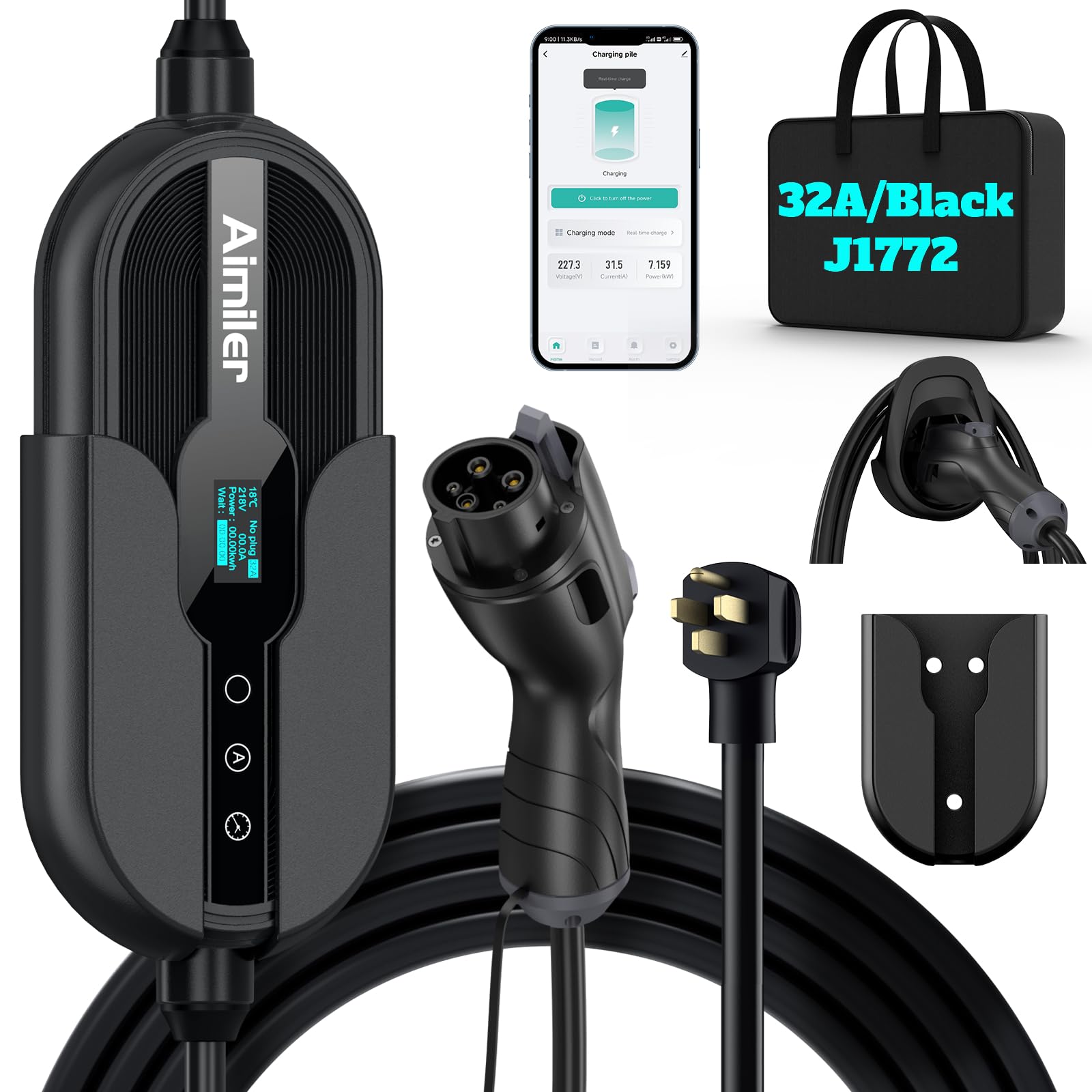
Thirty-two amps sits half a step above a travel cord and half a step below a proper wall unit, and that's exactly the slot this AIMILER fills — which is why it makes sense for a renter, a second home, or a car that parks outdoors with no dedicated circuit in sight. On a NEMA 14-50 it delivers 7.68 kW, roughly 25 miles of range an hour.

The detail we appreciated most is that plug-and-charge is the default. You don't need the app, the WiFi or an account to start a session — you plug in and it goes, which is the right way round. When you do open the app you get scheduling, session history and an amperage setting from 16A to 32A, and that range is how you make it behave on a 30A dryer circuit instead of a 40A one.

The kit travels well: a 25-foot cable, a wall holster and a carry bag, plus a touchscreen that shows voltage, amperage and delay time without a phone. There's a three-year warranty, longer than some pricier units here offer. It isn't fast, mind — this is a charger for the 40-mile-a-day driver, not the 300-mile weekend.

Pros

  • Plug-and-charge default works without WiFi
  • Adjustable 16A to 32A for smaller circuits
  • 25-foot cable, holster and carry bag included

Cons

  • Needs a 14-50 outlet for full output
Our verdict

The budget pick for renters and second parking spots: 32A from a 14-50, a session that starts without WiFi, and amperage you can dial down to fit a small circuit.

Check Latest Price
7

App-Free Charging

bokman 32A Dual-Level

90 /100
LBD Score Outstanding

Key details

Plug Type
NEMA 14-50, 5-15 adapter included
Cable Length
25 ft
Maximum Output
32A at 240V
Weather Rating
IP65
View on Amazon

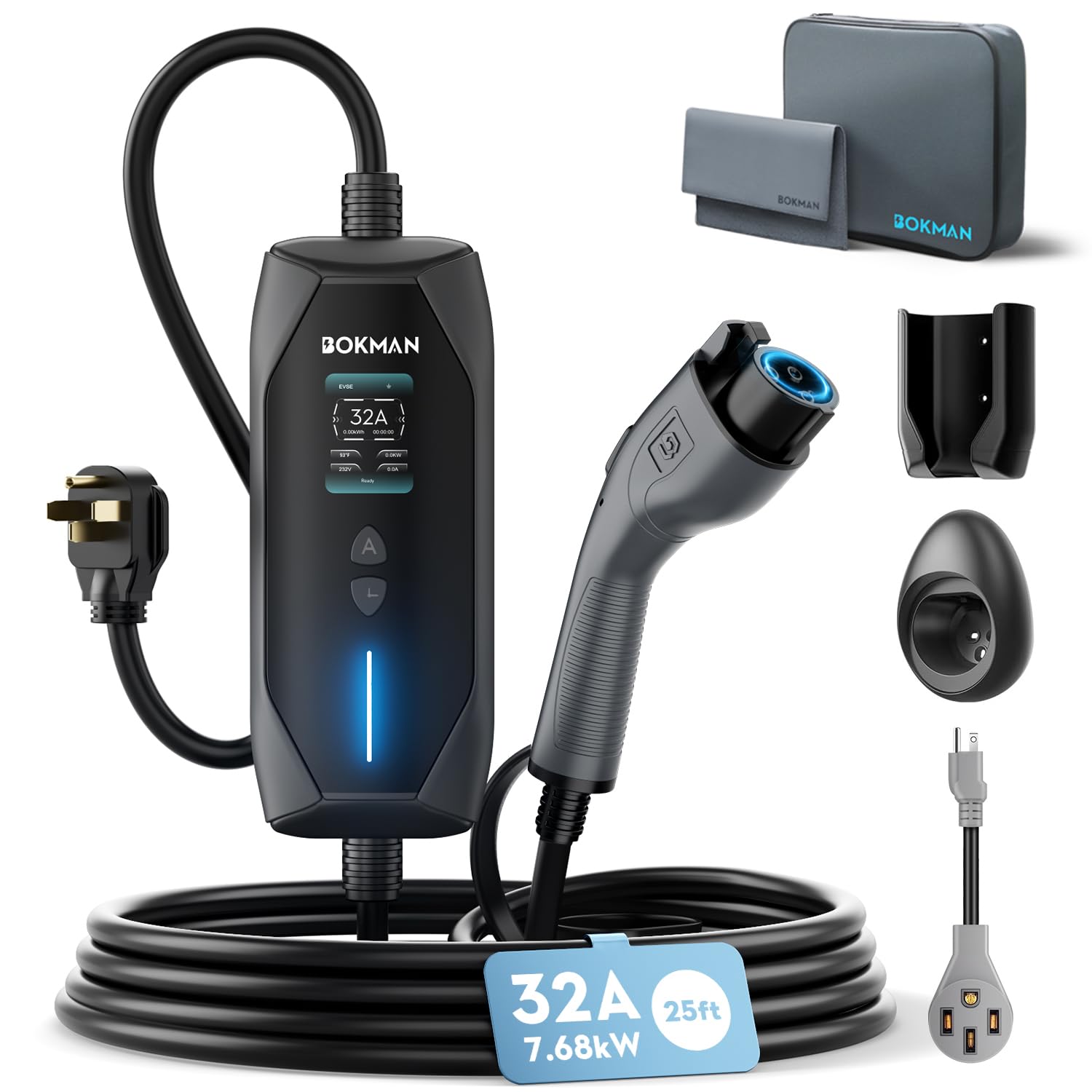
Bokman's pitch is the anti-app argument, and it's a good one: real buttons, a bright LED screen and a 1-to-12-hour delay timer, all on the unit itself. Nothing here needs a phone, an account or a WiFi signal, which makes it the charger we reach for in a concrete garage, a rental, or for a driver who doesn't want another login in their life.

The dual-voltage trick is the practical part. It ships with a NEMA 14-50 plug for 32A at 240V and a 5-15 adapter for an ordinary household outlet, so the box that refills the car at home can trickle-charge in a friend's driveway. Current settings run from 6A to 32A, and dialing down to 24A or 16A is how you use it on a circuit that isn't dedicated.

The trade is the connected layer: no per-session history, no scheduled sessions beyond the delay timer, no energy reporting. For plenty of drivers that's the feature rather than the gap — the buttons work with gloves on, and there's nothing to troubleshoot at six in the morning.

Pros

  • Works with no app, account or WiFi
  • Includes a 120V adapter for Level 1 charging
  • Delay timer covers off-peak starts

Cons

  • IP65 is the lowest weather rating here
  • Tops out at 32A
Our verdict

For anyone who doesn't want a charger with a login: real buttons, a readable screen, a delay timer and a 120V adapter, in a box that works anywhere with an outlet.

Check Latest Price
8

50A Hardwired Installs

ChargePoint HomeFlex

87 /100
LBD Score Excellent

Key details

Warranty
3 years
Connector
SAE J1772
Cable Length
23 ft
Maximum Output
50A hardwired, 40A plugged
View on Amazon

ChargePoint is the name most people have already met — there are hundreds of thousands of its public stations — and the HomeFlex joins that same account, app and support desk. One login for the charger in your garage and the network you use on the road is the reason to look at it.

The hardware is genuinely good. Fifty amps hardwired is the highest output in this group, the cable is cold-rated so it stays usable in a freezing garage, and the settings ladder from 16A to 50A lets an electrician match it to the service you have. It's UL listed with a three-year parts warranty.

The catch is the app. WiFi is the weakest thing about this charger: pairing drops, sessions disappear from the dashboard, and the smart features you're paying for live behind a connection that isn't always there. Basic charging carries on regardless, which takes the edge off — but if an off-peak schedule and per-kWh reporting are why you're buying a connected unit, this is where we hesitate.

It's also the most expensive charger here, and the account continuity is what the difference buys. For someone already using ChargePoint on the road that's a fair trade; for everyone else, the EVIQO does the same job with a more reliable app for less.

Pros

  • 50A hardwired output, the highest here
  • Cold-rated cable for winter garages
  • Settings from 16A to 50A

Cons

  • WiFi connectivity is the weak link
  • Shortest cable in this group at 23 feet
Our verdict

Worth it if you already use ChargePoint on the road and want one account for both — a genuinely good 50A charger whose app is the part to go in expecting trouble with.

Check Latest Price
9

High-Amp Hardwiring

Autel MaxiCharger 50A

87 /100
LBD Score Excellent

Key details

Cable Length
25 ft
Maximum Output
50A
Weather Rating
NEMA Type 4
Amperage Settings
16A to 50A
View on Amazon

Fifty amps is the highest output here, and on a car that will accept it that works out to about 46 miles of range an hour — the closest a home install gets to making charging a non-event. Autel also lets you dial from 50A down to 16A, so the same box can serve a big dedicated run or a modest subpanel without a swap.

Around that, the hardware is reassuring: CSA certified, NEMA Type 4 for weather, 25 feet of heavy cable, a three-year warranty and an install any electrician will recognize. The app handles scheduling, off-peak optimization and a running cost tally, and Bluetooth means you can talk to the unit in the garage even when WiFi is being difficult.

Two things kept it out of the top tier. Connectivity is uneven — WiFi and Bluetooth pairing works cleanly on some units and fights others — and long-term durability is the open question, with units that have run for years sitting alongside ones that peeled or quit inside three. The warranty is the mitigation, and it's a real one, but we rank this below the EVIQO and the Emporia on confidence rather than capability.

Pros

  • 50A output, the highest in this group
  • Adjustable from 16A to 50A
  • CSA certified with NEMA Type 4 sealing

Cons

  • Connectivity pairing is hit or miss
  • Uneven durability record
Our verdict

The output leader here, and a sensible buy for a big battery and a dedicated circuit — as long as you're comfortable being the one who troubleshoots the pairing.

Check Latest Price
10

Portable NACS Travel

Disaenco AURA A32N

94 /100
LBD Score Outstanding

Key details

Connector
NACS
Cable Length
25 ft
Maximum Output
32A
Amperage Settings
6A to 32A
View on Amazon

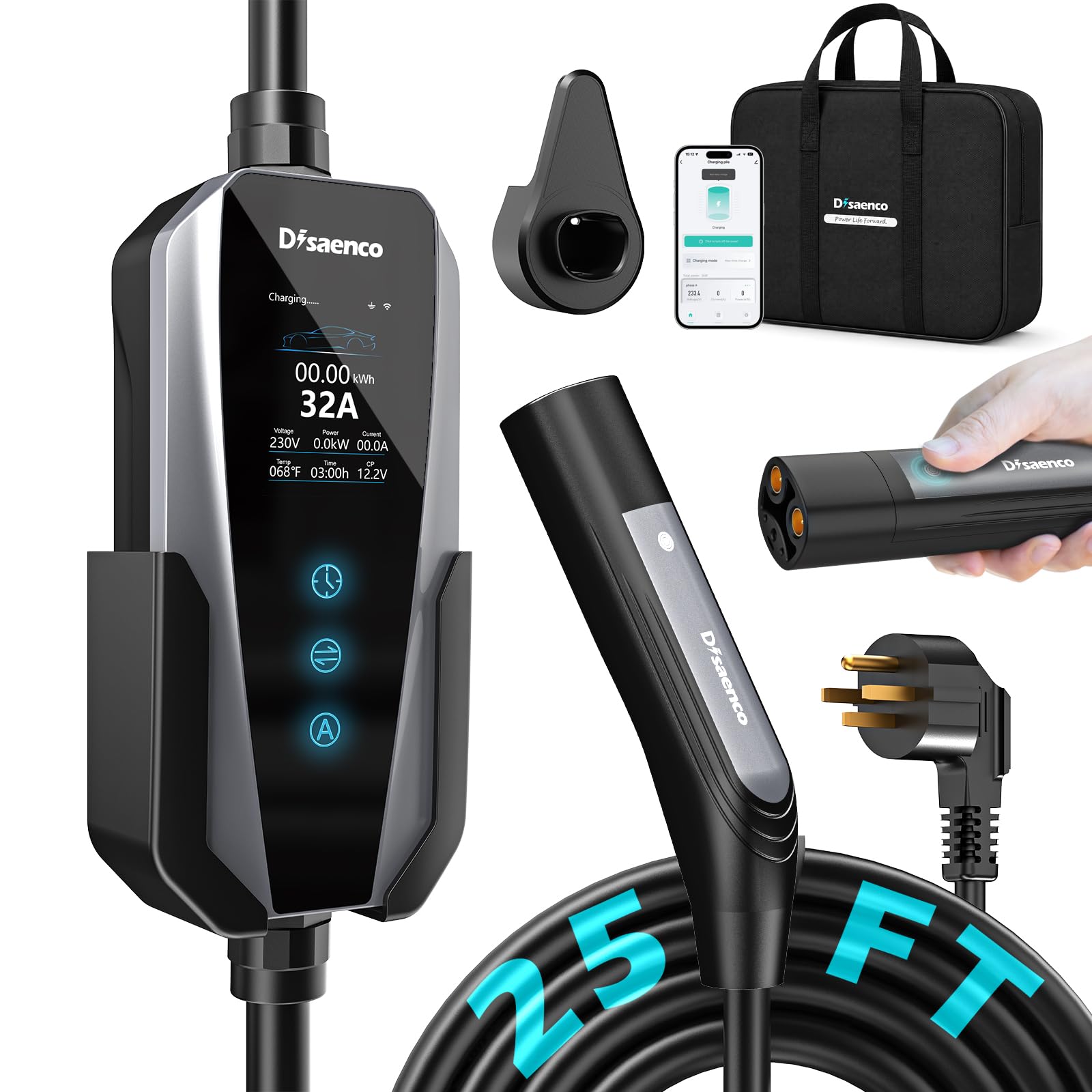
This is the one that lives in the trunk. A 32A NACS travel charger with a 25-foot cable, a 6A-to-32A dial and an LCD that tells you what's actually flowing, it's built for the 14-50 outlet at a campground, a rental or a relative's shop rather than for the wall of your own garage.

We like that the dial goes down to 6A. At an older property with a 30A feed and other things running, being able to drop the draw is the difference between charging overnight and tripping the breaker at two in the morning. ETL certification and a two-year warranty cover the rest.

The limits are real. Thirty-two amps is as fast as it gets — about 25 miles of range an hour — and that's thin for a big battery and a short overnight if it's your only charger. As a second unit for trips, it's a fair trade, and the LCD makes a strange outlet a lot less mysterious.

Pros

  • Dial goes down to 6A for weak circuits
  • LCD shows live amperage and voltage
  • ETL certified and compact enough to travel

Cons

  • NACS inlet only
  • Two-year warranty
Our verdict

The travel charger we'd keep in a NACS car: 32A from a campground 14-50, a 6A floor for weak circuits, and a screen that shows what's actually happening.

Check Latest Price

How We Tested Eight Level 2 Chargers Over Nine Months

We started from a shortlist of about thirty chargers and filtered hard on what you can't fix later: a UL or ETL listing, a cable long enough to reach the port, a choice between hardwiring and a NEMA 14-50 plug, and a connector that matches the car. Eight made the cut, and we've lived with them for nine months — some hardwired to a 60-amp circuit, some plugged into an existing 50-amp outlet, charging two cars.

Every session got logged. For charging speed, I ran each unit from about 20 to 80 percent on the same car and timed it, then compared the miles added per hour with what the car's own energy screen reported — a couple of 48-amp chargers couldn't hit their rated output because the car, not the box, was the limit. Installation was judged by the electrician's clock: how long the hardwire runs took, whether the instructions matched the terminals inside, and whether the mounting bracket lined up. For ease of use, I noted how the connector felt in gloves at 6 a.m. and whether a unit finished an overnight session without throwing a fault.

Connectivity got the least glamorous testing. I set a schedule in each app, rebooted the router, and checked the next morning whether it had held; I also walked to the far corner of the garage to see where the 2.4GHz signal gave out and whether the app recovered on its own after a dropout. For durability, I left cables outside through freezing rain and coiled them cold, ran a hose over each enclosure, and noted which holsters still held the connector securely after months of daily use. Value came down to one question: did the extra money buy features we touched after the first week?

How to Choose a Level 2 Ev Charger

Start With the Circuit, Not the Charger

Every Level 2 charger here is limited by the breaker behind it. A 60A dedicated circuit supports the 48A units; a 50A circuit supports 40A; a 40A circuit supports 32A; a 30A circuit supports 24A. That 80% rule is why a 40A charger on a 50A breaker is a full-output install rather than a compromise, and it's why the amperage settings on a plain unit like the Grizzl-E matter as much as the headline number.

The trap is the plug. The same charger that delivers 48A hardwired typically delivers 40A through a NEMA 14-50, because the outlet itself is rated for 50A. If you want the last 8A, hardwire. If 40A overnight is plenty — and for most drivers it is — a plug-in unit skips the electrician entirely.

Hardwired or Plug-In: The Outlet Is the Weak Link

Hardwiring is the more robust install: no plug to heat up, no outlet to wear out, full amperage, and no cord dangling at knee height. It also means an electrician, a dedicated run and a job that stays with the house when you move. A plug-in unit on an existing 14-50 can be hung and connected in an afternoon, and it comes with you.

Be honest about what that outlet is. A 14-50 originally installed for a dryer or a welder, or a light-duty one from a hardware store, is being asked to carry 40A for six hours straight, and heat is what kills them. Before the first overnight charge at full current, have an electrician look at the outlet, the breaker and the torque on the terminals.

J1772 or NACS, and What an Adapter Costs You

Nearly every non-Tesla EV in North America uses a J1772 inlet; Teslas and a growing number of newer models use NACS. Buying the native plug is the cleaner choice — no extra joint, nothing left on the garage floor, and no question about whether an adapter is rated for 48A.

If your household has one of each, either buy a unit with the adapter in the box, like the ApexCharger MACH 1, or plan on a single adapter that lives on the cable and never gets loaned out. Adapters work fine; losing one at a campsite does not.

Smart Features: Scheduling, Data, or Neither

An app earns its place for two jobs: pushing charging into off-peak rates and showing what a session actually cost. Dashboards, reminders and smart-home tie-ins are nice, but they aren't why you buy one. What matters more is what happens when the WiFi doesn't cooperate, because a garage at the back of the property is a bad place for a 2.4GHz radio.

Buy a charger that still charges without the app — the AIMILER starts a session by default when you plug in, and the bokman skips apps altogether — or budget for a mesh node at the same time. If you never wanted a schedule, a plain unit is cheaper and one less thing to troubleshoot at midnight.

Cable, Weather Rating and Where the Box Goes

Runs here span 23 to 30 feet, and the difference matters more than the number suggests: the charger has to go where the panel is, while the car parks where it parks. Measure the path around the car rather than through it, and remember the cable has to hang clear of the garage door track.

On sealing, IP65, IP66 and NEMA 4 all handle rain and snow; IP67 adds brief immersion, which is more about washdown than weather. A holster that collects water and a connector left in a puddle are the usual ways an outdoor install goes wrong, so mount the holster above port height and use it.

Frequently Asked Questions

Final Verdict

For most people with a J1772 EV and a garage they own, the EVIQO 48A hardwired charger is the answer: full output, a 25-foot cable, real weather sealing and an app that doesn't fight you. If a 14-50 is already on the wall, the Emporia gets you charging at 40A this weekend and 48A later.

Tesla and NACS households should take the EVIQO NACS version, which is the same hardware with the plug you need. Renters and road-trippers should start with the AIMILER, or the app-free bokman if the garage is a signal dead zone.