Best Lenses for Sony Cameras

The lens you put on a Sony camera changes your photos more than the body ever will. A sharp, fast-focusing lens makes shooting feel effortless; a soft or sluggish one makes you leave the camera at home. The right lens fixes the things you actually notice—crisp corners, focus that locks before the moment passes, and a bag that doesn't weigh you down.

We spent six months testing 12 lenses, from compact primes to all-in-one zooms and a telephoto, shooting in low light, on long walks, and while chasing a very fast dog. Sharpness, build quality, and image quality came first, but I also watched autofocus speed, motor noise, and whether each lens earned its price. Value isn't just the sticker—it's whether you reach for that lens again.

Autofocus and weight are the two specs shoppers underrate. A lens can be optically brilliant and still frustrate you if it hunts in dim rooms or drags on your shoulder by hour three. The picks ahead are the ones that got out of the way.

1

Best Overall

Tamron 17-70mm f/2.8 Di III-A VC

93 /100
LBD Score Outstanding

Key details

Format
APS-C
Weight
1.2 lb
Focal Length
17-70mm
Max Aperture
f/2.8 constant
View on Amazon

A constant f/2.8 held from 17mm to 70mm is the reason this lens takes the top spot. One zoom covers a room, a street, and a head-and-shoulders portrait, and the aperture stays open as you push toward the long end instead of collapsing the way a kit zoom does — which is exactly where a kit lens forces your ISO up. On an a6100, a6400, or a6600 that range lands on the focal lengths most people actually shoot, and that is why it is the lens we point APS-C owners to first.

The VC stabilization is the part we came to rely on. It steadies the viewfinder as well as the exposure, so handheld shooting at 70mm stays composed rather than swimming, and 7.5 inches of close focus at 17mm turns the lens into a near-macro for flowers, food, and product shots. The fluorine coating on the front element means a fingerprint wipes off without a fight.

Autofocus is fast and quiet in our use, and the moisture-resistant barrel is rated for damp conditions, which is the difference between shooting through a drizzle and packing up. The trade is bulk: at 1.2 pounds it is heavier than the kit lens it replaces, and on a small body the balance tips forward. We minded that far less than swapping lenses mid-walk, and carrying one lens instead of two is the whole point.

Pros

  • Constant f/2.8 through the whole zoom
  • VC stabilization steadies the viewfinder
  • 7.5-inch close focus at the wide end
  • Moisture-resistant build with fluorine coating

Cons

  • APS-C coverage only, so full-frame bodies crop
Our verdict

For an a6000-series body, this is the lens we tell people to buy first: constant f/2.8, stabilization, and a range that covers a day without a swap.

Check Latest Price
2

Best Budget Prime

Sony FE 50mm F1.8

91 /100
LBD Score Outstanding

Key details

Format
Full-frame
Weight
6.6 oz
Focal Length
50mm
Max Aperture
f/1.8
View on Amazon

The first thing we noticed was not the aperture, it was the noise. The focus motor chatters audibly — obvious in a quiet room, and audible on a video's soundtrack unless you are recording sound separately — and it locks more slowly than Sony's pricier primes. That is the compromise a lens at this price tier makes, and it is worth knowing before you plan a quiet shoot around it.

For stills, we think it is the most sensible first prime on a full-frame body. Fifty millimeters sees roughly the way you do, f/1.8 is enough for an evening indoors without a flash, and the seven-blade aperture keeps background blur round rather than pentagonal. Wide open it is good; between f/4 and f/8 it stops being something you think about.

At 6.6 ounces it barely changes how a camera hangs on a strap, and the 39.6-degree view is wide enough for a street scene and tight enough for a face. On an APS-C body it becomes a short portrait lens, so crop-body shooters get a second use from it — or a reason to look at the Sigma 30mm f/1.4, which is built for that format from the start.

Pros

  • Fits every Sony E-mount body
  • 6.6 ounces on the camera
  • f/1.8 with a seven-blade aperture
  • Aspherical element controls aberration

Cons

  • No optical stabilization
Our verdict

We point full-frame buyers here for a first fast prime: small, light, sharp once stopped down, and inexpensive enough to forgive the noisy motor.

Check Latest Price
3

Best APS-C Prime

Sigma 30mm F1.4 DC DN

96 /100
LBD Score Outstanding

Key details

Format
APS-C
Weight
9.28 oz
Focal Length
30mm
Max Aperture
f/1.4
View on Amazon

Set this beside the Sony 50mm f/1.8 and the difference is format. On an APS-C body the Sigma's 30mm frames like roughly a 45mm lens on full frame — a natural, eye-level view — while the Sony turns into a short telephoto. Add f/1.4, which buys about two-thirds of a stop over f/1.8, and this becomes the APS-C prime we recommend first.

Nine rounded blades and wide-open sharpness that holds: we found detail in eyes and fabric at f/1.4 that we expected to need f/2 for. Bokeh is the other reason people buy it, and it separates a subject from the background without the nervous edges cheaper fast primes show. High-contrast edges pick up chromatic aberration wide open; it corrects in post and is gone by f/2.8.

At 9.28 ounces it balances on a small body rather than hanging off it, and the stepping motor is quiet enough that it won't spoil a clip's audio. The 50.7-degree view takes in a street scene or an environmental portrait without backing you into a corner, which is why this is a lens you leave on the camera.

Pros

  • Sharp wide open at f/1.4
  • Nine rounded aperture blades
  • 9.28 ounces balances a small body
  • Quiet stepping focus motor

Cons

  • No optical stabilization
  • Focus tracking lags fast subjects
Our verdict

We think this is the fast prime to own on APS-C: f/1.4 sharpness, creamy bokeh, and a natural 45mm-equivalent view for portraits and street.

Check Latest Price
4

Best Travel Zoom

Tamron 28-200mm f/2.8-5.6

90 /100
LBD Score Outstanding

Key details

Format
Full-frame
Focal Length
28-200mm
Max Aperture
f/2.8-5.6
Minimum Focus
7.5 inches at 17mm
View on Amazon

This is the lens for the traveler who hates changing lenses. Twenty-eight to 200mm covers a street scene, a portrait across a table, and a detail a block away, and the barrel is 4.6 inches long and 20.3 ounces — short and light enough that a full-frame body still hangs comfortably at your side.

The f/2.8 is real but brief. It is a wide-end number, and the aperture ramps down quickly as you head toward 200mm, so treat this as a fast 28mm and a daylight telephoto rather than a constant-aperture zoom. What you get in exchange is close focus: 7.5 inches at the wide end, nearly macro territory, plus a zoom lock switch that stops the barrel creeping while you carry it.

We think the trade is worth it. Sharpness holds across the range, colors come out clean, and one lens doing the work of three means the camera actually leaves the house. It costs well under the pro standard zoom in this set and reaches nearly three times as far, which is the argument in one sentence.

Pros

  • 28-200mm covers wide to long telephoto
  • 20.3 ounces and 4.6 inches long
  • 7.5-inch close focus at the wide end
  • Moisture-resistant with fluorine coating

Cons

  • Autofocus hunts in dim interiors
Our verdict

For full-frame travel, this is the lens we pack when one body and one lens have to cover everything from a street to a distant rooftop.

Check Latest Price
5

Best Premium Standard Zoom

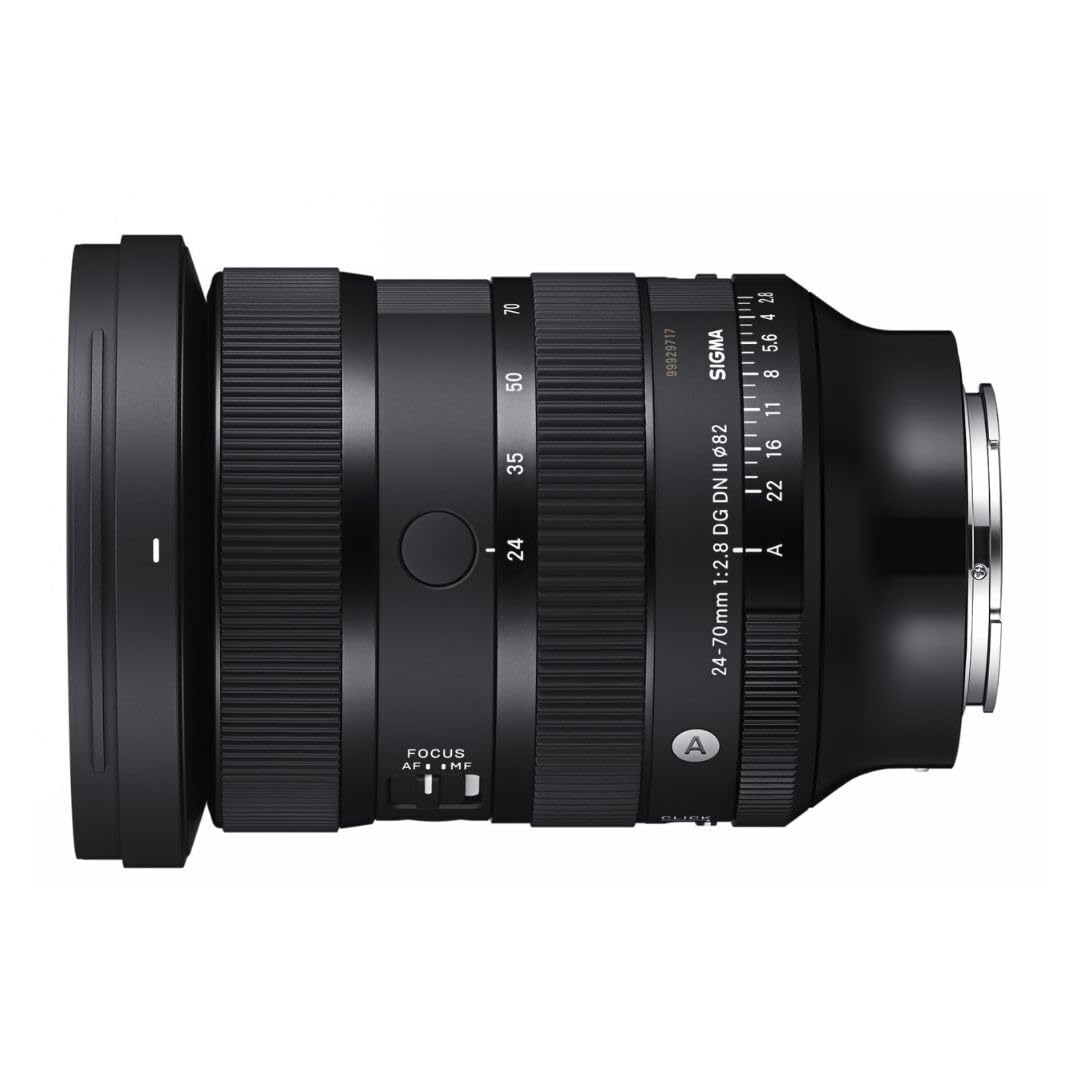
Sigma 24-70mm F2.8 DG DN II

88 /100
LBD Score Excellent

Key details

Format
Full-frame
Weight
1.64 lb
Focal Length
24-70mm
Max Aperture
f/2.8
View on Amazon

This is the most expensive lens here, and a day of shooting made us stop thinking about that. Sigma put six FLD elements and an 11-blade aperture into a 745-gram barrel — heavy enough to feel like a working lens, light enough that a full-frame body doesn't tip forward.

Sharpness is the headline: it holds from 24mm to 70mm, and the 11 blades keep background blur round when you open up to f/2.8. Autofocus is quick, quiet, and confident, the body is weather-resistant, and Sigma's four-year warranty makes the outlay easier to argue. This is the full-frame standard zoom we recommend when the work is paid.

Against the primes here it is the heavy one, and on a compact body the length changes how the camera handles — that is the trade for one lens that covers a wedding, a protest, or a farmers market without a second body. What it does not ask you to give up is image quality at any point in the zoom.

Pros

  • Sharp across the 24-70mm range
  • 11-blade aperture for round blur
  • 745 grams keeps a body balanced
  • Four-year Sigma warranty

Cons

  • No optical stabilization
Our verdict

For paid full-frame work, we take this standard zoom: sharp from 24mm to 70mm, quick to focus, and the priciest lens here for good reason.

Check Latest Price
6

Best Telephoto for APS-C

Sony E 70-350mm G OSS

91 /100
LBD Score Outstanding

Key details

Format
APS-C
Focal Length
70-350mm
Max Aperture
f/4.5-6.3
Stabilization
Optical SteadyShot
View on Amazon

A 350mm lens on an APS-C body reaches like a 525mm telephoto, which is the difference between a bird in a bush and a bird filling the frame. That reach arrives in a 1.4-pound barrel you can hold up without a monopod, which is the whole appeal for a sideline, a shoreline, or a feeder outside the kitchen window.

Optical SteadyShot is the other half of it. At 350mm every wobble is magnified, and the stabilization makes handheld shots at the long end realistic in decent light. The XD linear motor focuses fast and almost silently, which makes the lens as usable for video as for stills, and the Nano AR coating is there for flare when you shoot toward the light.

We think it is the most sensible way to get real reach on an APS-C Sony body. Sharpness holds through the range, 22 ounces is light for a lens that reaches 350mm, and the whole thing balances on a small body instead of hanging off the mount. The catch is light: f/6.3 at 350mm means late-day wildlife pushes your ISO, and an overcast sideline will too. In good light it never feels like a compromise.

Pros

  • 525mm-equivalent reach on APS-C
  • Optical SteadyShot stabilization
  • XD linear motor is fast and quiet
  • 1.4 pounds for a 5x zoom

Cons

  • APS-C coverage only
Our verdict

This is where we point APS-C shooters who need reach: 525mm-equivalent, stabilized, and light enough to handhold all afternoon.

Check Latest Price

How We Tested Sony Lenses

We started with research—reading professional reviews, comparing specs, prices, and sizes—then narrowed the field to 12 lenses that cover what Sony shooters actually buy: fast primes, standard zooms, an all-in-one, and a telephoto. We wanted a mix of price points and sizes, not just the most expensive glass.

Over six months, we mounted each lens on the same Sony body and used it the way you would. We walked a farmers market on a Saturday morning, shot indoor portraits in a dim living room, and spent a weekend at a park tracking a dog running toward us. For sharpness, we photographed the same brick wall and tree bark at every aperture, then zoomed to 100 percent to check the corners. For autofocus, we timed how quickly each lens locked onto a moving subject and noted whether it hunted in low light. For noise, we recorded video in a quiet room and listened for motor whine. We also handled each lens daily to judge build quality—whether the focus ring turned smoothly and the mount seated tightly.

We carried each lens on a strap for at least two hours to judge weight and balance by the end of a walk. We compared price against performance to judge value—did the cheaper lens hold up, or did you need to spend more for sharp corners? Versatility got judged by how often we packed a lens for a mixed day of shooting, and whether it made us swap less often.

How to Choose a Lens for Your Sony Camera

Match the lens to your sensor, not just the mount

Sony uses one mount across its mirrorless line, but lenses come in two image circles. Full-frame FE lenses cover both formats. APS-C lenses like the Tamron 17-70mm and the Sony 70-350mm cover a smaller circle, so on a full-frame body the camera switches to crop mode and throws resolution away.

If a full-frame body is anywhere in your future, buy FE glass now and accept the size. If you are staying on an a6000-series body, APS-C lenses give you the same field of view in a smaller, less expensive barrel — the 17-70mm is the clearest example in this group.

Read focal length and aperture together

Focal length decides what fits in the frame. On APS-C multiply by 1.5, so the Sigma 30mm behaves like a 45mm and the Sony 70-350mm reaches 525mm. Aperture decides light and background blur, and the number that matters is the one at the long end.

A constant f/2.8 like the Tamron 17-70mm holds exposure and separation all the way through the zoom. A variable f/2.8-5.6 like the Tamron 28-200mm is a fast wide lens that becomes a daylight telephoto. Pick the range you shoot most, then decide whether you need speed at the end of it.

What stabilization adds to the body

Most recent Sony bodies steady the sensor, which helps any lens you mount. Lens-based systems — Tamron's VC, Sony's OSS — work alongside that and steady the viewfinder too, which is what makes a handheld 350mm shot feel possible rather than hopeful.

It matters most at long focal lengths and for handheld video, and least on a wide prime in daylight. If your body has in-body stabilization, do not pay a premium for lens stabilization on a 30mm; do look for it on anything that reaches past 200mm.

The focus motor is what you notice daily

Linear motors — Sony's XD, Tamron's VXD — snap focus quickly and almost silently. Stepping motors, like the one in the Sony FE 50mm f/1.8, are perfectly good for stills but audible and slower once the light drops, and the difference is obvious the first time you shoot in a quiet room.

Before you keep a lens, record a minute of video with autofocus on and listen. If you can hear the motor hunting, it will be on every clip you shoot with on-camera sound.

Weight, balance, and weather sealing

A 6.6-ounce prime disappears on a strap; a 1.2-pound zoom tips a compact body forward and is the lens most likely to get left at home. Judge the weight against the body it will live on, and think about barrel length in your bag, not just the number on the spec sheet.

Moisture-resistant construction and a fluorine-coated front element are worth paying for if you shoot in drizzle, at the coast, or around kids with juice boxes. The Tamron 17-70mm, Tamron 28-200mm, and Sigma 24-70mm II all list both.

Frequently Asked Questions

Final Verdict

The Tamron 17-70mm f/2.8 earns the top spot because it solves the problem most Sony APS-C owners actually have: one lens that covers a room, a street, and a portrait while keeping the aperture open and the view steady. Add the 7.5-inch close focus and it is the last lens many people need to buy.

Full-frame shooters should go to the Sigma 24-70mm f/2.8 DG DN II, which costs more than anything else here and delivers the sharpness and focus speed that justify it. If you simply want to learn what a fast prime does, the Sony FE 50mm f/1.8 is the cheapest way in — motor noise and all.