Best Laser Rangefinders of 2026

A laser rangefinder answers one question — how far is that — by timing a pulse of light out to a target and back. Everything that separates a good one from an aggravating one happens in the half second after: whether the number appears instantly and holds, whether it caught the flag or the oak behind it, and whether you can read it without pulling your eye away. Twelve units and seven months of use made those differences impossible to ignore.

Slope is the feature people ask about most and the one that trips them up. A slope-adjusted number is genuinely better for practice and for hunting, but it's illegal in sanctioned play unless you can shut it off, so if you post scores, look for a physical switch or a lockout mode. Display clarity matters just as much — a dim reticle is useless at dusk, which is exactly when late tee times and last light both happen.

Reliability is the quieter worry. Almost anything feels solid on day one; the ones that disappoint do it in season two, at the battery door or the eyepiece. What follows are the units that held up under that longer view.

1

Best Overall

Acer SW-RF700 Rangefinder

93 /100
LBD Score Outstanding

Key details

Weight
11.2 oz
Battery
USB-C rechargeable
Magnification
6x
Measuring Range
800 yards
View on Amazon

The vibration is what sold us. Sweep the Acer across a flag with trees behind it and the unit buzzes the moment it commits to the stick, so you get a number you can swing at instead of one you second-guess on the way down. On an approach into trouble, that confirmation is worth more than another few hundred yards of rated range.

Six modes cover more ground than most players will use, including slope, vertical and horizontal distance, speed, and continuous scan, and the useful part is how little friction there is between them. The mode you want for a given shot is a press away rather than a menu away, which is the difference between a quick read and an apology to the group behind you.

The magnetic strip is the detail that turns it into a cart unit: set it on the frame between shots and it is in your hand before you reach the ball. Charging runs over USB-C, so there is no coin cell to hunt for on the morning of a round, and Acer rates the battery for all-day play.

What you give up is reach. Eight hundred yards is plenty to a flag and to any deer inside normal Eastern hunting distances, but step into open country where the animal sits much further out and the 1,400- and 2,000-yard units in this guide are the ones doing the work. Past that boundary you are buying optics rather than features, and the price climbs accordingly.

Pros

  • Slope plus a vibrating flag lock
  • Six modes cover golf, hunting, and archery
  • USB-C rechargeable, no coin cell
  • Magnet holds it on the cart

Cons

  • 11.2 ounces, heavy for a jacket pocket
Our verdict

Our default for anyone who plays golf and hunts: slope, a vibrating flag lock, a strong magnet, and no premium-name markup.

Check Latest Price
2

Best for Golfers

Bushnell Tour V6 Shift

93 /100
LBD Score Outstanding

Key details

Weight
16 oz
Magnification
6x
Measuring Range
5-1,300 yards
Water Resistance
IPX6
View on Amazon

The Tour V6 Shift is the most expensive rangefinder in this guide, and the premium buys something specific: a pin lock that fires almost immediately and a jolt you feel through the body of the unit rather than a number you have to hunt for. Where the flag sits behind a bunker lip, that certainty is the difference between a committed swing and a tentative one.

Bushnell's PinSeeker with Visual Jolt flashes a red ring and vibrates once it has isolated the flag, rated range runs to 1,300 yards at 6x magnification, and slope compensation supplies a plays-like number with a switch to turn it off. The BITE magnet is strong enough that the unit rides the cart frame instead of living in the bag, and IPX6 means a wet round is not the end of it.

Sixteen ounces is a lot to hang off a pocket, the heaviest unit here by a wide margin, so a rider will not care and a walker will notice on the back nine. In exchange you get a body that feels like a tool rather than a toy, and a kit that arrives complete, down to the challenge coin in the box.

Pros

  • Fastest pin lock with a visual and physical confirm
  • Slope switch for tournament rounds
  • IPX6 and a strong BITE magnet

Cons

  • 16 ounces, the heaviest unit here
  • Runs on a disposable CR2
Our verdict

Play for a card and the Tour V6 Shift earns its premium with the fastest, most certain pin lock here; casual rounds do not need it.

Check Latest Price
3

Best for Bowhunters

Leupold RX-1400i TBR/W Gen 2

93 /100
LBD Score Outstanding

Key details

Weight
5.1 oz
Display
Red TOLED, adjustable brightness
Magnification
5x
Measuring Range
1,400 yards reflective, 1,200 on trees
View on Amazon

Flightpath is the feature nothing else in this guide offers. In bow mode the RX-1400i draws the arc your arrow will take, so a branch you did not see at 32 yards becomes a branch you aim around rather than one you find out about after the shot.

The rifle side is just as specific. TBR/W calculates a ballistically corrected range for long shots and steep angles with wind factored in, so the figure on the display is closer to the one you dial than the one you work out in your head. Ranging reaches 1,400 yards on reflective targets and 1,200 on trees, and the whole unit is 5.1 ounces in an aluminum body.

What we appreciate most is the red TOLED display with adjustable brightness. Red numbers hold against a dark treeline where a black LCD goes gray, and three brightness settings cover everything from midday sun to the last minutes of legal light. The glass is clear and the focus ring is where your fingers expect it.

That is the trade the Leupold makes: it computes more and magnifies less than the long-range units here, and the exchange is right if you shoot at angles and distances where a raw yardage stops being useful. It is not a golf unit, with no pin lock, no magnet, and no slope switch for a card, so the golfer in your foursome should keep reading.

Pros

  • Flightpath shows arrow obstructions
  • TBR/W ballistic range with wind
  • Red TOLED display with brightness settings
  • 5.1 ounces in an aluminum body

Cons

  • 5x magnification, the lowest in this group
Our verdict

For archers and rifle hunters who want the shot solution rather than just the yardage, Flightpath and TBR/W make this the most capable unit here.

Check Latest Price
4

Best Midrange Golf Rangefinder

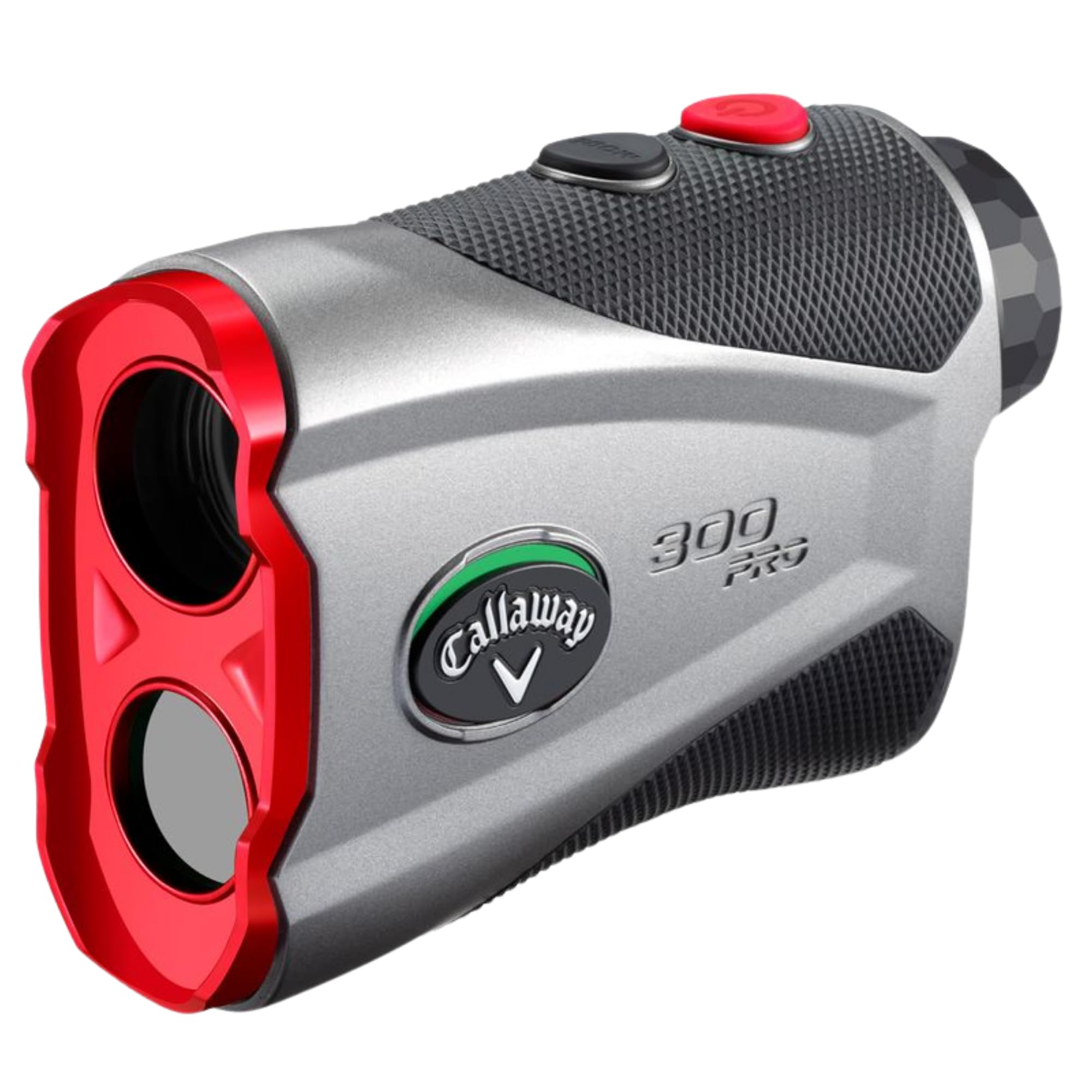
Callaway 300 Pro

93 /100
LBD Score Outstanding

Key details

Weight
8 oz
Accuracy
+/- 1 yard
Magnification
6x
Measuring Range
5-1000 yards
View on Amazon

The slope switch on the Callaway 300 Pro is a physical slider on the outside of the body, which is the right place for it. Flip it and the plays-like number disappears, leaving a straight-line yardage you can use when the round counts. No menu, no two-button hold, no conversation with a playing partner about whether the device is allowed.

The rest of the package is standard-issue golf done properly. P.A.T. pin acquisition locks the flag out to 300 yards and pulses to confirm it, magnification is 6x, and the rated range runs 5 to 1,000 yards at plus or minus a yard. The integrated magnet holds the unit on a cart frame over rough ground, the hard case clips to a bag with a carabiner, and 8 ounces sits in a pocket without dragging at you.

Of the golf-first units here, this is the one we point most players to. The pin lock grabs the flag without the shaky-hand retry that sends people back to the cart GPS, the magnet is the strong kind rather than a suggestion, and the price sits in the middle of this group while the feature set matches units above it. It does not have the fastest lock here, and it does not need to.

Pros

  • External slope slider you can kill instantly
  • Pin lock to 300 yards with a pulse confirm
  • Strong integrated cart magnet
  • 8 ounces, easy to pocket

Cons

  • Can stop ranging; reliability is the soft spot
  • IPX4 only, so heavy rain is the limit
Our verdict

This is the golf rangefinder we recommend to the widest range of players, because the pin lock, the magnet, and the slope switch all work the way you expect them to.

Check Latest Price
5

Best Budget Hunting Rangefinder

TIDEWE HR-F700 Rangefinder

95 /100
LBD Score Outstanding

Key details

Weight
5.67 oz
Accuracy
+/- 1 yard
Magnification
6x
Measuring Range
3-700 yards
View on Amazon

The screen on the TideWe is not backlit, and that single detail decides whether it suits you. In daylight the numbers are large and easy to pick up; in the last half hour of legal light they fade into the background, and a rangefinder you cannot read at dusk is one you leave in the truck. If your hunting happens at first and last light, pay for a lit reticle elsewhere in this guide.

Everything else is aimed squarely at a hunter watching the budget. It weighs 5.67 ounces, reads in 0.46 seconds to plus or minus a yard out to 700 yards, and switches between straight-line distance, vertical distance, horizontal distance, speed, and continuous scan with a short press. The buttons work with a glove on, which is the only test that matters in November.

The rechargeable battery is the quiet win we did not expect at this end of the market: a full charge is rated for 21,000 measurements, which is a season of weekends without thinking about it, and USB charging beats hunting for a CR2 at a gas station. IP54 covers rain and snow, and at just over four inches long the body disappears into a chest pocket.

Pros

  • 0.46-second read at plus or minus a yard
  • 21,000 measurements per charge
  • 5.67 ounces and pocket sized
  • Angle, speed, and scan modes

Cons

  • 700-yard rating is the shortest here
Our verdict

Cheap, light, and rechargeable, it is the hunting rangefinder to buy when the budget is the first question and the shots are inside 700 yards.

Check Latest Price
6

Best Ultralight Hunting Rangefinder

Vortex Crossfire HD 1400

94 /100
LBD Score Outstanding

Key details

Weight
4.8 oz
Warranty
Unlimited, unconditional
Magnification
5x
Maximum Range
1,400 yards reflective, 750 on game
View on Amazon

At 4.8 ounces the Crossfire HD 1400 is the lightest rangefinder in this guide, and that is not a trivia stat. It is the one that ends up in a chest pocket instead of staying in the truck, because carrying it costs you nothing and there is no excuse not to have it.

The specification is hunting-first throughout: 5x through a 21mm objective with Vortex's HD glass and XR coatings, a red TOLED display, three target modes including First and Last so you can range through brush to the animal behind it, and ArmorTek coatings over a waterproof, shockproof body. Rated range is 1,400 yards on reflective targets and 750 on game.

The combination we keep coming back to is that weight paired with Vortex's unlimited, unconditional warranty. A dropped unit is not a dead unit under that guarantee, and a rangefinder you will actually carry beats one with a bigger number on the box every time you walk out the door.

Pros

  • 4.8 ounces, the lightest here
  • Unlimited, unconditional lifetime warranty
  • First and Last target modes for brush
  • Red TOLED display for low light

Cons

  • 750 yards on game limits open-country work
Our verdict

If ounces decide what goes in your pack, this is the hunting rangefinder to beat here: 4.8 ounces, HD glass, and an unconditional lifetime warranty.

Check Latest Price
7

Long-Range Hunting

Vortex Diamondback HD 2000

93 /100
LBD Score Outstanding

Key details

Magnification
7x
Maximum Range
2,000 yards reflective, 1,400 on game
Objective Lens
24mm
Water Resistance
Waterproof
View on Amazon

Two thousand yards is the number on the box, and 1,400 is the number that matters: that is Vortex's rating on game, and it is still the furthest game rating in this guide. Everything else about the Diamondback HD 2000 is built to make that figure usable.

Seven power through a 24mm objective is the most magnification here, and it is what lets the unit resolve a bedded animal across a basin. HD glass with XR coatings, a red OLED display that stays readable in low light, two target modes, and both HCD and LOS ranging modes cover the field side: angle-compensated for the shot, line-of-sight for the map.

The body is polymer with rubber armor and ArmorTek lens coatings, it is waterproof, and it carries the same unlimited, unconditional warranty as the Crossfire. A CR2 battery runs it, so a spare in the pack is the whole power plan. We stopped thinking about the weight after the first mile, which is the most you can ask of a unit this capable.

Most hunters do not need 1,400 yards on game, and the 750 of the Crossfire covers the shots nearly everyone takes. The Diamondback is the pick when the shot might be the longest one you will ever take, whether that is open sage, a cut line, or a canyon, and when 7x is the difference between a number and a guess.

Pros

  • 1,400 yards on game, the furthest here
  • 7x magnification and a 24mm objective
  • HCD and LOS ranging modes
  • Unlimited lifetime warranty

Cons

  • Premium price for a specialist's tool
  • 7x narrows the field of view up close
Our verdict

Buy this one if your shots start where most rangefinders stop: 1,400 yards on game and 7x glass earn it a place for open country.

Check Latest Price
8

Close-Woods Hunting

Bushnell BoneCollector 850

92 /100
LBD Score Outstanding

Key details

Scan Rate
4x per second
Magnification
6x
Measuring Range
350 to 850 yards
Water Resistance
IP54
View on Amazon

One button runs the whole thing, and for a treestand or a spot-and-stalk hunt that is exactly right: press to wake it, put the reticle on the animal, press again for a number. There is no mode wheel to fumble with when something steps out at 30 yards and your hands are already cold.

The rest of the package is built for the same hunter. ARC angle compensation gives a true horizontal distance from a ridge or a climber, the all-glass optical system uses a fully multi-coated objective 50 percent larger than the standard for a brighter image at first light, and scan mode refreshes four times a second so you can track a walking animal or sweep a treeline.

Rated range is 350 to 850 yards on reflective targets, magnification is 6x, and the body is IP54 and 180 grams, light enough that we stopped thinking about it on a lanyard. It comes in Realtree Edge, which is either the point or an afterthought depending on how you hunt.

It is not a golf unit: no pin lock, no magnet, no slope switch for a card. What you get instead is a hunting tool that behaves the same way every time you pick it up, in a kit that leaves room in the budget for the rest of your gear.

Pros

  • One-button operation with no mode wheel
  • ARC angle compensation for true distance
  • Scan updates 4x per second
  • All-glass optics with a larger objective

Cons

  • 850-yard rating is short of the long-range picks
Our verdict

One button, angle compensation, and a fast scan make this the simplest hunting rangefinder here for timber and brush inside 400 yards.

Check Latest Price

How We Tested Laser Rangefinders

We started with spec sheets for more than 40 rangefinders and filtered on the things that change how one actually performs: magnification, display type, whether slope can be locked out, battery type, mount or carry method, and price band. That narrowed the field to 12 models, which ran the same routine for seven months.

Accuracy came first. I marked known distances on a practice range and open ground at 25, 50, 100, 200, and 400 yards, then ranged them repeatedly against flat signs, pine trunks, fence posts, and a black roof that swallows a return. Each target got five readings; I logged how far the number wandered and whether the unit ever grabbed a background tree instead of the pin.

Then the human part. I ranged one-handed, in gloves, and through sunglasses, counting button presses to get from straight distance to angle to slope, and timing how long it took from lifting the unit to having a number I trusted. Displays got read at dusk, in fog, and against a glaring white sky to see which reticles washed out.

Every unit rode in a cart cup holder or a pack pocket, got knocked off a tailgate onto gravel, and sat through cold, wet mornings, with the rubber armor, eyepiece, and battery door checked afterward. I tracked whether rechargeables held a charge between trips and whether magnetic mounts stayed put over a bumpy path. Value was judged last, on what the extra spend bought in glass rather than in range claims.

How to Choose a Laser Rangefinder

Judge It on the Game Rating, Not the Box Number

Every manufacturer quotes a maximum on something reflective, and a road sign bounces far more light back than a deer's shoulder. That is why the Vortex Diamondback HD 2000 reads 2,000 yards on a sign and 1,400 on game, and why the Crossfire HD 1400 reads 1,400 and 750. When a listing offers only one figure, treat it as the reflective number and expect noticeably less on an animal.

Then match the figure to your ground. Seven hundred yards is generous in Eastern timber and thin in a Western basin where a bedded animal can sit well beyond where a budget unit will read. Buy for the longest shot you realistically take, not the longest one you have seen on video.

Spend on the Display Before the Magnification

Magnification gets the marketing; the display is what actually fails. An unlit LCD is crisp at noon and turns into a gray smudge in the last twenty minutes of light, which is exactly when game moves and when the number matters most.

An illuminated red display, the kind the Leupold and both Vortex units use, stays legible against a dark treeline. If you hunt dawn and dusk, pay for the lit reticle and dial the brightness down so you keep your night vision. If you only shoot at midday, bank the difference.

Slope, Pin Lock, and the Rules You Play Under

Slope compensation converts the distance you see into the distance you play, accounting for the climb to the flag. It is also the feature that can make a device unwelcome in a round that counts, which is why the units here built for competition put it on a physical control: the Callaway's external slider, the Bushnell's switch. Confirm your committee or tour accepts the device at all, then check the switch is on the outside of the body where you can kill it in a second.

Pin lock with a vibration or visual confirm is the other golf feature worth paying for. It tells you the unit has found the flagstick rather than the maple behind the green, and it saves the three-attempt dance that makes people give up and reach for the cart GPS.

Rechargeable Battery or a Spare Coin Cell

Rechargeable units end the annual hunt for a CR2 and, on the golf side, mean a run of rounds off one charge. The trade is a dead rangefinder if you forget the cable, and cold weather is hard on lithium-ion in a way a fresh disposable is not.

A CR2 is the simpler arrangement for a hunting pack that lives in the truck: keep a spare in the case and swap it in the field. Either way, check the charge the week before a trip rather than the morning of.

Weight, Carry, and the Magnet Question

The units here run from under 5 ounces to a full pound, and that gap decides whether the thing rides in a pocket or stays in the bag. If you walk, stay light, under about 6 ounces, and pick a case you can clip to a strap.

If you ride, weight matters less than the magnet. A strong integrated magnet holds the unit on the cart frame where you can grab it one-handed; a weak one drops it on the first bump in the fairway. Golf-first units are the ones worth checking on that score.

Frequently Asked Questions

Final Verdict

The Acer SW-RF700 is the rangefinder we point most people to, and the reason is coverage: slope and a vibrating flag lock for the course, six modes and a cart magnet for the field, without a premium-name markup. Very few buyers will run past its 800-yard ceiling on a golf hole or a whitetail.

Two requirements change the answer. If you play for a card and want the flag on the first press, the Bushnell Tour V6 Shift locks faster and more certainly, and that is the case where spending up makes sense. If your shots start in open country, the Vortex Diamondback HD 2000 and its 1,400 yards on game is the number that decides it.