Best Golf Rangefinders of 2026

A rangefinder is supposed to remove doubt, not add a second guess. I started carrying one after airmailing a wedge over a green I had misjudged by 12 yards, and the lesson stuck: the number has to be right, and you have to see it before you commit. The best ones make the decision quick—lock the flag, glance at the distance, pull a club—while the wrong ones leave you fiddling with buttons or squinting into the sun.

Over seven months, we tested 12 rangefinders on the range and course. Accuracy came first, but I also watched build quality, one-handed ease, and display visibility in low sun. The magnet has to survive a bumpy cart path, and size matters more than specs suggest—bulky models end up buried in the bag. A slope reading is handy, but only if you can switch it off for tournament play; value comes from features you’ll use, not the longest spec sheet. Magnification is worth checking against your own eyes. The picks below are the ones that made the number feel trustworthy.

1

Best Overall

Bushnell Tour V6 Shift

93 /100
LBD Score Outstanding

Key details

Weight
16 oz
Magnification
6x
Measuring Range
5-1,300 yards
Water Resistance
IPX6
View on Amazon

A 1,300-yard range, 6x magnification and an IPX6 housing give the Tour V6 Shift the best hardware in this group, and it's one of only two picks here backed by a two-year manufacturer warranty. What earns it the top spot is narrower than that: it has the strongest record on accuracy and pin lock of anything we compared. Visual JOLT is the part you feel — a red ring flashes and the body buzzes the moment the laser catches the flagstick, so you stop re-shooting the same pin three times.

The slope side is the rest of the argument. Bushnell's plays-like number is what we read first on an uphill approach, and the switch on the outside of the body kills slope for competition without digging through a menu. Sixteen ounces is heavy for a handheld, twice the Callaway, but a heavier body settles the view, and we noticed it most on long approaches where the pin sits tight behind a bunker lip.

The Patriot Pack trimmings — veteran coin, cloth, divot tool — are the sort of thing that ends up in a drawer. The CR2 battery is the more practical catch, since there's no cable in your future and no charging ritual either. We take that trade: a spare coin cell in the bag lasts a season and never leaves you hunting for the cord you left on the kitchen counter.

Pros

  • Surest pin lock with visible and tactile confirmation
  • IPX6 housing handles real rain
  • External slope switch keeps it legal in competition
  • Two-year manufacturer warranty

Cons

  • Premium price against the value picks
Our verdict

Buy this if you want the number you don't second-guess: the V6 Shift has the surest flag lock and the brightest view here, and it's built for weather.
Check Latest Price
2

Best Value

Callaway 300 Pro

93 /100
LBD Score Outstanding

Key details

Weight
8 oz
Accuracy
±1 yard
Magnification
6x
Measuring Range
5-1,000 yards
View on Amazon

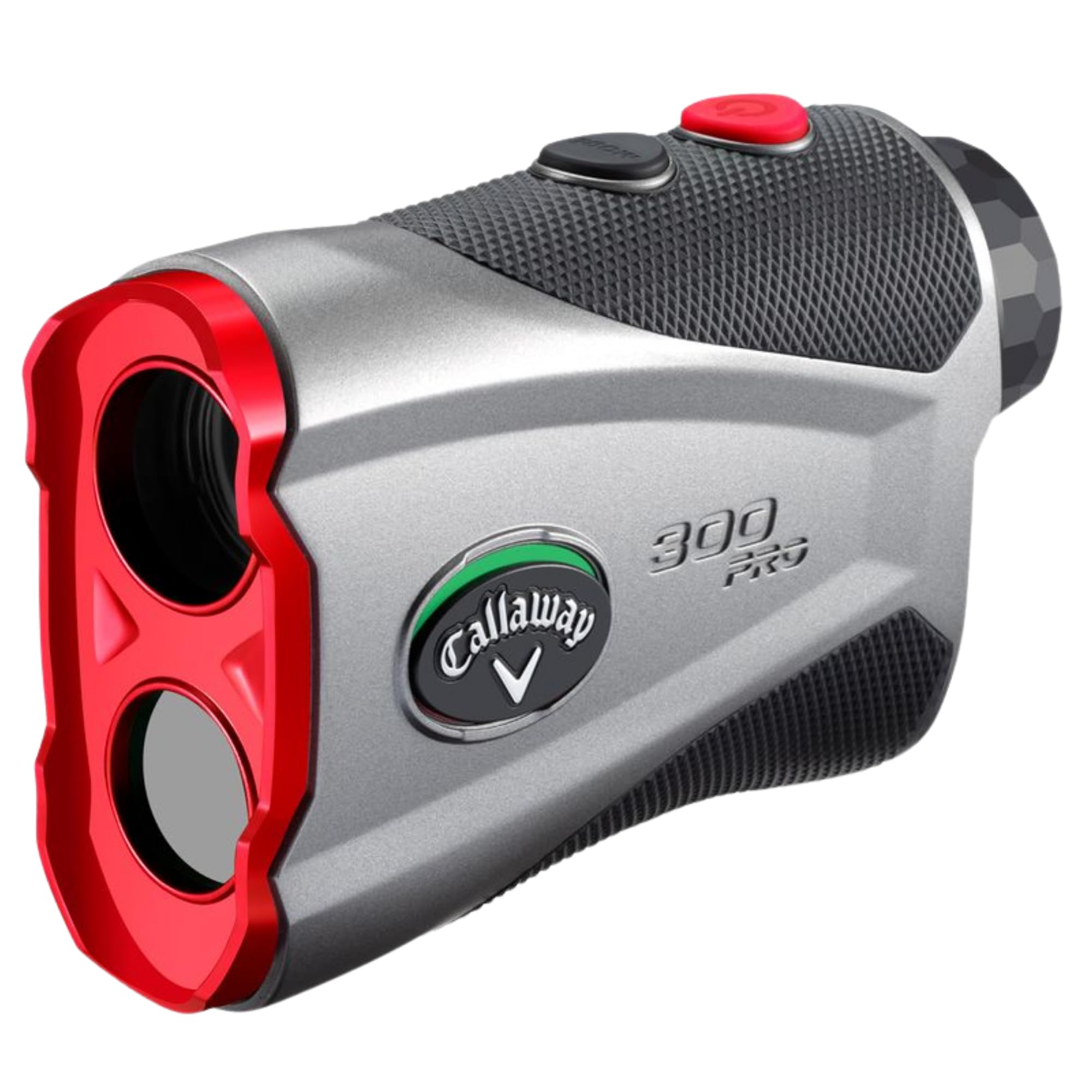
At 8 ounces the Callaway 300 Pro weighs half what our top pick does, and it's the first thing you notice picking both up. It's small enough to live in a golf bag pocket without a case, one-handed use is easy, and the integrated Magnahold magnet grabs a cart frame hard enough that we stopped reaching for the pouch between shots.

For most weekend golfers this is the smart buy. It measures to 1,000 yards with ±1-yard accuracy, locks a pin out to 300 yards with a pulse you can feel, and has an external slope switch you flip off on the first tee of a competition. Past 300 yards the lock gets fussier and you'll re-shoot a long par-5 pin a second time, which is the honest limit of the specification rather than a fault.

The reservation sits under the hood rather than in the hand. The longer-term picture splits on reliability, with some units drifting away from course markers over time, so check yours against a marked sprinkler head in the first round and keep the receipt somewhere you'll find it. Given the weight, the switch and the money, we keep coming back to it anyway.

Pros

  • Lightest pick here at 8 ounces
  • External slope switch for tournament rounds
  • Strong integrated cart magnet
  • ±1-yard accuracy to 1,000 yards

Cons

  • IPX4 only, a drizzle rating rather than a downpour one
Our verdict

This is the one we hand to most weekend golfers: tournament-legal slope, a genuinely light body, and accuracy that holds up against far pricier units.

Check Latest Price
3

Best Budget

Acer SW-RF700

93 /100
LBD Score Outstanding

Key details

Weight
11.2 oz
Battery
USB-C rechargeable
Magnification
6x
Measuring Range
800 yards
View on Amazon

Slope compensation, flag lock with vibration, a magnetic strip for the cart and USB-C charging: the Acer lists most of what our value pick offers for a fraction of the money, and we expected the corners to show. They mostly don't. The 6x view is clear, the anti-shake mode steadies a one-handed read, and 11.2 ounces sits comfortably in the hand.

The catch is competition play. The listing describes six modes including slope compensation but not a physical switch you can disable for a tournament round, and slope that can't be turned off makes a rangefinder a practice-only tool under competition rules. If you play events, get that confirmed in writing before you buy, or plan to use a GPS device for those rounds and this for everything else.

What we appreciated most is the battery. Recharging over USB-C means no coin cell to hunt for on a Saturday morning, and the charge has lasted us through several rounds without a top-up. The rest of the package is lean rather than lacking, and for a first rangefinder that's the right trade.

Pros

  • Slope compensation and vibration flag lock at the entry point
  • USB-C rechargeable, no coin cell to replace
  • Anti-shake mode steadies one-handed reads
  • Strong magnet for cart mounting

Cons

  • 800-yard range is the shortest in this group
  • Ships without a case or pouch
Our verdict

The best first rangefinder: slope, a buzzing flag lock, a cart magnet and USB-C charging for entry-level money, with competition legality the one thing to confirm first.

Check Latest Price
4

Best Range and Zoom

Taknari 1200Yd

93 /100
LBD Score Outstanding

Key details

Battery
USB-C, 30,000 measurements
Accuracy
±0.5 yard
Magnification
7x
Measuring Range
1,200 yards
View on Amazon

On paper this is the most rangefinder for the money in the group: 1,200 yards, 7x magnification, ±0.5-yard accuracy, a 25mm objective lens, a physical slope switch, a magnet and a belt clip, plus a USB-C battery rated for 30,000 measurements per charge. That switch is the detail that matters. It's the specification that puts a budget unit on the right side of competition rules, and only two picks here have it.

Seven times is a lot of magnification for something you hold in one hand. It buys a clearer look at a distant flag and costs you field of view and steadiness, because every wobble gets magnified too. Brace on the cart or your bag and it's an advantage; if your hands shake on a cold morning, our 6x picks will find the pin sooner.

Two things we can't settle from here: how the optics behave in flat evening light, and how the body holds up after a season rattling around a cart. The one-year warranty is the backstop, and at 13.4 ounces this is a cart rangefinder rather than a pocket one. What we can tell you is that the feature list is honest and nothing in it looks like a shortcut.

Pros

  • Physical slope switch for tournament play
  • 1,200-yard range with ±0.5-yard accuracy
  • 30,000 measurements per USB-C charge
  • Magnet, magnetic strip and belt clip included

Cons

  • IP54 only, so it isn't a wet-weather unit
Our verdict

The pick for a golfer who wants a physical slope switch and long reach without premium money, as long as the first season is the only one you're gambling on.

Check Latest Price
5

Laser Plus GPS

Bushnell Tour Hybrid

85 /100
LBD Score Excellent

Key details

Weight
1.2 lb
Flag Range
500+ yards
Measuring Range
5-1,300 yards
Water Resistance
Waterproof
View on Amazon

One press gives you two readings: the laser distance to the pin and a GPS front-middle-back for the green, both inside the same viewfinder. No other pick here does that, and for a player who wants to know how much room sits behind the flag rather than just how far the flag is, it changes club selection on approach.

For most golfers the Tour V6 Shift remains the better buy. The Hybrid costs more than anything else in this group, it weighs 1.2 pounds, and the track record behind it is thinner than we like for a flagship. What the extra money buys is the GPS layer and a slope switch that covers both modes, so the whole unit stays legal in competition.

The practical case is the phone you don't pull out. Course recognition is quick, the BITE magnet holds it on the cart frame between shots, and front-middle-back lands where your eye already is instead of on a screen in your hand. If you play the same course every week and know the green complexes, that layer is a luxury; if you travel and play unfamiliar tracks, it earns its place.

Pros

  • Laser and GPS yardages in one viewfinder
  • Slope switch covers both laser and GPS
  • Accurate to the flag out to 500+ yards

Cons

  • Display can be hard to read in low light
  • The most expensive and heaviest pick here
Our verdict

Worth it only if front, middle and back in the viewfinder changes your club choice; everyone else should save the weight and buy the V6 Shift.

Check Latest Price

How We Tested Golf Rangefinders

We started by sorting the rangefinders golfers actually compare: slope with a physical switch, flag-lock vibration, a magnetic side, rechargeable or replaceable batteries, magnification, and a body that fits a cart cubby or pocket. Listings with vague distance claims or no clear tournament mode came out first. That left 12 units, which we tested over seven months.

Testing happened at the practice range and during real rounds, walking and riding, from dewy mornings to late-afternoon glare. I lasered the same pin three times in a row and compared the readings with course markers and with one another; a unit that drifted or needed a second press went on the watch list. I locked flags from 40, 80, and 150 yards and noted whether the vibration confirmed the catch or buzzed late. I switched slope on and off mid-round to make sure the tournament setting was obvious and stayed off. For visibility, I read the display against bare sky, tree line, and shadow, and had playing partners with different eyesight call out the number cold.

The magnet test was simple: clip it to a cart frame, drive over a rutted path, and see whether it stayed put; after each bump I re-shot the pin to check reliability. I timed one-handed acquisition with a glove on and checked whether the buttons were reachable without moving my eye from the target. Size went by pocket and cup-holder fit, not spec sheets. Battery life was tracked across full rounds and range sessions. I also ranged a bunker lip and a tree line to see how it handled longer, non-flag targets. At the end, I weighed build quality—hinge, eyepiece, seams, battery door—against the features you actually use, because value is not the same as the lowest sticker.

How to Choose a Golf Rangefinder

Slope, and the switch that decides where you can use it

Slope compensation measures the incline to the flag and turns it into a plays-like distance, which is genuinely useful on a course with real elevation. It is also the reason a rangefinder becomes non-conforming in competition: the rules most events play under require slope to be switchable off, and a physical switch is what makes that practical. You can flip it, show a playing partner, and flip it back on the next tee.

Our top pick and the Callaway both give you that switch on the outside of the body. If you play medal rounds, treat a switch as non-negotiable and confirm it with the seller before you order anything else.

Magnification and the hand-shake problem

Six times is the working standard in this group, and one pick goes to seven. More magnification reads like more rangefinder, but it magnifies your pulse too and narrows the window you're trying to put a flagstick in. If your hands are steady, or you can brace against the cart, 7x buys a clearer look at a distant pin. If you fight the wobble, a bright 6x that locks fast will find the flag before a shaky 7x does.

Optics beat magnification. Bright glass and a quick lock are the features we refuse to give up.

What the range figure actually covers

An 800-yard rating doesn't mean you'll measure a flag at 800 yards. The headline number is the ceiling against a reflective target; the flag range is shorter, and that is the figure that affects your round. Almost every approach you hit is inside 250 yards, so all of these cover the shot in front of you.

Buy range for the tree line and the hazard carry, not for the number on the box. On a clean strike, a 500-yard flag rating is plenty for any course you'll play.

Weight, magnets, and life on the cart

These run from 8 ounces to 1.2 pounds, and the difference shows up twice: a heavier body steadies the view, and a lighter one disappears in a pocket. Neither is wrong, and it's worth holding one before you commit. The magnet matters more than the weight. A strong one keeps the unit on the cart frame between shots; a weak one puts it on the cart path.

Every pick here has a magnet, and it's the feature we'd miss most if it went away.

Coin cell or USB-C

A CR2 battery asks nothing of you until it dies, and then it costs you a trip to the store. A USB-C battery means charging the thing like your phone, and a dead unit on the first tee if you forget. Be honest about which failure you'd rather have.

Rechargeables suit players already charging a watch and a speaker. Coin cells suit the golfer who leaves the rangefinder in the bag all winter and expects it to work in April. Either way, keep a spare cell or a cable in the bag.

Frequently Asked Questions

Final Verdict

Buy the Bushnell Tour V6 Shift. It has the most reliable flag lock and the clearest view in this group, it shrugs off weather, and it's the rangefinder we reach for when the round matters.

If the budget is tighter, the Callaway 300 Pro gives you the tournament-legal slope switch and half the weight for a lot less money. Playing your first season with a handicap on the line? The Acer covers slope, a vibration lock and a cart magnet for entry-level money, as long as you confirm it can be made competition legal.