Best Ham Radio Antennas of 2026

The letdown almost never happens at the unboxing. It happens the first time you key up and the SWR meter climbs past 2:1, because an antenna is only ever as good as its match to the band you're working. A whip cut for the wrong band, a mount that grounds poorly, or a connector that doesn't seat will turn a strong signal into a scratchy one — which is why fit, length, and connector type matter before reception ever does.

I've spent the past six months with 14 antennas, moving them between handhelds, a truck mount, and a mast in the backyard. The ones that stuck around installed cleanly on the first try and gave an SWR reading close to what the listing promised. Worth knowing: on a mobile install, the ground plane under the mount shapes your range more than whip length does.

The picks below run from a 15-inch handheld whip to a field antenna you can raise alone in the dark; what they share is that they held up on the meter and in the weather.

1

Best Overall

Nagoya NA-771

93 /100
LBD Score Outstanding

Key details

Gain
Up to 3 dBi
Length
15.6 in
Connector
SMA-Female
Frequency
144/430 MHz
View on Amazon

A better antenna is the cheapest real improvement you can make to a handheld, and the NA-771 is the one we hand people first. It's a 15.6-inch soft whip rated at up to 3 dBi on 2 m and 70 cm, which is modest on paper and obvious on the air: more radiating length and a proper coil instead of the stubby rubber duck in the box. We spent our handheld time on local repeaters, and the pattern held — the radio heard things it hadn't heard before, and transmissions that used to need a walk to a window went through from the kitchen.

The base is the part to protect. The whip is soft enough to bend rather than snap, but the joint where it meets the connector is where these eventually give out, so don't lever the radio out of a pocket by the antenna. Fit is the other thing worth knowing: SMA-Female threads straight onto UV-5R, BF-F8HP, UV-82, and Anytone D878 bodies, and BTECH includes a thin spacer for radios whose connector sits in a recess. Leave the spacer out if the antenna already seats flush.

One warning worth the paragraph: the Nagoya name is copied constantly, and the copies are not the same antenna. BTECH sells the genuine article with a one-year warranty through its own store, which is why we point people there rather than at whichever marketplace listing looks familiar. Buy the real one and this is a fit-and-forget upgrade.

Pros

  • Clear reception gain over a stock rubber duck
  • Genuine BTECH stock with a one-year warranty
  • Threads onto common SMA-Female handhelds with a spacer included

Cons

  • 15.6 inches is long on a small handheld
Our verdict

We tell any handheld owner to start here: real gain, proven fit on the common radios, and the simplest upgrade for 2 m and 70 cm.

Check Latest Price
2

Best for Tri-Band Handhelds

Nagoya NA-320A

90 /100
LBD Score Outstanding

Key details

Gain
2.15/2.15/3.5 dBi
Length
17.7 in
Frequency
2 m / 1.25 m / 70 cm
Max Power
10 W
View on Amazon

1.25 meters is the band almost no handheld transmits on, and it's the only reason to look at the NA-320A instead of the NA-771. If your radio is a UV-5X3 or a BF-F8HP PRO, this whip covers 2 m, 1.25 m, and 70 cm, and nothing else in this group does. For a tri-band owner that's a straight win; on a dual-band radio it's a duplicate of the NA-771 with an inch and a half more length to manage.

The ratings are sensible for a handheld: 2.15 dBi on 2 m, 2.15 dBi on 1.25 m, 3.5 dBi on 70 cm, a 10 W input limit that covers every handheld we've run it on, and a stated VSWR of 1.5:1 or better at the band centres. We ran it through a stretch of repeater work, and what we came back to is not having to swap whips when we move between 2 m and 220 MHz. The 70 cm side holds up like the dual-band whip it shares a family with.

Check the fit on arrival. It ships with a rubber O-ring for radios whose connector sits deep, and some bodies seat better with it than without — if it won't thread flush either way, the antenna is wrong for that radio, not the other way round. The 17.7-inch length is the other thing to live with, and it balances better on a radio wearing the larger battery than on a bare body.

Pros

  • Covers 2 m, 1.25 m, and 70 cm on one whip
  • Strong SWR results across all three bands
  • No swapping whips between bands

Cons

  • 17.7 inches swings around on a belt
  • Rubber O-ring fit varies between radio bodies
Our verdict

Our tri-band pick, and the only antenna here that reaches 1.25 m — worth its length if your radio transmits there.

Check Latest Price
3

Best Portable HF Antenna

GOOZEEZOO JPC-12

91 /100
LBD Score Outstanding

Key details

Bands
8 (40 m–6 m)
Height
13.5 ft
Tuning
Sliding coil
Weight
3 lb
View on Amazon

Four aluminum tubes, a stainless top rod, a ground anchor, and a set of radials — the JPC-12 goes up from the ground rather than out of a tree, and that's the whole argument for it. It covers eight bands from 40 through 6 meters, stands 13.5 feet, and packs into its own case at about 3 pounds.

That's the antenna we grab when we're setting up in a field with no trees and a schedule. One person can have it standing and tuned in about five minutes: you set the band by sliding the coil collar to the marked point, check SWR, then move it again for the next band. No tuner in line, no fishing line over a branch, no walking the perimeter looking for a support.

The honest caveats. It's a ground-mounted vertical with a modest counterpoise, so treat it as a compromise antenna — expect it to work stations rather than dominate a pileup. The radials matter more than the whip does: lay them out across the ground rather than coiling them at the base, and the difference shows on 40 m. Get that right and it's a lot of antenna for a backpack.

Pros

  • One-person setup in about five minutes
  • Sliding coil tunes each band without a tuner
  • Packs small and light for POTA trips
  • No trees or supports needed

Cons

  • 40 m is the lowest band it covers
Our verdict

The one we grab for solo field work: a ground-mounted vertical with no trees, no tuner, and about five minutes to on-air.

Check Latest Price
4

Best Low-Band Wire Antenna

GOOZEEZOO JYR8010

87 /100
LBD Score Excellent

Key details

Bands
8 (80 m–10 m)
Power
150 W SSB, 120 W CW, 80 W FT8
Radiator
40 m wire
Transformer
1:64
View on Amazon

Forty meters of radiator wire, a 1:64 transformer in a hard ABS housing, and eight bands from 80 through 10. The JYR8010 is an end-fed half wave, which means the wire does the radiating and the box mostly matches impedance — the classic way to get on the low bands without a tower or a radial field.

That wire wants space, and getting it up is the job. A pull line is included so you can get the far end over a branch without climbing, and the setup notes ask for roughly 10 feet of clearance from obstacles. The higher the middle of the wire sits the better it behaves, and a shallow slope beats a flat line at head height.

For a fixed site, or a campsite with actual trees, this is our favorite low-band antenna in the group. On 80 and 40 meters it puts you on the air when the bands are open at night, and it does it without a tuner's help: it's rated to handle 150 W SSB, 120 W CW, and 80 W FT8, which leaves any 100 W rig with headroom. The SWR lands low across the design bands without a matching step, which is the point of buying an end-fed rather than a random wire.

Two practical notes from setting one up. The printed instructions are thin, so read a proper guide to end-fed antennas before your first deployment rather than at the trailhead. And keep the transformer housing off wet ground — the wire is coated and tough, but the box and its connections are the parts that need looking after.

Pros

  • Covers 80 through 10 meters on one wire
  • Handles 150 W SSB and 80 W FT8
  • Low SWR with no tuning step
  • 1.8 lb pack weight

Cons

  • Needs two supports and about 10 ft of clearance
Our verdict

We keep coming back to this wire for 80 and 40 meters: eight bands, low SWR without a tuning step, and 1.8 lb in the pack.

Check Latest Price
5

Best Magnetic Mobile Mount

Bingfu Magnetic Mobile

84 /100
LBD Score Excellent

Key details

Whip
16.5 in
Cable
16.4 ft RG58/U
Connector
PL259 male
Frequency
136–174 / 400–470 MHz
View on Amazon

Sixteen feet of coax is the number that makes this mount useful: enough to run from a trunk lid or roof to the dash with slack left over. The base lifts off and goes onto the next vehicle, so one antenna covers two cars, and the felt pad under the magnet means you're not polishing scratches out of the paint afterwards.

The kit is why we recommend it over a bare whip and a separate mount. The whip measures 16.5 inches and covers 136–174 MHz and 400–470 MHz, and you get six ground-plane rods — three short for UHF, three long for VHF — so you fit the set that matches the band you're working. There's a PL259 on the end for a mobile radio and an SO-239-to-SMA adapter in the box, which means the same antenna can sit on a metal table and feed a handheld when you're not in the car.

VHF is where these mounts usually need adjusting: the SWR comes down by shortening the whip, so start long and trim in small steps rather than cutting first and hoping. Route the coax along the trim rather than across a hinge, and the mount will behave like a factory install.

Pros

  • Felt-padded magnet holds on steel at speed
  • Both VHF and UHF ground-plane rod sets included
  • 16.4 ft of coax reaches most dashboards
  • Adapter lets it feed a handheld too

Cons

  • Needs a steel panel to couple to
  • Set screw and coax joint corrode outdoors
Our verdict

What we recommend for a driver splitting time between vehicles: a strong magnet, 16 feet of coax, and no hole to drill.

Check Latest Price
6

Best Permanent Vehicle Mount

HYS NMO Mobile Kit

88 /100
LBD Score Excellent

Key details

Gain
3.0/5.0 dBi
Whip
20 in
Mount
NMO, 3/8 to 3/4 in hole
Frequency
136–174 / 400–470 MHz
View on Amazon

A 3/8-to-3/4 inch hole is the decision. A drilled NMO mount bolts through the panel, runs the coax underneath, and holds by metal rather than by paint and magnet strength — for a vehicle you own and plan to keep, that's the better install.

The kit itself is complete: a 20-inch pretuned whip, the NMO base, an L-bracket, screws, and 13 feet of RG58 with a PL259 already fitted. The whip is rated 3.0 dBi on 2 m and 5.0 dBi on 70 cm, handles 100 W, and covers 136–174 and 400–470 MHz. Trunk lid, fender, or hood all work, and the flexible whip bends when it meets a low clearance instead of snapping off. What we liked about the kit is how little else you need to buy.

Two things worth flagging before you drill. First, 2 m is the variable band on this whip: check SWR there before you transmit, and if the reading is high, move the mount or swap the whip before you blame the radio — a bad match can stress the finals. Second, the coax ends and the connection at the base are the parts that fail first, so seal them and support the cable instead of letting its weight hang on the joint. Everything else about the install is genuinely straightforward, which is why we still prefer it to a removable mount on a vehicle you own.

Pros

  • Sealed NMO base holds at speed
  • Pretuned 20-inch whip rated 3.0/5.0 dBi
  • Bracket, screws, and 13 ft of coax included
  • 100 W handling suits most mobile radios

Cons

  • Requires drilling a permanent hole
Our verdict

The install we prefer on a vehicle you're keeping: a sealed NMO base, a pretuned 20-inch whip, and 2 m SWR to verify first.

Check Latest Price
7

Best Base Station Antenna

SignalPlus Base Station

76 /100
LBD Score Very Good

Key details

Gain
3.5/5.5 dBi
Length
1.1 m
Connector
SO-239
Frequency
136–174 / 400–470 MHz
View on Amazon

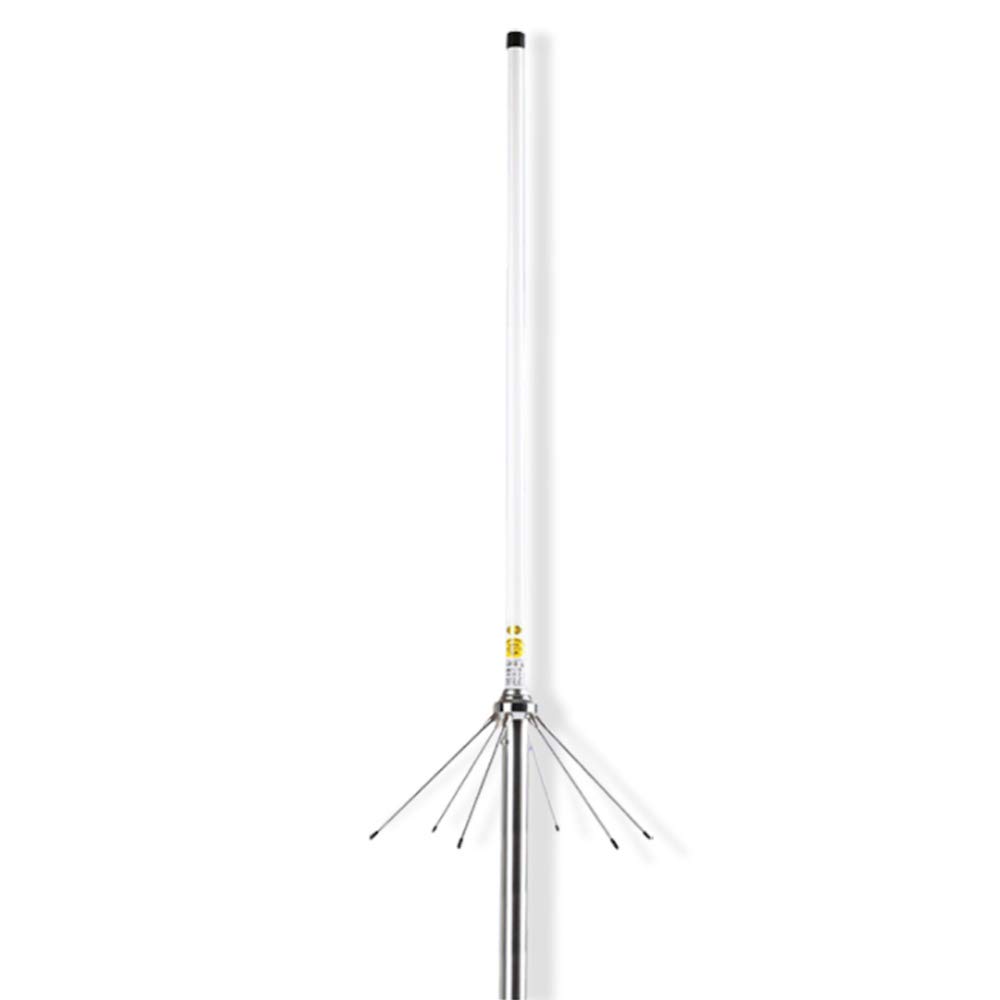
A white fibreglass vertical a little over a meter long, with stainless radials and a 360-degree horizontal pattern — this is what a base station antenna looks like, and it's the only one in this group. It's rated 3.5 dBi on 144 MHz and 5.5 dBi on 433 MHz, handles 100 W, and terminates in an SO-239.

Where it earns its place is height. Getting a vertical above the roofline does more for a 2 m station than another few tenths of a dB of gain, and at 1.1 meters this one can go on a gable, a short mast, or an attic frame without a tower. Vertical polarization is exactly what the FM repeaters expect, so it's a straight match for everyday voice work.

One frequency caution. The 400–470 MHz rating covers GMRS on paper, but the antenna is tuned around the 70 cm ham band, so check SWR at 462 MHz before you transmit there rather than assuming the range figure settles it. That's a two-minute check with a meter, and it's the difference between using this on GMRS and damaging a radio.

It's an antenna rather than a system, so plan the rest: a mast or gable bracket, a run of decent coax, and a way to weatherproof the connector where it leaves the antenna. We think that's the right way to judge it — it's a height play more than a gain play. Do the installation properly and a modest vertical on a roof will out-reach any handheld you've ever clipped to a belt.

Pros

  • 3.5 dBi on 2 m and 5.5 dBi on 70 cm
  • Fibreglass and stainless, built for outdoor use
  • 1.1 m fits a gable or attic mast

Cons

  • 70 cm is weaker than its 2 m performance
Our verdict

We recommend it as the base-station option here: a 1.1-meter fibreglass vertical that makes the most of 2 m.

Check Latest Price
8

Folding Backup

ABBREE 18.8-Inch Foldable

91 /100
LBD Score Outstanding

Key details

Gain
2.15 dBi
Length
18.8 in
Connector
SMA-Female
Frequency
144/430 MHz
View on Amazon

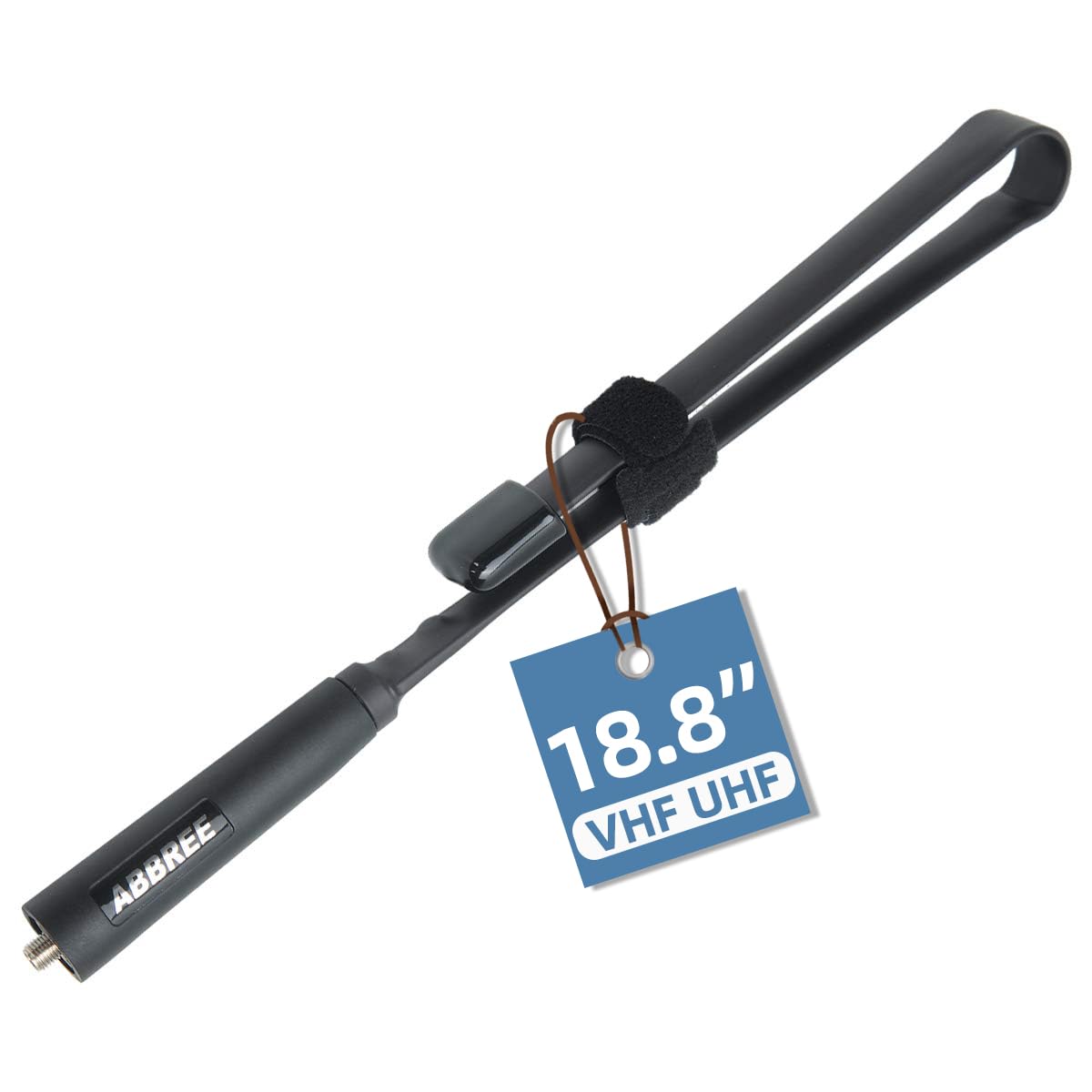
Eighteen inches of antenna that folds in the middle is a simple idea, and this one executes it well. The hinge lets the top section drop flat against the radio while you carry it and snap back into line when you work — we folded it down to fit a glovebox and it came back straight with no play.

It looks the part, too. The tactical styling, the fat coil housing, and the soft bendy whip give a small handheld a military-radio silhouette, and at 2.4 ounces it doesn't pull the radio over in a cupholder. On receive it's a clear step up from a stock rubber duck, which is the least you can ask of any replacement.

The thing to check is the connector. It's SMA-Female and fits the usual Baofeng-family bodies, but seating varies from unit to unit — thread it on fully before you trust it, and exchange rather than force it if it won't sit flush. The same applies to resonance: put a meter on it, and if SWR reads high on the band you care about, send it back instead of living with it.

What it isn't is a gain antenna. At 2.15 dBi it's rated the same as far shorter whips and below the Nagoya's 3 dBi, so don't expect it to out-hear a proper 15-inch whip just because it's longer. Buy it for the fold and the look, and keep the Nagoya on the radio for the days when reach matters more than pack size.

Pros

  • Hinged whip folds flat for storage
  • Tactical look on a standard handheld
  • 2.4 oz, so it won't unbalance a small radio

Cons

  • Hinge is the first part to wear
Our verdict

We treat it as a spare rather than a primary: a folding 18.8-inch whip that stows anywhere, once the connector checks out.

Check Latest Price

How We Tested the Best Ham Radio Antennas

We started by narrowing the field to antennas that are honest about band coverage and built for a common connector — SMA-female for handhelds, PL259 or SO239 for mobile and base radios. From there we filtered by mounting style, whip length, and price, and dropped any listing that couldn't say plainly which bands it covered. Fourteen antennas made the cut.

Testing ran six months and followed the antennas into ordinary use rather than onto a bench. Handheld whips rode along on neighborhood walks, up one local trail, and through evening nets; mobile antennas lived on a truck through commutes, highway miles, and a week of rain; the base and field models went up on a backyard mast and came along to a park activation.

SWR was measured, not assumed. We swept each antenna at the bottom, middle, and top of every band it claimed and wrote the readings down beside the manufacturer's numbers, flagging any that drifted. Fit got checked by threading each one onto several radios and watching for cross-threading or a gap at the collar. For range and reception, we worked the same repeater from the same spot and asked for signal reports from operators who had no idea which antenna was up.

We also watched the parts nobody brags about: whether a mount stayed tight after a week of rough road, whether a foldable whip still held its angle after a few dozen folds, how much coax clutter a mobile install left behind, and whether the whole thing looked like it belonged on the vehicle. Length was weighed against real life as well — a 13-foot field antenna that wants two hands and open sky is a different purchase from a 15-inch whip you forget you're carrying.

How to Choose a Ham Radio Antenna

Start with the connector

The socket on the antenna is what has to match the radio. SMA-Female is what a UV-5R, BF-F8HP, or UV-82 needs, while most mobile rigs and base radios use an SO-239 socket and expect a PL259 plug on the coax. A drilled NMO mount takes an NMO whip and nothing else.

Adapters exist and often work, but each one adds a joint that can work loose, corrode, or let water in. Buy the connector your radio actually has rather than the antenna you found first.

Match the bands your radio transmits on

An antenna is cut for specific bands, and a dual-band whip tuned for 144 and 430 MHz is not a 220 MHz or a 6 m antenna no matter what the packaging implies. Decide what you actually work — 2 m and 70 cm for repeaters, 1.25 m only if you own a tri-band radio, HF if you're chasing distance — then confirm the antenna lists those frequencies in its own specifications.

A tri-band whip on a dual-band radio is money spent on a band the radio cannot use. The reverse error costs more: an HF antenna on a handheld is a paperweight.

Choose the mount for where the antenna lives

Handheld whips screw on and need nothing else. Vehicle antennas come as magnetic, lip, or drilled NMO mounts: a magnet needs a steel panel to couple to and lifts off when you sell the car, while a drilled NMO is permanent, sealed, and steadier at speed. Base and field antennas need a mast, a roofline, trees, or a ground spike.

Be honest about the site before you fall for the antenna. Forty meters of wire is a wonderful thing with two tall trees and a miserable one without them.

Read gain and SWR together

Gain is quoted at the band centre against a reference ground plane, so 2.15 dBi and 3 dBi can sound closer than they behave on your belt or your trunk lid. What matters more is SWR where you actually operate: under 2:1 is fine, near 3:1 means stop and adjust before you transmit.

Higher gain also flattens the pattern toward the horizon, which is what you want from a roof or a vehicle. It will not rescue a bad ground plane, a mismatched whip, or a poorly sited antenna.

Check power handling and the parts that wear

A handheld whip rated 10 W is fine on a handheld and wrong on a 50 W mobile radio, while HF antennas rated 100 to 150 W leave a 100 W rig with headroom. Match the rating to the radio rather than to the antenna's size.

Wear shows up in the same places every time: the joint where a whip meets its connector, the hinge on a folding antenna, and any coax connection left outdoors. Support the cable so its weight isn't hanging on a joint, seal outdoor connections, and re-check SWR after a storm.

Frequently Asked Questions

Final Verdict

If you own a handheld, buy the Nagoya NA-771 and stop shopping. It's the one antenna in this group with both the gain and the fit to justify swapping out the stock whip, and it works on the radios most people actually carry.

Two exceptions earn their keep. A tri-band radio changes the answer to the NA-320A, since nothing else here transmits on 1.25 m. And if the antenna is going on a vehicle rather than a belt, start with the Bingfu magnetic mount: no hole to drill, 16 feet of coax, and it moves when you change cars.